In August 2007, Sierra Leone experienced its first democratic turnover when the Sierra Leone People's Party (SLPP) ceded power to its 1960 offshoot, the All People's Congress (APC). Although a watershed in the country's democracy, a remarkable feature of the turnover is that both were former autocratic ruling parties. Following the SLPP's post-independence rule, the APC violently took over in 1968 until a civil war and coup ousted it in 1992. The SLPP then ruled from 1996 through the 2002 democratization, finally losing in 2007 after the APC merged with the vestiges of the rebel movement (Cheeseman Reference Cheeseman2010). Although a dramatic example of democratic parties’ surprising origins, Sierra Leone is far from unusual.
Former autocratic ruling parties frequently survive and prosper within democracy (Grzymala-Busse Reference Grzymala-Busse2002; Ishiyama and Quinn Reference Ishiyama and Quinn2006; Friedman and Wong Reference Friedman and Wong2008; Loxton Reference Loxton2015; Loxton and Mainwaring Reference Loxton and Mainwaring2018). Following forty-one transitions around the world from 1940 to 2010, the most recent autocratic ruling party won power after democratization. Among parties acceding to democratization, nearly two-thirds won power in the ensuing democracy. In South Korea, Honduras, Lesotho and elsewhere, these parties have in fact dominated democratic politics. Moreover, this phenomenon has not faded over time: in 2015, eighteen democracies had a former autocratic ruling party in power. From 2014 through July 2016 alone, five such parties newly regained power in democracy and, in separate cases, four ex-dictators won control of the executive.Footnote 1
Why do some former ruling parties thrive within democracy while elsewhere (such as South Africa, the Philippines and Georgia) they quickly fade away? A prominent view is that ruling parties are initially discredited and thrust out of power by democratization. Success is therefore a product of outsider struggle in which parties engineer a ‘sharp break with the past’ (Grzymala-Busse Reference Grzymala-Busse2002) and reinvent themselves to adapt to democracy (Orenstein Reference Orenstein1998; Kitschelt et al. Reference Kitschelt1999; Grzymala-Busse Reference Grzymala-Busse2002, Reference Grzymala-Busse, Friedman and Wong2008; Burgess and Levitsky Reference Burgess and Levitsky2003).
This article challenges this view and argues that autocratic party success is more about continuity than change. Autocratic parties typically start from a position of strength and often display no more adaptation than a typical democratic party (Cheng Reference Cheng, Friedman and Wong2008; Serra Reference Serra2013; Loxton Reference Loxton2015; Loxton Reference Loxton, Loxton and Mainwaring2018). Of autocratic parties that ever win power in democracy, half do so in the first democratic election and more than 80 per cent do so within five years. As a result, a party's success is strongly shaped by how well its autocratic legacy – namely, its style of governance, institutional inheritance and performance while in office – carries over to democratic competition. Success is further promoted by political institutions in democracy that limit openings for new parties and the influence of new democratic actors.
Using original data covering eighty-four former ruling parties across all democratizing countries since 1940, I predict each party's electoral success through 2015 from autocratic party characteristics, the circumstances of the transition and political conditions in democracy. This is the most comprehensive quantitative study to date of autocratic ruling parties in democracy; most past work has instead focused on a small number of cases or a single region, with special attention to the post-communist world (Waller Reference Waller1995; Ishiyama Reference Ishiyama1997; Ishiyama Reference Ishiyama, Friedman and Wong2008; Orenstein Reference Orenstein1998; Kitschelt et al. Reference Kitschelt1999; Grzymala-Busse Reference Grzymala-Busse2002; Grzymala-Busse Reference Grzymala-Busse, Friedman and Wong2008). This study is also the first to provide a general quantitative evaluation of the implications for democratic survival.
I find strong evidence that ruling parties are more successful in democracies when their autocratic legacy includes broad programmatic experience, strong organization, and a successful economic and military record – elements that easily translate to democratic party competition. Autocratic parties also benefit from electoral rules and institutions that disadvantage new parties and actors. With the exception of programmatic experience, these predictions differ considerably from work focusing on reinvention. I also show that parties that accede to democratization secure more favorable political rules than those ousted earlier. Lastly, using an instrumental variables analysis, I provide the first causal evidence showing that the success of autocratic parties harms democratic survival and quality.
The findings contribute to several critical questions for young democracies. Most directly, they illustrate how elements of the autocratic past shape the origins and evolution of party systems (Friedman and Wong Reference Friedman and Wong2008; Hicken and Kuhonta Reference Hicken and Kuhonta2011; Riedl Reference Riedl2014; Loxton and Mainwaring Reference Loxton and Mainwaring2018). Autocratic experiences cast a shadow well past democratization, influencing popular attitudes on democracy (Rose, Mishler and Haerpfer Reference Rose, Mishler and Haerpfer1998; Bernhard and Karakoç Reference Bernhard and Karakoç2007), social policy (Mares and Carnes Reference Mares and Carnes2009) and democratic survival (Miller Reference Miller2015). As Riedl (Reference Riedl2014, xv) argues, ‘[D]emocratization is not a tabula rasa: legacies from the past, specifically authoritarian strategies for maintaining power, play a major role in determining how democracy operates’. Autocratic ruling parties – often the most significant political actors in young democracies – serve as primary carriers of this legacy.
In particular, this article demonstrates that some democratic transitions involve more political continuity than is often assumed. Overthrowing incumbent leaders and renouncing the authoritarian past is neither necessary nor sufficient for democratization. Rather, the same dominant parties, using many of the same appeals and techniques of control, frequently persist into the democratic period. This finding complements work on political continuities of various actors from the autocratic period, including autocratic leaders (Baker Reference Baker1998; Grzymala-Busse Reference Grzymala-Busse, Friedman and Wong2008; Riedl Reference Riedl2014), economic elites (Albertus and Menaldo Reference Albertus and Menaldo2018) and rebel groups (Matanock Reference Matanock2017).
This article also adds to our understanding of the difficulties of consolidation in young democracies. How long an autocratic party maintains power into the transition period represents a critical juncture for institutional choice, party competition and regime type. Parties in power at democratization craft more favorable democratic rules, shifting the partisan balance of power and disadvantaging new democratic actors (Karl Reference Karl1990; Riedl Reference Riedl2014; Loxton Reference Loxton, Loxton and Mainwaring2018). In turn, the greater likelihood of ruling party success hampers democratic consolidation.
Finally, the potential to win power in democracy influences parties’ choices to democratize (Wright and Escribà-Folch Reference Wright and Escribà-Folch2012; Slater and Wong Reference Slater and Wong2013; Riedl Reference Riedl2014). In many cases, elites relent to democracy only because they believe a sufficiently competitive autocratic party will protect their interests.Footnote 2 Given that about 90 per cent of post-Cold War democratic transitions are from regimes with a ruling party, how these parties calculate their chances is critical to understanding democracy's future path.
Background
Autocratic Parties and Elites in Democracy
This article focuses on the direct continuations of autocratic ruling parties within democracy (allowing for name changes and minor mergers and splits). During the autocratic period, these parties formed a diverse menagerie, including revolutionary parties, communist parties, creations of sitting dictators and military juntas, and parties formed to compete in colonial elections. Some developed extensive organizations and totalitarian control over their societies (the Falange in Spain), while others remained little more than electoral labels for dictators’ cliques (Cambio 90 in Peru). Some ruled through broad policy appeals and effective governance (Taiwan's Kuomintang), while others relied on narrow ethnic appeals (South Africa's National Party) or repression (Dominican Party under Trujillo).
This rich variation produced a range of outcomes following democratization, from quick dissolution to dominance.Footnote 3 A former autocratic ruling party kept or regained power following fifty-two democratic transitions from 1940 to 2010 (defined as executive control or a legislative plurality). An additional sixteen ruling parties became competitive (defined below). To put this into perspective, only ninety-seven transitions in the period featured a ruling party in the country's past. If we only consider the most recent ruling party, forty-one regained power and another fourteen became competitive.
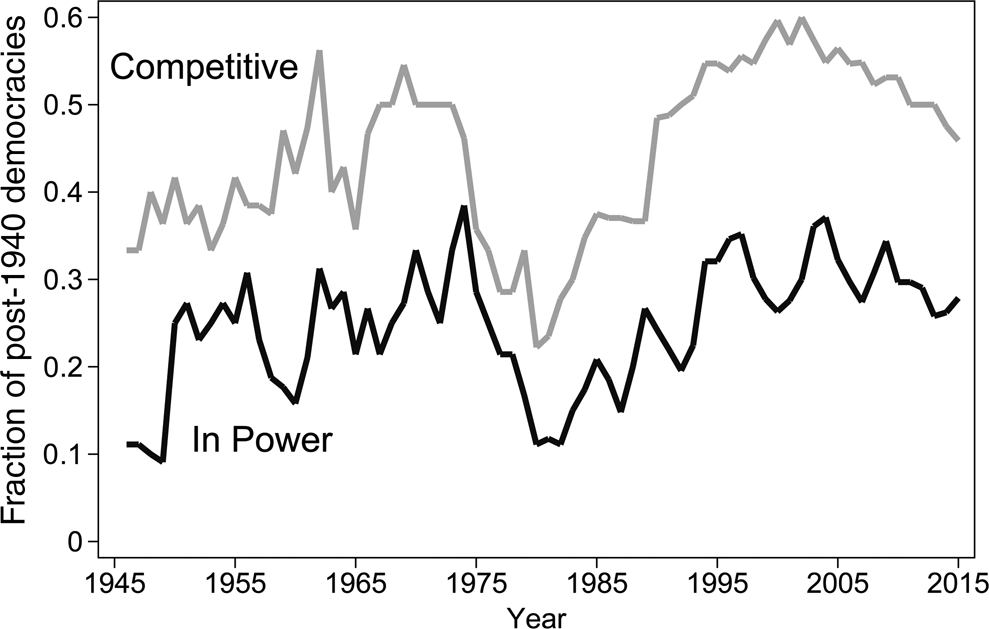
In 2015, eighteen democracies had a former ruling party in power and twenty-eight had a nationally competitive party. Figure 1 shows the fraction of post-1940 democracies meeting these two conditions in each year. At the peak in 2002, 60 per cent featured a competitive former ruling party. Table A1 lists the ruling parties in this article's sample and their outcomes.
Former autocratic ruling parties
Note: for each year, the figure shows the fraction of democracies (democratizing between 1940 and 2010) that have a former autocratic ruling party as a significant competitor and the fraction that have a former ruling party in power (controlling either the legislature or executive). Former ruling parties remain a major player in dozens of democracies. The figure encompasses all former autocratic ruling parties, including altered parties and those from previous autocratic spells.

This can be considered alongside the phenomenon of former dictators regaining power (Baker Reference Baker1998). From 1940 to 2015, I find thirty-seven cases of former autocratic leaders winning executive power within democracy, including eight democracies ruled by former dictators as of 2018. This has been especially common in Latin America, which accounts for eighteen cases.
New parties founded in democracy can also have varying ties to autocracy. More than a dozen ex-dictators founded competitive parties in democracy, including Hugo Banzer's Nationalist Democratic Action in Bolivia and Dési Bouterse's National Democratic Party in Suriname, which the former military dictators later used to win executive office. Many more parties were founded by prominent elites from the autocratic regime, such as Romania's National Salvation Front. Parties that split from old autocratic parties in Brazil, Paraguay, the Philippines and elsewhere have also been competitive.Footnote 4 Other parties have limited institutional or personal ties to autocratic parties, but present themselves as spiritual successors. In Benin, the Chameleon Alliance (coined from a popular nickname for ousted dictator Mathieu Kérékou) has campaigned as the People's Revolutionary Party of Benin's successor. Similarly, in Peru, Popular Force has run as a continuation of Alberto Fujimori's autocratic legacy and is currently led by his daughter.Footnote 5
This article focuses on the ruling parties themselves since they have comparable histories within autocracy and are the most relevant to understanding choices to democratize and political reforms during transition. Although Jhee and Loxton include parties founded in democracy by autocratic elites, I omit them as they never ruled as autocratic parties (Jhee Reference Jhee2008; Loxton Reference Loxton2015; Loxton Reference Loxton, Loxton and Mainwaring2018). This provides a clear sample of relevant parties defined at the point of transition, whereas young democracies might have several parties with elite links or claims to being successors.Footnote 6
Past Work
The literature on autocratic ruling parties after democratization has focused on two closely related questions: how successful parties manage democratic transitions (Waller Reference Waller1995; Grzymala-Busse Reference Grzymala-Busse2002; Cheng Reference Cheng, Friedman and Wong2008; Friedman and Wong Reference Friedman and Wong2008; Langston Reference Langston2017) and which parties succeed in democracy (Grzymala-Busse Reference Grzymala-Busse2002; Ishiyama and Quinn Reference Ishiyama and Quinn2006; Jhee Reference Jhee2008; Riedl Reference Riedl2014; Loxton Reference Loxton, Loxton and Mainwaring2018). Despite deep qualitative work, the literature remains sharply divided on both questions. In part, this may be due to a lack of work that crosses regional boundaries and encompasses the full range of cases (Riedl Reference Riedl2014; but see Jhee Reference Jhee2008; Loxton Reference Loxton, Loxton and Mainwaring2018; Grzymala-Busse Reference Grzymala-Busse2019).
The first divide concerns whether ruling parties succeed in democracy through radical reinvention or continuity. The initially dominant view was that autocratic parties are discredited and thrust from power by democratization and must rebuild vote support by fundamentally transforming themselves (Orenstein Reference Orenstein1998; Grzymala-Busse Reference Grzymala-Busse2002; Grzymala-Busse Reference Grzymala-Busse, Friedman and Wong2008; Burgess and Levitsky Reference Burgess and Levitsky2003; Levitsky Reference Levitsky2003). Grzymala-Busse (Reference Grzymala-Busse2002, 9) thus argues that ‘organizational transformation and a break with the past are the prerequisites for pursuing further party regeneration’ and ‘these transformations must occur early, rapidly, and decisively’. Although this view provides a central role for skills and resources developed within autocracy, it stresses elements that enable fundamental reform and adaptation (Ishiyama Reference Ishiyama1997; Ishiyama Reference Ishiyama, Friedman and Wong2008; Orenstein Reference Orenstein1998; Grzymala-Busse Reference Grzymala-Busse2002).
This view of autocratic party resurgence occurring through major transformations is heavily influenced by the literature's focus on the post-communist world, especially Poland and Hungary (Waller Reference Waller1995; Ishiyama Reference Ishiyama1997; Ishiyama Reference Ishiyama, Friedman and Wong2008; Orenstein Reference Orenstein1998; Kitschelt et al. Reference Kitschelt1999; Grzymala-Busse Reference Grzymala-Busse2002; Grzymala-Busse Reference Grzymala-Busse, Friedman and Wong2008). Although these studies have produced key theoretical advances, these ‘neo-communist’ parties may be unrepresentative as they were all ideologically discredited and faced severe economic crises during the transition period. They also display limited variation in repression, political competition, programmatic basis and duration of rule.
Other work emphasizes the advantages that autocratic ruling parties bring to democracy, making electoral success more about continuity than reinvention (Cheng Reference Cheng, Friedman and Wong2008; Serra Reference Serra2013; Slater and Wong Reference Slater and Wong2013; Langston Reference Langston2017; Loxton Reference Loxton, Loxton and Mainwaring2018). Although this does not preclude moderate adaptation, as practiced by all democratic parties, it focuses attention on the sources of ruling party dominance and how they are maintained. Former ruling parties enter democracy with significant advantages in organization, membership and brand recognition, particularly if they are still in power up to the democratic transition (Langston Reference Langston2017; Loxton Reference Loxton, Loxton and Mainwaring2018). In nearly all cases, they are the most professional and experienced party in the system. Further, they often carry over reserves of autocratic power, including clientelist networks, state and military allies, control of the media, monetary resources and mass support (Birch Reference Birch2003; Serra Reference Serra2013; Langston Reference Langston2017; Loxton Reference Loxton, Loxton and Mainwaring2018). This perspective predominates in work on successful parties in Mexico (Cheng Reference Cheng, Friedman and Wong2008; Serra Reference Serra2013; Langston Reference Langston2017), Taiwan (Cheng Reference Cheng, Friedman and Wong2008; Slater and Wong Reference Slater and Wong2013; Langston Reference Langston2017) and much of sub-Saharan Africa (Riedl Reference Riedl2014).
This prompts the question of which ruling parties succeed after democratization. Ishiyama and Quinn (Reference Ishiyama and Quinn2006) distinguish between two camps: the ‘internalist’ view that focuses on party characteristics and the ‘externalist’ view that emphasizes economic and political facets of the democracy. I similarly distinguish between party-specific factors and external factors, while also broadening the features included in each category. Within each set of factors, the specific characteristics that predict success will depend on how power is won.
Working within the reinvention school, internalist theories have focused on how party attributes enable adaptation and moderation within democracy (Ishiyama Reference Ishiyama1997; Orenstein Reference Orenstein1998; Grzymala-Busse Reference Grzymala-Busse2002; Friedman and Wong Reference Friedman and Wong2008). Although adaptation and moderation constitute standard behavior for democratic parties, some autocratic successors find the transformation more challenging. In the most detailed study to date, Grzymala-Busse (Reference Grzymala-Busse2002) explores the relative success of Communist successors in Poland and Hungary compared to those in the Czech Republic and Slovakia. She argues that communist parties that had more responsive approaches to governance and reformist elites in more prominent positions during the autocratic period were able to quickly centralize and reform after the transition. In turn, these parties became more adaptive and moderate, promoting success in democracy. Similar studies link success to greater competition within autocracy (Ishiyama Reference Ishiyama1997); the forging of cross-class alliances by party reformers, particularly with trade unions (Orenstein Reference Orenstein1998); and less institutionalized parties, which are more flexible (Levitsky Reference Levitsky2003). As discussed below, working from a continuity perspective yields different predictions.
Externalist theories have highlighted three factors: popular attitudes toward democracy, opposition strength and the electoral system. First, autocratic parties should benefit if the citizenry turns away from democracy, often out of nostalgia for the autocratic past (Seligson and Tucker Reference Seligson and Tucker2005; Jhee Reference Jhee2008). The most commonly cited reason for this turn is economic failure within democracy, especially if the autocratic period is remembered as more prosperous (Waller Reference Waller1995; Rose, Mishler and Haerpfer Reference Rose, Mishler and Haerpfer1998; Jhee Reference Jhee2008). Secondly, autocratic parties benefit if they face weaker or more ideologically extreme competitors. Of particular concern for autocratic parties is strong competition on their ideological wing, such as leftist parties for ex-communists (Waller Reference Waller1995). As Kitschelt (Reference Kitschelt1995) notes, however, opposition strength can be a legacy of autocratic repression, which blocks parties from developing before democratization, or a consequence of the former ruling party's weakness. Thirdly, the electoral system may have an impact (Ishiyama and Quinn Reference Ishiyama and Quinn2006; Ishiyama Reference Ishiyama, Friedman and Wong2008), although there have been few specific predictions. As discussed below, the electoral system's role depends on assumptions about whether ruling parties compete as outsiders or dominant players.
As noted, most of this literature is limited to a small number of cases in specific regions (Waller Reference Waller1995; Ishiyama Reference Ishiyama1997; Orenstein Reference Orenstein1998; Grzymala-Busse Reference Grzymala-Busse2002; Serra Reference Serra2013; Riedl Reference Riedl2014; Langston Reference Langston2017). To my knowledge, Ishiyama and Quinn (covering twenty-two African countries), Jhee (covering founding democratic elections) and Grzymala-Busse have the only published cross-national quantitative studies on autocratic party success (Ishiyama and Quinn Reference Ishiyama and Quinn2006; Jhee Reference Jhee2008; Grzymala-Busse Reference Grzymala-Busse2019). Ishiyama and Quinn mainly test external factors, whereas Jhee focuses on retrospective economic voting. Grzymala-Busse tests parties’ decisions about whether to exit from power or reinvent themselves, but not party characteristics. In contrast to the qualitative literature's emphasis, all are limited in the party attributes they consider.Footnote 7
This article aims to advance this literature by examining a full sample of former autocratic parties and their democratic fates. Further, I use newly collected data on ruling party characteristics to greatly expand the party-specific and external factors that are tested.
Theory on Autocratic Ruling Parties after Democratization
I argue that competing and winning in democracy for former autocratic ruling parties is more about maintaining power than reviving it. Although some past work emphasizes the advantages that ruling parties bring to democracy, this has not been developed into a testable theory on which parties succeed. After reviewing the evidence for power continuity, this section presents predictions for the party-specific and external factors that facilitate autocratic party success, as well as the resulting effects on democratic survival and quality. I also note how these predictions differ from the reinvention school.
Continuity of Power
Looking at the full range of cases, many former autocratic ruling parties succeed despite modest reforms after democratization. Of course, all competitive parties in democracy require some adaptation. However, autocratic parties have frequently won power with the same core messaging and methods of control as under autocracy. In Mexico, Langston (Reference Langston2017, 11, 19) notes that the Institutional Revolutionary Party (PRI) ‘never renounced its authoritarian past’ and ‘modernized their campaign strategies…but did not eschew their traditional clientelist mobilization tactics’. Similarly, across sub-Saharan Africa, autocratic elites relented to liberalization because they ‘saw a path forward for maintaining power through electoral mobilization, using the party machinery’, but did not require fundamental change beyond increased competition (Riedl Reference Riedl2014, 19). In Ghana, for instance, rulers ‘decided to maintain the authoritarian incumbent party organization in its entirety, transporting the party wholesale into the multiparty era as the vehicle for garnering victory’ (Riedl Reference Riedl2014, 134). Even within the post-communist world, parties in Bulgaria and Albania maintained old techniques of control to win power in democracy (Kitschelt et al. Reference Kitschelt1999).Footnote 8
Why is there so much continuity despite democratic change? As discussed above, autocratic parties typically enter democracy with major advantages, including name recognition, governing experience, party membership, financial resources, local organization, and allies in the media and military (Birch Reference Birch2003; Cheng Reference Cheng, Friedman and Wong2008; Serra Reference Serra2013; Slater and Wong Reference Slater and Wong2013; Loxton Reference Loxton, Loxton and Mainwaring2018). As Langston (Reference Langston2017, 200) argues, ‘Almost all authoritarian parties are better positioned than their upstart opposition party rivals when the transition to democracy begins and ends.’ In Mexico, the PRI leveraged major advantages in resources, local organization, party identification and experience to quickly rebound after democratization in 2000 (Serra Reference Serra2013; Langston Reference Langston2017). In Ghana, advantages in experience, professionalization and the past incorporation of rivals enabled the ruling party PNDC to retain power for most of the post-democratization period (Riedl Reference Riedl2014, 19). The exceptions that lack these advantages or collapse before democratization almost always disappear or remain permanently uncompetitive. Parties with poor organization or unfavorable reputations may attempt a fundamental reinvention, but this is usually not successful.
As a result, the paths to power in democracy are typically not long struggles. Of the forty-one autocratic parties that were their country's most recent ruling party and then won power in democracy, twenty won the first democratic elections. Another thirteen regained power within five years and only three took longer than ten years. In total, the average time to power is only 3.6 years. Further, outside of interruptions to democracy, it is extremely rare for these parties to become uncompetitive and then come back.Footnote 9 Thus if autocratic ruling parties ever achieve success, it is almost always as a continuation or quick restoration. Even when parties lose the country's founding elections, the ensuing struggle still tends to focus on preserving the party's advantages in the face of temporary setbacks.
How does this affect which autocratic parties succeed in democracy? In turn, how do these predictions differ from theories that stress ruling party reinvention? I find three implications. First, parties that are still in power at democratization should be more successful as they benefit from greater continuity and influence on democratic design. The reinvention school does not offer a clear prediction here, as parties may find it easier to reform if they are already out of power, but will have less control over democratization. Secondly, parties are more likely to succeed if they have strong autocratic legacies that translate easily to democracy, such as policy experience, organizational strength and records of success. The reinvention school concurs on policy experience, but not necessarily the latter two. Strongly institutionalized parties may have high capacity, but also suffer from lower flexibility and impetus to change (Levitsky Reference Levitsky2003).Footnote 10 Thirdly, political features of the democracy can maintain the party's dominance by disadvantaging smaller parties and democratic actors. This contrasts even more sharply with the reinvention school, which generally argues that parties must struggle back to power starting from a position of weakness.
The latter two sets of factors are explored below in greater depth. The first can be summarized as the following hypothesis:
Hypothesis 1
Former autocratic ruling parties are more likely to succeed in democracy if they accede to democratization rather than being overthrown prior to democratization.
Party Success: Party-Specific Factors
Successful democratic parties need to excel at several tasks, including running effective campaigns, building mass membership, recruiting elites, crafting policy and organizing legislative behavior. These goals are furthered by three key attributes: (1) the ability to appeal to a broad electorate, (2) strong organization and resources and (3) a reputation as credible and competent. In contrast, parties can survive in autocracy in many different ways, from good governance to loyal support from a narrow clique to mass repression. In addition, some autocratic parties are simply weak and quickly overthrown. I argue that autocratic parties’ success in democracy is intimately tied to legacies of their autocratic rule – specifically those attributes that translate into broad programmatic policy appeals, strong organization and competent images. I now consider each of these attributes in turn and discuss the characteristics from the autocratic period that can capture them in testing.
First, autocratic parties sharply differ in their styles of governance, some of which translate more easily to democratic competition. Those with skills, networks and resources that facilitate plurality-winning policy messages will be more successful in democracy. Grzymala-Busse (Reference Grzymala-Busse2002) refers to these attributes as parties’ ‘portable skills’, although it remains an open question which elements of autocratic governance are more or less ‘portable’. Autocratic parties that focus on programmatic appeals and speak to broad segments of the citizenry can adapt more easily to democracy (Orenstein Reference Orenstein1998; Grzymala-Busse Reference Grzymala-Busse2002; Grzymala-Busse Reference Grzymala-Busse, Friedman and Wong2008; Serra Reference Serra2013; Langston Reference Langston2017). This prediction is shared by scholars who claim that parties need to reinvent themselves to succeed in democracy (for example, Orenstein Reference Orenstein1998; Grzymala-Busse Reference Grzymala-Busse2002), but the mechanism is different. Like Langston (Reference Langston2017), I argue that policy experience and campaign skills can translate directly to democracy without a fundamental break with the past.
In contrast, parties that rely on narrow ethnic appeals or coercion in autocracy will find democratic competition more challenging. A narrow ethnic focus can maintain autocratic power when combined with mass coercion, but does not translate well to democratic competition in which all ethnic groups get an equal vote. South Africa's National Party, for instance, was not only tarred by its apartheid past but struggled to craft convincing policy appeals once the electorate broadened beyond whites. After renaming itself and ironically allying with the ANC, it disbanded in 2005. Purely clientelistic parties will also struggle in democracy because they can no longer exploit state resources to the same degree.
Hypothesis 2a
Former autocratic ruling parties are more likely to succeed in democracy the more they governed during the autocratic period through broad programmatic appeals rather than clientelism, repression or ethnic favoritism.
Secondly, parties vary in capacity and durability due to their organizational strength and resources. Many attributes that improve party durability in autocracy also help parties endure in democracy, including internal cohesion, mass membership, monetary resources, media control and local organization (Serra Reference Serra2013; Tavits Reference Tavits2013; Loxton Reference Loxton2015; Loxton Reference Loxton, Loxton and Mainwaring2018). As Tavits (Reference Tavits2013, 67) writes on the post-communist world, the ‘stronger the party organization – that is, the more sizable its membership, extensive its local presence, and professional its staff – the more successful is the party electorally’. The Kuomintang (KMT) in Taiwan, for instance, retained significant advantages in local control and resources after democratization, including billions of dollars in real estate and business ventures (Cheng Reference Cheng, Friedman and Wong2008). As a very different example, Mozambique's FRELIMO benefited from an extensive coercive apparatus, deep internal cohesion and mass support due to its long struggle in the country's civil war. In contrast, Peru's Cambio 90 was effectively a shell organization for Alberto Fujimori's personal brand, with little internal organization or independent loyalty. The KMT and FRELIMO have prospered in democracy, whereas Cambio 90 faded as the Fujimoristas shifted to new parties.
Although direct, comparable measures of autocratic party organization and resources are not readily available,Footnote 11 several characteristics of autocratic parties help to indicate their strength and durability. The party's age and years in power proxy for institutional strength since weaker parties are gradually sifted out and parties build internal capacity and mass support over time. Parties that were the supreme power in autocracy (versus sharing power with a military junta or monarch) tend to be stronger, better resourced and more deeply embedded socially. Additionally, the origins of parties can predict their later strength (Brownlee Reference Brownlee2007; Levitsky and Way Reference Levitsky and Way2013). Parties founded by sitting dictators are generally less durable, as they are often individual projects that quickly fade when the dictator leaves office. Examples include Ferdinand Marcos’ New Society Movement and Eduard Shevardnadze's Union of Citizens of Georgia. Because these parties tend to remain weak and subordinate to the dictator, Brownlee (Reference Brownlee2007) finds that leadership change usually occurs through hereditary succession rather than party choice. In contrast, Levitsky and Way (Reference Levitsky and Way2013) argue that revolutionary parties are the most cohesive, although their coercive advantages do not translate as well.
Hypothesis 2b
Former autocratic ruling parties are more likely to succeed in democracy if they inherit greater institutional strength, resources and internal cohesion from the autocratic period, as proxied by age, institutional supremacy and founding origin other than from a sitting dictator.
Thirdly, citizens are likely to evaluate former ruling parties by their records of success. Extending the retrospective logic that governs much of democratic voting, parties with more successful tenures under autocracy should fare better within democracy (Jhee Reference Jhee2008; Slater and Wong Reference Slater and Wong2013). For instance, the PRI's comeback in the 2009 and 2012 Mexican elections was connected to the widespread belief in its experience and competence, especially among older voters (Serra Reference Serra2013). Loxton (Reference Loxton, Loxton and Mainwaring2018) similarly contrasts the successful tenures and party resurgences in Taiwan and South Korea to the opposite pattern in 1970s Greece and Argentina. Although success is subjective, we can look at performance metrics that populations consistently value, such as economic growth, military success, public goods and low levels of corruption. If ruling parties excel at these features during their tenure, we should expect them to be viewed as more competent, magnifying their support in democracy.
Hypothesis 2c
Former autocratic ruling parties are more likely to succeed in democracy if, during the autocratic period, they excelled at common metrics of governmental performance like economic growth, public goods provision and low levels of corruption. They will be less successful if they suffered military defeat.
Party Success: External Factors
Autocratic parties in democracy seek to leverage their persistent political and economic power to maintain or restore dominance. This involves limiting the empowerment of new political parties, civil society groups and state actors that often flourish after democratization, but can challenge the party in elections and erode its reserves of power. As a result, autocratic party success should be negatively related to political features that advantage new parties, broaden participation and constrain central government. Again, one would predict the polar opposite if ruling parties struggled to come back as reinvented outsiders.
Which political features facilitate the inclusion and influence of new actors? First, specific electoral rules favor younger and smaller parties (Harmel and Robertson Reference Harmel and Robertson1985; Lijphart Reference Lijphart1999; Birch Reference Birch2003; Riedl Reference Riedl2014). More ‘permissive’ electoral systems provide openings for new challengers and encourage party splits, which endangers established parties (Langston Reference Langston2017). Among the most significant elements of permissiveness is proportional representation (PR), which lowers the barriers to legislative representation and encourages party fractionalization (Boix Reference Boix1999; Birch Reference Birch2003). However, higher national thresholds for entering the legislature in PR systems eliminate smaller parties from representation and advantage more powerful parties (Lijphart Reference Lijphart1999, 153; Birch Reference Birch2003, 81). Compulsory voting is another electoral rule that significantly broadens electoral participation, especially for disadvantaged populations, bringing new parties and issues into the political sphere (Birch Reference Birch2003, 11). Lastly, federal systems provide openings for participation, foster access points for new parties and groups, and predict more competitive parties (Hicken Reference Hicken2009).
Hypothesis 3a
Former autocratic ruling parties are less likely to succeed in democracies with ‘permissive’ electoral systems that advantage smaller and younger parties, as captured by proportional representation, low national PR thresholds, compulsory voting and federalism.
Outside of the electoral sphere, democracies have several potential sources of constraint that can hamper autocratic parties’ monopolization of power and ensure openings for challengers. Chief among these constraints are civil society and independent courts, both of which are critical for revealing and challenging undemocratic behaviors that parties carry over from autocracy. For instance, popular protests and High Court decisions regarding the disputed 2001 election were pivotal for preventing Didier Ratsiraka's Association for the Rebirth of Madagascar (AREMA) from consolidating power in Madagascar. Further, strong civil societies are critical to developing credible opposition parties (Randall and Svåsand Reference Randall and Svåsand2002). In contrast, a strong legislature does not necessarily constrain the ruling party since the party itself can control it.
Hypothesis 3b
Former autocratic ruling parties are less likely to succeed in democracies with a stronger civil society and more powerful independent courts.
A strategic consequence of these hypotheses is that autocratic parties that are in power at the time of democratization, and thus have influence over the transition process, will seek to secure more favorable political rules (Boix 1999; Kitschelt et al. Reference Kitschelt1999; Slater and Wong Reference Slater and Wong2013; Riedl Reference Riedl2014; Langston Reference Langston2017; Loxton Reference Loxton, Loxton and Mainwaring2018). Taiwan's KMT and Mexico's PRI both sequenced reforms ‘to maximize the chance of creating a one-party dominant system under democracy’ (Cheng Reference Cheng, Friedman and Wong2008, 130). In sub-Saharan Africa, ruling parties fought to control the transition process ‘to manipulate the process of rule-making to maintain and maximize their political advantage’ (Riedl Reference Riedl2014, 72). African incumbents especially prioritized ‘high barriers to entry to screen out potential popular challengers’, including less permissive electoral systems and prohibitive party registration requirements (Riedl Reference Riedl2014, 14). Although they do not focus on parties, Albertus and Menaldo (Reference Albertus and Menaldo2018) show that autocratic elites hold more power in a democracy if the country retains an autocratic constitution. I discuss further evidence for this below.
One feature of democracy I do not test is the strength of the political opposition, as this is often a legacy of autocratic characteristics like the freedom of party competition. Thus, controlling for it risks post-treatment bias. Further, there is a significant reverse causation problem whereby a strong opposition can fail to develop because of the former ruling party's dominance. This was especially clear in the evolution of leftist alternatives in the post-communist sphere (Kitschelt Reference Kitschelt1995; Grzymala-Busse Reference Grzymala-Busse2002; Grzymala-Busse Reference Grzymala-Busse, Friedman and Wong2008; Pop-Eleches Reference Pop-Eleches2008). However, I do test opposition freedom under autocracy, which contributes to later democratic contestation, and opposition fractionalization within democracy.
Democratic Survival and Quality
How does autocratic party success affect democratic survival and quality? Clearly, having a competitive former ruling party is not a death warrant for democracy. Mexico, Taiwan and South Korea stand out as cases with successful autocratic parties and democratic consolidation. However, there are also numerous examples of such parties eroding democratic governance after they win power. In Nicaragua, the Sandinista National Liberation Front and ex-revolutionary leader Daniel Ortega regained power in the 2006 election after a sixteen-year absence. Ortega's tenure has featured state dominance of the media and widespread abuse of the courts to abolish term limits and disqualify opposition candidates. Freedom House's (2016) political rights rating for Nicaragua declined two points on a seven-point scale from 2006 to 2011. Similar erosions of democracy occurred in Mozambique under FRELIMO, in Madagascar under Didier Ratsiraka's AREMA, in Zambia under the Movement for Multiparty Democracy and in Guatemala in the 1970s under the Institutional Democratic Party's control.
Theoretical expectations point in different directions. On the one hand, successful autocratic parties may harm democracy as they have experience in ruling undemocratically and may be eager to manipulate the rules to re-establish dominance. As Karl (Reference Karl1990) argues, autocratic influence over democratic design can produce a ‘frozen’, elite-dominated democracy. Further, after electing a clear representative of the autocratic period, voters may feel that the system and their fellow citizens are turning away from democracy (Seligson and Tucker Reference Seligson and Tucker2005). This can result in democratic decline, as in Nicaragua, or a full democratic breakdown initiated by the party or military factions.
On the other hand, autocratic parties can contribute much-needed experience and strong party identities to a potentially chaotic electoral environment. The presence of these parties fundamentally shapes countries’ party systems, providing order and meaning to electoral competition (Grzymala-Busse Reference Grzymala-Busse2002; Grzymala-Busse Reference Grzymala-Busse, Friedman and Wong2008; Hicken and Kuhonta Reference Hicken and Kuhonta2011; Riedl Reference Riedl2014; Loxton Reference Loxton, Loxton and Mainwaring2018). Grzymala-Busse (Reference Grzymala-Busse, Friedman and Wong2008) argues that the presence of reformed communist parties in Poland and Hungary led to clear policy choices for voters, whereas the diffusion of communist elites in Bulgaria and Romania produced blurred parties that lent themselves to non-programmatic and nationalist appeals. Opposition parties also copy the organizational models set by strong autocratic incumbents (Riedl Reference Riedl2014). In turn, stronger party institutionalization promotes democratic quality and survival (Kuenzi and Lambright Reference Kuenzi and Lambright2005; Riedl Reference Riedl2014).
Competitive autocratic parties can also reassure formerly empowered elites and allies who might otherwise fight to restore autocracy (Langston Reference Langston2017; Ziblatt Reference Ziblatt2017; Loxton Reference Loxton, Loxton and Mainwaring2018). Besides providing these groups with representation and the prospect of power, autocratic party persistence can also prevent policy shifts that might provoke coups. For instance, business and landed elites in El Salvador were more accepting of democracy given the survival of the conservative ARENA party (founded by a military-allied death squad leader), which has held power nearly continuously since 1988 (Mainwaring and Pérez-Liñán Reference Mainwaring and Pérez-Liñán2013, 190–92). Given these opposing factors, it is unclear where the balance lies for democratic survival.
Data and Empirical Design
Democracy, Ruling Parties and Party Outcomes
This article's sample covers all countries that democratized between 1940 and 2010, tracking the resulting democratic spells up to 2015. This corresponds to eighty distinct countries and 115 democratic spells. Democracy is defined using Boix et al.’s coding, which has been updated to 2015 (Boix, Miller and Rosato Reference Boix, Miller and Rosato2013). This is a ‘minimal’ democracy coding that requires free and fair elections, but does not require electoral turnover, minimizing any reverse link from party outcomes to the democracy measure.Footnote 12
For each transition, I identify the last ruling party (if any) in the preceding autocratic spell.Footnote 13 A ruling party is defined as a political party that is either the supreme power within autocracy or is used as a significant vehicle of power by the regime, such as parties allied with military juntas. I exclude parties created solely to compete in founding democratic elections.Footnote 14
In total, eighty-four democratic transitions had a ruling party in the preceding autocratic spell.Footnote 15 I focus on the electoral success of each party in the following democratic period, tracking by year whether the party remains in existence, remains competitive and wins power. Existence requires that it remains a political party with some active organization. Competitiveness is defined as the party remaining a significant political actor with a meaningful chance of winning or sharing in national power. As a rule of thumb, parties that gain 10 per cent of legislative seats or 10 per cent of presidential votes are usually considered competitive. However, parties slightly below this threshold that join governing coalitions or cabinets can be rated competitive. Existence and competitiveness are not counted if the party competes in the democratizing election and quickly dissolves, since this does not involve existence within democracy. Finally, parties win power if they control the executive or win a plurality of legislative seats.Footnote 16
A complication concerns changes to parties within democracy. If a party's name or strategy changes, but no major splits or mergers occur, this is considered a continuation of the same party. If a party experiences a major split or merger, but the result remains widely identified with the previous party, this is coded as an altered party. For instance, Poland's SdRP split off as the main faction of the long-ruling Polish United Workers’ Party in 1990 and became the senior partner in the SLD alliance, which transformed into a new party in 1999. The SdRP (and then SLD) is thus coded as an altered form of the old ruling party. If a party splits into several small pieces or is absorbed into a large coalition as a junior partner, such as Ecuador's Conservative Party in 1977, this is coded as party death. I do not include parties claiming to be successors that are not connected by any organization or core leadership, such as the fledgling Romanian Communist Party. Of the eighty-four ruling parties, ten became altered. I track the same outcomes as for unaltered parties and treat them as equivalent in the main models.
Descriptive Statistics
A full list of the eighty-four ruling parties is displayed in Table A1. For each, the table shows the year of democratization and whether it remained in existence, was competitive and won power at any point in the following democratic spell. Parties that only qualify as altered parties are indicated with a star. The table also shows whether the party acceded to democratization (fifty-four cases) or was ousted from power prior to democratization (thirty cases).Footnote 17
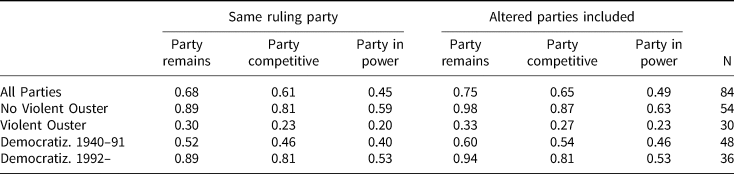
Table 1 shows the fraction of former ruling parties that qualify for each marker of success, with and without altered parties counted. The first row includes all parties; the following rows divide by whether the party was ousted before democratization and by time period. Including altered parties, 75 per cent of all ruling parties survive in democracy. However, the likelihood is much higher for parties that usher in the transition. Only one such case (the Falange in Spain, which dissolved in 1977) disappeared completely. In addition, 87 per cent of such cases remain competitive and 63 per cent win power, compared with 27 per cent and 23 per cent of ousted parties. Of course, great care is needed in causal interpretations, as parties that anticipate success are more likely to accede to democratization. Finally, parties are more successful post-Cold War, partly due to a lower likelihood of violent ouster.
Autocratic ruling parties after democratization

Note: the table shows the fraction of former autocratic ruling parties that remain in existence, remain competitive, and win power at some point in the following democratic spell. The last ruling party in each autocratic spell is included for every democratic transition between 1940 and 2010. Results are shown for the same ruling party (allowing for name changes), as well as for altered parties (allowing for splits and mergers). The first row shows all parties, then results are divided by whether the party was violently ousted before democratization and by time period. Autocratic parties are much more successful when they accept democratization and in the post-Cold War period.
Several scholars have focused on the fates of former communist parties (for example, Waller Reference Waller1995; Ishiyama Reference Ishiyama1997; Grzymala-Busse Reference Grzymala-Busse2002). These parties are indeed more likely to remain competitive: including altered parties, ten of thirteen (77 per cent) remained competitive, compared to forty-four of seventy-one remaining parties (62 per cent). Further, 54 per cent of communist parties won power versus 47 per cent of other parties. However, among parties in power at democratization, those outside the post-communist region were slightly more successful. Thus the region is roughly representative.Footnote 18
Empirical Design
To predict ruling party fates after democratization, I run models of the following form:
 $$Y_{{\rm it}} = \alpha + {\bi P}_{{\bf it}}{\bi \beta} {\rm}+{\rm } {\bi X_{{\bf it}}\theta} + \pi _1{\rm Year} + \pi _2{\rm Post {\hbox -}Cold \; War} + \varepsilon _{{\rm it}}$$
where Y is a measure of party success, P are party characteristics from the autocratic period and X are country-level controls (such as economic development and electoral rules). The sample is all democratic years from 1940–2015 in which the country democratized between 1940 and 2010 and had a ruling party in the prior autocratic spell. After eliminating micro-states, we are left with seventy-nine democratic spells across sixty-six countries. Because changes in the dependent variable (DV) are rare between elections, I cluster standard errors by electoral period. I also run a check including only election years.
I focus on three annual measures of party success: Party Competitive (a dummy); Party in Power (a dummy); and a four-valued ordinal measure called Party Success in which 0 = the party does not exist, 1 = existence as a non-competitive party, 2 = competitiveness, and 3 = the party in power. Altered parties are included, but the results are virtually identical if limited to the original parties. In the main sample, Party Competitive and Party in Power are coded 1 in 47.5 per cent and 25.7 per cent of country-years, respectively.
For P, I test several party features like the duration of party control, age, how each party was founded and whether the party was ousted prior to democratization. I also test core features of party governance, such as whether parties favored a specific ethnicity, allowed competitive elections and used policy or clientelistic appeals.Footnote 19 Except where noted, this is based on original data collected for this study.
To capture the party's performance in office under autocracy, I calculate the averages of several country characteristics during the party's ruling spell. These constitute markers of good governance on which there is wide agreement: Economic Growth (see below), Corruption (a 0–1 index of political corruption), Equal Resources (a 0–1 index of whether public goods, health and education are equally spread across ethnic groups and gender) and Freedom from Repression (a 0–1 index of freedom from torture and political killings). The latter three are from V-Dem (Coppedge et al. Reference Coppedge2016). I also record whether the country experienced territorial loss from conquest or secession during the party's rule (Tir et al. Reference Tir1998; COW Project 2015).
The first empirical tests use logit for Party Competitive and Party in Power and an ordered logit for Party Success. One concern with this design is that the sample is limited to countries in which a ruling party lost power or acceded to democratization. Unfortunately, we cannot observe the democratic success of ruling parties that were able to prevent democratization, risking selection bias. The second tests therefore apply a Heckman selection model in which democratized countries are observed and all autocracies with ruling parties are treated as unobserved.Footnote 20 This model first estimates a selection equation predicting which types of countries are observed, and then uses this estimate in the outcome equation to account for selection bias.Footnote 21 I use a Heckman probit (heckprob in Stata) for Party Competitive and Party in Power and a continuous Heckman model for Party Success.Footnote 22
For the models predicting democratic survival and quality, I separately test the effects of Party Competitive, Party in Power and Party Success on a sample of democracies. For survival, I predict the likelihood of democracy in the next year. For quality, I track democratic rule-following by elites, the most likely source of threat from former autocrats. I use the Liberal Index from V-Dem (Coppedge et al. Reference Coppedge2016), which combines measures of the rule of law, civil liberties and executive constraints into a 0–1 index. A five-year lag of the liberal index is included, so the models measure changes in liberalism.
Causal Identification
To predict party success in democracy, a key feature of the analysis aiding causal identification is that the party variables are all drawn from the autocratic period and primarily track features established before or early in the party's rule, such as its founding and governing strategy. This provides valuable temporal and causal distance between the explanatory variables and outcomes. For instance, few party variables could plausibly have been adopted in anticipation of democracy. The external variables are drawn from democracy, but are generally either exogenous or a product of party variables that I control for. The results are also highly robust to the sample selection correction and various controls and robustness checks.
The endogeneity problem is more serious for predictions of democratic survival and quality, since party success occurs within democracy and is predicted by a range of political characteristics. I therefore use an instrumental variables (IV) analysis that separately instruments for each party success variable. Drawing on my empirical results, I use four instruments that strongly predict party success but are unlikely to directly influence democratic survival. Each is an average from the party's autocratic tenure on one of four variables: Economic Growth, Corruption, Equal Resources and Freedom from Repression. IV analysis requires that the instruments predict the DV through their effects on the endogenous variable, but are uncorrelated with the outcome equation's error term. There are two ways this assumption might be violated. First, the prior values might predict their modern values and thus influence democratic politics. In response, I control for contemporary values of each variable in the outcome equation. Secondly, the instruments might proxy for general autocratic nostalgia, turning people away from democracy. In response, I control for the average difference of each variable in the democratic and autocratic periods. These controls block the potential links from the instruments directly to the DV. The results are similar after dropping either set of controls or using other plausible instruments, such as dummies for dictator-founded parties and ethnic parties.
Controls
The standard country-level controls include logged GDP per Capita (in real 2000 dollars) (Haber and Menaldo Reference Haber and Menaldo2011; World Bank 2015) and Economic Growth (the average change in GDP per Capita over the previous two years). To account for international influence, Regional Democracy is the surrounding region's fraction of democracies. To capture democratic consolidation, I include the country's current Democracy Age and number of Previous Democratic Spells. Lastly, I control for the year (as a linear term) and a Post-Cold War (1992+) dummy. The results are minimally affected by adding region or year fixed effects.
What Predicts Autocratic Party Success?
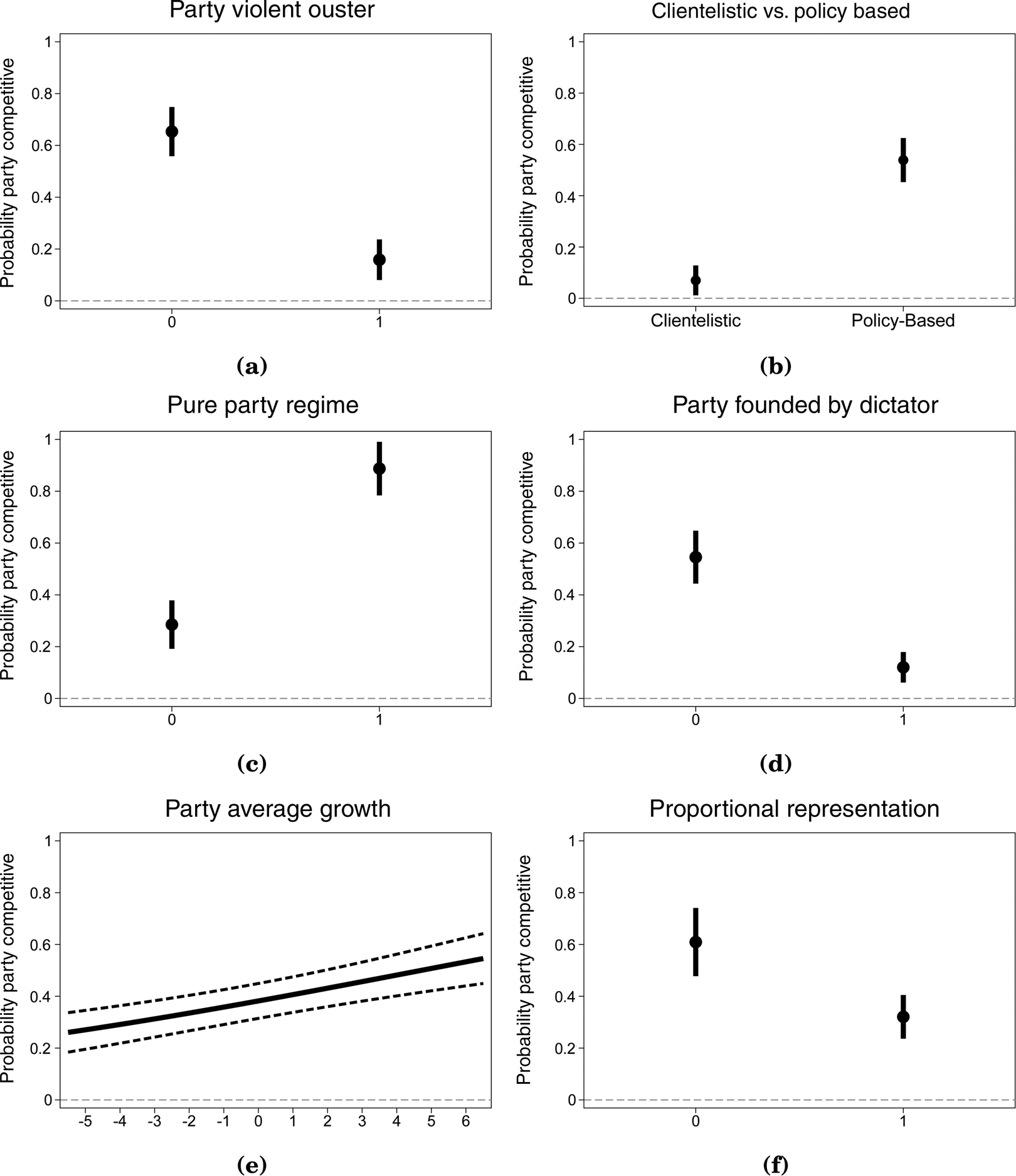
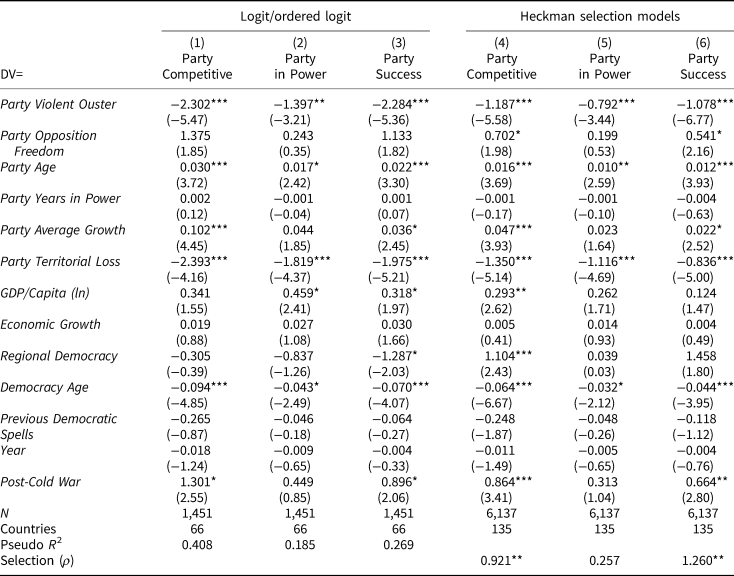
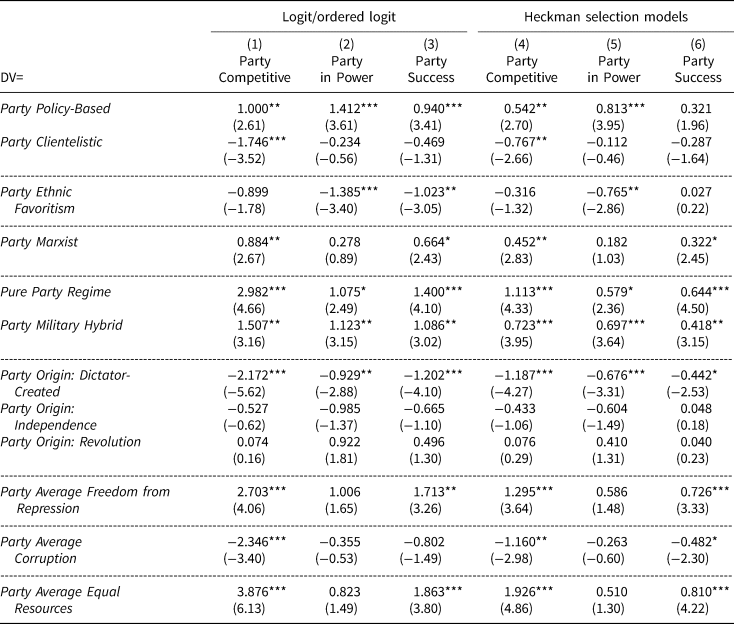
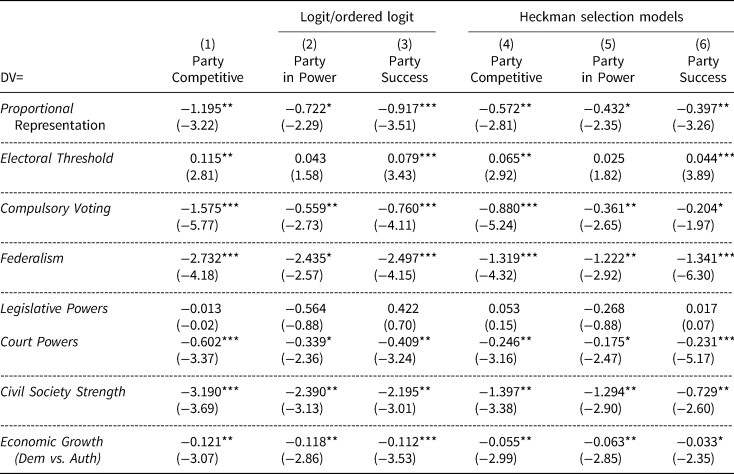
Tables 2–4 show the results predicting Party Competitive, Party in Power and Party Success in each democratic country-year. Models 1–3 use logit or ordered logit. Models 4–6 use a Heckman selection model. The results are generally consistent between these two approaches. Table 2 includes several variables of interest that form a base model. Tables 3 (party-specific factors) and 4 (external factors) then add variables in turn to this base model. Separate regressions are indicated by the dotted lines. Figure 2 shows the effect sizes for several key variables.
Predicted likelihood that autocratic ruling parties remain competitive post-democratization
Note: the predicted likelihood is calculated based on variation in six key predictors. Panels A and E are derived from Model 1 of Table 2. The remainder are from Model 1 variations in Tables 3 and 4. Predicted values are calculated holding other variables at their means.

Models predicting ruling party success after democratization

Note: the table displays models predicting the success of former autocratic ruling parties in democracy. Separate models predict parties becoming competitive or winning power, as well as a combined measure. Models 1–3 use logit and ordered logit. Models 4–6 use a Heckman selection model to account for sample selection bias. Years are 1940–2015. t statistics (based on robust standard errors clustered by electoral period) are in parentheses. *p < 0.05, **p < 0.01, ***p < 0.001
Additional models of ruling party success after democratization (party factors)

Note: the table displays models predicting autocratic party success in democracy from party-specific characteristics. Each distinct model (divided by dotted lines) adds variables to the model shown in Table 2. Years are 1940–2015. t statistics (based on robust standard errors clustered by electoral period) are in parentheses. *p < 0.05, **p < 0.01, ***p < 0.001
Additional models of ruling party success after democratization (external factors)

Note: the table displays models predicting autocratic party success in democracy from external political variables. Each distinct model (divided by dotted lines) adds variables to the model shown in Table 2. Years are 1940–2015. t statistics (based on robust standard errors clustered by electoral period) are in parentheses.*p < 0.05, **p < 0.01, ***p < 0.001
Party Factors
I examine in turn variables that track party governance strategies, institutional strength and performance during autocracy – elements of the party's autocratic legacy that directly translate to democracy. Unless noted otherwise, these are based on original coding. Before turning to these variables, I first consider two other important party attributes in Table 2.
First, a party's violent ouster before democratization is sharply negative for success, which supports Hypothesis 1. Although this may result from strategic anticipation, there are reasons to believe in a causal link. Parties that accede to democratization may be remembered more positively by citizens and, as discussed below, use their leverage during the transition to influence the structure of democracy (Slater and Wong Reference Slater and Wong2013; Riedl Reference Riedl2014; Loxton Reference Loxton, Loxton and Mainwaring2018). Further, greater continuity in power helps parties preserve the legacies of their political dominance, such as local organization, mass membership and media control.
Secondly, average opposition party freedom (a 0–1 index) (Coppedge et al. Reference Coppedge2016) during the party's tenure just misses positive significance for democratic success. Two countervailing factors are likely at play. First, ruling parties facing freer opposition are forced to develop electoral skills that translate to the democratic context (Langston Reference Langston2017). Secondly, this freedom also allows the opposition to mature, gain experience and present a tougher electoral challenge in democracy (Riedl Reference Riedl2014; Miller Reference Miller2015).
Governance strategies
I now examine whether more policy-focused and inclusive governing styles have translated more effectively to democracy, as Hypothesis 2a predicts. Moving to Table 3, I first test whether parties relied on policy-based appeals or clientelism within autocracy (included as dummies, with some parties like Mexico's PRI relying on both). The reference category is reliance on repression. A clear finding is that more policy-based parties (for example, Taiwan's Kuomintang) have fared better than clientelist parties (such as Kenya's African National Union) or repressive parties (Liberia's National Patriotic Party). Autocratic parties with policy experience can maintain their programmatic identities and are often the most skilled at campaigning and policy innovation (Cheng Reference Cheng, Friedman and Wong2008; Serra Reference Serra2013; Langston Reference Langston2017). To calculate substantive effects throughout, I look at Models 1 and 2 and hold other variables at their means. Shifting from a clientelist to a policy focus increases a party's likelihood of competitiveness by 47 per cent and of holding power by 20 per cent (see Figure 2). Clientelist parties only have an estimated 7 per cent chance of being competitive.
Parties that favored a specific ethnic or religious group (such as the Uganda People's Congress or South Africa's National Party) have also fared poorly under democracy, especially at winning power. This remains significant after controlling for ethnic fractionalization. Strong ethnic ties may help parties retain a core constituency, but not appeal to a sufficiently broad electorate to win power. Exactly one in four parties were ethnically based, of which about half are African and just over half favored a minority ethnic group. The results are similar for minority and majority ethnic parties. Ethno-centrist parties are about 30 per cent as likely to hold power as other parties.
Next, I test whether parties were Marxist in the autocratic period. This includes communist and radical socialist parties, but not all leftist parties. Exactly one in three parties were Marxist, with several cases in sub-Saharan Africa and Latin America. A Marxist history is significantly positive for competitiveness, but not power. Although this may be surprising given their radicalism, Marxist parties tend to have strong internal cohesion, mass support and programmatic identities that fare well in democracy. In sum, autocratic ruling parties succeed when they can draw on policy legacies aimed at broad segments of society.
Party strength
I next examine several indicators of institutional strength: party age, ‘pure’ ruling parties and the party's founding origin. All strongly predict autocratic party success in democracy, supporting Hypothesis 2b. In Table 2, the party's age (years since founding) is strongly positive. Although an indirect measure, age tracks the development of the organization and popular support over time, and proxies for those parties strong enough to survive. Surprisingly, the party's years in power under autocracy are non-predictive when Party Age is controlled for, implying that longevity either in or out of power builds party capacity.
Turning to Table 3, parties from pure single-party regimes are significantly more successful.Footnote 23 This tracks parties that were supreme powers within autocracy, with resulting advantages in state control, resources, elite support and organization. As seen with Paraguay's Colorado Party and Taiwan's KMT, these advantages frequently persist into democracy. The effect is strong: pure single parties are more than three times as likely to be competitive and twice as likely to be in power (see Figure 2). The test also controls for parties from military or military-hybrid regimes, which are more successful than those from personalist regimes (the reference category). This accords with Geddes’ theory that personalist regimes are institutionally fragile compared to party-based regimes, while showing that the effects persist past democratization.Footnote 24
The next model includes three dummies for the party's founding origin: Dictator-Created (started by a sitting dictator), Independence (founded as an independence movement) and Revolution (founded as a violent revolutionary movement).Footnote 25 As expected, dictator-founded parties are much less successful, as they are frequently personal projects that fade away after the dictator leaves office.Footnote 26 These parties have a 43 per cent lower likelihood of being competitive and a 12 per cent lower likelihood of being in power (see Figure 2). Although Levitsky and Way (Reference Levitsky and Way2013) argue that revolutionary parties are especially strong and cohesive, these parties are not more successful in democracy.Footnote 27
Party performance
I now turn to measures of party performance during autocratic rule (Hypothesis 2c). In Table 2, average economic growth during the party's tenure is significantly positive for competitiveness, suggesting that voters associate the party with economic prosperity and reward it at the ballot box (see Figure 2). A one-standard-deviation increase in average growth increases the likelihood of competitiveness by 13 per cent. In contrast, parties that experienced territorial loss (a highly salient failure) during their tenures fare poorly within democracy. The effect is large: a party that loses territory decreases its likelihood of competitiveness from 56 per cent to 10 per cent and its chance of holding power from 27 per cent to 6 per cent.
Table 3 includes additional averages from the party's tenure. First, straddling governance and performance, average Freedom from Repression is strongly positive for competitiveness, suggesting that parties are rewarded for having less violent and repressive pasts. This may also capture the more moderate and programmatic-minded parties. Secondly, average Corruption is significantly negative for competitiveness, again indicating a reward for effective governance. Thirdly, the average provision of Equal Resources across social and ethnic groups is positive for competitiveness. Thus, citizens appear to critically evaluate autocratic performance legacies, rewarding parties that avoided territorial loss and achieved high economic growth, low repression, low corruption and equitable access to public goods.
External Factors
Few socioeconomic and background political features of democracy are strong predictors of autocratic party success. Table 2 shows that average income is only marginally positive for success, whereas economic growth, regional democracy, previous democratic spells and the year are unrelated. The democracy's age is strongly negative, which supports the claim that autocratic parties start from a position of strength and, like most parties, fade over time. In other models (not shown), literacy, average education, economic inequality and the population's age structure are not robustly associated with party success.
The pattern that instead emerges is that autocratic party success is tied to specific political features that disadvantage new parties and limit the influence of democratic actors. Autocratic parties prosper when new challengers face uphill battles. Note that this directly compares whether autocratic party success is best explained as outsider struggle versus continuity. To test this, I use variables that are not themselves products of the ruling party's success (as with most opposition characteristics) or choices once in office; these are systemic political features.
We begin in Table 4 with four facets of the electoral system that capture permissiveness to younger and smaller parties. First, PR systems (versus majoritarian, from V-Dem) are significantly negative for autocratic party success, as they are more open to new challengers and party splits (see Figure 2) (Coppedge et al. Reference Coppedge2016). However, a higher Electoral Threshold, the national quota required for parties to enter the legislature in PR elections (with majoritarian systems set at 0), is positive for autocratic party competitiveness (Keefer Reference Keefer2012). Higher thresholds remove smaller parties from representation and advantage dominant parties. Thirdly, compulsory voting (a four-point index for required voting and associated penalties, from V-Dem) is strongly negative for success, as this widens participation and provides openings for new parties. Fourthly, federalism (measured as a dummy) (Henisz Reference Henisz2013) is strongly negative, as this predicts more parties and is less amenable to centralized control.Footnote 28 This strongly supports Hypothesis 3a.
The next models test potential sources of constraint by non-electoral actors, namely court powers (a count of powers including judicial independence and review) (Wig, Hegre and Regan Reference Wig, Hegre and Regan2015) and civil society strength (Coppedge et al. Reference Coppedge2016). For comparison, court powers are tested alongside legislative powers over the executive (Coppedge et al. Reference Coppedge2016). Court powers and civil society both significantly limit autocratic party success, whereas legislative powers are ineffectual. Strong courts and civil society groups can critically check ruling party abuses and advantages held over from autocracy. This strongly supports Hypothesis 3b.
I also find evidence that ruling parties that accede to democratization use their leverage to craft more favorable rules in the new democracy. Consider the fifty-four democracies with a ruling party in power at democratization versus those with an intervening non-party regime after the ruling party was ousted. Only 20 per cent of the former have compulsory voting (including lightly enforced rules), compared to 59 per cent for the ousted-party cases. In contrast, five years before democratization, 17 per cent of acceding parties and 23 per cent of ousted parties had compulsory voting. Thus, the transitional period represents a point of divergence dependent on dominant party participation. Similarly, 45 per cent of the accession cases have an independent judiciary versus 72 per cent of the ouster cases using the Henisz (Reference Henisz2013) measure. Again, this represents a shift from autocracy, in which 7 per cent of the former and none of the latter had independent judiciaries (see Figure A1). Finally, accession cases are 18 per cent less likely to have PR in democracy (compared to 2 per cent more likely prior to democratization) and tend to have higher PR thresholds.Footnote 29 In each case, parties with leverage over the democratization process produced political rules favoring their later success.
Finally, several authors argue that voters turn to autocratic alternatives when they view democracy as failing economically (Seligson and Tucker Reference Seligson and Tucker2005; Jhee Reference Jhee2008; Miller Reference Miller2016). Although I control for current economic growth, this does not adequately capture the relative success under democracy. The final model of Table 4 thus tests the democratic spell's average economic growth through the current year minus the average economic growth in the preceding autocratic spell. This is robustly negative for autocratic party success, even controlling for current growth and the party's growth record under autocracy. Thus, citizens appear to apply a retrospective logic to democracy itself (Miller Reference Miller2016).
Robustness Checks
Several robustness checks of the base model are shown in Table A4. Each variation predicts Party Success with an ordered logit. Except for one variable added to Model 1, the controls are the same as in Table 2.
Model 1 expands the sample by including ruling parties from the prior autocratic spell, but before the most recent ruling party. This adds fifty parties, including prominent cases like Liberia's True Whig Party and Turkey's Republican People's Party. Although much less successful than the final ruling parties, there are twelve cases that became competitive and six that regained power. Model 1 includes each party-country-year as a separate observation, clustering standard errors by country electoral period. It also controls for the number of years between the party's loss of power and democratization. Unsurprisingly, this is strongly negative for later success. The results are generally similar, except Party Opposition Freedom is now significantly positive for success.
Models 2–4 respectively restrict the sample to election years only, parties that ruled in autocracy for at least five years (to ensure they are not products of a transition process) and democracies ten years or younger. The results are highly robust. Models 5–6 alternately limit the sample to parties not ousted and ousted violently. A party's years in power and age have much stronger effects if ousted violently, likely because only parties with high internal cohesion and entrenched support can come back after being ousted from power. In contrast, much weaker parties can find success if they control the transition process. Table A5 shows the robustness of the model to alternative measures of democracy, alternately restricting the sample to meet requirements on Polity Marshall and Jaggers (Reference Marshall and Jaggers2017), Freedom House (2016) and V-Dem (Coppedge et al. Reference Coppedge2016).
Do Autocratic Parties Threaten Democratic Survival?
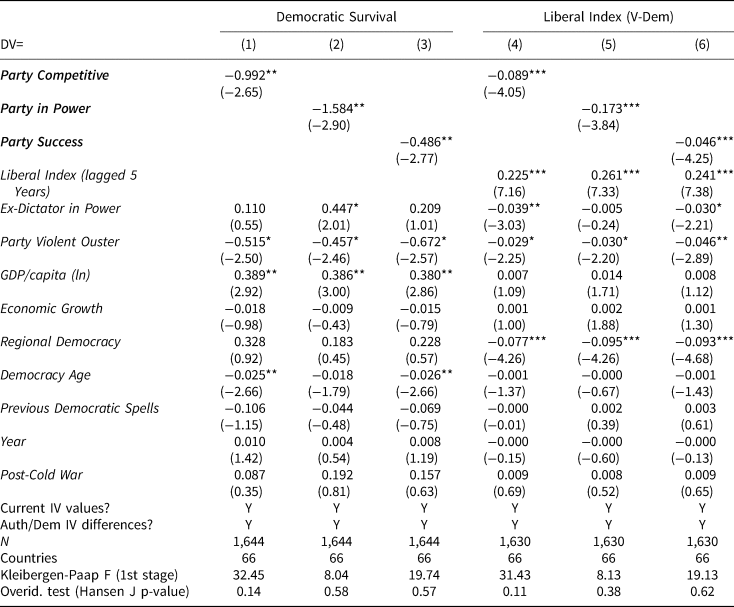
Table 5 shows the IV results predicting democratic survival and quality from autocratic party success. To account for endogeneity, I instrument for each success variable using averages of growth, freedom from repression, corruption and equal resources during the party's tenure, while also controlling for their contemporary values and average differences under autocracy and democracy. The results are even stronger if these controls are dropped. The F-tests for these instruments (shown at the bottom) indicate a strong prediction of each success variable, especially competitiveness. Further, overidentification tests (Hansen J) lend support for the exclusion restriction, since they calculate whether the instruments are correlated with the error term in the outcome equation. A non-significant test fails to reject the exclusion restriction. The first stages are shown in Appendix Table A6. To maximize coverage, all post-1940 democratic spells with a former autocratic ruling party are included, regardless of whether the party ruled in the immediately preceding autocracy. The results are unchanged if restricted to the Table 2 sample (Table A7).
IV models predicting democratic survival and liberalism

Note: the table displays instrumental variables models testing how autocratic ruling party success influences democratic survival (Models 1–3) and quality (Models 4–6). Bolded variables are instrumented. Years are 1940–2012. t statistics (from robust standard errors clustered by electoral period) are in parentheses. *p < 0.05, **p < 0.01, ***p < 0.001
The results are clear and striking. Autocratic success is strongly negative for democratic survival and quality. With all variables at their means, having a competitive former ruling party shifts the estimated likelihood of survival from 97.7 per cent to 93.0 per cent, making breakdown three times as likely. It also decreases the liberal index by about 9 per cent of its range, or about one-half a standard deviation within democracies. A party in power is even more dangerous for democracy, decreasing the liberal index by a full standard deviation. This sharply negative effect is perhaps surprising, given findings that experience with autocratic elections supports democratic survival (Miller Reference Miller2015) and that autocratic elites are reassured by party persistence (Riedl Reference Riedl2014; Ziblatt Reference Ziblatt2017). Combined, the results imply that the ideal is to have electoral experience but for the old ruling party to quickly fade away.Footnote 30 This further supports this article's continuity theory, in which autocratic ruling parties maintain the techniques of autocratic rule, often at the expense of democratic consolidation.Footnote 31
I also test the effect of having a former autocratic executive in power.Footnote 32 This is narrowly positive for survival in one model, but significantly negative for liberalism in two models.Footnote 33 Among the controls, a party ouster prior to democratization is negative for survival and liberalism, likely as a legacy of violence. This presents an interesting tension, as ousted parties are less likely to regain power and threaten democracy through that route. Wealthier countries are more stable, but have only marginally higher-quality democracies.
Conclusion
Autocratic ruling parties are often so entrenched that their successes within democracy shouldn't register as comebacks—they've been there for years. Yet there is significant variation in how well parties perform (and for how long). This article challenges the view that autocratic party success necessarily follows radical change. Rather, autocratic parties often possess significant advantages at the time of transition and win by preserving them. Thus success is predicted by the extent to which the party's autocratic legacy extends to democratic competition (including its policy experience, ethnic basis, organization and performance in office) and whether political rules disadvantage new parties and actors.
Former autocratic ruling parties are often the most significant political actors in young democracies and thus strongly shape democratic development. The potential for success encourages parties to democratize (Wright and Escribà-Folch Reference Wright and Escribà-Folch2012; Slater and Wong Reference Slater and Wong2013; Ziblatt Reference Ziblatt2017). Parties that accede to democratization then use their leverage to influence democratic design, influencing the party structure, policy and regime support. In turn, autocratic party success negatively impacts democratic survival and quality. Given the degree of continuity when autocratic parties hold onto power, scholars should rethink how much fundamental political change can be expected after many cases of democratization.
The strategic implications for pro-democratic oppositions within autocracy are complex: promising to later ban or restrict the ruling party can improve long-term democratic quality, but may reduce the initial chances for democratization. Domestic actors and international observers involved in transition processes should pay close attention to how institutional reforms may contribute to ruling parties’ continued dominance. The findings on external factors point to reforms that allow autocratic parties to compete, but not dominate – a compromise that may aid democracy's chances.
Autocratic parties have a wide-ranging influence on democracy that deserves further exploration. Future work can expand on how ruling parties erode democratic quality, providing insight into why some parties threaten democracy more than others. More work is also needed on how parties influence political reforms during transition. As nearly all modern democratic transitions come from electoral autocracies with dominant ruling parties, the question of how these parties shape democratic development will be a vital subject for some time.
Supplementary material
Data replication sets are available in Harvard Dataverse at: https://doi.org/10.7910/DVN/E3NJN8 and online appendices are available at https://doi.org/10.1017/S0007123419000012.
Acknowledgements
Thanks to Aleksandr Fisher for excellent research assistance. Thanks to David Szakonyi, Celeste Arrington, Arturas Rozenas, Abel Escribà-Folch, Anna Grzymala-Busse, audiences at MPSA 2016, APSA 2016, and Washington University at St. Louis, Editor Tobias Böhmelt and three anonymous referees for their helpful comments.