1. Introduction
Active stars, from young F- to K-type stars, as well as for M-dwarfs, exhibit flare rates and energies that can be orders of magnitude higher than those observed on the Sun (Kowalski Reference Kowalski2024). Given this intense activity, one might expect frequent and powerful coronal mass ejections (CMEs). However, stellar CMEs are rarely detected (Leitzinger and Odert Reference Leitzinger and Odert2022). This raises the question: is their apparent scarcity merely the result of observational limitations, or does it point to a deeper physical mechanism at play?
Another important open question concerns the potential impact of such energetic stellar CMEs on the habitability of exoplanets (Micela Reference Micela2018; Tilley et al. Reference Tilley, Segura, Meadows, Hawley and Davenport2019). Moreover, the occurrence of frequent CMEs in active stars, if assumed, leads to conflicting predictions with the expected lifetimes of these stars. Extrapolating the solar flare-CME relationship to the stellar regime suggests unrealistically high mass and energy losses, which would significantly shorten stellar lifetimes (Drake et al. Reference Drake, Cohen, Yashiro and Gopalswamy2013).
One proposed explanation is that strong overlying magnetic fields can suppress CMEs (Drake et al. 2016; Alvarado-Gómez et al. Reference Alvarado-Gómez, Drake, Cohen, Moschou and Garraffo2018). The challenge, however, lies in determining whether this suppression can be directly observed.
To investigate these issues, we turn to Sun-like stars, where high-resolution solar observations and magnetohydrodynamic simulations allow us to examine CME dynamics in detail (Sahade et al. Reference Sahade, Cécere, Sieyra, Krause, Cremades and Costa2022; Cécere et al. Reference Cécere, Wyper, Krause, Sahade and Rice2025). By understanding the physical conditions that lead to CME suppression in the solar context, we can gain valuable insight into similar processes in other magnetically active stars, where direct observations remain challenging.
The central question we address here is: Are there observational signatures, suggested by simulations, of CME suppression in Sun-like stars?
2. Overview
As we know, coronal mass ejections (CMEs) are the most energetic events in the Solar System. Predicting their trajectories is crucial for space weather, since the ejected particles can damage spacecraft instruments and trigger geomagnetic storms on planets. However, predicting whether an ejection will fail is equally important. A failed eruption can result from intrinsic properties of the magnetic structure itself, but also from the surrounding coronal environment. In particular, coronal structures containing closed magnetic field lines–such as pseudostreamers or helmet streamers–can form magnetic cages that inhibit the upward motion of the eruption.
In Cécere et al. (Reference Cécere, Wyper, Krause, Sahade and Rice2025), we show that null-point reconnection plays a fundamental role in the dynamics of magnetic flux ropes (MFRs). Depending on the initial configuration, null-point reconnection can either confine the eruption by disrupting the MFR, or assist its rise by reducing the strapping flux above it. We also identify a critical threshold in the relation between the overlying strapping flux and the MFR’s own magnetic flux (the
 $q_{\textrm{MFR/MC}}$
ratio). Specifically, if the strapping flux is less than two-thirds of the poloidal flux of the MFR, the rope can rise. Otherwise, if the background field is sufficiently strong, the CME source may fail to ascend. Still, depending on its initial position, some eruptions may succeed despite these constraints.
These results connect with earlier numerical studies of CMEs in M-dwarf stars, which indicate that failed eruptions can leave observable signatures. For instance, Alvarado-Gómez et al. (Reference Alvarado-Gómez, Drake, Moschou, Garraffo and Cohen2019) show that coronal compression caused by the falling CME source produces peaks in X-ray emission as well as in EUV bands (94 and 304 Å), while simultaneously generating dimming in 171 Å. Such findings suggest that emission diagnostics may provide indirect evidence of eruption failure.
Building on this, the next step is to investigate in detail the EUV synthetic emission signatures of both successful and failed CMEs in Sun-like stars. We will perform a series of MHD simulations with systematically varied initial conditions: changing the source position within the helmet streamer, the strength of the background magnetic field, and the mass and intrinsic magnetic field of the CME flux rope. These simulations will enable us to compare eruptive and failed cases under controlled conditions and to identify specific emission features that can be used as diagnostics. By synthesizing EUV emission from these scenarios, we aim to establish measurable signatures that connect numerical models with observations. Ultimately, this approach not only advances our understanding of the physical mechanisms behind CME failure but also provides predictive tools to support the interpretation of current and future solar observations.
3. Ongoing work
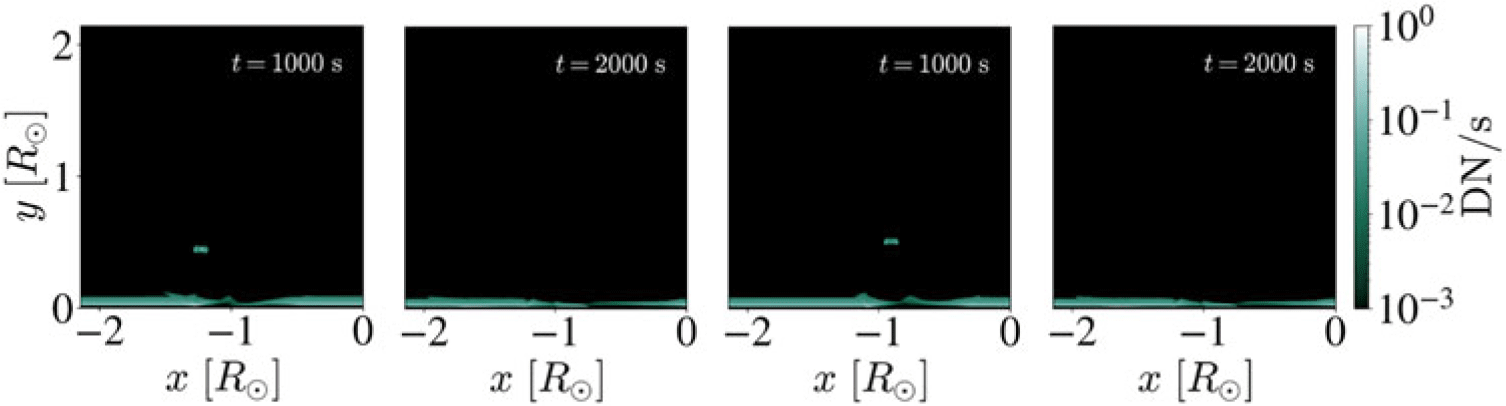
To investigate the EUV emission signatures in both failed and eruptive cases, we analyze the simulations presented in Cécere et al. (Reference Cécere, Wyper, Krause, Sahade and Rice2025), focusing in particular on cases 5 and 6. In these scenarios, case 5 fails due to magnetic erosion, while case 6 erupts successfully because its
 $q_{\textrm{MFR/MC}}$
coefficient exceeds the two-thirds threshold. When examining the EUV emission, however, we find that their temporal evolution is nearly indistinguishable (see Fig. 1 at 94 Å). Although both cases share the same background magnetic field, the failure arises from the larger magnetic cage encountered by the flux rope in case 5, determined by its initial position. This results in enhanced erosion that prevents the CME from escaping.
Synthetic emission at 94 Å for times 1000 and 2000 seconds. The first two panels show the evolution of case 6, and the last two correspond to case 5 of Cécere et al. (Reference Cécere, Wyper, Krause, Sahade and Rice2025).

This preliminary analysis suggests that it is not straightforward to discriminate between eruptive and failed events based solely on EUV emission when magnetic erosion is the determining factor. It also indicates that stronger background magnetic fields may intensify the magnetic cage, further increasing the likelihood of failure. These findings point to the need for a more comprehensive study, including simulations with higher magnetic field strengths as well as variations in the intrinsic properties of the MFR, such as its mass and internal magnetic field. Advancing along these lines will be essential for improving our understanding of CME dynamics and for developing more reliable diagnostic tools in the future.