INTRODUCTION
The Mediterranean mussel, Mytilus galloprovincialis Lamarck, 1819 has been accepted as an aggressive invasive species which is listed among the ‘World's worst 100 invasive alien species’ distributed worldwide (GISD, 2012). It has a rapid growth rate under a wide range of environmental conditions and its high level of tolerance to physiologically limiting factors allows it to colonize in marginal areas (Calvo-Ugarteburu & McQuaid, Reference Calvo–Ugarteburu and McQuaid1998). Its introduction, culture and transfer to different geographic areas increase the risks of spreading their parasites and diseases around the world (Francisco et al., Reference Francisco, Hermida and Santos2010). Diseases in molluscs caused by parasites have been documented worldwide and Mytilus galloprovincialis has been reported to be infected by several parasites, including the protozoan Nematopsis legeri and Peniculostoma mytili, the turbellarian Urastoma cyprinae, the polychaeta Polydora ciliata and the trematode Parvatrema duboisi (Machkevsky, Reference Machkevsky1989; Murina & Solonchenko, Reference Murina and Solonchenko1991; Bower et al., Reference Bower, McGladdery and Price1994; Robledo et al., Reference Robledo, Caceres-Martinez, Sluys and Figueras1994; Belofastova, Reference Belofastova1996, Reference Belofastova1997; Caceres-Martinez et al., Reference Caceres-Martinez, Vasques-Yeomans and Sluys1998; Comps & Tige, Reference Comps and Tige1999; Holodkovskaya, Reference Holodkovskaya and Minicheva2002; Francisco et al., Reference Francisco, Hermida and Santos2010; Machkevsky et al., Reference Machkevsky, Popov, Kovrigina, Lozovsky, Kozintsev and Ivanov2011; Özer & Güneydağ, Reference Özer and Güneydağ2014).
Urastoma cyprinae (Graff, 1882) is a pathogenic agent of serious damage on the gills of M. galloprovincialis (Robledo et al., Reference Robledo, Caceres-Martinez, Sluys and Figueras1994; Villalba et al., Reference Villalba, Carballal and Lopez1997). Bataller & Boghen (Reference Bataller and Boghen2000) reported that the visible presence of the worms on the gills, especially when occurring in the hundreds and even thousands, could cause a decrease in demand by the lucrative half-shell market. Urastoma cyprinae has a wide distribution area including the Black Sea, having been recorded in several bivalve species including M. galloprovincialis from both cultured and natural beds (Fleming et al., Reference Fleming, Burt and Bacon1981; Goggin & Cannon, Reference Goggin and Cannon1989; Noury-Srairi et al., Reference Noury-Srairi, Justine and Euzet1990; Murina & Solonchenko, Reference Murina and Solonchenko1991, Caceres-Martinez et al., Reference Caceres-Martinez, Vasques-Yeomans and Sluys1998; Özer & Güneydağ, Reference Özer and Güneydağ2014).
Polydora ciliata (Johnston, 1838) is an infective spionid polychaeta that excavates a U-shaped burrow lining with a tube composed of protein and sand grains. Kent (Reference Kent1979) reported that heavy infestations of P. ciliata caused lower fecundity in mussels due to the reduction in mantle tissues, the main repository of gametes, and reduced flesh content as a consequence of lowered condition index. Kent (Reference Kent1981) also reported that high levels of P. ciliata infestations tended to weaken the shells of Mytilus edulis, thus, weak-shelled mussels became more vulnerable to the predatory activities of the crab, Cancer pagurus. Polydora ciliata has been reported from several bivalve species including M. galloprovincialis in the Black Sea (Murina & Solonchenko, Reference Murina and Solonchenko1991; Machkevsky et al., Reference Machkevsky, Popov, Kovrigina, Lozovsky, Kozintsev and Ivanov2011; Özer & Güneydağ, Reference Özer and Güneydağ2014).
Gymnophallid trematodes are parasites of coastal birds and they use marine bivalve molluscs as first intermediate hosts and molluscs (bivalve or gastropod) or polychaetes as second intermediate hosts (Galaktionov, Reference Galaktionov2006). Parvatrema duboisi is a pathogenic agent causing compression and displacement in gonads (Machkevsky, Reference Machkevsky1989), formation of pearls and decrease in the reproductive potential of the mussels (Gaevskaya & Machkevsky, Reference Gaevskaya, Machkevsky, Skirnisson and Skorping1996). Parvatrema duboisi has been reported from M. galloprovincialis in the Black Sea (Machkevsky & Trinitko, Reference Machkevsky, Trinitko and Ivanov1985; Machkevsky, Reference Machkevsky1989; Gaevskaya & Machkevsky, Reference Gaevskaya and Machkevsky1995; Machkevsky et al., Reference Machkevsky, Popov, Kovrigina, Lozovsky, Kozintsev and Ivanov2011; Özer & Güneydağ, Reference Özer and Güneydağ2014).
Oocysts of several species of Nematopsis gregarines infect various tissues of many species of bivalve molluscs which are acting as intermediate host. Due to passive entrance of gymnospores into the intermediate host's tissues, no significant harm occurs in the host (Hatt, Reference Hatt1931; Kinne, Reference Lauckner and Kinne1983). Mytilus galloprovincialis acts as an intermediate host and Eriphia verricosa serves as a definitive host for Nematopsis legeri. This parasite has been reported from M. galloprovincialis in the Black Sea (Belofastova, Reference Belofastova1996, Reference Belofastova1997; Özer & Güneydağ, Reference Özer and Güneydağ2014).
The ciliate protozoan Peniculistoma mytili (Morgan, 1925) Jankowski, 1964 is strictly host specific to Mytilus edulis (Otto, 1983) and has been reported from the gills of M. galloprovincialis in the Black Sea coasts (Gaevskaya et al., Reference Gaevskaya, Gubanov, Machevsky, Naidenova, Colonchenko, Tkachuk, Holodkovskaya and Gaevskaya1990; Dumitrescu & Zaharia, Reference Dumitrescu and Zaharia1993; Özer & Güneydağ, Reference Özer and Güneydağ2014).
Studies on parasites and diseases affecting molluscs with economic interest are important both for the management of natural stocks and for aquaculture (Boehs et al., Reference Boehs, Villalba, Oliveira Ceuta and Rocha Luz2010). Considering the potential impact of the above-mentioned parasites on the shellfish industry, more studies are needed to achieve a better understanding of host–parasite interactions and their ecology. Parasites of M. galloprovincialis in the Sinop coast of the Black Sea have been reported by Özer & Güneydağ (Reference Özer and Güneydağ2014) and the objective of this study was to determine the distribution of parasite species in time and space by calculating their infection indices between seasons and length classes of mussels at three localities in Sinop, Turkey. This is the first research study on the simultaneously occurring parasites mentioned above and their infection indices in M. galloprovincialis.
MATERIALS AND METHODS
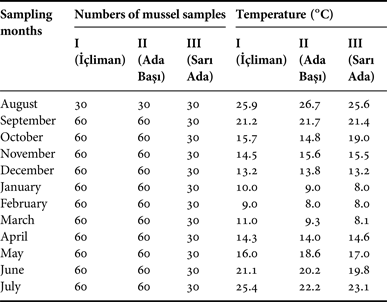
Mussel samples were collected monthly in the period between August 2012 and July 2013 at three sampling localities representing three ecologically different environments at the Sinop coasts of the Black Sea (Figure 1). Of the three sampling localities, Sampling locality I: İçliman (42°00′56″N, 35°10′37″E) is located at the inner harbour of Sinop and mussel samples were collected from a dock leg of the landing stage which has maximum depth of 14 m. This location is disturbed mainly by fishing boats during the process of landing captured fish, especially in the period between autumn and spring. Sampling locality II: Ada Başı (42°01′05″N, 35°12′42″E) is located at the extreme north of Sinop and is a natural ecosystem with rocky floor, which is not affected by any kind of human activity, with maximum depth being 20 m. Sampling locality III: Sarı Ada (42°02′51″N, 35°02′56″E) is located at the outer harbour of Sinop with maximum depth of 3 m and is a shallow area with rocky floor, which is from time to time affected by small-scale fishing boats, human waste discharges and a small stream. At least 30 mussel samples were collected by scuba divers from each sampling locality. Water temperature (°C) values (Table 1) were measured monthly using a digital YSI Professional Plus water quality instrument. Seasons were distinguished according to calendar months and monthly data obtained from both parasite and mussel hosts were pooled, calculated and presented seasonally.
Map of sampling locations around the Sinop coasts of the Black Sea. *indicates the border of sampling localities II and III, #indicates exact location of sampling locality I.

Monthly mussel samples and temperature (°C) values at each sampling locality at the Sinop coasts of the Black Sea.
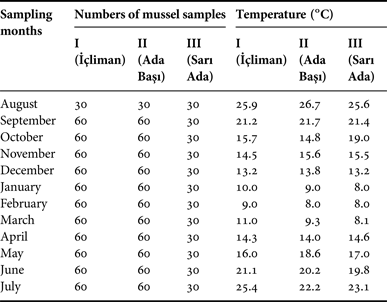
A total of 1740 mussels constituted from monthly samples (Table 1) were examined for parasites. The specimens in the samples were measured in their longest axis using a vernier caliper to the nearest 0.1 mm, allocated to three length classes of ≤4.5, 4.6–5.9 and ≥6.0 cm, weighed, placed in a Petri dish, and then opened. Each organ was then cut into small pieces, placed on slides separately and fresh smears were prepared from all pieces of each organ. Parasites were determined by screening all smears prepared from each organ of mussels using a light microscope at 400× magnification and full parasite count was conducted one by one to obtain the exact number rather than an average estimate. Their infection prevalence (the percentage of infected mussels), mean intensity (the average number of parasites in the total number of infected mussels) and mean abundance (the average number of parasites in the total number of examined mussels) were calculated in accordance with Bush et al. (Reference Bush, Lafferty, Lotz and Shostak1997). Parasites were identified to species level using the keys provided by Raabe (Reference Raabe1971), Gaevskaya et al. (Reference Gaevskaya, Gubanov, Machevsky, Naidenova, Colonchenko, Tkachuk, Holodkovskaya and Gaevskaya1990), Crespo-Gonzalez et al. (Reference Crespo-Gonzalez, Reza-Alvarez, Rodriguez-Dominguez, Soto Bua, Iglesias, Arias-Fernandez and Garcia-Estevez2005), Gaevskaya (Reference Gaevskaya2006), Chung et al. (Reference Chung, Lee, Sohn, Park, Chai and Seo2010) and Francisco et al. (Reference Francisco, Hermida and Santos2010).
Quantitative Parasitology 3.0 software (Reiczigel & Rózsa, Reference Reiczigel and Rózsa2005) was used to calculate Sterne's exact 95% confidence limits for prevalence, bootstrap 95% confidence limits (number of bootstrap replications = 2.000) for mean abundance and mean intensity. The differences in prevalence values between sampling seasons, sampling localities and length categories of mussels were determined by Fisher's exact test. A Kruskal–Wallis test (non-parametric ANOVA) was performed to find out the significant differences in the mean intensity and mean abundance values of each parasite species at different sampling seasons, sampling localities and length classes of mussels at the significance level of 5% using the statistical program GraphPad InStat 3.00.
RESULTS
A total of five parasite species were identified and their infection prevalence, mean intensity and mean abundance values are presented in Table 2.
Parasite species identified in Mytilus galloprovincialis and their overall infection indices (N = 1740), CI – 95% confidence intervals based on Stern's exact score limit, Mean I – mean intensity and Mean A – mean abundance with bootstrap 95% CI (Mean I, A).
Overall infection prevalence (%) and abundance values of mussel parasites
The overall infection prevalence, mean intensity and mean abundance values were 45.30% (exact 95% confidence limits 42.9–47.6), 166.04 (bootstrap 95% confidence limits 141.9–199.4) and 75.20 (bootstrap 95% confidence limits 64.9–91.4), respectively. Nematopsis legeri was the most prevalent parasite species and it was followed by Peniculistoma mytili, Urastoma cyprinae, Parvatrema duboisi and Polydora ciliata (Table 2). Nematopsis legeri was also the most abundant parasite while Polydora ciliata was the least abundant among all parasite species (Table 2).
The distribution of mussel parasites with respect to season
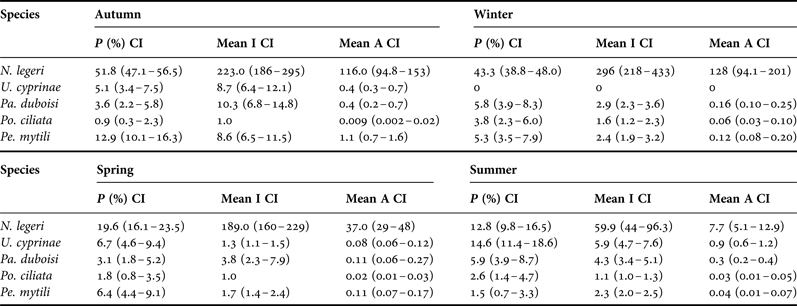
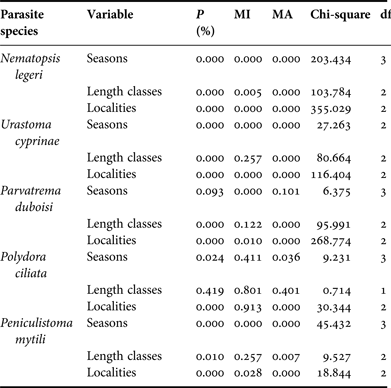
Seasonal prevalence, mean intensity and mean abundance values of all parasite species infecting M. galloprovincialis are presented in Table 3. Statistically significant differences in infection indices between seasons in all parasite species are presented in Table 4. Nematopsis legeri and Pe. mytili had their highest prevalence values in autumn while U. cyprinae and Pa. duboisi in summer and Po. ciliata in winter (Table 3). Comparison of seasonal differences in prevalence by sampling seasons are presented in Table 4; while there is a statistically significant difference in prevalence between seasons in N. legeri, U. cyprinae, Po. ciliata and Pe. mytili (Fisher's exact test, P = 0.000), there is no significant difference between seasons in Pa. duboisi (Fisher's exact test, P = 0.093) (Table 4). It must be mentioned that U. cyprinae was not detected in winter samples. The mean intensities of N. legeri in winter, U. cyprinae, Pa. duboisi and Pe. mytili in autumn, and Po. ciliata in winter were at their maximum values (Table 3). Comparison of seasonal differences in mean intensity by sampling seasons are presented in Table 3; while there are statistically significant differences in the mean intensity values between seasons in N. legeri, U. cyprinae, Pa. duboisi and Pe. mytili (non-parametric Kruskal–Wallis test, P = 0.000), there is no significant difference between seasons in Po. ciliata (non-parametric Kruskal–Wallis test, P = 0.411) (Table 4). The mean abundance of N. legeri in winter, Pa. duboisi and Pe. mytili in autumn, Po. ciliata in winter and U. cyprinae in summer were at their maximum values (Table 2). Comparison of seasonal differences in mean abundance by sampling seasons are presented in Table 3; while there are statistically significant differences in the mean abundance values between seasons in N. legeri, U. cyprinae, Po. ciliata and Pe. mytili (non-parametric Kruskal–Wallis test, P = 0.000), there is no significant difference between seasons in Pa. duboisi (non-parametric Kruskal–Wallis test, P = 0.101) (Table 3).
Parasite species identified in Mytilus galloprovincialis and their infection indices according to seasons, CI – 95% confidence intervals based on Stern's exact score limit, Mean I – mean intensity and Mean A – mean abundance with bootstrap 95% CI.
Comparative differences in prevalence (%), mean intensity (MI) and mean abundance (MA) of parasite species in mussel samples relative to season, mussel size and sampling localities, the significance of the test <0.05, df = degree of freedom.
The distribution of mussel parasites with respect to sampling localities
Table 5 shows the prevalence (%), mean intensity and mean abundance of parasites according to sampling localities and all parasite species were determined at all sampling sites at least once. Statistically significant differences in infection indices between seasons in all parasite species are presented in Table 4. Nematopsis legeri and Pa. duboisi occurred with their highest prevalence values in sampling locality III; U. cyprinae and Po. ciliata occurred in sampling locality II and Pe. mytili occurred in sampling locality I (Table 5). Comparison of seasonal differences in prevalence by sampling seasons are presented in Table 4 and statistically significant differences in prevalence between sampling localities were determined in all parasite species (Fisher's exact test, P = 0.000) (Table 4). The mean intensities of N. legeri and Pa. duboisi in sampling locality III, U. cyprinae and Pe. mytili in sampling locality I and Po. ciliata in sampling locality II were at their maximum values (Table 5). Comparison of seasonal differences in mean intensity by sampling seasons are presented in Table 4; while there are statistically significant differences in the mean intensity values between sampling localities in N. legeri, U. cyprinae, Pa. duboisi and Pe. mytili (non-parametric Kruskal–Wallis test, P < 0.05), there is no significant difference between sampling localities in Po. ciliata (non-parametric Kruskal–Wallis test, P = 0.913) (Table 4). The mean abundances of N. legeri and Pa. duboisi in sampling locality III, U. cyprinae and Po. ciliata in sampling locality II and Pe. mytili in sampling locality I were at their maximum values (Table 5). Comparison of seasonal differences in the mean abundance values by sampling localities are presented in Table 4 and statistically significant differences between sampling localities were determined in all parasite species (non-parametric Kruskal–Wallis test, P < 0.05) (Table 4).
Parasite species identified in Mytilus galloprovincialis and their infection indices according to sampling locality, CI – 95% confidence intervals based on Stern's exact score limit, Mean I – mean intensity and Mean A – mean abundance with bootstrap 95% CI.
The distribution of parasites with respect to the length classes of the host mussels
Prevalence (%), mean intensity and mean abundance of infection in three length classes of mussels ranging between 2.2 and 8.4 cm were calculated (Table 6). Statistically significant differences in infection indices between length classes in all parasite species are presented in Table 4. Within the three different mussel length classes studied (Table 6), there was a clear decrease in the infection prevalence of N. legeri and Pa. duboisi as the mussel length enlarged. However, the situation was the opposite for U. cyprinae, Pe. mytili and Po. ciliata as the infection prevalence increased when the length classes enlarged. While there are statistically significant differences in the prevalence values between length classes in N. legeri, U. cyprinae, Pa. duboisi and Pe. mytili (Fisher's exact test, P = 0.000), there is no significant difference between length classes in Po. ciliata (Fisher's exact test, P = 0.419) (Table 4).
Parasite species identified in Mytilus galloprovincialis and their infection indices according to host length classes, CI – 95% confidence intervals based on Stern's exact score limit, Mean I – Mean Intensity and Mean A – Mean Abundance with bootstrap 95% CI (Mean I, A).
Similar to prevalence, the mean intensity values of all parasite species, except Po. ciliata, increased when length classes of mussels were larger (Table 6). Comparison of differences in mean intensity by length classes of mussel are presented in Table 4; while there is a statistically significant difference in the mean intensity values between mussel length classes only in N. legeri (non-parametric Kruskal–Wallis test, P = 0.005), there is no significant difference between mussel length classes in U. cyprinae, Pa. duboisi, Pe. mytili and Po. ciliata (non-parametric Kruskal–Wallis test, P > 0.05) (Table 4). It must be mentioned that Po. ciliata was not determined in the smallest length class of mussel samples.
DISCUSSION
The turbellarian U. cyprinae has been reported from the gills of M. galloprovincialis in the Black Sea (Murina & Solonchenko, Reference Murina and Solonchenko1991), on the French Mediterranean coast (Noury-Srairi et al., Reference Noury-Srairi, Justine and Euzet1990; Robledo et al., Reference Robledo, Caceres-Martinez, Sluys and Figueras1994), on the Galician region, NW Spain (Robledo et al., Reference Robledo, Caceres-Martinez, Sluys and Figueras1994), on the Pacific coasts of North America (Caceres-Martinez et al., Reference Caceres-Martinez, Vasques-Yeomans and Sluys1998) and in the Adriatic Sea (Westbald, Reference Westblad1955; Mladineo et al., Reference Mladineo, Petric, Hrabar, Bocina and Peharda2012). Caceres-Martinez et al. (Reference Caceres-Martinez, Vasques-Yeomans and Sluys1998) reported infestation prevalence ranges from 10 to 87% and a mean number of 1.9 per infested M. galloprovincialis in the Pacific coasts of North America. They also indicated that larger sized mussels had more parasites, winter was more usual for infestation and prevalence values were different at their sampling localities. Several authors also reported that this parasite preferred colder seasons and larger host sizes (Murina & Solonchenko, Reference Murina and Solonchenko1991; Robledo et al., Reference Robledo, Caceres-Martinez, Sluys and Figueras1994; Canestri-Trotti & Baccarani, Reference Canestri-Trotti and Baccarani2001; Rayyan et al., Reference Rayyan, Photis and Chintiroglou2004; Crespo-Gonzalez et al., Reference Crespo-Gonzalez, Rodriguez-Dominguez, Segade, Iglesias, Arias and Garcia-Estevez2010). On the other hand, a marked seasonal pattern with the highest level of infestation during summer and autumn were also reported (Fleming et al., Reference Fleming, Burt and Bacon1981; Fleming, Reference Fleming1986; Plourde et al., Reference Plourde, Boghen and Allard1991; McGladdery et al., Reference McGladdery, Boghen and Allard1992; Crespo-Gonzalez et al., Reference Crespo-Gonzalez, Rodriguez-Dominguez, Segade, Iglesias, Arias and Garcia-Estevez2010). In the present study, Urastoma cyprinae showed a seasonal trend such as being completely absent in winter; it was more prevalent in rocky substratum areas, was more abundant in the sampling site which was disturbed by fishing boats’ landing activities, and more prevalent in the largest length class of mussel. Currently available data on the seasonality are contradictory, as seen above, making it difficult to draw conclusions on a general seasonal behaviour. However, the determined differences in U. cyprinae infestations among seasons might have possibly resulted from the availability of more food for feeding activities, the availability of hosts and temperature related reproduction activities of U. cyprinae which occur in the external environment. On the other hand, there is a clear agreement between our results and above-mentioned authors about larger sized mussels having more parasites since there is a larger space on which this worm can feed itself. Detected differences in the present study on the parasite load at different sampling areas were also reported by Murina & Solonchenko (Reference Murina and Solonchenko1991) as a result of the differences in the nature of substratum or distance to the bottom at the sampling areas. Caceres-Martinez et al. (Reference Caceres-Martinez, Vasques-Yeomans and Sluys1998) explained this situation by the effects of the tide activities; they stated that during low tides, mussels close their valves which affects the presence of U. cyprinae. On the other hand, its existence at different environments reflects its wide distributional ability.
The gregarine Nematopsis legeri has been reported from the gills of M. galloprovincialis in the Black Sea (Özer & Güneydağ, Reference Özer and Güneydağ2014) and Belofastova (Reference Belofastova1997) reported it to be one of the most spreading parasites of the Black Sea molluscs with infection prevalence ranging from 30 to 100% at natural and artificial M. galloprovincialis beds, contrary to the prevalence of 10–20% in the same host at the Romanian coast of the Black Sea (Dumitrescu & Zaharia, Reference Dumitrescu and Zaharia1993). Francisco et al. (Reference Francisco, Hermida and Santos2010) reported Nematopsis sp. infections in M. galloprovincialis populations from the Aveiro Estuary in Portugal with clear seasonal peak prevalence in summer and autumn (100%) and sharp decreases in winter and spring (15–17%) and mean abundance ranging between 1.1–120.2. Some authors also reported more than 59% infection indices of Nematopsis spp., in Perna canaliculus in New Zealand (Jones, Reference Jones1975), low level infections in summer in Arcuatula arcuatula, Anadara granosa, Perna viridis and Paphia undulate in the Gulf of Tayland (Tuntiwaranuruk et al., Reference Tuntiwaranuruk, Chalermwat, Upatham, Kruatrachue and Azevedo2004) and in Callista chione in the North-Western Adriatic Sea (Canestri-Trotti et al., Reference Canestri–Trotti, Baccarani, Paesanti and Turolla2000). Tuntiwaranuruk et al. (Reference Tuntiwaranuruk, Chalermwat, Upatham, Kruatrachue and Azevedo2004) and Francisco et al. (Reference Francisco, Hermida and Santos2010) reported that infections were related to the habitat type; heavy infections occurred in species living in a muddy substratum or they occurred in association with the presence of fouling organisms. Tuntiwaranuruk et al. (Reference Tuntiwaranuruk, Chalermwat, Upatham, Kruatrachue and Azevedo2004) and Francisco et al. (Reference Francisco, Hermida and Santos2010) concluded that the high levels of infections resulted from a close association of hosts with the presence of such fouling organisms. The prevalence of N. legeri infection obtained in the present study falls in the range of the above reports on Nematopsis spp. despite the differences in geographic locations and host species and reflects its wide range of infectious potential, which may result from the presence of fouling organisms, as was reported by the above-mentioned authors. In the present study, statistically significant differences among seasons and localities in the occurrence of N. legeri obviously indicate that this species has the ability to complete its life cycle in a host that is available all-year round and at all the sampling localities. Bilgin & Çelik (Reference Bilgin and Çelik2004) reported that the crab Eriphia verricosa, the final host for this parasite, was common in the Sinop coasts of the Black Sea, and this study found that there was a high level of infection at sampling locality III.
The gymnophallid trematode Parvatrema duboisi has so far been reported from M. galloprovincialis in the Black Sea (Özer & Güneydağ, Reference Özer and Güneydağ2014). In the present study, this parasite occurred more in the smallest length class of mussels, at the sampling locality III and in autumn, despite occurring all year-round. Machkevsky (Reference Machkevsky1989) and Machkevsky et al. (Reference Machkevsky, Popov, Kovrigina, Lozovsky, Kozintsev and Ivanov2011) reported very high prevalence up to 100% and intensity values of up to 3000 individuals of Pa. duboisi in M. galloprovincialis in the Sevastopol coast of the Black Sea. The former author also reported five times higher numbers of metacercariae in winter (900 mtc) than in summer (200 mtc) and an increase in the number of metacercariae with increasing size of mussels and concluded that this seasonal pattern was related to the presence of large numbers of birds arriving to Sevastopol for wintering. Machkevsky & Trinitko (Reference Machkevsky, Trinitko and Ivanov1985) reported a sharp increase in the prevalence of metacercariae of Pa. duboisi in mussels in an inshore zone polluted by sewage. Gaevskaya & Machkevsky (Reference Gaevskaya and Machkevsky1995) explained this increase with the presence of high numbers of sea birds, the definitive host for Pa. duboisi, present in the vicinity due to the availability of highly abundant food. They also claimed that the weakened physiological condition and concomitant decrease in resistance of the mussels played a role in this increase. Our data had some contradictions to those findings of Machkevsky (Reference Machkevsky1989) that Pa. duboisi was more prevalent in the smallest length class, in summer and autumn seasons. On the other hand, our data were in agreement with Machkevsky & Trinitko (Reference Machkevsky, Trinitko and Ivanov1985) in terms of higher infections occurring in an inshore zone, the sampling locality III, the location polluted by sewage from time to time. All-year round occurrence of Pa. duboisi in mussels could result from the presence of marine birds at the vicinity of all of our sampling localities. The life cycle of Pa. duboisi has not been revealed yet and the present study provides valuable data to focus on the sampling locality III which is one of the main nests for primary marine bird hosts in the Sinop coasts.
The spionid polychaeta Po. ciliata has been reported from M. galloprovincialis in the Black Sea (Özer & Güneydağ, Reference Özer and Güneydağ2014). Machkevsky et al. (Reference Machkevsky, Popov, Kovrigina, Lozovsky, Kozintsev and Ivanov2011) determined very low infection prevalence (7%) and intensity (1 individual) in the Sevastopol coast of the Black Sea. Murina & Solonchenko (Reference Murina and Solonchenko1991) reported that young spionids occurred in M. galloprovincialis with a shell length of 35 mm and maximum intensity was determined in intermediate sized mussels. They concluded that this was due to the fouling of the oldest molluscs by other invertebrates and by algae which prevented the settlement of Po. ciliata larvae on mussels. According to Daro & Polk (Reference Daro and Polk1973), this parasite occurs at inshore areas and has the ability of dispersion as planktonic larvae. Moreover, due to a relatively short duration of this planktonic phase before settlement, the probability of larvae dispersal to mussels in offshore areas was limited and thus, infection potential of offshore mussels was greatly impaired and overall burden was substantially reduced (Buck et al., Reference Buck, Thieltges, Walter, Nehls and Rosenthal2005). In the present study, its overall infection value was very low and in winter, sampling locality II and middle sized mussels had the highest infection values and the data obtained here were in agreement with the above-mentioned authors.
The protozoan ciliate Pe. mytili has been reported from M. galloprovincialis in the Black Sea (Dumitrescu & Zaharia, Reference Dumitrescu and Zaharia1993; Dumitrescu & Telembici, Reference Dumitrescu and Telembici1996; Gaevskaya, Reference Gaevskaya2006; Özer & Güneydağ, Reference Özer and Güneydağ2014), however it was reported to be strictly host specific to M. edulis (Lauckner, Reference Lauckner and Kinne1983). In the present study, it occurred more on larger sized mussels, sampling locality I and in autumn with all year-round occurrence. Gaevskaya (Reference Gaevskaya2006) reported high infestation prevalence ranging between 76–100% in northern seas of Europe with increased infestations as the size of mussel increases. Dumitrescu & Zaharia (Reference Dumitrescu and Zaharia1993) and Dumitrescu & Telembici (Reference Dumitrescu and Telembici1996) reported temperature-dependent high infestation prevalence values and our results are partially in agreement with the results of the above-mentioned authors due to the differences in sampling areas and durations along with coastal characteristics.
In conclusion, the present study yielded five parasite species in the Mediterranean mussel M. galloprovincialis collected from the northern part of the Black Sea for the first time. Details on how identified parasite species interacted with season, the size of mussel and different localities with different ecological peculiarities were also determined and presented. Thus, this study provided new as well as up-to-date data on the parasite–host–environment interactions for M. galloprovincialis.
ACKNOWLEDGEMENTS
The comments provided by the anonymous reviewers are gratefully acknowledged. Authors also thank the Sinop University Academic Writing Center for their editing on the text.
FINANCIAL SUPPORT
This study (Project Number 112O337) was supported financially by the Scientific and Technological Research Council of Turkey (TUBİTAK). The authors are grateful for this valuable support.