Implications
A majority of health problems in the dairy cow occur around parturition and relate to cows having difficulty adapting to the nutrient needs for lactation. This review discusses the complex relationships between metabolic status and immune function and how these complex interactions increase the risk of disease. Focus will be placed on the major energetic fuels currently known to be used by immune cells and how certain metabolic states, such as degree of negative energy balance (NEB) and risk of physiological imbalance, contribute to immunosuppression around parturition. Finally, we will address some issues on disease prevention through nutrition.
Introduction
Changes occur continuously in the dairy industry. For decades animals have been selected for high milk yield to increase competitiveness. Over the last 20 years the average milk yield in, for example, Danish cows has increased from an average of 6693 kg/cow per year in 1989 to 8983 kg/cow per year in 2009, which is equivalent to a yearly increase of 1.5% and a 50% increase within 27 years. However, the average milk yield reflects a large variation between cows and the world record cow ‘Lucy’, which in 1998 produced more than 34 000 kg milk in 365 days, shows that the potential of the dairy cow is large.
Coupled with increases in production per cow over the past few decades, there has been a major structural development in the dairy industry in Denmark. Although the total milk production nationally has been relatively constant during the last 20 years, the number of farms and average herd size have changed considerably because of the European Union quota system. During the 20-year span from 1989 to 2009, the number of dairy cows has decreased from 769 000 to 563 000. However, the number of dairy farms has changed even more markedly from 21 500 to 4300 resulting in a change in average herd size from 36 in 1989 to 131 in 2009. This means that the farmer in 2009 had 3.7 times as many cows to observe compared with 1989.
The large increase in milk yield and the structural changes in the dairy industry have caused major changes in the housing, feeding and management of the dairy cow. The quality of roughage has been improved markedly, the proportion of concentrates has been increased and the diet composition has been balanced to accommodate the needs of the average modern dairy cow. However, while large improvements have occurred in production and efficiency, the recorded veterinary disease incidence rates from 1991 (Andersen, Reference Andersen1991) to 2001 (Trinderup et al., Reference Trinderup, Kjeldsen and Andersen2001) have not been improved (Krogh and Tinderup, Reference Krogh and Tinderup2008).
In earlier reviews, it has been argued that physiological imbalance (PI) and decreased immune competence are key risk factors for disease rather than milk yield per se (Ingvartsen et al., Reference Ingvartsen, Dewhurst and Friggens2003; Kehrli et al., Reference Kehrli, Neill, Burvenich, Goff, Lippolis and Nonnecke2006). A number of excellent earlier reviews have covered critical periods such as the transition period in the cow and its influence on health and immune function (Mulligan and Doherty, Reference Mulligan and Doherty2008), the interplay between the endocrine system and the immune system (Ingvartsen and Boisclair, Reference Ingvartsen and Boisclair2001; Vangroenweghe et al., Reference Vangroenweghe, Lamote and Burvenich2005), nutrition and immune function (Kehrli et al., Reference Kehrli, Neill, Burvenich, Goff, Lippolis and Nonnecke2006) and PI and prevention of diseases in the periparturient cow (Ingvartsen, Reference Ingvartsen2006). The scope of this review is to improve the prevention of diseases and the welfare of herbivores using the dairy cow as the main example through insight in the PI during the transition period, nutrition and immune function and perspectives for prevention of diseases.
The periparturient phenomenon – a brief overview
The modern dairy cow is kept and selected for the purpose of producing milk and offspring and is consequently managed to secure a mammary tissue matrix capable of delivering a large milk output. This management involves, for example, drying off dairy cows before calving and thus decisions on dry period length, reduction in feeding, cessation of milking and feeding in the dry period that may impact production, reproduction and health (Sorensen and Enevoldsen, Reference Sorensen and Enevoldsen1991; Enevoldsen and Sorensen, Reference Enevoldsen and Sorensen1992; Friggens et al., Reference Friggens, Andersen, Larsen, Aaes and Dewhurst2004a; Pezeshki et al., Reference Pezeshki, Capuco, De Spiegeleer, Peelman, Stevens, Collier and Burvenich2010). In a recent detailed review, potential effects of the management of dry period length on mammary biology and defence were studied, which emphasized a need to integrate mammary gland biology and defence mechanisms in studies dealing with modified dry period lengths in order to potentially improve disease resistance and animal welfare (Pezeshki et al., Reference Pezeshki, Capuco, De Spiegeleer, Peelman, Stevens, Collier and Burvenich2010).
The periparturient period (the last 1 to 2 months of gestation and the first few months after delivery) and particularly the transition period (3 weeks before to 3 weeks after parturition) of dairy cattle are characterized by dramatic changes in metabolism and host defence mechanisms that are associated with an increased risk of disease. Particularly, the transition period is a most challenging period for most mammals that may threaten both health and welfare if the challenges exceed the coping mechanisms of the animal. Both periods are associated with an elevated incidence of metabolic and other non-infectious and infectious diseases such as fatty liver, milk fever, retained placenta, metritis, ketosis, left-displaced abomasum, lameness and clinical mastitis (Kelton et al., Reference Kelton, Lissemore and Martin1998; Ingvartsen et al., Reference Ingvartsen, Dewhurst and Friggens2003; Ingvartsen, Reference Ingvartsen2006). Mammals in early lactation mobilize large amounts of nutrient reserves, particularly lipid from adipose tissue, in support of lactation. Mobilization of lipid is a normal physiological adaptation in mammals to critical physiological states such as in the periparturient period; however, excessive mobilization has been linked to an increased risk of diseases (Vernon, Reference Vernon2005; Contreras and Sordillo, Reference Contreras and Sordillo2011).
On the basis of a review of 11 epidemiological and 14 genetic studies, Ingvartsen et al. (Reference Ingvartsen, Dewhurst and Friggens2003) found little evidence that high yielding cows have an increased risk of dystocia, retained placenta, metritis, periparturient paresis and left-displaced abomasum. Although they found no phenotypical relationship between milk yield and the risk of ketosis and lameness, the selection for higher milk yields will probably increase the incidence risk for these diseases during lactation. Mastitis was the only disease showing a clear relationship between milk yield and risk of infection. Ingvartsen et al. (Reference Ingvartsen, Dewhurst and Friggens2003) suggested that the high acceleration in milk yield may potentially cause physiological stress and subsequent health problems. Later studies indeed show that milk yield acceleration was highest around calving and also reflected that cows with high milk yield acceleration tended to experience higher levels of stress/risk. Also, it was concluded that acceleration in milk yield could be considered an indicator of risk of health and reproductive problems (Hansen et al., Reference Hansen, Friggens and Hojsgaard2006).
The nutrient demand increases quite dramatically during late pregnancy and particularly in early lactation. In late pregnancy, the nutrient demand increases as a result of fetal development (Bell et al., Reference Bell, Slepetis and Ehrhardt1995), which specifically increases glucose and amino acids (Bell et al., Reference Bell, Slepetis and Ehrhardt1995; Bell and Ehrhardt, Reference Bell and Ehrhardt2000). The substantial milk yield acceleration, seen particularly in the last week prepartum and in the first 2 weeks of lactation, reflects the dramatic increase in nutrient demand at the onset of lactation. A cow with a milk yield of 50 kg secretes ∼2 kg of milk fat daily, 1.6 kg of milk protein, 2.5 kg of lactose, 65 g of Ca, 50 g of P and 8 g of Mg, all of which increase the demand for energy, protein and minerals. The nutrient requirement in late pregnancy, and particularly the nutrient demand for lactation, calls for a coordination of the physiological processes in different tissues resulting in metabolic changes that try to ensure that cows reach their maximum genetic potential for milk yield.
Consequently, this review will address the metabolic adaptions of periparturient animals with a specific focus on the changes in the concentration of nutrients/metabolites considered to be relevant for the immune function. We believe that these metabolic adaptations play a key role with regard to immune function and will discuss how immune competence and risk of disease can be improved through nutrition and management.
PI – the common currency reducing immune function and health
An inadequately coordinated regulation and thereby the adaptation to changed physiological states will lead to PI – a situation where the homeorhetic and homeostatic mechanisms are insufficient for the animal to function optimally. PI in cows has been defined as cows whose parameters deviate from the normal and who consequently have an increased risk of developing production diseases (clinical or subclinical) and reduced production and/or reproduction (Ingvartsen, Reference Ingvartsen2006). A prominent example of PI would be the excessive mobilization, for example, due to over conditioning or malnutrition, in some cases for extended periods in early lactation. In the case of excessive mobilization, the rates of lipogenesis are very low, whereas lipolysis is very high, resulting in high plasma concentrations of non-esterified fatty acids (NEFA) and glycerol. Interlinked with this increased NEFA is a reduced dry matter intake (Ingvartsen and Andersen, Reference Ingvartsen and Andersen2000; Allen et al., Reference Allen, Bradford and Oba2009) and consequently a low plasma concentration of glucose and an increased ketogenesis and thereby increased levels of ketone bodies (Drackley et al., Reference Drackley, Donkin and Reynolds2006; Ingvartsen, Reference Ingvartsen2006). The metabolic changes linked to excessive mobilization can also be secondary to diseases, for example displaced abomasum and stress and pain due to lameness (Ingvartsen, Reference Ingvartsen2006). The above example also illustrates that, generally, more metabolic parameters are affected in the case of excessive mobilization or disease, stress or pain. Consequently, it is probably relevant to consider PI as an index on the basis of several metabolic parameters, for example NEFA, glucose and ketone bodies, that is, beta-hydroxybutyrate (BHBA). In the following, the focus will be on the effect of nutrition and different metabolic parameters on the immune system.
General aspects of the immune response
The immune system, or host defence system, consists of a variety of cells and molecules that are capable of specifically (specific immunity) or non-specifically (innate immunity) recognizing and eliminating invading foreign microorganisms. The innate, or non-specific, immunity is rapidly activated and serves as the primary immune defence in the initial stages of an infection. The innate immunity is provided by phagocytes, such as polymorphonuclear neutrophils (PMN) and resident macrophages, as well as mammary epithelial cells. Macrophages (1) detect and recognize non-specific foreign pathogens; (2) produce cytokines, that is, interleukin (IL)-1β, IL-6 and tumour necrosis factor-α (TNF-α) that initiate the innate and specific immune responses as well as recruit PMN to the site of infection; (3) phagocytose and kill invading pathogens; and (4) are the bridge between the innate and specific immune responses through antigen presentation, that is, the major histocompatibility complex (MHC) class II, to prime T cells (Rainard and Riollet, Reference Rainard and Riollet2006). After initiation of the inflammatory response, PMN become the predominant cell type observed during an infection. PMN migrate from the blood to the location of the invading organism by a process called chemotaxis (Suriyasathaporn et al., Reference Suriyasathaporn, Daemen, Noordhuizen-Stassen, Dieleman, Nielen and Schukken1999). Once at the site of infection, PMN and resident macrophages phagocytose, that is, engulf, and kill invading microorganisms (Paape et al., Reference Paape, Guidry, Jain and Miller1991). Once a microorganism is engulfed, a burst of oxidative metabolism called a respiratory burst occurs in activated phagocytes via the activation of a membrane-associated nicotinamide-adenine-dinucleotide-phosphate (NADPH) linked oxidase that catalyses the reduction of oxygen to superoxide anion, a reactive oxygen metabolite that is extremely toxic to ingested bacteria. After the respiratory burst, the digested contents of the microorganism are eliminated by exocytosis.
If the infection persists, the specific immune system becomes activated. Specific immunity consists of antibodies, macrophages (antigen-presenting cells) and T and B lymphocytes that recognize specific microorganisms (Sordillo et al., Reference Sordillo, Shafer-Weaver and DeRosa1997). The T cells can be sub-divided into T-helper and T-cytotoxic lymphocytes. The T-helper cells produce cytokines, such as IL-2 and interferon (IFN)-γ, which are crucial for an effective cell-mediated immune response. The cytotoxic T cells recognize and eliminate cells infected with an antigen, and old or damaged immune cells that, if present, can increase the susceptibility to infections. The B lymphocytes differentiate into plasma cells that produce antibodies or immunoglobulins (Igs), that is, IgG1, IgG2 and IgM, or memory cells (Sordillo et al., Reference Sordillo, Shafer-Weaver and DeRosa1997). Both the innate and the specific immunity have a broad diversity of mechanisms. Their interaction enables the body to recognize and discriminate between foreign substances and the host's own molecules.
Nutrition and the immune system
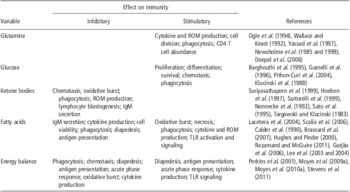
Nutrition plays a pivotal role in the immune response and nutrients can influence several, if not all, aspects of the immune response. This section of the review discusses the complex relationships between metabolic status and immune function and how these complex interactions increase the risk of disease during early lactation. A special focus will be placed on the major energetic fuels currently known to be used by immune cells (i.e. glucose, NEFA, BHBA and glutamine (Gln)) and how certain metabolic states, such as PI or degree of NEB, contribute to immunosuppression during the periparturient period. Table 1 summarizes the effect of Gln, ketone bodies, fatty acids, glucose and energy balance on the immune function of leukocytes, for example PMN, macrophages and lymphocytes.
Effect of glutamine, ketone bodies, fatty acids, glucose and energy balance on immune function of leukocytes

ROM = reactive oxygen metabolites; IgM = immunoglobulin M; TLR = toll-like receptor.
First, we will review the current literature regarding nutrient uptake and utilization by immune cells in order to better understand the mechanisms relating nutrition and immunity. To our knowledge, the metabolism and fates of energetic fuels in bovine leukocytes have not been characterized and most studies have used human, murine or rodent models. Studies of the fuel use of 14C-labeled glucose, amino acids, fatty acids and ketones by activated murine macrophages and PMN have indicated that: (1) only 5% of glucose is completely oxidized via the Krebs’ cycle and the rest is either directed towards the pentose phosphate pathway for the generation of NADPH as an electron donor during respiratory burst or is converted to lactate; (2) Gln is the preferred amino acid utilized by phagocytes, with ∼74% of Gln being completely oxidized; (3) fatty acids are primarily incorporated into cellular lipids including triacylglycerols (79%), phospholipids (18%) and cholesterol esters (3%); and (4) ketone bodies, such as acetoacetate and BHBA, are not utilized as an energy source by phagocytes (Newsholme et al., Reference Newsholme, Curi, Gordon and Newsholme1986 and Reference Newsholme, Gordon and Newsholme1987; Calder et al., Reference Calder, Bond and Newsholme1990).
Gln
Gln is characterized as a functional amino acid because it serves as a precursor for (1) purine and pyrimidine synthesis leading to DNA and RNA synthesis; (2) the production of NADPH for superoxide production in phagocytes; (3) oxidation for energy; and (4) nitric oxide production by macrophages (Newsholme et al., Reference Newsholme, Curi, Pithon Curi, Murphy, Garcia and Pires de1999; Furukawa et al., Reference Furukawa, Saito, Inoue, Matsuda, Fukatsu, Han, Ikeda and Hidemura2000; Pithon-Curi et al., Reference Pithon-Curi, De Melo and Curi2004). To our knowledge, the fate of utilized Gln in bovine leukocytes has not been metabolically characterized. In rodent and human models, Gln is important for the synthesis of cytokines (e.g. IL-1β and IL-6) in macrophages and monocytes, phagocytosis and the production of reactive oxygen intermediates (Wallace and Keast, Reference Wallace and Keast1992; Ogle et al., Reference Ogle, Ogle, Mao, Simon, Noel, Li and Alexander1994; Yassad et al., Reference Yassad, Lavoinne, Bion, Daveau and Husson1997). Lymphocytes utilize Gln primarily for cell division and lactate production (Newsholme et al., Reference Newsholme, Crabtree and Ardawi1985; Newsholme et al., Reference Newsholme, Curi, Pithon Curi, Murphy, Garcia and Pires de1999). Studies have shown that Gln is generally used by lymphocytes at high rates, well above requirements (i.e. >100-fold) for other metabolic processes, because of rapid cell division that is not observed in terminally differentiated cells such as PMN and macrophages (Newsholme et al., Reference Newsholme, Curi, Pithon Curi, Murphy, Garcia and Pires de1999; Pithon-Curi et al., Reference Pithon-Curi, De Melo and Curi2004).
During infection, the plasma concentration of Gln decreases because of increased uptake and utilization in immunological tissues and cells (Meinz et al., Reference Meinz, Lacy, Ejiofor and McGuinness1998; Holtenius et al., Reference Holtenius, Persson, Essen-Gustavsson, Holtenius and Hallen2004). During the periparturient period, plasma Gln also decreases relative to the high metabolic demands for Gln for gluconeogenesis, milk protein synthesis and tissue growth, especially in the intestine and mammary gland (Doepel et al., Reference Doepel, Lessard, Gagnon, Lobley, Bernier, Dubreuil and Lapierre2006). An increasing circulating supply of Gln to periparturient cows may be beneficial in improving the immune function and reduce the risk of mastitis in early lactation. Abomasal infusions of Gln during the first 21 days in milk increased plasma Gln and the abundance of CD4 T cells, but did not alter T lymphocyte proliferation, abundance of CD8 T cells and IFN-γ secretion when compared with controls (Doepel et al., Reference Doepel, Lessard, Gagnon, Lobley, Bernier, Dubreuil and Lapierre2006). More studies are encouraged to examine how an increased supply of circulating Gln alters the immune response that may lead to new management strategies improving the immune response and reducing the risk of mastitis during early lactation.
Glucose
Glucose is required by phagocytic cells (i.e. macrophages and PMN) for proliferation, survival and differentiation, and glucose has been shown to be the preferred metabolic fuel during inflammation for activated PMN, macrophages and lymphocytes rather than fatty acids, amino acids or ketone bodies (Barghouthi et al., Reference Barghouthi, Everett and Speert1995; Gamelli et al., Reference Gamelli, Liu, He and Hofmann1996; Pithon-Curi et al., Reference Pithon-Curi, De Melo and Curi2004). For example, the glucose uptake increased in murine PMN and peritoneal macrophages after stimulation with lipopolysaccharides (LPS) in vitro (Gamelli et al., Reference Gamelli, Liu, He and Hofmann1996; Schuster et al., Reference Schuster, Brody, Zhou, Bernstein, Arch, Link and Mueckler2007). Studies have shown that the inhibition of glucose uptake decreased phagocytic capabilities and increased the risk of infection in murine macrophages (Lang and Dobrescu, Reference Lang and Dobrescu1991; Barghouthi et al., Reference Barghouthi, Everett and Speert1995). The cellular uptake of glucose in phagocytic cells is facilitated via the non-insulin dependent glucose transporter (GLUT1; Barghouthi et al., Reference Barghouthi, Everett and Speert1995) and evidence indicates that the glucose uptake may be restricted solely to the GLUT1 isoform in phagocytes (Fukuzumi et al., Reference Fukuzumi, Shinomiya, Shimizu, Ohishi and Utsumi1996; Gamelli et al., Reference Gamelli, Liu, He and Hofmann1996). Interestingly, Moyes et al. (Reference Moyes, Drackley, Salak-Johnson, Morin, Hope and Loor2009a) observed that an intramammary challenge with Streptococcus uberis (S. uberis) did not alter dry matter intake in cows during mid-lactation, whereas serum insulin and glucose concentrations increased after challenge. Increases in serum glucose after intramammary infection may be associated with either enhanced hepatic gluconeogenesis or reduced uptake of glucose by peripheral tissues thereby increasing the glucose availability for phagocytic cells during infection. An efficient glucose uptake by immune cells is critical for maintaining cellular functions and eliciting an optimal host response to invading microorganisms. Like Gln, serum glucose concentrations are lowest in cows during early lactation and low glucose availability may limit the immune function and increase the risk of infection for cows during early lactation.
Ketones
Cows with subclinical ketosis (BHBA >1000 or 1200 μmol/l) during the first 1 to 2 weeks after calving are at greater risk for diseases, that is, metritis (Duffield et al., Reference Duffield, Lissemore, McBride and Leslie2009), left-displaced abomasum (LeBlanc et al., Reference LeBlanc, Leslie and Duffield2005) and a greater incidence and severity of mastitis (Kremer et al., Reference Kremer, Noordhuizen-Stassen, Grommers, Schukken, Heeringa, Brand and Burvenich1993; Janosi et al., Reference Janosi, Kulcsar, Korodi, Katai, Reiczigel, Dieleman, Nikolic, Salyi, Ribiczey-Szabo and Huszenicza2003). Several studies have identified potential mechanisms associated with the impairment of the cellular immune function by increased media concentrations of ketones (Franklin et al., Reference Franklin, Young and Nonnecke1991; Detilleux et al., Reference Detilleux, Kehrli, Stabel, Freeman and Kelley1995). Chemotactic capabilities (Suriyasathaporn et al., Reference Suriyasathaporn, Daemen, Noordhuizen-Stassen, Dieleman, Nielen and Schukken1999) and respiratory burst activity (Hoeben et al., Reference Hoeben, Heyneman and Burvenich1997) are reduced in bovine blood PMN when supplemented with BHBA in vitro. Furthermore, Sartorelli et al. (Reference Sartorelli, Paltrinieri and Agnes1999) observed an inhibition of ovine PMN superoxide anion production, whereas acetoacetate had minimal effects on PMN function indicating that only the ketone body BHBA may impair the immune function during the transition period and periods of PI. The inhibitory effects of BHBA may be partly attributed to the fact that the migration of leukocytes is glucose-dependent (Klucinski et al., Reference Klucinski, Degorski, Miernik-Degorska, Targowski and Winnicka1988) and the cells could not use ketones as a supplemental energy source. With regard to specific immunity, in vitro studies have shown that incubation of BHBA decreased blastogenesis and mitogenic responses and inhibited IgM secretion and proliferation in bovine blood lymphocytes (Targowski and Klucinski, Reference Targowski and Klucinski1983; Nonnecke et al., Reference Nonnecke, Franklin and Young1992; Sato et al., Reference Sato, Suzuki and Okada1995). Therefore, higher circulating BHBA concentrations in cows experiencing subclinical or clinical ketosis may impair the immune function, thereby increasing the risk of mastitis and other infectious diseases during early lactation.
NEFA
Higher circulating NEFA concentrations in cows during the periparturient period have been associated with an increased risk of disease such as hepatic lipidosis (Bobe et al., Reference Bobe, Young and Beitz2004; Ingvartsen, Reference Ingvartsen2006), a left displacement of the abomasum (LeBlanc et al., Reference LeBlanc, Leslie and Duffield2005), retained placenta (Quiroz-Rocha et al., Reference Quiroz-Rocha, LeBlanc, Duffield, Wood, Leslie and Jacobs2009) and mastitis (Moyes et al., Reference Moyes, Larsen, Friggens, Drackley and Ingvartsen2009b). The mechanisms associated with the role of NEFA, for example saturated (SFA), unsaturated (UFA) and polyunsaturated (PUFA) fatty acids, on the immune function are complex and poorly understood. NEFA have been shown to have both immunostimulatory and immunosuppressive effects on the cellular function and may also act as ligands for toll-like receptors (TLR), primarily on resident macrophages. In cows, Lacetera et al. (Reference Lacetera, Scalia, Franci, Bernabucci, Ronchi and Nardone2004) reported that a higher concentration of NEFA (1.0 mM) suppressed DNA synthesis, IgM secretion and IFN-γ production for blood monocytes when compared with lower NEFA concentrations in vitro (0.0625 and 0.125 mM). Several studies have also reported that NEFA alter the oxidative burst, apoptosis and necrosis of PMN and macrophages in vitro that may be responsible for host cell damage and death via necrosis during early lactation. In bovine PMN, high NEFA concentrations (2.0 mM) increased phagocytosis-associated oxidative burst activities and reduced cell viability by 50% when compared with controls (Scalia et al., Reference Scalia, Lacetera, Bernabucci, Demeyere, Duchateau and Burvenich2006). In addition, necrosis was increased by 48% in PMN incubated with NEFA, whereas the occurrence of apoptosis was similar between NEFA and control cell cultures. During the periparturient period, the reactive oxygen species production increases via lipid mobilization to support the energy demands for milk production; and the level of reactive oxygen species production is controlled by several antioxidant defence systems that prevent tissue damage and optimize cellular performance (Sordillo and Aitken, Reference Sordillo and Aitken2009). Therefore, cows with a more rapid mobilization of lipids may experience increased oxidative stress causing cell and tissue damage, providing linkages between cows suffering from periods of PI and increased risk of mastitis during the periparturient period.
The type of NEFA, that is, SFA, UFA and PUFA, has been shown to impair the immune response suggesting that the type of fatty acid may potentially affect the efficiency of the immune system during the periparturient period. For instance, Calder et al. (Reference Calder, Bond and Newsholme1990) observed that SFA decreased the phagocytic capability of murine macrophages by 28%. Palmitate (C16:0), oleate (C18:1) and linoleate (C18:2) have been shown to inhibit LPS-induced increases in the expression of L-selectin and intercellular adhesion molecule-1 (ICAM-1) as well as a reduced production of TNF-α and IL-6 in human monocytic cell lines (Brassard et al., Reference Brassard, Larbi, Grenier, Frisch, Fortin, Carpentier and Fulop2007). Furthermore, the antigen presentation to autologous lymphocytes was reduced in IFN-γ-activated human monocytes when incubated with n-3 PUFA, that is, eicosapentaenoic acid (EPA) and docosahexaenoic acid (DHA), primarily via inhibition of the cell surface expression of MHC II and ICAM-1 (Hughes and Pinder, Reference Hughes and Pinder2000). The cellular production of TNF-α and IL-6 decreased with increasing n-3 PUFA intake in human monocytes (Trebble et al., Reference Trebble, Arden, Stroud, Wootton, Burdge, Miles, Ballinger, Thompson and Calder2003a). With regard to bovine mammary epithelial cells, Rezamand and McGuire (Reference Rezamand and McGuire2011) observed a downregulation of mRNA expression for IL6 and IL8 for cells sub-cultured with UFA when compared with controls (i.e. no UFA). The growing evidence suggests that the type of NEFA has the ability to alter the immune response of cells, but may also impact bovine mammary gland health and provide an additional link between immunosuppression during the periparturient period and increased risk of mastitis during early lactation.
In contrast, immunostimulatory effects of NEFA on the immune function have also been reported. Rezamand and McGuire (Reference Rezamand and McGuire2011) reported an upregulation of IL1B and ICAM1 for bovine mammary epithelial cells incubated in UFA when compared with controls. For leukocytes, Calder et al. (Reference Calder, Bond and Newsholme1990) observed an increase in macrophage phagocytosis from 25% to 55% by UFA. Similar results were reported by Gorjão et al. (Reference Gorjão, Verlengia, Lima, Soriano, Boaventura, Kanunfre, Peres, Sampaio, Otton, Folador, Martins, Curi, Portiolli, Newsholme and Curi2006) where the phagocytic activity of PMN (62%) and monocytes (145%) increased in vitro in male subjects supplemented with DHA (3.0 g/day) for 2 months. Gorjão et al. (Reference Gorjão, Verlengia, Lima, Soriano, Boaventura, Kanunfre, Peres, Sampaio, Otton, Folador, Martins, Curi, Portiolli, Newsholme and Curi2006) also observed an increased rate of reactive oxygen species production in PMN and increased lymphocyte production of IL-10, IFN-γ and TNF-α when compared with controls. EPA has also been shown to increase the IL-4 production of circulating T lymphocytes in vitro in young adult males (Miles et al., Reference Miles, Banerjee, Wells and Calder2006). One potential mechanism explaining the beneficial effects of NEFA on lymphocyte function may be via the inhibitory effect of NEFA, especially EPA and DHA, on prostaglandin E(2) production, a potent inhibitor of lymphocyte function (Brassard et al., Reference Brassard, Larbi, Grenier, Frisch, Fortin, Carpentier and Fulop2007). Researchers have observed that oral supplementation of a combination of EPA and DHA in adult males inhibited prostaglandin E(2) production thereby increasing the production of IFN-γ and lymphocyte proliferation in vitro (Trebble et al., Reference Trebble, Wootton, Miles, Mullee, Arden, Ballinger, Stroud, Burdge and Calder2003b). Therefore, individual NEFA profiles in the circulation may have different immunomodulatory effects on lymphocyte and phagocyte function. Future studies examining the effect of shifts in blood NEFA profiles in cows during the periparturient period on suppression and stimulation of immune cells are warranted to potentially uncover new linkages between degree of PI and risk of disease during early lactation.
Growing evidence suggests that NEFA, especially the increased amount of SFA that occurs during the periparturient period, may act as ligands for TLRs; however, this relationship between lipids and immune response is not fully understood (Sordillo et al., Reference Sordillo, Contreras and Aitken2009; Moyes et al., Reference Moyes, Drackley, Morin, Rodriguez-Zas, Everts, Lewin and Loor2010b). TLRs, primarily expressed on monocytes and resident macrophages, recognize pathogen-associated molecular pattern (PAMP) on invading pathogens and play a major role in inducing innate immunity, activating the pro-inflammatory response and linking the innate and adaptive immune systems (Lee and Hwang, Reference Lee and Hwang2006). The PAMP for gram-negative bacteria is lipid A of LPS, a TLR-4 agonist; however, the PAMP for lipoteichoic acid (LTA), a TLR-2 agonist for gram-positive bacteria, is currently unknown. PAMP contain SFA including lauric acid (C12:0), myristic acid (C14:0) and palmitic acid (C16:0). Researchers have shown that SFA activate TLR-2 and TLR-4, whereas n-3 PUFA either fail to activate TLR or inhibit their activity (Lee et al., Reference Lee, Plakidas, Lee, Heikkinen, Chanmugam, Bray and Hwang2003; Lee et al., Reference Lee, Zhao, Youn, Weatherill, Tapping, Feng, Lee, Fitzgerald and Hwang2004). Incubation of murine monocytes with DHA (22:6) suppressed the nuclear factor kappa B (NF-κβ) activity induced by TLR-2 and TLR-4 that is required for downstream cytokine expression, whereas Shi et al. (Reference Shi, Kokoeva, Inouye, Tzameli, Yin and Flier2006) observed that a mixture of 16:0 and 18:1 stimulated the TLR-4 mediated pro-inflammatory response in murine adipocytes. UFA (i.e. α-linolenic acid) have also been shown to inhibit the peroxisome proliferator-activated receptor (PPAR)-γ activation that can lead to suppression of the inflammatory response (Lee et al., Reference Lee, Plakidas, Lee, Heikkinen, Chanmugam, Bray and Hwang2003).
The relationship between NEFA and TLR signaling may be partly explained by the shifts in NEFA profiles in blood and the phospholipid content of cellular membranes during the periparturient period. During early lactation, SFA accounted for 35.7% of the total long-chain fatty acids in plasma, primarily palmitic and stearic acid (18:0), whereas UFA accounted for 64.3%, primarily oleic and linoleic acid (Douglas et al., Reference Douglas, Overton, Bateman, Dann and Drackley2006). Decreases in stearic acid, eicosatrienoic acid (20:3) and EPA (20:5) and increases in 16:0 and 18:1 were also observed in the phospholipid cellular membrane of hepatocytes in cows during early lactation (Douglas et al., Reference Douglas, Rehage, Beaulieu, Bahaa and Drackley2007). Therefore, the higher concentration of UFA during the periparturient period may contribute to the periparturient immunosuppression and changes in cell membrane lipid profiles that may influence cellular functions such as membrane fluidity. However, more in vivo studies are encouraged to verify the relationship between NEFA profiles in blood and the expression of the TLR-mediated NF-κβ activity pro-inflammatory response in order to better understand the relationship among PI, immunosuppression and risk of mastitis during the periparturient period.
Energy balance
In this review, we have discussed in detail the current knowledge regarding the relationship between individual metabolites that characterize the degree of NEB (i.e. NEFA, BHBA and glucose) and PI on the immune function in vitro. Studies examining the relationship between energy balance and inhibition of the immune system response and risk of disease in vivo have mainly focused on the individual metabolites associated with severe NEB rather than calculated energy balance alone. Dietary-induced NEB models of cows in later lactation (i.e. >90 days in milk) have been useful models to identify the mechanisms that link energy status with immune system function during early lactation without the confounding effects of glucocorticoids (Kehrli and Harp, Reference Kehrli and Harp2001; Mehrzad et al., Reference Mehrzad, Dosogne, Meyer, Heyneman and Burvenich2001); however, results vary and are inconsistent. For instance, Perkins et al. (Reference Perkins, VandeHaar, Tempelman and Burton2001) observed that protein-level expression of L-selectin and MHC II of PMN were increased in steers subjected to feed restriction (i.e. 60%) compared with steers fed to 210% of maintenance requirements. However, Perkins et al. (Reference Perkins, VandeHaar, Burton, Liesman, Erskine and Elsasser2002) observed no effect of feed restriction (i.e. 80% of maintenance requirements) on serum TNF-α concentration, total leukocyte count or milk IgG concentrations when compared with ad libitum fed cows in mid-lactation. The feed-restricted cows were not in as severe NEB (average of −6.2 Mcal/day) as might occur (−12.9 Mcal/day) during early lactation (Rastani et al., Reference Rastani, Andrew, Zinn and Sniffen2001). Moyes et al. (Reference Moyes, Drackley, Salak-Johnson, Morin, Hope and Loor2009a) therefore subjected cows in mid-lactation to a more severe dietary restriction (i.e. 60% of NEL requirements for 7 days) that resulted in a calculated NEB similar to that of cows experiencing postpartal NEB (Rastani et al., Reference Rastani, Andrew, Zinn and Sniffen2001). This level of feed restriction resulted in a lower PMN phagocytic capability in NEB than cows in positive energy balance. After intramammary challenge with S. uberis, acute phase proteins in milk were higher in NEB than cows in positive energy balance (Moyes et al., Reference Moyes, Drackley, Salak-Johnson, Morin, Hope and Loor2009a). It can therefore be concluded that dietary-induced NEB models to mimic postpartal NEB can alter the immune response, but do not seem to reflect studies that have observed more significant correlations among circulating metabolites and increased susceptibility to infection in dairy cows during postpartal NEB. In addition, the immunosuppression associated with, for example, the changing metabolic and hormonal environment normally observed around the periparturient period contributes considerably to the impairment of the immune response and risk of disease during early lactation.
Large-scale epidemiological studies examining naturally occurring postpartal NEB have provided more evidence regarding the links between NEB, and the metabolites that characterize NEB, and the immune system response in dairy cattle during the peripartal period. Results from studies examining postpartal NEB and associated metabolites more accurately reflect in vitro studies regarding a negative association between NEB and the immune function. For example, Suriyasathaporn et al. (Reference Suriyasathaporn, Heuer, Noordhuizen-Stassen and Schukken2000) observed that cows with a low body condition score (BCS; 1.0 to 1.75) during mid-lactation were more susceptible to developing clinical mastitis than were cows with a higher BCS (3.0 to 3.75). They concluded that cows with a lower BCS during mid-lactation were likely to experience more severe NEB resulting in greater losses in tissue energy stores during early lactation than cows with a higher BCS, as supported by Lacetera et al. (Reference Lacetera, Scalia, Bernabucci, Ronchi, Pirazzi and Nardone2005). Furthermore, Stevens et al. (Reference Stevens, Peelman, De, Pezeshki, Van De Walle, Duchateau and Burvenich2011) reported lower blood PMN phagocytosis, chemotaxis and diapedesis for cows in early lactation, that is, experiencing NEB, than cows in mid-lactation. As previously stated, large-scale studies have shown strong evidence of linkages between circulating metabolites that characterize NEB and risk of mastitis for peripartal cows. Perhaps an index for PI, based on several metabolites in blood, will more directly relate to mechanisms associated with the development of several diseases and thereby more accurately predict risk of disease than calculated energy balance or the use of individual metabolites alone for cows during early lactation.
Coupled with recent technological advances in immunology, the potent research tools in functional genomics have provided information into the mechanistic links between metabolic status, immunosuppression and risk of mastitis during early lactation. For PMN, dietary-induced NEB for cows in mid-lactation resulted in a downregulation of PMN expression by NEB including genes involved with antigen presentation (MHC genes HLADRA and HLAA), respiratory burst (superoxide dismutatse 1; SOD1) and the pro-inflammatory response (TNFA; Moyes et al. Reference Moyes, Drackley, Morin and Loor2010a), although genes upregulated by NEB were also associated with immune response, that is, IL1R2 and IL6 and TLRs (TLR2 and TLR4). As stated previously, the increased expression of TLR2 and TLR4 may be partially explained by the elevated concentrations of circulating NEFA that have been shown to activate TLR for cows experiencing NEB (Lee et al., Reference Lee, Plakidas, Lee, Heikkinen, Chanmugam, Bray and Hwang2003 and Reference Lee, Zhao, Youn, Weatherill, Tapping, Feng, Lee, Fitzgerald and Hwang2004; Sordillo et al., Reference Sordillo, Contreras and Aitken2009). These results provide new information on transcriptomic mechanisms of PMN associated with postpartal NEB and immune response during early lactation.
Recent work examining the transcriptomic-level profiles of mammary tissue from cows in NEB during mastitis has further elucidated the mechanistic links between degree of postpartal NEB and risk of mastitis. Using microarray technology, Moyes et al. (Reference Moyes, Drackley, Morin, Rodriguez-Zas, Everts, Lewin and Loor2010b) revealed that the most affected canonical pathways by dietary-induced NEB after intramammary infection with S. uberis were (1) IL-8 Signaling, of which 80% of the genes were downregulated by NEB suggesting a suppression of the pro-inflammatory response and PMN recruitment; (2) Glucocorticoid Receptor Signaling suggestive of an upregulation of anti-inflammatory mechanisms; and (3) NRF2-mediated Oxidative Stress Response, although it is unclear as to whether a true change in oxidative stress response occurred in mammary tissue of NEB cows during an S. uberis challenge. Individual gene expression showed an upregulation of HLAA, which encodes the MHC I complex, due to NEB, whereas the majority of genes involved in the immune response were downregulated (e.g. AKT1 – gene coding for serine-threonine protein kinase, IL-1 receptor-associated kinase 1(IRAK1), mitogen-activated protein kinase 9 (MAPK9) and TNF-associated receptor factor 6 (TRAF6)). Other studies have examined the effect of degree of NEB on the expression of genes associated with the immune response in the uterus (Wathes et al., Reference Wathes, Cheng, Chowdhury, Fenwick, Fitzpatrick, Morris, Patton and Murphy2009), spleen (Morris et al., Reference Morris, Waters, McCarthy, Patton, Earley, Fitzpatrick, Murphy, Diskin, Kenny, Brass and Wathes2009) and liver (McCarthy et al., Reference McCarthy, Waters, Kenny, Diskin, Fitzpatrick, Patton, Wathes and Morris2010) of dairy cows at 15 days in milk. The knowledge gained from previous studies has just begun to unravel the mechanistic linkages between metabolic status, reflected in the degree of NEB and level of individual metabolites and amino acids, and the immune response during the periparturient period. However, these relationships are still unclear. Future studies using recent technological advances in immunology coupled with functional genomics, proteomics and metabolomics will help provide further insight into the relationships between metabolic status, especially relating to degree of PI, and immune response that will assist the dairy industry in developing good management practices for cows during the transition period.
Strategies for preventing disease during early lactation
The transition from late gestation to early lactation is the most metabolically challenging stage in the lactation cycle of a dairy cow. With the growing amount of evidence linking degree of nutrient balance with immunity and risk of infectious and non-infectious diseases, minimizing the severity and duration of negative nutrient balance during the periparturient period should be of high importance for improving animal health and welfare and reducing economic losses to farmers. It is beyond the scope of this review to discuss all of the factors that influence the degree of nutrient balance and risk of disease during early lactation, including management, environmental stressors and dietary factors (e.g. physical form and feed quality), and feed supplements (e.g. propylene glycol). This paper will focus on a few of the major management strategies previously and currently being investigated that focus on improving transition cow success.
Before parturition, many dairy cows experience a transient decrease in dry matter intake that can further exacerbate the imbalance between energy needs and energy supply (Ingvartsen and Andersen, Reference Ingvartsen and Andersen2000). Dry matter intake typically decreases by 32%, ∼3 weeks before parturition, and 89% of this decline occurs during the last week before calving (Hayirli et al., Reference Hayirli, Grummer, Nordheim and Crump2002). Greater dips in dry matter intake at this time have been associated with increased blood NEFA and BHBA and liver triacylglyceride accumulation during early lactation thereby increasing the risk of infectious and non-infectious diseases (Bertics et al., Reference Bertics, Grummer, Cadorniga-Valino and Stoddard1992; Janovick et al., Reference Janovick, Boisclair and Drackley2011). Strategies designed to help minimize this natural drop in dry matter intake have shown improvements in metabolic (i.e. lower blood NEFA and BHBA) and liver (i.e. lower triacylglyceride accumulation) profiles and have reduced the incidence of metabolic diseases for cows during early lactation (Ingvartsen, Reference Ingvartsen2006).
In his review of nutritional influences on bovine health during the periparturient period, Goff (Reference Goff2006) raised an important question as to whether limiting caloric intake prepartum by feeding high roughage diets will lead to an increased sense of ‘hunger’ that will subsequently lead to increased intake to prevent ‘off-feed’ situations around calving. Growing evidence indicates that overconsumption of energy during the dry period increases the severity of energy balance, reduces the liver function and increases the risk of metabolic diseases during early lactation (Herdt, Reference Herdt2000; Dann et al., Reference Dann, Litherland, Underwood, Bionaz, D'Angelo, McFadden and Drackley2006). Drackley and colleagues at the University of Illinois limited energy intake to ∼100% of the National Research Council (2001) requirements by supplementing wheat straw for silage that allowed ad libitum intake in group-fed settings while remaining cost efficient for farmers. This nutritional strategy prevented large changes in dry matter intake and energy balance, decreased the magnitude of BCS changes and reduced plasma NEFA and BHBA and liver lipid and triacylglyceride accumulation postpartum. Recent evidence suggests that limiting energy intake prepartum was not a negative for primiparous cows (Janovick et al., Reference Janovick, Boisclair and Drackley2011). However, future studies are encouraged to determine if similar responses are observed in other breeds, especially Jerseys.
Avoiding over conditioning (i.e. BCS ⩾ 4.0 on a 5-point scale) during the dry period is of high importance for dairy farmers in order to prevent PI and reduce the risk of disease during early lactation (Grummer, Reference Grummer1993; Ingvartsen et al., Reference Ingvartsen, Dewhurst and Friggens2003). Most dairy professionals agree that a BCS of 3.25 at calving is optimal to allow for sufficient body fat reserves to support the energy requirements for maintenance, parturition and lactation while minimizing excessive tissue energy mobilization, fatty acid infiltration to the liver and risk of disease during early lactation. Studies have examined the effect of dietary manipulation on changes in BCS during the dry period (Dann et al., Reference Dann, Litherland, Underwood, Bionaz, D'Angelo, McFadden and Drackley2006; Law et al., Reference Law, Young, Patterson, Kilpatrick, Wylie, Ingvarsten, Hameleers, McCoy, Mayne and Ferris2011). Altering BCS during the dry period has proven to be difficult owing to the short duration of time (i.e. ∼60 days) coupled with the natural drop in intake before parturition that results in relatively small differences in BCS from dry off to calving (±0.5 units; Markusfeld et al., Reference Markusfeld, Galon and Ezra1997; Friggens et al., Reference Friggens, Ingvartsen and Emmans2004b). In our opinion, too much focus has been placed on how nutrition during the late and close-up dry periods alters BCS and lipid mobilization during early lactation. Implementing feeding strategies early on in the previous lactation to obtain the desired BCS at calving may be more beneficial. However, recent work revealed no differences in BCS and dry matter intake at calving for primiparous cows fed high- or low- energy diets starting from 80 days before expected calving date, and only a 0.34-unit difference was observed between treatment groups for multiparous cows (i.e. starting 100 days before expected calving date). These results emphasize the difficulty in achieving large changes in BCS in the late lactation and dry periods.
Insulin resistance is a key factor regarding the development of obesity-related diseases such as type II diabetes and the metabolic syndrome in humans (Tilg and Moschen, Reference Tilg and Moschen2008). The metabolic profiles of peripartal cows mimic those of patients suffering from type II diabetes and non-alcoholic fatty liver disease (Bastard et al., Reference Bastard, Maachi, Lagathu, Kim, Caron, Vidal, Capeau and Feve2006; Tilg and Moschen, Reference Tilg and Moschen2008). An insulin-resistant state is normally observed in most cows during the transition period in order to ensure a shift in nutrient supply from muscle and adipose to the mammary gland for milk synthesis (Bauman, Reference Bauman2000). Insulin resistance is associated with a low-grade inflammation with adipose tissue, and partly liver tissue, as the main contributor to heightened inflammation in blood. In postpartal dairy cows, Loor et al. (Reference Loor, Dann, Everts, Oliveira, Green, Guretzky, Rodriguez-Zas, Lewin and Drackley2005) observed an increase in hepatic mRNA expression of serum amyloid A (SAA1), a pro-inflammatory acute phase protein. Recent evidence shows that adipose tissue depots of Holstein cows are immune responsive, as reflected in greater mRNA abundance of TNFA and IL6 after stimulation with LPS in vitro (Mukesh et al., Reference Mukesh, Bionaz, Graugnard, Drackley and Loor2010). Studies suggest that dietary energy supply during the dry period and metabolic diseases can alter insulin resistance during early lactation. Overfeeding during the dry period has been shown to increase hepatic IL1B mRNA expression (Janovick-Guretzky et al., Reference Janovick-Guretzky, Dann, Carlson, Murphy, Loor and Drackley2007). Furthermore, Liu et al. (Reference Liu, Zhang, Wang, Wang, Xu and Zhu2010) observed lower hepatic insulin receptor mRNA expression for cows with ketosis and hepatic lipidosis when compared with normal cows indicating that responses to insulin are decreased for cows suffering from a metabolic disease. These studies may indicate why some cows fail to adapt to the metabolic demands around the periparturient period and encourage future research studies linking insulin resistance to risk of PI and the development of infectious and non-infectious diseases during the periparturient period.
Conclusion
A majority of health problems in the dairy cow occur around parturition and relate to cows having difficulty adapting to the nutrient needs for lactation. Complex relationships between metabolic status and immune function exist and are potentially influencing the risk of disease. Physiological parameters show major individual differences and some cows experience PI in the periparturient period as a consequence of inadequate adaptation to lactation. This imbalance may decrease immune function and increase the risk for disease as metabolites and nutrients, for example Gln, glucose, BHBA and NEFA, can influence several important aspects of the immune response and thereby potentially disease resistance. It is argued that feeding strategies avoiding PI may improve the immune response and thereby disease resistance and health.