Our central premise is that citizens as principals prefer a high level of human rights protection, but must depend on politicians and bureaucrats to get what they want. We conceptualize the mechanisms that stimulate the two types of agents that prioritize human rights protection as ‘accountability of politicians’ and ‘accountability of bureaucrats’ relationships. As in all principal-agent relationships, some agency loss is inevitable, so human rights practices will be less than what citizens prefer unless both politicians and bureaucrats are properly motivated to put more effort into protecting human rights. This conceptualization focuses research on the identifying factors that magnify or reduce agency losses in either or both accountability relationships.
The most important way to make politicians accountable to citizens for human rights and other public policies is, of course, to hold regular, free and fair competitive elections.Footnote 1 However many non-electoral attributes of democratic political systems can also enhance political accountability, such as a free press, an independent judiciaryFootnote 2 and a developed civil society.Footnote 3 The idea that democratic institutions will promote good human rights practices is well supported by the evidence and is sometimes referred to as the ‘domestic democratic peace’.Footnote 4
For the accountability of bureaucrats, the large and growing literature emphasizes the fact that in modern states, administrative officials are held accountable through several connected accountability regimes – including fiscal, political, legal and internal controls. Previous human rights research has examined many of these empirical relationships, and some studies have adopted a principal-agent theoretical focus.Footnote 5 However most previous theory building assumes that politicians prefer to protect human rights because repression is costly while protection is not;Footnote 6 it has given little attention to the important, independent contribution bureaucrats make to the protection of human rights.Footnote 7
To illustrate the usefulness of the principal-agent conceptual framework, and to make an empirical contribution that helps explain global variations in government human rights practices, we focus on an important and under-researched non-electoral mechanism of human rights accountability: the state's fiscal rules. Fiscal rules refer to the set of laws that determines how the state raises revenue to support government activities and how much revenue the state collects. We hypothesize that fiscal rules influence the incentives of both politicians and bureaucrats to prioritize human rights protection relative to other tasks. Human rights protection is diminished by agency losses via two distinct principal-agent relationships that are controlled by separate mechanisms of accountability. Politicians and bureaucrats act as agents whose strategic choices about how much effort to devote to protecting human rights independently influence the policy outcome. The ‘accountability of politicians’ connection constrains, and thus, motivates politicians. The ‘accountability of bureaucrats’ relationship does the same for appointed state officials such as police, soldiers and prison guards. Expected agency losses in both relationships lead to less human rights protection than citizens would prefer.
We hypothesize that the adoption of a fiscal rule requiring that a relatively large share of government revenue is collected through taxation causes politicians to be more accountable to their citizens. A greater reliance on taxes does not diminish the accountability of bureaucrats. The adoption of a fiscal rule requiring the collection of greater revenues from all sources makes bureaucrats more accountable to citizens. Higher state revenue allows the state to pay for more closely monitored, better motivated and properly trained agents. More state revenue does not diminish the accountability of politicians. Greater accountability of politicians and bureaucrats to citizens, the ultimate principal, leads to better human rights practices. The effect of both factors is positive, but each fiscal factor promotes a different type of accountability – and both types of accountability independently contribute to the production of good human rights practices.
This conceptual framework makes an important distinction between two types of accountability; each separately contributes to (or detracts from) the level of human rights protection produced by a political system. The framework also allows for new insights to be produced by considering the effects of other explanatory factors of interest on both accountability relationships. Jointly considering the two accountability relationships and their determinants enhances our ability to explain human rights policy outcomes.
Theoretical Argument
We make the following assumptions. First, citizens as principals prefer a high level of human rights protection.Footnote 8 In representative democracies, to attain this preference, citizens must rely on the efforts of their elected representatives and on the professional efforts of the bureaucrats who constitute various arms of the executive branch. Secondly, we assume that politicians and bureaucrats as agents are indifferent about the level of human rights protection, and that the efforts they make to protect human rights are always costly for them. Thirdly, politicians and bureaucrats acting as agents choose how much effort to put into human rights protection. Given the costs, it follows that (other things equal), agents put in minimal effort, which would result in the under-provision of human rights protection. Finally, for the sake of clarity of the argument that follows, we make a technical assumption : that a range of contracts for either type of agents is available, in which higher compensation generates better expected performance, and that citizens know the terms of the actual contract held by the politicians and the bureaucrats. This assumption implies that the principal can evaluate the efforts of each of its agents and assign blame appropriately. In other words, citizens can reasonably determine what part of human rights violations is due to the low effort of politicians, and what part is due to the deficiency of bureaucrats.Footnote 9
The choices of politicians and bureaucrats are based on their calculations of the costs and benefits of devoting more effort to protecting human rights. The efforts that politicians devote to human rights protection can best be understood as an outcome of the multiple-principal, single-agent situation in principal-agent analysis. Greater reliance on taxes increases the salience of the human rights preferences of the citizen principal. Addressing these two accountability mechanisms in parallel generates testable propositions that substantially improve our ability to explain the resulting policy performance. Agency losses in both relationships lead to a decline of human rights protection and account for variations in human rights practices that we seek to explain.Footnote 10 We expect the size of government revenues to promote the accountability of bureaucrats and the reliance of the government on taxes to promote the accountability of politicians.
Accountability of Politicians
The large literature that examines the politicians’ accountability problem usually assumes that politicians are accountable to a single objective – for example, economic performance. We depart from this view of political accountability and instead assume that politicians face multiple tasks and that they are accountable to multiple principals. In other words, politicians may be agents for other principals besides citizens, and those other principals may have different expectations for their performance. While only citizens select national incumbents, citizens must often share the right to define politicians’ priorities with other actors, both domestic and international. For example in a modern state, politicians might also be accountable to the demands of international organizations, foreign aid providers, commodity traders, international financial institutions, commercial banks and resource extraction companies. Those other actors and the citizens are like multiple principals contracting with a common agent – a politician.Footnote 11 With some exceptions, these other potential principals will care less about some of the issues of concern to the citizenry. Thus when politicians respond to the preferences of principals other than their own citizens, they make policy decisions that lead to agency loss for their ultimate principal – the people.
Control over politicians can be analyzed as a common agency model in which a risk-averse agent (politician) performs multiple tasks for multiple principals who differ in the relative value they place on each task.Footnote 12 Sinclair-Desgagné (Reference Sinclair-Desgagné2001) offers a formal example: an agent faces a set of separate contracts; each one is designed to align the agent's preferences with those of a specific principal. The agent's incentives are lower than they would be had the contract been offered by a single principal. Formally defined, in this context the ‘lower incentives’ mean that the agent's overall payoff is less dependent on the outcome of interest. Each principal encourages the politician to pursue activities that she values the most, and thus discourages her from performing tasks that are more valuable to other principals. For our purposes this means that politicians in states that allow the influence of alternative constituencies other than citizens will have lower incentives to prioritize the protection of human rights.Footnote 13
As a result of the common agency problem outlined above, when state revenue is less reliant on taxes, agency loss is generated in the principal-agent relationship between citizens and politicians. This is because other sources of revenue go up in importance; each revenue source brings with it a new principal with different preferences. Most additional principals care less about human rights than do the citizens. Thus with the addition of new principals, citizens’ preferences are less salient for the agent because the compensation citizens might offer now weighs less in the overall contract. Empirically, therefore, a greater reliance on taxes should be associated with higher indicators of accountability. Conversely, a lesser reliance on taxes should be associated with lower indicators of accountability.
Accountability of Bureaucrats
Political accountability is not a necessary condition for the protection of human rights. Bureaucrats make an important, independent contribution to the level of human rights protection in a society. They may be held accountable to citizen preferences for good human rights practices through several connected accountability regimes, including fiscal, political, legal and internal controls. In this article, we argue that adopting a fiscal rule requiring the collection of greater revenues from all sources is an important factor in making bureaucrats more accountable to citizens. Higher state revenue allows politicians to write contracts with bureaucrats to provide greater compensation.
A significant literature covers a variety of processes and mechanisms that promote the accountability of bureaucrats.Footnote 14 It demonstrates, for example, that without well-designed accountability mechanisms, soldiers, police and prison guards will engage in practices that violate human rights.Footnote 15 Bureaucrats prefer greater discretion; more bureaucratic discretion means fewer constraints and more human rights violations. For example, when the police arrest an alleged criminal, following procedures that ensure the right to a fair trial is costly to the police and prosecutors, whose task to maintain social order needs to be accomplished with limited resources that need to be spread across as many criminal cases as possible.Footnote 16
In many states, bureaucrats are subject to monitoring by their principal, the citizenry. While it is often difficult to organize in a consistent and uniform way, many democratic countries institute various venues for direct citizen control over bureaucracy. This control often takes the form of citizen review boards for police, school administrators and public utilities regulators. Even non-democracies have mechanisms that allow citizens to complain about state officials. Thus citizens have a number of direct and indirect means to control bureaucrats as their agents.
While citizens are the ultimate principals of bureaucrats, in practice most bureaucrats are controlled by other bureaucrats, with only top officials serving as political appointees. Indeed, in all modern states administrative officials are subject to multiple accountability mechanisms. There are various political, social, legal and inter-bureaucratic controls that in essence are part of the contractual structure in which bureaucrats’ performance is evaluated. Agency loss occurs if there is a lack of resources to contract with high-quality bureaucratic agents to ensure their maximal effort.
Adequate government revenue is needed in order to be able to pay for a well-staffed, educated and monitored executive branch that is capable of faithfully implementing policies.Footnote 17 Most importantly, risk sharing by agents requires extra compensation, which in turn requires that greater total revenues are available to the state. For example, the agent will exert maximal effort to protect the civilian population in a war, if she was paid enough to agree to a contract by which she would be punished for any observed civilian casualties, regardless of whether there is proof that such losses were her fault.Footnote 18 The surplus compensation needed to interest an agent in such a demanding contract may have to be substantial. A cash-strapped government unable to afford such a contract would incur greater agency loss. A well-funded government, on the other hand, can offer attractive and competitive contracts to its soldiers, police and prison guards, thereby increasing their accountability. Empirically, therefore, greater overall government revenue should be associated with higher indicators of accountability. Conversely, lower levels of government revenue should be associated with lower indicators of accountability.
Based on this theoretical framework, we argue that fiscal rules determining who compensates the agents (and by how much) serve as important instruments that affect the accountability of politicians and bureaucrats. For each of the two different principal-agent mechanisms, alternative institutional arrangements and other state attributes can exert consistently positive, consistently negative or opposite effects on accountability. A fiscal rule resulting in a greater reliance on taxes should reduce agency losses in the relationship between citizens and politicians without adversely affecting the accountability of bureaucrats. A fiscal rule producing greater state revenue overall should improve the accountability of bureaucrats by increasing the available compensation for bureaucratic agents.
Previous Research
There are three theoretically distinct fiscal rules: (1) reliance on taxes (tax revenues as a share of total government revenues), (2) the level of taxation (tax revenues as a share of gross domestic product, GDP) and (3) government revenues (government revenues as a share of GDP). All three rules potentially affect the quality of governance, and the mechanisms and directions of their influence are potentially distinct. Yet the literature does not separate those influences.
Many case studies support a connection between a high reliance on taxes and democratic development and good governance, including efficiency and transparency. For example in Argentina, provinces that depended on the broad taxation of their citizens have historically been more democratic.Footnote 19 Similarly, in Tanzania and Zambia, local governments that receive more resources from local sources (and less from central government transfers and foreign assistance) are more accountable to the local citizens and waste a relatively smaller share of the local budgets on administrative costs.Footnote 20
Other evidence suggests that a low reliance on taxes reduces the quality of governance. For example many studies demonstrate the negative influence of natural resource rents on the quality of governance. Natural resource rents may make politicians more willing to accommodate the interests of corporations in the natural resource sector and not serve the best interests of their citizens. Something resembling an implicit contract evolves between corporations in the natural resource sector and the state's politicians; contributions from the major economic players are made in return for the state's protection.Footnote 21 More broadly, research has linked reliance on natural resource rents with the development of less-democratic political institutions,Footnote 22 a weak administrative and bureaucratic structure,Footnote 23 fewer and lower quality services to citizens, and poor levels of economic growth.Footnote 24
However, most cross-national studies do not directly test the reliance on taxes proposition but focus instead on the relationship between the level of taxation and various aspects of governance.Footnote 25 The accumulated evidence shows that higher levels of taxation are associated with better respect for human rightsFootnote 26 and other indicators of good governance.Footnote 27 These analyses make it impossible to determine authoritatively whether improved governance and human rights result from a reliance on taxes or the size of government revenues.Footnote 28 This is true because tax revenue as a proportion of GDP increases both with a greater reliance on taxes and with the size of government revenues:
 $$Taxes / GDP \ = \, \left( {Taxes / Revenues} \right)\, \ast\, \left( {Revenues / GDP} \right)$$
The inability to empirically separate the effects of these two fiscal rules on human rights and other indicators of good governance is also important because there is theoretical disagreement about whether big government is a good or bad influence.
The human rights literature is generally consistent with the idea that greater government size is associated with better human rights practices, contending that human rights protection requires substantial government involvement in the economy to redistribute wealth, safety and well-being among citizens. The dominant theoretical model developed to explain cross-national variation in respect for human rights and the accumulated evidence also support the idea that larger government size should be associated with better human rights practices. That model, adapted by Poe and TateFootnote 29 from earlier work by Most and Starr,Footnote 30 with some variations,Footnote 31 is still used in most of the global comparative human rights research conducted today. It assumes that political leaders decide how much repression to use for political survival. If politicians believe their regime to be strong and secure, they will not be inclined to violate the human rights of their citizens. Leaders will become repressive if they believe that the strength of domestic or international threats (or both combined) is equal to or greater than the strength of the regime they wish to protect. In such circumstances, they may use the repression of human rights as a strategy to redress an undesirable imbalance in the strength/threat ratio.Footnote 32 States with relatively large revenues from any source would be less easily threatened, and therefore should be less repressive.
Others disagree, noting that large, intrusive states present the greatest danger to human freedom. While protecting some human rights may require government involvement, upholding most human rights requires the government to refrain from interfering with the liberty of individuals to speak freely, freely assemble with other individuals, own and dispose of property, and to conduct their affairs in privacy. Small governments will be less able to do these things or to engage in widespread torture, surveillance of their citizens, large-scale political imprisonment of opponents or mass killing. Some of the most repressive states in history have controlled a relatively large share of the state's economy. Our empirical analysis helps resolve this debate.
Possible Endogeneity Problem
Our empirical analysis will also address the potential problem of reverse causality. If the world operates as we have stipulated, some fiscal rules adopted by states cause politicians and bureaucrats to be more accountable to citizens, and greater accountability leads to better human rights practices. Thus we conceptualize reliance on taxes and total government revenue as exogenous influences on human rights practices. This conceptualization is consistent with a large and growing body of work in new fiscal sociology, which asserts that fiscal rules have a theoretical and causal importance in explaining economic, social and political phenomena.Footnote 33 In that research tradition, states’ fiscal attributes are independent variables that explain the development of democracy, better representation, state accountability and good governance.Footnote 34 However the causal direction of the empirical relationship may be the reverse of what we have proposed. Good human rights practices may cause a greater reliance on taxes and more government revenue. In this section, we review the alternative relevant arguments in the literature and provide historical examples that support our conceptualization. In the findings section, we conduct tests of endogeneity that support our claim that fiscal rules are exogenous.
In her seminal contribution, which highlights the importance of fiscal rules for the political and economic development of states, Levi (Reference Levi1989) describes taxation as the outcome of a social contract between the rulers and the taxpayers, suggesting a two-way relationship between rights and taxation. However upon closer examination, her theoretical framework is consistent with the idea that fiscal rules are exogenous factors that cause rights to be expanded or contracted. She introduces a model of taxpayers’ ‘quasi-voluntary compliance’, in which the taxpayers choose to pay taxes, but their co-operation is quasi-voluntary, because those who do not pay are coerced. The result is a quasi-voluntary equilibrium in which each taxpayer strategically chooses to pay taxes because she knows that the others will pay, thus enabling the coercion of defectors.Footnote 35 However, the logic of this strategic ‘quasi-voluntary compliance’ implies that by relying on taxes, the state gives citizens extra bargaining power. Once the state relies on taxes, a second equilibrium becomes possible in which most citizens refuse to pay taxes and the state now lacks the resources to coerce them. In that case the state would have to compromise with most taxpayers in order to ensure their compliance. Thus when assessed in full, the tax bargain argument is consistent with ours. First the rulers rely on taxation. Then they are forced to agree with the taxpayers’ demands to modify the social contract.
Historical accounts also indicate that in most countries, demands for better representation followed the introduction of taxes on citizens. Ross describes this process in Europe: ‘in exchange for new taxes, the estates eventually received greater accountability from the princes, and influence over how their money was spent’.Footnote 36 Not only did reliance on taxes precede changes in the social contracts between the rulers and citizens, but factors that led to greater reliance on taxes (such as geography) were also exogenous to human rights. Short-term changes in reliance on taxes followed economic shocks, fluctuations in global trade and changes in opportunities to extract rents. Similarly, as noted by Tilly,Footnote 37 in Europe, wars and military threats, rather than improved human rights practices, led the rulers to enlarge revenue collection in Europe.Footnote 38 Even today, a state's decision to rely less on taxing citizens depends primarily on whether or not it happens to enjoy large non-tax domestic revenues from rents such as the sale of oil or foreign aid. The size of such rents is largely determined by unpredictable conditions of global economy and geopolitical calculations.
The ability of modern states to change the sources and amounts of their revenue sources is also severely limited by factors outside their control. In modern economies, taxes not only finance the state but also redistribute wealth between social groups. Thus it is difficult to change the levels of taxation as there are strong vested interests that stand to lose from any changes.Footnote 39 Furthermore, the increasing global competition for investments causes domestic interest groups to demand low taxes. Under such circumstances it is difficult to mobilize public and special interest groups’ support for any tax increase or to reach popular consensus for a major change in tax allocation.
In summary, the previous literature, most historical evidence, and modern developments generally support our conceptualization of fiscal rules as exogenous to human rights practices. While it is possible that citizens’ trust in government when it is accountable could make citizens more willing to pay taxes in exchange for the reliable delivery of public goods, more accountability also means greater citizen control over the level of taxes, and, therefore, likely limits on tax expansion. A more oppressive state could force its citizens to pay more taxes, but may have difficulty in maintaining the tax base due to trust issues.
One might argue that the relationship between fiscal rules and human rights is not causal at all. Perhaps it is spurious, with democracy causing changes in human rights and fiscal rules. However there is little support in the literature for this argument. The effects of political and institutional variables on fiscal rules are also ambiguous, both theoretically and empirically: Cheibub reported that contemporary non-democracies were just as effective as democracies in raising taxes.Footnote 40 Most recently, Csapo found no direct effect of political regime type on the level of taxation.Footnote 41 She noted that while some existing theoretical arguments predict that non-democracy would lead to a higher level of taxation, other arguments explain why taxation could be lower in democracies.
Hypotheses
We represent the policy outcome of human rights protection as an increasing linear function of two independent components: the accountability of politicians and the accountability of bureaucrats. In particular, if poorly motivated politicians set low legal standards, the practices will be at a lower level still, due to subsequent bureaucratic agency loss. To evaluate the overall effect of revenue rules on human rights, the analysis that follows takes into account the independent effects of state reliance on taxes and the total size of state revenue. The weight of citizen taxes in the budget is expected to reduce agency loss between citizens and politicians, while the size of the total state revenue reduces agency loss between citizens and bureaucrats. Empirically, then, we should expect both the greater reliance on taxes in the state budget and the greater share of state revenue in GDP to be associated with better human rights practices.
Research Design
To test the effects of reliance on taxes and size of government revenues on government protection of human rights, we focus on physical integrity rights. As noted, the theoretical framework and the hypotheses outlined above are designed to explain variation in the protection of all human rights. We chose to focus on physical integrity rights because they have been the focal point of most of the previous theory building and hypothesis testing in the human rights subfield. Thus our results will be easily compared with the results of earlier work. We estimate an ordered probit regression model in which the dependent variable measures government respect for physical integrity rights; the independent variables are the characteristics of the fiscal system and a set of control variables for all countries in the world between 1981 and 2007.
The Dependent Variable
The CIRI physical integrity rights index is our principal measure of the level of government respect for human rights,Footnote 42 and we check our results using the Political Terror Scale (PTS).Footnote 43 The CIRI index is a nine-point cumulative scale derived from a Mokken scaling analysis of four ordinal indicators of government respect for physical integrity rights: the rights of all human beings to be protected from torture, summary execution, disappearance and political imprisonment. Physical integrity rights are sometimes referred to as ‘negative rights’, because they refer to the right of individuals to be left alone. The CIRI index ranges from 0 (no respect for any of the four physical integrity rights) to 8 (full respect for all four physical integrity rights). Each of the four components of the index was scored based on a count of the number of instances of violations of each right in each country year (2 = no violations; 1 = 1–49 violations; 0 = 50 or more violations). One advantage of the CIRI Index is that scale scores can be associated with particular patterns of violations of rights.Footnote 44 The CIRI Index can also be disaggregated to assess relationships between the independent variables of theoretical interest and each of the four index components. To test robustness, we present some results broken down in this way. The PTS is a five-point index that is also designed to measure government respect for physical integrity rights. As originally constructed, higher values indicate more violations of human rights. We reversed the values of the index so that the expected relationships between our main independent variables and both human rights indices would be positive.
The Main Independent Variables
Measures of our main independent variables, Reliance on Taxes and Size of Government Revenues, were both calculated using Easterly'sFootnote 45 data on government revenue and expenditure and updated using data from the IMF's World Development Indicators (WDI 2009).Footnote 46 Importantly, these two variables are uncorrelated. Reliance on Taxes was measured as total government revenue from taxes as a percentage of total government revenue.Footnote 47 It is a continuous variable. We expect its effect to be positive:
 $$Reliance\,on\,Taxes\, = \, Tax\,Revenue / Total\,Revenue$$
Size of Government Revenues was measured as total government revenue as a percentage of GDP. It too is a continuous variable. We also expect its effect to be positive:
 $$Size\,of\,Government\,Revenues\, = \, Total\,Revenue\, /\, GDP$$
Control Variables
Our control variables are related both to human rights and to the level of state reliance on taxation. In the social sciences there is a debate about whether research designs should be constructed to include all potentially relevant control variables or only a limited set of controls in the estimation. Some argue for the need to supply proper micro foundations for all control variables, critiquing the overuse of long lists of controls.Footnote 48 However the failure to include relevant control variables leads to a biased estimation, even though the exact mechanisms of their relevance might not always be readily apparent. As an imperfect but practical solution to this methodological conundrum, we present estimations in three stages: (1) with no control variables, (2) with the baseline controls typically used in the research program explaining variation in government human rights practicesFootnote 49 and (3) with still more potentially relevant control variables (for example, regional dummies). Our purpose is to show that the addition of control variables neither reduces the level of statistical significance nor changes the signs for our independent variables of chief theoretical interest.Footnote 50
Baseline Control Variables
As noted, previous research has established a baseline model showing that more democracy, higher Income per Capita and a previous history of colonization by the United Kingdom (UK Colony) are associated with greater respect for human rights. Large population size (as indicated by the Log of Population Size), high levels of Internal Armed Conflict and External Conflict are associated with lower levels of respect. These relationships, with modest variations, have been supported in most (if not all) subsequent research projects.Footnote 51 To measure the degree of institutionalized democracy, we use the 0–10 Polity IV democracy index, which is widely used in comparative studies of government human rights practices.Footnote 52 We use measures of internal and external armed conflict from the Peace Research Institute of Oslo (PRIO) dataset.
Additional Control Variables
As a robustness check, we include a series of other relevant control variables beyond the standard baseline model that may help to explain human rights practices, state reliance on taxes and size of government revenues. These additional control variables are Roeder's index of Ethnic Fractionalization Footnote 53 measuring the heterogeneity of the society,Footnote 54 Muslims as a Percentage of the Population, Catholics as a Percentage of the Population Footnote 55 and Regional Fixed Effects controls to capture the geographic, historical, cultural and socio-economic factors common to regions. These additional control variables do not change our main findings.
Results
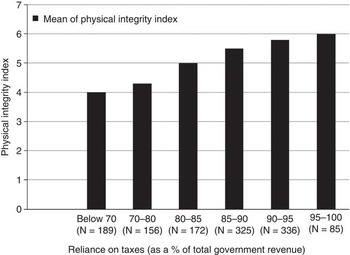
As a first look at the data, Figure 1 divides the sample into groups according to Reliance on Taxes, indicating the mean CIRI Index score that each group of countries attained. Figure 1 demonstrates that the group of countries for which Reliance on Taxes was lowest had the lowest average score on the CIRI Index. The group of countries for which Reliance on Taxes was highest had the highest average score. As an illustration, the countries with the lowest reliance on taxes in 2005 included Bahrain, the Congo and Iran, with CIRI scores of 5, 4, and 1, respectively. The group with the highest reliance on taxes included Spain, Guatemala, Germany and Belgium, which had higher CIRI scores of 6, 6, 8 and 8, respectively. The average value of the CIRI Index for countries with the highest reliance on taxation exceeds that of countries with the lowest reliance (below 70 per cent) by 2 index points (6 versus 4 points). This difference in means is in the hypothesized direction, and is statistically significant at the 0.01 confidence level. These differences in mean scores are also interpretable. Governments with scores of 6 are likely to engage in some torture and political imprisonment, but governments with a score of 4 will tend to commit these violations more frequently – and also be responsible for occasional disappearances of citizens or extrajudicial killings, or both.Footnote 56
Physical integrity and reliance on taxes (1981–2007)

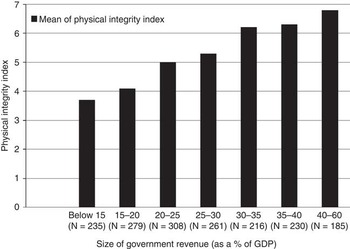
Figure 2 divides the sample into groups according to Size of Government Revenue, indicating the mean CIRI Index score that each group of countries attained. Figure 2 demonstrates that the group of countries for which Size of Government Revenue was lowest had the lowest average score on the CIRI Physical Integrity Rights Index. The group of countries for which Size of Government Revenue was highest had the highest average score.
Physical integrity and size of Government Revenue (1981–2007)

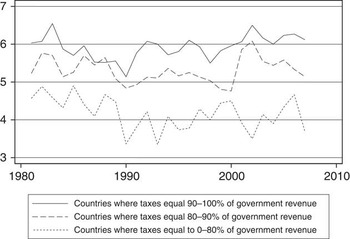
To see whether the differences in respect for human rights shown in Figures 1 and 2 were consistent over time, we divided the countries in our study into three groups based on their Reliance on Taxes and into three groups based on the Size of Government Revenue. Then we plotted the average annual levels of the CIRI Index for the period 1981–2007. As Figure 3 shows for Reliance on Taxes, in almost every year between 1981 and 2007 there were consistent differences in average levels of human rights protection between countries with high, moderate and low reliance on taxes for government revenue. Plotting groups based on the Size of Government Revenue produced a similar graph.Footnote 57
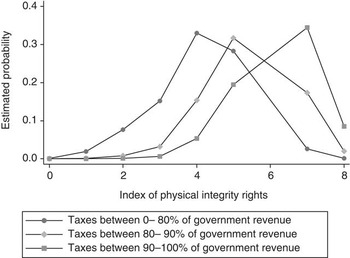
Average level of Physical Integrity Index (1981–2007) Note: the figure illustrates the probability estimates of the different values of the CIRI Index of Physical Integrity Rights for three groups of countries – where between (1) 0 per cent and 80 per cent; (2) 80 per cent and 90 per cent; and (3) 90 per cent and 100 per cent of government revenue are formed through taxation, holding all other variables. The simulations were performed using Clarify software (Tomz, Wittenberg and King Reference Tomz, Wittenberg and King2003). Clarify simulations were run on the equation with the all control and regional variables included.

We have hypothesized that the policy outcome of human rights protection is an increasing linear function of the accountability of politicians and the accountability of bureaucrats. Each is expected to exert positive, independent effects on the outcome. It is easy to believe that citizens are better off with highly accountable politicians, even when the bureaucracy is weak and difficult to control. However, even when political accountability is low, we expect that more capable, better-monitored bureaucrats would, on average, produce better human rights practices. One can think of extreme cases of powerful totalitarian regimes with very capable bureaucracies where human rights practices were (and are) poor. However we argue that in more normal cases, citizens are better off with a controlled, capable bureaucracy than they would be with one that is not well controlled by politicians and citizens.
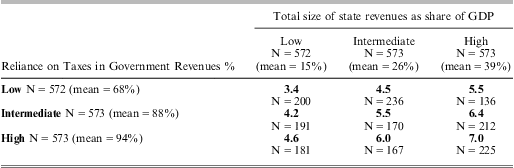
We begin our demonstration of the accuracy of this assertion in Table 1. We label three categories of Reliance on Taxes (Low, Intermediate and High) and three categories of Size of Government Revenue based on equally populated intervals of the original data. We computed the mean value of the CIRI Index for each subset, and arranged the results in a two-way table. As shown in Table 1, the average value of the CIRI Index increases with each incremental increase either in Reliance on Taxes or Size of Government Revenue, and it is not surprising that countries with the highest respect for physical integrity rights are both politically and bureaucratically accountable (mean CIRI score of 7, shown in the bottom right cell).
Average CIRI Physical Integrity Rights Index (1981–2007) by Reliance on Taxes and Size of Government Revenue

Note: cells are mean values of CIRI Index for subgroups. All 1,718 cases are divided into three equal size subgroups based on Reliance on Taxes in Government Revenues and into three equal size groups based on Total Size of Government Revenues as a share of GDP. CIRI scores for human rights range from 0 (low) to 8 (high).
The independent, additive effects are best demonstrated by other evidence contained in Table 1. Even for low values of Reliance on Taxes, an increase in the Size of Government Revenue corresponds to a better human rights record. Conversely, even when the Size of Government Revenue is relatively low, an increase in Reliance on Taxes corresponds to higher scores for human rights. In fact, as shown in Table 1, human rights protection is likely to be better when political accountability is low but bureaucratic accountability is high (mean CIRI score of 5.5 shown in the top right cell) than when political accountability is high but bureaucratic accountability is low (mean CIRI score of 4.6 shown in the bottom left cell). We have conducted additional multivariate robustness tests interacting Reliance on Taxes and Size of Government Revenue, and there is no significant interaction.
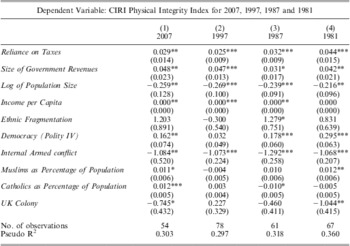
Table 2 presents cross-sectional ordered probit equations estimated for the 1981, 1987, 1997 and 2007 cross sections. The dependent variable is the CIRI Physical Integrity Index. We include as controls a number of variables identified in the literature as potentially important for human rights protection. The coefficients of the main independent variables have the expected signs in all four equations, and all are statistically significant at (at least) the 0.05 level. The consistent patterns over time we observe in Figure 2 and Table 1 are evidence that the pattern of the data during the entire period of our study is consistent with our hypotheses. Thus it is appropriate to pool the data for a time-series, cross-sectional analysis.
CIRI Physical Integrity Rights Index and Taxes: Cross-Section Ordered Probit with Robust Standard Errors

Robust standard errors in brackets. ***p < 0.01, **p < 0.05, *p < 0.1.
Main Tests
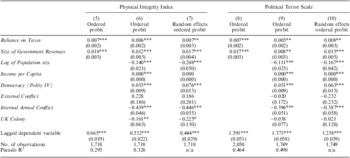
Equation 5 in Table 3 shows the cross-sectional time-series-ordered probit results estimated without the control variables except for the lagged dependent variable. Equation 6 adds the baseline control variables usually included in research explaining cross-national variation in government human rights practices. In order to account for the time-series, cross-sectional nature of the data, we also estimated a random-effects-ordered probit model (Equation 7). Equations 8 to 10 repeat the analysis using the Political Terror Scale Footnote 58 as an alternative measure of government respect for human rights. In all six equations, the estimated coefficients of the main independent variables measuring Reliance on Taxes and Size of Government Revenues have the expected signs and are statistically significant. All of the control variables relate to the dependent variables as expected, given the results of previous research, or are statistically insignificant.Footnote 59
Human Rights, Reliance on Taxes, and Size of Government Revenue, 1981–2007 Time-Series Cross-Section Ordered Probit with Lagged Dependent Variable and Robust Standard Errors

Robust standard errors in parentheses. ***p < 0.01, **p < 0.05, *p < 0.1.
Note: values of the PTS are reversed, so higher values mean more respect for human rights. Dependent variables are CIRI Physical Integrity Index and Political Terror Scale.
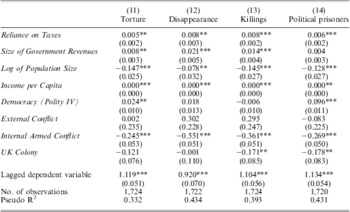
Table 4 disaggregates the main dependent variable, the CIRI Index of Physical Integrity Rights, into its four component parts, including the baseline control variables. It shows that greater Reliance on Taxes and Size of Government Revenues are associated with less government use of torture, fewer extra-judicial killings, fewer political prisoners and fewer disappearances. All the coefficients of the Reliance on Taxes variable have the expected signs and are statistically significant at the 0.05 level or higher. The coefficients of the indicator measuring Size of Government Revenues all have the expected signs and all are statistically significant at the 0.05 level or higher, with the exception of the Political Prisoners variable (Equation 14), which is not significant. From this evidence we conclude that the results presented in Tables 1 and 2 were not due to the effects of one or two index components on the index scores for each country.
CIRI Physical Integrity Rights Components and Taxation Time-Series Cross-Section Ordered Probit with Lagged Dependent Variable and Robust Standard Errors

Robust standard errors in parentheses ***p < 0.01, **p < 0.05, *p < 0.1.
Dependent variable is CIRI Physical Integrity Index Components (1981–2007).
Controlling For Possible Endogeneity
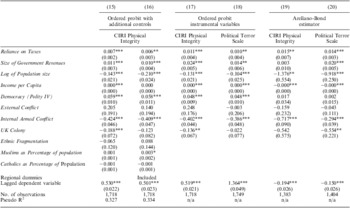
Table 5 reports the results of two tests of endogeneity. While our theoretical focus is on how fiscal arrangements shape accountability, it is important to emphasize that the analysis of accountability should take other potentially important factors into account. Political institutions work together with a variety of societal, economic and legal conditions to create the appropriate motivations for politicians, including motivating them to vigorously protect human rights. Moreover, recent studies have demonstrated that fiscal arrangements, including reliance on taxation, are not uniformly found in all political system types.Footnote 60 Thus we could expect fiscal rules to be correlated with observable and non-observable country characteristics, which separately influence human rights practices. To deal with such complications, we need to include all relevant control variables on the right-hand side of the regression equation. This estimation strategy is based on the assumption that the selection of fiscal rules could be viewed as ‘conditionally independent’ or random, once we control for the effects of all relevant observable non-institutional variables.Footnote 61 In practice, the strategy suggests the inclusion of more control variables in the regression equations. Therefore in Equations 15 (Table 5) we include measures of ethnic and religious fragmentation as additional controls. In Equations 16 (Table 5) we also include in the regression analyses regional fixed effects to capture what geographic, historical, cultural and socio-economic factors might be common to those regions. The coefficients of the measures of ethnic and religious fragmentation are not statistically significant in either specification.
Human Rights, Reliance on Taxes and Size of Government Revenues: Additional Controls, Instrumental Variables Analysis and Arellano-Bond Estimator

Robust standard errors in parentheses. ***p < 0.01, **p < 0.05, *p < 0.1.
Dependent variables are CIRI Physical Integrity Index and Political Terror Scale (1981–2007).
We also address the issue of potential endogeneity by using an instrumental variable (IV) ordered probit model with the CIRI Physical Integrity Rights Index as the dependent variable.Footnote 62 In Equations 17 and 18 the geographical characteristics of countries and the measures of their ethnic and religious fragmentation serve as instrumental variables to predict Reliance on Taxes.Footnote 63 The first-stage regressions reveal that the set of instrumental variables is strongly correlated with Reliance on Taxes, and the corresponding validity test confirms the appropriateness of these instruments. The second-stage instrumental variable-ordered probit model produces statistically significant results that are similar to the estimations without the use of instrumental variables. Moreover, the p-value associated with the test of exogeneity shows that we cannot reject the hypothesis that the reliance on taxes is in fact exogenous. We also estimated the model by the generalized method of moments GMM in first differences as suggested by Arellano and Bond (Reference Arellano and Bond1991), using lags of the dependent and endogenous variables plus the exogenous variables as instruments (Equations 19 and 20).
Overall, in all specifications the effects of our two main independent variables (Reliance on Taxes and Size of Government Revenues) on the CIRI Index of Physical Integrity Rights are positive and statistically significant at least at the 0.05 level.Footnote 64 Where they are statistically significant, all other control variables exert effects that are consistent with the findings of previous research. The Democracy coefficient is always positive and the Log of Population Size coefficient is negative and highly significant in each of the models. Similarly, the Internal Armed Conflict coefficient is significant and negative in all equations. Other control variables exert statistically significant effects in some specifications but not in others.
Substantive Effects
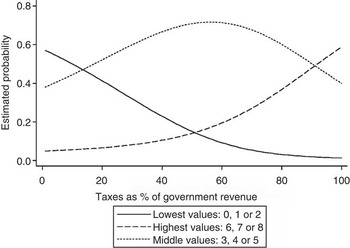
We use the Clarify software to provide additional substantive meaning to the statistical estimates.Footnote 65 The simulated predicted probabilities of the values of the CIRI Physical Integrity Rights Index indicate that, other things equal, the probability of observing the best human rights practices – index values of 6, 7 or 8 – increases from about 0.2 to above 0.55 as the share of taxes in revenue increases from 60 to near 100 per cent. Conversely, the probability of receiving the lowest scores (0, 1 or 2) increases from about 0.10 to above 0.4 if the share of taxes in revenue decreases from 60 to 20 per cent (see Figure 4). In 2007, a hypothetical country with a per capita income of $15,000, government revenues at 20 per cent of GDP and a 60 per cent reliance on taxes in its budget was estimated to have an expected value on the CIRI Physical Integrity Rights Index of 3.7. Such a hypothetical country could ‘improve’ its estimated value on the human rights index by one point (to 4.7) either by increasing its reliance on taxes to 90 per cent of the revenue, by increasing state revenues to 40 per cent of GDP or by tripling its per capita income (see Figure 5). Simulated predicted probabilities of the values of the CIRI Physical Integrity Index indicate that, other things equal, the probability of observing the best human rights practices also substantially increases as the Size of Government Revenues increases.
Physical Integrity Rights in Three Groups of Countries: 1981–2007 Note: this figure illustrates the change in the estimated probability of the three levels of the Index of Physical Integrity Rights as the proportion of taxes in total government revenue changes, for 2007, holding all other variables at their means. The simulations were performed using Clarify software (Tomz, Wittenberg and King Reference Tomz, Wittenberg and King2003).

Tax revenue and probability of different levels of Human Rights Protection (2007) Note: this figure illustrates the change in the estimated probability of the three levels of the Index of Physical Integrity Rights as the proportion of taxes in total government revenue changes, for 2007, holding all other variables at their means. The simulations were performed using Clarify software (Tomz, Wittenberg and King 2003).

Conclusion
We have conceptualized the production of human rights protection as the result of two conceptually distinct principal-agent mechanisms. Our argument and findings provide support for the idea that politicians and bureaucrats make strategic choices about how much effort to exercise to protect human rights. Both politicians and bureaucrats prefer to exert less effort than citizens want, but it is possible to change their motivations.
This conceptualization has some advantages over the Most and Starr threat-repression framework that is generally used in the human rights subfield.Footnote 66 First, by emphasizing that it is costly for politicians and bureaucrats to protect human rights, it accounts for human rights violations even in states that are not experiencing internal or external threats. Secondly, it can be applied to understand variation in government respect for a wider variety of human rights including freedom of religion, women's rights, workers’ rights and children's rights. For these rights, arguments about threat leading to repression are less relevant. Thirdly, our assumption that citizens prefer full protection of their human rights could be the subject of future refinement; the unanimity of citizen preferences may vary among different human rights. Fourthly, the framework encourages more attention to bureaucratic accountability, which has received relatively little attention in the literature.
Our argument and findings speak to several popular propositions in the institutional design literature. First, the literature suggests that there are multiple paths to greater accountability, while no single solution is perfect.Footnote 67 Practical difficulties with accountability multiply as more principals and agents get involved in the process. Secondly, by focusing our empirical work on the effects of fiscal rules we emphasize that money plays a pivotal role in shaping public policy and accountability. Following the money helps better understand politicians’ priorities and constraints, whether the money comes from taxes, campaign contributions or international investment flows. Among these sources, ‘taxation may play the central role in building and sustaining the power of states, and shaping their ties to society’.Footnote 68
The findings connect reliance on taxation and greater state revenues with better human rights practices, even when controlling for the level of democracy and national wealth. These relationships were strong in all empirical specifications. They confirm and clarify the earlier findings of Englehart.Footnote 69 Moreover, our finding that a big government (relative to the size of its economy) is more likely to protect physical integrity rights supports Ignatieff's conjecture that, ceteris paribus, strong states are necessary for the protection of human rights.Footnote 70 Citizens who live in a state where politicians are not accountable, but the bureaucracy is well funded are likely to fare better than those who live in states where politicians are unaccountable and the bureaucrats are also uncontrolled. In other words, even for the ‘negative rights’ examined in this article, on average, large, intrusive states do not present a danger to human freedom.
This may help explain why World Bank, International Monetary Fund (IMF) and World Trade Organization (WTO) policies designed to promote economic liberalization in developing countries have been shown to hurt human rights practices.Footnote 71 Those policies promote a ‘weaken the state, but grow the market’ strategy of economic development.Footnote 72 This is the wrong formula if one cares about human rights, because shrinking the state reduces citizens’ ability to control bureaucrats. The international organizations that promote these reforms also typically care less about human rights than citizens of target countries, and they compete with citizens for the attention of national politicians. They make additional demands on the politicians in developing countries that often are neither endorsed by the citizenry nor subjected to legislative approval. By offering financial rewards for performance such as larger and more certain future loans, the involvement of external organizations changes the incentive structure in ways that do not encourage politicians to give high priority to making better human rights policies and do not enable bureaucrats to enforce them.
More generally, the practical conclusion from our findings is that fiscal rules can influence the motivations of politicians and bureaucrats to protect human rights. A change in fiscal arrangements, such as a new source of revenue, potentially effects reliance on taxes and the total revenue available to the government. For example when a government receives new foreign aid – a new loan from the IMF or World Bank, for instance – or when the prices of natural resource exports increase, those unearned income streams reduce reliance on taxes but increase total revenue. In order to evaluate the overall effect of such fiscal changes on human rights, we must assess the effects of the new income streams on the accountability of both politicians and bureaucrats in a particular political system. Much would depend upon the other accountability mechanisms in place between citizens and both agents. Thus even non-tax sources of revenue can be helpful. This conjecture is consistent with some findings in the literature that the effects of foreign aid and revenue from the natural resource sector on public policies are conditional on the level of institutional development.Footnote 73
A principal-agent approach to the study of human rights can enlarge and enrich the human rights research agenda by encouraging a greater connection with the fields of comparative politics, political economy, international relations and institutional design. The principal-agent framework encourages scholars and policy makers to consider how the institutional design of a particular political system (such as its fiscal and electoral rules, separation of powers, and checks and balances), its non-institutional characteristics (such as culture, societal diversity, social norms and civil society) and its participation in international regimes (such as the WTO, World Bank and IMF program lending and human rights treaties) may affect the incentives of politicians and bureaucrats to give more or less effort to human rights protection. Thus it provides a potentially unifying framework for the study of human rights.