INTRODUCTION: RELIGION, PIETY, AND ISLAM'S POLITICAL ADVANTAGE
Confounding the predictions of Marx, Weber, Durkheim, and many others, religion has not withered away. From North America to Sub-Saharan Africa to the Middle East, religion remains a potent force for popular mobilization (Inglehart and Norris Reference Inglehart and Norris2004). In many countries, it is not just that religious ideas and organizations are capable of influencing individual attitudes and behaviors in the political realm; in many cases — particularly in many Muslim-majority countries — they appear to confer a distinct political advantage compared to secular alternatives. From Algeria to Indonesia, Islamic parties have been able to successfully mobilize popular support by capitalizing on economic grievances (Pepinsky, Liddle, and Mujani Reference Pepinsky, Liddle and Mujani2012). But to what extent are pious candidates evaluated differently according to their sectarian affiliations? And can such piety be a source of disadvantage when the candidates are found or alleged to be corrupt?
Scholars provide many possible reasons for religious appeals displacing other, more secular, entreaties grounded in class or ethnic cleavages. One conventional explanation is that appeals framed within the rhetoric of Islam are either more easily understood or perceived as more legitimate by the average voter (Wickham Reference Wickham2002).Footnote 1 A second view is that the appeal of political Islam derives from the effectiveness of nominally Islamic organizations in providing social services and public goods, which result in grateful populations that reward Islamic political candidates with their electoral support (Masoud Reference Masoud2014). The first view that religiously-framed appeals offer some intrinsic benefit to Islamist parties has been criticized as essentialist and exaggerated (Wedeen Reference Wedeen2002), while the second view explains religiously-grounded appeals by explaining it away, attributing the persuasiveness of Islamic political forces to their organizational effectiveness. A more promising theory is offered by Pepinsky, Liddle, and Mujani (Reference Pepinsky, Liddle and Mujani2012) who suggest that a specifically Islamic political ideology often serves as heuristic, or informational shortcut, that communicates something positive about a party's policy intentions, especially under conditions when voters are uncertain about party platforms. Using a series of experiments embedded in a nation-wide survey in Indonesia, they find that Islamic parties are more popular than otherwise identical non-Islamic parties, but only under cases of economic policy uncertainty. They explain this finding by suggesting that voters in Muslim-majority countries are predisposed to equate religious piety with other normatively desirable outcomes, such as moral probity, trustworthiness, and reliability (Davis and Robinson Reference Davis and Robinson2006; Norenzayan Reference Norenzayan2014).
But, where religious fault-lines have proven to be sources of conflict and violence, do individuals purporting to be pious or religious still receive a political advantage? Are there times when the political invocation of religion accrues costs rather than benefits, even among the intended target audience? We investigate the conditions under which voters punish corrupt politicians and ask whether religious individuals discovered to be corrupt are more or less likely to be tolerated. In April 2014, we carried out a survey experiment in Quetta district of Pakistan's Balochistan province that randomized information about Islamic sectarian affiliation as well as aspects of personal piety to investigate the impact of these factors on voter choice. Our survey and survey experimental results point to four primary findings. First, we find that cross-sectarian candidates (i.e., candidates who belong to a sect distinct from the respondent's) are significantly more likely to be punished for being pious. Second, individuals belonging to the minority Shia sect were more likely to demonstrate positive in-group bias than those belonging to the majority Sunni sect. Third, our survey results demonstrate that, contrary to much of the received wisdom about the power of religiously-based political appeals in Pakistan, Sunni respondents react negatively to prompts emphasizing candidate piety for both in-group and out-groups alike. This “piety penalty” is surprising given the personal religiosity of the respondents, but perhaps in line with a general distrust of mixing politics and religion. Finally, we provide evidence of what we term a “hypocrisy effect” in which voters disproportionately punish candidates purporting to be pious for corrupt behavior compared to candidates who make no such claims. We attribute this result to a mechanism in which priming the religious identity of candidates causes potential voters to evaluate candidates according to a higher standard of conduct and then punishes them accordingly for failing to meet such standards. Evidence for both a piety penalty and hypocrisy effect indicates that piety causes potential voters to expect higher standards of conduct from the candidate even when the pious candidates are themselves viewed less favorably.
Religious Identity: Distinct From Secular Ethnic Identities?
While religion is often subsumed under the broader rubric of ethnicity, scholars going back to Marx and Weber have argued that religious identity evokes special kinds of attitudes and behaviors. For Marx, religion was thought to distract poor people from their material interests; for Weber, certain theological ideas were highly conducive to capital formation (Marx Reference Marx1977; Weber Reference Weber2002). Contemporary work has continued to explore how religion may change preferences over redistribution, because of doctrinal differences (Kahl Reference Kahl, van Kersbergen and Manow2009), because it offers a substitute mechanism of insurance against adverse life events (Scheve and Stasavage Reference Scheve and Stasavage2006), or because it creates a secondary issue dimension of “moral value” that mitigates against the relationship between income level and redistributive preferences (De La O and Rodden Reference De La O and Rodden2008; McClendon and Riedl Reference McClendon and Riedl2015). More broadly, a growing body of experimental work in psychology suggests that experimentally-induced religious reminders are linked with a variety of pro-social behaviors, including generosity, honesty, cooperation, and altruistic punishment (Norenzayan and Shariff Reference Norenzayan and Shariff2008; Sosis and Ruffle Reference Sosis and Ruffle2003; Henrich et al. Reference Henrich, Ensminger, McElreath, Barr, Barrett, Bolyanatz, Cardenas, Gurven, Gwako, Henrich, Lesorogol, Marlowe, Tracer and Ziker.2010).
Political science literature has also demonstrated that candidates’ socio-demographic characteristics have important effects on a citizen's willingness to vote for them. Candidates’ religions function as readily available and accessible information heuristics for voters, particularly those who are politically unsophisticated. As Campbell, Green, and Layman (Reference Campbell, Green and Layman2011) explain, a candidate's religion can have either a direct effect on voting, with voters preferring a candidate of their own religious faith, or an indirect effect with voters inferring traits or behavior on the basis of the candidate's religious faith.
Among recent work examining the distinctiveness of religious identity, McCauley's Reference McCauley2014 experimental study in Côte d'Ivoire and Ghana finds that religious identity primes participants to prefer political candidates that focus on moral policy while priming on secular ethnic identity causes respondents to prefer candidates that prioritize local development. McCauley attributes these results to the varying territorial boundedness of the imagined ethnic community compared to the geographic dispersion of world religious traditions like Islam and Christianity. Variation in territorial boundedness, he suggests, explains the types of political goods that its members prioritize once a given identity is brought to the forefront: when bounded ethnic identities are mobilized, group members prioritize local club goods; by contrast, the transnational expansiveness of religious identity elicits stronger interests for “social and behavioral policies, and lifestyle guidelines based on sacred texts” (McCauley Reference McCauley2014). However, it may also be the case that this is simply the result of conformity effects driven by individual efforts to behave in a way that is consistent with the social group to which they identify (Shayo Reference Shayo2009; Tajfel and Turner Reference Tajfel and Turner1979).
Religion and Corruption
Corruption is often defined as the appropriation of public resources for private gain. Much empirical research within political science has focused on institutional design as a primary factor explaining levels of corruption through the mechanism of electoral competition and accountability (Rose-Ackerman Reference Rose-Ackerman1999). A far smaller but emerging literature has also considered the role that religious beliefs may play in promoting or deterring certain kinds of behavior relevant to corruption. For example, experimental studies have found that participants primed with religious representations cheated significantly less on a subsequent classroom task (Randolph-Seng and Nielsen Reference Randolph-Seng and Nielsen2007). Other empirical work has found evidence that some religions, particularly those that are less embedded in hierarchical structures, are more amenable to the establishment of procedural and legal institutions, which may lower levels of corruption (Lambsdorff Reference Lambsdorff2002; Paldam Reference Paldam2001), while personal religiosity can raise individual motivations to pay taxes (Torgler Reference Torgler2006). The mechanism here is that religion provides a code of ethics that can be translated into political behavior: because all major religious traditions generally contain precepts proscribing dishonesty and illegality, faithful adherents will refrain from taking part in corrupt activities that run contrary to religious teachings (Beets Reference Beets2007). Specific understandings of individual manifestations of corruption may vary from one cultural context to the next. Moreover, there may also be a distinction to be drawn in certain institutional contexts where political corruption may not be viewed as intrinsically unethical (Sommer, Bloom, and Arikan Reference Sommer, Ben-Nun Bloom and Arikan2013).
In this article, we are concerned less with the impersonal forces of market corruption than elements of personal morality in the evaluation of political candidates, who may use their access to public office for private gain. For the sake of verisimilitude, our corruption prime draws on two chronic issues concerning problematic personal conduct that have plagued electoral candidates in recent Pakistani history: tax evasion and the misrepresentation of educational credentials that are needed to stand for election. Both allegations are common in the Pakistani context, as politicians are often accused of making up educational qualifications and failing to abide by tax regulations, and hence provide tangible and realistic examples of corrupt behavior by politicians. Lying about academic credentials became a particularly controversial issue when legal challenges were brought against 160 elected officials (more than 10% of the country's legislators) for falsely claiming to hold degrees to meet a previous requirement for holding office (Khan and Toosi Reference Khan and Toosi2010). As a result of these allegations, the Supreme Court ordered the Election Commission in 2010 to vet the credentials of all federal and provincial legislators. Such behavior on the part of elites is viewed as symptomatic of a system that privileges the status quo and works to further disadvantage the poor.Footnote 2 Indeed, the Election Commission, while investigating the issue of fake degrees, also examined other indicators of possible monetary fraud and corrupt behavior, including legislators’ bank loans and unpaid bills. Similarly, tax evasion by elites is perceived as part and parcel of a series of fraudulent acts taken by legislators who use their political connections to strengthen their personal financial situation.Footnote 3
Our experiment investigates how voters react when nominally pious candidates are alleged to be corrupt and whether mention of religiosity causes such candidates to incur any political cost, measured as a change in voter willingness to vote for them. We use the concept of religious piety as a popular heuristic to signal moral probity. Piety (taqwa, also sawab) is a foundational moral virtue in Islam, one of the most frequently mentioned concepts in the Qur'an, and denotes a universal measure of the sincere religious life of the faithful (Lewisohn Reference Lewisohn, Th. Bianquis, Bosworth, van Donzel and Heinrichs2012). Our study speaks to a burgeoning literature on heterogeneous tolerance of corrupt politicians by investigating whether pious individuals are punished more for their behavior relative to individuals who make no claims about their piety. It further assesses whether the insider-outsider dynamic holds among sectarian groups: do respondents systematically evaluate corrupt candidates from their own sectarian in-group less punitively than a candidate from a group to which the respondent does not belong, all things equal?
Research suggests that whether voters punish candidates for corruption or misdeeds in general often depends on whether or not the candidate is a member of the voter's in-group. One of the reasons for such in-group bias at the expense of candidate quality may come from a psychological desire for self-esteem, wherein the desire to view one's self positively is transferred onto the group in which one is a member, causing one's own group to be perceived more positively (or less harshly) relative to outside groups (Tajfel and Turner Reference Tajfel and Turner1979). Still, even the mere act of social categorization itself may be sufficient to cause in-group bias (Sherif et al. Reference Sherif, Harvey, Jack White, Hood and Sherif1961). Chang and Kerr, for example, find that in Africa, members of in-groups are less likely to punish corrupt individuals either by virtue of being members of certain patronage networks or as a result of affective identity ties, be they ethnic or partisan (Chang and Kerr Reference Chang and Kerr2009).Footnote 4 If voters place greater value in the ethnic identification of politicians, then a given candidate associated with the in-group has a competitive advantage even if he or she is of poorer quality along other dimensions, including competence or moral probity (Banerjee and Pande Reference Banerjee and Pande2007). Our experiment contributes to the literature by also considering how appeals to religion interact with identity politics in terms of candidate evaluation.
CONTEXT: ISLAM, SECT, AND VIOLENCE IN BALOCHISTAN, PAKISTAN
Bordering Iran and Afghanistan, the southwestern province of Balochistan boasts an ethnically diverse population, but has suffered from chronic poverty as well as the fallout of a longstanding separatist insurgency against the Pakistani state. In recent years, the province has also experienced a spike in sectarian-related violence victimizing local Shias who tend to be ethnically Hazara and especially vulnerable on account of their distinctive appearance. Attacks against them have become increasingly deadly. For example, in January 2013, a year before our survey was undertaken, an attack in an ethnically Hazara neighborhood in Quetta resulted in the death of 115 individuals, with more than 270 injured. One year later, 28 Hazara individuals were killed in a suicide bombing attack on a bus in Mastung district to the south of Quetta. The vast majority of violent anti-Shia attacks in Balochistan are carried out by an extremist outfit known as Lashkar-e-Jhangvi, which was formed as an offshoot of the Sipah-e-Sahaba Pakistan and still maintains strong links with it. The Lashkar-e-Jhangvi allegedly has links to both Al Qaeda and the Pakistan Taliban.
This violence is not specific to Balochistan but increasingly forms the backdrop to sectarian relations in much of the country. Shia make up somewhere between 15–20% of Pakistan's population, although estimates vary widely because the census does not collect information on sectarian affiliation. Due to a confluence of factors in the late 1970s and early 1980s, including the Iranian revolution, the Afghan jihad against the Soviet Union, and the Islamization policies of General Zia-ul-Haq, Shia and Sunni political identities were made more salient with the sectarian cleavage between them correspondingly heightened. Due to security concerns, we limited our survey in Balochistan to the administrative district containing its capital city, Quetta.
HYPOTHESES
Our preceding discussion motivates the following hypotheses. First, following basic insights from social categorization theory, we expect in-group favoritism to operate among our respondents. Individuals value their in-groups positively and extend positive evaluations to other members of the group, which is enhanced by social comparisons with out-groups.
-
• H1a: Respondents will express more favorable opinions of in-group (co-sectarian) candidates relative to out-group (cross-sectarian) candidates.
By extension, we believe that the political advantage of being pious, if it exists, will be less likely to travel to those individuals who belong to a different Islamic sect as the respondent. Particularly where sectarian cleavages are salient like our research site, in-group (co-sectarian) candidates will have a distinct advantage compared to out-group (cross-sectarian) ones for expressed piety. This is because respondents will not necessarily associate an out-group candidate's expressed piety as simply an index to a higher level of moral conduct, but rather as a signal of more intense and parochial loyalty to the sectarian group to which the candidate belongs. Hence:
-
• H1b: Respondents will be more likely to express favorable opinions of in-group (co-sectarian) candidates described as pious relative to out-group sectarian candidates described as pious.
We also suggest that respondents will display different degrees of tolerance of corrupt behavior depending on the in-group/out-group distinction. Respondents belonging to the same sect as the hypothetical candidate will punish the candidate less for deception than they will candidates belonging to another sectarian group.
-
• H2a: In-group candidates will be punished less for corrupt or deceitful behavior than out-group candidates.
Because Shias in Pakistan are the minority and have been, especially in recent years and especially in Balochistan, targeted for their religious beliefs, they are likely to act more cohesively given the persistent threats that they face. We argue that they will exhibit consistently elevated levels of preferences for in-group candidates regardless of candidate behavior.
-
• H2b: Shia respondents will exhibit greater degrees of in-group favoritism relative to Sunni respondents. They will also be less likely than Sunni respondents to punish in-group sectarian candidates for corrupt behavior.
Finally, we hypothesize that pious individuals are penalized for corrupt behavior more than otherwise identical candidates. Even if individuals do not intrinsically prefer a religious candidate, claims to personal religiosity will alter voter expectations of candidate conduct. Because we prime individuals on the basis of the candidate's self-reported practice of Islam and personal piety, rather than support for an Islamic policy, we suggest that individuals will be penalized for a failure to meet standards that their personal adherence to Islam creates. Given known limitations in sampling Shia respondents, we decided beforehand to test this hypothesis only with regard to Sunni evaluations of in-group candidates in order to conserve statistical power.
-
• H3: A [Sunni] candidate described as religious or pious will be punished more for corrupt and deceitful behavior by Sunni respondents than otherwise identical in-group [Sunni] candidates about whom no religious information is provided.
RESEARCH DESIGN
In April 2014, working with the Pakistan Institute of Public Opinion (an affiliate of Gallup International in Pakistan), we carried out a representative and randomized household survey among 800 men in Quetta district, home of the largest city and provincial capital of Balochistan.Footnote 5 The survey was carried out door-to-door in 80 sampling points chosen at random by local enumerators hired by Pakistan Institute of Public Opinion.Footnote 6 Of these, 59 were urban census blocs and 21 were rural villages as defined in the last country-wide census in 1998. Within each of these blocs, 10 households were randomly selected. Within each household, the Kish grid method using a pre-assigned table of random numbers was used to choose males above the age of 18 to interview. Security considerations prevented us from carrying out a province-wide survey. Although the last nation-wide census took place in 1998 making precise estimates difficult, recent studies suggest that Quetta has a population of just over 1 million. 8.5% of our sample was composed of Shias, with the remaining 91.5% Sunni.Footnote 7
Three versions of the survey were administered as shown in Table 1. Approximately 266 respondents were assigned to each version of the survey in a block randomization process. We follow closely the experimental script of LeBas (Reference LeBas2010). In all versions, a hypothetical candidate was introduced to the respondents. In two of these versions, the candidate was identified as Sunni and named Osman Rasheed, while in the third, he was identified as Shia and given the name Hussain Najafi.Footnote 8 The candidate was described as standing for election in the upcoming local union council elections, and as having provided many development projects to the community: “Imagine a Sunni/Shia community leader Osman Rasheed/Hussain Najafi from your area stands for a seat in the upcoming local union council elections. He has provided many development projects in the community and is in regular communication with his constituents.” Respondents were asked to report how positively they felt about the candidate on a seven-point Likert scale, with higher numbers indicating greater positive feelings.
Experimental assignment to piety treatment

In the treatment conditions, respondents were told: “Imagine that in his speeches, Mr. Rasheed/Najafi says that he is a pious man who prays five times a day and regularly gives zakat (charity). He has campaigned on the promise of serving God through the work he does to better your community.” They were then asked whether this information made them more or less likely to vote for the candidate, measured on a five-point scale (much more likely, somewhat more likely, the same, somewhat less likely, much less likely). In the control condition, no information was provided regarding the candidate's personal piety. Our study focuses on the effect of an individual's personal piety on voter support. That is, we are not investigating the impact of campaigning on an Islamic political platform or as a member of an Islamic political party. Rather, we are interested in the effects of personal morality as signaled by personal religiosity. Our hypothetical pious candidates are described as personally abiding by tenets of Islam, such as praying regularly and giving zakat. They are not advocating the implementation of Islamic law (shari'a), yet, because we include mention of their sectarian affiliation, candidates are associated with either Sunni or Shia Islam.
Finally, the respondents in both the treatment and control conditions were told, “Last time he ran for office, Mr. Rasheed/Najafi's campaign was marred with allegations that he failed to pay his taxes and lied about his university degree.” The same five-point scale was used again to measure the likelihood of respondents’ voting for the hypothetical candidate. This prime was intended to impugn the candidates’ character, and as explained earlier, is a realistic and common occurrence in the context of Pakistani politics. Figure 1 provides a visual overview of how the survey experiment unfolded.
Flowchart depicting survey experiment.

RESULTS
Sectarian In-Group Bias
Table 2 presents a simple difference-of-means of baseline evaluations of candidates distinguished by sectarian identity before any information about piety or corrupt behavior is introduced. We rescale the variable to run from 0 to 1 for ease of interpretation, with higher numbers indicating more favorable evaluations. At this point, respondents are only told the candidate's name and sectarian identity with information that he provided the respondent's community with development projects and was attentive to the needs of constituents. As can be seen, Sunni respondents and Shia respondents both display significant preference for political candidates that are members of their religious in-group: Sunni respondents tended to rate the Sunni candidate higher than his Shia counterpart, while Shia respondents tended to favor the Shia candidate relative to the Sunni candidate. Intriguingly, although Shia respondents displayed significant in-group bias in favor of the Shia candidate, we could not detect a significant difference in how Shia respondents evaluated the Sunni candidate relative to how the same Sunni candidate was evaluated by Sunni respondents. In other words, Shia respondents rated the Sunni candidate in roughly the same way as Sunni respondents did, but simply displayed a marked preference for the Shia candidate. This co-sectarian bias or in-group favoritism on the part of Shia respondents (0.75) is significantly larger than the co-sectarian bias displayed by Sunni respondents (0.53) at p < 0.001.
Initial evaluation of candidates by respondent sect prior to piety treatment

*p < 0.10, **p < 0.05, ***p < 0.01.
Significance levels derived from two-sided t-tests assuming unequal variances; standard errors in parenthesis. Variables are standardized between 0 and 1 with 0.50 indicating a neutral attitude.
Table 3 displays results comparing the likelihood of voting for candidates once one of our experimental treatment primes of personal religious piety was introduced, again rescaled from 0 to 1 (with 0.5 indicating no change in likelihood of voting for candidate) for ease of interpretation. As expected, we see a statistically significant preference on the part of both Shia and Sunni respondents for candidates from their own religious in-group. We also find that Sunni respondents are, on average, less likely to vote for both Sunni and Shia candidates once the personal piety prime is introduced. This piety “penalty” is significantly greater for Shia candidates than Sunni candidates, but exists for both: 77% of Sunni respondents were somewhat or much less likely to vote for the Shia candidate after the prime, while 59% of Sunnis were somewhat or much less likely to vote for the Sunni candidate after the same prime. Unlike their Sunni counterparts, Shia respondents were more likely to vote for their co-sectarian candidate after the piety prompt was introduced. However, they too were less likely to vote for the Sunni (cross-sectarian) candidate when told about his piety.
Does new information about a candidate's piety alter likelihood of voting for that candidate?

*p < 0.10, **p < 0.05, ***p < 0.01.
Significance levels derived from two-sided t-tests assuming unequal variances; standard errors in parenthesis. Variables are standardized between 0 and 1 with 0.50 indicating no change in likelihood of voting for the candidate.
While our sample of Shia respondents is small, our results demonstrate that, overall, Sunni candidates received approximately the same candidate evaluations from all respondents regardless of sectarian identity whereas Shia candidates are rated lower by Sunni and higher by Shia respondents. This is especially surprising since, relative to Sunni respondents, the Shia respondents in our sample were significantly less likely to consider themselves personally religious, pray as frequently, fast, or attend mosque regularly. Once again, this Shia co-sectarian (in-group) favoritism after the piety prompt is introduced (0.62) is significantly greater than the Sunni co-sectarian preference (0.38) at p < 0.001. Meanwhile, the Sunni respondents’ evaluation of the cross-sectarian [Shia] candidate (0.23) is significantly lower than the Shia respondents’ evaluation of the cross-sectarian [Sunni] (0.41) candidate at p < 0.01. Shia respondent evaluations of the Sunni candidate are once again not significantly lower than those given to the same candidate by Sunni respondents; rather Shia respondents simply appear to display a marked preference for the candidate from their own in-group.
Punishing the “Pious”: Co-Sectarian and Cross-Sectarian Analysis
How do voters react when nominally pious candidates are alleged to be corrupt? Table 4 displays results from t-tests comparing the extent to which respondents sanction the candidate by not voting for them based on allegations that the candidate falsified his university degree and failed to pay taxes. For ease of interpretation, the variable is again rescaled from 0 to 1 but values are inverted so higher numbers indicate greater willingness to sanction the candidate (through a lower likelihood of voting for him).
Willingness to sanction pious candidate by respondent sect

*p < 0.10, **p < 0.05, ***p < 0.01.
Significance levels derived from two-sided t-tests assuming unequal variances; standard errors in parenthesis. Variable can take values between 0 and 1 with greater values indicating a willingness to sanction the candidate by not voting for him. The control condition refers to the survey version of a Sunni candidate about whom no information about personal piety is given.
Once again, difference of means tests show that when it comes to comparing co-sectarian candidates versus cross-sectarian candidates, significant in-group bias is displayed along the lines seen earlier. As expected, Sunni respondents are significantly more willing to punish the pious Shia candidate for corruption allegations compared to the pious Sunni candidate about whom the same information is given. Meanwhile, mean levels of sanctioning for Shia respondents are significantly lower for both Sunni and Shia candidates who are pious, although once again, Shia respondents display marked in-group preferences.
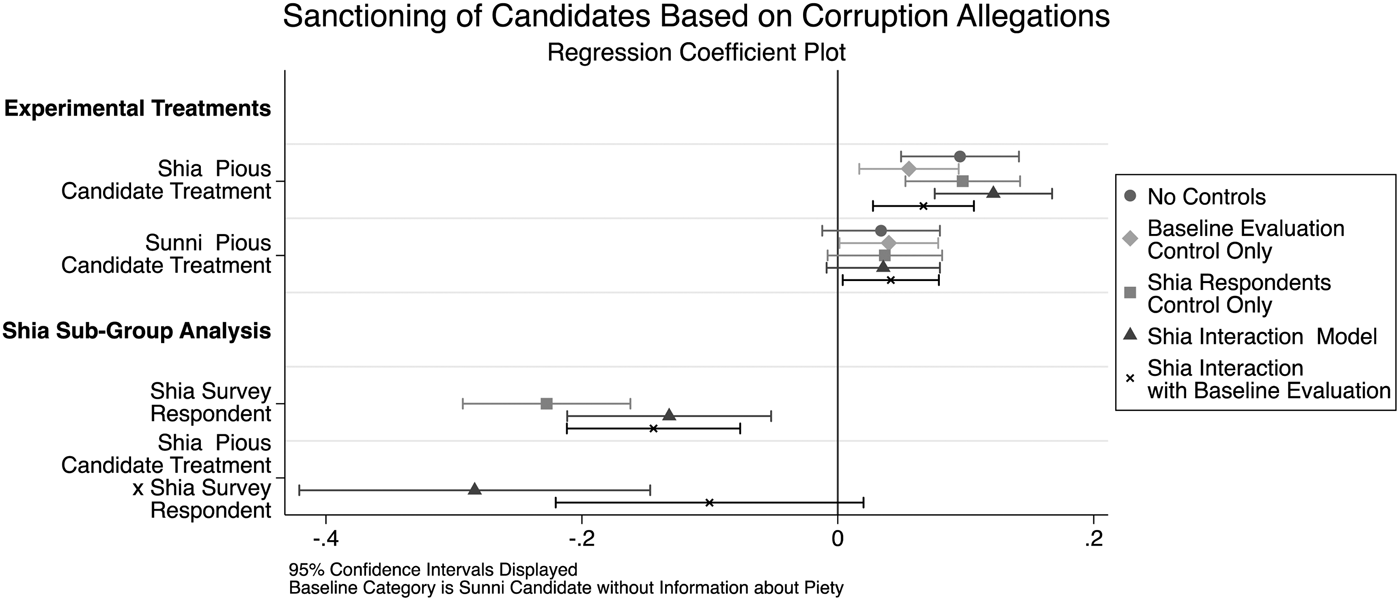
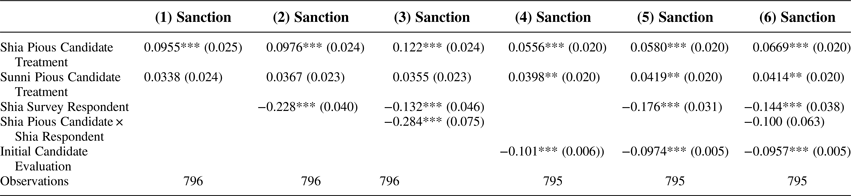
In order to make comparisons between our two treatment conditions involving a pious Sunni and pious Shia candidate with our control condition involving a Sunni candidate without information about piety, we employ a regression framework. Table 5 displays results from our analysis of how allegations of corruption affect respondent willingness to sanction candidates. Model 1 contains only indicator variables for the treatment assignment without controlling for any covariates. Models 2 through 6 contain controls for Shia respondents while models 3 and 6 include an interaction effect; the reference category throughout is a Sunni respondent. The significance of our coefficient estimates all reflect the results we obtain in our difference of means t-tests. Finally, models 4–6 introduce a control for the respondent's original evaluation of the candidate prior to being given information about either the candidate's religious piety or the corruption allegations. Introducing the initial candidate evaluation into these regression models allows us to consider with greater precision how information about piety itself alters respondent willingness to sanction candidates. This is important since respondents who are initially predisposed to feel positively about the candidates are generally less inclined to sanction them. Conditional on the respondent's initial evaluation of the candidate prior to experimental religious treatment, our results show that Sunni respondents sanction not only the Shia religious candidates but also the Sunni religious candidates relative to a Sunni candidate about whom no information about personal piety is provided. The former is statistically significant at p < 0.001 while the latter is significant at p < 0.05. For the latter, coefficient estimates for Sunni respondents in all of our models suggest that they are more inclined to punish a nominally religious or pious candidate for corruption relative to an identical candidate who does not claim to be religious. Moreover, the interaction effect wherein Shia respondents are less likely to penalize Shia candidates loses significance, suggesting that this may well be an artifact of their initial preference for the Shia religious candidate as a member of their sectarian in-group rather than as a religious candidate per se. To facilitate comparison, we present these regression coefficients graphically in Figure 2. For our purposes, the evidence suggests that, all things equal, respondents tended to penalize self-declared religious candidates for corruption relative to candidates facing the same allegations who make no such claims.
Coefficient plot of candidate sanctioning based on corruption allegations.

How allegations of corruption affect willingness to sanction candidate

*p < 0.10, **p < 0.05, ***p < 0.01.
Estimates are based on an ordinary least squares (OLS) model with robust standard errors shown in parentheses. The baseline comparison is a Sunni candidate about whom no information about personal piety is given. As in Table 4, our dependent variable is a normalized variable that measures the extent to which respondents would be less likely to vote for the candidate based on allegations of corruption, with more positive values indicating greater willingness to sanction, i.e., not vote for the candidate. Model 1 controls only for treatment assignment while Models 2 and 3 introduce controls for Shia respondents with the latter including co-sectarian interaction effects. Models 4–6 include the initial candidate evaluation prior to information about corruption allegations in order to isolate the effect of the corruption allegations themselves on respondents’ willingness to sanction. After controlling for this baseline evaluation, the magnitude and significance of the coefficients on the pious Sunni candidates become greater and statistically significant, suggesting that the allegations of corruption hurt them more than an otherwise identical Sunni candidate who does not claim to be pious.
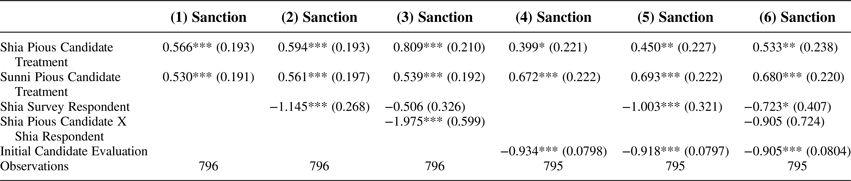
For robustness, we also consider an alternative binary re-specification of the dependent variable that takes on a value of 1 if respondents indicate that the corruption allegations make them less inclined to vote for the candidate and 0 otherwise. Results are shown in Table 6. Under all model specifications, Sunni respondents are more willing to sanction Sunni candidates when information about their personal religiosity is mentioned compared to when it is not. Here, although the willingness to sanction Shia and Sunni religious candidates is statistically significant relative to the Sunni candidate that is not explicitly pious, neither of these two estimates are statistically different from one another in the model that we estimate.
Robustness check: How allegations of corruption affect willingness to sanction candidate with binary outcome variable

*p < 0.10, **p < 0.05, ***p < 0.01.
Estimates are based on a binary logistic model with robust standard errors shown in parentheses, with the dependent variable taking a value of 1 if respondents indicate that they are either “somewhat” or “much less” likely to vote for the candidate and 0 otherwise. Again, the baseline comparison is a Sunni candidate about whom no information about personal piety is given. Model 1 controls only for treatment assignment, while Models 2 and 3 introduce controls for Shia respondents with the latter including co-sectarian interaction effects. Models 4–6 include the initial candidate evaluation prior to information about corruption allegations in order to isolate the effect of the corruption allegations themselves on respondents’ willingness to sanction.
DISCUSSION
The preceding analysis demonstrates several key findings. First, consistent with social categorization theory, survey respondents display statistically significant preferences for political candidates from their sectarian in-group relative to out-group candidates. Second, this in-group preference manifests in different ways depending on whether we examine our minority Shia or majority Sunni survey respondents. Sunni preferences for Sunni candidates were expressed via out-group derogation (Tajfel and Turner Reference Tajfel and Turner1979) by assigning Shia candidates a relatively lower evaluation. In contrast, Shia respondents did not penalize Sunni candidates compared to Sunni respondents, but more positively evaluated candidates from their own in-group. This Shia in-group preference is significantly greater than the Sunni co-sectarian preference. Indeed, Shia respondents are significantly less likely than Sunnis to punish pious candidates for corruption across both in-group and out-group treatment conditions. Third, [Sunni] respondents were not only likely to sanction the pious candidate from a sectarian out-group for corruption relative to the pious candidate from their religious in-group but were also more likely to punish the in-group pious candidate relative to an in-group candidate who makes no claims to personal piety. We term this finding a “hypocrisy effect” in which voters disproportionately punish candidates purporting to be pious for corrupt and deceitful behavior compared to candidates who make no such claims. We suggest that priming the religious identity of candidates causes potential voters to evaluate candidates according to a higher standard of conduct and then punish them accordingly for failing to meet such standards.
This finding is striking and speaks to a broader disenchantment among respondents in our survey with mixing religion and mainstream politics. In fact, as demonstrated earlier, more Sunni respondents said that they were less likely to vote for the candidate after they heard of his piety (and before any information concerning allegations of corruption) than more likely to vote for him. This was true for both the in-group Sunni candidate and, as expected, for the out-group Shia candidate. The large percentage of Sunni individuals who sanctioned the hypothetical candidates, including in-group candidates, for their piety is particularly intriguing given that this was a soft prime emphasizing individual piety rather than support for an Islamic party platform.
It may be the case that our treatment's mention of piety as a quality that the candidate described about himself was perceived by respondents as a self-serving effort to win public esteem, rather than a genuine quality. However, our descriptive statistics from the survey do lend support to the reading that respondents are generally cynical about introducing religion into the political arena. Only 16% of the respondents, for example, believed that Islamic parties were better than non-religious parties operating in Pakistan while 42% believed them to be worse than other parties.Footnote 9 Nearly 73% believed that religious leaders lost at least some credibility when they joined political parties or the government with less than 7% saying that such leaders gained credibility. While our experimental prime involves personal piety rather than party platforms, these statistics are surprising given the high levels of respondent religiosity. Indeed, the vast majority of respondents prayed and went to the mosque daily and kept all religious fasts. Self-reported statements of religiosity are of questionable reliability and must be taken with a grain of salt; yet, respondent antipathy toward mixing religion and politics is unlikely to be due to any obvious bias and runs contrary to much of the received wisdom about the power of religiously-based political appeals in Pakistan.
Concerning the results for the Shia respondents in our sample, we believe there are several possible explanations that may help explain why they display consistently high levels of in-group favoritism without the out-group negativity or derogation that is frequently assumed by empirical researchers to be reciprocally related (Brewer Reference Brewer2007). It seems plausible that Shias, as members of a minority group, exhibit greater levels of psychological identification with the group to which they belong compared to their Sunni counterparts. They may exhibit this identification in order to compensate for the vulnerability associated with belonging to the smaller group (Sachdev and Bourhis Reference Sachdev and Bourhis1984), or simply because the smaller group size causes Shia respondents to perceive the group to be more homogenous, and therefore they consider a Shia candidate to be more like them (Simon and Brown Reference Simon and Brown1987).
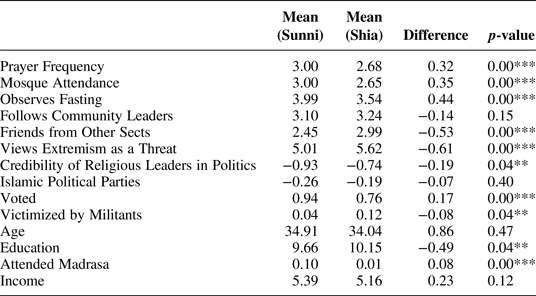
The relatively small number of Shia individuals in the sample means we must exercise caution in making broad inferences about this group, but our sample of Shia respondents was significantly different from Sunni respondents in our survey as can be seen in the summary statistics in Table 7. For example, while Shias and Sunnis alike tended to view Islamist parties negatively, compared to Sunni respondents, Shia respondents claimed significantly lower levels of religiosity, higher numbers of friends from the other sect, and were more likely to view violent extremism as a threat and experience victimization first-hand.
Key summary statistics by respondent sect

Notes: All variables are coded such that greater values mean greater frequency (prayer, mosque attendance, fasting), greater agreement (follows community leaders, considers extremism a threat) or higher values (age, education, income). Variables measuring attitudes towards Islamist parties and towards religious leaders in politics are centered at 0 such that negative values indicate negative views. Voting and victimization are binary indicators taking the value of either one or zero.
As a minority group in Pakistan that faces frequent discrimination as well as such violence, we believe that social desirability bias may also play some role in Shia respondents under-reporting their true preferences vis-à-vis sectarian out-groups compared to Sunni respondents who may not feel that displays of negative attitudes toward Shias will be construed as socially unacceptable. It is also possible that the Shia community of Pakistan is so accustomed to considering representation by nominal Sunni politicians such that in this context out-group derogation is not expressed. However, we argue that it is more likely the case that the Shia exhibit higher degrees of in-group cohesiveness because they are a minority group that faces significant persecution at the hands of society at large and must consequently exhibit more self-reliance. As such, group norms that promote in-group favoritism would be advantageous to survive in such a hostile environment. In this context, allegations about a corrupt candidate may be viewed by in-group members as a broader attack against them or their kin rather than a personal failing on the part of the individual candidate, which may thereby cause the rallying effect our results suggest. A separate logic explaining this result is that members of the minority groups may feel that they benefit from any form of corruption in which individual co-ethnic candidates partake. However, we argue this is unlikely to be the case here because the forms of corrupt behavior described do not easily transfer to gains for other in-group members.
CONCLUSION
Experiments embedded in our survey of 796 Muslim men in Quetta, Balochistan allow us to reach three primary conclusions. First, as hypothesized, voters generally express in-group favoritism and are significantly more punitive of corrupt behavior committed by candidates from sectarian out-groups. While our Shia respondents tended to express favorable opinions of in-group candidates described as pious, Sunni respondents surprisingly tended to respond negatively to prompts about candidate piety from both in- and out-group candidates alike. Second, as expected, we observe heightened levels of in-group preferences for the Shia minority group we sampled. Finally, we found evidence for our hypothesis of a “hypocrisy effect” in which voters disproportionately punish candidates purporting to be pious for bad behavior compared to an otherwise identical candidate who makes no such claims. Restated, appeals to religion and personal piety can cause a backlash from voters when candidates fall short of the higher moral standards that they implicitly invoke. Our findings suggests that candidates may at times incur higher electoral costs for using religion even implicitly if it raises voter expectations in ways they are unable to meet.
Scholars have presumed that appeals to religion, particularly in the Muslim world, confer a distinct political advantage to secular alternatives. Our research builds on existing work by suggesting that this view be tempered by greater awareness of the conditions under which appeals to religion may be a hindrance as well as a help. Policy-wise, practitioners would do well to refrain from automatically assuming that people in Muslim-majority countries invariably prefer religious candidates to secular ones. Indeed, despite the near-daily invocations of religion in Pakistani public discourse, Islam's place as the official state religion, and the presence of Islamist parties in the country's electoral history, our study found ample evidence of public disenchantment with the mixing of religion and politics amongst people who otherwise declare themselves to be extremely observant. Given some of the limitations of our sampling strategy, future work can profitably extend this research by testing these hypotheses in areas with greater variation in the salience of sectarian cleavages as well as further identifying the factors that may lead religious people to view the mixing of religion and politics with disdain.