Introduction
Abnormalities in emotion have been noted as a core feature of schizophrenia since Kraepelin (Reference Kraepelin, Barclay and Roberston1919) and Bleuler (Reference Bleuler1972) first observed the significance of affective disturbances. Individuals with schizophrenia consistently display deficits in the recognition of emotion (Muzekari & Bates, Reference Muzekari and Bates1977; Mueser et al. Reference Mueser, Penn, Blanchard and Bellack1997; Kohler et al. Reference Kohler, Bilker, Hagendoorn, Gur and Gur2000), which are independent of demographic factors or medication status (Kline et al. Reference Kline, Smith and Ellis1992; Schneider et al. Reference Schneider, Gur, Gur and Shatsel1995; Salem et al. Reference Salem, Kring and Kerr1996; Poole et al. Reference Poole, Tobias and Vinogradov2000; Herbener et al. Reference Herbener, Hill, Marvin and Sweeney2005). Furthermore, emotion recognition deficits are present in individuals at heightened risk for schizophrenia (Gooding & Tallent, Reference Gooding and Tallent2003; Phillips & Seidman, Reference Phillips and Seidman2008; Eack et al. Reference Eack, Mermon, Montrose, Miewald, Gur, Gur, Sweeney and Keshavan2010; Amminger et al. Reference Amminger, Schäfer, Papageorgiou, Klier, Schlogelhofer, Mossaheb, Werneck-Rohrer, Nelson and McGorry2011, Reference Amminger, Schäfer, Klier, Schlögelhofer, Mossaheb, Thompson, Bechdolf, Allott, McGorry and Nelson2012) and first-episode schizophrenia patients (Edwards et al. Reference Edwards, Pattison, Jackson and Wales2001; Herbener et al. Reference Herbener, Hill, Marvin and Sweeney2005; Amminger et al. Reference Amminger, Schäfer, Klier, Schlögelhofer, Mossaheb, Thompson, Bechdolf, Allott, McGorry and Nelson2012). Difficulties in emotion recognition have been found to be associated with poorer social functioning in out-patients with schizophrenia (Mueser et al. Reference Mueser, Doonan, Penn, Blanchard, Bellack, Nishith and de Leon1996; Penn et al. Reference Penn, Corrigan, Bentall, Racenstein and Newman1997; Hooker & Park, Reference Hooker and Park2002; Couture et al. Reference Couture, Penn and Roberts2006; Pinkham & Penn, Reference Pinkham and Penn2006) and social cognitive functioning is believed to be uniquely related to overall social functioning, above and beyond what can be explained by general neurocognitive deficits (Pinkham & Penn, Reference Pinkham and Penn2006; Sergi, et al. Reference Sergi, Rassovsky, Nuechterlein and Green2006).
Much of what we know about emotion recognition deficits in schizophrenia has been obtained from studies using static faces as stimuli (Edwards et al. Reference Edwards, Jackson and Pattison2002; Kohler et al. Reference Kohler, Walker, Martin, Healey and Moberg2010). These results from studies of facial emotional expressions are supported by a more sparse body of literature on prosody (Edwards et al. Reference Edwards, Jackson and Pattison2002; Leitman et al. Reference Leitman, Foxe, Butler, Saperstein, Revheim and Javitt2005; Hoekert et al. Reference Hoekert, Kahn, Pijnenborg and Aleman2007; Cohen et al. Reference Cohen, St-Hilaire, Aakre and Docherty2009). Although the inclusion of auditory stimuli (for example, emotional prosody) leads to a more holistic understanding of the nature of emotion recognition deficits in schizophrenia, faces and, to some extent, voices are physically proximal cues; the extraction of socially relevant information occurs within a close distance from the subject. In contrast, human movement cues can be detected at a distance, out of an immediate social interactional range. In other words, an individual's gait or body movements can provide rich, proximal and distal information in the way of social communication (Barclay et al. Reference Barclay, Cutting and Kozlowski1978; Dittrich et al. 1998; Ikeda & Watanabe, Reference Ikeda and Watanabe2009).
The study of gait perception has often utilized point light displays (PLDs; Blake & Shiffrar, Reference Blake and Shiffrar2007) in studies of ‘biological motion’, referred to as movements elicited by living things. Biological motion is integral to accurate social perception. Such sparse and impoverished stimulus presentation in PLDs can provide a surprisingly robust presentation of a wide range of socially relevant information. Moreover, the presence of affective information appears to enhance our ability to detect biological motion. Chouchourelou et al. (Reference Chouchourelou, Matsuka, Harber and Shiffrar2006) demonstrated that the presence of emotion in gait enhanced the perception of biological motion. Beyond the overall enhancement of biological motion detection, the authors found that the presence of anger in the movement had a uniquely facilitative effect on the detection of biological motion. Similarly, Ikeda & Watanabe (Reference Ikeda and Watanabe2009) reported that discriminability of biological motion was enhanced when it contained emotional content. Thus, the presence of emotional components in human movement seems to aid in its detection and provide salient distal cues for subsequent social behavior.
The accurate identification of socially relevant information from gait is crucial in preparing appropriate social behaviors. For example, detection of anger or joy in a person approaching from a distance allows us to prepare accordingly well before we are able to ascertain the identity of this person. In a natural setting, we usually perceive someone from a distance prior to face-to-face social interactions. Therefore, accurate recognition of a potential social partner's gait as aggressive or gregarious provides an important input towards the preparation of appropriate social action. Activation of appropriate social schemata primes us to act appropriately in context. For example, we act differently depending on the perceived gender or emotional state of our social partner (Smoski & Bachorowski, Reference Smoski and Bachorowski2003; Campbell et al. Reference Campbell, Neuert, Friesen and McKeen2010).
To our knowledge, very little is known about the recognition of social cues in gait in the psychiatric literature. Couture et al. (Reference Couture, Penn, Losh, Adolphs, Hurley and Piven2010) recently compared social cognitive processes in individuals with schizophrenia (SZ) and high-functioning individuals with autism (HFA) using PLDs. HFA and SZ performed significantly worse in the perception of emotion presented in PLDs than healthy controls (CO). Moreover, perception of happiness was more problematic than other emotions for SZ. On the other hand, another study (Henry et al. Reference Henry, Hippel von, Ruffman, Perry and Rendell2010) found a specific deficit of fear perception in gait using PLDs in schizophrenia. However, this study suffered from a very small number of trials. Thus, the nature of emotion recognition deficits from gait in schizophrenia is still poorly understood.
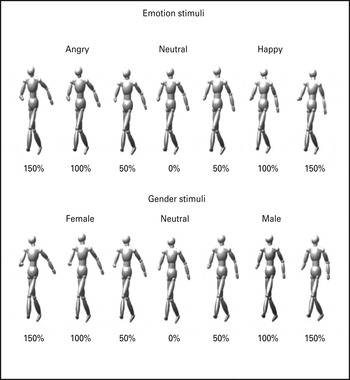
One potential problem with using PLDs to study emotion perception is that SZ are impaired in processing biological motion from PLDs. Specifically, SZ tend to ‘see’ human movements even in random noise (Kim et al. Reference Kim, Doop, Blake and Park2005, Reference Kim, Park and Blake2011). Therefore, impairments in emotion perception using PLDs may be confounded with a difficulty in discriminating human movements from non-biological motion. To circumvent this confound, while keeping the visual characteristics of stimuli simple, the current study used volumetric, polygonal avatars (Roether et al. Reference Roether, Omlor, Christensen and Giese2009). These avatars, unlike PLDs, provide explicit body form information (i.e. skeletal structure) whereas PLDs provide implicit form information through coordinated movement of dots (see Fig. 1).
Example of the gait stimuli used in both the emotion and gender recognition tasks. Each stimulus had three signal intensities (50%, 100%, 150%). Participants viewed a fixation cross for 1000 ms and then the stimulus was presented for 1000 ms. After stimulus presentation, participants indicated their chosen response with one of two keys. There was no response time limit.

Emotion recognition plays an important role in social interactions (Hooker & Park, Reference Hooker and Park2002), but it is unclear whether emotion and social perception difficulties arise from the same underlying perceptual processes. Therefore, it would be useful to investigate emotion and social cue recognition using the same stimuli and methods, in order to better understand the origins of social cognitive impairments in schizophrenia. The goal of the current study was to investigate whether SZ exhibit a deficit in the recognition of social information such as emotional state or gender, in gait. We were also interested in how the intensity of a social cue signal might interact with the likelihood of accurate emotion or gender recognition of the stimulus. Parametrically adjusted intensity levels of the emotion and gender were incorporated in order to identify whether there is a point at which patients would perform similarly to CO. By including a parametric adjustment of the intensity levels for the emotions and gender cues, we were able to look at how the intensity of the social cues affected participants' sensitivity to the social cues.
We selected two ‘approach’ emotions, happy and angry, of opposite valence (positive versus negative) (Davidson, Reference Davidson1998) to control for any directional cue that could confound the results. The speed with which the stimuli moved was also equated across both happy and angry gait in order to isolate the influence of coordinated postural cues on emotion and gender recognition. In accordance with Couture et al. (Reference Couture, Penn, Losh, Adolphs, Hurley and Piven2010), we predicted that SZ would show deficits in discriminating the emotions present in the gait stimuli. We expected gender recognition from gait would be intact because there has not been any evidence to indicate that SZ are impaired in gender perception. We expected no clear relationship between emotion perception from gait and clinical symptoms because emotion recognition has been suggested to be an endophenotypic marker for schizophrenia and therefore would be state-independent (for example, Kee et al. Reference Kee, Horan, Mintz and Green2004; Eack et al. Reference Eack, Mermon, Montrose, Miewald, Gur, Gur, Sweeney and Keshavan2010). This is consistent with the conclusion of a recent meta-analysis on facial emotion recognition performance and clinical symptoms, which indicated that there is no consistent relationship. Lastly, we expected social functioning to be associated with both emotion and gender discrimination as accurate extraction of emotion and gender cues from distant stimuli (i.e. gait) would be important for preparing to either enter or withdraw from impending social interactions.
Method
Participants
A total of 22 SZ were recruited from a local out-patient clinic. Diagnoses were confirmed according to the Diagnostics and Statistical Manual of Mental Disorders, Fourth Edition Text Revised (DSM-IV-TR) using structured clinical interviews (SCID; First et al. Reference First, Spitzer, Gibbon and Williams2002). A total of 19 SZ were taking atypical antipsychotics (clozapine, olanzapine, risperidone, quetiapine, aripiprizole), two were taking typical antipsychotics (haloperidol, thiothixene), and one was taking venlafaxine. Clinical symptoms were assessed using the Brief Psychiatric Rating Scale (Overall & Gorham, Reference Overall and Gorham1962), the Scale for the Assessment of Positive Symptoms (Andreasen, Reference Andreasen1984a ), and the Scale for the Assessment of Negative Symptoms (Andreasen, Reference Andreasen1984b ).
A total of 20 healthy CO were recruited from the same community as SZ using advertisements. All CO were screened for current and prior history of Axis I disorders using the SCID (First et al. Reference First, Spitzer, Gibbon and Williams2002) and a history of psychosis in their first-degree relatives.
Exclusion criteria for both groups were as follows: intelligence quotient (IQ) score lower than 85, a prior history of head injury or neurological disorder or history of drug use in the year prior to the study.
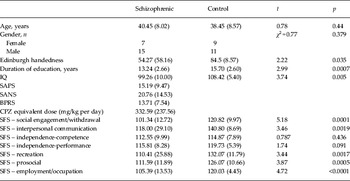
IQ was estimated using the National Adult Reading Test-Revised (Blair & Spreen, Reference Blair and Spreen1989), an assessment tool measuring pre-morbid IQ. All subjects were assessed to be of at least average intelligence. Years of education were also assessed. All participants had normal or corrected-to-normal vision. Participants gave written informed consent as approved by the Vanderbilt Institutional Review Board. The two groups were matched on age and gender but not IQ or years of education. Table 1 presents the demographic information.
Demographic characteristics of schizophrenic and control participants

Data are given as mean (standard deviation).
Intelligence quotient; SAPS, Scale for the Assessment of Positive Symptoms; SANS, Scale for the Assessment of Negative Symptoms; BPRS, Brief Psychiatric Rating Scale; CPZ, chlorpromazine; SFS, Social Functioning Scale.
Design
Stimuli
A detailed description of the creation and standardization of the stimuli can be found elsewhere (Giese & Lappe, Reference Giese and Lappe2002; Roether et al. Reference Roether, Omlor, Christensen and Giese2009). The stimuli were volumetric polygonal figures walking towards the viewer angled to the participant's left side, in order to provide full perspective of gait. The dimensions for the movies were 672 × 504 pixels and the figure within had a height of 391 pixels. For an example of the stimuli used, see Fig. 1. Stimuli were constructed using motion morphing (Giese & Poggio, Reference Giese and Poggio2000) based on the three female and three male angry and happy gait movements that have been rated to be highly expressive (Roether et al. Reference Roether, Omlor, Christensen and Giese2009) as prototypes. Morphing was done on a continuous axis from happy to angry or from female to male. This morphing allowed for parametric adjustment of the emotional or gendered ‘signal’ in the stimulus. Therefore, for each stimulus type (for example, ‘happy’, ‘angry’, ‘male’, ‘female’) three stimuli were created varying in the intensity of the particular signal. For example, three happy gait stimuli were created: a 50% (attenuated) happy gait walker, a 100% (prototypical) happy gait walker, and a 150% (exaggerated) happy gait walker. These three levels of signal intensity for all of the stimuli allowed for the investigation of whether exaggeration or attenuation of the social information ‘signal’ affected performance in the SZ compared with CO.
In the emotion recognition condition, the stimuli were devoid of gender components in gait. Aspects of the movement that defined the emotional content in the emotion stimuli were flexion of the head and arms (head tilted forward for anger and tilted backward for happy), and postural positioning of the torso (pitched forward for anger and leaned back for happy). Likewise, in the gender recognition condition, the stimuli were devoid of emotional components in gait. The aspects of movement that defined gendered movement were greater hip sway side to side for female gait and greater rotation of the torso for male gait. The neutral stimulus was devoid of emotional or gender components in its gait. There were three categories of stimuli for the emotion recognition task: happy, angry and neutral. In the happy and angry categories, there were three levels of signal intensity: 50%, 100% and 150%. In each task, the three intensities were evenly distributed across the emotion and gender trials.
For each task, there were 224 trials consisting of 32 neutral trials, 96 happy/female and 96 angry/male trials presented across eight blocks. Neutral stimuli did not vary in intensity. Thus, within one block there were four neutral trials, 12 happy/female (4 × each intensity level) and 12 angry/male (4 × each intensity level) trials. Presentation of the stimuli was randomized within each block.
For both tasks, participants sat 16.5 inches (42 cm) away from the screen of a Macintosh computer with a 32-inch (81 cm) screen. Both tasks were presented with PsyScope (http://psy.ck.sissa.it/). The order of presentation of the two tasks was counter-balanced across participants. All participants were given detailed instructions and provided with five gender and five emotion practice trials to make sure that they understood the task procedure. Participants were informed that accuracy was more important than speed and that there was no time limit for a response. After each block of trials, participants were allowed to take a short break before continuing.
Procedure
Emotion recognition task
At the beginning of the task participants were told that they would be viewing walking mannequins and would then be asked to make a decision on whether the mannequin's gait seemed happy or angry. Participants were asked to place their left and right index fingers on two keys labeled with H (for happy) and A (for angry), respectively. Each stimulus was presented for 1 s. After viewing the stimulus, participants were asked to press H or A. There was no time limit for participants to respond. An example of each of the stimuli used is presented in Fig. 1.
When determining a participant's performance on the emotion task, responses to the neutral stimulus (32 trials) were not included in the analyses.
Gender recognition task
Participants were instructed that they would be viewing mannequins walking and that they would make a decision on whether the mannequin's gait was like that of a female or a male. Responses for this task were made by pressing the keys labeled ‘F’ or ‘M’ with their left or right index fingers to indicate if they thought the mannequin's gait was female or male, respectively. Each stimulus was presented for 1 s. After viewing the stimulus, participants were asked to press F or M. There was no time limit for participants to respond.
Responses to the neutral stimulus (32 trials) were not included in the performance analyses.
Social functioning
The Social Functioning Scale (α = 0.75; SFS; Birchwood et al. Reference Birchwood, Smith, Cochrane, Wetton and Copestake1990) was used to evaluate recent social functioning. The SFS is an interview-based assessment of social functioning over the past 3 months. It is comprised of seven subscales: social engagement/withdrawal, interpersonal communication, independence-performance, independence-competence, recreation, prosocial, and employment/occupation. Scores are reported in their standardized form.
Data analysis
To determine sensitivity indices for discriminating happy from angry or male from female, d' was calculated according to signal detection theory (SDT; Green & Swets, Reference Green and Swets1966); d' indicates the sensitivity of an individual in discriminating two different categories by subtracting the proportion of hits by the proportion of false alarms. For the current study, identifying a happy stimulus as happy or a female stimulus as female was defined as hits. Identifying an angry stimulus as happy or a male stimulus as female was defined as false alarms.
To calculate the biases, or the tendency to engage in a particular response style on the tasks, the formula for bias (C) in a forced-choice paradigm was used as indicated by SDT (Green & Swets, Reference Green and Swets1966). C is calculated by summing the proportion of hits and false alarms and then subsequently multiplying by −0.5, which results in a metric indicating the direction and magnitude of an individual's response style. Thus, a negative value of C indicates a response style of identifying the emotional walkers as happy or the gendered walkers as female. Conversely, a positive value of C indicates a response style towards identifying the emotional walkers as angry or the gendered walkers as male.
Group difference in discrimination sensitivity (d') was tested with repeated-measures analysis of variance (ANOVA) with diagnosis as the between-groups factor and task and stimulus intensity as the within-groups factor. Response bias (C) for each task was tested with two repeated-measures ANOVAs with diagnosis as the between-groups factor and stimulus intensity as the within-groups factor.
Spearman's correlations were performed to examine associations between performance on the gait tasks, social functioning, and clinical symptoms. Associations between performance and total scores on the three symptom scales were conducted; further exploration into subscale associations was conducted contingent upon a significant association between performance and total scores. All tests were two-tailed.
Significant group differences in years of education and estimated IQ were found; therefore statistical analyses were performed with education and IQ as covariates. The results remained unchanged with or without the covariates. Thus, the results are presented without the covariates included in the performance analyses.
Results
Discrimination sensitivity (d')
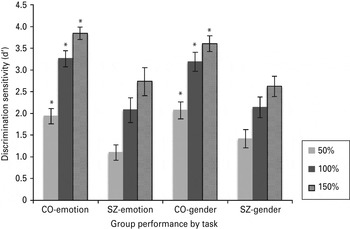
See Fig. 2 for results. There was a main effect of diagnostic group, whereby SZ exhibited significantly less sensitivity to discriminating social cues from gait compared with CO (F 1,40 = 16.94, p < 0.001, η 2 p = 0.298). Discrimination sensitivity was similar across tasks (F 1,40 = 0.008, p = 0.93, η 2 p = 0.00). There was a main effect of intensity, whereby performance improved as the intensity of social cues increased (F 2,80 = 220.55, p < 0.0001, η 2 p = 0.846). The magnitude of performance deficits in SZ was similar for both tasks compared with CO as indicated by the lack of a group × task interaction (F 1,40 = 0.18, p = 0.67, η 2 p = 0.005). The group × intensity interaction was significant (F 2,80 = 3.37, p = 0.04, η 2 p = 0.078). Post-hoc analysis revealed that for the CO performance improvement from the 50% intensity to the 100% intensity was significantly greater than the SZ (t 80 = 2.44, p = 0.016). The task × intensity interaction also was significant (F 2,80 = 4.27, p = 0.02, η 2 p = 0.097). Finally the group × task × intensity interaction was not significant (F 2,80 = 0.03, p = 0.97, η 2 p = 0.001).
Discrimination sensitivity (d') for both groups' performances on the emotion recognition task and the gender recognition task. Values are means, with standard errors represented by vertical bars. * Healthy controls (CO) were significantly better at discriminating the emotion stimuli and gender stimuli compared with schizophrenia patients (SZ) (p < 0.05). Higher values indicate greater ability in discriminating the stimuli from one another.

Bias (C)
Emotion recognition task
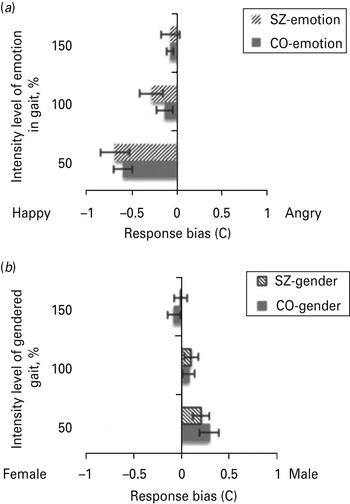
See Fig. 3 a for results. The two groups did not differ in their response bias towards identifying the stimuli in the emotion recognition task as happy (F 1,40 = 0.28, p = 0.60, η 2 p = 0.007). Across both groups, response bias magnitude decreased as the intensity of the emotional cues increased (F 2,40 = 47.90, p < 0.0001, η 2 p = 0.545). Tukey's honestly significant difference (HSD) analyses indicated that response bias magnitude was significantly reduced from the 50% signal intensity to the 100% signal intensity whereas the reduction in response bias magnitude from the 100% signal intensity to the 150% signal intensity was strongly trending towards significance. The two groups did not differ in this decrease in response bias magnitude with increasing intensity of the emotional cues (F 2,80 = 0.79, p = 0.46, η 2 p = 0.019).
Response bias (C) for both groups' performances on (a) the emotion recognition task and (b) the gender recognition task. Values are means, with standard errors represented by vertical bars. The healthy controls (CO) and schizophrenia patients (SZ) showed similar response biases on both tasks. Across both groups, response bias was reduced as the emotion/gender cue signal intensity increased. Negative values indicate a response bias towards identifying the stimuli as happy/female whereas positive values indicate a response bias towards identifying the stimuli as angry/male.

Gender recognition task
See Fig. 3 b for results. Both groups exhibited a similar response bias towards identifying the stimuli as male (F 1,40 = 0.0041, p = 0.95, η 2 p = 0.000). Similar to the emotion recognition task results, the magnitude of C decreased as the cue intensity increased (F 2,40 = 18.59, p < 0.0001, η 2 p = 0.317). Tukey's HSD pairwise comparisons indicated that all three intensity levels were significantly different from each other at p = 0.05. Finally, the two groups did not significantly differ in their reductions in response bias magnitudes as the cue intensity increased (F 2,80 = 1.47, p = 0.26, η 2 p = 0.036). The bias toward detecting ‘male’ in our participants could be driven by their own gender. There were more men than women in our sample. Therefore, we examined the C for male and female participants and found no significant gender difference in response biases (t 40 = 0.017, p = 0.98).
Correlations
Associations between performance, social functioning and symptom severity are presented collapsed across intensities for descriptive clarity and redundancy of findings at each level.
For CO, neither d' nor C on either task was associated with social functioning.
For SZ, d' on the emotion task was not correlated with the severity of symptoms or social functioning. However, their response bias for the emotion task was significantly and negatively associated with both the social engagement and interpersonal communication subscales of the SFS (r ρ = −0.49, p = 0.02 and r ρ = −0.43, p = 0.04, respectively). Specifically, SZ who were more likely to report perceiving the gait as happy were also more likely to report greater social engagement and better interpersonal communication abilities. There were no significant relationships between response bias and symptoms.
The d' of SZ on the gender task was unassociated with symptoms but was positively correlated with the independence-competence subscale of the SFS (r ρ = 0.45, p = 0.03). Thus, SZ who were better able to discriminate male from female gaits were better at carrying out daily living activities. There were no correlations with symptoms.
Discussion
In this study we examined sensitivity to gait-presented social cues in SZ and CO. Emotion cue sensitivity was assessed using volumetric avatars expressing either happiness or anger in their movement. Gender cue sensitivity was assessed using volumetric avatars whose gait was feminine or masculine to examine non-emotive social cue perception. We used volumetric avatars rather than PLDs to circumvent potential confounds arising from difficulties discriminating biological from non-biological motion in SZ (Kim et al. Reference Kim, Doop, Blake and Park2005, Reference Kim, Park and Blake2011), as we were concerned with the perception of social cues in gait rather than the perception of biological motion per se. Consistent with our predictions, we found reduced discrimination sensitivity for gait-presented emotion in SZ. Interestingly, SZ also exhibited significantly reduced discrimination sensitivity in identifying gender in gait compared with CO, which suggests that their difficulty in extracting socially relevant information from distal cues is not limited to emotion. While SZ were less sensitive to the social cues on both tasks, their sensitivity improved as the intensity increased, similar to the pattern observed in CO. These findings are partially consistent with the report by Kohler et al. (Reference Kohler, Turner, Bilker, Brensinger, Siegel, Kanes, Gur and Gur2003). Similar to the current study, high-intensity facial expression facilitated emotion recognition but SZ were still significantly impaired compared with CO. These findings suggest that SZ are able to detect socially relevant information in gait or face albeit with greater difficulty than CO. Finally, it is unclear whether the deficits exhibited by the SZ group are reflective of a specific social information perception deficit or due to generalized cognitive impairment. While performance deficits persisted after controlling for IQ and education, the explanation of a generalized deficit cannot be ruled out.
SZ and CO did not differ in their response bias on gait tasks. Therefore, reduced sensitivity to social cues in SZ is not due to a strong bias towards a particular response or idiosyncratic responses. It seems that the SZ were picking up on cues in the gait stimuli resulting in a pattern of responses comparable with that of CO. This conclusion is further supported by the similar pattern of results across the intensities of the social cues. Both groups benefited from the increasing signal intensity in the stimuli.
The discrimination sensitivity of the patients was unrelated to social functioning for the most part. It appears that for the SZ, response bias was the variable most associated with daily social functioning. Such associations were not found in CO even though both groups displayed similar response biases. SZ who exhibited a bias towards perceiving the emotional gait avatars as happy also reported greater social engagement as well as better interpersonal communication skills. It is possible that such a bias towards perceiving other individuals as happy and approachable, even if such perceptions are incorrect, would lead SZ to interact more with others. This interpretation cannot be supported directly by the current study because the SFS is an interview-based self-report measure and not an objective assessment of social engagement and interpersonal communication but future research could further elucidate this potential relationship.
With respect to the absence of correlation between clinical symptoms and social cue perception, this is not an unusual finding; there is a fair amount of heterogeneity in the associations between emotion recognition and clinical symptoms (for a review, see Kohler et al. Reference Kohler, Walker, Martin, Healey and Moberg2010). However, it must also be noted that emotion perception deficit has been suggested to be an endophenotypic marker for schizophrenia that is present in prodromal, first-episode and chronic stages regardless of medication (for example, Herbener et al. Reference Herbener, Hill, Marvin and Sweeney2005; Phillips & Seidman, Reference Phillips and Seidman2008; Amminger et al. Reference Amminger, Schäfer, Papageorgiou, Klier, Schlogelhofer, Mossaheb, Werneck-Rohrer, Nelson and McGorry2011, Reference Amminger, Schäfer, Klier, Schlögelhofer, Mossaheb, Thompson, Bechdolf, Allott, McGorry and Nelson2012). Therefore, the absence of correlations between symptoms and emotion perception in the present study may reflect the relative permanence of emotion recognition deficit in schizophrenia.
While we were able to demonstrate deficits in identification of social information in bodily cues, the nature of these impairments requires further elucidation in SZ. Facial emotion recognition literature supports the theory that aberrant attentional allocation when viewing faces leads to deficits in SZ (Phillips & David, Reference Phillips and David1997, Reference Phillips and David1998; Loughland et al. Reference Loughland, Williams and Gordon2002; Loughland, Reference Loughland2004). It is therefore possible that aberrant attentional allocation contributed to the deficits in social cue recognition observed in our study. Future research should investigate the role of attentional allocation in accurate social cue processing. Such work could point to a possible avenue for remediation of these social cognitive deficits.
A limitation of the current study is the lack of a psychiatric control group, which precludes any discussion of specificity of social cue recognition deficits in SZ. Couture et al. (Reference Couture, Penn, Losh, Adolphs, Hurley and Piven2010) did find evidence for cross-diagnostic deficits in emotion recognition from PLDs in both HFA and SZ. Both of these disorders are characterized by significant social impairment, which may be due, in part, to the misreading of social cues inherent in body movement, vocal prosody, or facial expression. Future studies should investigate social cue recognition deficits in other psychiatric disorders to determine not only whether they are present but also the particular patterns of such deficits. Another limitation is the narrow range of emotional gait examined in this study. We focused on two ‘approach’ emotions of opposing valence but the range of emotions expressed by the human body can be vast. Future studies should expand the range of emotions and social cues elicited by the body.
In conclusion, we found a deficit in extracting social information from human movement in SZ. Interestingly, SZ and CO showed a similar facilitation of performance on both emotion and gender tasks when the intensity of the ‘social signal’ was increased. This suggests that SZ are able to take advantage of the increasing signal intensity to guide their decisions. Future studies should investigate the role of signal intensity in social cue detection to determine the feasibility of training SZ. If the sensitivity to the social signal could be increased in SZ by training, this could lead to an improvement in social cognition. Lastly, further research is needed to expand our understanding of social cue perception in SZ and CO from multiple channels. We focused on gait perception in this study while others have studied facial emotion perception or vocal prosody. However, real-life social cognition involves multisensory integration (for example, visual, auditory, somatosensory, olfactory) over multiple channels (for example, voice, facial expression, gait). How social cues presented across multiple channels may be integrated or fragmented during social information processing in schizophrenia is not yet determined but warrants systematic investigation.
Acknowledgements
We would like to thank C. L. Roether for providing us with the gait data of the prototypical walkers. This research was supported by the National Institutes of Health (no. MH073028, no. P30 HD15052, no. T32 MH018921), European Union (FP7 Project TANGO grant no. FP7-249858-TP3, AMARSi grant no. FP7-ICT-248311), German Research Foundation (Deutsche Forschungs Gemeinschaft; DFG; no. GI 305/4-1, no. GZ KA 1258/15-1) and German Federal Ministry of Education and Research (Bundesministerium für Bildung und Forschung; BMBF; no. FKZ 01GQ1002).
Declaration of Interest
None.