


INTRODUCTION
A long line of research on political socialization concerns the intergenerational transmission of political attitudes and behavior through which children come to resemble their parents, with an emphasis on parent-child links, such as social learning and social milieu (Jennings and Niemi Reference Jennings and Niemi1968; Tedin Reference Tedin1974; Jennings and Niemi Reference Jennings and Niemi1981; Sears and Funk Reference Sears and Funk1999; Plutzer Reference Plutzer2002; Jennings, Stoker, and Bowers Reference Jennings, Stoker and Bowers2009). However, scholars have also argued that adolescents have the potential to affect the attitudes and behaviors of their parents through the so-called trickle-up effect (Jennings and Niemi Reference Jennings and Niemi1981; Simon and Merrill Reference Simon and Merrill1998; McDevitt and Chaffee Reference McDevitt and Chaffee2000, Reference McDevitt and Chaffee2002; Linimon and Joslyn Reference Linimon and Joslyn2002). In this paper, I ask the specific question: Does a parent become more likely to vote when one of his or her children enters the electorate?
I contribute by using a regression discontinuity (RD) design in a rich dataset of validated turnout, demographic information, and a parent-child link for Danish voters, to identify how parents become more likely to vote as their child enters the electorate. I rely on validated turnout from Danish voters in four elections. For each election, I find that parents of recently eligible children are more likely to vote compared to parents of children who are just ineligible. The precision weighted average of the effects is 2.8 percentage points, which implies that about one out of nine parents becomes mobilized when his or her child comes of age. The effect is only present for parents who live with their children.
THE EFFECTS OF CHILD CHARACTERISTICS
Although the classic literature primarily focuses on political socialization from parent to child, it acknowledges that children could also affect their parents through so-called reverse socialization (Hyman Reference Hyman1959, 72; Jennings and Niemi Reference Jennings and Niemi1981, 82, 101). This perspective has received recent attention focusing on more complex social patterns explaining the resemblance between parents and children, including the idea that children’s characteristics, attitudes, and behavior can causally affect parents (Jennings, Stoker, and Bowers Reference Jennings, Stoker and Bowers2009; Washington Reference Washington2008; Glynn and Sen Reference Glynn and Sen2015; Urbatsch Reference Urbatsch2014, 9-11). One strand of the literature has emphasized the impact that adolescents have on their parents as they come of age through trickle-up political socialization (Simon and Merrill Reference Simon and Merrill1998; McDevitt and Chaffee Reference McDevitt and Chaffee2000, Reference McDevitt and Chaffee2002; Linimon and Joslyn Reference Linimon and Joslyn2002; Wong and Tseng Reference Wong and Tseng2008). My main contribution is to use a rich administrative dataset to provide new and causally identified evidence to show that trickle-up socialization in families can potentially explain a substantial part of the relationship between parents’ and children’s attitudes and behaviors.
Two mechanisms could explain why parents would become more likely to vote when one of their children enters the electorate. First, parents might have already inculcated a norm, which makes them likely, but not guaranteed, to vote, and as their child enters the electorate, they want to convey that norm to their children (Gidengil, Wass, and Valaste Reference Gidengil, Wass and Valaste2016). Another likely mechanism, which I will call trickle-up socialization, is that a newly enfranchised voter becomes engaged in the election. Parents could either be persuaded to vote or, as McDevitt and Chaffee (Reference McDevitt and Chaffee2002, 292) suggest, parents could adjust their behavior because they take on the role of maintaining family stability, which is enforced when parents and children behave in accordance with each other. In the discussion, I offer some insights from heterogeneous effects suggesting that both potential mechanisms play a role.
Children’s Date of Birth as an Identification Strategy
How do we identify the effect children have on their parents? Comparing voters with and without children would be biased, since people select in to parenthood. Likewise, correlating the behavior of parents and children would be problematic, since that correlation is also driven by traditional socialization and exposure to common surroundings (Cho and Rudolph Reference Cho and Rudolph2008; Jennings, Stoker, and Bowers Reference Jennings, Stoker and Bowers2009). A trivial, yet important, observation is that eligible children may vote, whereas ineligible children will not vote. We can use this to identify how parents respond to their children coming of age. In general, comparing parents with young and old children would also be biased, since voters may have unobserved preferences for when to have children. Instead, comparing parents over the cutoff of their children’s eligibility can give causal identification, at least in a local area around the age threshold. It is a perfect setting for an RD design.
In the RD design, a forcing variable sorts cases into either a treatment or a control condition separated by a threshold (Imbens and Lemieux Reference Imbens and Lemieux2008). In my application, the treatment condition is having a child who is eligible to vote, the control condition is having a child who is not, and the forcing variable is the age of the child in days. If parents of eligible voters show a higher degree of turnout, it means that their eligible child somehow affects them. Previous research has used a similar design to estimate the effect of past eligibility on future turnout and party identification (Meredith Reference Meredith2009; Dinas Reference Dinas2014; Coppock and Green Reference Coppock and Green2015; Bhatti, Hansen, and Wass Reference Bhatti, Hansen and Wass2016; Nyhan, Skovron, and Titiunik Reference Nyhan, Skovron and Titiunik2017). However, to the best of my knowledge, this paper is the first to use it as a source of exogenous variation for family members. This is possible with the rich Danish administrative data.
CONTEXT AND DATA
The study relies on data from two rounds of the Danish municipal elections held on November 17, 2009, and November 19, 2013, the European Parliament elections held on May 25, 2014, and the national election held on June 18, 2015. The municipality elections take place simultaneously in all 98 Danish municipalities every fourth year. The elections had an overall turnout of 65.8% and 71.9% in 2009 and 2013, respectively. The 2014 European Parliament elections are nationwide and held every five years. Turnout in 2014 was 56.3%. The Prime Minister calls the national election no more than four years after the previous election. Turnout in 2015 was 85.8%.
All Danes have a unique civil registration number, which identifies them in public registers. Registration in administrative data is automatic and required for everyone with permanent residence in Denmark. For this study, I have access to de-identified, full population data for all four elections. The Danish administrative data are incredibly rich and contain, among many other things, individual birthdates, ethnicity, sex, education, and income for the entire population. Consequently, I know any person’s exact age in days on election day. The data also include the de-identified civil registration numbers of an individual’s parents, which allows me to easily match parents to their children and deduce if the parents’ children are old enough to vote on election day. I also know voters’ addresses, which allows me to estimate the effects conditioned on cohabitation.
One thing not routinely stored in the public records is turnout. However, in 2009, validated turnout from the official voting records for 2.3 million of 4.4 million voters was linked to the administrative data; in 2013 it was done for 98.9% of all Danish voters; in 2014 it was again done for roughly 2.3 million voters; and in 2015, around 3.1 million voters were linked. The number of included voters varies over elections because, contrary to the rest of the data used in the analyses, the collection of turnout data relied on opt-in participation by the municipalities. In 2009, 2014, and 2015, only some municipalities chose to participate, whereas all did so in 2013. In all four elections, the municipalities committed to participate several months prior to the election.
The fact that varying subsets of municipalities participate across the elections is a challenge. We try to estimate the same parameter across elections, but when the subset changes, so does the parameter that we estimate. Within the participating voting districts in each election, I have data on all voters, allowing me to causally identify effects in the subset of participating municipalities. For 2013, that gives us an effect estimate for the entire country. For all other elections, we get an effect estimate for the municipalities that opted to participate. If that varies, it could be because the effect is different in another election, or because it is a new set of voters being treated in the election, or because voters respond differently in the excluded municipalities.
Although I only have turnout for some municipalities, I still argue that my study has advantages over other studies that have relied on primarily American voter lists. The fact that I have complete voter lists for an entire country in even one election is rare, and the parent-child link is an innovation over previous datasets. For instance, the previous studies using American voter lists rely on statewide voter files for between one and 42 states, plus the District of Columbia (Meredith Reference Meredith2009; Coppock and Green Reference Coppock and Green2015; Holbein and Hillygus Reference Holbein and Hillygus2016; Nyhan, Skovron, and Titiunik Reference Nyhan, Skovron and Titiunik2017). Still, I report two sets of results for my main finding. First, I use all the municipalities with data in each year. For this set, the parameter changes from year to year, which we need to take into account when we take precision weighted averages of the results. Second, I present results for only the 32 municipalities that report turnout in all 4 years. For this set, the target population is fixed over the elections. The results are very similar. Each yearly estimate is well within sampling variability, and the precision weighted averages are 0.09 percentage points apart.
THE CAUSAL EFFECT OF CHILD ELIGIBILITY ON PARENT TURNOUT
In a classic motivation for the RD design, the forcing variable is continuous and the design relies on the assumptions that units are unable to sort exactly around the cutoff, that the potential outcomes are continuous in the cutoff, and that the forcing variable has positive density around the cutoff (Hahn, Todd, and Van der Klaauw Reference Hahn, Todd and Van der Klaauw2001; Lee and Lemieuxa Reference Lee and Lemieuxa2010; Cattaneo, Titiunik, and Vazquez-Bare Reference Cattaneo, Titiunik and Vazquez-Bare2016). It seems reasonable that parents cannot and do not decide when to have children based on an election 18 years later. With respect to the other assumptions, we have, in this case, a discrete forcing variable, the age of the child in days, in which case a polynomial fit implies extrapolation of 1 day, as there are no data on the exact cutoff. Lee and Card (Reference Lee and Card2008, 657-660) recommend using a regression model where the outcome of interest is expressed as an indicator variable for being in the treatment condition plus some function of the forcing variable. I follow their recommendation and, as a heuristic, we can think of a regression of the form
 $$\begin{equation*}
\mbox{Parent Turnout}_i = \beta _0 + \beta _1\mbox{T}_i + \beta _2\mbox{Z}_i + \beta _3\mbox{T}_i*\mbox{Z} _i + \epsilon _i,\end{equation*}$$
where Parent Turnouti is the outcome of interest, T is an indicator equal to one when the children are eligible to vote, Z is the children’s age in days, which I set to zero for parents whose child became eligible on election day, and ε is the error term. The main parameter of interest, β1, gives us the jump of parents’ turnout in the cutoff include another “f” to spell “cutoff”, and we can interpret it as the causal estimate of parenting a recently eligible child. The interaction between the forcing variable and the indicator variable for child eligibility means that I allow the forcing variable to have different slopes on either side of the threshold.
I use the rdrobust package for R to estimate the effect in the cutoff (Calonico et al. Reference Calonico, Cattaneo, Farrell and Titiunik2017). The software includes an algorithm for choosing the estimation windows, that is, the number of days around the threshold I include observations for, and by default assigns triangular weights to the observations as a function of the distance to the cutoff. The software returns both a conventional and a robust estimate and standard errors, and I report both.Footnote 1 I use the default options in the package. See Calonico et al. (Reference Calonico, Cattaneo, Farrell and Titiunik2017) for details. The model is estimated individually for each of the four elections in question and I also take a precision weighted average of the four estimates (Gerber and Green Reference Gerber and Green2012, 362).
Some parents have two or more children who enter the electorate within the estimation window. I omit the parents if the children enter the electorate on separate sides of the cutoff. I keep the parents who have more than one child entering the electorate within the estimation window on the same side of the cutoff (primarily, the parents of twins), but I make sure to only count them once. In the few cases where fathers have more than one child with different mothers on the same side of the cutoff, I randomly choose which of the days to cluster the father with.
Parents with Eligible Children Are More Likely to Vote
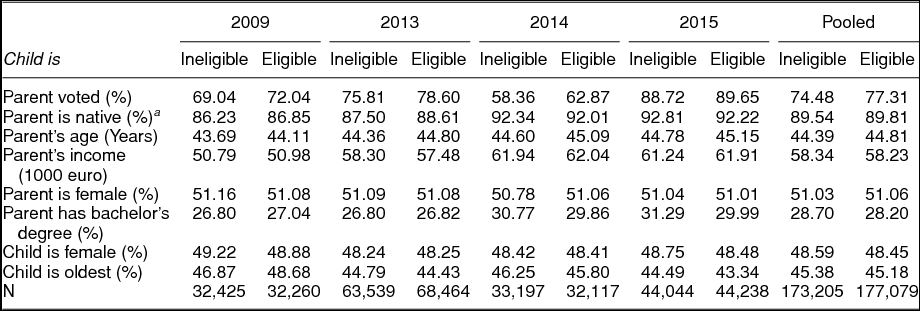
Before I estimate the effect in the cutoff, I report the means for parental turnout, whether the parent is a native Dane,Footnote 2 the parent’s age in years, income, sex, and education, as well as the sex of the child and if the child close to the cutoff is the parent’s firstborn, in Table 1. The means are displayed for each year and pooled together. In all four elections, the parents of eligible voters are more likely to vote than parents of ineligible voters. In support of the assumption of no exact sorting, there are no large imbalances in covariates between the groups. I show in the supporting information that there are no effects on any of the pretreatment variables when I substitute parents’ turnout with them, and that the p-values for differences in proportions is above 0.05 in a window of up to 10 days.
Means within 6 Months of Cutoff

Note: N varies across elections as the proportion of voters for whom turnout was recorded varies. aThe proportion of native Danes is higher in the 2014 and 2015 elections because of different requirements for which nationalities are eligible to vote.
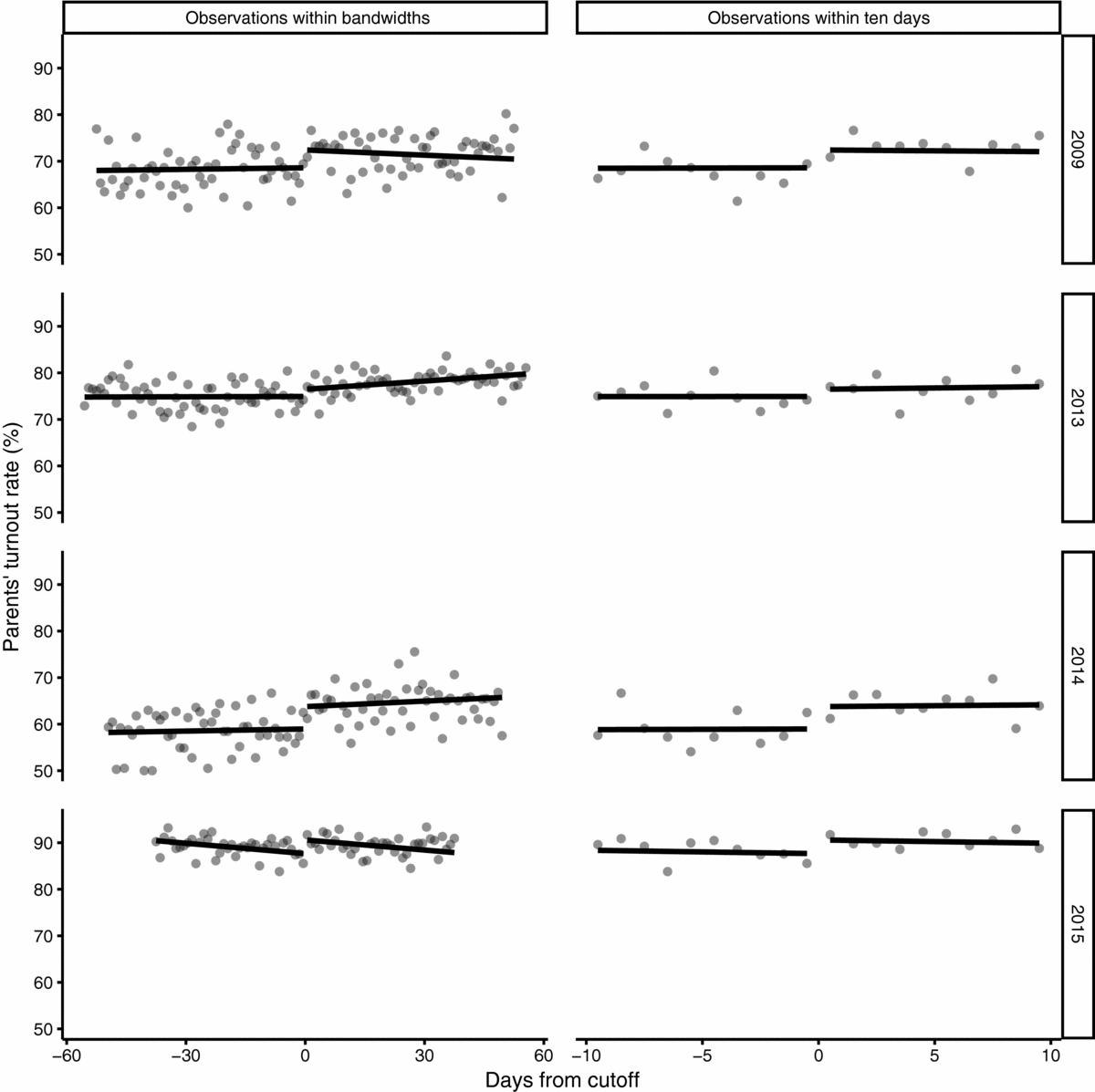
Figure 1 shows mean turnout aggregated by day with model fits from the rdrobust software for each election to illustrate the jumps in turnout rates around the threshold. In the left panel, I plot aggregated turnout within the bandwidths picked by the software. In the right panel, I show daily aggregates in a window of 10 days around the cutoff. The jump at the cutoff in all graphs indicates that there is a sharp increase in turnout as one’s child moves from ineligibility to eligibility. Based on the figure, a linear fit within the bandwidths seems appropriate.Footnote 3
Turnout over Child’s Age in Days

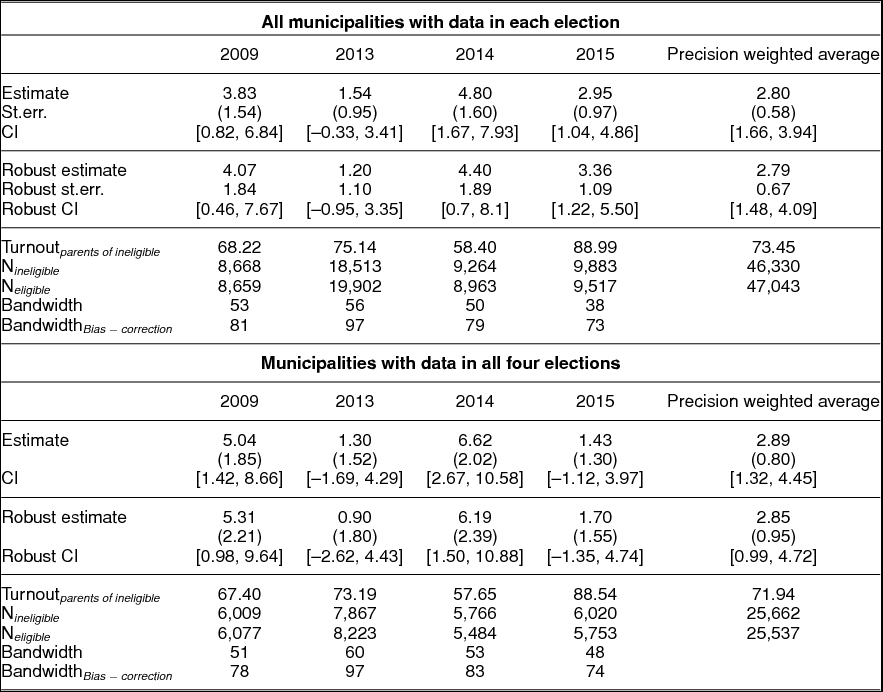
In Table 2, I summarize the jumps from Figure 1. The top half shows results for all of the municipalities that I have data for in each year. There are positive effects of 3.83, 1.54, 4.80, and 2.95 percentage points in the 2009, 2013, 2014, and 2015 elections, respectively, when we look at the conventional estimates and standard errors. In each election, baseline turnout is the average turnout for parents with ineligible children. For three of the elections, the confidence intervals are bounded well away from zero. In 2013, the point estimate is also positive, but zero is included in the confidence interval. The precision weighted estimate is 2.80 percentage points, with a standard error of 0.58 (95% Confidence interval: 1.66, 3.94). Given that an average of approximately 25% abstain in the baseline condition, the effect corresponds to about one in nine parents being mobilized to vote.
Effect on Turnout of Parenting an Eligible Voter

For complicity, I also show the bias corrected estimates that the rdrobust software returns in Table 2. They all vary within sampling variability. In the table, I also show the estimation windows picked by the algorithm, one bandwidth for estimating the regression function on both sides of the cutoff, and one for estimating the bias of the regression function. I use the default option of picking the same bandwidth on either side of the cutoff (Calonico et al. Reference Calonico, Cattaneo, Farrell and Titiunik2017). Finally, I separately report the number of included cases within the window for estimating the regression function above and below the cutoff.
In the lower half of Table 2, I show estimates for only the 32 municipalities that reported turnout in every election. Within this set of municipalities, the effects are comparable across elections, although they could still differ from the effects we would observe if we had full population data. However, the estimates in the lower half of Table 2 are all well within sampling variability of the estimates in the upper half. The point estimates of the precision weighted averages are 0.09 percentage points apart.
The Effect Conditional on Cohabitation and Level of Turnout
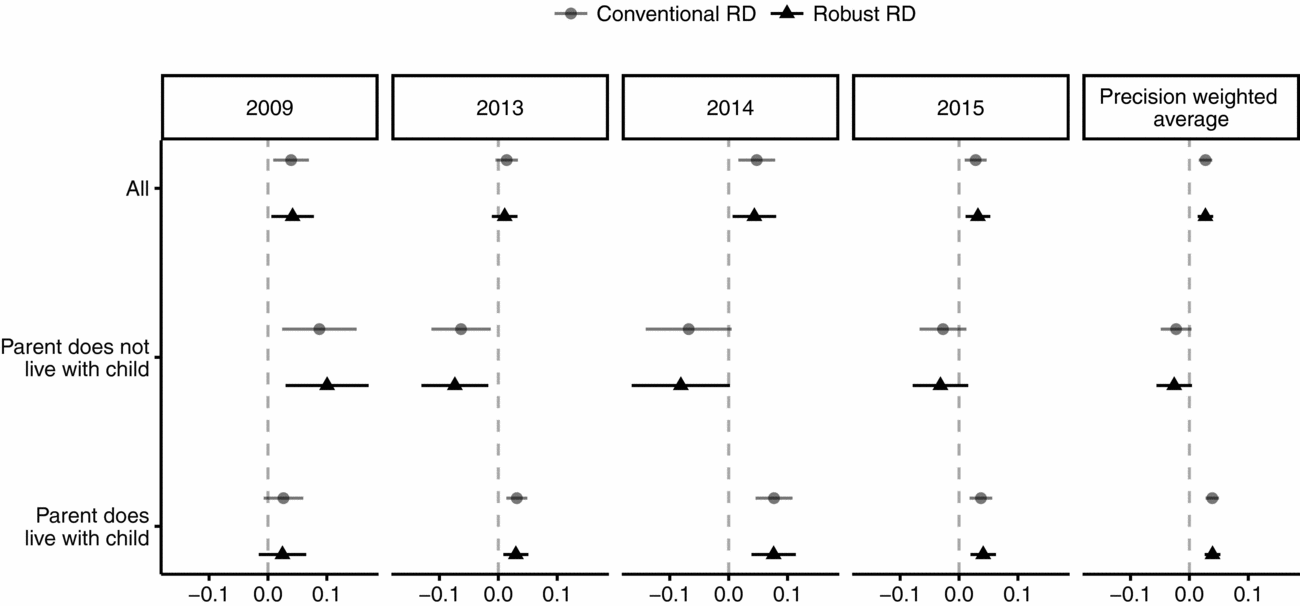
In Figure 2, I display yearly estimates and their precision weighted average of the effect conditional on cohabitation between the parents and children in each year. For every year, we see that parents become more likely to vote when they live with their child, while the estimate fluctuates around zero for parents who do not. The precision weighted average for parents who live with their child is around four percentage points, while the point estimate for parents who do not live with their child is negative.
Heterogeneous Effects Conditional on Cohabitation and Level of Turnout

Caution is warranted when interpreting treatment by covariate interactions, as the covariate, in our case cohabitation, is not randomly assigned (Gerber and Green Reference Gerber and Green2012, 301). One interpretation is that cohabitation is a necessary condition for the effect. In Denmark, one’s polling place is determined based on one’s address.Footnote 4 Therefore, parents and children who do not live together will most often not be able to accompany each other to the polling place or even meet at the polling place. If parents vote because they want to convey the voting norm in their child, they should only do so if they can do it with their child. Likewise, if parents are mobilized to vote by their children, they may have an easier time shirking voting when they do not live together.
Analyzing the Data as a Local Randomized Experiment
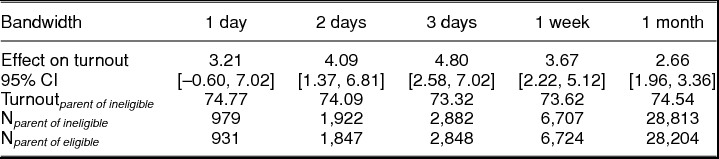
Cattaneo, Frandsen, and Titiunik (Reference Cattaneo, Frandsen and Titiunik2015) propose an alternative interpretation of the RD design, in which the main assumption is that cases close to the cutoff are as though randomly distributed and can be compared using a difference-in-proportions estimator. In Table 3, I show the pooled effect estimates across all four elections using data from all municipalities with available data for each year. I compare the proportion of voters that participated above and below the cutoff in windows of 1 day, 2 days, 3 days, 1 week, and 1 month. Table 3 shows that the results are robust to analyzing the data as a local randomized experiment. The point estimate is large and positive even in the 1-day window. If anything, the results suggest that we get larger effect estimates when we analyze the results as local randomized experiments and that we may underestimate the effect when we include observations outside the 1-week window.Footnote 5 In the supporting information, I show that pretreatment covariates and the distribution of parents around the cutoff is balanced at least up to the 1-week window.
Difference in the Proportion of Voters over Bandwidth in Days (Averaged over All Elections)

The table includes data from all election years (2009, 2013, 2014, and 2015). For every year, all municipalities with available turnout in the given year are included.
Additional Robustness of the RD Design
In the supporting information, I estimate the effect in all other bandwidths up to six months, both assuming the continuity of potential outcomes and analyzing it as a local randomized experiment. I also show that if I estimate the effect in mock cutoffs, we never see discontinuities that compare with what we see in the true cutoff. Furthermore, I run the model using everything from a second- to a sixth-order polynomial for the forcing variable and run the analyses with individual level data clustered by child. I also estimate a range of placebo tests in which I switch the dependent variable with six different variables, all of which show no discontinuity in the cutoff or difference in proportions when treated as a local randomized experiment.
DISCUSSION
I have provided causal support for the proposition that children causally affect their parents’ political participation (Simon and Merrill Reference Simon and Merrill1998; McDevitt and Chaffee Reference McDevitt and Chaffee2000, Reference McDevitt and Chaffee2002; Linimon and Joslyn Reference Linimon and Joslyn2002; McDevitt and Kiousis Reference McDevitt and Kiousis2006; Wong and Tseng Reference Wong and Tseng2008). With rich data and a strong identification strategy, I show that when Danish children come of age, their parents’ turnout rate increases, and one out of nine who would have abstained are mobilized.
Why do parents become mobilized to vote? They could hold a norm of political participation and try to pass it on to their recently enfranchised children. Alternatively, a child’s engagement in the election could somehow cause parents to adjust their behavior. In the supporting information, I discuss how heterogeneous effects additional to those presented above can cast light on either mechanism. First, I find an effect among both parents with a history of abstention and parents with a history of voting. I interpret this as support of both mechanisms: parents who have previously voted are more likely to repeat this behavior in order to convey that as a norm, and parents who have previously abstained become mobilized by their engaged children.
Furthermore, I look at whether the child is in high school and if the parent has completed high school.Footnote 6 I find that when the child is in high school, only parents who themselves do not have a high school education are mobilized. Among the young voters, high schoolers arguably receive the most external stimuli through events in school and their network of friends. In other words, they should be the most keen on voting. When the child is not in high school, the effects are similar for parents regardless of whether they have a high school diploma. For parents with a high school diploma, the effect is slightly larger when the child is in high school than when the child is not; for parents without a high school diploma, the effect is slightly smaller.
As above, we should be cautious when we interpret treatment by covariate interactions. One reading of the results is that parents who are more likely to hold a norm of voting (those who have been in high school) step up when the child lacks external stimuli (is not in high school). At the same time, parents are mobilized the most when they are least likely to hold the norm of voting (they do not have a high school diploma) and their children are most likely to vote (they are in high school).Footnote 7 In other words, we can interpret the results as supporting both mechanisms.
In many countries, including Denmark, there is an ongoing debate as to whether the voting age should be lowered to 16 or 17 years, and some countries have already done this in either some or all elections (Zeglovits and Zandonella Reference Zeglovits and Zandonella2013; Bergh Reference Bergh2013; Larsen, Levinsen, and Kjaer Reference Larsen, Levinsen and Kjaer2016). One prominent argument for lowering the voting age is that it will ensure that more young voters enter the electorate while they still live at home, in which case their parents can introduce them to voting (Franklin Reference Franklin2004). As I found strong evidence that parents are only mobilized when they live with their children, the results indicate that one advantage of a lower voting age would be that parents could become mobilized.
SUPPLEMENTARY MATERIAL
To view supplementary material for this article, please visit https://doi.org/10.1017/S0003055418000059.
Replication material can be found on Dataverse at: https://doi.org/10.7910/DVN/KWPEKK.




Comments
No Comments have been published for this article.