The field of developmental psychopathology has long advocated the need to examine mediators and moderators of child outcomes among high-risk cohorts (Cicchetti & Toth, Reference Cicchetti and Toth2009; Rutter & Garmezy, Reference Rutter, Garmezy and Mussen1983). Mediation implies that there are different pathways to risk or resilience, while moderation examines variables that may exacerbate or ameliorate risk or resilience. One such risk outcome for substance exposed children may be the development of behavior problems. A number of studies have examined the association between prenatal cocaine exposure and children's behavior problems (e.g., Accornero, Anthony, Morrow, Xue, & Bandstra, Reference Accornero, Anthony, Morrow, Xue and Bandstra2006; Bagner et al., Reference Bagner, Sheinkopf, Miller-Loncar, LaGasse, Lester and Liu2009; Linares et al., Reference Linares, Singer, Kirchner, Short, Min and Hussey2006; Richardson, Goldschmidt, & Willford, Reference Richardson, Goldschmidt and Willford2009; Warner, Malik, Lindahl, & Claussen, Reference Warner, Malik, Lindahl and Claussen2006). Results have been mixed with a few studies reporting significant direct associations between prenatal cocaine exposure and child behavior problems (Bada et al., Reference Bada, Das, Bauer, Shankaran, Lester and LaGasse2007; Richardson et al., Reference Richardson, Goldschmidt and Willford2009), some reporting associations only for boys (Bailey et al., Reference Bailey, Sood, Sokol, Ager, Janisse and Hannigan2005; Delaney-Black et al., Reference Delaney-Black, Covington, Nordstrom, Ager, Janisse and Chiodo2004), and some reporting no direct associations (e.g., Bada et al., Reference Bada, Langer, Twomey, Bursi, Lagasse and Bauer2008; Warner et al., Reference Warner, Malik, Lindahl and Claussen2006). Several studies have reported associations that were moderated by other variables or predictors other than prenatal substance exposure (e.g., Bailey, Avitsur, Engler, Padgett, & Sheridan, Reference Bailey, Avitsur, Engler, Padgett and Sheridan2004; Bennett, Bendersky, & Lewis, Reference Bennett, Bendersky and Lewis2002; Warner et al., Reference Warner, Malik, Lindahl and Claussen2006; Yumoto, Jacobson, & Jacobson, Reference Yutomo, Jacobson and Jacobson2008).
Maternal stress or psychopathology (Bada et al., Reference Bada, Das, Bauer, Shankaran, Lester and LaGasse2007; Bagner et al., Reference Bagner, Sheinkopf, Miller-Loncar, LaGasse, Lester and Liu2009; Bennett et al., Reference Bennett, Bendersky and Lewis2002; Warner et al., Reference Warner, Malik, Lindahl and Claussen2006), and maternal parenting behavior or caregiving situation (Bada et al., Reference Bada, Das, Bauer, Shankaran, Lester and LaGasse2007, Reference Bada, Langer, Twomey, Bursi, Lagasse and Bauer2008; Bennett et al., Reference Bennett, Bendersky and Lewis2002; Linares et al., Reference Linares, Singer, Kirchner, Short, Min and Hussey2006; Yumoto et al., Reference Yutomo, Jacobson and Jacobson2008) have been consistently reported across a number of studies as predictors of behavior problems among these high-risk children. Other variables such as child sex, and arousal or stress regulation have been primarily conceptualized as moderators of risk in this literature (e.g., Bailey et al., Reference Bailey, Avitsur, Engler, Padgett and Sheridan2004; Delaney-Black et al., Reference Delaney-Black, Covington, Nordstrom, Ager, Janisse and Chiodo2004; Sheinkopf et al., Reference Sheinkopf, LaGasse, Lester, Liu, Seifer and Bauer2007). Finally, several studies have included a cumulative environmental risk variable, although there are variations across studies in their conceptualization of environmental risk as an independent predictor (Bennett et al., Reference Bennett, Bendersky and Lewis2002, Reference Bennett, Bendersky and Lewis2007) or as a moderator (Yumoto et al., Reference Yutomo, Jacobson and Jacobson2008).
The purpose of this study was to examine direct and indirect associations between prenatal cocaine/other substance exposure and toddler behavior problems via maternal warmth and psychopathology, and to examine if environmental risk and infant stress reactivity moderated these associations. The maternal variables were considered as proximal predictors of risk because they are known to vary across levels of maternal substance use and have consistent associations with child behavior problems across studies. For instance, cocaine-using mothers have been reported to display lower sensitivity and warmth toward their infants (Burns, Chethik, Burns, & Clark, Reference Burns, Chethik, Burns and Clark1997; Eiden, Veira, & Granger, Reference Eiden, Veira and Granger2009). Lower maternal warmth is a concurrent and longitudinal predictor of higher child behavior problems across a number of studies (e.g., Denham et al., Reference Denham, Workman, Cole, Weissbrod, Kendziora and Zahn-Waxler2000; Mullineaux et al., Reference Mullineaux, Deater-Deckard, Petrill and Thompson2009), including studies of substance exposed children (Yumoto et al., Reference Yutomo, Jacobson and Jacobson2008). In addition to parenting, substance using mothers generally report higher rates of psychiatric symptoms (Bendersky, Alessandri, Gilbert, & Lewis, Reference Bendersky, Alessandri, Gilbert and Lewis1996; Eiden, Foote, & Schuetze, Reference Eiden, Foote and Schuetze2007; Singer et al., Reference Singer, Arendt, Minnes, Frakas, Yamashita and Keligman1995; Woods, Eyler, Behnke, & Conlon, Reference Woods, Eyler, Behnke and Conlon1993). There are significant and consistent associations between maternal psychiatric symptoms and maternal reports of child behavior problems among both clinical and community samples (Downey & Coyne, Reference Downey and Coyne1990; Goodman & Gotlib, Reference Goodman and Gotlib1999; Yumoto et al., Reference Yutomo, Jacobson and Jacobson2008). This association has been demonstrated across different child ages from preschool (Campbell, Pierce, Moore, Marakovitz, & Newby, Reference Campbell, Pierce, Moore, Marakovitz and Newby1996) to adolescence (Gartstein, Bridgett, Dishion, & Kaufman, Reference Gartstein, Bridgett, Dishion and Kaufman2009; Thomas, Forehand, & Neighbors, Reference Thomas, Forehand and Neighbors1995).
Although these maternal variables may serve as proximal predictors of risk that could be reasonably expected to vary as a function of maternal substance use, individual differences in aspects of infant temperament such as stress reactivity and more distal environmental risk could be better conceptualized as moderators of these associations. For instance, diathesis–stress models (Zuckerman, Reference Zuckerman1999) would indicate that high reactive infants would be more susceptible to a negative caregiving context. In contrast, the more recent theories of biological sensitivity to context (Boyce & Ellis, Reference Boyce and Ellis2005) and of differential susceptibility to context (Belsky & Pluess, Reference Belsky and Pluess2009) emphasize that high reactivity may not be pathogenic, invariably leading to maladaptive outcomes. These theories would suggest that high reactive infants may be more sensitive to the positive influence of high maternal warmth and low maternal psychopathology. Thus, high reactive infants may display greater adaptive functioning in the context of positive caregiving experiences compared to low reactive infants, and higher behavior problems in the context of negative caregiving experiences.
Cortisol is the primary glucocorticoid hormone produced by the hypothalamic–pituitary–adrenal system in humans, and it is considered a major indicator of physiological states in response to negative affect or stress (Hellhammer, Wust, & Kudielka Reference Hellhammer, Wüst and Kudielka2009). Both basal levels and cortisol reactivity (change in response to stress) have been associated with child behavior problems (Essex, Klein, Cho, & Kalin, Reference Essex, Klein, Cho and Kalin2002; Granger et al., Reference Granger, Serbin, Schwartzman, Lehoux, Cooperman and Ikeda1998; Gunnar & Vazquez, Reference Gunnar, Vazquez, Cicchetti and Cohen2006), although direction of effect has varied by the measure of cortisol, type of stimulus used, child gender, and type of behavior problem. More relevant to the current investigation is the study by Obradovic, Bush, Stamperdahl, Adler, and Boyce (Reference Obradovic, Bush, Stamperdahl, Adler and Boyce2010) indicating significant cortisol by caregiving adversity effects on child behavior. Results from this study indicated that among infants with high cortisol reactivity, high environmental adversity was associated with low prosocial behaviors but low adversity was associated with higher prosocial behaviors. Thus, cortisol reactivity may be a significant moderator of the association between caregiving experiences and child behavior problems in this high-risk sample.
In addition to individual differences in stress reactivity, researchers have long advocated the need to include environmental risk as a significant predictor of outcome in cocaine exposed cohorts. Teratological models of development suggest that fetal insults such as prenatal substance exposure may increase vulnerability to negative caregiving experiences. Results from Yumoto et al. (Reference Yutomo, Jacobson and Jacobson2008) lend empirical support for this hypotheses indicating that substance exposed children have a lower threshold of tolerance to environmental risk for outcomes such as delinquency, compared to children without prenatal exposure. Thus, environmental risk may moderate the association between prenatal cocaine exposure and child behavior problems.
To add to this complexity, the majority of cocaine using mothers also use other substances such as alcohol, cigarettes, and marijuana. Results from several studies, both animal and human, indicate that prenatal alcohol and cigarette exposure may have significant effects on child behavior problems (for review, see Dixon, Kurtz, & Chin, Reference Dixon, Kurtz and Chin2008; Wakschlag & Hans, Reference Wakschlag and Hans2002). Thus, the association between prenatal cocaine exposure and toddler behavior problems needs to be examined in the context of comorbid substance use.
Based on this literature, we hypothesized that prenatal cocaine and/or other substance exposure would be associated with children's behavior problems at 18 months either directly, or indirectly via maternal psychiatric symptoms and maternal warmth. We also hypothesized that child gender, infant cortisol reactivity, and environmental risk would moderate these associations. Specifically, we expected that the association between the caregiving context (maternal warmth and psychopathology) and behavior problems would be stronger for children with higher, compared to lower, cortisol reactivity to stress. Similarly, we expected the direct association between prenatal exposure and behavior problems to be significant under conditions of higher but not lower environmental risk. Finally, we expected the association between substance exposure and behavior problems to be stronger for boys compared to girls.
Method
The sample consisted of 220 mother–infant dyads participating in an ongoing longitudinal study of prenatal cocaine exposure (119 cocaine exposed, 101 not cocaine exposed). Maternal interviews and infant assessments were conducted at 4–8 weeks, 7 and 13 months of infant age, and maternal interviews regarding child behavior problems were conducted at 18 months of toddler age. By 18 months of toddler age, 21 toddlers in the cocaine group had been removed from parental care and placed in nonparental care. Of these 21 infants, 67% were placed in nonkin care, with the remainder being cared for by a grandmother or maternal aunt. All assessments were conducted with the primary caregiver of the child at that time, although for ease of presentation the terms mother and maternal are used throughout the manuscript when referring to the primary caregiver. The primary caregiver was identified as the adult who had legal guardianship of the child and accompanied the child at all appointments. An outreach worker on the project staff recruited all participants after delivery from two local area hospitals. Mothers ranged in age from 18 to 42 years (M = 29.78, SD = 5.46). The majority of mothers were African American (74%), were receiving Temporary Assistance for Needy Families (71%) at the time of their first laboratory visit (years 2001–2004), and were single (60%). Of the 220 children, 108 (49%) were male. All families were recruited from two hospitals serving a predominantly low-income population and the two groups were matched on maternal education, maternal race/ethnicity, and infant gender. The study received approval from the institutional review boards of the hospitals as well as the primary institution at which the study was conducted. Informed written consent was obtained from all recruited participants. Participants were compensated for their time in the form of gift certificates, checks, and infant toys at each assessment, with the amount increasing over time. All assessments were conducted at age corrected for prematurity.
Procedure
All mothers were screened after delivery for initial eligibility and matching criteria. Interested and eligible mothers were given detailed information about the study and asked to sign consent forms. About 2 weeks after delivery, mothers were contacted and scheduled for their first laboratory visit, which took place at the time that their infant was approximately 4–8 weeks old. Additional visits were scheduled when the infant was 7, 13, and 18 months old. All visits (with the exception of the 18 month visit consisting of maternal interview only) consisted of a combination of maternal interviews, observations of mother–infant interactions, and infant assessments. In the circumstance of a change in custody arrangements, the person who had legal guardianship of the child was contacted and asked to participate. Biological mothers were interviewed at the 4- to 8-week assessment in order to obtain accurate information about prenatal substance use.
Once a family was recruited into the cocaine group, the closest matching noncocaine group family was recruited. However, a significantly higher proportion of mothers in the noncocaine group declined participation or withdrew before formal enrollment, resulting in a smaller number of families in the control group. Of the 4,800 women screened at delivery, 340 were eligible for participation in either group. Of the 4,460 women who were not eligible, the majority were noncocaine users who did not fit matching criteria and were thus not eligible to be recruited into the control group. Of the 340 women who did meet eligibility criteria, 35% either declined participation or were not enrolled in the study because they expressed initial interest but did not keep their assessment appointments within the 4- to 8-week infant age window for the initial visit, resulting in a final sample of 220 mother–infant dyads. Mothers who participated were more likely to be between 18 and 25 years of age compared with those who were eligible but not enrolled in the study, χ2 (2, N = 340) = 20.10, p < .001, and were more likely to have a high school or below high school education, χ2 (2, N = 340) = 52.89, p < .001. Mothers who participated were also more likely to be in the cocaine group (91% of mothers who were eligible to be in the cocaine group participated in the study) compared to those who were eligible but not enrolled, χ2 (2, N = 340) = 70.13, p < .001. The majority of the mothers in the cocaine group who were eligible but not enrolled in the study had children who were placed in nonmaternal care. There were no other differences on any of the demographic variables between those who participated and those who were eligible but not enrolled.
Assessment of growth and risk status
Three measures of growth were used in this study: birth weight (g), birth length (cm), and head circumference (cm). All measurements were taken by obstetrical nurses in the delivery room and recorded in the infant's medical chart. Research staff recorded this information from the charts after recruiting the mother–infant dyad. Medical chart review at the time of recruitment also was used to complete the Obstetrical Complications Scale (Littman & Parmelee, Reference Littman and Parmelee1978), a scale designed to assess the number of perinatal risk factors experienced by the infant. Higher numbers on this scale indicate a more optimal obstetric score. Gestational age was calculated by dates and extracted from medical records.
Identification of substance use
Cocaine status was determined by a combination of maternal report, chart review, and maternal hair analysis. Urine toxicologies were routinely conducted at the first prenatal visit on maternal urine and/or at delivery (for those mothers who tested positive prenatally, obtained prenatal care elsewhere, or did not receive any prenatal care) on infant and maternal urine by participating hospitals. Mothers were included in the cocaine group if self-reports were positive, regardless of urine toxicology or hair sample results. Similarly, mothers who reported that they did not use cocaine but had positive urine toxicology or hair samples were included in the cocaine group.
Urine toxicologies consisted of standard urine screening for drug level or metabolites of cocaine, opiates, benzodiazepines, and tetrahydrocannabinol. Urine was rated positive if the quantity of drug or metabolite was >300 g/ml. Hair samples were collected from the mothers at the first laboratory visit and sent to the Psychemedics Corporation for Radioimmunoanalyses (RIAH). Hair samples were screened for cocaine followed by a gas chromatography/mass spectrometry confirmation for positive cocaine screens. Drugs and their metabolites are absorbed into the hair and can be extracted and measured. As hair grows at an average rate of 0.52 in./month, it can record a pattern of drug consumption related to the amount and frequency of use (see Baumgartner, Hill, & Blahd, Reference Baumgartner, Hill and Blahd1989). Thus, a 2-in. length of hair could contain a record of approximately 4 months of use, and given adequate hair length (i.e., about 4–5 in.), use per trimester may be recorded. Drugs become detectable in hair about 3 to 4 days after use, a time when cocaine is rendered undetectable by urinalysis. RIAH is the most well-established hair analysis technique and has been replicated by independent laboratories across the world (see Magura, Freeman, Siddiqi, & Lipton, Reference Magura, Freeman, Siddiqi and Lipton1992). Gas chromatography/mass spectrometry confirmations of RIAH have not revealed any false positives because of testing errors (see Magura et al., Reference Magura, Freeman, Siddiqi and Lipton1992).
Approximately 22% of mothers in the study (41% of the mothers in the cocaine group) had positive urine toxicologies at delivery, and 25% of mothers (79% of the mothers in the cocaine group) had hair samples that tested positive for cocaine during pregnancy. The remainder of mothers in the cocaine group admitted having used cocaine in the brief self-report screening instrument administered after delivery (N = 23). There were no significant differences between mothers with and without positive biomarkers on any of the variables considered in this study. Mothers in the comparison group reported not having used any illicit substances other than marijuana. Additional exclusionary criteria for all mothers were (a) maternal age younger than 18 years, (b) use of illicit substances other than cocaine or marijuana, and (c) significant medical problems for the infant (e.g., genetic disorders, major perinatal complications, baby in critical care for over 48 hr).
The Timeline Follow-Back Interview (TLFB; Sobell, Sobell, Klajmer, Pavan, & Basian, Reference Sobell, Sobell, Klajmer, Pavan and Basian1986) was used to assess maternal substance use during pregnancy. Participants were provided a calendar and asked to identify events of personal interest (i.e., holidays, birthdays, vacations, etc.) as anchor points to aid recall. This method has been established as a reliable and valid method of obtaining longitudinal data on substance-use patterns, has good test–retest reliability, and is highly correlated with other intensive self-report measures (Brown, Burgess, Sales, Whiteley, Evans, & Miller, Reference Brown, Burgess, Sales, Whiteley, Evans and Miller1998). The TLFB yielded data about the average number of days of cocaine use per week, average number of joints smoked per week, average number of cigarettes smoked per week, and average number of standard drinks per week during pregnancy. These variables were quite skewed and were transformed using square root transformations before further analyses. Average number of cigarettes per week, number of standard drinks per week, and number of joints per week were used as measured indicators of the latent construct reflecting maternal substance use other than cocaine. Confirmatory factor analysis indicated that average number of joints per week had a poor factor loading. Average number of joints per week was also not associated with cocaine group status (see below), or with the mediators or outcomes examined in this study. Thus, this variable was dropped from further analysis. Average number of cigarettes per week and number of standard drinks per week loaded onto one latent factor in the model, with factor loadings of 0.50 (drinks per week) and 0.74 (cigarettes per week). Cocaine group status was used in model testing as this variable was based on both biomarkers and self-reported use. However, we have included associations between the continuous measure of cocaine use (days per week during pregnancy) and other variables in the correlation table.
Infant cortisol
At 7 months, infant reactivity and regulation was assessed in three different behavioral paradigms designed to induce affect that were taken from the Laboratory Temperament Assessment Battery (Goldsmith & Rothbart, Reference Goldsmith and Rothbart1988). These included the arm restraint paradigm designed to elicit anger/frustration, a puppet show to elicit positive affect, and presentation of four different scary masks to elicit fear. The order of the procedures was as follows: Time 1 or pretask saliva sample was collected after the infant arrived at the lab, infant was then seated in a high chair, hooked up to electrodes (for measurement of heart rate), and watched a Baby Einstein video for 3 min, puppet show was presented for the next 3 min, followed by another 3 min of the video. Time 2 saliva sample was collected at the end of these 3 min. The arm restraint procedure was presented next (consisting of two trials), followed by another 3 min of video. Infant was then unhooked from the heart rate monitor and presented with some blocks for a 3-min play episode, followed by the presentation of four masks lasting a total of 60 s. Next, the mother–infant dyad was moved to the floor with a variety of toys for 8 min of interaction. This was followed by Time 3 saliva sample. The infant was measured and weighed and the mother was interviewed. Time 4 saliva sample was collected 20 min after Time 3.
Saliva samples were collected by placing an absorbent dental cotton roll in the mouth of infants. The saliva in the cotton roll was expressed into a storage vial using a 10-cm3 needleless syringe. Samples were immediately placed in a −80°F freezer and were shipped on dry ice to Salimetrics Laboratories at Penn State University for assay. On the day of testing, all samples were centrifuged at 3000 rpm for 15 min to remove mucins. All samples were assayed for salivary cortisol using a highly sensitive enzyme immunoassay US FDA (510k) cleared for use as an in vitro diagnostic measure of adrenal function (Salimetrics, State College, PA). The test used 25 μl of saliva and had a lower limit of sensitivity of 0.007 μg/dl and a range of sensitivity from 0.007 to 3.0 μg/dl. All samples were assayed in duplicate, average intra- and interassay coefficients of variation were less than 5% and 10%, and averaged duplicate scores were used in all statistical analyses. Following previous studies (e.g., Ramsay & Lewis, Reference Ramsay and Lewis2003), cortisol reactivity was indexed by the difference between the peak poststressor cortisol value (Time 3 or 4) and the pretask value. Higher values indicated higher cortisol reactivity. There was an average increase of 0.102 µg/dl from pretask to peak value for the sample as a whole (see Eiden et al., Reference Eiden, Veira and Granger2009).
Maternal psychiatric symptoms and maternal warmth
Maternal psychiatric symptomatology was assessed using the Brief Symptom Inventory (BSI; Derogatis, Reference Derogatis1993) at the 4- to 8-week, 7-month, and 13-month assessments. This scale is a brief form of the Symptom Checklist 90-R and is a widely used mental health screening measure in a variety of clinical and research settings. The measure consists of 53 items rated on a 5-point scale. The items are grouped into nine scales of anxiety, hostility, somatization, obsessive–compulsive, interpersonal sensitivity, depression, phobic anxiety, paranoid ideation, and psychoticism. A positive symptom distress index was computed by summing the items for all the subscales and dividing by the number of items endorsed with a positive response. The BSI subscales have high internal consistency and the measure has been used in a large number of studies, including studies of maternal cocaine use (e.g., Eiden, Foote, & Schuetze, Reference Eiden, Foote and Schuetze2007; Singer et al., Reference Singer, Salvator, Arendt, Minnes, Farkas and Kliegman2002). The positive symptom distress index was highly stable over time with correlations ranging from r = .60 to .79. A composite index of maternal psychiatric symptoms was created by computing the average BSI score from all three time points, reflecting maternal psychiatric symptoms over infancy.
Maternal warmth was assessed using behavioral observations during a free play task at 7 and 13 months. Mothers were asked to interact with their infants as they normally would at home for 10 min in a room filled with toys. These interactions were coded using a collection of global 5-point rating scales developed by Clark, Musick, Scott, and Klehr (Reference Clark, Musick, Scott and Klehr1980), with higher scores indicating more positive affect or behavior. The scale for maternal warmth consisted of items such as warm tone of voice, expressed positive affect, enthusiastic, cheerful mood, and connectedness with the child. The maternal warmth scale had high internal consistency with a Cronbach α of 0.90. Two coders rated maternal behavior. Both coders were trained on the Clark scales by the first author and were unaware of group membership. Interrater reliability was conducted on a random selection of 14% (n = 24) of the tapes and was fairly high (r = .90 and .92 at 7 and 13 months, respectively). Maternal warmth at 7 and 13 months were moderately correlated with each other (r = .40). A composite measure of maternal warmth was computed by taking the average across the two ages and used in model testing.
Environmental risk
Following previous studies (Bendersky, Bennett, & Lewis, Reference Bendersky, Bennett and Lewis2006; Eiden et al., Reference Eiden, Veira and Granger2009; Sameroff, Seifer, Baldwin, & Baldwin, Reference Sameroff, Seifer, Baldwin and Baldwin1993), an environmental risk score was computed from measures administered at 4–8 weeks and 7 and 13 months of infant age. This score was a composite of maternal race (non-White = higher risk), education (less than high school degree or general education development = higher risk), single parent status, unstable living arrangements (living with friends or in a shelter at any time point), lack of close friendships or support for the primary caregiver (taken from the Addictions Severity Index, administered at all three time points; McLellan, Kushner, Metzger, & Peters, Reference McLellan, Kushner, Metzger and Peters1992), and a number of items administered as part of the Structured Clinical Interview at all three time points (Platzman, Coles, Lynch, Bard, & Brown, Reference Platzman, Coles, Lynch, Bard and Brown2001). These items included lack of male caregiver involvement, lack of a caregiving (sleeping, bathing, etc.) routine, no routine medical care, and prolonged and/or frequent separations from the primary caregiver. Environmental risk scores for the sample as a whole ranged from 0 to 17 (M = 7.88, SD = 3.44), with higher scores indicating higher cumulative risk.
Child behavior problems
Maternal reports of child behavior problems were obtained at 18 months of child age using the 1.5- to 5-year version of the Child Behavior Checklist (CBCL; Achenbach, Reference Achenbach1992). The CBCL is a widely used measure of children's behavioral/emotional problems. It consists of 100 items on a 3-point response scale ranging from “not true” to “very true,” with some open-ended items designed to elicit information about a particular problem behavior. The behavior ratings yield two broadband dimensions of internalizing and externalizing behavior problems as well as a total score. Higher scores indicate more toddler behavior problems. The correlation between the internalizing and externalizing subscales was r = .73. Thus, the total child behavior problems score was used as the dependent measure in model testing. About 19% of toddlers in this sample had T scores in the borderline/clinical range (T ≥ 60).
Data analytic strategy
Group differences in demographics, perinatal risk characteristics, maternal substance use variables, maternal psychiatric symptoms, maternal warmth, environmental risk score, and child behavior problems were examined first using analyses of variance (ANOVAs) or multivariate ANOVAs (MANOVAs). MANOVAs were used when multiple theoretically associated constructs were the dependent measures in order to control for high Type 1 error rate. Demographic or perinatal risk variables that were associated with both the predictors and outcomes were used as covariates in subsequent analyses. Structural equation modeling (SEM) was used to test the hypothesized model with maternal psychiatric symptoms, and maternal warmth as intervening variables between maternal substance use and child behavior problems. SEM analyses were conducted using Mplus, Version 5.2 software (Muthén & Muthén, Reference Muthén and Muthén2006) using full-information maximum likelihood estimation procedures (Arbuckle, Reference Arbuckle, Marcoulides and Schumacker1996). Indirect effects were tested using the bias-corrected bootstrap method. This method has been found to provide a more accurate balance between Type 1 and Type 2 errors compared with other methods used to test indirect effects (MacKinnon, Lockwood, & Williams, Reference MacKinnon, Lockwood and Williams2004). Five hundred bootstrap samples and the 95% bias-corrected confidence intervals (CIs) were used to test significance of indirect effects. Multiple group analyses were used to examine moderation by gender, cortisol, and environmental risk. These models were tested by comparing fully unconstrained with fully constrained models. The Δχ2 was used as an omnibus test of differences across groups. Given a significant Δχ2, we examined modification indices to locate group differences in path coefficients.
Missing data
As expected in any longitudinal study, there were some incomplete data for some of the participants at one or more of the four assessment points included in this study. Of the 220 mother–infant dyads who completed the 4- to 8-week laboratory visit, 189 completed the 7-month visit and saliva samples were collected from 168 infants at 7 months, 189 completed the 13-month visit, and 179 completed the 18-month mother maternal interview. There were no significant differences between families with complete versus missing data at 18 months on any demographic or substance use variable. Approximately 55% of the families with missing data on the child behavior checklist or saliva samples were in the cocaine group, but this association (between missing data status and cocaine group status) was not significant. As noted earlier, full-information maximum likelihood was used to estimate model parameters.
Results
Demographics and perinatal risk
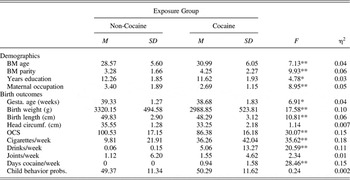
Results from MANOVA with the demographic variables as the dependent measures and cocaine group status yielded a significant multivariate effect of group status, F (3, 163) = 6.05, p < .01. Results from univariate analyses indicated that control group mothers were younger, had lower parity, and higher education compared to those in the cocaine group, although the effect sizes were generally small (see Table 1). Among these demographic variables, only maternal education was used as a covariate in all model testing. A second MANOVA was conducted with infant birth outcomes as the dependent measures. Results indicated a significant effect of group status on infant birth outcomes, F (5, 161) = 8.11, p < .001. Univariate analyses indicated that cocaine exposed infants had lower gestational age, birth weight, birth length, and cocaine using mothers had higher scores on the obstetrical complications scale compared to those in the control group (see Table 1). A total of 86% of the cocaine exposed and 97% of the comparison infants were full term (≥37 weeks gestational age). When these analyses were repeated after using gestational age as covariate, the differences in birth weight and length remained significant (p < .01). However, there were no significant associations between any of the perinatal risk variables and toddler behavior problems. Thus, none of the perinatal risk variables were included in model testing as covariates. ANOVA with child sex as the independent variable indicated no differences between boys and girls on internalizing or externalizing behavior problems.
Group differences in demographic variables and birth outcomes

Note: BM, biological mother; OCS, obstetrical complications scale score, where high scores are more optimal. The means for child behavior problems reflect t scores. Maternal occupation was coded using the Hollingshead (Reference Hollingshead1956, Reference Hollingshead1975) scoring system.
*p < .05. **p < .01.
Maternal substance use and other variables
Results from MANOVA with prenatal substance use variables as the dependent measures and group status as the independent variable yielded a significant multivariate effect of group status, F (4, 162) = 14.32, p < .001. As expected, mothers in the cocaine group were heavier users of cigarettes, alcohol, and cocaine during pregnancy (see Table 1). There was no group difference in marijuana use. These results remained unchanged when the 21 foster care mothers were excluded from the analyses. There were no significant differences between children in biological care versus foster care on internalizing or externalizing behavior problems. Thus, the full sample was used in model testing.
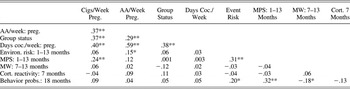
Results from ANOVA with cocaine group status as the independent variable and child behavior problems as the dependent measure indicated no significant group difference (see Table 1). Following previous studies (Bailey et al., Reference Bailey, Sood, Sokol, Ager, Janisse and Hannigan2005; Delaney-Black et al., Reference Delaney-Black, Covington, Nordstrom, Ager, Janisse and Chiodo2004) we created an ordinal cocaine exposure variable to examine potential differences between children with some exposure and children with more persistent exposure. Within the cocaine group, there were 49 families were identified as having persistent exposure based on positive maternal or infant urine at delivery. Results from ANOVA with cocaine group status based on this ordinal variable yielded no significant differences on child behavior problems. We examined the association between cocaine group status and the number of children in the borderline/clinical range for child behavior problems. There was no significant group difference in the number of children in the borderline/clinical range (19% for both groups). Finally, we examined the correlation between the continuous measure of self-reported days of cocaine use per week from the TLFB data and child behavior problems (see Table 2). Results indicated no significant associations between this continuous measure and child behavior problems (r = .05, p > .05).
Correlations among study variables

Note: Cigs, cigarettes; Preg., pregnancy; AA, average alcohol; Coc., cocaine; MPS, maternal psychiatric symptoms; MW, maternal warmth, Cort., cortisol.
*p < .05. **p < .01.
Model testing
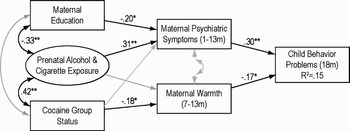
Correlations among variables in the model are depicted in Table 2. The hypothesized model tested included maternal psychiatric symptoms and maternal warmth as potential intervening variables between maternal substance use and toddler behavior problems. The model also included covariances among the residuals of maternal warmth and psychiatric symptoms and between maternal substance use and cocaine group status. This model only included the indirect paths from maternal substance variables to child behavior problems via maternal psychiatric symptoms and warmth. As described above, maternal education was used as a covariate because no other variable was associated with both cocaine exposure and child behavior problems at p < .10. Goodness of fit indices indicated that the structure of our hypothesized model was an adequate explanation of the data: χ2 (7) = 5.69, p = .58, comparative fit index = 1.00, root mean square error of approximation = 0.00, 95% CI = 0.00, 0.08. The significant parameter coefficients for this model are depicted in Figure 1. The structural paths indicated that maternal cigarette/alcohol use was predictive of higher maternal psychiatric symptoms over the first year of life, which in turn predicted higher behavior problems at 18 months. Cocaine-using mothers displayed lower maternal warmth toward their infant at 7 to 13 months, which in turn predicted higher behavior problems at 18 months. Addition of direct paths from maternal substance use variables to child behavior problems did not improve the fit of the model, Δχ2 (2) = 0.01, p > .05.
A structural equation modeling model predicting behavior problems. Nonsignificant causal paths or covariances are depicted in grey.

Our model included hypotheses about several indirect effects. Thus, the bias-corrected bootstrap method was used to determine whether the implied indirect effects within our hypothesized model were statistically significant. Results indicated that the indirect effect of prenatal cigarette/alcohol exposure on child behavior problems via maternal psychiatric symptoms was significant (β = 0.08, 95% CI = 0.02–0.09). However, the indirect effect of prenatal cocaine exposure on behavior problems via maternal warmth was not significant (β = 0.03, 95% CI = 0.005–0.06).
Moderation
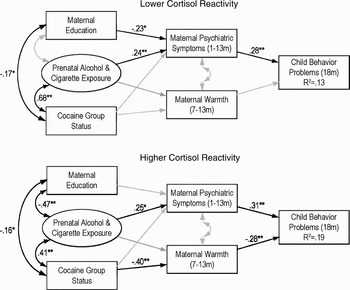
We hypothesized that infant gender, cortisol reactivity, and environmental risk may moderate the associations between maternal substance use and child behavior problems. We used median splits to group children into high and low cortisol reactivity groups and high and low cumulative environmental risk groups. For moderation by gender, we examined the fit indices for a fully uncontrained model with a fully constrained model. These two nested models were not significantly different from each other, Δχ2 (8) = 8.68, p > .05. Thus, gender did not moderate the associations between prenatal substance exposure and behavior problems. Similarly, with regard to moderation by cortisol reactivity, we first examined fit indices for a fully unconstrained model for high and low cortisol reactivity groups and compared this unconstrained model with a fully constrained model. These two nested models were significantly different from each other, Δχ2 (8) = 20.74, p < .05. Modification indices indicated that the paths from prenatal cocaine exposure to maternal warmth and the path from maternal warmth to child behavior problems were significantly different across the two groups. The covariance between maternal alcohol/cigarette use and cocaine use were also different across groups. In the final multiple group model these two paths and the covariance were freely estimated and all other paths were constrained. This model fit the data well, χ2 (19) = 16.02, p = .66, comparative fit index = 1.00, root mean square error of approximation = 0.00, 95% CI = 0.00, 0.06. The significant parameter estimates for this are depicted in Figure 2. As depicted in the figure, maternal cocaine use was associated with lower maternal warmth, and lower maternal warmth was predictive of higher child behavior problems for high reactive, but not low reactive children. This indirect effect of prenatal cocaine exposure on child behavior problems was significant for high, but not low reactive children (β = 0.23, 95% CI = 0.06–0.40).
A structural equation modeling model for the relation among maternal substance use, maternal risk variables, and child behavior problems moderated by infant cortisol.

Moderation by environmental risk was examined following the same steps of comparing the fully unconstrained model for higher and lower environmental risk groups with the fully constrained model. Because we had hypothesized that the direct association between prenatal substance exposure and child behavior problems would vary as a function of environmental risk, these models included direct paths from prenatal exposure to child behavior problems. The two nested models were not significantly different from each other, Δχ2 (10) = 5.89, p > .05. Thus, environmental risk did not moderate the associations between prenatal substance exposure and child behavior problems.
Discussion
The first goal of the study was to examine potential direct associations between prenatal cocaine and other substance exposure and toddler behavior problems. Results indicated that there were no significant direct associations between prenatal substance exposure and toddler behavior problems. Most studies reporting significant direct associations between cocaine exposure and behavior problems find such associations at older child ages (3–7 years; Bada et al., Reference Bada, Das, Bauer, Shankaran, Lester and LaGasse2007; 36 months, Richardson et al., Reference Richardson, Goldschmidt and Willford2009), only for boys (Bailey et al., Reference Bailey, Sood, Sokol, Ager, Janisse and Hannigan2005; Delaney-Black et al., Reference Delaney-Black, Covington, Nordstrom, Ager, Janisse and Chiodo2004; ages 7 and 6 years, respectively, results from the same longitudinal cohort), or only for cocaine exposed children in foster care (Linares et al., Reference Linares, Singer, Kirchner, Short, Min and Hussey2006). Perhaps the lack of direct associations in this study was because behavior problems were measured at 18 months. Some degree of behavior problems is fairly normative at earlier child ages and this may be especially true among samples characterized by high risk, regardless of prenatal exposure. It is possible that exposure effects of parental substance use may not be apparent until there are normative declines in behavior problems between 3 and 4 years of child age. In a study of children of alcoholic and nonalcoholic parents, Edwards, Eiden, Colder, and Leonard (Reference Edwards, Eiden, Colder and Leonard2006) reported that children of alcoholics did not differ from children in the nonalcoholic group at initial assessment (18 months of child age), but did not show the normative declines in aggressive behavior from 36 to 48 months. In contrast, the results of the current study are supportive of lack of direct effects noted in previous studies with older age groups ranging from about 3 to 7 years (Accornero et al., Reference Accornero, Anthony, Morrow, Xue and Bandstra2006; Bagner et al., Reference Bagner, Sheinkopf, Miller-Loncar, LaGasse, Lester and Liu2009; Bennett et al., Reference Bennett, Bendersky and Lewis2002; Chaplin, Fahy, Sinha, & Mayes, Reference Chaplin, Fahy, Sinha and Mayes2009; Sheinkopf et al., Reference Sheinkopf, LaGasse, Lester, Liu, Seifer and Bauer2007; Warner et al., Reference Warner, Malik, Lindahl and Claussen2006; Yumoto et al., Reference Yutomo, Jacobson and Jacobson2008). The difference in findings regarding direct effects across studies is not due to reporter bias. Studies using teacher reports have the same mixture of findings. However, studies reporting no direct associations do indicate that among substance exposed samples, factors other than cocaine exposure that are particularly significant in substance exposed samples may predict child behavior problems.
Thus, the second goal was to test if the association between maternal substance use variables and child behavior problems may be indirect via maternal warmth and psychopathology. Results indicated that there was a significant indirect association between prenatal cigarette/alcohol exposure and toddler behavior problems via maternal psychiatric symptoms. Although maternal cocaine use was associated with lower maternal warmth, and lower maternal warmth was predictive of higher child behavior problems, this indirect path was not significant. The results are similar to those obtained by Yumoto et al. (Reference Yutomo, Jacobson and Jacobson2008) reporting that for behavioral outcomes such as aggression and delinquency, emotional responsiveness of the primary caregiver and the emotional climate of the home were the most important predictors. Other aspects of parenting such as harsh discipline has also been found to be a significant predictor of behavior problems in cocaine exposed children (Bennett et al., Reference Bennett, Bendersky and Lewis2002). These results are also similar to previous reports of cocaine exposed cohorts indicating that maternal psychiatric symptoms such as depression are a significant predictor of child behavior problems at older ages (Bennett et al., Reference Bennett, Bendersky and Lewis2002; Warner et al., Reference Warner, Malik, Lindahl and Claussen2006), and the broader set of studies on the association between maternal depression and child behavior problems (see Downey & Coyne, Reference Downey and Coyne1990; Goodman & Gotlib, Reference Goodman and Gotlib1999). Taken together with these earlier findings, the current results indicate focusing on maternal psychiatric symptoms and parenting variables as targets of intervention to ameliorate child risk among substance exposed cohorts.
With respect to moderation by infant cortisol reactivity, results indicated that the indirect association between prenatal cocaine exposure and child behavior problems via maternal warmth was significant for high but not low reactive children. Thus, the combination of high cortisol reactivity and low maternal warmth was particularly significant for cocaine exposed children. The nature of this interaction is similar to that labeled vulnerable and reactive by Luthar and colleagues (Luthar, Cicchetti, & Becker, Reference Luthar, Cicchetti and Becker2000), where the overall disadvantage linked with having high cortisol reactivity is heightened for cocaine exposed children experiencing lower maternal warmth. Few studies of cocaine exposed children have examined the interactive effects of variables other than sex and other substance use. One exception is the study by Sheinkopf et al. (Reference Sheinkopf, LaGasse, Lester, Liu, Seifer and Bauer2007), indicating that among high-risk children (with risk including prenatal substance exposure), those with consistently high autonomic regulation at 1 and 36 months (as indexed by low vagal tone) had more adaptive outcomes. The current results are supportive of this study, indicating that among cocaine exposed children experiencing lower maternal warmth, higher cortisol reactivity may increase vulnerability. These results are also supportive of diathesis–stress models (Monroe & Simons, 1992; Zuckerman, Reference Zuckerman1999) suggesting that high reactive infants would be more susceptible to a negative caregiving context. Although there were no direct associations between cortisol reactivity and behavior problems in this sample, other studies have reported direct associations between cortisol reactivity and higher levels of comorbid internalizing and externalizing behavior problems (Klimes-Dougan et al., Reference Klimes-Dougan, Hastings, Granger, Usher and Zahn-Waxler2001; McBurnett et al., Reference McBurnett, Lahey, Frick, Risch, Hart and Hanson1991; Van Goozen et al., Reference VanGoozen, Matthys, Cohen-Kettenis, Gispen-deWeid, Wiegant and Van Engeland1998) at older child ages with different clinical samples. Given the paucity of research on the role of these individual differences in reactivity and regulation as moderators of risk in samples characterized by high biological risk, these results should be interpreted with caution and need further replication. However, upon further replication, they do suggest that interventions designed to teach mothers methods to promote infant/toddler stress regulation may be of some benefit in promoting positive parenting as well as reducing the risk for behavior problems among cocaine exposed children. An alternative may be to focus on teaching mothers how to regulate their own affective, physiological, and behavioral systems. Because of the association between maternal and infant stress regulation (e.g., Feldman, Singer, & Zagoory, Reference Feldman, Singer and Zagoory2010), teaching self-regulation strategies to substance using mothers may serve the dual purpose of reducing maternal stress and regulating infant arousal. Interventions with other at risk populations such as children in foster care have indicated significant intervention effects on children's cortisol activity by reducing caregiver stress (Fisher & Stoolmiller, Reference Fisher and Stoolmiller2008).
Contrary to expectations, environmental risk or child gender did not moderate the association between prenatal cocaine or other substance exposure and child behavior problems. Although most studies of prenatal cocaine exposure have examined the effects of prenatal exposure after controlling for environmental risk, a recent study by Yumoto et al. (Reference Yutomo, Jacobson and Jacobson2008) suggested that cocaine exposed children were at higher risk for behavior problems at lower levels of environmental risk. In other words, these children experiencing greater biological risk were more vulnerable to cumulative risks in the social environment, indicating an additive effect of biological and environmental risk. However, the average age of the children in this study was 7.8 years. It is possible that it takes time for more distal social environmental factors to impact child behavior, and effects of cumulative environmental risk will become more apparent with increasing age. The cumulative risk variable in the current study consisted of more distal environmental factors, and did not include factors such as maternal depression, parental violence, and current substance abuse that were included in the study by Yumoto et al. (Reference Yutomo, Jacobson and Jacobson2008). We wanted to distinguish between proximal maternal risk factors (maternal psychopathology and parenting) and more distal environmental risk characteristics. Perhaps if our measure included more proximal risk factors, our results regarding environmental risk would be different.
Although environmental risk was not a moderator of the associations between maternal substance use and child behavior problems, at the level of correlations, higher environmental risk from 1 to 13 months was significantly associated with higher behavior problems at 18 months. This association between cumulative environmental risk and child behavior problems is similar to that reported by Bennett et al. (Reference Bennett, Bendersky and Lewis2002). The impact of cumulative risk on child behavior problems has also been reported in other samples characterized as high risk by minority group status and poverty (Jones, Forehand, Brody, & Armistead, Reference Jones, Forehand, Brody and Armistead2002).
Similarly, gender did not moderate associations among variables in the model. Previous studies reporting interactive associations between gender and prenatal substance exposure variables have been with elementary school-aged children (Bailey et al., Reference Bailey, Sood, Sokol, Ager, Janisse and Hannigan2005; Delaney-Black et al., Reference Delaney-Black, Covington, Nordstrom, Ager, Janisse and Chiodo2004), and using teacher reports of behavior problems. It is possible that the demands of the school context lead to higher variability in child behavior problems and teachers are more objective reporters of child behavior than are parents.
The study has several limitations. One major limitation is that the measure of toddler behavior problems was based solely on maternal report. The depression–distortion hypothesis (Richters & Pelligrini, Reference Richters and Pelligrini1989) suggests that dysphoria associated with maternal depression and other psychopathology may activate a negative perceptual bias in maternal ratings of child behavior, resulting in overreporting of child behavior problems. Thus, this may be one explanation for the robust association between maternal psychiatric symptoms and internalizing and externalizing symptoms. However, it is difficult to obtain other ratings of child behavior problems at this age, especially for samples with low levels of male caregiver involvement. A second limitation is that accurate assessment of substance use both prenatally and postnatally is difficult. Pregnant and postpartum women are often hesitant to divulge substance use information, particularly illicit substances such as cocaine. We used multiple methods to ascertain prenatal substance use, which partially mitigated this limitation. A third limitation is that the assessment of maternal warmth was brief and limited to a single play session. However, this was an objective measure of parenting, as opposed to parent reports of their own parenting behavior. A fourth limitation is the analyses of hypotheses regarding moderation. We used median splits to dichotomize children into high and low cortisol reactivity groups and into high and low environmental risk groups in order to examine moderated mediation (MacKinnon et al., Reference MacKinnon, Fairchild and Fritz2007) proposed in hypotheses using the SEM framework. An alternate method would have been to use multiple regression to examine interaction effects. The problem with this approach is listwise deletion of missing data and inability to examine moderated mediation proposed in hypotheses. However, dichotomizing continuous measures based on median splits is not ideal, and results regarding moderation should be interpreted with caution. The associations at higher and lower levels of cortisol reactivity and environmental risk reflect rank ordering across a continuum, and not conceptually meaningful distinctions. Finally, there may be unmeasured bias arising from differences in variables other than demographics between those who participated and those who were eligible but not enrolled in the study.
Despite these limitations, these findings are important because they elucidate pathways by which prenatal substance exposure may affect child behavior problems and highlight factors that may exacerbate or ameliorate risk for child behavior problems. The results have significant implications for substance exposed toddlers by highlighting the role of maternal warmth and psychopathology as important intervening variables explaining pathways to risk, and infant stress reactivity as an important moderator of risk. Thus parenting interventions that serve the dual purpose of enhancing maternal warmth and teaching mothers to help their infants regulate arousal may serve to reduce vulnerability among these high-risk infants. In addition, substance use interventions that focus on maternal mental health and maternal addiction issues simultaneously may have beneficial effects for both mothers and children.