1 Introduction
1.1 Front rounded vowels
Front rounded vowels are rare in terms of their occurrence in the world's languages. Out of the 562 languages that feature in the World Atlas of Language Structures (WALS), only 6.6% are reported to have front rounded vowels (Maddieson Reference Maddieson, Haspelmath, Dryer, Gil and Comrie2008). Nevertheless, it would be unreasonable to consider them ‘exotic sounds’. After all, they occur phonemically in such diverse languages as French, German, Hong Kong Cantonese, Hungarian, Korean, and Turkish, to name but a few (IPA 1999).
In articulatory terms, front rounded vowels are characterized by anterior tongue position coupled with rounded lip posture (Raphael et al. Reference Raphael, Bell-Berti, Collier and Baer1979). One of the first detailed descriptions of the position of the lips in rounded vowels was provided by Sweet (Reference Sweet1877). In his Handbook of Phonetics, a distinction is made between inner and outer rounding. Inner rounding, which typically affects back vowels, is characterized by lateral compression of the corners of the mouth, while outer rounding, typical of front vowels, involves vertical lip constriction. Catford (Reference Catford1988: 150) uses the terms endolabial and exolabial, respectively. The former is defined as an articulatory gesture that involves pushing ‘the corners of the lips . . . towards the centre so that both lips are pushed forwards, or “pouted”’, thus forming ‘a kind of small tunnel in front of the mouth’. Catford labels this posture endolabial since ‘the channel between the lips is formed by the inner surface of the lips rather than their outer surface’. In contrast, exolabial rounding involves vertical compression of the corners of the mouth, ‘leaving a small central channel between the lips, of a slit-like flat elliptical shape rather than actually round’. This gesture is exolabial since it involves ‘the outer surface of the lips’.
A different account of lip rounding is provided by Laver (Reference Laver1980: 31–43; Reference Laver1994: 278–284). According to this account, what all rounded vowels have in common is the horizontal contraction of the inter-labial space, compared with neutral lip position. In addition, lip rounding may involve vertical lip displacement. Where horizontal contraction is coupled with simultaneous expansion of the vertical dimension, this is referred to as open rounding, while horizontal contraction on its own, or coupled with simultaneous vertical contraction, is referred to as close rounding.
Finally, implicit in Catford's definition of endolabial rounding, lip rounding may also involve forward movement, or protrusion, of the lips. In the case of front rounded vowels, this results in an extended supra-laryngeal tract, which has the acoustic effect of formant lowering. This is particularly noticeable with respect to the second and third formants (Wood Reference Wood1986). Note that other articulatory parameters, most notably larynx depression, may also contribute to the acoustic outcome (see Wood Reference Wood1986 or Hoole & Kroos Reference Hoole and Kroos1998 for a detailed account).
Although front rounded vowels were part of the Old and Middle English vowel inventory (e.g. Lass Reference Lass and Colman1992, Laing & Lass Reference Laing, Lass, Ritt and Schendl2005), they, of course, do not occur phonemically in present-day English.Footnote 1 Nevertheless, various varieties of the language contain front rounded vowels as allophonic realizations. For instance, in varieties of Scottish English, the vowel in the goose and foot lexical sets, which Scottish speakers would not normally distinguish, is typically pronounced [ʉ] or [ʏ] (Wells Reference Wells1982: 401–402; Chirrey Reference Chirrey1999: 225; Stuart-Smith Reference Stuart-Smith1999: 206–207, Reference Stuart-Smith2008: 55).Footnote 2 What is more, fronted versions of goose may well constitute a wider change in progress since even speakers of Received Pronunciation (RP) have been shown to produce central rounded versions of the vowel, as evidenced by high second-formant frequencies (Hawkins & Midgley Reference Hawkins and Midgley2005).
Front rounded realizations have also been reported for the nurse vowel. For instance, in Southern Hemisphere varieties of English, such as South African English (Wells Reference Wells1982: 615; Lass Reference Lass and Ramsaran1990: 273, 278 and Reference Lass and Hickey2004: 376–377; Bekker Reference Bekker2009: 363–394), New Zealand English (Wells Reference Wells1982: 607–608; Trudgill Reference Trudgill2004: 143), Falkland Islands English (Sudbury Reference Sudbury2001: 68), and Australian English (Trudgill Reference Trudgill2004: 143, but see Harrington, Cox & Evans Reference Harrington, Cox and Evans1997: 163 for an alternative account), this vowel is commonly depicted as a front rounded monophthong. Within the United Kingdom, front rounded realizations of the nurse vowel have been reported in the English accents of Tyneside (Wells Reference Wells1982: 374–375; Watt & Milroy Reference Watt and Milroy1999: 28, 33–34, 38–40; Maguire Reference Maguire2008: 293–295), Liverpool (Cruttenden Reference Cruttenden2008: 131), London (Wells Reference Wells1982: 305), the West Midlands (Clark Reference Clark2008: 158–159), and South Wales (e.g. Wells Reference Wells1982: 381; Mees & Collins Reference Mees and Collins1999: 187–190). It is front rounding in this latter variety that constitutes the focus of the present study.
1.2 The nurse vowel in South Wales English
The vowel in the nurse lexical set, which is a long mid central unrounded vowel in Standard Southern British English (SSBE) (Deterding Reference Deterding1990, Reference Deterding1997; Hawkins & Midgley Reference Hawkins and Midgley2005), has been described as a long mid front rounded monophthong in English accents of South Wales. The same realization may also be given to items from the near lexical set. Thus, year, hear and ear, for instance, are either pronounced [iːə] or [jøː] by Cardiff speakers (Collins & Mees Reference Collins and Mees1990: 92–93; Mees & Collins Reference Mees and Collins1999: 187–188). As a result, these words may contrast with the vowel in the beer lexical set (e.g. idea, real), which is only ever pronounced [iːə].
In their discussion of accents of English in South Wales, Mees & Collins (Reference Mees and Collins1999) distinguish between Cardiff English (CE), on the one hand, which stretches from Newport in the east via Cardiff to Barry in the west, and General South Wales English (GSWE), on the other, which refers to the remaining industrial south of the country. They cite a number of systematic differences across these two varieties, such as the absence in CE of the ‘lilting’ intonation patterns that are seen as stereotypical of South Wales as well as the lack of a phonemic split in CE between the goose and juice vowels, pronounced [uː] and [ɪʊ] in GSWE, respectively, to name but a few (p. 187). For the present study, the distinction between CE and GSWE is not directly relevant since long mid front rounded realizations of the nurse vowel are reported in both varieties.Footnote 3 As a result, in the remainder of this paper, reference will merely be made to South Wales English (SWE).
Rounded realizations of the nurse vowel are reported in speakers from Cardiff (Collins & Mees Reference Collins and Mees1990, Coupland Reference Coupland1988, Mees & Collins Reference Mees and Collins1999), Port Talbot (Connolly Reference Connolly1981, Reference Connolly1990) and the Rhondda Valley (Walters Reference Walters1999, Reference Walters2001, Reference Walters2003). Interestingly, however, these forms do not appear to be a ubiquitous feature of SWE. Studies on the English of Abercrave, as spoken in the Swansea Valley (Tench Reference Tench1990), North Carmarthenshire (Parry Reference Parry1990a), and South Pembrokeshire (Parry Reference Parry1990b), have shown a prevalence of unrounded realizations. Tench (Reference Tench1990: 136), for instance, reports that in Abercrave English ‘/ɜː/ appears to be identical to [Standard Southern British] English /ɜː/, without any of the lip-rounding attributed to Cardiff and Port Talbot renderings of the vowel’. Together with data from Parry's (Reference Parry1977, Reference Parry1979) Survey of Anglo-Welsh Dialects, the evidence suggests that rounded forms predominate in eastern parts of South Wales, while unrounded forms are mainly found in the west.
The origin of the rounded realizations is apparently unknown (Walters Reference Walters1999). Although their easterly distribution may indicate an influence from England, accents in areas immediately across the Welsh–English border (e.g. Herefordshire, Gloucestershire) do not contain rounded forms of the vowel. As Walters (Reference Walters1999) speculates, they may derive from urban centres not immediately adjacent to South Wales, such as Birmingham or London, where rounded forms of the nurse vowel occur, as well (Clark Reference Clark2008: 158–159, Wells Reference Wells1982: 305).
Across the various studies, there is some disparity with respect to the description of the rounded realizations. Collins & Mees (Reference Collins and Mees1990), for instance, describe the vowel as ‘more front and closer than RP /ɜː/’, ‘of about half-close tongue height’ (p. 95), and as having ‘extended’ duration (p. 101). Like Connolly (Reference Connolly1981, Reference Connolly1990), they use [øː] to designate the vowel. Parry (Reference Parry1990a) and Penhallurick (Reference Penhallurick2008), on the other hand, make use of the [œː] symbol, which suggests greater openness and a lesser degree of lip-rounding. Finally, Wells (Reference Wells1982) and Walters (Reference Walters1999) make use of both symbols in their descriptions: Wells suggests that in SWE realizations of /ɜː/ give the effect of a ‘centralized raised [œː] or lowered [øː]’ (p. 381), and Walters describes the rounded forms as ranging from a slightly rounded central vowel [ ː] to a more fronted [
 ː] or [
 ː].
Despite such valuable auditory-based descriptions, there is to date no systematic instrumental investigation of the nurse vowel in SWE. The purpose of the present study is to address this gap in the literature by providing an acoustic account of the spectral and temporal properties of the vowel, coupled with an articulatory investigation of its lip posture. In addition, the study seeks to explore the relationship of this vowel to realizations of SSBE /ɜː/, on the one hand, and Standard German (SG) /øː/, on the other. SSBE was included to show how the SWE vowel compares with a well-documented, supra-regional reference accent. The purpose of the cross-linguistic comparison with German, on the other hand, was to determine whether the properties of the SWE vowel are comparable to those found in a language that contains front rounded vowel phonemes.
2 Method
2.1 Participants
Ten speakers of SWE, seven speakers of SSBE, and eight speakers of SG participated in the study. All 25 participants were female and had a mean age of 23 years (SD: 6 years, range: 18–42 years) at the time of the study.
The English-speaking participants were recruited from the student population of a Welsh university, the German-speaking ones from a university in Germany. This was done on the basis of their place of origin and their native accent. The SWE speakers had spent their formative years in various parts of South Wales (Cardiff, Merthyr Tydfil, Neath, Port Talbot, Bridgend, Newport), the SSBE speakers in various parts of Southern England (Kent, Surrey, Essex) and the SG speakers in north-western parts of Germany (North-Rhine Westfalia, Lower Saxony). None of the participants reported having had significant exposure to any other language or accent via input from carers or peers, i.e. individuals that are known to be instrumental in native-language acquisition (Labov Reference Labov, Shuy, Davis and Hogan1964).Footnote 4 The SWE speakers all judged their accent to have strong regional features of pronunciation, e.g., a ‘Valleys accent’, while the SSBE and SG speakers considered their accents to conform to the respective supra-regional standards.
2.2 Materials
In addition to the vowel of interest, i.e. /ɜː/, the English materials comprised the point vowels /iː ɑː ɔː/.Footnote 5 These were placed in the context /tVt/ to yield the words turtle, teat, tart, and taught, respectively, which, in turn, were embedded in the carrier phrase I say X again. An alveolar frame was used to avoid labial co-articulation, while at the same time minimizing tongue movement and thus the effect on formant transitions.
The German materials encompassed the vowels /øː iː aː oː/. Like their English counterparts, they were placed in an alveolar context, yielding the target words töten ([tøːt ] ‘to kill’), zieht ([
 iːt] ‘(s)he/ it pulls’), Tat ([taːt] ‘deed’), and tot ([toːt] ‘dead’), respectively. These were embedded in the carrier phrase Ich habe X gesagt (literally: ‘I have X said’).
2.3 Set-up and procedure
The English data were gathered in a quiet laboratory room at a university in Wales, while collection of the German data took place in a quiet room at a German university. Otherwise, the procedure and equipment were the same in both settings.
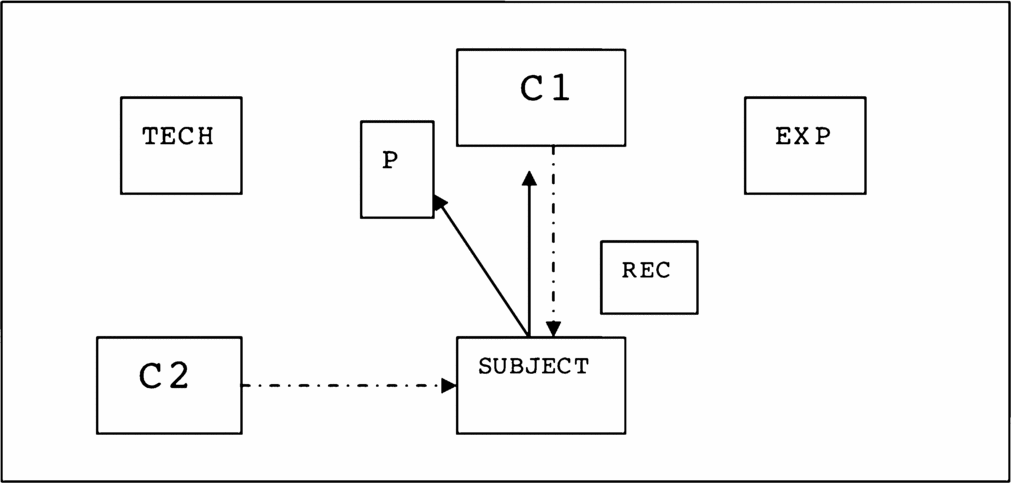
Two digital camcorders, a Panasonic VDR-D250 (C1 in figure 1) and a Canon MV-890 Mini DV (C2 in figure 1), both attached to tripods, were positioned so as to capture the subjects’ lip posture during speech production from frontal and lateral views, respectively. To obtain high-quality acoustic data, a Zoom H2 Handy Recorder with integrated microphone was used. The recorder was positioned a few centimetres to the right of each participant's mouth, yet without appearing in the visual field of either of the two camcorders. Figure 1 displays the set-up for the study.
Set up for the study (overhead view). C1 and C2 = camcorders capturing the subjects’ lip posture from frontal (C1) and lateral (C2) views, rec = ZOOM H2 Handy Recorder with integrated microphone, p = paper holder with A4 sheet displaying target sentences, exp = experimenter, tech = technician, unbroken arrows indicate direction of subject's gaze, broken arrows indicate locus of field of view of camcorders, scaling device not shown here.

The subjects were seated on a standard chair with static legs. Their lips were positioned in the centre of the field of view of the two camcorders. The display of C1 was visible to the subjects, which enabled them to monitor their lips during recording. C2 was set up at a right angle to the participants’ left in order to capture the extent of lateral lip protrusion during vowel production (see figure 1). No device was used to fixate the subjects’ heads. However, they were instructed to keep their heads still throughout data collection. This was monitored closely by the experimenter and the technician, and in the few cases where noticeable head movement did occur, the subjects were re-recorded.
For the measurement of the subjects’ lip posture from frontal views, a scaling device, attached to a stand, was positioned directly in front of the subjects’ chin, and was thus at the same distance from C1 as their lips. For subsequent analysis, it was ensured that the scaling device was visible at the bottom of the display of C1.
In addition to the measuring and recording equipment, a paper holder with an A4 sheet containing a list of the target sentences was positioned to the left of C1 (P in figure 1). It was ensured that the subjects were able to read the sentences without having to move their heads.
Following familiarization with the target sentences, the subjects read each of them aloud three times in succession at a natural pace, thus producing 4 × 3 = 12 sentences in total. Including instructions, the recording sessions lasted approximately three to five minutes. The participants were paid a small fee.
2.4 Acoustic analysis
The acoustic material was directly transferred onto a standard PC and analysed using Praat software (Boersma & Weenink Reference Boersma and Weenink2008). First, the duration of the carrier phrases was measured to control for differences in speaking rate across the three varieties. Subsequently, following extraction of the target words from the carrier phrases, the duration of the test vowels was measured from the first positive peak in the digitized waveform up to, but not including, the following portion of acoustic silence that signals the constriction of the post-vocalic plosive. The frequencies of the first three formants were then measured at the vowel mid-point as well as the 25% and 75% portions of each vowel. This was to account not only for the spectral properties of the steady-state portion of the vowel, but also for vowel-inherent spectral change. The latter analysis was performed to determine whether the SWE vowel constitutes a true monophthong, like its RP counterpart, or whether it behaves more like the nominal monophthongs /iː/ and /uː/, which are characterized by some degree of diphthongization in many accents of British English (Wells Reference Wells1982). Formant frequencies were measured using formant trackers, set at a frequency maximum of 5000 Hz with a dynamic range of 30 dB and a window length of 0.025 seconds. In the few instances where mistracking occurred, the automatically tracked formants were hand corrected.
2.5 Articulatory analysis
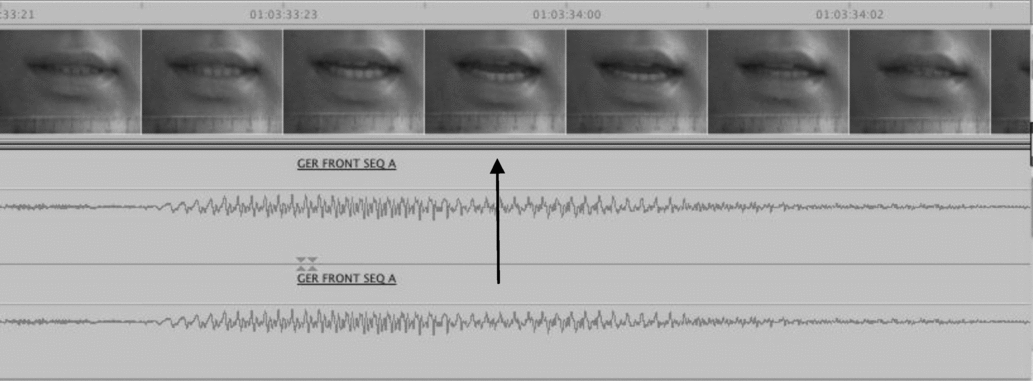
Both digital camcorders operate at a rate of 25 frames per second, yielding a series of stills for each vowel. The specific number of images per vowel, of course, depends on the duration of the vowels in question. The articulatory analysis in this study is confined to measurements of the subjects’ lip posture at a single point in time during vowel production, i.e. the point of maximal lip displacement. In the majority of cases, this point coincided with the vowel mid-point, as represented by the middle frame of each production. In order to identify the relevant stills, the video footage from each participant was analysed using Final Cut Pro (Version 5.0.1), a video editing software application that displays still pictures in synchrony with audio data (see figure 2).
Example of SG speaker's production of [taːt]. Arrow indicates point of maximal vertical lip opening.

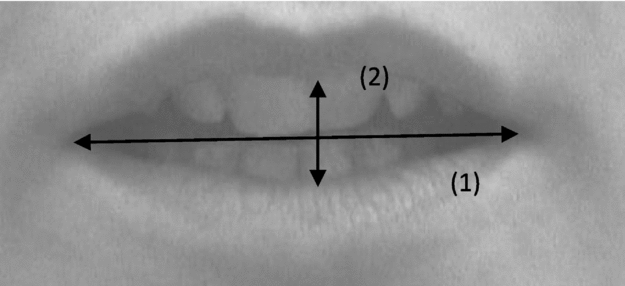
In line with previous studies (e.g. Balasubramanian Reference Balasubramanian1981, Fromkin Reference Fromkin1964), the following two sets of measurements (in millimeters) were taken directly from the frontal view images (see figure 3):
(i) The degree of horizontal lip displacement, as measured inside the corners of the lips.
(ii) The degree of vertical lip displacement, as measured from the middle of the upper lip, below the centre of the philtrum, to the middle of the lower lip.
These were subsequently converted into life-size using the scaling device depicted in the stills.
Measurements taken from the frontal view pictures.

The degree of lip protrusion during vowel production was also determined. However, since reliable measures that are robust enough to cope with inter-speaker differences are hard to come by, no formal measurements of lip protrusion were carried out. Instead, lip protrusion was assessed impressionistically via inspection of the lateral view images.
3 Results
3.1 Acoustic characteristics
3.1.1 Centre formant frequencies
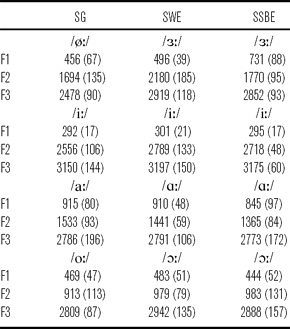
Table 1 depicts the mean frequencies, with standard deviations in parentheses, of the first three formants for SG /øː/, SWE /ɜː/, SSBE /ɜː/, as well as the point vowels, as measured at the respective vowel mid-points.
Mean formant frequency values (in Hertz) of the test vowels. Standard deviations in parentheses.

Inspection of the formant values for the point vowels indicates that the speakers in the three groups made approximately equal use of the vowel space (see also figure 4). As a result, any spectral differences found in relation to the nurse vowel in SWE and SSBE as well as /øː/ in SG are not due to variations in vocal tract shape, but constitute ‘real’ phonetic differences across the three varieties.
F1~F2 plot (in Hertz) of the test vowels.

With respect to the latter vowels, the values reported here are in line with previous accounts of SG (Mooshammer & Geng Reference Mooshammer and Geng2008) and SSBE (Deterding Reference Deterding1997).Footnote 6 To determine whether the mean formant frequency values differ significantly across the three groups, a series of one-way ANOVAs was carried out. The results for F1 and F2 revealed significant between-group differences (F1: F(2,22) = 39.651, p < .001; F2: F(2,22) = 27.834, p < .001). A Games-Howell post-hoc test, in turn, showed that the F1 values produced by the SSBE speakers were significantly higher than those produced by the SWE speakers (p < .001) and the SG speakers (p < .001). The difference between the latter two, on the other hand, did not prove to be significant (p = .326). With respect to F2, a Games-Howell post-hoc test revealed significantly higher values for SWE than SSBE (p < .001) and SG (p < .001). No significant difference was found between SSBE and SG, however (p = .431).
Figure 4 depicts the mean F1 and F2 values from each participant in an F1~F2 plot. Inspection of the figure shows that the nurse vowel in SWE has lower F1 and higher F2 values than its SSBE equivalent. This suggests that the SWE vowel is comparatively more fronted and less open. While it is also more fronted than the German vowel, these two vowels do not appear to differ in terms of vowel height, as a comparison of their F1 values indicates. Interestingly, although each group exhibits a certain degree of variability, there is virtually no F1~F2 overlap across the three groups.
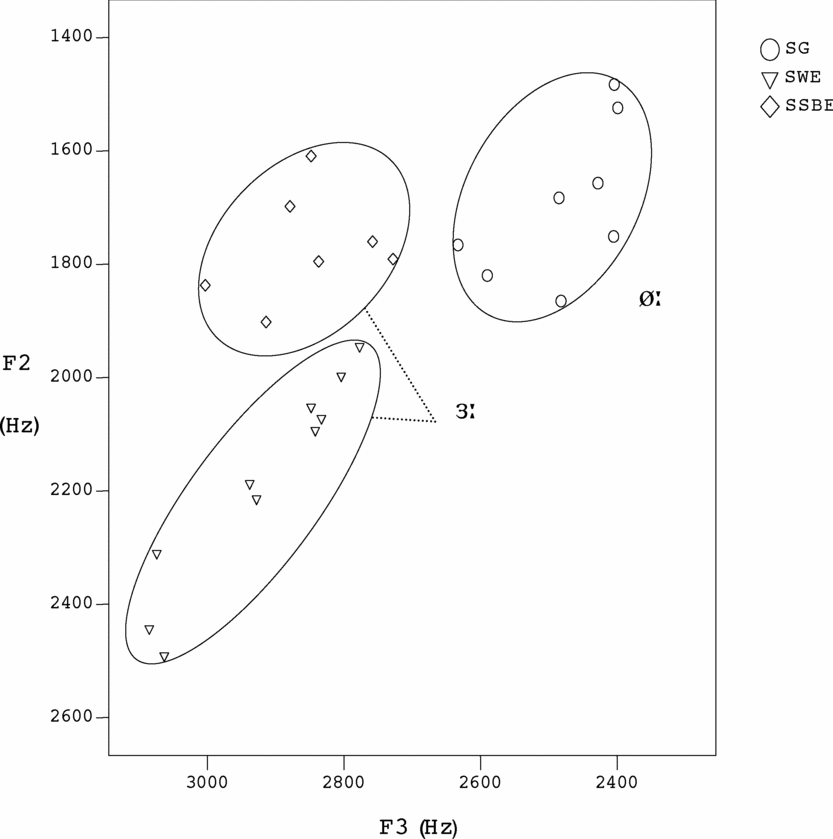
As with F1 and F2, a one-way ANOVA also revealed significant between-group differences for F3 (F(2,22) = 44.862, p < .001). A Games-Howell post-hoc test, in turn, showed that the F3 values produced by the SG speakers were significantly lower than those of the SWE speakers (p < .001) and the SSBE speakers (p < .001). The difference between SWE and SSBE, on the other hand, was not significant (p = .414). Inspection of figure 5 shows that, as with the F1~F2 values (see figure 4), the three groups do not overlap with respect to their F2~F3 values.
F2~F3 plot (in Hertz) of /ɜː/ in SWE and SSBE, and /φː/ in SG.

3.1.2 Vowel inherent spectral change
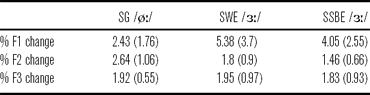
In addition to an analysis of the centre formant frequencies, it was investigated to what extent productions of /ɜː/ in SWE and SSBE as well as /øː/ in SG showed signs of vowel-inherent spectral change (VISC). This was done by calculating and transforming into a percentage score, changes in F1, F2 and F3 frequencies from the 25% to the 75% portions of each vowel production. Table 2 depicts a breakdown of the mean percent spectral change, with standard deviations in parentheses, for each formant and group.
Vowel-Inherent Spectral Change. Standard deviations in parentheses.

Andruski & Nearey (Reference Andruski and Nearey1992) consider VISC to be significant if it constitutes a change of ten percent or more (see also Morrison & Nearey Reference Morrison and Nearey2007 for a more recent theoretical account). The results obtained in this study indicate that movement through the middle half of the vowel was minimal in productions of SSBE /ɜː/ and SG /øː/. This is not surprising since these vowels are commonly described as monophthongal. The same was also found to hold true for realizations of SWE /ɜː/. This suggests that, like SSBE /ɜː/ and SG /øː/, this vowel constitutes a phonetic monophthong.
3.1.3 Vowel duration
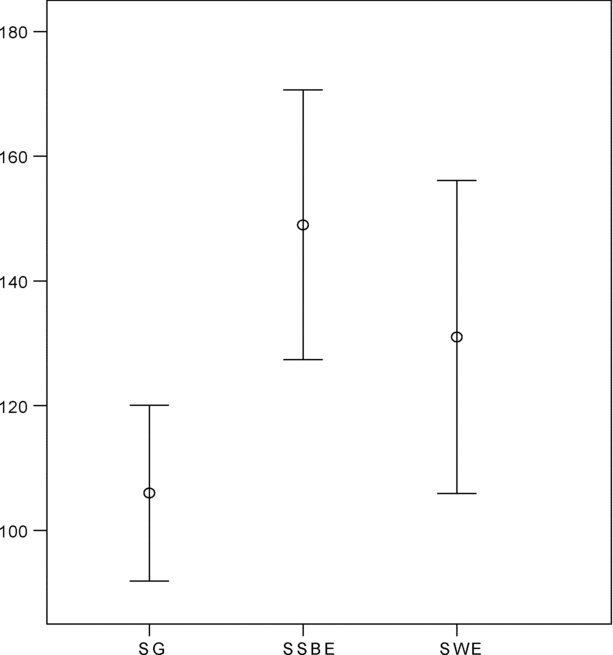
Figure 6 depicts the mean vowel duration values and standard deviations for /ɜː/ in SWE and SSBE, and /øː/ in SG.
Mean duration (in ms) of /ɜː/ in SWE and SSBE and /φː/ in SG. Error bars indicate ±1 SD.

The results obtained here are in line with previous accounts of vowel length in English and German (e.g. House Reference House1961, Antoniadis & Strube Reference Antoniadis and Strube1984, Whitworth Reference Whitworth2003, Mooshammer & Geng Reference Mooshammer and Geng2008). To determine whether the mean vowel duration values differ significantly across the three groups, a one-way ANOVA was carried out. Its result revealed significant between-group differences (F(2,22) = 7.805, p = .003). A Games-Howell post-hoc test showed that the vowel productions of the SG speakers were significantly shorter than those of the SWE speakers (p = .042) and the SSBE speakers (p = .003). The difference between the two English varieties, on the other hand, was not significant (p = .307).
3.1.4 Speaking rate
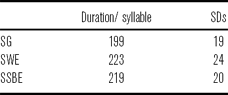
Vowel duration is known to vary according to speaking rate. To control for possible speaking rate effects in the present study, the duration of the phrases I say turtle again and Ich habe töten gesagt was measured. Since the German carrier phrase contains seven syllables, while the English one only six, the duration of each carrier phrase was divided by the number of syllables. Table 3 displays the mean syllable duration, with standard deviations, in the three varieties.Footnote 7
Mean syllable duration and standard deviations (in ms) for SG, SWE, and SSBE.

The mean syllable duration values were submitted to a one-way ANOVA. Its result revealed that the three groups do not differ significantly from each other in terms of syllable duration (F(2,22) = 3.006, p = .07). This suggests that, despite the slightly lower syllable duration of the German carrier phrase, the differences in vowel duration across the three groups are not likely to be a function of differences in speaking rate.
3.2 Articulatory characteristics
3.2.1 Horizontal and vertical lip displacement
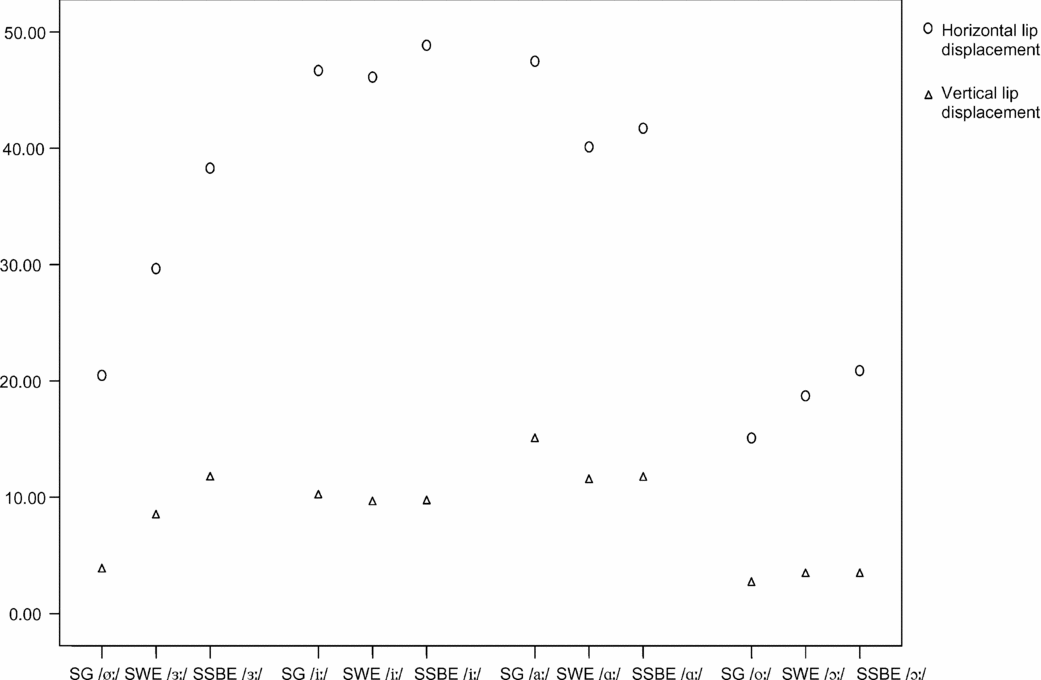
Figure 7 displays the mean horizontal and vertical lip displacement values across all vowels.Footnote 8
Mean horizontal and vertical lip displacement (in mm) for all vowels.

Inspection of the figure shows that, across the three varieties, the back rounded vowels exhibit the largest degree of horizontal and vertical lip contraction, consistent with a closely rounded vowel. The open vowels and the close front vowels, in turn, demonstrate the largest degree of vertical lip opening. Interestingly, SSBE /ɜː/ is produced with equally large degrees of vertical lip opening. Finally, the close front vowels exhibit the largest degree of horizontal lip opening. Note, however, that the vowels /iː/ and /aː/ are produced with roughly equal values in SG.
Table 4 depicts the mean degree of horizontal and vertical lip displacement for /ɜː/ in SWE and SSBE, and /øː/ in SG.
Mean horizontal and vertical lip displacement (in mm) for /ɜː/ in SWE and SSBE, and /φː/ in SG. Standard deviations in parentheses.

To test for differences in lip displacement across the three vowels, a series of one-way ANOVAs was carried out. The result for horizontal lip displacement revealed significant between-group differences (F(2,21) = 37.91, p < .001). A Games-Howell post-hoc test, in turn, showed that SG /øː/ is characterized by significantly greater horizontal lip contraction than SWE /ɜː/ (p < .001) and SSBE /ɜː/ (p < .001). Furthermore, the SWE vowel was produced with significantly greater horizontal lip contraction than the SSBE vowel (p = .011).
A one-way ANOVA for vertical lip displacement also revealed significant between-group differences (F(2,21) = 23.252, p < .001). A Games-Howell post-hoc test showed that SG /øː/ is characterized by significantly greater vertical lip contraction than SWE /ɜː/ (p = .003) and SSBE /ɜː/ (p < .001). The difference between the latter two vowels, on the other hand, was not significant (p = .061).
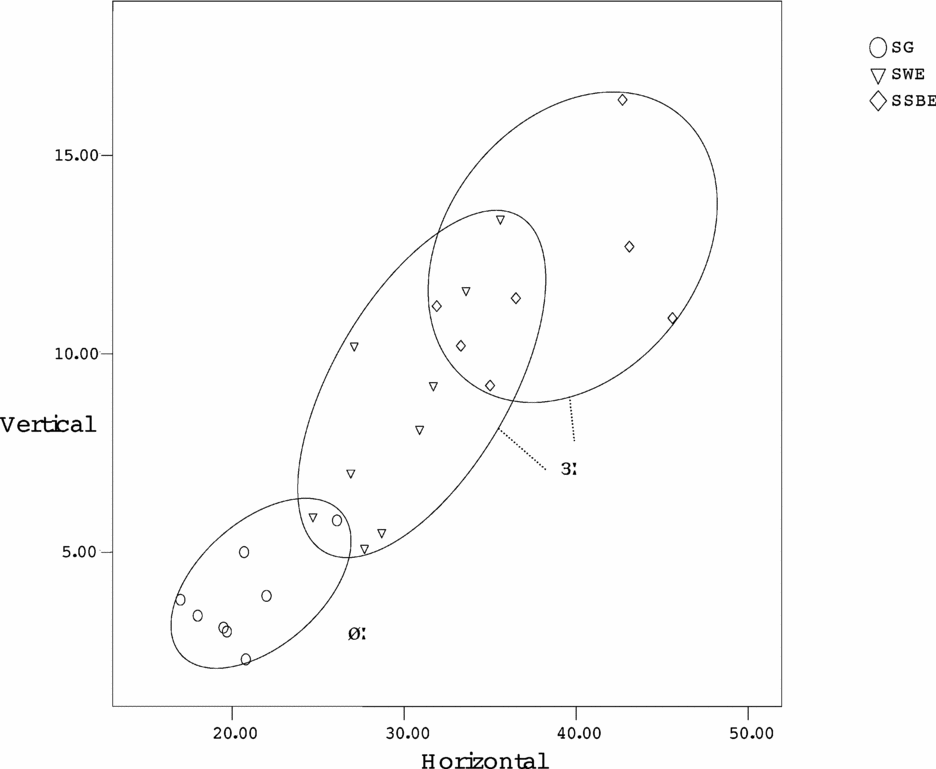
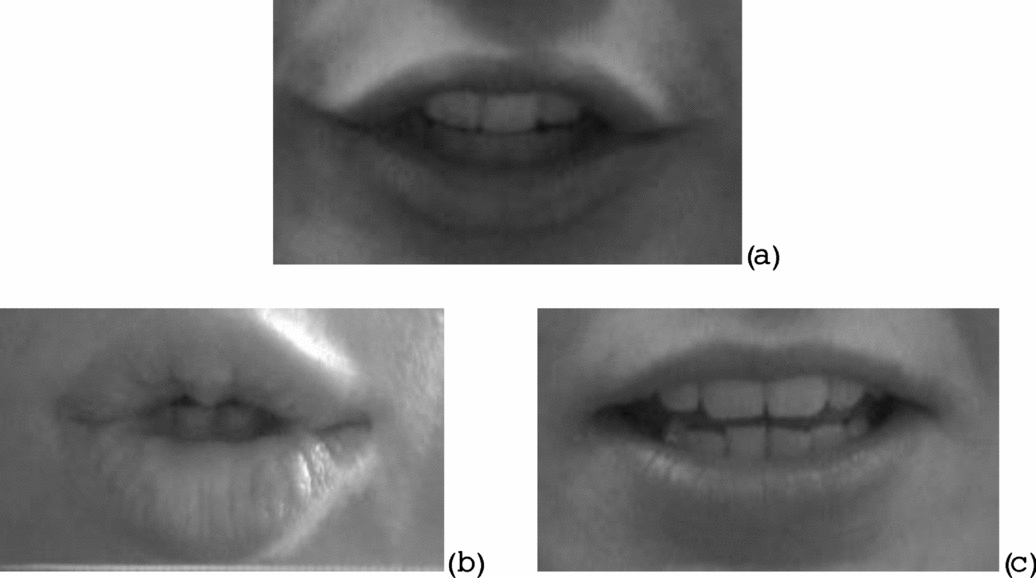
Despite these systematic differences, an inspection of individual speakers’ lip displacement values indicates a certain degree of variation within each group, as well as some overlap across the groups (figure 8). This is not surprising considering the potentially substantial inter-speaker differences in lip size and shape. However, physiological differences notwithstanding, visual inspection of the vowel productions indicates that they clearly fall into three distinct categories. Figure 9 provides an image of the typical lip posture for each of the three vowels.
Individual speakers’ horizontal and vertical lip displacement values (in mm) for /ɜː/ in SWE and SSBE and /φː/ in SG.

Example of frontal view lip posture at vowel mid-point for (a) SWE /ɜː/ in turtle, (b) SG /φː/ in töten and (c) SSBE /ɜː/ in turtle.

Inspection of figure 9a indicates that the SWE vowel is consistent with Catford's (Reference Catford1988) characterization of exolabial rounding. Recall that this involves vertical compression of the corners of the mouth, resulting in an elliptical slit between the lips. In Laver's (Reference Laver1980, Reference Laver1994) terms, the SWE vowel is characterized by open rounding, as represented by horizontal contraction combined with vertical expansion. The SG vowel, in contrast, appears to be characterized by endolabial rounding in Catford's terms, involving a pouting posture. In Laver's terms, the vowel is characterized by close rounding. Recall that this involves both horizontal and vertical contraction (see figure 9b). Finally, the SSBE vowel appears to be characterized by some degree of expansion of the horizontal and vertical dimensions, suggesting that it is a slightly spread vowel (see figure 9c).
3.2.2 Lip protrusion
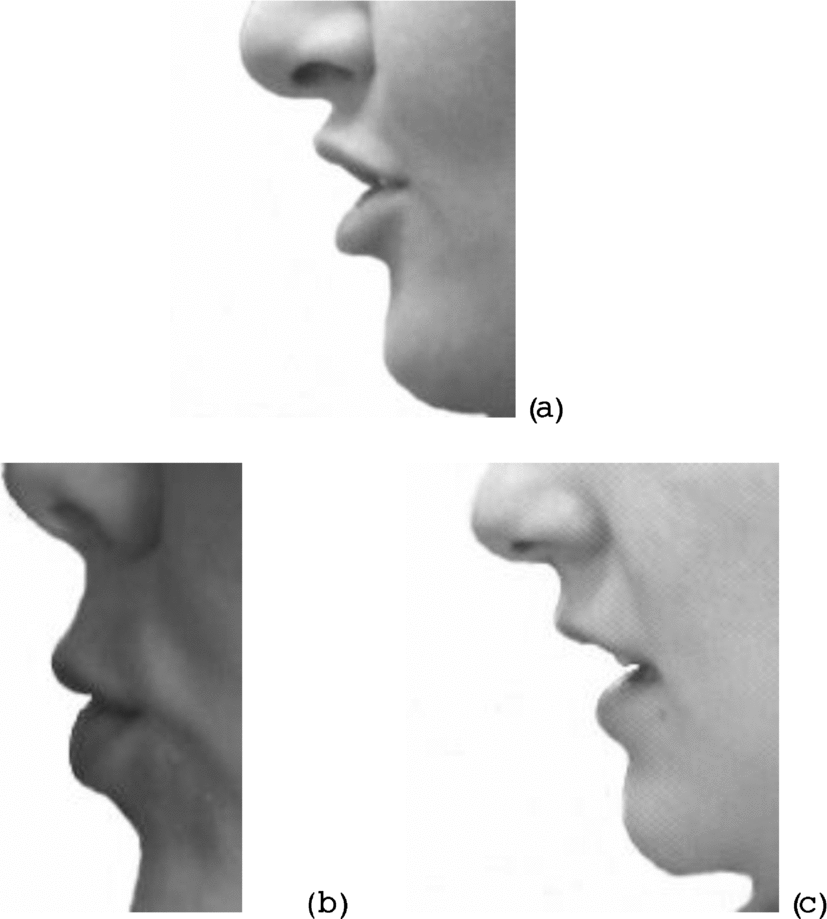
In addition to horizontal and vertical lip displacement, a third articulatory parameter was examined in the study: lip protrusion. Recall that this dimension was assessed impressionistically, rather than based on formal measurements. Figure 10 depicts representative lateral view images of the three vowels.
Example of lateral view lip posture at vowel mid-point for (a) SWE /ɜː/ in turtle, (b) SG /φː/ in töten and (c) SSBE /ɜː/ in turtle.

Inspection of figure 10a indicates that the SWE vowel is characterized by a considerable degree of protrusion of the upper and lower lips. Furthermore, in conformity with the frontal view images, the lips are wide apart in the production of this vowel. In contrast, the German vowel, while also characterized by a protruding posture, is produced with closed lips (figure 10b). Finally, the SSBE vowel involves a large degree of vertical lip opening, as we have seen. Figure 10c indicates that this posture is not combined with any forward movement of the lips, however.
4 Discussion
4.1 Summary of the results
This study set out to investigate the acoustic characteristics and the lip posture of the nurse vowel in South Wales English, with a view to verifying instrumentally the accuracy of auditory-based accounts of the vowel. To provide cross-linguistic and cross-dialectal comparators, productions of Standard Southern British English /ɜː/ and Standard German /øː/ were also included in the study.
Although all three vowels were found to be monophthongal, the acoustic and articulatory analyses revealed systematic differences between them. Thus, compared with the British English reference accent, the SWE vowel had a significantly higher F2 value and a significantly lower F1 value, which suggests that the vowel is more fronted and less open than SSBE /ɜː/. This lends support to Collins & Mees’ (Reference Collins and Mees1990) auditory characterization of the frontness and height of this vowel in Cardiff English. However, contrary to their claims, the SWE vowel was not found to be of extended duration, compared with the SSBE vowel. Furthermore, the two vowels were found to differ in terms of their lip posture. Thus, the articulatory analysis revealed that the SWE vowel was produced with a significantly greater degree of horizontal, but not vertical, lip contraction than SSBE /ɜː/. Accordingly, the SWE vowel was found to be characterized by exolabial rounding in Catford's (Reference Catford1988) terms, or open rounding according to Laver's (Reference Laver1994) classification, while the SSBE vowel was produced with a slightly spread lips. Production of the SWE vowel, but not the SSBE vowel, also involved protrusion of the upper and lower lips.
The comparison of the SWE vowel with German /øː/ also revealed similarities and differences. Thus, both vowels are, for instance, of close-mid height, as determined by their first-formant frequencies. On the other hand, the study revealed that the SWE vowel is significantly longer than SG /øː/, and produced with significantly less vertical and horizontal lip contraction than the German vowel. Unlike the SWE vowel, the SG vowel is characterized by endolabial rounding. This involves horizontal and vertical contraction, coupled with a protruding lip posture.
It is well known that the latter gesture leads to an extended supra-laryngeal tract, which, in turn, results in the lowering of formant frequencies, in particular those of the second and third formants. This effect is cross-linguistically robust, as the evidence from a large number of languages with front rounded vowels, not only German, indicates (Pols, Tromp & Plomp Reference Pols, Tromp and Plomp1973, Linker Reference Linker1982, Wood Reference Wood1986, Gendrot & Adda-Decker Reference Gendrot and Adda-Decker2005). Not surprisingly, the acoustic analysis revealed that SG /øː/ was produced with lowered F2 and F3 values, compared with those of unrounded front vowels. Crucially, however, this was not the case for the SWE vowel. Instead, the latter was found to have significantly higher second- and third-formant frequencies than SG /øː/. In fact, its formant values were found to be comparable to those of unrounded front vowels. This suggests that the open rounded lip posture, characteristic of the SWE vowel, had little or no lowering effect on F2 and F3, despite the fact that the vowel was produced with protruding lips.
4.2 Front rounding
The comparison of the nurse vowel in SWE with its SSBE counterpart provides useful descriptive detail, and shows how the SWE vowel relates to a well-documented supra-regional reference accent. However, it is the cross-linguistic comparison with German that perhaps raises the more interesting questions. Thus, in view of the observed differences between the two vowels, is the nurse vowel in SWE really a front rounded vowel, as claimed by previous auditory-based accounts (e.g. Mees & Collins Reference Mees and Collins1999, Penhallurick Reference Penhallurick2008, Walters Reference Walters1999), or is it an altogether different kind of vowel than SG /øː/? The answer to this question crucially depends on one's definition of front rounding.
At one level, one could claim that SWE /ɜː/ is indeed a front rounded vowel. After all, as we have seen, the acoustic data suggest a front tongue position and the articulatory data indicate an open rounded lip posture. As such, it is both a ‘front’ and a ‘rounded’ vowel, and the label ‘front rounded’ may thus be considered appropriate. Consistent with this view, the vowel could be assigned the same IPA symbol as the German sound, i.e. [øː]. Indeed, Beverley Collins and Inger Mees (personal communication) suggest that the SWE vowel may best be represented by [ ː].
This interpretation is not without problems, however. While acknowledging roundedness, it ignores the spectral differences between the two vowels. This is problematic since the high F2 and F3 values indicate that the nurse vowel in SWE is qualitatively different from SG /øː/. Hence, assigning both vowels to the same category implies that they are vowels of the same kind, their only difference being the degree and type of lip rounding involved. Furthermore, more generally, this view implies that lowered second- and third-formant frequencies are not a criterial attribute of front rounded vowels. Thus, theoretically, any front vowel with some degree of lip rounding, however minute, could be labelled ‘front rounded’, irrespective of its specific acoustic properties.
Alternatively, one could start out with the acoustic evidence. This is the approach adopted here. Thus, as the SWE vowel is characterized by formant values akin to those of unrounded front vowels of close-mid height, it may be more appropriate to classify the vowel accordingly, and hence, crucially, not as a front rounded vowel. What underlies this view is the assumption that, for a vowel to be labelled ‘front rounded’, it is not only required to be ‘front’ and ‘rounded’, but its articulatory gesture also needs to result in the characteristic lowering of formants. It is worth reiterating that this acoustic effect may be achieved not only through lip rounding, but also through the manipulation of other articulators, most notably depression of the larynx. Taken together, it is argued here that the nurse vowel in SWE, rather than being a front rounded monophthong with reduced lip rounding, is, in fact, a monophthong with the acoustic characteristics of an unrounded front vowel that is not actually altogether unrounded. This result suggests that there may be a tipping point in the lip gesture dimension which the SWE vowel has not reached.
How, then, should this vowel be represented phonetically? To begin with, as the acoustic data indicate a front vowel of close-mid height, it may best be represented by [e] as a base symbol. Indeed, raised and fronted versions of the nurse vowel are not uncommon across different varieties of English. For example, they have been attested in the varieties of East Yorkshire (Williams & Kerswill Reference Williams and Kerswill1999), Tyneside (Watt Reference Watt1996) and Liverpool (Knowles Reference Knowles1973, Reference Knowles and Trudgill1978; Newbrook Reference Newbrook1999; Watson Reference Watson2007).Footnote 9 Secondly, the relatively long duration of the vowel together with the fact that its length does not differ significantly from that of SSBE /ɜː/ suggest that it ought to be represented as a long vowel. Finally, as the articulatory evidence suggests open rounding, the feature of roundedness needs to be added. Accordingly, the nurse vowel in SWE may best be represented as a slightly rounded long close-mid front monophthong [ ː].
5 Conclusion and outlook
On the basis of instrumental measurements, this study has shown that, contrary to auditory-based accounts, the nurse vowel in SWE appears to be an altogether different kind of vowel from the prototypical front rounded vowels in other languages.
This result raises a number of interesting questions for future research. With respect to English, it may be worth investigating other varieties of the language in which the nurse vowel is purportedly realized as a front rounded vowel, such as New Zealand English or Tyneside English. As the nurse vowel in SWE was found to be qualitatively different from prototypical front rounded vowels, it is not entirely inconceivable that the same may be true for realizations of the vowel in other varieties of English.
Another aspect that could be explored in future research is the role of the nurse vowel within the vocalic system of SWE. Thus, it may be interesting to investigate instrumentally the relationship of the vowel to other vowels in its vicinity, notably the square vowel, which is realized as monophthongal [ɛː] in South Wales accents of English (Mees & Collins Reference Mees and Collins1999).
It may also be interesting to investigate possible lexical factors affecting the realization of the nurse vowel in SWE. This could be done by including other sample words from the lexical set, not only turtle.Footnote 10 Such factors are apparent in a number of other varieties of English. In local Dublin English, for instance, nurse, typically pronounced as non-rhoticized [nʊːs], contrasts with girl, which tends to be realized as [ɡɛːl] (Hickey Reference Hickey1999: 274).
Finally, future work is needed to investigate the phonetic properties of the SWE vowel further. In terms of vowel acoustics, this could involve exploring the effect of different consonantal contexts on the spectral and temporal properties of the vowel. More work is also needed on its articulation. After all, the method of assessing lip posture in this study was relatively unsophisticated. The use of more technologically-advanced methods, such as strain gauge movement transduction (e.g. Shaiman, Adams & Kimelman Reference Shaiman, Adams and Kimelman1995) or electromyography (e.g. Strauss-Hough & Klich Reference Strauss-Hough and Klich1999), would make it possible to obtain a dynamic account of lip movement in the production of the vowel. Furthermore, in addition to the lips, future research could address the role of the tongue, larynx and jaw in its articulation. This would make it possible to determine, on the basis of instrumental measurements, how the articulatory gestures of the SWE vowel differ from those of the mid front rounded vowels [œ] and [ø].
Acknowledgements
The author wishes to thank Torsten Müller for help with the recruitment of the German participants and Julian Kelly for technical support. Thanks also to Helen Pandeli, Barry Heselwood, Alison Murray, Beverley Collins, Inger M. Mees, and two anonymous reviewers for comments on earlier drafts of this paper. Any shortcomings are, of course, the sole responsibility of the author. This work is supported by a Small Grant from the Cardiff School of Health Sciences.