Introduction
The genus Salacia L. (Hippocrateaceae) consists of approximately 200 species distributed in tropical America, Africa and Asia (Mabberley, Reference Mabberley2005). In India it is represented by 21 species, of which 15 species are known to occur in Peninsular India (Ramamurthy & Naithani, Reference Ramamurthy, Naithani, Singh, Vohra, Hajra and Singh2000). Among them, eight species are recorded from Kerala (Sasidharan, Reference Sasidharan2004; Ramamurthy & Venu, Reference Ramamurthy, Venu and Daniel2005; Nayar et al., Reference Nayar, Rasiya Beegam, Mohanan and Rajkumar2006). During intensive botanical studies along the Western Ghats of Kerala State in South India we collected an interesting species of Salacia from Agasthiamala forest of Thiruvananthapuram District. Critical studies revealed it to be a new species and it is described here with an illustration.
Species Description
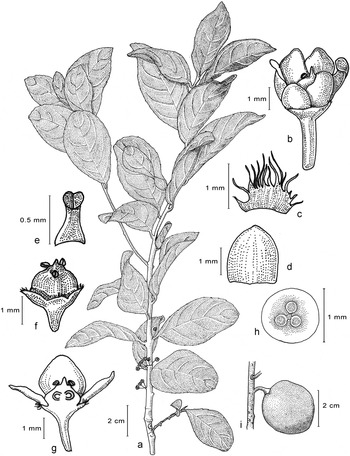
Salacia agasthiamalana Udayan, Regy Yohannan & Pradeep, sp. nov.Fig. 1.
Salaciae macrospermae Wight affinis, sed ab ea praesertim habitu fruticoso scandenti, ramulis denigrescentibus lenticellatis, foliis 5–6.5 cm longis ellipticis atrovirentibus coriaceis serrato-crenatis, petiolis 5–7 cm longis, cymis 2–8-floribus et fructibus laevigatis differt. – Type: India, Kerala, Thiruvananthapuram District, Agasthiamala, evergreen forest, 900–1000 m, 11 iv 2010 (fl), Udayan & Regy Yohannan S004 (holo MH; iso K, SKCFootnote 1, SNCHFootnote 2).
Fig. 1.Salacia agasthiamalana Udayan, Regy Yohannan & Pradeep, sp. nov.: a, twig with flowers; b, single flower; c, sepal; d, petal; e, stamen; f, calyx and disk with androecium and gynoecium; g, longitudinal section of flower; h, cross-section of ovary; i, fruit. a from Udayan S006; b–h from Udayan S004; i from Udayan S008. Drawn by Umesh M.


Scandent bushy shrubs; branchlets lenticellate, blackish. Leaves elliptic, 5–6.5 × 2–3.5 cm, acute, acuminate or rounded-retuse at apex, acute or cuneate at base, coriaceous, margin serrate in young leaves but crenate in mature leaves, venation reticulodromous; petiole 0.5–0.7 cm long. Flowers 2–8, cauliflorous umbelliform cyme in dense fascicles from axillary or extra-axillary branches; pedicel 0.4–0.6 cm long. Sepals 5, oblong, brown, c.0.1 cm long, much shorter than the petals, margins fimbriate. Petals 5, elliptic, 0.2 × 0.15 cm, green with a tinge of yellow when young but orange tinged towards the upper margins in older flowers. Disk green when young but with a faint orange tinge towards the base at maturity, 0.05 cm high, 0.1 cm wide, conical, tapering to a short style. Anthers 3, rarely 4, discoid, creamy-white with a brown tinge; filament slightly tri-radiate, creamy-white when young but yellowish with an orange tinge later. Ovary superior, 3-loculed; ovules 1 in each locule; stigma simple umbonate, pale green. Berry globose, smooth, 4–6 cm across, orange-red. Seeds slightly plano-convex, 1.5–2 × 1–1.5 cm.
Distribution. Salacia agasthiamalana is known from Pongalapara in the Agasthiamala region of the southern Western Ghats of Kerala. It is apparently endemic and very sparsely distributed on the slopes.
Habitat and ecology. This species occurs in evergreen grassland vegetation at an altitude of 900–1100 m. Flowering and fruiting: September and April; March and July.
Etymology. The species is named after the type locality, Agasthiamala Biosphere Reserve, one of the floristically rich regions of the southern Western Ghats.
Additional specimens examined. India. Kerala, Thiruvananthapuram District, Agasthiamala, 950–1100 m, 4 v 2010, Udayan & Regy Yohannan S006 (CALI, SNCH); ibid., 10 iii 2011, Udayan & Regy Yohannan S008 (CAL, CALI, FRLH, MH).
This new species is most similar to Salacia macrosperma Wight in its cauliflorous many-flowered umbelliform cymes and globose orange-red berries but can be distinguished from it by its bushy scandent habit; blackish lenticellate branchlets; 5–6.5 cm long, dark green, elliptic, coriaceous, serrate-crenate leaves; short (5–7 mm) petioles; few-flowered (2–8) cymes and smooth berries.
The plant was found growing together with other rare and endemic species such as Actinodaphne campanulata Hook.f. (Lauraceae), Bentinckia condapanna Berry & Roxb. (Arecaceae), Byrsophyllum tetrandrum (Bedd.) Hook.f. ex Bedd. (Rubiaceae), Eugenia indica (Wight) Chithra (Myrtaceae), Euphorbia santapaui A.N.Henry (Euphorbiaceae), Hedyotis albonervia Bedd. (Rubiaceae), Microtropis ramiflora Wight (Celastraceae) and Polyscias acuminata (Wight) Seem. (Araliaceae).
Acknowledgements
The authors are grateful to Dr V. P. Prasad, IBLO, Royal Botanic Gardens, Kew, for comments on the identity of the species; Dr M. Sanjappa, Botanical Survey of India (BSI), Kolkatta, Dr G. V. S. Murthy, Botanical Survey of India (BSI), Coimbatore, and Dr N. Sasidharan, Kerala Forest Research Institute (KFRI), Thrissur for their help; Kerala State Council for Science, Technology & Environment (KSCSTE), Thiruvananthapuram for financial support; Mr Umesh M., Project Fellow, Sree Narayana College, Kollam for the illustration; the authorities of Kerala State Forest Department for permission for field visits, and Mr Satheesh George, Arya Vaidya Sala, Kottakkal and Mr A. J. Robi, Project Fellow, KFRI, Thrissur for assistance in the field.