Thus, it is as a Moment of fundamental vulnerability that recognition becomes possible, and need becomes self-conscious. What recognition does at such a moment is, to be sure, to hold destruction in check.Footnote 2
In Violence Performed: Local Roots and Global Routes of Conflict (2009), Patrick Anderson and Jisha Menon interrogate the ‘representational prominence of violence both as an awesome spectacle to behold and as a domain of political discourse that dominates contemporary world-making’.Footnote 3 This article similarly seeks to respond to the doing of violence in the everyday, but also to temper scholarship within theatre and performance studies heavily invested in the social and political efficacy of violence. Despite better intentions, perhaps even despite the desire to change an oppressive norm, dominant critical methodologies have been significantly shaped by the language of resistance, interruption, and transgression. The notion that performance does something in the present, and that this is the mark of its radicalism, is well established.Footnote 4 The danger of such a conceptualization, however, is not only that the stakes are especially high for determining a successful performance – ‘if it doesn't do anything, it's worth nothing’ – but also that critical discourse risks shutting down under autoerotic satisfaction. Indeed, it can be said that a certain attachment to violence, whether as rhetorical resistance or actual physical destruction, has dominated theatre and performance scholarship over the last two decades.
This near-fetishization of performance's disruptive virtues might well make the recent writing of Jill Dolan and José Muñoz on notions of utopia appear rather naive and sentimental.Footnote 5 Yet these contributions are important interventions that must be developed not in the service of creating utopias per se, but in order to give gravitas to theatre and performance's role in envisioning a (better) future. That is to say, following Derrida, that practitioners and scholars must take a more patient, nuanced approach to anticipating/preparing/rehearsing for the (impossible) event of l'avenir – the democracy to come.Footnote 6 Something of this urgency to redress the role imagined for theatre and performance also pulses through Alan Read's Theatre, Intimacy and Engagement (2008), in which the author suggests that scholarly emphasis on theatre's political efficacy has prevented other matters from coming to the fore, in particular questions that are concerned with an ‘ethics of association, an understanding of the relationship between intimacy and engagement, an expansion of the humanist collective’.Footnote 7
This article joins this ethical turn by considering the art of letting go. I frame letting go as a kind of weak performance that loosens attachments while creating the possibility for relatively non-aggressive modes of being to emerge.Footnote 8 This ‘relative’ dimension is important, for while letting go is not conceivable outside of pressurized or oppressive conditions, to let go is always to choose the less violent option, and it may even amount to a choice between life and death. Sidestepping these formative theoretical contexts, this article examines the practice and ethics of non-violent relationality by focusing on a production of Charles Mee's Big Love on the Peacock Stage of the Abbey Theatre, Dublin in July 2008. Thinking about and around this performance, I am primarily concerned with the following question: when, why and how should the violence of the law be suspended in the service of letting the subject go?
For love or law
Directed by Selina Cartmell, Big Love dramatizes the fleeing of fifty women by yacht from forced marriage to their Greek cousins who have recently returned from military duty in the USA. Based on Aeschylus's The Suppliant Women, in Mee's adaptation the sisters (three of whom appear onstage here) eventually land off the Italian coast. Confusing a luxurious villa for a hotel, Lydia leads the way inland, where she meets Giuliano, and beseeches him for asylum. The arranged marriages are nothing less than kidnap and rape, she insists, and her sisters’ plight must be treated urgently:
- guiliano:
You want to be taken in as immigrants?
- lydia:
As refugees . . .
- guiliano:
I mean, from, you know: political oppression, or war . . .
- lydia:
Or kidnapping. Or rape.
- guiliano:
From rape.
- lydia:
By our cousins.
- guiliano:
Well, marriage really.
While gay Giuliano's response seems to naturalize the equation of kidnap and rape with marriage, he does not own the house, and so passes on the dilemma to his uncle, Piero. First, Lydia grounds her plea on the basis of kinship, articulating a rambling genealogy that relates their families via Zeus. Although Piero offers the women dinner and a room for the night, he is less convinced of his obligation to help the arrivals at all costs. Replacing blood ties with a shared humanity, Thyona interjects: ‘Whose business is it if not yours? You're a human being.’ Taken aback by her accusatory tone, Piero insists that he cannot take in every refugee who lands on his doorstep, or else he would ‘have a house full of Kosovars and Ibo and Tootsies/boat people from China and God knows what all’. While Olympia reads this as a viable utopia, Piero reinforces his inability to help everyone. More specifically, he is moved to question why he should assist the women who stand before him, and not others who are outside his immediate company:
While issues of power in the field of gender and sexuality are at the fore of this early interaction, these matters also challenge mobilizations of nationality and imperialism in the play world and beyond. Moreover, despite the production's playful, postmodern aesthetic – clashing design choices, pop songs and contemporary cultural references – the performance also raises timely questions concerning what determines an ethical relationship to others, and how such a field of relationality might be effectively constituted.
Histories of violence
On the level of narrative, much of the play appears as an embittered attack by women against men, where ‘woman’ and ‘man’ figure in essentialized, heterosexist terms. The plight of women is ostensibly given centre stage, and for much of the production it is inflected with the kind of convenient truisms perpetuated by commercial texts such as John Gray's Men Are from Mars, Women Are from Venus. In this world, men own women, not just symbolically as the ‘Big Love’ signifier might phallically suggest, but legally too. Crucially, however, in this version the historically oppressed are afforded the opportunity to speak out against greater histories of individual and collective subjection. When it comes to charging against the injustices wreaked by men, Thyona's voice is the loudest and most unyielding. ‘Men don't have a good side,’ she announces to her sisters, even after they have been welcomed by Piero; ‘Boy babies should be flushed down the toilet at birth.’ In Judith Roddy's fiery take on Thyona, a whole history of violence against women is given expression, and this is implicitly deemed to date at least as far back as the tragedy's first estimated production in the fifth century bc.
Despite the fierce enthusiasm with which Thyona speaks, and the sisters’ shared frustration, neither Olympia nor Lydia joins in easy agreement. Lydia is most forthright in her thoughts on the topic, maintaining that men have capacity for good. Male and female experience is not all that distinct, she reckons. Instead of talking around binaries, Lydia imagines a ‘human history’,
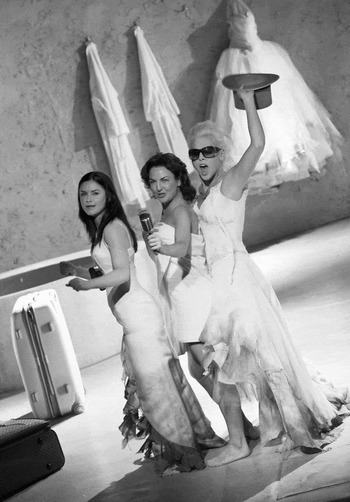
Although her speech is nearly drowned out by the sound of a helicopter overhead that contains the jilted men who have come to retrieve their would-be brides, Lydia presses on, as if her rhetoric can stand the test of this situational, masculinist interruption. Far from reiterating an established discourse about men and women, or military occupation, what Lydia describes in her interlocution is a form of relationality that does not perpetuate endless cycles of destruction in the name of retribution, while sacrificing pleasure, love or even life in the process. Rather, Lydia calls forth what Judith Butler identifies as ‘the primary vulnerability to others’,Footnote 9 independent of discursive positionality or the sociosymbolic inscriptions of sex, gender, nationality and so on. Uttered against a scene of militaristic acquisition, Lydia's speech is less the statement of resignation and submission that Thyona sees it to be (even as both Olympia and Giuliano claim that being controlled is also sometimes enjoyable). Rather, her utopianism works to critique life widely accepted as a cycle of violence (Fig. 1).
Left to right: Thyona (Judith Roddy), Lydia (Ciara O'Callaghan) and Olympia (Kelly Gogh) declare war even as they sing pop tunes. Abbey Theatre production of Big Love at the Peacock, 9 July–2 August 2008. Photo: Ros Kavanagh.

Aggressive attachments
One of the most striking motifs in Big Love is its meditation on the subject's attachment to violence. This is conveyed through various discussions that concern what is at stake in compromising pleasure over principle, individual desire over a presumed or enforced sense of collective good. As noted, Lydia is the most determined in sticking to her beliefs, while her sisters readily concede that many men have good points too, such as Piero, who presents them with a range of expensive cosmetic products to soothe their tired bodies.
Constantine, Thyona's would-be husband, speaks most passionately and articulately of male experience. Men must also sacrifice desire in fulfilling a social function, he contends. Men are produced for physical work and war, yet women still want them to be civilized. ‘When push comes to shove,’ he declares, ‘and people need defending, then no one wants a good guy any more, then they want a man who can fuck someone up.’
Given that the male cousins return from operations in the USA, we might interpret the play's critique of nationalism and imperialism to comment somewhat obliquely upon contemporaneous American military operations. But under Cartmell's direction, these power dynamics are given more local resonance, not least of all by having Thyona and Constantine – the two most outspoken representatives of the sexes – speak with Northern Irish accents. In this, the Abbey production links highly current global concerns over US occupation in the Middle East with more local concerns surrounding the Troubles and their legacy, and with more specific matters still of interpersonal relationships. Implicitly, the production seems to ask what is at stake in returning violence with violence? What happens to those individuals raised to fight whose aggression can no longer be channelled into organized military activity, and is no longer culturally valued? What happens to those subjects, as Constantine presses most urgently, who are asked to switch from human, to inhuman, and back to human again when their work is done? And this critique of violence cuts through nationality, gender and sexuality. Although Constantine, like Thyona, defines this deadlock most brilliantly, he is seemingly unable to enact anything other than violence. Nikos, on the other hand, makes this transition by articulating his vulnerability to Lydia, face-to-face.
The attachment to states of subjection and forms of violence finds ample explication in the writing of Freud. His seminal paper ‘Mourning and Melancholia’ (1917) focuses on self-punishment in response to loss. Distinguishing between mourning – where the love object is actually gone and has been psychically ‘let go’ – and melancholia – where the love object is unavailable but psychically preserved – Freud observes that the melancholic internalizes the lost love-object, and reproaches himself for its loss in the ‘external’ world:
The melancholic displays something else besides which is lacking in mourning – an extraordinary diminution in his self-regard, an impoverishment of his ego on a grand scale. The patient represents his ego to us as worthless, incapable of any achievement and morally despicable; he reproaches himself, vilifies himself and expects to be cast out and punished. He abases himself before everyone and commiserates with his own relatives for being connected with anyone so unworthy.Footnote 10
Developing Freud's discussion, Butler suggests that all gendered identity might be seen as inherently melancholic. If a love-object must be given up to secure identity in the Oedipus complex, she reasons, then all gender might be seen as a kind of melancholia for an other that is lost, with the sex of the lost object becoming psychically internalized as prohibition.Footnote 11 What emerges through these select discourses of identification is a picture of subjectivity as inherently unable to let go; a melancholic individual effected through repression, prohibition and censure; marked in, on and through the body. Within these narratives, subjectivity is constantly haunted by loss as the inability to undo, work through or move beyond certain atachments. What seems most important here, however, is not even that loss is difficult to reconcile, but rather that this is the result of the symbolic's violent imperative for the subject to foreclose other possible forms of being. Melancholia emerges when the subject is pressed to choose an other over (many) other others, whether unconsciously in the disciplining of desire or in the practice of everyday relations.
Big Love offers a very useful consideration on the impossibility of securing stable identity. Perhaps most interestingly, it reveals what is lost in every (coercive) effort to fix identity by concealing loss, whether it relates to gender, sex or nationality. If loss only appears through prohibition, Big Love seems to promote a radical openness to the vulnerability of others as the precondition for non-violent relationality to emerge. In Thyona and Constantine, we are given embodied examples of the symbolic's imperative for subjects to take shape in the service of a wide variety of social and political functions. But the play also illuminates how violence towards others ultimately deprives and damages the self. In respect of personal relationships alone, the play cautions against compromising bodily pleasure, or something closer to what Foucault refers to as ‘care of the self’,Footnote 12 in the service of maintaining a defensive distance from the other. The older married couple Elenor and Leo, who wander by Piero's party, are the chief messengers of this outlook:
- leo:
I always say: you need to embrace life.
- elenor:
You need to let it in through every pore.
- leo:
We come this way but once
this brief, brief time on earth
we need to suck it in.
The key thing is
you'll be wanting to let go [my emphasis] of fear.
While we might readily resist this dialogue as sentimental, we might also resist such an act of foreclosure in order to think further about how the affective encounter with the other signalled here might redirect how we think about theatre, performance and ethics more generally.
The fascist face of the baby/‘smashing the neighbor's face’
Given that the question of ethical violence is so central to Big Love, it warrants discussion alongside the work of two of the most influential contributors on the subject: Lee Edelman and Slavoj Žižek. In No Future: Queer Theory and the Death Drive (2004), Edelman argues that the logic of reproductive futurism, spearheaded by the ‘fascism of the baby's face’,Footnote 13 cannot account for ‘queerness’, and, in response, queer persons should embody the death drive with which they are associated, and puncture the social's heteronormative fantasy of totalization. Drawing on Lacan's notion of the ‘sinthome’,Footnote 14 Edelman understands all subjectivity to be sinthom-osexual, but calls upon those marked as queer to fulfill the sinthom-osexual's mandate of returning violence with violence:
sinthom-osexuals, like the death drive they are produced to represent – and produced to represent insofar as the drive undoes all representation – endanger the fantasy of survival by endangering the survival of love's fantasy, insisting instead on the machinelike working of the partial, dehumanizing drives and ceaselessly offering access to their surplus of jouissance.Footnote 15
Discussing the moment in Hitchcock's North by Northwest (1959) when Leonard menaces over Roger and Eve as they dangle over Mount Rushmore's façade, Edelman describes the most appropriate act of ‘neighborly love’ for Leonard thus: ‘breaking his hold on the cliff he would give him the break for which he was asking: the neighborly love sufficient to break him open with jouissance and launch him into the void around which and against which the subject congeals’.Footnote 16 Breaking the hold on reality, for Edelman, ‘is the ethical task for which queers are singled out’.Footnote 17 I would argue, however, that there are other ways of ‘breaking the hold on reality’ that when thought of as letting go – that is, the weak undoing of attachment – might disrupt conditions of violence without literally annihilating the subject.
Edelman finds a loving neighbour in Žižek, who, in the provocatively entitled essay ‘Neighbors and Other Monsters’ (2006) (which includes the subheading ‘Smashing the Neighbor's Face’), criticizes Emmanuel Levinas's writing on the ethical dimension to the face-to-face encounter. Žižek sees in Levinas's regard for the other's face a ‘gentrification’ of the neighbour:
In other words, what if the ultimate function of the Law is not to enable us not to forget about the neighbor, to retain our proximity to the neighbor, but, on the contrary, to keep the neighbor at a proper distance, to serve as a kind of protective wall against the monstrosity of the neighbor? In short, the temptation to be resisted here is the ethical ‘gentrification’ of the neighbor, the reduction of the radically ambiguous monstrosity of the Neighbor-Thing into an Other as the abyssal point from which the call of ethical responsibility emanates.Footnote 18
In particular, Žižek critiques Butler's affective writing on the aftermath of 9/11, condemning it as ‘an ethics of finitude of making a virtue out of our very weakness, in other words, of elevating into the highest ethical value the respect for our very inability to act with full responsibility’.Footnote 19 Looking beyond the ‘vulnerable place of the other’, he proposes that ‘the true ethical step is the one beyond the face of the other, the one suspending the hold of the face, the one of choosing against the face, for the third. This coldness is justice at its most elementary’.Footnote 20 In both Edelman and Žižek, violence and ethics are virtually inseparable.
The question of ethical violence also troubles Piero in Big Love. When he puts to the sisters ‘but why should I help you?’ and not ‘someone else’ he is effectively wondering why he should attend to the face of the neighbour-other who stands before him, and not some other neighbour, if any neighbour at all? This is the theoretical problematic that propels and frames the ensuing action. Perhaps, what emerges as most interesting in considering this question through live performance, as distinct from the texts and films about which both Edelman and Žižek write, is how ignoring or violating the other is rendered especially troublesome.
Earlier, I noted how Thyona and Constantine verbally account for the deadlock of subjectivity in which they find themselves: they hate what they desire and desire what they hate. What initially amounts to an exchange of words eventually gives way to an embodied disarticulation of identity that opens up the field of relationality to rethinking. Following Thyona's lead towards the beginning of the performance, which includes shouting obscenities about men and firing plates across the stage, Olympia and Lydia join in to question, with one voice, ‘Why can't a man be more like a woman?’ Less compelling than the question is its physicalized counterpoint onstage: as the women speak, they repeatedly throw themselves against the floor, working themselves into a state of frenzy. Despite careful choreography by Ella Clarke and Paul Burke, the brutality is relentless, and it signifies violence carried out or re-enacted in the name of the other (men), which ultimately does damage to the self (the women), not to mention the ‘community of genders’. Following Constantine's mirroring speech, he, Oed and Nikos enact a similar masochistic ritual that ends with a pile of exhausted bodies, bleeding, sweating and weeping centre stage. For the actors, this dynamic has real ramifications too. In the production in question, aside from innumerable cuts and bruises incurred, the actress playing Thyona lost her voice and broke two ribs, while a male actor from the ensemble sprained his foot.
In this situation of real danger, the performance centralizes the intersubjective (between the actors, and the actors and the audience) and embodied dimension to experiences of and responses to violence. In the chapter entitled ‘Looking for Recognition’ in Undoing Gender (2004), Butler returns to Hegel, whose master–slave dialectic is so crucial to theories of mastery, servitude and otherness. She writes,
The moment in ‘Lordship and Bondage’ when the two self-consciousnesses come to recognize one another is, accordingly, in the ‘life and death struggle,’ the moment in which they each see the shared power they have to annihilate the Other and, thereby, destroy the condition of their own self-reflection. Thus, it is as a moment of fundamental vulnerability that recognition becomes possible, and need becomes self-conscious. What recognition does at such a moment is, to be sure, to hold destruction in check.Footnote 21
Holding destruction in check, as it affects self/other, male/female, gay/straight, native/foreign bodies, structures the dramatic tension of Big Love. Neither the play nor Butler suggest the possibility of absolute non-violent interaction, however; both emphasize that the deferral of destruction is a precondition for the emergence of ‘community’.Footnote 22 For the male characters, it is the fleeing of their prospective wives that prompts self-reflection; for the women it is the generosity of Piero that interrupts their preconceptions about men. Both processes amount to an undoing of identity that registers in and through the body. This takes the shape of the females and males separately collapsing into corporal mounds following their self-harming rituals, but it also takes the form of murder when the brides make a pact to kill their husbands during the wedding they agree to under false pretences. This is Thyona's initiative, and it aims to uphold her law, even as her sisters express love for their suitors.
The wedding scene rapidly dissolves into a disaster. Cake is thrown about the room, plates are smashed and knives are flung. Characters alternately lie on the ground while others jump on top of them. Against a visual backdrop of ostensible joy, which includes Elenor and Leo dancing, Handel's Arrival of the Queen of Sheba gives way to Widor's Toccata from Organ Symphony No. 5, and the women slay the men as planned. All, that is, except Lydia and Nikos, who make love while the others wreak destruction.
Embracing the other
When Thyona notices that Lydia did not follow through on her promise to kill her partner, she is outraged, and accuses her of treason. Olympia, on the other hand, is more exasperated, claiming that had she known that Lydia was not going to kill, she too may have loved. Thyona, not unlike Edelman and Žižek, claims that there can be no love without justice: ‘It cannot be free unless every person has equal standing.’ While Lydia does not disagree with Thyona's criticism of justice, she objects by appealing to her emotions:
In a way, Lydia can be seen to answer Piero's preliminary question for him: she responds to the face of the other not because he is strictly in more need than another party, but because they make each other ‘feel good’. Here, feeling good is not the anti-intellectual, apolitical, sentimental experience that it is so often understood to be. Rather it marks the most difference that minimal contact can positively effect. Feeling good pertains to emotions, as in ‘I feel well,’ but it also refers to an embodied intelligence for knowing the self and the other in the world, as in ‘I feel well.’
Matriarchal Bella, Piero's mother, tries Lydia for the treason of which she is accused. She refuses to condemn her as she did all she could:
Although Bella refers to love, the ethical act she names is the one in which Lydia and Nikos relieve each other of the violence of the law, embracing rather than destroying one another. While she condemns the killing of the men, she also refuses to hold Thyona and Olympia to justice, noting that violence was constitutive of the law her family practised in the first instance:
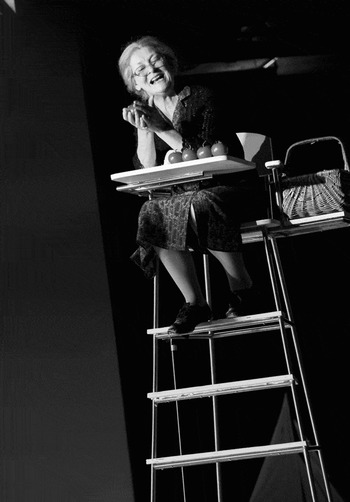
While Edelman's and Žižek's notions of ethical violence suggest that we return the law's violence to our monstrous neighbour, Big Love makes a clearer distinction between ethics and law: ‘for the sake of healing, for life to go on’, justice will be suspended (Fig. 2).
Bella (Barbara Brennan) suspends the law for life to go on. Abbey Theatre production of Big Love at the Peacock, 9 July–2 August 2008. Photo: Ros Kavanagh.

In Precarious Life: Powers of Mourning and Violence (2004), Butler focuses on post-9/11 America, and critiques the enactment of violence in response to loss, whereby some lives are considered less grievable than others. Within the operating sovereign system, Butler cites prisoners in Guantánamo Bay as such figures. Impressing the need to respond to violence with something other than violence, she insists, ‘If we are interested in arresting cycles of violence to produce less violent outcomes, it is no doubt important to ask what, politically, might be made of grief besides a cry for war.’Footnote 23 Butler's ethical position, then, begins with recognizing the vulnerability of others. While she urges us to think beyond the immediate other – ‘there are others out there on whom my life depends, people I do not know and may never know. This fundamental dependency on anonymous others is not a condition that I can will away’Footnote 24 – she does so less to minimalize the importance of responding to immediate encounters than to caution against political ideologies that routinely construct restrictive categorizations of the human. While I acknowledge the structural insight that the work of figures such as Edelman and Žižek provides, ‘for the sake of healing, for life to go on’, I would like to press further the necessity of a politics of mercy (without religion) within the context of the phenomenology of ‘letting go’Footnote 25 which theatre and performance might effectively illuminate.
The law ‘not strained’
As a subject of inquiry, mercy is not new to the theatre. Although wrapped up in Semitic and Christian prejudices, it structures the central tension of The Merchant of Venice. Like Thyona, who insists that ‘this game isn't over till someone lies on the ground with the flesh pulled off their bones’, Shylock demands of Antonio a pound of flesh to avenge his perceived injustice. Portia reminds him that mercy is ‘not strained’ and that it should always ‘season justice’.Footnote 26 Mercy is also a condition of war, when the white flag of surrender waves to indicate ‘no more – for life to go on’. Introducing a collection of essays on the subject of compassion, mercy's close relative, Lauren Berlant convincingly cautions against easy responses to the rhetoric of ‘compassionate conservatism’, by questioning
what kinds of obligation are being entailed when we witness the theatrical scene of suffering that makes, minimally, moral demands of our bodies – our hearts and tears – as well as, sometimes, political and economic demands on the people and institutions that house that suffering.Footnote 27
I would argue, however, that what sets mercy apart from compassion or sentimentality is that it does not rely upon emotional attachment to the same extent, although this may be a precipitating factor. Rather, set apart from any kind of godly purpose, we might think of mercy as a mechanism within the law that allows for the release of subjects from cycles of violence in order for life to go on, as in Bella's verdict. John Caputo persuasively separates mercy from religious doctrine, by illuminating it as a facility within the law to relieve those who have already suffered too much. In Demythologizing Heidegger (1993) he writes that mercy
takes the demands of the one who is afflicted to override and trump the Law, to lift the Law from the backs of the ones who need help, especially when they are afflicted by the Law itself. It is not so much insight and practical nous as melting or succumbing to the needs of the other.Footnote 28
In his account, mercy figures as physical descent – melting – where authority drops down as it does from Bella's podium to help those most in need.
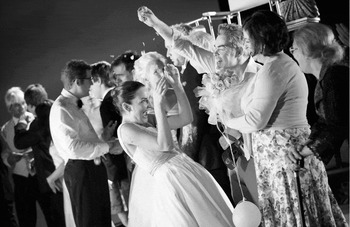
Discussing theories of subjectivity, I have already described how letting go is considered a feature of successful mourning in Freud. This idea has been challenged not only by Butler, but also by Dennis Klass and Phyllis Silverman, who maintain that what is more important than a definitive moment of closure is ‘negotiating and renegotiating the meaning of the loss over time’.Footnote 29 Sara Ahmed takes up this point, foregrounding that what is most significant in the field of relationality (where relationality is implicitly or explicitly structured by violent loss) is being ‘able to let go another as an outsider, but maintain [or work through] one's attachments’.Footnote 30 Moving beyond psychoanalysis and into phenomenology, Ahmed suggests that body-objects form attachments by sticking to an/other, and that this stickiness is an effect of the law: ‘stickiness involves a form of relationality, or a “withness,” in which the elements that are “with” get bound together’.Footnote 31 Undoing these attachments, setting them aside or strategically letting them go, paves the way for alternative forms of relationality to develop (Fig. 3).
Left to right: Lydia (Ciara O'Callaghan), Leo (Malcolm Adams), Elenor (Marion O'Dwyer) and Bella (Barbara Brennan) embrace otherness and celebrate the emergence of new communities. Abbey Theatre production of Big Love at the Peacock, 9 July–2 August 2008. Photo: Ros Kavanagh.

Letting go might pertain to surviving a whole range of circumstances, then, but in everyday life it might inform how we understand and do relationships. Letting go is something that I can do, and it is also something which is done to me: it is about stopping short of violence in order that life might go on, especially when one is already heavily afflicted by the law. In the production of Big Love in question, this translates from words to a phenomenology of falling. This dynamic begins violently, with all six main characters throwing themselves on the ground. The movement replicates a submission to the law, but also indexes a need for release. When they can fall no more, bodies beat and kill each other at the wedding scene. When they can fall no more, Lydia and Nikos fall in love. When the law falls on Lydia's shoulders in court, she falls to plead for mercy, claiming to have no choice over her actions. In order for life to go on, the law melts before its subjects, releasing them from certain destruction.
In his critique of queer theory's ‘tropaic gravitation toward negative affect and depersonation’,Footnote 32 Michael Snediker calls for an optimism that is not sentimental and ineffective, but intensely affective and interrogative. This critique of queer theory might be similarly mapped onto theatre and performance studies, and indeed such a rationale appears to inform Gavin Butt's ongoing work on ‘serious’ performance.Footnote 33 I do not mean to suggest that theatre and performance practice ought to deliberately stage forms of ‘letting go’, whatever these might be. Rather, I propose that we need to recognize the importance of this kind of mobility in our formulations of subjectivity in and through our paradigmatic critical encounters. In this regard, the article also suggests that we refocus disciplinary value beyond the presumption of, or aspiration for, performance as violation, to address the form's unique facility to rehearse non-violent modes of being with others, and being in the world, that resemble the art of letting go.