

Introduction
The International Energy Agency (IEA)’s definition of an energy subsidy is “any government action that concerns primarily the energy sector that lowers the cost of energy production, raises the price received by energy producers or lowers the price paid by energy consumers.”Footnote 1 Energy subsidies, or the so-called fossil fuel subsidies (hereafter FFS), can take many forms, ranging from direct transfers, cross subsidies, and price controls to purchase requirements and tax exemptions.Footnote 2
Over the past decade, the issue of FFS has become an important one for several reasons. Firstly, preliminary studies indicate that FFS account for a large proportion of the gross domestic product (GDP) in many countries. For example, a recent study on the western Balkans reports that direct and indirect subsidies add up to 5 to 11 percent of the GDP in these countries.Footnote 3 Such subsidies are intended to promote industrialization with low energy prices, as well as to lower the price of energy products for consumers.Footnote 4 However, in many cases, FFS have failed to meet their intended objectives. They are in fact recognized as impediments to sustainable development, resulting in an economically inefficient allocation of resourcesFootnote 5 and accelerating the speed of natural resource depletion. They cause significant market distortions by acting as barriers to energy efficiency and clean energy investments. Moreover, FFS encourage higher levels of greenhouse gas (GHG) emissions like carbon dioxide (CO2) and sulfur dioxide (SO2), thereby increasing local and global atmospheric pollution. According to Kovacevic, FFS have the potential to multiply climate change mitigation costs five times in terms of the proportion of GDP—from about 5 percent to about 25 percent of GDP in the western Balkans.Footnote 6 FFS also impose heavy burdens on national balance of payments accounts, especially for importers of fossil fuels. They also tend to be regressive, since richer households have higher energy consumption and therefore benefit disproportionately from low energy prices.
In September 2009, G20 leaders agreed to “rationalize and phase out over the medium term inefficient FFS that encourage wasteful consumption,”Footnote 7 an engagement that two months later was also endorsed by the Asia-Pacific Economic Cooperation (APEC).Footnote 8 Currently, in the post-Rio+20 context, the topic of FFS is gaining momentum.Footnote 9 The recommendation to gradually phase out FFS has ranked as one of the most voted-upon topics (66 percent) throughout the Rio Dialogues and the Rio voting processes.Footnote 10 Reform of “environmentally harmful subsidies” also forms part of the Europe 2020 strategy.Footnote 11 Since the Paris Agreement of 2015, intentions to eliminate FFS have gained momentum, leading to a number of developments, such as the pledge by the G7 countries to phase out FFS by the end of 2025.
Extending the national-level assessments of FFS conducted by the IEA and the Organisation for Economic Co-operation and Development (OECD) in recent years, this study utilizes existing data on FFS in Turkey, related regulations, and policy documents to provide a clear picture of the current situation and produce relevant recommendations. In terms of emissions, Turkey has one of the lowest amounts of per capita GHG among OECD nations, equivalent to 6.11 tons of CO2 per capita in 2015.Footnote 12 However, Turkey also has one of the fastest growth rates of CO2 emissions among OECD nations, with a rapid acceleration of CO2 emissions from 214 million tons of CO2 equivalent in 1990 to 475 million tons in 2015.Footnote 13 Furthermore, the carbon footprint of the country currently retains the largest share of the overall ecological footprint owing to massive levels of fossil fuel combustion.Footnote 14
Based on these environmental problems in relation to global climate change concerns, FFS need to be assessed in detail, and their impacts on both macroeconomic outcomes and environmental indicators, especially GHG emissions and other pollutants, need to be analyzed in depth. Turkey needs to reconsider its incentive mechanisms regarding natural resource extraction and energy generation. In this respect, FFS, in their current form, stand in stark conflict with Turkey’s national commitments towards sustainable development, hampering the country’s strategic target of obtaining at least 30 percent of its power from renewable energy sources by the year 2023.Footnote 15 Insistence on the orthodox notion of “grow first, clean up later” impedes Turkey’s sustainable development strategies and artificially constrains the country to the traditional energy system, which is largely environmentally hazardous. Furthermore, through the implementation of such distortions, market signals lead to inefficiencies due to a misallocation of resources.
This article provides an extensive overview of Turkish FFS. To this end, the following section undertakes a summary of previous efforts to quantify FFS. Following that, the third section provides an overview of Turkey’s energy situation and summarizes the legal and policy background for the electricity, coal, petroleum, and natural gas sectors. The subsequent section then presents our findings and discusses the results. Finally, the concluding section discusses relevant policy implications.
Overview of previous findings and the literature regarding FFS
The previous literature has adopted several approaches to classifying and measuring various support mechanisms. At the global level, there are three main sources of inventories: the IEA, the International Monetary Fund (IMF), and the OECD. As already noted, the IEA’s definition of an energy subsidy is “any government action that concerns primarily the energy sector that lowers the cost of energy production, raises the price received by energy producers or lowers the price paid by energy consumers.”Footnote 16 The IEA measures the difference between domestic fossil-fuel prices and international reference prices to estimate FFS directed toward consumers in developing countries. This method consists of multiplying that market price differential by the affected volume consumed in a country. According to the IEA, global fossil-fuel consumption subsidies amounted to approximately USD 260 billion in 2016, less than half of their peak of USD 544 billion in 2012.Footnote 17 Consumer energy subsidies, such as those realized through price regulations, are more widespread in developing countries, while in both developing and developed countries subsidies to energy producers, such as tax concessions, are common. Since 2007, 80 percent of estimated subsidies worldwide have been in countries that are net exporters of oil and gas.
In 2011, the OECD released an inventory of all types of FFS (both consumer and producer) in 24 of its member countries. Its inventory now covers 43 countries—all 35 OECD member countries plus 7 non-OECD G20 countries and Colombia—and identifies over 1,100 support mechanisms, with tax exemptions being the most frequent. In terms of budgetary support, coal is the most heavily subsidized energy source in developed countries. The OECD’s data come from official government documents and cover both producer and consumer support. Uniquely, the database also includes estimates of support provided by a number of sub-national governments in federal countries (viz., Australia, Canada, Germany, and the United States).
In 2013, the IMF provided estimates of pre-tax and post-tax FFS for 176 countries; these estimates were updated again in 2015. Its estimates of the consumption-subsidy component of what the IMF calls “pre-tax subsidies” are comparable to those of the IEA. What it calls “post-tax energy subsidy estimates” are an order of magnitude higher, since they are measured against a benchmark price that integrates a tax on fossil fuels (as well as electricity) in order to offset some of the negative externalities associated with their use. In 2015, the IMF estimated these “post-tax subsidies” to be on the order of USD 5.3 trillion in 2015, or 6.5 percent of the world’s GDP.Footnote 18
A series of studies have also provided national-level assessments of FFS. These aim to improve transparency concerning the magnitude of FFS within a given economy and, in some cases, to assess the impacts of their potential removal as well. A common theme in these studies is the difficulty of obtaining comprehensive data: because subsidies are channelled through different means, data are scattered across government bodies at the national and local levels as well as among state-owned energy enterprises—or are simply unavailable. Accordingly, most studies have only been able to establish partial estimations of the magnitude of FFS.
Building on a method that utilizes the four types of subsidies defined by the World Trade Organization (WTO),Footnote 19 the Global Subsidies Initiative (GSI) of the International Institute for Sustainable Development (IISD) identifies sub-categories of FFS that are used as a checklist toward conduct a comprehensive list.Footnote 20 In its study on Russia, the GSI traced 30 schemes of support to oil and gas production.Footnote 21 It has quantified 17 of those schemes, amounting to USD 8.1 billion in 2009 and USD 14.4 billion in 2010. In Norway, a GSI study found nine government programs supporting the oil and gas industry, totalling USD 4 billion in 2009.Footnote 22 This bottom-up approach was also employed by Riedy and Diesendorf to quantify individual governmental programs of support to fossil fuels in Australia.Footnote 23
In India in 2012, GSI published jointly with The Energy and Resources Institute (TERI) A Citizen’s Guide to Energy Subsidies in India,Footnote 24 which focuses on consumption subsidies for petroleum products and electricity. The guide states that the Indian government provides a fiscal subsidy on public distribution system (PDS) kerosene and domestic liquefied petroleum gas (LPG) that amounted to USD 640 million in 2010–2011. This subsidy did not cover the full difference between the production cost and the end price of these products, thereby leading to “underrecoveries” of the oil companies, which amounted to USD 17.15 billion, or 1.07 percent of the GDP, in 2010–2011. These underrecoveries are partly covered by further government cash assistance, and are themselves subsidies. The government also provides substantial subsidies to the electricity sector, which are more difficult to estimate because electricity policies and tariff rates vary among different states and consumer groups. In its February 2014 energy subsidy briefing, for instance, GSI reported that India had decided to increase the annual quota of subsidized LPG to the amount of USD 0.5–0.9 billion owing to the pressures of “public demand.” Some state governments also announced plans to cut electricity tariffs for poorer households by half.
There is also a substantial literature that attempts to assess the socioeconomic and environmental impacts of reforming FFS at the national and global levels. These studies use quantitative methodsFootnote 25 to simulate the effect of different reform scenarios. Six global empirical assessments were reviewed by Ellis,Footnote 26 and all found that FFS reform would lead to an increase in GDP and reductions in CO2 emissions globally, although the magnitude of these predictions varied significantly among the studies. Regarding assessments on the national level, a 2012 United Nations Development Programme (UNDP) study on FFS in Vietnam found that the removal of FFS would lead to an increase in real GDP of about 1 percent, as well as to significant reductions in emissions.Footnote 27 In all these studies, the results depended notably on assumptions regarding how the government would reallocate subsidy spending.
A few studies have focused on FFS in Turkey, such as an energy policy review by the IEAFootnote 28 and the section on Turkey in the OECD inventory.Footnote 29 The IEA reported that, while the lignite sector in Turkey receives no financial support, the hard coal sector enjoys significant subsidies. In 2008, the subsidy was, on average, around USD 250/ton, reaching almost USD 400 million, or 0.5 percent of the GDP. The OECD inventory emphasizes that the main support measures to FFS in Turkey, through 2016, had been transfer payments to the hard coal industry, distribution of coal to poor families, and tax exemptions for specific sectors. The inventory provides quantitative estimates concerning some of these schemes, but the data remains incomplete. There is also a recent report by the IISD-GSI on subsidies to coal and renewable energy in Turkey.Footnote 30 The findings of the current paper rely in part on the IISD-GSI’s research report. The present study leans on these inventories while also filling in specific data gaps and adding information on recently introduced subsidy schemes, thereby representing the most complete assessment of FFS in Turkey to date.
The Turkish energy system
In this study, we pursue a bottom-up approach through which we identify specific transfers to the fossil fuel sector at the national level. In this section, we outline the existing regulations and laws in the relevant sectors.
Overview of energy statistics in Turkey
Over the last decade, economic and social development in Turkey have led to a massive increase in energy demand. The Turkish Electricity Transmission Company (Türkiye Elektrik İletim Anonim Şirketi, TEİAŞ) estimates that demand will continue to increase at an annual rate of 6 to 7 percent through 2023.Footnote 31 However, several studies and experts have questioned this projected demand growth, claiming that overly optimistic assumptions for economic growth have led to an unrealistically high estimate for future demand. The manner by which such projections are prepared might be seen as demonstrative of a political choice in favor of sustaining fossil fuel investments and FFS.Footnote 32
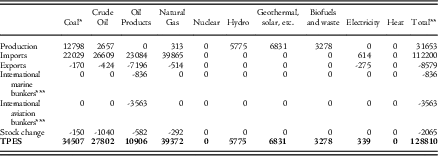
Turkey is highly dependent on energy imports and faces significant challenges to maintaining its energy security. The total primary energy supply (TPES) of the country amounted to 128,810 ktoe in 2015, with around 88 percent of this coming from fossil fuels and 12 percent from electricity, hydropower, and renewable energy sources (see Table 1). Natural gas and oil and oil products were the main sources of fossil fuels, accounting for, respectively, 31 percent and 30 percent, followed by coal and coal products, at 27 percent of the country’s TPES in 2015. The country has no significant fossil fuel resources of its own, and thus imports the majority of its energy. In 2015, for instance, Turkey imported 112,200 ktoe of energy, accounting for around 87 percent of the total energy supplied in the same year (see Table 1). Domestic production of hard coal and lignite contributed only 37 percent of the TPES of coal in 2015.Footnote 33 Almost all of Turkey’s natural gas was imported as well, with Russia and Iran being the largest suppliers of oil and natural gas.Footnote 34
Energy balances of Turkey, 2015 (in kilotons of oil equivalent (ktoe))

Source: International Energy Agency, “Turkey: Energy Balances, 2017.”
* The coal column also includes peat and oil shale where relevant, while the crude oil column includes crude oil, NGL, refinery feedstocks, additives, and other hydrocarbons.
** Totals may not add up precisely due to rounding.
*** International marine and aviation bunkers are included in transport for world totals.
Legal and policy background
In the 1980s, the Turkish economy underwent a trade liberalization episode with far-reaching effects. One of these was the shift to an export-oriented industrialization strategy. Previously, protected industries had been exposed to competition from imports, and the Turkish economy had begun to become gradually integrated with the global economy. However, export promotion policies accelerated the pace of environmental degradation and resource depletion in the country.Footnote 35
Turkey has declared its intentions to mainstream climate change into national development policies through increases in energy efficiency and the use of clean and renewable energy resources. Before the Conference of Parties (COP21) meeting in Paris, Turkey submitted its Intended National Determined Contribution (INDC) to the United Nations, with a GHG reduction target of up to 21 percent as compared with the business as usual (BAU) scenario for 2030. Achieving this target would have significant implications for the country’s energy policies in the near future.
Since 1963, Turkey has regularly been drawing up five-year development plans setting targets for specific sectors for development purposes. In contrast to its aim of mainstreaming climate change, almost all of the country’s five-year development plans from 1963–1967 to 2014–2018 have targeted increases in coal, petroleum, and electricity production. Priority is given to public investments in exploring for coal and oil. It is estimated that demand for fuel and energy will continue to increase, and that this demand must be covered by new private and public investments in domestic energy resources, as well as by the construction of new hydroelectric plants and power plants fuelled by coal and nuclear fuel. The country’s high reliance on imported oil and natural gas increases its current account deficit, which is expressed, especially in recent development plans, as the main reason behind Turkey’s goal of utilizing all its domestic energy resources and exploring for new deposits of oil and natural gas where available.
To spur such developments, in 2013 the public company for petroleum exploration and production (Türkiye Petrolleri Anonim Ortaklığı, TPAO) was granted responsibilities in this regard, with generous budgets (USD 553 million in 2013) to be used in the search for oil and gas.Footnote 36 This policy aimed to encourage not only domestic investors, but also foreign companies specializing in oil and gas exploration. The five-year development plan for 2014–2018 states that domestic resources—including the Afşin-Elbistan lignite reserves, which are used to produce electricity—need to be developed and utilized, that nuclear energy should be introduced, and that the share of energy from renewables should be increased in order to reduce balance-of-payments deficits and foster economic growth. Domestic production of energy equipment is also subsidized for purposes of energy security. On the demand side, the plan suggests that energy efficiency should be increased, with the target being to reduce energy intensity by at least 20 percent by 2023.
The electricity sector
In line with a broader transition to a more market-oriented regime in the 1980s, the electricity sector also began to be liberalized. Before the liberalization, the Turkish electricity sector had been dominated by a state-owned vertically integrated company, the Turkish Electricity Authority (Türkiye Elektrik Kurumu, TEK), which exercised control over generation, transmission, and distribution.Footnote 37 In 1993, TEK was restructured into two separate state-owned companies, the Turkish Electricity Generation and Transmission Company (Türkiye Elektrik Üretim İletim Anonim Şirketi, TEAŞ) and the Turkish Electricity Distribution Company (Türkiye Elektrik Dağıtım Anonim Şirketi, TEDAŞ).Footnote 38
One of the key driving forces behind the decision to liberalize the electricity market was Turkey’s ambition to join the European Union (EU) and its effort to meet the preconditions for membership. Other key factors were the needs to better meet the growing demand for electricity, to improve the fiscal position of the government, and to reduce inefficiency in the electricity sector.Footnote 39
The first law in relation to the restructuring—Law No. 3096, which set up a framework for private participation in electricity—was enacted in 1984 and allowed for private participation through a variety of new contracts, such as Build-Operate-Transfer (BOT) contracts for new power-generating facilities, Transfer of Operating Rights (TOOR) contracts for existing generation and distribution assets, and the auto producer system for companies to produce their own electricity.Footnote 40
Additional laws were adopted in the 1990s with the aim of further facilitating the participation of the private sector in the electricity market.Footnote 41 Specifically, Law No. 3996 and the accompanying Decree No. 5907, both from 1994, authorized the granting of guarantees and tax exemptions for BOT projects by the Undersecretariat of the Treasury (Hazine Müsteşarlığı).Footnote 42 In 1999, a constitutional amendment enacted the application of private law to contracts in the electricity sector and reduced the requirements related to review processes conducted by the Council of State (Danıştay).
With the same goals of meeting the country’s accelerating demand, improving efficiency, and ensuring energy security, Turkey continued to take further steps toward the development of a competitive electricity market. In 2001, the country commenced a broad electricity reform program via the enactment of the Electricity Market Law (Law No. 4628). This law established a “new and radically different” legal framework for the design of electricity markets and “set up a new independent Energy Market Regulatory Authority (EMRA)”.Footnote 43 Further changes in the electricity market combined fragmented state-owned enterprises into different entities (generation, transmission, distribution, wholesale and retail supply), as well as introducing a competitive wholesale electricity market in 2006.Footnote 44
Despite these remarkable steps toward the privatization of the electricity market, electricity prices remained under state control. Between 2002 and 2007, electricity prices remained constant in spite of rising demand and significant increases in the prices of inputs. This situation led to a lack of funding for investment and infrastructure maintenance, while also encouraging strong growth in electricity demand.
In 2008, the government set up a “cost-based pricing mechanism” for state-owned enterprises in the energy sector, aiming to achieve full-cost recovery.Footnote 45 This mechanism allowed for a transition period during which retail electricity tariffs were progressively adjusted upwards every three months toward full cost reflection. Enacted in July 2008, the mechanism “resulted in several price increases by the end of 2009.”Footnote 46
The petroleum sector
The Turkish petroleum sector underwent a similar restructuring in line with the policies of market liberalization in the 1980s. As with other sectors, the motivations for reform in the petroleum sector were to improve the fiscal position of the government, reduce inefficiencies, and meet the preconditions for Turkish membership in the EU.Footnote 47 Prior to the petroleum-sector reform, both the refining and distribution of petroleum had been undertaken by subsidiaries of TPAO, the public petroleum exploration and production company, and the prices of petroleum products had been set by the government.Footnote 48 As of 1989, however, private companies were permitted to set the prices of petroleum products, and in 1990 public petroleum companies began to undergo privatization.Footnote 49
In 1998, the government adopted the Automatic Pricing Mechanism (APM), which remained operational until the end of 2004.Footnote 50 This mechanism set a ceiling on the prices of diesel, gasoline, kerosene, heavy fuel oil, heating oil, and LPG, based on five-day averages of international petroleum prices and exchange rates.Footnote 51 The mechanism was introduced in order to ensure price stability and predictability, as well as to protect inland petroleum refineries from transport costs.Footnote 52
Adopted in 2003, the Petroleum Market Law (Law No. 5015) was a stepping stone toward the institutionalization of a private and competitive petroleum market in Turkey, in compliance with EU legislation and other international commitments. The main achievement of this law, which went into full effect in 2005, was the complete liberalization of prices in the petroleum sector. Today, Turkish fuel prices are set entirely by the market. Gasoline and diesel retail prices are among the highest in the OECD, owing to the addition of high excise taxes.Footnote 53 With Law No. 5015, the regulatory authority for the petroleum market was passed from the government, specifically the Ministry of Energy and Natural Resources (Enerji ve Tabii Kaynaklar Bakanlığı), to the independent agency EMRA (Enerji Piyasası Düzenleme Kurumu or EPDK), which also served as the regulator of the electricity and natural gas market. Furthermore, the Petroleum Market Law weakened other types of government control in the petroleum market, such as license management and importation limits, and accelerated the privatization of state-owned enterprises.Footnote 54 With competition thus having been introduced into the petroleum market, there are now many private players in distribution and retail, though there are still relatively few refineries.
The natural gas sector
As with other fossil fuels, the Turkish natural gas market was traditionally state-controlled and vertically integrated. Over the past two decades, it has been progressively liberalized and partly privatized. The most important law reforming the natural gas market is the Natural Gas Market Law (Law No. 4646), which was adopted in 2001 with the aim of establishing a competitive market and complying with EU legislation. Prior to the passage of this law, the state-owned Pipeline and Petroleum Transport Company (Boru Hatları ile Petrol Taşıma Anonim Şirketi, BOTAŞ) enjoyed monopoly rights on the import, distribution, storage, and sale of natural gas. The 2001 law limited BOTAŞ’s market share of imports to a maximum of 20 percent.Footnote 55 Furthermore, this law required BOTAŞ to be unbundled by 2009 into three distinct companies operating in different market segments: trading, transmission, and storage. The law also imposed a gradual privatization of the distribution network.Footnote 56 This liberalization of the gas market was complemented by further legislation regarding licenses, tariffs, market certificates, and services.Footnote 57 Since 2008, wholesale tariffs have been set freely by the market, but retail tariffs remain regulated by means of an internally uniform national retail tariff that is approved by EMRA and does not reflect regional cost differences.Footnote 58 Despite the advancements allowed by the legal framework in terms of liberalization, BOTAŞ remains the dominant player in the Turkish natural gas market.
The coal sector
Turkey produces both hard coal and lignite, although hard coal amounts are meager and most of the reserve base is comprised of low-quality lignite. In 2016, more than half of domestic coal production was undertaken by three state-run enterprises: Turkish Coal Enterprises (Türkiye Kömür İşletmeleri, TKİ), the Electricity Generation Company (Elektrik Üretim Anonim Şirketi, EÜAŞ), and Turkish Hard Coal Enterprises (Türkiye Taşkömürü Kurumu, TTK). TTK acts as a monopoly in the production of hard coal, while TKİ undertakes lignite production and EÜAŞ is the largest entity of electricity production. Previously, the private-sector share in coal production was quite limited, with roughly 20 percent of coal mining being subcontracted to private companies in 2012.Footnote 59
Turkey also took steps toward restructuring the coal sector, specifically TTK, within the context of the 9th Development Plan (2007–2013).Footnote 60 Following several years of losses sustained by TTK, the new program, initiated in 2009, aims at more productive and profitable production of hard coal under conditions of international competitiveness.Footnote 61 The Undersecretariat of the Treasury is responsible for the process, in collaboration with the Ministry of Energy and Natural Resources, the Ministry of Development (Kalkınma Bakanlığı), TTK, and other relevant institutions. Since the program started, many coal mines have already been privatized via a royalty tender scheme.
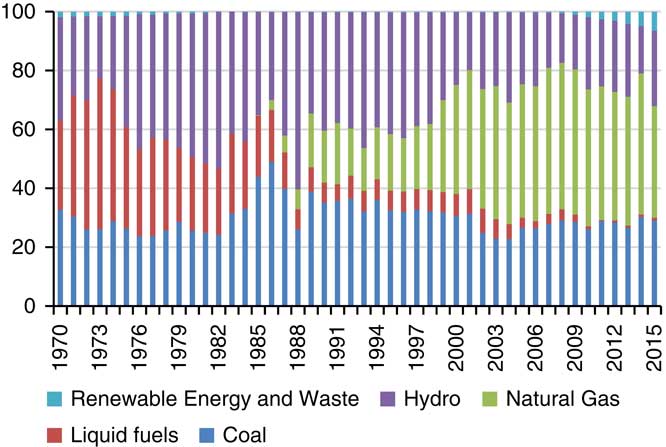
As of 2015, Turkey generates around 38 percent of its electricity from natural gas and around 30 percent from coal. In total, the proportion of electricity generated from fossil fuels in 2015 was 68 percent of the total 261,783 GWh generated (see Figure 1). The majority of coal-fired thermal plants use coal imported from the United States, Ukraine, Canada, Australia, Russia, or Colombia.
Electricity generation and shares by energy resources Source: TEİAŞ (2017), Electricity Generation – Transmission Statistics of Turkey

Identifying and quantifying FFS
In principle, government subsidies, including FFS, for investments in any sector in Turkey are provided with the goal of eliminating regional development differences within the country, increasing employment, and enhancing the international competitiveness of domestic sectors through the creation of higher value added and the transition to higher-level technologies. This section identifies the subsidies provided to coal, petroleum, and natural gas in Turkey, distinguishing between consumer subsidies and producer subsidies, and gives estimates where data are available.
Consumer subsidies for coal
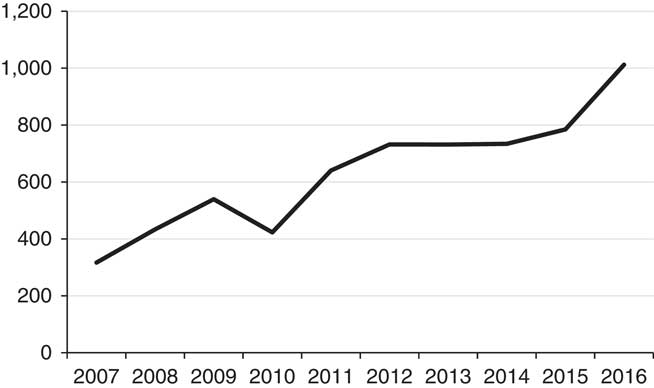
The only type of coal subsidy to consumers existing in Turkey is the distribution of coal to poor families, which covers over 2 million households and amounts to approximately USD 140 million. Executed by the Ministry of Family and Social Policies (Aile ve Sosyal Politikalar Bakanlığı) and the General Directorate of Social Assistance (Sosyal Yardımlar Genel Müdürlüğü), the program has been in effect since 2003. Coal supplied by TKİ is sent to poor families at a minimum amount of 500 kg per household. According to TKİ’s Coal Sector Report,Footnote 62 more than two million tons of coal have been distributed annually to poor families in recent years, corresponding to around 743 million Turkish lira (USD 413 million) in 2012 and 746 million Turkish lira (USD 392 million) in 2013, according to the Undersecretariat of the Treasury. OECD.Stat reports that in 2016 coal aid to poor families reached 1 billion Turkish lira (see Figure 2).
Coal Aid to Poor Families ( million) Source: OECD.Stat, “OECD Fossil Fuel Support Statistics: Turkey.”

Producer subsidies for coal
Turkey subsidizes both the domestic exploration for and production of coal. The OECD reports that “the most important measure supporting energy production is the financial assistance” provided to the hard-coal industry—that is, to TKİ—in the form of transfer payments from the Undersecretariat of the Treasury.Footnote 63 These transfers mainly target the subsidization of regional employment in coal-mining regions like Zonguldak. In the period 2001–2013, around USD 3.5 billion was injected into TTK and TKİ from the treasury in the form of capital and duty loss payments, reaching around USD 300 million per year, which was the equivalent of more than 0.1 percent of GDP in several of the years within the stated period.Footnote 64 (See Table 10 for the most recent figures.)
Turkey also subsidizes investments in coal-fired power plants via a new Investment Incentive System (Yatırım Teşvik Programı) that has been in effect since June 2012. While it is difficult to fully quantify these subsidies, we will here provide an overview of the terms and conditions that are offered by this system. The new program is made up of four schemes: a General Investment Incentive Scheme, a Regional Investment Incentive Scheme, a Large-Scale Investment Incentive Scheme, and a Strategic Investment Incentive Scheme.Footnote 65
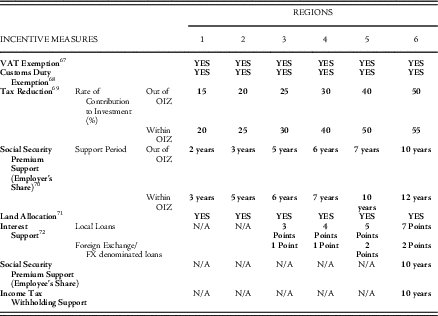
Coal exploration and production and investments in coal-fired power plants are subsidized within the scope of the Regional Investment Incentive Scheme as “priority investments.”Footnote 66 In general, this scheme offers subsidies in the form of customs duty exemptions, VAT exemption, tax reduction, the employer’s share of social security premium support, land allocation, and interest support. The terms and rates of support within the Regional Investment Incentive Scheme are summarized in Table 2.
Regional Investment Incentive Scheme Measures

Note 1: OIZ = Organized Industrial Zones.
Note 2: These measures are described in the footnotes. The definitions are all taken from the source provided.
Source: Ministry of Economy, “New Investment Incentives Program.”
As a criterion for qualifying for government assistance, the scheme defines the required amount of minimum fixed investment separately for each sector and each region, with theFootnote Footnote Footnote Footnote Footnote Footnote lowest amount being 1 million Turkish lira in Regions 1 and 2 and 500,000 Turkish lira in Regions 3, 4, 5, and 6.Footnote 73 The Ministry of Economy (Ekonomi Bakanlığı) identifies “priority” investments, which are to be treated differently than normal investments and will benefit from the terms and rates of the support measures for Region 5 even if the investments in question are made in Regions 1, 2, 3, or 4.Footnote 74 Among these priority areas, mining investments and electric production investments using IV-b group mines as defined in the Mining Law as inputFootnote 75 benefit from Region 5 incentives. The support measures specified for Region 5 are some of the most generous, including a 40 percent rate of contribution to investment in the form of tax reduction, seven years of social security premium support (employer’s share), land allocation, VAT exemption, customs duty exemptions for imported equipment, and interest support.Footnote 76
In March 2013, the Electricity Market Law (Law No. 6446) was passed, aiming at a redesign of the current electricity market system, with a focus on the types of licenses, the introduction of a pre-licensing mechanism, and extended deadlines for certain incentives. Among other things, the law officially granted electricity producers in the process of being privatized a grace period, extending until the end of 2018, for compliance with environmental requirements. This period could be extended up to three years with the warrant of the Council of Ministers (Bakanlar Kurulu); this provision was eventually annulled by the Turkish Constitutional Court (Anayasa Mahkemesi) via Decision No. 2014/93, made on May 22, 2014. However, a new provision to replace it was introduced by Law No. 6719, passed on June 4, 2016, which extended the period in question through the end of 2019 but does not include a provision allowing the Council of Ministers to extend it. During this period, electricity suppliers cannot be prevented from producing electricity, nor can they be charged with any administrative fines.Footnote 77
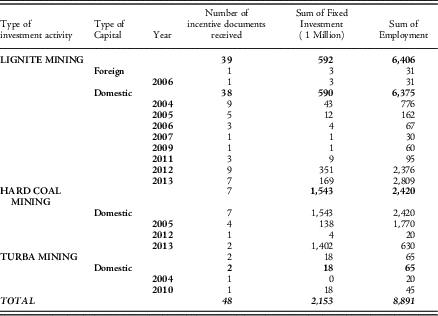
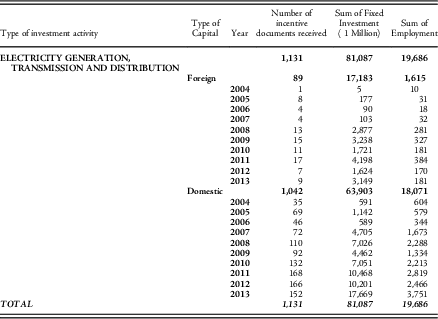
Table 3 and 4 display the counts of grant documents awarded, the sum of fixed capital, and the sum of employment created in the coal mining and energy sectors—consisting mainly of coal-fired power plants, among others—within the Regional Investment Incentive Scheme.Footnote 78 The tables only report data in those years in which an incentive document was filed. Between 2004 and 2013, 48 incentive documents were received by the coal sector (see Table 3). These investments totaled 2,153 million Turkish lira, generating employment for almost 9,000 people. Moreover, 1,131 documents were received by the electricity generation, transmission, and distribution sector within the same period. Some 81 billion Turkish lira in fixed investment was to be initiated, with almost 20,000 new jobs to be generated (see Table 4). These statistics do not include investments in renewable energy, since these are subsidized within the scope of the General Investment Incentive Scheme, which also provides VAT exemption, customs duty exemption on imported equipment, and, for investments made in Region 6, income tax withholding support.
Regional Investment Incentive Scheme statistics for coal (2004–2013)

Source: Ministry of Economy, Investment Incentives (2014)
Regional Investment Incentive Scheme statistics for the electric industry (2004–2013)

Source: Ministry of Economy, Investment Incentives (2014)
In addition, the Undersecretariat of the Treasury has provided investment guarantees to coal power plants for up to twenty years of the plant’s operating life (e.g., the Çayırhan and İskenderun thermal plants).
Consumer subsidies to petroleum and natural gas
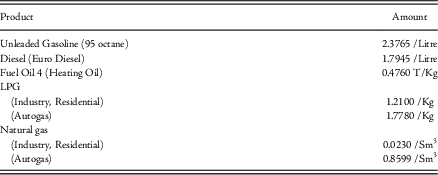
There are no direct consumer subsidies on oil or natural gas in Turkey. On the contrary, in June 2002, via Law No. 4760, Turkey introduced a special consumption tax (SCT or Özel Tüketim Vergisi, ÖTV), an excise duty levied on certain goods, including petroleum and gas products, with the aim of making the taxation system compatible with EU directives. Beyond this, however, the main economic reason for the introduction of the SCT was to deal with the budget deficit at the time.
List (1) SCT rates

Source: Ministry of Finance, http://www.gib.gov.tr/fileadmin/mevzuatek/otv_oranlari_tum/08092016.htm (2016)
According to Erdoğdu, the primary goal of Turkey’s high fuel taxes has been fiscal revenue generation.Footnote 79 SCT receipts make up around 23 percent of the central government’s tax revenues. Nevertheless, the taxation of gasoline and diesel could also help internalize several costs, such as those related to CO2 emissions and air pollution. Tax rates on diesel, which in Turkey are lower than those on unleaded gasoline despite diesel being a greater pollutant, could also be increased.
Producer subsidies to petroleum and natural gas
Because Turkey imports almost all the oil and natural gas it needs, it has long been a political goal to decrease import dependency in the area of energy. In line with this goal, Turkey has been engaged in a continuous search for oil and gas reserves in various parts of Anatolia. Accordingly, the Turkish Petroleum Law (Law No. 6491) was revised in June 2013 in order to promote fast, permanent, and efficient exploration, as well as improvement and production of petroleum resources in the country. The law “covers the terms and procedures regarding the regulation, management, provision of incentives for, and auditing of petroleum exploration and production activities in Turkey, as well as the compilation, evaluation, and provision of necessary information and data for exploration and production.”Footnote 80 As stated in the 10th Development Plan (2014–2018),Footnote 81 TPAO, the public petroleum exploration and production company, has been financed with high budgets—raised from 450 million Turkish lira (USD 315 million) in 2006 to 1,050 million Turkish lira (USD 553 million) in 2013—in order to better explore oil and gas.Footnote 82 (See Table 10.)
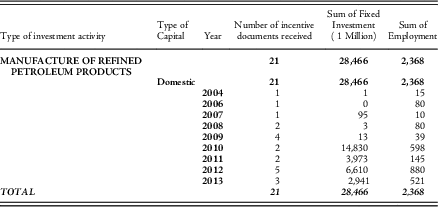
In addition, the manufacture of refined petroleum products is subsidized within the scope of the Large Scale Investment Incentive Scheme, with the provision that the investment amount is at least one billion Turkish lira. Table 6 lists the investment incentives provided by the Ministry of Economy to the manufacture of refined petroleum products between 2004 and 2013. During this period, 21 incentive documents (consisting of VAT and customs exemptions as well as tax reduction and land allocation, depending on region) were allocated to the sector, with an accumulated fixed investment of 28,466 million Turkish liras.
New Investment Incentive Scheme statistics for petroleum (2004–2013)

Source: Ministry of Economy, Investment Incentives (2014)
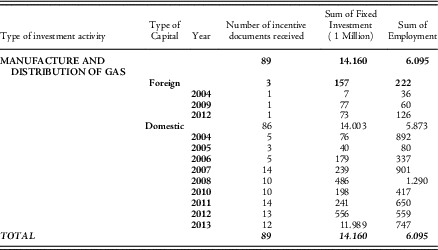
Table 7 displays investment incentives provided to the manufacture and distribution of gas between 2004 and 2013. During this period, 89 incentive documents were allocated to the investors, amounting to 14,160 million Turkish lira of fixed investment.
New Investment Incentive Scheme statistics for gas (2004–2013)

Source: Ministry of Economy, Investment Incentives (2014)
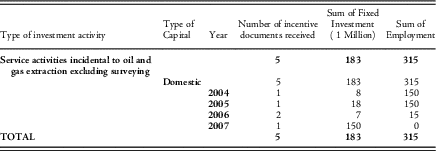
Finally, Table 8 shows the investment incentives provided by the Ministry of Economy to the service activities incidental to oil and gas extraction, excluding surveying. Five incentive documents were received by the sector, amounting to a sum of 183 million Turkish lira fixed investment. Furthermore, the Undersecretariat of the Treasury has also provided investment guarantees to natural gas power plants for up to 15 to 20 years of operational life (e.g., the Adapazarı, Ankara, and Gebze natural gas cycle plants).
New Investment Incentive Scheme Statistics for services related to petrol and gas extraction (2004–2007)

Source: Ministry of Economy, Investment Incentives (2014)
Some other incentives provided to the oil and gas sector by Turkish tax law include a tax exemption for oil and gas exploration and transportation and a tax exemption for the transportation and distribution of oil and gas.Footnote 83 These, however, have proven impossible to quantify.
Fossil fuel research and development budgets
Table 9 displays government research and development expenditures on fossil fuels in Turkey. Among the various fuels, coal receives the highest amount of expenditure. In the period 1986–2009, 13.4 million Turkish lira (USD 1.68 million in 2009 alone) was spent by the government on R&D related to fossil fuels, with more than 60 percent of this amount being related to coal.
Government R&D expenditures on fossil fuels in Million (nominal)

Source: International Energy Agency (2013)
Summation and comparison with previous estimates
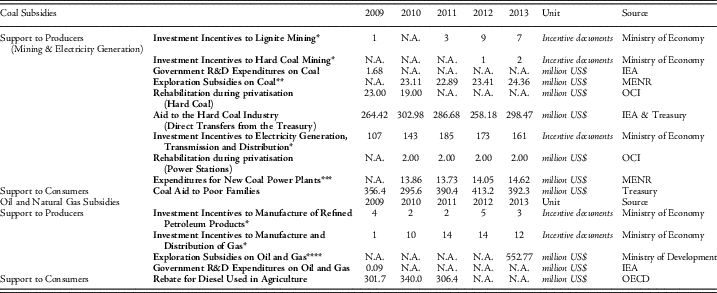
Based on the available data from the 2000s, it can be said that Turkey provides various types of subsidies to coal, oil, and natural gas. Annual consumer subsidies on coal have reached around USD 400 million, whereas quantifiable producer subsidies on coal have approached USD 350 million per year. Adding R&D and exploration subsidies for oil and gas, the sum of around USD 1,300 million represents roughly 0.16 percent of Turkey’s nominal GDP in 2013. When compared to countries like Turkmenistan, Iran, Libya, and Uzbekistan—where total subsidies, primarily to their oil sectors, reaches 10 percent or more of GDP—Turkey’s subsidy share remains relatively low. Instead, Turkey ranks close to Thailand, China, and Sri Lanka in terms of the FFS share of GDP.Footnote 84
These numbers, however, provide an underestimate of the “true” subsidy level, since the Regional Investment Incentive Scheme was very recently introduced and the corresponding subsidy on coal investments has not yet been fully realized. Furthermore, these numbers do not include investment guarantees, explicit or de facto exemptions from environmental regulation, or any of the other subsidies identified above. The estimate presented here is significantly higher than that of the IEA, which only identifies subsidies of USD 398 million to the hard coal sector in 2008.Footnote 85 It is also higher than that of the OECD, which only pertains to transfer payments to the hard coal industry, distribution of coal to the poor, and tax exemptions for specific sectors.Footnote 86 Both reviews fail to touch upon the Regional Investment Incentive Scheme, among others. The GSI report on Turkey’s coal and renewable energy subsidies points out that the total subsidy due to regional investment incentives for coal-fired power generation could add up to very significant amounts by 2030.Footnote 87 Considering present concerns regarding the energy deficit, the continued role of coal in the electricity generation mix, commitments to exploiting all the available domestic reserves of coal by 2023, and the over 70 coal-fired power plants planned to be built in the near future, subsidies on coal can be expected to increase significantly in Turkey in coming years. This expectation was recently, as of April 2016, supported by a declaration by the current minister of the Ministry of Energy and Natural Resources that focused on the need to expand regional subsidies for coal and introduce alternative financing mechanisms in order to boost the energy sector.
Finally, although the government does not directly subsidize oil or gas consumption and Turkey’s citizens face the most expensive fuels in the region, differential taxation does not seem to be encouraging environmentally friendly patterns of fuel consumption. Furthermore, the new Investment Incentive Scheme, not to mention the generous exploration budget provided for TPAO, is motivating new investments in the oil and gas industry. (For a summary, see Table 10.)
Summary table of quantifiable subsidies on coal, oil, and gas in Turkey

Conclusion and policy discussion
In this paper, we have examined and discussed the fiscal aspects of Turkey’s arsenal of consumer and producer subsidies on coal, oil, and natural gas. In line with its desire to reduce import dependence on energy and to maintain energy security, Turkey focuses heavily on the expansion of coal-fired power generation through a utilization of domestic resources and subsidization of the coal sector. During the 2001–2013 period, approximately USD 3.5 billion was injected into TTK and TKİ by the Undersecretariat of the Treasury in the form of capital and duty loss payments. Moreover, a new investment incentive scheme was developed by the Ministry of Economy, which dispatched approximately 1,300 incentive documents to various energy production and transmission activities in the fossil fuel sector. At the same time, there are tax exemptions in the areas of domestic commercial aviation, vehicles used for national security, ships in cabotage lines, and rebates for diesel used in agriculture, as well as tax exemptions for oil and gas exploration, transportation, and distribution. Finally, according to IEA statistics, during the 1986–2009 period, 13.4 million Turkish lira (around USD 6 million) was channelled into R&D for fossil fuels by the public sector, 8 million Turkish lira (USD 3.5 million) of which was spent on coal.
Given the fact that Turkey’s coal reserves are limited, it is likely that the majority of hard coal will continue to be imported, and so the chronic problem of import dependence will not be entirely solved. This will not only worsen current account deficits, but also deadlock the country’s energy security efforts. Turkey is a country that aims to “utilize all the opportunities to increase the share of domestic and renewable energy resources in energy supply, to enhance energy efficiency in energy generation and consumption process [sic], and to provide a transition into clean production technologies by improving R&D.”Footnote 88 If energy import dependency is to be reduced and renewables such as solar and wind power are to be promoted, the signals delivered to economic agents should be in harmony with these objectives.
In spite of subsidies, Turkey still has among the world’s most expensive fuels, especially gasoline and diesel, due to a special consumption tax. Nonetheless, it is observed that differential taxation of fuels fails to address concerns related to environmental friendliness or the fight against poverty. First of all, high fuel prices are income-distortive, which leads to regressive income consequences because all income segments of society face the same tax burden regarding fuel consumption. It ought to be remembered that, in the absence of any viable alternative energy sources, final consumers suffer from the very low elasticity of demand for energy sources. Without provision of alternative sources of energy, (indirect) taxation itself does not help to reduce the utilization of fossil fuels, but instead leaves households and firms stuck in expensive and ecologically unsustainable patterns of consumption and production. Furthermore, funds collected via the taxes levied on fuels are not earmarked for environmental concerns, but are rather regarded as an easy way of raising tax revenues for the central government budget.
From an energy governance perspective, this situation generates a series of very important questions. Why are there conflicting fiscal policies pertaining to the energy sector, and who have actually benefited from these policies? How does such a heavy and complex subsidy system, which indirectly aims to transfer a substantial part of fossil fuel costs to the public, impede sustainable development? What are the subsidy system’s effects on employment? Does this system prevent more efficient and environmentally friendly fuels and technologies from entering the market by supporting uncompetitive ones? Would other, similar mechanisms perhaps lead to environmentally and socially better results if they were directed to alternative sectors of energy supply, such as renewables?
One recent study by Acar and Yeldan examines the macroeconomic and environmental impacts of removing coal subsidies in Turkey within a general equilibrium framework.Footnote 89 In accordance with this, if the production and investment subsidies provided to coal were eliminated by 2030, CO2 emissions would decrease significantly in both high- and low-income regions of Turkey. In line with such a scenario, by 2030 an emission decrease of 5.4 percent as compared to the base path could be realized nationwide. Given the fact that the coal sector makes up only a small portion of Turkey’s sectoral composition, it is clear that eliminating the subsidies provided to coal would have significant benefits in terms of combating environmental pollution and climate change. In addition, existing coal subsidies make competitiveness on the part of renewable energy technologies more difficult and jeopardize renewable energy investments, in addition to making the energy system dependent on fossil fuel-based energy generation (i.e., “lock-in”).Footnote 90 On the other hand, the removal of subsidies may have adverse impacts on certain parts of the society, such as a drop in employment in coal-related industries. In such cases, mitigation strategies should be developed.
Although domestic coal offers the appearance of energy security and is thus supported with this specific aim in mind, it only does this at the expense of other aspects of security. Most notably, Turkey is highly vulnerable to the effects of climate change and emissions by other pollutants. Furthermore, an emphasis on coal and other fossil fuels is ultimately incompatible with sustainable development. Continuing to subsidize coal fortifies it within the economic structure, jeopardizes the development of renewable energy, and narrows down the fiscal options that could otherwise be used to support cleaner technologies and mitigation actions.
Further research is clearly needed to assess the impact that such support measures could have on energy access, security, and the aforementioned development objectives. Given these concerns, a gradual phasing-out of FFS should be regarded as a crucial step in enabling Turkey to tap into its potential for alternative and cleaner sources of energy while simultaneously securing its sustainable development objectives and the welfare of its future generations.