The Ottoman Empire's financial difficulties in the first half of the nineteenth century are reflected in the fact that during the 1808–39 reign of Mahmud II the state's silver coinage was debased by 83 per cent – with 47 different types of silver coins being put into circulation with progressively lower specie content (Pamuk Reference Pamuk2000, p. 193). Mounting fiscal demands fuelled this increasing resort to seigniorage revenue and expenditures by the central government are estimated to have increased by 250–300 per cent in real terms from 1800 to 1840 (Pamuk Reference Pamuk, Avramov and Pamuk2006, p. 10). There was a dramatic shift in policy after Mahmud II's death, however, as the Ottoman Empire launched a series of reforms aimed at adopting a more western-focused economic structure with a unified market and more balanced law and tax systems. As part of the new government's efforts to increase trade with the western powers, the Anglo-Turkish Convention was signed on 3 November 1839. The old reliance on debasement was also abandoned at this time and the government began issuance of a new interest-bearing currency that circulated alongside the existing gold and silver coinage. This interest-bearing money was issued from 1840 to 1851 and represents what is almost certainly the most large-scale and enduring experience with interest-bearing money yet seen. It was the only paper money widely accepted alongside metallic money for day-to-day transactions in Istanbul and was issued during a period of relative stability.
Interest-bearing notes are the key focus of the legal restrictions theory of money, which posits that the historical dominance of non-interest-bearing currency stems from legal impediments that prevent financial institutions from offering interest-bearing alternatives (Wallace Reference Wallace1983).Footnote 2 The theory has remained largely untestable, however, owing to the lack of historical experiences in which governments chose to issue a viable interest-bearing medium. Even if interest-bearing notes are issued, they could not truly be a candidate for hand-to-hand currency unless they are not only large enough to make interest calculations and interest payments feasible but also small enough to purchase day-to-day items (White Reference White1987). Another problem is that, of the few recorded episodes of meaningful interest-bearing money issuance, most occur under extreme conditions such as wars, making it difficult to assess their potential for competing with traditional non-interest-bearing currency under more normal conditions. The $100 interest-bearing notes of the Confederate government, for example, were affected by the rapid depreciation affecting all Confederate money but had initially been deliberately issued in denominations too big for most day-to-day transactions as the government hoped they would be used more as an investment vehicle.Footnote 3 While Civil War Arkansas offers a historical case of low-denomination interest-bearing notes enjoying widespread use and acceptance in daily transactions, their issuance was short-lived and occurred in the midst of quite chaotic circumstances and northern invasion (Burdekin and Weidenmier Reference Burdekin and Weidenmier2008).
In this article we argue that the Ottoman experience sheds long-overdue light on the question of whether government-issued interest-bearing money can circulate in the absence of legal restrictions. We find support for these notes being used for day-to-day transactions involving ordinary goods and services. Moreover, data on the relative valuations attached to the different denominations suggest a consistent liquidity preference favouring the lower-value notes. This implies that the smaller-denomination issues were prized for their usefulness as hand-to-hand currency, offering at least some tangible proof that the theoretical attraction of interest-bearing money espoused in legal restrictions theory might be realizable in practice. The interest-bearing notes also held their value against gold throughout the 1840–51 period of their issuance, in sharp contrast to the experience with the non-interest-bearing notes that took their place in 1852.
I
Following the final conquest of the Byzantine Empire in 1453, Istanbul (formerly Constantinople) became the capital of an empire that at its height extended deep into Europe as well as the Persian Gulf and covered North Africa as far west as Algiers. By 1840, although the Ottoman Empire remained an important world power, most of the European holdings had been lost and a series of damaging wars had drained the treasury. Meanwhile, the government's ongoing resort to currency debasement fuelled an overall 1,200 per cent depreciation against the pound sterling between 1800 and 1839 (see Pamuk Reference Pamuk2000, p. 191).Footnote 4 The sweeping administrative, commercial and military reorganisation following the death of Sultan Mahmud II in 1839 was accompanied by banking system reforms that introduced the new interest-bearing currency known as kaime.Footnote 5 The issuance of kaime was followed by a coinage reform and formal adoption of a bimetallic standard with both gold and silver coins accepted as legal tender. The gold/silver ratio was fixed at 15.09 and all coins issued from 1844 all the way through 1922 adhered to this new standard. Unfortunately, a wide variety of old coinage continued to circulate as well and remained legal tender, with the government announcing official rates applying to each one (Pamuk Reference Pamuk2000, pp. 208–9). This meant that the coinage actually circulating in the Ottoman Empire did not, in practice, fully embody the strict bimetallic standards imposed in the monetary reform.
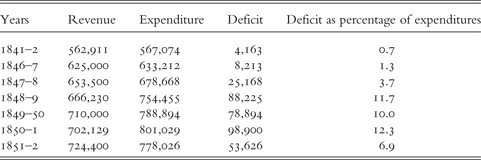
Although adoption of the new standard was accompanied by a final depreciation from 104 piastres to the pound sterling in 1839 to 110 in 1844, the exchange rate was then held fixed at this new rate. Prices also remained quite stable pending the outbreak of the Crimean War in 1853. Pamuk (Reference Pamuk, Avramov and Pamuk2006, p. 12) points to a close relationship between the exchange rate (and silver content) of the currency and the Istanbul price level over the 1780–1845 period. The linkage between currency debasements and the price level remains apparent over the 1469–1914 period as a whole as well as during the period of most rapid debasement prior to the reforms, when an annual rate of decline in the silver content of the currency of 3.49 per cent per year was accompanied by an annual rate of inflation of 3.81 per cent over the 1769–1843 period (Pamuk Reference Pamuk2004, p. 468). The end of currency debasement and the establishment of a new, stable exchange rate was therefore key to re-establishing price stability in both Istanbul and the Ottoman Empire as a whole. Price increases remained moderate in the post-reform period, with any continued initial upticks being seen as merely ‘the lagged result of the debasements of the previous period' (Pamuk Reference Pamuk2004, p. 468). The government's fiscal position was also stabilised. Budget deficits accounted for just 0.7 per cent of total government expenditures during the 1841–2 fiscal year and were still just 3.7 per cent of expenditures in 1847–8 (Table 1).Footnote 6 Foreign trade data provide further evidence of an improving macroeconomic backdrop. Exports rose from an annual average of 4.2 million pounds sterling in the 1830s to 6.0 million in the 1840s, while imports similarly expanded from 5.1 million in the 1830s to 6.9 million in the 1840s (Pamuk Reference Pamuk1987, p. 149).Footnote 7
Ottoman government revenues and expenditures, 1841–51
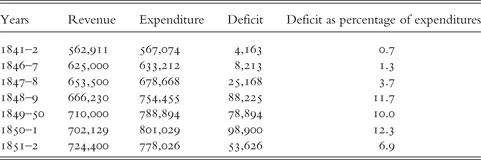
Notes: The data in the first three columns are in thousands of piastres; the fourth column is in percentages; all data are provided by fiscal year; and there are no source data for 1842–3 through 1845–6.
Source: Güran (Reference Güran2003, p. 8).
The first kaime issue in 1840 was in the relatively large denomination of 500 piastres but this was quickly followed in that same year by smaller denominations of 50, 100 and 250 piastres. All of these issues bore interest of 12.5 per cent per annum payable semi-annually and notation of each payment was entered on the reverse of the note. These smaller denominations were equivalent to slightly less than one pound, two pounds and five pounds sterling, respectively, and were certainly not too large for daily transactions. The circulation was limited at first and largely restricted to Istanbul itself, being hampered by the notes' coarse construction and ease of counterfeiting.Footnote 8 More sophisticated notes with protection against forgery were introduced in 1842. The kaime were now printed with an embossed seal of the sultan and the earlier issues were called in and exchanged for the new notes (Pamuk Reference Pamuk2000, p. 210). Contemporary observer White (Reference White1845, p. 72) notes that the kaime remained able to
pass with difficulty in the bazaars at par … [while], about the time when the interests are due, they are at a premium, and then, becoming much in request, form an article of traffic and speculation on 'Change.
White's (Reference White1845) account suggests that the interest paid on the kaime was not sufficient to induce holders to treat them simply as a form of savings and that it was only when the interest payment was imminent that they became more in demand. Gresham's Law, whereby ‘bad money' drives ‘good money' out of circulation did not necessarily apply here because the interest payable on the kaime must be balanced against the fact that the alternative metallic money had clear intrinsic value not enjoyed by government-issued paper money. Moreover, the seemingly high interest rate (relative to, say, the benchmark 3 per cent coupon rate offered by British consols at the time) actually fell within ‘the normal lower range for local government borrowing in Istanbul' (Davison Reference Davison, Okyar and İnalcik1980, p. 245). The kaime also represented the Ottoman Empire's first experience with anything other than metallic money and the prospective rate of return needed to offset any inherent reluctance to accept such an unfamiliar form of currency. Hoarding of the notes does seem to have eventually come into play, but only after the kaime had become more established and the government had established a track record for making all the promised interest payments on time. Concern that hoarding was, in fact, leaving too few kaime in circulation in Istanbul prompted the authorities to reduce the interest rate from 12.5 per cent to 6 per cent in 1844 (Davison Reference Davison, Okyar and İnalcik1980, p. 248).
The first kaime notes entered circulation as payment for supplies purchased by the government and through salaries issued to civil servants, who now received half their funds in kaime (Davison Reference Davison, Okyar and İnalcik1980, p. 244). The government sought to encourage usage of the new notes by declaring that the kaime were to be accepted in transactions like the existing silver and gold coins and that they would be accepted by its tax collectors. As Autheman (Reference Autheman1996, p. 3) points out, this distinguished the kaime from earlier issues of government paper:
Unlike the other floating debt issues of the government, as with the metallic coins, [the interest-bearing] notes were accepted as a means of payment by public institutions.Footnote 9
Ottoman officials even asked foreign embassies and legations to ‘see that merchants of their nationality resident in the Empire accepted the new paper money' (Davison Reference Davison, Okyar and İnalcik1980, p. 245). Such eagerness reflected the kaime's importance to the government's efforts to raise the funds needed to stave off its debt crisis (cf. Davison Reference Davison, Okyar and İnalcik1980; Autheman Reference Autheman1996; Pamuk Reference Pamuk2000). Merchants were not compelled to accept kaime, however, and only government offices were obliged to accept the notes (Davison Reference Davison, Okyar and İnalcik1980, p. 246). The kaime were not only never favoured by legal tender legislation but also were not convertible into specie until the end of their eight-year maturity (later extended to ten years). Nevertheless, over the 1840–4 period the merchants in Istanbul ‘seem to have become used to the kaime and to have accepted it' (Davison Reference Davison, Okyar and İnalcik1980, p. 248). Pamuk (Reference Pamuk2000, p. 210) adds that the kaime generally circulated at par against metallic coins.Footnote 10
Total kaime issuance in 1840 amounted to 40 million piastres or approximately £360,000 (Pamuk Reference Pamuk2000, p. 210).Footnote 11 Although no complete money supply data series exist, Toprak (Reference Toprak2005) concludes that, based on the available records of the mint, the amount of hard currency in circulation never exceeded 200 million piastres in gold and 200 million piastres in other coins between 1840 and 1863.Footnote 12 Given that the interest-bearing notes were used only in Istanbul and surrounding areas, whereas the money supply estimates are for the entire Ottoman Empire, the percentage of kaime to even the maximum metallic money supply rises above 20 per cent if we conservatively assume that at least half of this metallic money was held outside the capital. With gold itself typically not being used in day-to-day transactions but rather serving as ‘the traditional Ottoman investment vehicle' (Toprak Reference Toprak and Cottrell2008, p. 147), the available evidence strongly points to the interest-bearing notes being a major circulating medium in Istanbul in the 1840s.
II
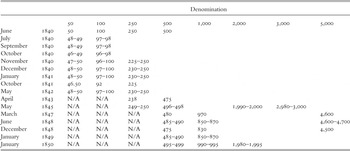
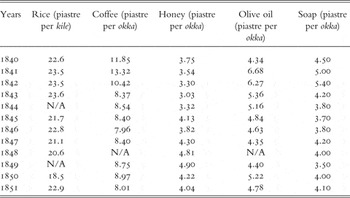
Data on the available market quotations for kaime notes in Istanbul are presented in Table 2. All of these figures were newly collected from contemporary primary newspaper sources and are presented exclusive of accrued interest. The 50 and 100 piastre notes generally traded within 3 or 4 per cent of their par values during 1840–2 in spite of the counterfeiting problems that plagued the early handwritten issues. The 250 piastre notes traded at somewhat larger discounts over this same period that reached 10 per cent – while the 500 piastre notes were typically not quoted at all. Combined with the smaller discounts attached to the lower denomination notes, this suggests there may have been a liquidity preference that would be hard to explain were the smaller notes not being utilised in day-to-day transactions. As shown in Table 3, which lists market prices of a range of everyday goods during the 1840–51 period, the lowest denomination 50 piastre note in 1840 purchased approximately two standard packages of rice, six packages of coffee, 13 packages of honey, and ten packages of olive oil and soap. The lower-value piastre notes were clearly much more in line with such basic goods prices, and therefore much more likely to be accepted in payment, than the larger denomination 250 and 500 piastre notes that received less favourable market quotations – to the extent that they were quoted at all.
Kaime currency values, 1840–50

Sources: All data are drawn from the Prime Ministry Ottoman Archive and the following contemporary newspapers: Basiret, Ceride-i Havadis, Ikdam, La Turquie, Takvim-i Vekayi, Tercuman-i Ahval, The Times and Vakit.
Representative prices of everyday items in Istanbul, 1840–51

Notes: 1 kile = 10.83 kilograms; 1 okka = 1.283 kilograms
Source: Pamuk (Reference Pamuk2001).
The 1842 introduction of more sophisticated, printed notes in 1842 was followed, first, by the axing of the smallest 50 and 100 piastre notes in 1843 and then by the reduction of the interest rate payable on kaime to 6 per cent per annum. At the same time, the discounts attached to the 250 piastre notes, which had typically reached 8–10 per cent during 1840–2, declined to under 5 per cent in April 1843 and to essentially zero in May 1845. Although we cannot be certain that this shrinkage in the discount was caused by the new role of the 250 piastre note as the smallest available denomination, the data are certainly again not inconsistent with a liquidity-based explanation. Meanwhile, the discount attached to the 500 piastre note declined from 5 per cent in April 1843 to less than 1 per cent in May 1845.
After 1845 comparative valuations are available only for the 500, 1,000 and 5,000 piastre notes. In March 1847, whereas the 500 piastre note traded at a 4 per cent discount and the 1,000 piastre note at a 3 per cent discount, the 5,000 piastre note traded at an 8 per cent discount. Through January 1850 the 500 piastre note went on to trade at discounts of between 5 per cent and 1 per cent, while the 1,000 piastre note saw discounts as high as 17 per cent and the 5,000 piastre note faced discounts of up to 10 per cent. Even though the denominations were by now out of the reach of many people, there remains a strong suggestion of a liquidity preference favouring the lowest available denomination (which had a value slightly below that of an English five pound note).
III
The Ottoman Empire offers a rare, and quite possibly unique, example of a large issue of interest-bearing money associated not with the turmoil of civil war but rather with an era of stability that followed the wide-ranging reforms initiated by the Ottoman authorities in 1839. The kaime issuance that began in 1840 not only helped the government raise funds to ease its debt crisis but also played a part in the reining in of the rampant inflation of the preceding decades.Footnote 13 Acceptance of the kaime in daily transactions and their use as hand-to-hand currency is consistent with valuation differentials that consistently seem to favour the smaller denominations most useful in everyday life. Even after the lowest-value notes were eliminated after 1842, the smallest denominations that were left enjoyed the most attractive valuations. Such pricing patterns seem most plausibly explained by liquidity preference and suggest that the kaime were valued as transactions media, notwithstanding the relatively high rates of interest paid on them.
The experiment ended not because of any problems with the kaime themselves but rather because of renewed fiscal strains as the government again resorted to heavy deficit finance. Indeed, the budget deficit ballooned to range between 10.0 per cent and 12.3 per cent of expenditures over the 1848–9 to 1850–1 fiscal years – compared to 3.7 per cent in 1847–8 and just 1.3 per cent in 1846–7 (Table 1). Although the former reliance on currency debasement was resisted at first, the government abandoned monetary restraint after switching to non-interest-bearing paper money in 1852. In contrast to the stability seen in the interest-bearing kaime notes, the new money issues quickly sparked inflationary pressures that were evident even before the outbreak of the 1853–6 Crimean War. The total currency in circulation had already reached 75 million piastres in 1853 before exploding during the Crimean War and its aftermath to reach a final high of 1,250 million piastres in 1861 (Pamuk Reference Pamuk2000, p. 211). During the wartime period alone, the new paper money depreciated by more than 50 per cent relative to gold.
Rapid debt issuance had accompanied these new paper money emissions and, for the first time ever, foreign borrowing commenced in 1854. Although this helped plug the short-term funding shortfall, the ensuing accumulation of debt denominated in foreign currency sowed the seeds of the eventual outright bankruptcy of the Ottoman state (Bernholz Reference Bernholz2008). With the financial system never recovering after the war, the foreign debt grew ever more burdensome and a three-month suspension was imposed as early as 1866 – at a time when the total debt was approaching 80 million pounds sterling, on its way to an eventual level of 220 million pounds sterling in 1880 (Van Dyck Reference Van Dyck1881, p. 68). The Ottoman Empire finally defaulted on its obligations in October 1875. After initially cutting debt payments in half, all debt payments were stopped in April 1876, with the exception only of the 1855 Loan guaranteed by the British government (Birdal Reference Birdal2010, p. 40). Debt renegotiation culminated in the establishment, under the Muharrem Decree of 20 December 1881, of a new Ottoman Public Debt Administration (OPDA) that included representatives from the major creditor nations (Eldem Reference Eldem2005; Birdal Reference Birdal2010).Footnote 14 Provision for OPDA control over state revenue built upon the earlier November 1879 agreement under which the Ottoman government surrendered their indirect revenue from taxes on stamp, spirits, and fishing, the silk tithe, and the salt and tobacco monopolies (Eldem Reference Eldem2005, pp. 441–2). Overall, more than one-third of total state revenue was ceded to the OPDA in a dramatic loss of financial sovereignty that did, at least, stave off the risk of foreign military intervention and restore the Ottoman Empire's access to foreign markets (Birdal Reference Birdal2010, pp. 56–7).
The aftermath of the 1840–51 Ottoman experiment with interest-bearing money is, in part, merely a reflection of escalating fiscal strains associated with military conflict and the losses suffered during the Crimean War and after. But the move towards excess money creation preceded the outbreak of hostilities and took place only after the government abandoned its prior commitment to pay interest on its currency issues. This raises the question of whether there are potential benefits arising from greater discipline under interest-bearing money issue insofar as the revenue garnered by increasing the number of notes in circulation must be at least somewhat balanced by the concomitant increase in interest expense.Footnote 15 Although the renewed deficit increases seen from 1848–9 onward eventually forced abandonment of monetary restraint as well, the appropriate parallel is perhaps with the commitment to tying one's hands under an exchange rate peg. Although the peg can, and will, be abandoned under sufficient duress, commitment to such a peg limits the scope for monetary expansion and imposes discipline on the policymaker while it is in force. Although there are unfortunately nowhere near enough historical episodes with interest-bearing money to offer any more general perspective on this issue, the Ottoman experience does, at the very least, offer the most long-running evidence yet of interest-bearing money circulating in the absence of legal restrictions. It does not seem, based on this episode, that government reluctance to issue such interest-bearing money can be justified on the basis of a lack of acceptability as the Ottoman notes appear to have functioned effectively as a circulating medium. It is also telling that data on the relative valuations attached to the different notes suggests that the smaller denominations were especially prized for their role as hand-to-hand currency.