Background
Loneliness is generally perceived as a subjective, unpleasant and distressing phenomenon resulting from a perceived discrepancy between an individual's desired and achieved levels of social relations (Perlman and Peplau, Reference Perlman and Peplau1981). Loneliness has been studied extensively, and previous research has shown that loneliness is experienced at all ages. Approximately 10 per cent of the older adult population appears to experience severe loneliness, whereas 20–30 per cent report occasional loneliness (Dykstra, Reference Dykstra2009). Older people are at higher risk of experiencing social and health-related changes and losses that might increase experiences of loneliness, suggesting the need to assess risk factors for loneliness in this specific age group. Further, loneliness in old age is related to various negative health outcomes, such as cognitive decline (Boss et al., Reference Boss, Kang and Branson2015; Lara et al., Reference Lara, Caballero, Rico-Ulribe, Olaya, Haro, Ayuso-Mateos and Miret2019), coronary heart disease and stroke (Valtorta et al., Reference Valtorta, Kanaan, Gilbody, Ronzi and Hanratty2016), mental health problems (Caccioppo et al., Reference Cacioppo, Hughes, Waite, Hawkley and Thisted2006; Coyle and Dugan, Reference Coyle and Dugan2012; Mushtaq et al., Reference Mushtaq, Shoib, Shah and Mushtaq2014) and increased mortality (Holwerda et al., Reference Holwerda, Beekman, Deeg, Stek, van Tilburg, Visser, Schmand, Jonker and Schoevers2012; Luo et al., Reference Luo, Hawkley, Waite and Cacioppo2012; Tilvis et al., Reference Tilvis, Routsalo, Karppinen, Strandberg, Kautiainen and Pitkälä2012; Holt-Lunstad et al., Reference Holt-Lunstad, Smith, Baker, Harris and Stephenson2015), indicating that the reduction of loneliness among older people is a public health issue that should be acknowledged in policy, practice and research. In this study, we aim to study the risk factors for loneliness over time by analysing older people living in regions of Finland and Sweden.
Changes in loneliness over time
On an individual level, loneliness might fluctuate and change across the lifespan, and occasional periods of loneliness are a normal part of life and are not seen as an elevated health risk (DiTommaso et al., Reference DiTommaso, Fizell, Robinson, Sha'ked and Rokach2015; Mund et al., Reference Mund, Freuding, Möbius, Horn and Neyer2020). It is chronic or enduring loneliness that is of public health concern (Prohaska et al., Reference Prohaska, Burholt, Burns, Golden, Hawkley, Lawlor, Leavey, Lubben, O'Sullivan, Perissinotto, van Tilburg, Tully, Victor and Fried2020). The evidence for chronic loneliness in later life has been relatively consistent across studies, showing longitudinal loneliness between 13 and 22 per cent (Jylhä, Reference Jylhä2004; Victor and Bowling, Reference Victor and Bowling2012; Newall et al., Reference Newall, Chipperfield and Bailis2014; Brittain et al., Reference Brittain, Kingston, Davies, Collerton, Robinson, Kirkwood and Jagger2017; Hawkley and Kocherginsky, Reference Hawkley and Kocherginsky2018). For example, a British study with an eight-year follow-up found that 22 per cent of the sample felt continuously lonely, 12 per cent overcame their loneliness and 44 per cent reported absence of loneliness (Victor and Bowling, Reference Victor and Bowling2012). A Finnish 10-year follow-up study (Jylhä, Reference Jylhä2004) showed that 17 per cent contentiously felt lonely, 13 per cent overcame their loneliness and another 19 per cent became lonely between baseline and follow-up. The majority (51%) reported an absence of loneliness at both study points. However, a Swedish seven-year follow-up study revealed that only a small minority (4%) of participants reported feeling lonely continuously, challenging the findings that loneliness is a long-term chronic condition (Dahlberg et al., Reference Dahlberg, Andersson, McKee and Lennartsson2015). Similarly, a British study analysing loneliness at five time-points across eight years found that 2 per cent of the sample remained consistently lonely over the years (Yang, Reference Yang2018). Considering these inconclusive results, more research is needed to understand loneliness across time in older people.
Risk factors for loneliness
Well-known risk factors for loneliness in older age are widowhood, social isolation and solitary living (de Jong Gierveld, Reference de Jong Gierveld1998; Pinquart and Sörensen, Reference Pinquart, Sörensen and Shohov2003; Dahlberg et al., Reference Dahlberg, McKee, Frank and Naseer2021). Loneliness is also influenced by health-related risk factors, such as poor self-reported health (Dykstra et al., Reference Dykstra, van Tilburg and de Jong Gierveld2005), functional limitations (Hawkley and Kocherginsky, Reference Hawkley and Kocherginsky2018) and depression (Dahlberg et al., Reference Dahlberg, Andersson, McKee and Lennartsson2015). Further, socio-demographic risk factors include older age (Donovan et al., Reference Donovan, Wu, Rentz, Sperling, Marshall and Glymour2017), low educational level (Nicolaisen and Thorsen, Reference Nicolaisen and Thorsen2014) and low socio-economic status (Donovan et al., Reference Donovan, Wu, Rentz, Sperling, Marshall and Glymour2017). Usually, women report higher levels of loneliness than men (Nicolaisen and Thorsen, Reference Nicolaisen and Thorsen2014; Dahlberg et al., Reference Dahlberg, Andersson, McKee and Lennartsson2015). However, this relationship is ambiguous and tends to be mediated by other factors, such as civil status (Dahlberg and McKee, Reference Dahlberg and McKee2014), indicating that, for example, the death of one's spouse or partner is more relevant than gender as an explanation for loneliness.
Changes in loneliness over different time-points could also be the result of changes in one's financial status; civil status; social resources, such as social support, social network and social participation; and health status (Dykstra et al., Reference Dykstra, van Tilburg and de Jong Gierveld2005; Aartsen and Jylhä, Reference Aartsen and Jylhä2011; Newall et al., Reference Newall, Chipperfield and Bailis2014; Dahlberg et al., Reference Dahlberg, Andersson, McKee and Lennartsson2015). Aartsen and Jylhä (Reference Aartsen and Jylhä2011) found a higher incidence of loneliness when people experienced depression, increased physical disability, increased feelings of uselessness and nervousness, loss of a partner and reduced social activity. In most cases, social and personal resources assessed at baseline did not predict loneliness at follow-up; this was only the case when there was a negative change in these resources. According to the authors, the results confirm the notion that loneliness is a subjective evaluation of the discrepancy between desired and actual resources (see Perlman and Peplau, Reference Perlman and Peplau1981) rather than an evaluation of limited social and health resources. Newall et al. (Reference Newall, Chipperfield and Bailis2014) analysed four different loneliness groups: those who became lonely, overcame loneliness, were persistently lonely and were persistently not lonely. Their results showed that becoming lonely at follow-up was related to changes in living arrangements and perception of social control, whereas living alone, being widowed, poor health and lower perceptions of control predicted persistent loneliness. Dahlberg et al. (Reference Dahlberg, Andersson, McKee and Lennartsson2015) assessed changes in loneliness in men and women separately and found different predictors of loneliness in men and women: widowhood, depression, mobility problems and mobility reduction predicted loneliness for women, while low levels of social contact and social contact reduction predicted loneliness in men. Thus, baseline resources, as well as changes in these resources, predicted loneliness over time.
The Nordic context
A growing body of evidence points to cross-national variation in loneliness rates in later life, with Southern and Eastern European countries tending to report higher levels of loneliness compared to Northern European countries (Sundström et al., Reference Sundström, Fransson, Malmberg and Davey2009; Yang and Victor, Reference Yang and Victor2011; de Jong Gierveld et al., Reference de Jong Gierveld, Dykstra and Schenk2012; Vozikaki et al., Reference Vozikaki, Papadaki, Linardakis and Philalithis2018). A recent report on loneliness analysing European Social Survey data confirmed that loneliness levels were lower in the Nordic countries than in other European countries (Dahlberg et al., Reference Dahlberg, Frank, Lennartsson, McKee, Naseer and Rehnberg2020). Furthermore, when comparing the Nordic countries specifically, loneliness was more prevalent in Finland and Sweden than in Denmark, Iceland and Norway (Dahlberg et al., Reference Dahlberg, Frank, Lennartsson, McKee, Naseer and Rehnberg2020). The reason for cross-national differences could be related to individual as well as societal features, including culture, norms and welfare-institutional arrangements (de Jong Gierveld and Tesch-Römer, Reference de Jong Gierveld and Tesch-Römer2012; Lykes and Kemmelmeier, Reference Lykes and Kemmelmeier2014; Nyqvist et al., Reference Nyqvist, Nygård and Scharf2019). However, research on how loneliness in older persons changes over time and differs between countries is still limited.
Therefore, the focus of this study is on two Nordic countries: Sweden and Finland. These countries are members of the Nordic welfare model (Kangas and Kvist, Reference Kangas, Kvist and Greve2019), where social and health-care services for older people are mainly tax-financed and delivered on a universal basis by regional and local authorities. Although Sweden and Finland have much in common culturally and socio-economically, previous work has shown that the regions included here, i.e. parts of northern Sweden and western Finland, differ somewhat from each other in social and health-related aspects (Hörnsten et al., Reference Hörnsten, Weidung, Littbrand, Carlberg, Nordström, Lövheim and Gustafson2016; Nyqvist et al., Reference Nyqvist, Nygård and Snellman2021), suggesting that, besides well-known risk factors for loneliness, region is a significant variable to be analysed.
In this study, we scrutinise various socio-demographic, social and health-related factors that have been identified as important risk factors for loneliness in previous research conducted with older people (e.g. Dahlgren et al., Reference Dahlberg, McKee, Frank and Naseer2021) by analysing longitudinal data collected in parts of northern Sweden and western Finland. We also assess changes in socio-demographic, social and health-related aspects in relation to loneliness, given the significant effect of negative changes and losses over time on loneliness.
The main aim of this study is to examine the prevalence of loneliness among older people and to identify the risk factors for loneliness in a Nordic regional context over a six-year period. This aim is further divided into two sub-aims: to study the prevalence of loneliness in 2010 and 2016 and the prevalence of enduring loneliness; and to understand which risk factors at baseline and changes in these factors predict loneliness at the follow-up.
Methods
Sample
The study was based on the Gerontological Regional Database (GERDA) questionnaire study conducted in parts of western Finland and northern Sweden in 2005, 2010 and 2016. The present study used data from the two most recent waves (2010 and 2016), as only these two waves allowed for a longitudinal follow-up. The aim of the GERDA study was to map the health and living conditions of older people residing in the Bothnia region, i.e. both sides of the Gulf of Bothnia, in Västerbotten, Sweden, and in Österbotten/Pohjanmaa, Finland. Although Österbotten and Pohjanmaa belong to the same geographical region in Finland, they are treated here as two separate regions due to different linguistic affiliations. The region is bilingual, with about 51 per cent Swedish speakers, whereas on a national level Swedish speakers are a clear minority and account for 5 per cent. Swedish-speaking participants were coded as belonging to Österbotten, while Finnish-speaking participants were coded as belonging to Pohjanmaa. In Finland, the questionnaires were sent out in either Swedish or Finnish, according to the registered language of the respondent. The participants were sampled from the National Tax Board in Sweden and the Population Register Centre in Finland.
In 2010, the postal questionnaire was sent out to every 65-, 70-, 75- and 80-year-old (born in 1930, 1935, 1940 and 1945) living in rural and semi-urban areas. Different sampling strategies were used for urban and rural participants to address the larger number of older people living in cities: in the city of Vaasa (Finland) and the cities of Umeå and Skellefteå (Sweden), the questionnaire was sent to every second and third person, respectively. The questionnaire was answered by 3,779 respondents in Västerbotten, Sweden, 1,906 in Österbotten, Finland and 1,153 in Pohjanmaa, Finland, resulting in a response rate of 70.7, 61.5 and 52.9 per cent, respectively.
In 2016, the questionnaire was sent out to every 66-, 71-, 76-, 81- and 86-year-old (born in 1950, 1945, 1940, 1935 and 1930) living in rural and semi-urban areas and in the city of Seinäjoki (Finland). It was sent to every second person meeting the age criteria in the city of Vaasa (Finland) and every third person in the cities of Umeå and Skellefteå (Sweden). The questionnaire was answered by 4,375 respondents in Västerbotten, Sweden, 2,296 in Österbotten, Finland and 2,715 in Pohjanmaa, Finland, resulting in a response rate of 70.8, 61.7 and 54.9 per cent, respectively.
A total of 4,696 respondents participated in both waves (i.e. 2010 and 2016) of data collection (Västerbotten, N = 2,693; Österbotten, N = 1,314; and Pohjanmaa, N = 689). Of these, 4,269 respondents (Västerbotten, N = 2,466; Österbotten, N = 1,182; and Pohjanmaa, N = 621) were included in the present study as they responded to the loneliness item in both study waves.
Variables
Outcome variable
Loneliness was used as an outcome variable and was measured with the question, ‘Do you suffer from loneliness?’ (yes/no).
Social variables
Frequency of social contact was based on the question, ‘How often do you have contact with the following persons?’ Friends and neighbours were grouped into one variable, and children, grandchildren and other relatives into another. The response alternative ‘several times a week’ was coded as ‘frequent social contact’, and ‘several times a month’, ‘few times a year’, ‘never’ and ‘does not exist’ were combined and coded as ‘infrequent social contact’.
Trust in friends and neighbours was assessed with the question, ‘How much trust do you have in the following persons?’, with the response alternatives being ‘much’, ‘neither much nor little’, ‘little’ or ‘cannot say’. Responses were dichotomised with the first response alternative coded as ‘high trust’ and the three latter as ‘low trust’. Respondents were considered highly trusting if they reported having high trust in friends or neighbours.
The number of confidants was based on the question, ‘Do you have a confidant with whom you can speak about anything that is sharing both concerns and joys?’ The answer alternatives included ‘spouse’, ‘children’, ’grandchildren’, ‘siblings’, ’parents’, ‘other relatives’, ‘friends’, ‘neighbours’, ‘home-care staff’, ‘nurses’ and ‘someone else’. The variable was dichotomised using a median split between ‘0–1 confidants’ and ‘2 confidants or more’.
Associational activity was assessed by membership of a voluntary organisation. These organisations included sports or outdoor organisations, political parties, religious organisations, and social or health organisations. For each of the nine organisations, the respondents were given three response options: ‘active member’, ‘passive member’ and ‘not a member’. We counted the number of organisations of which respondents said they were active members. If the respondents were active in any of the nine organisations, they were categorised as an ‘active member’; otherwise, they were grouped as ‘none or passive’.
Health-related variables
Self-rated health was assessed with the first question of the 36-item Short Form (SF-36; Ware and Sherbourne, Reference Ware and Sherbourne1992): ‘In general, how would you say your health is?’ Responses were based on a five-point scale (excellent, very good, good, fair or poor). This variable was dichotomised into ‘good health’ (excellent, very good or good) and ‘poor health’ (fair or poor).
Depression was assessed using the Geriatric Depression Scale four-item version (GDS-4) (D'Ath et al., Reference D'Ath, Katona, Mullan, Evans and Katona1994), which is a short assessment for depression comprising four yes/no questions. The four questions were: ‘Are you basically satisfied with your life?’, ‘Do you feel that your life is empty?’, ‘Are you afraid that something bad is going to happen to you?’ and ‘Do you feel happy most of the time?’ Scores of two or less were chosen as the cut-off point for significant depressive symptomatology (D'Ath et al., Reference D'Ath, Katona, Mullan, Evans and Katona1994). The present study also included the yes/no question ‘Do you feel depressed?’ Depression was defined in this study as answering ‘yes’ to the yes/no question, or a GDS-4 score ⩾ 2. A combination measure was selected to increase the sensitivity for depression and has previously been used in other articles based on the GERDA study (e.g. Hörnsten et al., Reference Hörnsten, Weidung, Littbrand, Carlberg, Nordström, Lövheim and Gustafson2016).
Instrumental activities of daily living (IADL) were assessed by four questions: ‘Do you clean your dwelling (vacuum and wipe the floor) without help from others?’, ‘Do you do grocery shopping without help from others?’, ‘Do you use public transportation such as buses, planes or trains without help from others?’ and ‘Do you cook without help from others?’ A person was considered dependent in IADL if they responded ‘no’ to all four questions. Personal activities of daily living (PADL) were measured with the question ‘Do you shower without help from another person?’ A person was considered dependent in PADL if they answered ‘no’ to the question. This question originates from the Katz Index of Independence in Activities of Daily Living (Katz and Akpom, Reference Katz and Akpom1976), where bathing is listed as a measure of the least severe degree of disability.
The socio-demographic characteristics of the sample included age (65, 70, 75 or 80 in 2010), gender (male, female), civil status (married, co-habiting; widowed; divorced, not married), educational level (lower secondary, upper secondary), region (Västerbotten, Österbotten, Pohjanmaa) and making ends meet. Making ends meet was assessed with the following question: ‘In your economic situation, is it possible to make ends meet?’ We grouped the response alternatives so that those who reported ‘without difficulty’ were categorised as ‘making ends meet without difficulties’, whereas those who reported ‘with some difficulty’, ‘with difficultly’ or ‘with great difficulty’ were categorised as ‘making ends meet with difficulty’.
Analysis
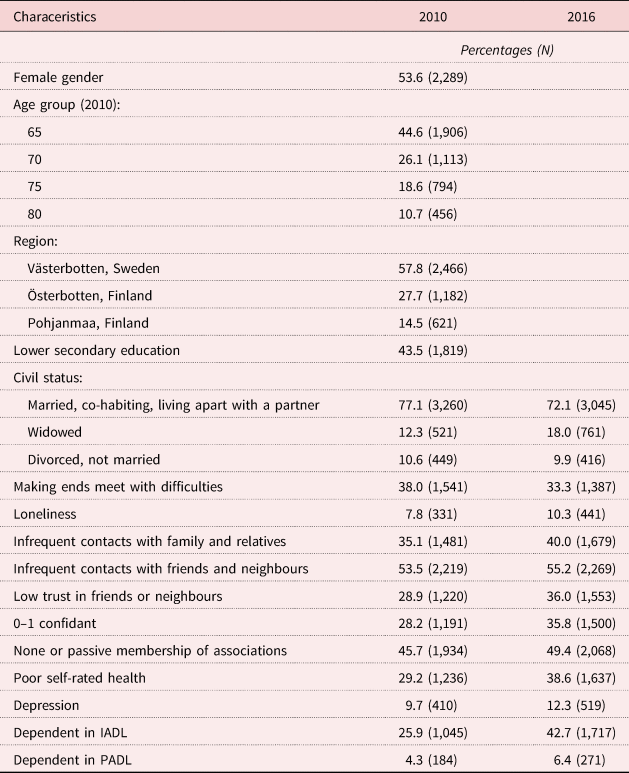
Initially, the distribution (%) of all variables was calculated for study years 2010 and 2016 (Table 1). Next, bivariate analyses, using cross-tables with Pearson's chi-square test, were conducted to analyse experienced loneliness in 2016 according to socio-demographic, social and health-related variables from the 2010 dataset and the 2010–2016 variable change scores (Tables 2 and 3). To control the overall Type I error rate, the Bonferroni correction for multiple comparisons was used when performing post hoc analyses (Table 2) (Beasley and Schumacker, Reference Beasley and Schumacker1995). Social and health-related change scores were created by subtracting the 2010 dichotomised scores from the 2016 dichotomised scores. This created a scale ranging from no change/positive change to negative change. However, to simplify the analyses, we dichotomised the change variables (no change/positive change versus negative change). A dichotomised change variable was also created for widowhood, identifying participants who had been widowed since 2010 (yes/no) and for the making ends meet variable (no change/positive change versus negative change).
Sample characteristics at 2010 and 2016

Notes: N = 4,269. IADL: instrumental activities of daily living. PADL: personal activities of daily living.
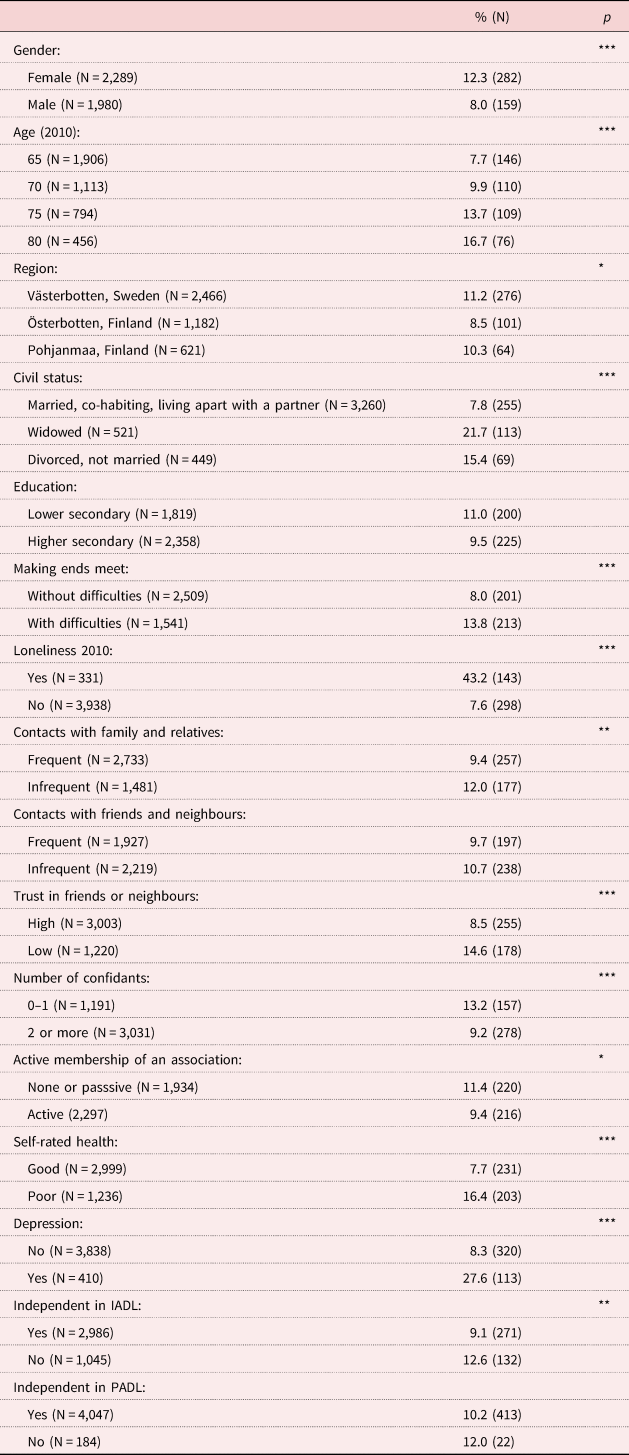
The distribution (%) of respondents reporting loneliness in 2016 by 2010 socio-demographic, social and health-related variables

Notes: N = 441. IADL: instrumental activities of daily living. PADL: personal activities of daily living.
Significance levels: * p < 0.05, ** p < 0.01, *** p < 0.001.
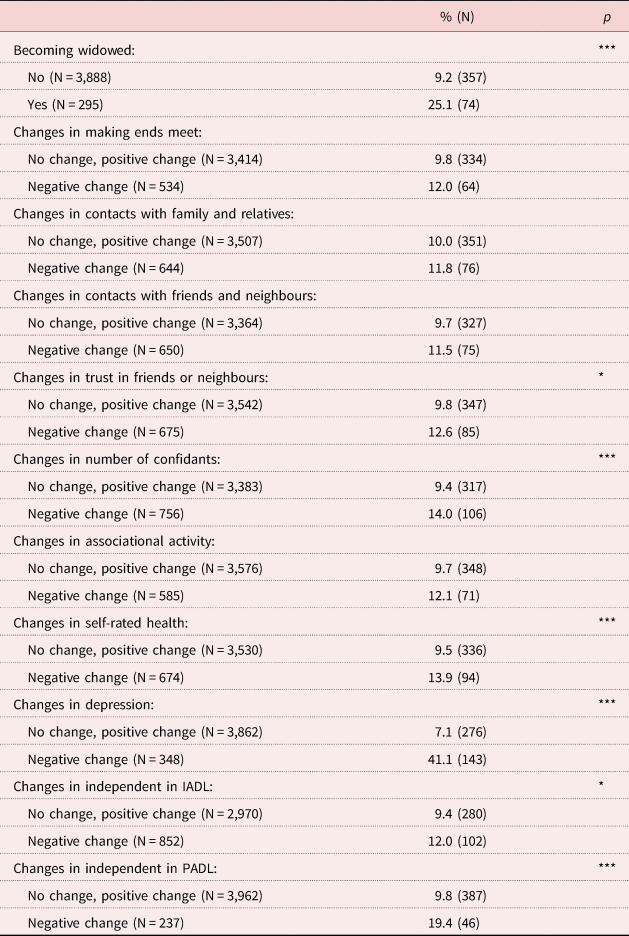
The distribution (%) of respondents reporting loneliness in 2016 by 2010–2016 changes

Notes: N = 441. IADL: instrumental activities of daily living. PADL: personal activities of daily living.
Significance levels: * p < 0.05, *** p < 0.001.
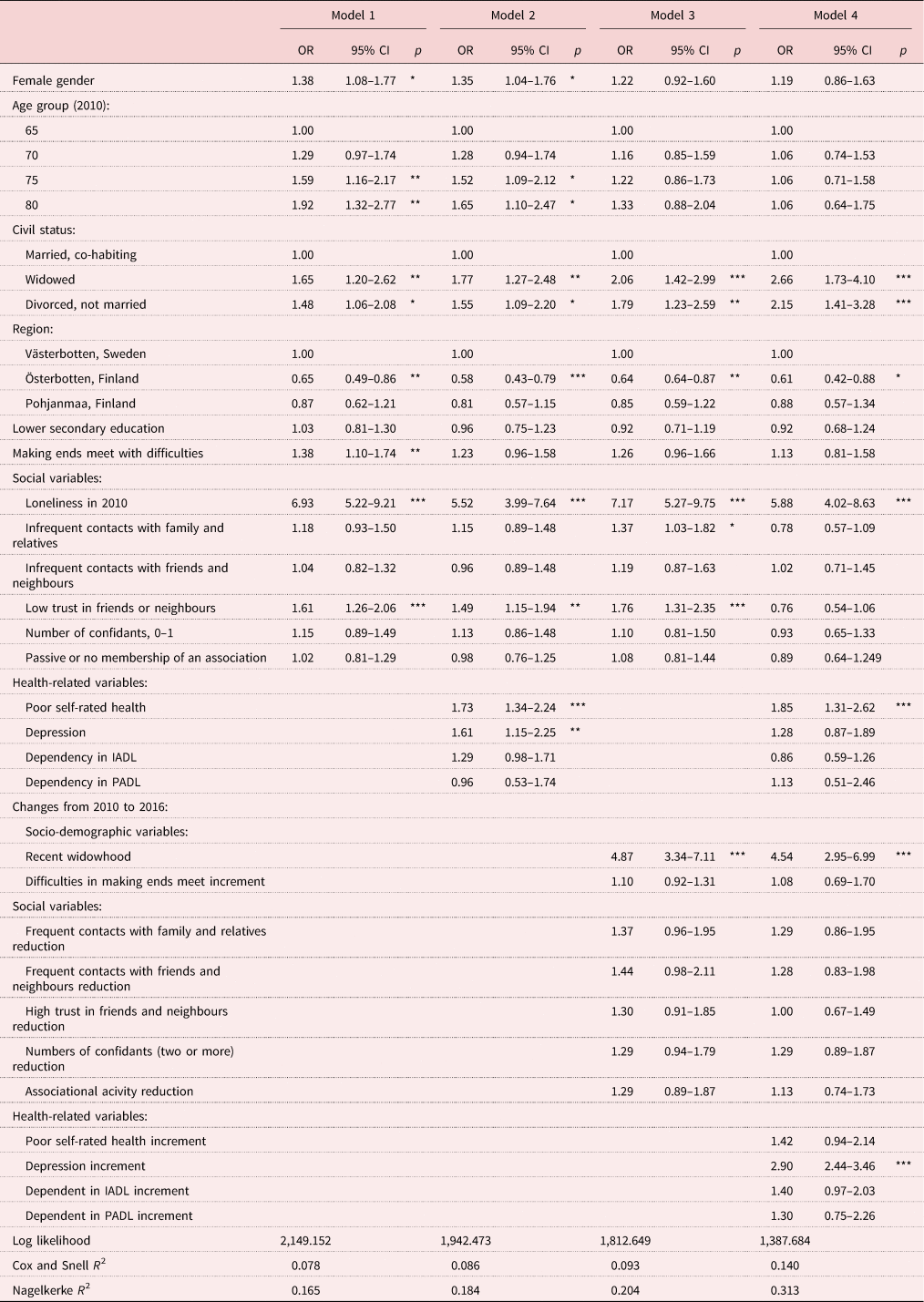
Finally, four logistic regression models were entered stepwise to analyse the risk factors for experiencing loneliness in 2016 (Table 4). These models analysed socio-demographic and social risk factors for loneliness (Model 1), health-related risk factors (Model 2), socio-demographic and social change variables (Model 3), and health-related change variables (Model 4). We compared the models using the log likelihoods. The results are presented as odds ratios and 95 per cent confidence intervals. IBM SPSS Statistics version 26 was used for analysis.
Odds ratios (OR) and 95 per cent confidence intervals (CI) for the probability of feeling lonely in 2016

Notes: IADL: instrumental activities of daily living. PADL: personal activities of daily living.
Significance levels: * p < 0.05, ** p < 0.01, *** p < 0.001.
Results
In 2010, 8 per cent of respondents reported loneliness compared to 10 per cent in 2016. The vast majority, 85.3 per cent (N = 3,640), reported no loneliness in either year (data not shown). Between 2010 and 2016, 7 per cent (N = 298) became lonely, whereas 4.4 per cent (N = 188) overcame loneliness; 3.3 per cent (N = 143) reported loneliness in both study years. The distribution (%) of all included variables is reported for study years 2010 and 2016 (Table 1). A negative change was reported for the included variables in the study sample, with the exception of the variable measuring making ends meet, as a lower proportion of older people reported poor ability to make ends meet in 2016 (33% versus 38% in 2010). Further, a higher proportion of the study population was widowed in 2016 compared to 2010 (12% versus 18%).
Table 2 presents the bivariate analyses of the association between loneliness in 2016 and socio-demographic, social and health-related variables in 2010. Loneliness was significantly more common among women and older people with difficulties in making ends meet in 2010. Further, age, region and civil status in 2010 were also associated with loneliness in 2016. To identify significant differences across categories, additional chi-square post hoc tests were conducted for age, region and civil status. Post hoc comparisons of loneliness by age group revealed that the null hypothesis for age groups 65, 75 and 80 was rejected, meaning that there were significant differences in loneliness between these three age groups. Also, significant loneliness differences were observed for Västerbotten and Österbotten, but not for Pohjanmaa. Finally, the null hypothesis for civil status categories was rejected, indicating a difference in loneliness among the three civil status categories.
Regarding the social variables, experience of loneliness in 2010, infrequent social contact with family and relatives, low trust in friends and neighbours, low (0–1) number of confidants, and none or passive membership of associations were significantly associated with loneliness in 2016. In addition, poor self-rated health, depression and dependency in IADL in 2010 were also significantly associated with loneliness in 2016.
Table 3 presents the bivariate analyses between loneliness in 2016 and 2010–2016 change scores. Loneliness in 2016 was significantly associated with becoming widowed, a negative change in trust, a negative change in the number of confidants, and negative changes in health including self-rated health, depression, IADL and PADL.
Table 4 presents the four logistic regression models examining the predictors of loneliness in 2016, including socio-demographic, social and health-related variables from 2010 and the 2010–2016 change variables.
In Model 1, when analysing social variables, loneliness in 2010 and low trust in friends or neighbours were found to be significantly associated with loneliness in 2016. Participants who reported loneliness in 2010 were more than six times more likely (OR = 6.93) than participants who did not report loneliness in 2010 to report loneliness in 2016. In addition, gender, age group, civil status, region and economic situation were significantly associated with loneliness in 2016. The likelihood for loneliness at follow-up was higher for women, 75- and 80-year-olds, widowed and single participants, and participants with difficulties making ends meet, and lower for participants living in Österbotten, Finland.
In Model 2, poor self-rated health and depression in 2010 were significant predictors of loneliness in 2016. The socio-demographic and social variables remained statistically significant. In Model 3, when socio-demographic and social change variables were added to the analyses, recent widowhood was associated with a higher likelihood of experiencing loneliness in 2016 compared to those who had not recently been widowed. Widowhood and being single in 2010 were still significantly associated with reports of loneliness at follow-up in Model 3. Also, the likelihood of reporting loneliness in 2016 was lower for participants living in Österbotten, Finland, and for those with infrequent contact with family and relatives. However, the effects of age groups and gender diminished in Model 3 and lost significance.
In the final model (Model 4), which included the health-related change variables, the likelihood of loneliness was higher for widowed and single participants than for married or co-habiting participants in 2010. There was a lower likelihood of loneliness among those living in Österbotten, Finland, compared to those living in Västerbotten, Sweden. Of the social variables examined in 2010, only loneliness was significantly associated with loneliness six years later, whereas poor self-rated health in 2010 predicted loneliness in 2016. Participants who were widowed after 2010 and those experiencing depression increments were also significantly more likely to report loneliness in 2016. A comparison of the models showed that there was a significant improvement in the model fit when social and health-related change variables were added (Models 2 and 4).
Discussion
The aim of this study was to analyse the prevalence of and changes in loneliness and to identify risk factors for loneliness in older people over time in regions of Finland and Sweden. The results showed that 8 per cent of the sample suffered from loneliness in 2010, increasing to 10 per cent in 2016. Forty-three per cent of those who experienced loneliness in 2010 again reported loneliness in 2016; in comparison, the remaining 57 per cent did not report suffering from loneliness six years later. Our analyses revealed that baseline resources and negative changes in resources predicted loneliness over time; we found that reported loneliness in 2010, being widowed and becoming a widow/er were important risk factors for loneliness. Poor self-rated health at baseline and the onset of depression were also risk factors for loneliness. Finally, the risk of loneliness was lower among older people living in Österbotten, Finland, than among people living in Västerbotten, Sweden.
About 10 per cent of our study sample reported loneliness at follow-up, which is in line with some previous work (Yang, Reference Yang2018) but does contradict the findings of some studies showing a higher increase of frequent loneliness at follow-up (Dahlberg et al., Reference Dahlberg, Andersson, McKee and Lennartsson2015). In line with other work (Tijhuis et al., Reference Tijhuis, de Jong-Gierveld, Feskens and Kromhout1999), our study confirms that age itself is not a risk factor for loneliness, while there is a growing propensity of social and health-related risk events when one gets older, such as widowhood and poor health. Our study also revealed that about 3 per cent of the total sample reported suffering from loneliness in both study years, indicating that this sub-group of older people deserves the most attention, as they might reflect a group of older people with enduring or chronic loneliness. At follow-up, 7 per cent of the sample became lonely, while 4 per cent overcame loneliness, suggesting that loneliness may be a transient experience that fluctuates over time (Mund et al., Reference Mund, Freuding, Möbius, Horn and Neyer2020). It should be noted that we assessed experiences of suffering from loneliness instead of frequent loneliness, and our follow-up period was comparatively short, covering six years. Nevertheless, older people experiencing loneliness at baseline were five times likelier to report loneliness at follow-up.
Older people are at a higher risk of social and health-related losses and changes, as was evident in our study. Between 2010 and 2016, there was a negative change at the population level in all indicators studied, an exception being making ends meet. In particular, the number of older people dependent in IADL increased between the study years. Our analyses focused on negative changes, and our bivariate analyses (Tables 2 and 3) revealed that limited social and health-related resources, including negative changes in these, were associated with loneliness at follow-up. There is a risk that research reporting negative changes hides the fact that some people gain resources, which is something that should be further explored in future work in relation to becoming lonely and recovering from loneliness. These types of loneliness studies are relatively rare (e.g. Newall et al., Reference Newall, Chipperfield and Bailis2014; Hawkley and Kocherginsky, Reference Hawkley and Kocherginsky2018).
Being unmarried or divorced increased the risk of experiencing loneliness. However, becoming a widow/er between the study years increased the likelihood of reporting loneliness at follow-up fourfold. Brittain et al. (Reference Brittain, Kingston, Davies, Collerton, Robinson, Kirkwood and Jagger2017) found that among very old adults, length of widowhood was a key factor for loneliness: that those with a longer experience of spousal loss experienced lower levels of loneliness compared to those experiencing recent widowhood (within 1–2 years). Since the death of a spouse is one of the most significant life events affecting adults’ daily interactions and social exchanges (Stroebe et al., Reference Stroebe, Zech, Stroebe and Abakoumkin2005), individuals who have lost their spouses require social support and engagement to aid in their adjustment to spousal loss (Sullivan and Infurna, Reference Sullivan and Infurna2020).
In our study, the onset of depression between study points, rather than depression at baseline, was related to loneliness at follow-up (Aartsen and Jylhä, Reference Aartsen and Jylhä2011; Houtjes et al., Reference Houtjes, van Meijel, van de Ven, Deeg, van Tilburg and Beekman2014; Dahlberg et al., Reference Dahlberg, Andersson, McKee and Lennartsson2015). It has been argued that depression causes reduced social networks and social participation, which might increase loneliness levels over time (Houtjes et al., 2014). However, in the literature, there is debate as to whether depression activates loneliness, whether loneliness is a risk factor for the development of depression or whether the relationship is reciprocal (Luanaigh and Lawlor, Reference Luanaigh and Lawlor2008; Schwarzbach et al., Reference Schwarzbach, Luppa, Forstmeier, König and Riedel-Heller2014). More research is clearly needed to understand the temporal relationship between loneliness and depression.
When it comes to other health-related variables, we found that only poor self-rated health – seen as an overall measure of an individual's health status (Lundberg and Manderbacka, Reference Lundberg and Manderbacka1996) – at baseline predicted loneliness six years later. Dykstra et al. (Reference Dykstra, van Tilburg and de Jong Gierveld2005) suggest that poor health may become a weaker predictor of loneliness over time due to adaptation and the use of coping strategies. Nonetheless, the issue of how to account for the finding that a negative change in self-rated health did not predict loneliness at follow-up is a matter for further research.
In some studies, loneliness has been linked to lower socio-economic status (Nicolaisen and Thorsen, Reference Nicolaisen and Thorsen2014; Donovan et al., Reference Donovan, Wu, Rentz, Sperling, Marshall and Glymour2017). Theoretically, a low socio-economic status could influence the possibility of social integration and, thus, loneliness levels (de Jong Gierveld and Tesch-Römer, Reference de Jong Gierveld and Tesch-Römer2012). Financial problems also influence the health and wellbeing of older people. Therefore, the relationship between low socio-economic status and loneliness might be mediated by various health-related factors, as suggested by de Jong Gierveld and Tesch-Römer (Reference de Jong Gierveld and Tesch-Römer2012). This finding was partly confirmed in our study. Difficulties in making ends meet independently predicted loneliness in our first model when controlling for socio-demographic and social variables, but not when controlling for health- and change-related variables.
Besides loneliness at baseline, none of the social variables, neither baseline nor social change variables, were independently related to loneliness at follow-up. While this contradicts some previous longitudinal work (e.g. Dykstra et al., Reference Dykstra, van Tilburg and de Jong Gierveld2005; Donovan et al., Reference Donovan, Wu, Rentz, Sperling, Marshall and Glymour2017; Dahlberg et al., Reference Dahlberg, McKee, Frank and Naseer2021), it corroborates other multivariable analyses showing no significant effects regarding social networks and support or changes in social variables (Dahlberg et al., Reference Dahlberg, Andersson, McKee and Lennartsson2015; Yang, Reference Yang2018; Warner and Adams, Reference Warner and Adams2016) on loneliness. Still, quality aspects of relationships are important, in terms of understanding loneliness (de Jong Gierveld, Reference de Jong Gierveld1998; Pinquart and Sörensen, Reference Pinquart, Sörensen and Shohov2003); however, in the context of other socio-demographic and health-related variables, the use of social variables to discriminate between the groups might be limited. Also, it might be that the loneliness measure used here could be more related to emotional loneliness, i.e. not having a partner or close confident, and that could be one reason why frequency of contact and other social variables in our study were not significant.
In this study, the highest levels of loneliness were observed in Västerbotten, Sweden. However, this difference was only significant between Swedish speakers in Finland and older people living in Västerbotten in Sweden; no significant difference was reported in relation to Finnish speakers in Finland. One reason for these differences may be that our study region was relatively rural and that the northern region of Sweden is even less populated than the western parts of Finland. The northern region of Sweden has also experienced high migration to the city of Umeå (Garli and Pettersson, Reference Garli and Pettersson2011), suggesting an increased risk of social isolation if elderly friends and family are not geographically close, which adheres to the cognitive theory of loneliness (Perlman and Peplau, Reference Perlman and Peplau1981) focusing on subjective perceptions of unmet desires for social contacts. These factors might serve as tentative explanations for the differences in loneliness between the two countries.
Further, we know from previous work conducted in the same region that Swedish speakers in Finland tend to be embedded in social resources to a higher degree than Finnish speakers and Swedish speakers in Västerbotten (Nyqvist et al., Reference Nyqvist, Nygård and Steenbeek2014). It has been suggested that Swedish speakers in Finland experience a higher degree of social inclusion due to their relatively small number, strong support from various institutions and lesser geographical mobility (McRae, Reference McRae1999) that could potentially explain observed differences in loneliness.
This study showed that many older people experience social and health-related losses, and that older widowed people, those who are depressed and those who are in poorer health are at higher risk of loneliness. Considering that these factors may reinforce one another, social and health-care services need to be observant in identifying older people facing these changes and problems. So far, there is no consensus as to how to reduce loneliness most efficiently (Masi et al., Reference Masi, Chen, Hawkley and Cacioppo2011; Cohen-Mansfield and Perach, Reference Cohen-Mansfield and Perach2015; Coll-Planas et al., Reference Coll-Planas, Nyqvist, Puig, Urrútia, Solà and Monteserín2017). It is, however, clear that combating loneliness requires strategies on both an individual and a societal level (de Jong Gierveld and Tesch-Römer, Reference de Jong Gierveld, Dykstra and Schenk2012). In order to develop relevant intervention strategies, more work is required to assess the extent to which individual, social and societal factors explain loneliness and their trajectories in older people.
Limitations
Loneliness has been studied extensively; however, estimates vary across studies, reflecting the different measurement approaches and populations sampled. We analysed a sample of older people between the ages of 65 and 80 at baseline and assessed them again six years later, thus including both younger and much older adults. In our study, loneliness was examined by a direct single-item loneliness question with only a yes/no answer, as opposed to Likert scale responses (see e.g. Eloranta, Reference Eloranta, Arve, Isoaho, Lehtonen and Viitanen2015). This approach assumes that respondents understand the definition of loneliness and are willing to admit to being lonely. It has also been argued that direct measures of loneliness might cause social desirability bias (de Jong Gierveld, Reference de Jong-Gierveld1987). This could result in an underestimation of loneliness, which might be of less concern if indirectly measuring loneliness using multiple-item scales, such as the Revised UCLA Loneliness Scale (Russell et al., Reference Russell, Peplau and Cutrona1980; Russell, Reference Russell1996) or the De Jong Gierveld Loneliness Scale (de Jong Gierveld and Kamphuis, Reference de Jong-Gierveld and Kamphuis1985). Further, the use of a single-item question cannot discriminate between social and emotional loneliness, as suggested by Weiss (Reference Weiss1973). Any comparison of results with other studies must, therefore, be made with caution.
One key methodological challenge in longitudinal research is loss at follow-up. In 2010, the total response rate was 64 per cent (N = 6,838), with the highest response rate in Västerbotten, Sweden (71%), followed by Österbotten (62%) and Pohjanmaa (52%) in Finland. Six years later, about 70 per cent of the 2010 respondents in Västerbotten and Österbotten participated in the survey, and 60 per cent of the 2010 respondents in Pohjanmaa. We have no information regarding the reasons for dropout; however, the response rate was lower among the older age group – an age group that is also more likely to be in poorer health (Chatfield et al., Reference Chatfield, Brayne and Matthews2005). Therefore, although the response rate was relatively high in 2010, there is a risk of sample selection bias as well as non-response bias, especially in Pohjanmaa, which might affect the reporting of loneliness as well as the predictors of loneliness. The reason for regional differences in the 2010 response rate is unknown; however, the pattern of response resembled that of the waves conducted in 2005 and 2016.
Longitudinal studies are important to increase our understanding of changes in loneliness. Our data were collected several years apart, and it is likely that loneliness may have fluctuated within this period. More qualitative as well as quantitative work is needed to explore the stability and changes in levels of loneliness as well as the factors triggering loneliness (see e.g. Morgan and Burholt, Reference Morgan and Burholt2020; Prohaska et al., Reference Prohaska, Burholt, Burns, Golden, Hawkley, Lawlor, Leavey, Lubben, O'Sullivan, Perissinotto, van Tilburg, Tully, Victor and Fried2020).
Conclusion
Our results are consistent with those of previous longitudinal studies showing that loneliness is predicted by socio-demographic, social and health-related risk factors. We also demonstrated the need to assess losses and changes in late-life loneliness. Further, our study confirmed that most older adults do not experience loneliness, although longitudinal studies are highly important in identifying those at risk of enduring loneliness. Our study adds insights into a Nordic regional perspective on loneliness. Even though older people in Nordic countries experience lower loneliness compared to those in other European countries, our study implies a diversity in loneliness and a need for further studies to explore the influence of within- and between-country differences.
Acknowledgements
The authors would like to thank the anonymous reviewers for their helpful and constructive comments.
Financial support
This work was supported by Högskolestiftelsen i Österbotten and Svenska kulturfonden as part of the ‘Social Inclusion Among Older Adults’ (AgeMin) project. The Gerontological Regional Database (GERDA) data collection in 2010 was supported by the Interreg-programme Botnia Atlantica; the Regional Council of Ostrobothnia and Umeå Municipality, whereas the data collection in 2016 was supported by the Swedish Research Council (grant number K2014–99X-22610–01–6), the Harry Schauman Foundation, the Regional Council of South Ostrobothnia, Svensk- Österbottniska Samfundet r.f., the Royal Skyttean Society, Vaasa Aktia Foundation and the Letterstedtska Association.
Ethical standards
The Gerontological Regional Database (GERDA) data collection in 2010 and 2016 was approved by the Regional Ethical Review Board in Umeå, Sweden (2010-220-32Ö and 05-084Ö; 2016-367-32 and 05-084Ö). In Finland, ethical approval is not needed for anonymous population-based postal surveys (Medical Research Act 488/1999; English translation is available at http://www.finlex.fi/en/laki/kaannokset/1999/en19990488). The study follows the guidelines of the Finnish National Advisory Board on Research Ethics (https://www.tenk.fi/sites/tenk.fi/files/HTK_ohje_2012.pdf).