INTRODUCTION
A central tenet of Darwinian evolution is differential survival and reproductive success mediated by natural selection (Gould, Reference Gould1981). In the context of human evolution and population dynamics, an unfortunate implication is that many children will die before reaching sexual maturity and adulthood. For those that remain, their lives will have been undoubtedly touched by episodes of ill-health and incapacity either by infectious or parasitic diseases. Of the 6·9 billion people who inhabit our planet, just fewer than 40% are younger than 19 years of age, with some 690 million children aged 4 years and below (http://populationpyramid.net). If general reproductive trends continue, these population totals are set to increase steadily such that by 2020 there will be 7·5 billion people with an additional 1·5 billion expected by 2050.
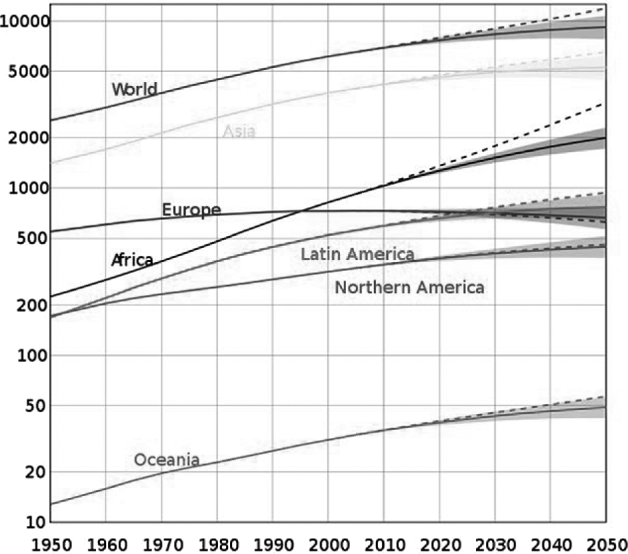
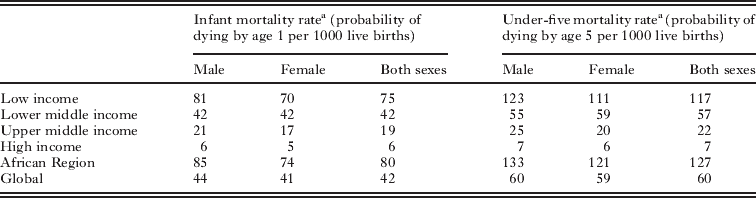
Different population trajectories on the major landmasses are predicted, Fig. 1. Whilst those on the continents of Africa and Asia are set to expand, trends in Europe will remain broadly constant but the latter with an ever more geriatric-biased population. As might be expected, current childhood mortality estimates are not homogeneous throughout the world owing to a range of causal factors, Table 1. Such factors often work in synergism and sometimes in vicious cycles – civil unrest with war, socio-economic impoverishment, nutritional and food insecurity, breakdown of family units and orphanage, ineffective obstetrics and management of endemic diseases – to name but a few (Black et al. Reference Black, Cousens, Johnson, Lawn and Rudan2010). Looking ahead, whilst the extent and balance of each of these factors will certainly change, with ameliorations hoped, it is unclear what their net effect will be upon reducing childhood mortality and disease.
Past and future population estimates in the world and its regions (in millions). Image taken from United Nations website, http://www.un.org/en/development/index.shtml.

Focusing upon child health
Recognising the importance and necessity for reducing childhood mortality across the globe, Goal 4 of the United Nation's Millennium Development Goals (MDGs) is specifically tailored towards this task (http://www.un.org/millenniumgoals/). Of the parasitic diseases known to contribute to this burden, foremost in their global significance is malaria, with more than 225 million cases each year with around 781,000 attributable deaths, some 2·23% of deaths worldwide (WHO, 2010). Young children are particularly at risk from this disease where the majority of deaths occur in sub-Saharan Africa, often in impoverished settings where there is substantial under-reporting and cryptic associations with HIV infection go unnoticed. In recognition of this, Goal 6 of the MDGs is tasked with combating HIV/AIDS, malaria and other diseases. ‘Other diseases’ is now frequently interchangeable with ‘neglected tropical diseases’ mainly caused by protists or helminths infections for which, as medical parasitologists, we are broadly familiar with their lifecycles, biology and epidemiology.
Childhood mortality rates for children aged between 0–1 and 1–5 years of age for those in different income stratification and from the developed or developing world

a Data compiled from the WHO report http://www.who.int/whosis/whostat/EN_WHS2011_Full.pdf.
Within this public health arena, whilst there is a clear international agenda to improve child health through more effective management of diseases, a number of obstacles remain in putting policy into practice (Medlin et al. Reference Medlin, Chowdhury, Jamison, Measham, Jamison, Breman and Measham2006). Clinical features and outcomes of parasitic diseases in children, for example, often differ from those in adults, so generic policies need realignment or specific-tailoring to be effective, or even appropriate, in children. This can be problematic. For example, setting absolute thresholds or age-related cut-offs for programmatic targeting can be confusing; children go through several physiological and developmental processes during childhood. Generic distinctions between infancy, (preterm) neonate, toddler, child and adolescent can be blurred as well as the biological meaning of ‘age’ as witnessed in the variations between growth-charts for age-to-weight or age-to-height relationships (de Onis et al. Reference de Onis, Onyango, Borghi, Siyam, Nishida and Siekmann2007).
Defining precisely the end of childhood and transition from adolescence into adulthood is also not easy for this varies by country, society and function (see http://futureofchildren.org/futureofchildren/publications/docs/20_01_FullJournal.pdf). Indeed there are many ‘ages’ at which an individual can be considered sufficiently mature to be entrusted by society with responsibilities or important behavioural milestones associated with adulthood. Heterogeneities include the legality of consent, with or without parental or guardian supervision, entry into sexual relationships, parenthood and formal marriage. What is absolute is that the end of childhood is signed by an increased independence from parents or guardians. In terms of public health policies, all of the above have ramifications for implementation of control, in setting parameters for inclusion/exclusion within (in)formal guidelines or on-the-ground practices.
Of most concern perhaps is the unique situation in which medicines for paediatric use find themselves; perhaps the majority of those routinely used are regularly provided in either off-licence (where the medicine does not have an official license for its use) or off-label (where the medicine is used in a different way than that described in the license) settings. The causal reasons for this are many and in recent years there has been change in legislation and registration of new drugs that come to market to have had some consideration in the potential use in paediatrics (see Regulation (EC) No 1901/2006 of the European Parliament and of the Council of 12 December 2006). Nonetheless, despite this impetus, identifying exactly who is able to authorise or take responsibility for the change of use of existing drugs at either individual or community-based treatment settings is unclear.
A SPECIALISED MEDICINE FOR CHILDREN
The oft-quoted adage that children are merely mini-adults is entirely inappropriate, for young children have much lower seizure thresholds, express their concerns differently and cannot always answer medical questions with patience and cooperation as adults might, notwithstanding their often poorer literacy. Indeed, signs and symptoms as well as developmental outcomes/prognoses associated with parasitic diseases in children can be unique and quite different from those of adults with parable infections. The need for a specialised branch of medicine was well-recognised long ago.
In short, paediatrics deals with the medical care of infants, children and adolescents. As a formalised discipline it can be traced back to the beginnings of the 19th Century where the first paediatric hospital (Hôpital des Enfants Malade) opened in Paris, on the site of a previous orphanage, in June 1802. Other European countries later followed suit but it took some fifty years for the creation of the first paediatric hospital in the UK, The Hospital for Sick Children, Great Ormond Street which continues to this day and gives specialist high quality care to sick children, operating alongside the adjoining Institute of Child Health, the latter tasked with both clinical and basic research.
The formation of paediatrics as a distinct speciality within the UK as a branch of medicine can be followed back to the founding of the British Paediatric Association (BPA) in 1928. However, it was not until 1996 that the BPA became the Royal College of Paediatrics and Child Health (http://www.rcpch.ac.uk/); this was seen as a significant advance, as Medical Royal Colleges play a major role in examining and training the specialists of the future, as well as harmonizing specialist training across Europe. Paediatric Tropical and Infectious Diseases Specialists (PTIDS), units devoted to the care of adolescents and the principle of separate care for paediatric patients, are now well established in the UK. Nonetheless, many shortcoming and obvious deficiencies remain. This was most keenly observed in the general paucity of the pharmaceutical sector in drug development specifically for paediatric use. For example, the British National Formulary (BNF), which is used on a daily basis by most clinicians, was launched in its modern form in 1981, but it took another 24 years before the BNF for Children appeared in 2005.
In the industrialised world, specialist training in infectious diseases for paediatricians is mainly focused upon management of common respiratory tract infections, HIV/tuberculosis and allergy but knowledge and appropriate case-management of malaria, as well as, the more common tropical diseases is mandatory. Alongside this are the ongoing public health interventions waged against several parasitic diseases at the community level. Many of these are specifically targeting children and encompass wide regions of the developing world. Here, we see the distinction between paediatric and international child health blur. This wind of change was witnessed perhaps in the recent rebranding of The Annals of Tropical Paediatrics to Paediatrics and International Child Health. A rationale adeptly defined by the editor J B S Coulter as paediatrics, which encompasses clinical and laboratory aspects, and international child health which covers the wide spectrum of topics in community child health.
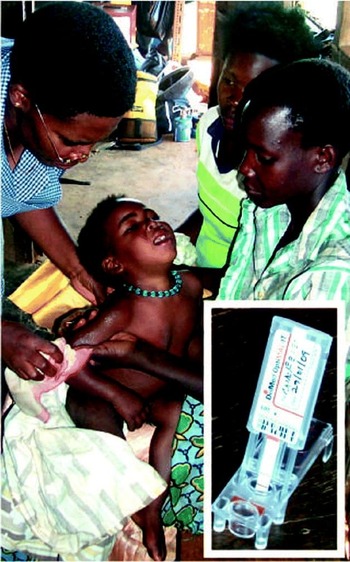
Despite the majority of their populations being poor, some developing countries are now using advanced medical treatments and medical procedures at a level only previously seen in industrialised countries. Moreover, with global aid and funding now flowing into certain parts of the developing world at unprecedented levels, the scale-up of prevention and treatment of parasitic diseases, e.g. malaria, at national and international levels is at a scale never before achieved; notwithstanding better point-of-care diagnosis such as rapid diagnostic tests, Fig. 2. With a multi-disciplinary subject like parasitology, as Cox (Reference Cox2009) remarked, it is often easier to define what parasitology isn't rather than what it is. Thus the role that medical parasitology is playing within this changing global arena of child health, from basic research to more clinical activities, is rather elusive to capture precisely.
Young child being examined in field-based clinic with a rampant malaria infection as later identified by rapid diagnostic test [inset] (see Green et al. 2011). The true burden of disease in many parts of Africa is likely under-reported and with the roll-out of rapid diagnostic tests could provide better disease surveillance. Prompt diagnosis allows prompt treatment which for malaria is often live-saving.

PROGRESS IN PAEDIATRIC PARASiTOLOGY
Attempting to bring together a better focus on parasitic diseases in childhood and relationship of medical parasitology with paediatrics, the 2010 Autumn Symposium of the British Society of Parasitology was dedicated to this task. The meeting was held in conjunction with support from the Royal Society for Tropical Medicine and Hygiene and this 2-day forum took place at the Wolfson Research Institute, University of Durham, on 23–24th September. The meeting brought together an international speakers' list inclusive of 14 clinicians and scientists addressing a range of parasitic disease topics, some as specialist paediatricians, unified under the auspices of improving child health. Indeed, all were working at the coal-face of implementation policy and public health practice.
Inspired by this meeting, a total of 17 manuscripts were received, representative of a collective authorship of just over 90 contributors, inclusive of those from the WHO. Whilst the majority of authors were based in industrialized countries, it was heartening to see that that nearly 40% of this authorship was from the developing world. Grouping the 17 papers into discrete categories with a specific indexing system was difficult, as might be expected with a diverse range of interests, but we have tried to assemble a coherent set in a logical flow connecting key themes.
Adaptable policies and useful maps
The first two papers by Sutherland et al. (Reference Sutherland, Babiker, Mackinnon, Ranford-Cartwright and El Sayed2011) and Naidoo and Roper (Reference Naidoo and Roper2011) address in detail the situation for treatment options for malaria in the paediatric setting. A more rational deployment of antimalarial drugs at district, national and regional levels is needed. This is to safeguard the potential spread of drug resistance in P. falciparum parasite populations, especially as new artimenisinin treatments are rolled out. Intermittent preventive treatment of infants (IPTi) with sulphadoxine pyrimethamine (SP) is recommended as an additional malaria control intervention in parts of Africa where transmission intensity is moderate to high, but care is needed ensure that the protective efficacy of SP-IPTi is not compromised by high levels drug resistance. Thus the growing database highlighted by Naidoo and Roper (Reference Naidoo and Roper2011) will become increasingly important in tracking the evolution and dispersal of drug resistance mutations across sub-Saharan Africa and elsewhere.
Highlighting other protist diseases, Wastling et al. (Reference Wastling, Picozzi, Wamboga, Von Wissmann, Amongi-Accup, Wardrop, Stothard, Kakembo and Welburn2011), Kelly (Reference Kelly2011) and Verweij and van Leishout (Reference Verweij and van Leishout2011) address unsolved aspects of disease epidemiology, challenges in disease control and application of new diagnostics methods, respectively. Whilst Trypanosoma brucei gambiense usually persists in established ancient foci from which clinical disease ebbs and flows, recent surveys in western Uganda point towards more silent foci of disease where mother–to–child transmission could be occurring. On the other hand, whilst cryptosporidiosis is easier to detect, there are no effective medicines to manage this disease in children which is further complicated by the HIV status of the child. Deciding exactly which of the intestinal protists that colonise the intestines of children and cause gastro-intestinal disease is becoming rather contentious since advances in parasite detection by multiplex real-time PCR offer more sensitive and specific forms of investigation of cross-sectional epidemiological surveys. Whilst Cryptosporidium-associated diarrhoea is well-known, the more cryptic role of Dientamoeba fragilis is starting to be more noticed in children.
Parasties and the immunological balance of power
The following four papers by Elliott et al. (Reference Elliott, Ndibazza, Mpairwe, Muhangi, Webb, Kizito, Mawa, Tweyongyere and Muwanga2011), Djuardi et al. (Reference Djuardi, Wammes, Supali, Sartono and Yazdanbakhsh2011), Imai et al. (Reference Imai, Rujeni, Nausch, Bourke, Appleby, Cowan, Gwisai, Midzi, Cavanagh, Mduluza, Taylor and Mutapi2011) and Green et al. (Reference Green, Sousa-Figueiredo, Basánêz, Betson, Kabatereine, Fenwick and Stothard2011) attempt to define the for and against arguments in treatment of parasitic diseases in mothers and children, highlighting our current knowledge of the unfolding story of childhood immunology in utero and ex utero. For example, anthelmintic treatment during pregnancy is now internationally recommended to reduce maternal anaemia, but few clinical trials have assessed the use of praziquantel during pregnancy with schistosomiasis. Elliott et al. (Reference Elliott, Ndibazza, Mpairwe, Muhangi, Webb, Kizito, Mawa, Tweyongyere and Muwanga2011) highlight that the benefits from treatment are far from clear, especially when later effects on the child are considered in terms of allergy during infancy. Indeed, the immunological environment of the developing child is complex and helminths are known to induce T-cell hyporesponsiveness that down-modulates immunity to not only the parasites themselves but also to other pathogens or vaccine antigens. The fact that children are also co-infected with helminths and malaria make the situation all the more challenging as shown by the changing cytokine dynamics in infected Zimbabwean children by Imai et al. (Reference Imai, Rujeni, Nausch, Bourke, Appleby, Cowan, Gwisai, Midzi, Cavanagh, Mduluza, Taylor and Mutapi2011). Whilst it is certain that children suffer from severe anaemia resultant from protist and helminth infections, in Uganda it appears that infant malaria is the dominant cause (Green et al. Reference Green, Sousa-Figueiredo, Basánêz, Betson, Kabatereine, Fenwick and Stothard2011).
As testing for HIV status in all epidemiological settings is not possible, many associations of this virus with the more common parasitic diseases may well go unnoticed. In recognition of the important role that HIV/AIDS plays in child health, the paper by Sangare et al. (Reference Sangare, Herrin, John-Stewart and Walson2011) reviews the available evidence. This is surprisingly meagre given that globally, an estimated 33 million individuals are currently infected with HIV and two-thirds of these individuals reside in sub-Saharan Africa. It is clear, however, that individuals with HIV are at higher risk for malaria infection and for more severe malaria disease. Rather strangely, however, is that malaria is not typically recognised as an HIV-associated disease yet recent studies showed that in 75% of HIV/AIDS sufferers their first symptom was fever (!) (Breiger, Reference Breiger2011). Routine de-worming, seems to play an important role in delaying HIV disease progression in some of these settings, thus these interventions may play an important role in restoring and maintaining immunological responses to common childhood vaccines among HIV-infected children.
Community level interventions and available medicines
Diseases which are traditionally not thought of being particularly prominent in early childhood are reappraised. Shenoy and Bockarie (Reference Shenoy and Bockarie2011) review the impact of lymphatic filariasis in children and development of more subtle morbidity in the absence of community-directed mass treatment with anthelmintics. Other issues concerning the scale-up and role out of preventive chemotherapy are highlighted by Odiere et al. (Reference Odiere, Opisa, Odhiambo, Jura, Ayisi, Karanja and Mwinzi2011) and Halwindi et al. (Reference Halwindi, Magnussen, Siziya, Handema, Meyrowitsch and Olsen2011) for soil-transmitted helminthiasis and Namwanje et al. (Reference Namwanje, Kabatereine and Olsen2011) and Stothard et al. (Reference Stothard, Sousa-Figueiredo, Betson, Green, Seto, Garba, Sacko, Mutapi, Vaz Nery, Amin, Mutumba-Nakalembe, Navaratnam, Fenwick, Kabatereine, Gabrielli and Montresor2011) for schistosomiasis. Across the globe, over 250 million children are exposed to lymphatic filariasis with more than 70 million children treated annually by mass drug administration in attempts to eliminate the disease. Whilst elimination of parasite transmission is still a long way off for soil-transmitted helminthiasis and schistosomiasis, the scale-up of mass drug administration in school-aged children has been impressive (Fenwick et al. Reference Fenwick, Webster, Bosque-Oliva, Blair, Fleming, Zhang, Garba, Stothard, Gabrielli, Clements, Kabatereine, Toure, Dembele, Nyandindi, Mwansa and Koulounari2009). Nonetheless, these diseases also occur in pre-school children and promoting better access to anthelminthics for this ageclass is challenging, especially for schistosomiasis (Namwanje et al. Reference Namwanje, Kabatereine and Olsen2011; Stothard et al. Reference Stothard, Sousa-Figueiredo, Betson, Green, Seto, Garba, Sacko, Mutapi, Vaz Nery, Amin, Mutumba-Nakalembe, Navaratnam, Fenwick, Kabatereine, Gabrielli and Montresor2011). Typical of other helminth diseases, there are as yet no available vaccines which elicit protective immunity. Thus the search for novel antigens that could be identified as potential vaccine candidates continues. Higon et al. (Reference Higón, Cowan, Nausch, Cavanagh, Oleaga, Toledo, Stothard, Antúnez, Marcilla, Burchmore and Mutapi2011) present a new approach to compare immunogenic proteins between schistosomes and echinostomes to identify novel species-specific targets.
In the final paper, Keiser, Ingram and Utzinger (Reference Keiser, Ingram and Utzinger2011) address the most important issue in this volume – medicines for paediatrics. They review and outline the necessary dialogue with the pharmaceutical sector to improve available medicines for use in children. Systematically reviewing the literature, all clinical trials attempted over the past 10 years were identified by group of medicines, the number, geographical location and type of trials conducted. It is immediately apparent that several paediatric pharmacokinetic studies are urgently needed. What is surprising are perhaps are the financial and technical challenges that cause current paucity of adequate paediatric formulations; here does the power of market forces sadly eclipse humanitarian need?
CONCLUDING REMARKS
As might be imagined, collating and developing these 17 manuscripts to their final published forms has been a significant challenge in communication and co-ordination. In this endeavour, it is most fitting to recognize the extra effort which Dr Les Chappell has given to this project bringing together these tasks to a successful fruition, and we warmly thank him for his endeavours. Similarly we are particularly grateful to the kind support in which Cambridge University Press has given in redaction of these contributions, as well as to the British Society for Parasitology and Royal Society of Tropical Medicine and Hygiene which facilitated this Autumn Symposium which was originally conceived by the authors in November 2009.
For the future, parasitic diseases in children will remain prominent hurdles to raising child health evenly across the globe. Whilst these burdens can be most easily seen in the developing world, and especially in tropical regions, with increasing travel to and from such zones, the public health management of such diseases will become ever more important as well as individual case-management outside this zone. The challenge is now how to harmonise existing international policies with best efforts on-the-ground for it is here that the future research endeavours and activities from either medical parasitologist, or perhaps even paediatric parasitologists, will be best applied.
ACKNOWLEDGEMENTS
We wish to thank the Councils of the BSP and RSTMH in supporting the 2010 Autumn Symposium on Paediatric Parasitology. We also thank Mr Jose Sousa-Figueiredo for his assistance in researching global population statistics.