Introduction
Recent studies have found a positive association between poor school performance and the risk of attempted and completed suicide in adulthood (Richardson et al. Reference Richardson, Bergen, Martin, Roeger and Allison2005; Jablonska et al. Reference Jablonska, Lindberg, Lindblad, Rasmussen, Ostberg and Hjern2009; Gunnell et al. Reference Gunnell, Löfving, Gustafsson and Allebeck2011). Other studies have found that poor performance on IQ tests, which is highly correlated with school performance (Furnham et al. Reference Furnham, Monsen and Ahmetoglu2009), is associated with an increased risk of subsequent suicide attempts and suicide (Allebeck et al. Reference Allebeck, Allgulander and Fisher1988; Gunnell et al. Reference Gunnell, Magnusson and Rasmussen2005; Hemmingsson et al. Reference Hemmingsson, Melin, Allebeck and Lundberg2006; Andersson et al. Reference Andersson, Allebeck, Gustafsson and Gunnell2008; Osler et al. Reference Osler, Nybo Andersen and Nordentoft2008; Alati et al. Reference Alati, Gunnell, Najman, Williams and Lawlor2009; Gravseth et al. Reference Gravseth, Mehlum, Bjerkedal and Kristensen2009). Few studies have, however, examined possible explanations for these associations.
Some studies have suggested that the association between cognitive function and suicide is partially mediated by socio-economic status (SES) and psychiatric disorders. For example, cognitive ability has been associated with the risk of developing mental disorders (Mortensen et al. Reference Mortensen, Sørensen, Jensen, Reinisch and Mednick2005; Gale et al. Reference Gale, Batty, Tynelius, Deary and Rasmussen2010), and adjustment for mental disorders attenuated, but did not fully explain, the association between cognitive function and self-harm (Osler et al. Reference Osler, Nybo Andersen and Nordentoft2008; Jablonska et al. Reference Jablonska, Lindberg, Lindblad, Rasmussen, Ostberg and Hjern2009). Furthermore, studies from Sweden found that adult SES may partially mediate the association between IQ and suicide (Hemmingsson et al. Reference Hemmingsson, Melin, Allebeck and Lundberg2006; Sörberg et al. Reference Sörberg, Allebeck, Melin, Gunnell and Hemmingsson2013). Parental SES appeared not to confound this association in other studies (Allebeck et al. Reference Allebeck, Allgulander and Fisher1988; Hemmingsson et al. Reference Hemmingsson, Melin, Allebeck and Lundberg2006; Björkenstam et al. Reference Björkenstam, Weitoft, Hjern, Nordström, Hallqvist and Ljung2011; Sörberg et al. Reference Sörberg, Allebeck, Melin, Gunnell and Hemmingsson2013).
However, other factors may also be important. In particular, adverse health behaviours, such as smoking and physical inactivity, correlate with cognitive ability (Batty et al. Reference Batty, Deary and MacIntyre2006; Corley et al. Reference Corley, Gow, Starr and Deary2010, Reference Corley, Gow, Starr and Deary2012; Gow et al. Reference Gow, Corley, Starr and Deary2012), depressive symptoms and suicide (Li et al. Reference Li, Yang, Ge, Hao, Wang, Liu, Gu and Huang2012; Stavrakakis et al. Reference Stavrakakis, de Jonge, Ormel and Oldehinkel2012; Zhang et al. Reference Zhang, Yan, Li and McKeown2013) and could thus mediate the association between cognitive function and self-harm. Smoking, for example, was found to be an independent risk factor for suicidal behaviour in some (Breslau et al. Reference Breslau, Schultz, Johnson, Peterson and Davis2005; Covey et al. Reference Covey, Berlin, Hu and Hakes2012), but not all (Kessler et al. Reference Kessler, Borges, Sampson, Miller and Nock2009), past studies and it may also be a proxy measure for risk taking and for use of other psychotropic substances. Engaging in physical activity may protect against suicidality through its effect on psychological well-being. To our knowledge, only one previous study has tested the hypothesis that adverse health behaviours may mediate the association between cognitive function and self-harm, and found that controlling for smoking and alcohol use attenuated the association of IQ with attempted suicide in a sample of Swedish men (Batty et al. Reference Batty, Whitley, Deary, Gale, Tynelius and Rasmussen2010). Another possible mechanism is that low cognitive function may impair individuals' ability to develop relationships and social networks, resulting in poor social support and risk for self-harm, but this has not been investigated.
Other mechanisms may also be involved. A study from the UK relating IQ to the risk of suicidal thoughts found an association with persistence of suicidal thoughts but not with their onset (Gunnell et al. Reference Gunnell, Harbord, Singleton, Jenkins and Lewis2009). The authors suggested that delayed recovery from suicidal thoughts may expose people to a prolonged period of heightened risk of suicide. If this hypothesis is true, the risk for self-harm should be higher among individuals with a history of suicidal thoughts. Individuals with low cognitive function may also have poor coping ability and, in times of crisis, are less able to identify solutions to their problems other than self-harm. If low cognitive performance also predicts suicide attempts among individuals without a history of suicidal thoughts, it is possible that there is an impairment of mechanisms that normally prevent individuals from acting immediately when suicidal thoughts emerge, for instance in stressful situations. Thus, the possibly modifying role of a history of suicidal thoughts mayilluminate the mechanisms linking cognitive ability with suicide.
The aim of this study was to examine the longitudinal association of school performance, measured as grade-point averages in the ninth and final year of compulsory education, with self-reported suicide attempts in a large sample of young Swedish adults, and the extent to which this association is explained by (i) adult life health behaviours, including sedentary lifestyle, body mass index (BMI) and daily tobacco smoking, and (ii) adult social conditions, including social support, employment status and financial strain, while controlling for a range of possible confounders. We also examined the potential modifying role of previous suicidal thoughts in the association between school performance and the risk of suicide attempts.
Method
Study population
The study population consisted of men and women aged 18–33 years who had participated in the 2002 and 2006 survey waves of the Stockholm Public Health Cohort (Svensson et al. Reference Svensson, Fredlund, Laflamme, Hallqvist, Alfredsson, Ekbom, Feychting, Forsberg, Pedersen, Vågerö and Magnusson2012) and were resurveyed in 2007 and 2010 respectively (n = 7816). The surveys used area-stratified, random samples of the population of Stockholm County aged 18–84 years. Data were collected using postal or web-based questionnaires that elicited information on sociodemographic factors, psychological distress and suicide attempts, in addition to other health and lifestyle characteristics. Self-reported exposure and outcome information was complemented by information from longitudinal health and sociodemographic data registers regarding the study participants and their first-degree relatives. The key to record linkages was the unique personal identification number assigned to each resident in Sweden. Response rates among individuals aged 18–33 were 54% in 2002 and 51% in 2006. Retention rates for the 2007 and 2010 follow-ups were 68% and 59% respectively. Non-responders were more likely to be men, born outside Sweden, single or separated, unemployed and with lower incomes (Svensson et al. Reference Svensson, Fredlund, Laflamme, Hallqvist, Alfredsson, Ekbom, Feychting, Forsberg, Pedersen, Vågerö and Magnusson2012). Individuals reporting lifetime suicide attempts at baseline (n = 446) and those with missing data (n = 1081) were excluded, leaving 6146 individuals in the final sample. Informed consent was obtained from all study participants, and the Stockholm regional ethical review board granted ethical approval for the study.
Data collection and definitions
Main exposure
School performance was defined as grade-point averages in the final year of compulsory education (year 9, when participants were approximately 16 years old), retrieved from the National School Register (available at www.skolverket.se), and was categorized into quartiles according to year of graduation.
Outcome
Suicide attempts were assessed at baseline and follow-up by a question based on the work of Meehan et al. (Reference Meehan, Lamb, Saltzman and O'Carroll1992): ‘Have you ever made an attempt to take your life?’ There were four alternative answers: ‘No, never’, ‘Yes, in the past week’, ‘Yes, in the past year’ and ‘Yes, more than a year ago’. Answer alternatives were slightly different for the 2007 follow-up: ‘No, never’, ‘Yes, in the past four years’ and ‘Yes, earlier’.
Covariates
With regard to adult health behaviours, current daily tobacco smoking was assessed at baseline by the question ‘Do you smoke daily?’, and was categorized as ‘Yes’ or ‘No’. Responders were asked about their weight and height at baseline and BMI was calculated and categorized as: < 20, 20 to < 25, 25 to < 30, and ⩾30 kg/m2. Responders were asked to estimate the average time per week they spent walking, cycling or getting any other form of exercise (Torgen et al. Reference Torgen, Alfredsson, Koster, Wiktorin, Smith and Kilbom1997). Those reporting less than 2 h/week of exercise were classified as having a sedentary lifestyle.
With regard to adult social conditions, responders reported their current employment status at baseline, categorized as: student, employed, unemployed, being on disability pension/sick leave, keeping the household/being on parental leave, and other. Financial strain was assessed by the questions: (i) ‘In the past 12 months have you spent your entire paycheque/pension or run out of money and been forced to borrow from relatives and friends to buy groceries or pay the rent?’ and (ii) ‘In the past 12 months have you spent your entire paycheque or run out of money and been forced to turn to social services to buy groceries or pay the rent?’ For both questions there were three response alternatives: ‘No’, ‘Yes, once’ and ‘Yes, many times’. These were combined to create a three-category variable: ‘no financial strain’, ‘sought financial help from others’ and ‘sought social benefits’. Social support was assessed by the question: ‘Do you know any people who can provide you with personal support for personal problems or crises in your life?’ There were four response alternatives: ‘Yes, always’, ‘Yes, for the most part’, ‘No, usually not’ and ‘No, never’, which were combined to create a dichotomized (Yes, No) variable.
Lifetime suicide thoughts were assessed at baseline by the question: ‘Have you ever been in the situation that you seriously considered taking your own life, maybe even planned how you would do that?’. There were four alternative answers: ‘No, never’, ‘Yes, in the past week’, ‘Yes, in the past year’ and ‘Yes, earlier than a year ago’. The three latter comprised our variable of having had lifetime suicide thoughts at baseline.
Information about country of birth was attained by linkage with the Longitudinal Integration Database for Health Insurance and Labour Market Studies (LISA), a central database held by Statistics Sweden that comprises family and individual data on sociodemographic parameters (www.scb.se). We categorized immigrant status as native Swede, European immigrant (those born, or born to parents with origins, outside Sweden in Europe) and Non-European immigrant (those born, or born to parents with origins, outside Europe). Data on study participants' own and parental education were also obtained from LISA and grouped into three categories: compulsory (duration 0–9 years), upper secondary (duration 10–12 years) and higher (duration>12 years), according to the highest educational achievement of the mother or father. The Swedish Multi-Generation Register (Ekbom, Reference Ekbom2011) was used to identify any adoptive parents for study participants. Information on diagnosis of mental disorder (any diagnosis in Chapter V of ICD-8 and ICD-9 or Chapter F of ICD-10) in study participants was obtained from the Swedish National Patient Register, which contains the dates and discharge diagnoses of all in-patient (since 1973) and specialist out-patient care (since 2001, although with incomplete psychiatric out-patient data) in Sweden (National Board of Health and Welfare, 2009) and the Stockholm County Adult Psychiatric Out-patient Register, which records the dates and diagnoses for any contact with specialist out-patient psychiatric services in Stockholm County since 1997 (Jorgensen et al. Reference Jorgensen, Ahlbom, Allebeck and Dalman2010). According to these registers, a positive history of mental illness was defined as having received any diagnosis of mental disorder between graduating from compulsory education and completing the baseline surveys.
In addition, we considered the following factors as possible confounders. Parental history of mental illness was obtained from the National Patient Register and the Stockholm County Mental Health Service Register and was defined as having received any diagnosis of mental disorder. These registers, along with the Cause of Death Register (1952 onwards), provided information on attempted or completed suicide in the parents of study participants. Data on childhood mental illness in study participants was obtained from the Child and Adolescent Psychiatric Register in Stockholm (Idring et al. Reference Idring, Rai, Dal, Dalman, Sturm, Zander, Lee, Serlachius and Magnusson2012) and the National Patient Register and was defined as any diagnosis of mental disorder prior to completing compulsory education. Information on childhood socio-economic conditions when the study participants were approximately 5 years old, including parental SES, type of housing and being raised in a single-parent household, was obtained through linkage to Statistics Sweden and the Population and Housing Censuses, which were held every 4 years between 1978 and 1994. Register-based data were supplemented by self-reported information on parental SES, available from the 2002 survey. Parental income in childhood was obtained through LISA. The Medical Birth Register provided information on whether study participants were born small for gestational age. Information on age at becoming a parent in study participants was obtained from the Multi-Generation Register at baseline. Information on participants' civil status (cohabiting or single) was self-reported. Study participants were asked about their history of specific somatic illnesses as diagnosed by health-care professionals including diabetes, angina pectoris, hypertension, myocardial infarction, heart failure, stroke and asthma at baseline. All positive answers were combined to produce a dichotomized (Yes/No) physical illness variable. Psychological distress was assessed at baseline with the 12-item version of the General Health Questionnaire (GHQ-12; Goldberg et al. Reference Goldberg, Gater, Sartorius, Ustun, Piccinelli, Gureje and Rutter1997). We used a cut-off score of ⩾3 (using the recommended standard 0–0–1–1 scoring), which is generally used in public health surveys and research reports to denote significant psychological distress, consistent with the presence of a common mental disorder. Alcohol consumption was obtained by self-report and categorized as: abstainer, moderate (1–24 and 1–12 g alcohol/week in men and women respectively) and heavy (>24 and > 12 g alcohol/week in men and women respectively); information on previous use of cannabis was available for the 2002–2007 sample only.
Statistical analysis
The 2002–2007 and 2006–2010 samples were pooled to increase the statistical power. The 76 individuals who had participated in both surveys were excluded from the analyses. We used calibration weights to reweight for non-response (Lundström & Särndal, Reference Lundström and Särndal1999). Weights were designed by Statistics Sweden to recalculate the population structure of Stockholm County with compensation for systematic non-response, created on the basis of available auxiliary variables from national registries and their association with survey data. The auxiliary variables included sex, age, country of birth, civil status, income, educational level, sickness allowance and area of residence. We carried out survey-weighted logistic regression analyses to estimate crude and adjusted odds ratios (ORs) and their 95% confidence intervals (CIs) for self-reported suicide attempts at follow-up among individuals without a history of suicide attempts at baseline, in relation to school performance. Adjustments were made for potential confounders. In multivariate models, we adjusted for (i) those characteristics that were associated with the outcome and modified the sex- and age-adjusted association between exposure and outcome by at least 5%, and (ii) for those characteristics that were associated with the possible mediators and the outcome and modified the association between exposure and outcome, after adjusting for possible mediating factors and confounders, by at least 5%. Model 1 included the covariates age and sex. Model 2 included the covariates of model 1 plus immigrant status, paternal education and adoptive parent. Adjusted ORs were also estimated with unweighted data.
Subsequent models were motivated by the specific mediating hypotheses to be tested. We examined the possible mediating effect of (i) adult health behaviours and (ii) adult social conditions in multivariate models where potential confounders were considered. Model 3 included the covariates of model 2 plus daily tobacco smoking, sedentary lifestyle and BMI, along with education and history of mental illness. Model 4 included the covariates of model 2 plus social support, employment status, financial strain, education and history of mental illness.
To examine the potential modifying role of history of lifetime suicide thoughts, we stratified the sample according to baseline history of such thoughts. Log-likelihood ratio tests were used to assess whether associations of school performance with suicide attempts differed in males and females and in those with and without a history of suicide thoughts respectively. Analyses were conducted using SAS version 9.1 (SAS Institute Inc., USA).
Results
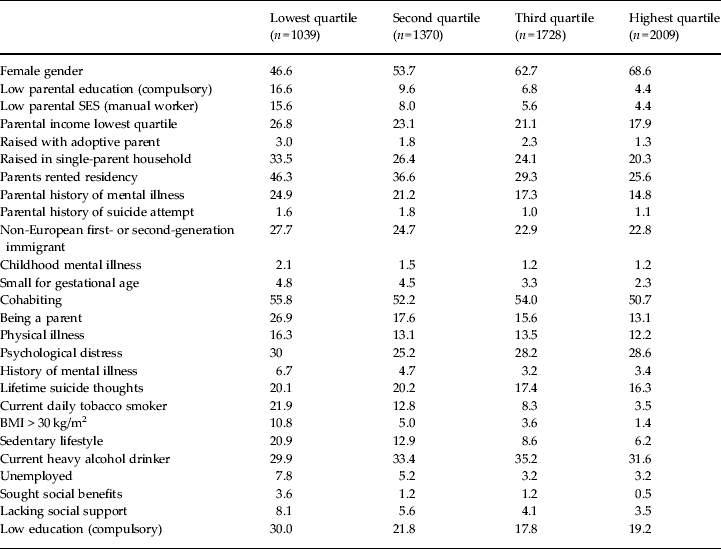
Baseline characteristics of the study participants according to school performance are presented in Table 1. The 6146 participants comprised 2465 men and 3681 women. Approximately 20% reported lifetime suicide thoughts at baseline (4.2% during the past year and 13.9% more than a year ago). At follow-up, 59 women and 32 men reported a history of suicide attempt (23 during the past 4 years, 48 more than a year ago, five during the past year and 15 more than 4 years ago). The corresponding 5-year cumulative incidence of self-reported suicide attempts was 1.2% among men and 1.8% among women.
Baseline characteristics of study participants according to compulsory school-leaving grades in quartiles (n = 6146)

SES, Socio-economic status; BMI, body mass index.
Values given as percentages.
There was a graded relationship between school performance and the risk of suicide attempts (Table 2) after adjustment for sex and age (model 1). ORs ranged from 3.35 (95% CI 1.88–5.96) for those in the lowest grade quartile to 2.60 (95% CI 1.48–4.57) and 1.76 (95% CI 0.99–3.13) for those in the second and third quartiles respectively. Controlling for family background (model 2) did not affect the relationship. The relationship was somewhat attenuated but remained after adjustment for adult health behaviours and social conditions. Adding alcohol or cannabis use in model 3 did not further attenuate the association (data not shown).
Suicide attempts at follow-up according to compulsory school-leaving grades in quartiles (n = 6146)

Model 1: Adjusted for age and sex.
Model 2: model 1 further adjusted for parental education, immigrant status and adoptive parent.
Model 3: model 2 further adjusted for body mass index (BMI), sedentary lifestyle, current daily tobacco smoking, education and history of mental illness.
Model 4: model 2 further adjusted for employment status, financial strain, social support, education and history of mental illness.
Values given as adjusted odd ratios (95% confidence intervals).
The results using weighted compared to unweighted data were similar, with most of the magnitudes of effects being slightly lower with the unweighted data. Unweighted ORs were 3.00 (95% CI 1.60–5.60) for those in the lowest grade quartile, and 2.36 (95% CI 1.29–4.33) and 1.51 (95% CI 0.81–2.84) for those in the second and third quartiles respectively (model 1).
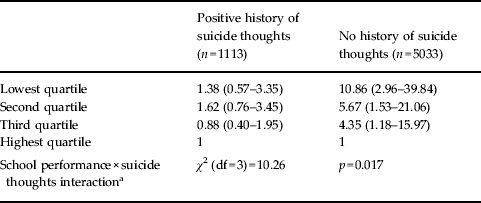
The relationship between school performance and the risk of suicide attempts were found to differ by baseline history of suicide thoughts (Table 3). Among those without a history of suicide thoughts, ORs ranged from 10.86 (95% CI 2.96–39.84) for those in the lowest grade quartile to 5.67 (95% CI 1.53–21.06) and 4.35 (95% CI 1.18–15.97) for those in the second and third quartiles respectively (model 2). No significant associations were found among those with a history of suicide thoughts at baseline. Finally, the association between school performance and suicide attempts did not differ between men and women (χ 2 = 0.21, df = 3, p = 0.98 for the log-likelihood test on the school performance × sex interaction).
Suicide attempts at follow-up according to compulsory school-leaving grades in quartiles, by baseline history of lifetime suicide thoughts (n = 6146)

df, Degrees of freedom.
a χ 2 value based on the log-likelihood ratio test.
Values given as odd ratios (adjusted for age, sex, parental education, immigrant status and adoptive parent), with 95% confidence intervals in parentheses.
Discussion
In this large population-based study, we found a clear positive gradient in the risk of incident suicide attempts with decreasing levels of compulsory school-leaving grades among young adults. The increase in risk of suicide attempts seemed to concern only individuals without a history of suicidal thoughts. Adjustment for adult health behaviours, including sedentary lifestyle, daily tobacco smoking, BMI, cannabis use and alcohol consumption, did not explain this relationship. The same was true for adult employment status, social support and financial strain.
Our finding that poor school performance during childhood predicts suicide attempts during adult life is in line with some previous studies. A register-based study from Sweden found that the relationship between school performance and hospital admissions due to self-harm was similar among men and women and was only marginally attenuated by family background (Jablonska et al. Reference Jablonska, Lindberg, Lindblad, Rasmussen, Ostberg and Hjern2009). To our knowledge, our study is the first to examine the association between school performance and self-reported suicide attempts in a general population of young adults in Sweden. One longitudinal study from New Zealand also found a positive relationship between school achievement and self-reported suicide attempts in a birth cohort of 1265 adolescents and young adults (Fergusson et al. Reference Fergusson, Beautrais and Horwood2003). Another register-based study from Sweden found that advantageous school performance is associated with a reduced risk of suicide attempt in men, but this protective effect was not seen among individuals with severe psychiatric illness (Gunnell et al. Reference Gunnell, Löfving, Gustafsson and Allebeck2011). A recent study among Swedish male conscripts found that low IQ was associated with risk of suicide attempts later in adulthood and this relationship was only marginally attenuated by adult SES and family status (Sörberg et al. Reference Sörberg, Allebeck, Melin, Gunnell and Hemmingsson2013). Our study also suggests that a lack of social support does not mediate the association between poor school performance and suicide attempts, even though social support probably reflects important predictors of suicidal behaviour, such as relationships with friends and relatives or the ability to engage in social networks and self-esteem (Fergusson et al. Reference Fergusson, Beautrais and Horwood2003). Controlling for smoking and alcohol use was reported by Batty et al. (Reference Batty, Whitley, Deary, Gale, Tynelius and Rasmussen2010) to attenuate the association of IQ with attempted suicide in a sample of Swedish men. We were able to test this hypothesis in both sexes and with a wider range of health behaviours. However, we found that health behaviours only accounted for a minor share of the association between school performance and self-reported suicide attempts. Furthermore, several previous studies failed to find a relationship between cognitive function and suicidality in people with severe mental illness (Andersson et al. Reference Andersson, Allebeck, Gustafsson and Gunnell2008; Batty et al. Reference Batty, Whitley, Deary, Gale, Tynelius and Rasmussen2010; Gunnell et al. Reference Gunnell, Löfving, Gustafsson and Allebeck2011; Webb et al. Reference Webb, Langstrom, Runeson, Lichtenstein and Fazel2011). It could be hypothesized that severe mental illness is over-represented among individuals with a past history of suicide thoughts. If true, this could explain the weak relationship between poor school performance and the risk of suicide attempts among individuals with a history of suicidal thoughts, confining the relationship to individuals who did not report suicidal thoughts. However, we adjusted for a history of mental illness in our study, thus mental illness is unlikely to explain this finding. To our knowledge, no other studies have examined the potential modifying role of previous suicidal thoughts in the relationship between cognition and self-harm.
This study's strengths include its large population-based sample and the combined use of self-reported and register-based data. The longitudinal design allowed us to avoid issues of reverse causality. We used a validated instrument to identify suicide attempters (Meehan et al. Reference Meehan, Lamb, Saltzman and O'Carroll1992) and we were able to adjust for a range of potentially confounding factors. Most previous studies on the association between cognitive performance and self-harm have been register based and used cases of hospital admissions for self-inflicted injury as outcome. However, not all suicide attempters seek treatment and decision on hospitalization depends on medical practice. We were able to avoid measurement error of this kind by using self-reported outcome. There are, however, some limitations. We studied young individuals, who are least likely to participate in surveys (de Graaf et al. Reference de Graaf, Bilj, Smit, Ravelli and Vollebergh2000). Although we used weights to adjust for non-participation, selection bias at baseline and attrition may have influenced our results to some extent. We were not able to impute data on individuals who refused to participate because of restrictions from our data provider Statistics Sweden. Furthermore, the exclusion of individuals reporting suicide attempts at baseline may have led to an underestimation of the relationship in our study. Lastly, although we had access to more comprehensive data than prior studies and could adjust for numerous potentially confounding factors, residual confounding by unmeasured exposures cannot be ruled out.
Individuals with poor school performance are more disadvantaged and have fewer resources than those succeeding in school, as shown by the data in Table 1, and may therefore suffer greater exposure to stress and adverse life circumstances. It is likely that they have poorer problem-solving abilities and lack of advantageous coping strategies and stress resilience (Fergusson & Lynskey, Reference Fergusson and Lynskey1996). Such characteristics may induce a sense of powerlessness in times of crisis, with consequent loss of ability to identify alternative solutions to coping with distress. Furthermore, cognitive ability seems to have a genetic basis and to correlate with some personality factors (Chamorro-Premuzic & Furnham, Reference Chamorro-Premuzic and Furnham2004; Bratko et al. Reference Bratko, Butkovic, Vukasovic, Chamorro-Premuzic and von Stumm2012). There are indications that aspects of the personality, such as impulsivity and neuroticism, are related to both cognitive ability (Buchmann et al. Reference Buchmann, Gierow, Reis and Haessler2011) and suicidal behaviour (Fergusson et al. Reference Fergusson, Beautrais and Horwood2003; O'Connor et al. Reference O'Connor, Rasmussen and Hawton2012) and could partially explain the relationship. Of note, a recent study (Sörberg et al. Reference Sörberg, Allebeck, Melin, Gunnell and Hemmingsson2013) found that two personality variables, ‘social maturity’ and ‘emotional control’, were the only variables with substantial explanatory impact on the association between cognitive ability and self-harm.
Our finding that a history of suicidal thoughts modifies the association between school performance and suicide attempts may offer some insight into the mechanisms involved. It is plausible that all suicidal acts are preceded by suicidal thoughts, which may differ in intensity and duration and may be impulsive or not. If individuals with low cognitive ability have less emotional control (Sörberg et al. Reference Sörberg, Allebeck, Melin, Gunnell and Hemmingsson2013), they may be at increased risk of acting on impulsive suicidal thoughts. Hence, we speculate that poor coping ability or related personality factors (e.g. impulsivity) may explain the heterogeneity in school performance: suicide attempts associations found in young people with and without a history of suicidal thoughts. An alternative explanation could be that suicide thoughts are a strong competing risk factor for suicide attempts, obscuring the effect of other risk factors.
In conclusion, school performance seems to be a strong predictor of future suicide attempts in young adults, and this relationship is particularly strong in individuals without a history of suicidal thoughts. Adult socio-economic factors and health behaviours do not seem to explain this relationship. Instead, other factors linked with poor school performance such as poor coping mechanisms and an increased risk of acting on suicidal thoughts in stressful situations may explain the relationship.
Acknowledgements
This study was supported by a grant from Stockholm County Council, the Swedish Council for Working Life and Social Research (DNR 2007–2064). The funders had no role in the analysis, interpretation of results or the writing of this manuscript.
Declaration of Interest
None.