INTRODUCTION
Studies of colonization of new artificial surfaces help us to answer science questions concerned especially with dispersal of organisms and likely colonization/recovery rates that are important information for marine environmental protection and management. They help us to understand which species settle readily, which species do not populate new surfaces or colonize very slowly, the time for a community to reach maturity (at least visually), the similarity (or otherwise) of communities on natural and artificial surfaces, and the growth rates of species. Such studies can also help to understand likely recovery rates where natural communities have been damaged and, where antifouling paints have been used on artificial surfaces, if and after how long colonization can occur there. Artificial habitats have often been placed to enhance fisheries or recreational SCUBA diving and have been seen as enhancing biodiversity or as a way of restoring degraded marine ecosystems (see, for instance, Seaman, Reference Seaman2007).
Studies of colonization have been undertaken worldwide and often involve deployment of concrete structures with an associated programme of monitoring settlement (see, for instance: papers in Jensen et al., Reference Jensen, Collins and Lockwood2000; Moura et al., Reference Moura, Boaventura, Curdia, Carvalho, Cancela Da Fosca, Leitao, Santos and Monteiro2007; Nicoletti et al., Reference Nicoletti, Marzialetti, Paganelli and Ardizzone2007; Relini et al., Reference Relini, Relini, Palandri, Merello and Beccornia2007). In the north-east Atlantic, the biogeographical area in which the study described here was undertaken, colonization on oil industry structures and, more recently, offshore wind farm pilings and other energy devices has been studied. Whomersley & Picken (Reference Whomersley and Picken2003) provide a summary of long-term dynamics of fouling communities on offshore installations. Shipwrecks are another source of information on colonization of artificial surfaces. Leewis et al. (Reference Leewis, van Moorsel, Waardenburg, Jensen, Collins and Lockwood2000) described five different communities occurring on wrecks in the southern North Sea off Holland. Detailed descriptions of the communities living on steel wrecks include those of Zintzen et al. (Reference Zintzen, Norro, Massin and Mallefet2008a) off the Belgium coast and Hiscock (Reference Hiscock1981) of a wreck off Lundy, south-west England. More detailed unpublished data are also available from the Lundy wreck. Jensen & Collins (Reference Jensen and Collins1995) undertook a detailed and systematic study of colonization on an artificial reef of concrete blocks in Poole Bay and Leewis & Hallie (Reference Leewis, Hallie, Jensen, Collins and Lockwood2000) of a reef of basalt boulders off the coast of Holland. Most recently, Langhamer et al. (Reference Langhamer, Wilhelmsson and Engstrom2009) describe colonization of mainly concrete surfaces at a test park for wave power devices on the Swedish west coast. ‘Scylla’ provided the opportunity to describe colonization on a large steel structure in south-west England.
Comparisons of artificial with natural reefs are few and many of the studies of colonization on artificial structures are short term and often on small settlement panels so that the species assemblages recorded have had insufficient time and are not subject to the same processes to become similar to natural rock communities. Perkol-Finkel & Benayahu (Reference Perkol-Finkel and Benayahu2005) report distinct differences between coral reef communities and an artificial reef community after ten years. In another study, Perkol-Finkel et al. (Reference Perkol-Finkel, Shaskar and Benayahu2006) compared natural coral reef communities and those on a 119-year old shipwreck and concluded that, even after a century, an artificial reef will mimic its adjacent natural communities only if it possesses structural features similar to those of the natural surroundings and that, if the two differ structurally, their communities will remain distinct. Connell (Reference Connell2001) found that different communities developed on artificial habitats compared to natural rock habitats in studies using the same types of settlement panels on pontoons, pilings and natural rock reef habitats in Sydney, Australia. For seabed habitats in Britain, analysis of survey data from the Marine Nature Conservation Review of Great Britain (Connor et al., Reference Connor, Allen, Golding, Howell, Lieberknecht, Northen and Recker2004) identified a distinctive biotope for steel wrecks as ‘Alcyonium digitatum and Metridium senile on moderately wave-exposed circalittoral steel wrecks’. For the study of colonization ‘Scylla’ provided the opportunity to see if a newly placed structure developed into that biotope and also to compare communities on ‘Scylla’ with those on nearby bedrock.
Parts of the hull of ‘Scylla’ were coated with tributyltin (TBT) antifouling paint. TBT has been found to have chronic effects on a wide variety of aquatic organisms (see Arai et al., Reference Arai, Harino, Ohji and Langston2009), including decreasing species diversity and abundance in the marine environment (see, for instance, Smith et al., Reference Smith, Bolam, Rees and Mason2008 for the Crouch estuary). A study of colonization of ‘Scylla’ would help to understand the extent to which the anti-fouling coating remained effective and on which species.
After ‘Scylla’ had been on the seabed for five years, it was considered timely to record the sequence of colonization in a way that will be useful to those concerned with understanding the character and dynamics of marine communities and the likely marine biological outcomes of any future placements of a steel reef.
MATERIALS AND METHODS
On 27 March 2004, an ex-Royal Navy frigate, HMS ‘Scylla’, was placed on the seabed in Whitsand Bay, south Cornwall at position 50°19.64′N 4°15.20′W and depth to the seabed 20 m below chart datum. The placement had been licensed under UK Food and Environmental Protection Act regulations. The vessel had been prepared for placement by, amongst other removals, cleaning of potential contaminants, removal of high parts of the superstructure, sealing-off potentially dangerous areas and cutting many large holes in the sides for diver access. After careful consideration, Defra (the Department for Environment, Food and Rural Affairs) decided that there was no requirement for the anti-fouling paint to be removed from ‘Scylla’ before its placement.
Following the placement of ‘Scylla’, it became clear that the monitoring that had been put in place to record colonization was not reporting many of the most significant events. To ensure that a record was kept of colonization, a simple methodology was developed that involved recording occurrence of conspicuous species, abundance of those species, seasonal occurrences/changes and growth rates of organisms. The first two authors together with colleagues and using the Seasearch programme of volunteer divers maintained a record of when and what species were seen, aided by acquisition of images. Those observations had started a few days after placement of the vessel. However, the limited personnel, financial and diving resources available meant that the survey was always going to be descriptive and opportunistic, but accurate in terms of identification of species.
Records were made and images were collected on all of the dives that the authors undertook on the reef. Samples were taken when identification of a species required confirmation. The dives were undertaken about once a month in the first 18 months following placement. Subsequently, dives were about every 10 weeks (K.H. undertook 33 dives, S.S. 22 dives). This paper describes colonization and succession over the five years since placement (first dive 30 March 2004 to last dive 18 March 2009).
In addition to recording abundance of conspicuous species, samples of animal and algal turf to identify smaller associated animal species were collected on 30 August 2006 from the foredeck of ‘Scylla’ using a suction sampler similar to that described by Hiscock & Hoare (Reference Hiscock and Hoare1973). In the subsequent week, the suction sampler was used occasionally to collect turf samples but most were collected by scraping on vertical and overhanging surfaces and allowing the scraped material to drop into a bag which was then sealed. Each area sampled was about 0.1 m2 and nine samples were fully analysed for species present and numbers of individuals. The samples were fixed in 4% formalin and then washed in water before being picked and identified and finally stored in 70% IMS.
To compare the community present on ‘Scylla’ by the end of summer 2008 with species that occur on natural bedrock reefs, records from sites surveyed off the open coast from off Plymouth Sound to Stoke Point in South Devon were inspected and a representative abundance, taking account of knowledge of the first two authors of the area, noted for lower infralittoral and circalittoral habitats. The records were from Hiscock & Moore (Reference Hiscock and Moore1986) and from a download of records held by the UK National Biodiversity Network for surveys undertaken in 1996 by the Devon Wildlife Trust.
Where abundances of species are referred to, the notations approximately follow the SACFOR (Superabundant, Abundant, Common, Frequent, Occasional, Rare) scale (Connor & Hiscock, Reference Connor, Hiscock and Hiscock1996) and are for areas on which those species occur and which were not coated in antifouling paint.
The extent of TBT antifouling paint was noted when the hull of the vessel was inspected (by the first author) immediately after being placed in dry dock at Devonport, Plymouth, in November 2003. The vessel had been moored at Portsmouth for many years prior to transfer to Plymouth. Advice from paint specialists in the dockyard suggested that the TBT paint coating was then more than 15 years old. The impact of TBT antifouling paint on colonization of the reef was addressed by observation of whether organisms settling on the reef also colonized areas coated with TBT paint and adjacent to those areas.
RESULTS
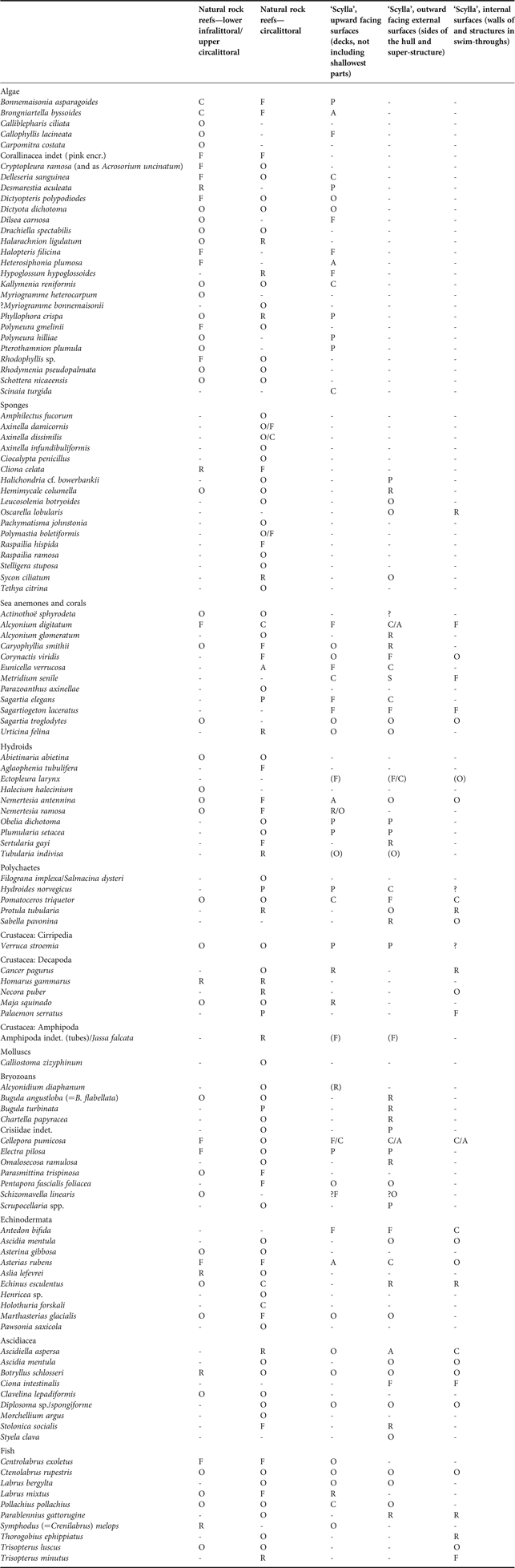
All of the taxa observed, collected and identified from photographs are listed in Appendix 1 together with the date first recorded and notes on abundance, growth rates (where observed) and any fluctuations in occurrence. Authorities and recent synonyms of species are given in Appendix 1. Appendix 2 is a comparison of species reported from natural bedrock surfaces in similar subtidal habitats to ‘Scylla’ with abundances of conspicuous species on horizontal, vertical and inner surfaces of ‘Scylla’. Appendices 1 and 2 are available in the electronic version of this paper on http://journals.cambridge.org/action/displayJournal?jid=MBI.
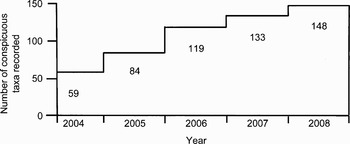
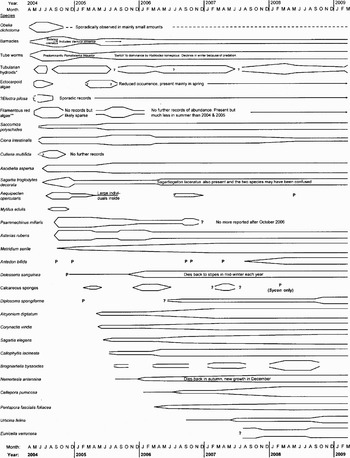
Figure 1 illustrates the annual increase in number of taxa observed or reported on the reef. Figure 2 illustrates the colonization sequence for the most characteristic (of different stages of settlement on ‘Scylla’ or of inshore reefs in the area) conspicuous species.
Increase in the numbers of taxa (mostly identified to species) observed in each year. The taxa are ones that have been recorded by in situ survey including from photographs and exclude species identified as genus only and where the same genus is identified elsewhere to species. One hundred and forty-eight taxa are included out of a total of 263 taxa identified by the end of March 2009.

The arrival, growth and succession of major colonizing species during the first five years of the establishment of a reef community on ‘Scylla’. A single line indicates present but very rarely recorded. The width of the histogram is illustrative of abundance (on the surfaces preferred by each species) on a three-point scale approximating to: 1. Rare and Occasional; 2. Frequent and Common; and 3. Abundant and Superabundant (see Appendix 9 of Hiscock, Reference Hiscock1996). P, present. *Tubularian hydroids were mainly Ectopleura larynx with some Tubularia indivisa. **Filamentous red algae were not identified to species on all occasions but were mainly Pterothamnion plumula, Polysiphonia elongata and unidentified Ceramiales. Heterosiphonia plumosa was noted as present in July 2004 and as secondarily dominant in May 2008 but there are insufficient records to plot abundance through time.
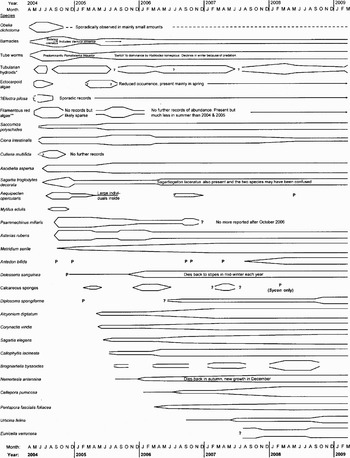
Colonization by conspicuous species
After initial settlement of opportunistic species (filamentous algae, hydroids, serpulid polychaetes and barnacles especially) in the first one or two months (Stage 1), there was a steady recruitment and growth of species during the first summer including of species that were not necessarily there for the long-term (Psammechinus miliaris, Mytilus edulis and Aequipecten opercularis) (Stage 2). During the first winter after placement, die-back of some seasonally abundant species occurred but also grazing by starfish and sea urchins removed much of the settlement of barnacles and tube worms so that, by late winter, large areas of the reef were again bare (Stage 3). Spring and summer of the second year completed recruitment of most of the species that were to become visually dominant although their abundance and size was low. The sea urchins also declined in abundance removing significant grazing pressure (Stage 4). After two years, winter reductions in abundance of some species were no longer part of succession but natural variability. The next stage was a prolonged period (spring 2006 to summer 2008) when species that were to become dominant grew or expanded in abundance and a very few additional species that were to become conspicuous settled (Urticina felina, Eunicella verrucosa and Cellepora pumicosa) (Stage 5). From the end of the summer of 2008, the reef community was composed mainly of long-lived species or there had been the same seasonal abundances of ephemeral species as in previous years so that the reef community was considered ‘mature’ (Stage 6).
The time of settlement, seasonal occurrence, location and growth of the most visually abundant species are noted below.
ALGAE (PLANTAE, CHROMISTA AND RHODOPHYCOTA)
Algae showed considerable seasonality in their presence with very sparse occurrence in winter. The earliest algae to be recorded were ectocarpoid (Hinksia) species which, on inspection in the laboratory, had many diatom species associated with their filaments. The kelp Saccorhiza polyschides settled early on and was noted as 15 cm high on 9 June 2004. Another early colonizer was Cutleria multifida as its ‘Aglaozonia’ encrusting stage which was first noted in June 2004. In 2004 and 2005, there were very few foliose red algae although filamentous reds were visually dominant in spring through to autumn with Pterothamnion plumula and Polysiphonia elongata abundant on decks. Heterosiphonia plumosa and unidentified Ceramiales were present in samples in July 2004 and H. plumosa was noted as ‘secondarily dominant’ in May 2008. Brongniartella byssoides was recorded in 2005 and 2006 and was the dominant red alga in 2007 and 2008. Other conspicuous species that were common on the upward parts of the vessel from spring through to early autumn were Dictyopteris polypodioides (=D. membranacea), Dilsea carnosa and Kallymenia reniformis. The fleshy red alga Scinia turgida, usually characteristic of disturbed habitats, was present in 2006 and common on decks in summer 2007. Halopteris filicina, a frequent species on nearby reefs, was not observed until 2008. In winter, Callophyllis lacinata remained conspicuous and H. filicina persisted. The midribs of Delleseria sanguinea were all that was visible of that species in December but by February new fronds had grown. In early December 2008, there were many very small unidentified algal fronds on the foredeck when silt was swept away, suggesting the beginning of new growth.
SPONGES (PORIFERA)
Calcareous sponges (Leucosolenia botryoides and Sycon ciliatum) were the first sponge species to be seen and occurred during late winter early in 2005. Both species appeared to be present in greatest abundance or only in winter to early summer. Demospongiae, Halichondria bowerbankii and Oscarella lobularis, were much less abundant but were seen sporadically from summer 2006 with many colonies of O. lobularis present by 2009. Hemimycale columella and Suberites carnosus were seen for the first time in 2008.
ANTHOZOA (CNIDARIA: ANTHOZOA)
One of the earliest colonizers was the anemone Sagartia troglodytes var. decorata, occurring frequently by mid-summer 2004 and still present at the end of 2008. Plumose anemones, Metridium senile, characteristic of wrecks in the area, were first observed in late summer of the first year. Elegant anemones, Sagartia elegans, also a characteristic species of steel wrecks in the area, were first seen in mid-summer 2005 and by the end of the summer in 2006 were well established with large groups and all of the different colour varieties present. The dahlia anemone, Urticina felina, which was abundant on ‘Scylla’ on arrival from Portsmouth, was first seen at the end of August 2006. It is not a common species off Plymouth and numbers remained low on the reef for the rest of the study period although, based on observation of visible individuals, there may have been some increase in abundance after summer 2008. Jewel anemones, Corynactis viridis, were first observed in summer 2004 when they had already started to form patches of many individuals produced by asexual division and therefore of the same colour. They occurred mainly on the outer part of the vessel but also inside. The Devonshire cup coral Caryophyllia smithii was first observed in September 2005. The coral was still only occasional on the reef after five years and only one has been seen colonized by the barnacle Bostrychia anglicum, which lives only on stony corals.
The common alcyonacean Alcyonium digitatum was first observed in early summer 2005 and grew to nearly full size in one year although it had only just started to branch in summer 2006. By early 2009, A. digitatum had become a visually dominant part of the reef community. The more unusual soft coral Alcyonium glomeratum, which occurs on other wrecks in the area as well as on rock reefs, was first observed in April 2007. It remained occasional on the reef at the end of the study. Sea fans, Eunicella verrucosa, which are a major feature of the marine life on most wrecks in the area, were especially searched for and eventually found on 12 August 2007, in the fourth year of the reef. There also appeared to be a settlement in summer 2008. Sea fans occur on the bedrock reefs within 50 m of ‘Scylla’. Growth was initially rapid and by the end of the first winter, individuals were up to 6 cm high and some had started to branch. By winter 2008–2009, the largest individuals were about 17 cm high and some had several branches.
HYDROIDS (CNIDARIA: HYDROZOA)
Obelia dichotoma was recorded within a month after placement of the vessel. The most conspicuous hydroids to settle early in colonization were Tubulariidae. Both Tubularia indivisa and Ectopleura (=Tubularia) larynx were present but were often difficult to tell apart and were most likely interwoven in places. Ectopleura larynx was the most abundant. Both species suffered the attentions of facellinid sea slugs which devastated colonies over a few days. Once kelp plants had settled, they were readily colonized by Obelia geniculata. A few colonies of the widespread Sertularella gayi were observed in early 2006. The widespread antenna hydroid Nemertesia antennina was first observed in August 2005 and, in autumn 2006 was still only present in small numbers but in 2007 was common and by 2008 was visually dominant on the decks and some internal horizontal surfaces together with occasional Nemertesia ramosa. Nemertesia spp. died-back in early winter but showed new growth by about December.
JELLYFISH (CNIDARIA: SCYPHOZOA)
The schyphistomae of Aurelia aurita were frequently seen.
GASTROPOD MOLLUSCS (MOLLUSCA: GASTROPODA)
Shelled gastropods have mainly been recorded from samples although some small species (Nassarius incrassatus and Rissoa parva) may be sufficiently abundant and conspicuous to be seen in situ. An unusual find (for hard substratum) was of six juvenile Aphorrhais pespelecani in a 0.1 m2 suction sample from the foredeck (A. pespelecani are normally characteristic of muddy sediments). A notable record was of the non-native slipper limpet Crepidula fornicata collected in samples in September 2006. Sea slugs were sometimes numerous, feeding mainly on Tubulariidae. The most abundant species appeared to be Flabellina (=Coryphella) brownii, Facelina auriculata and Facelina bostoniensis. However, appearance in massive numbers has been ‘fleeting’ and may last as little as a week in mid-summer. The nudibranch Trapania maculata, which is rare in Britain, was also recorded in one of the scrape samples. Trapania maculata is a southern and Mediterranean species which is at its northern most limits in Britain with records from Portland and the Lleyn Peninsula (Picton & Morrow, Reference Picton and Morrow1994).
BIVALVE MOLLUSCS (MOLLUSCA: BIVALVIA)
Mussels, Mytilus edulis, occurred and grew to a length of about 3 cm during the first summer but only in a few locations. However, they were not seen subsequently except as spat in samples. It is suspected that they were consumed by starfish, Asterias rubens. There was a remarkable settlement of large numbers of queen scallop Aequipecten opercularis from July to August 2004. Individuals were 15–20 mm across by November but there were much smaller numbers, most likely because of migration away from hard substratum onto sediment off the reef. Most other bivalve molluscs were cryptic and may be more abundant than in situ records suggest. For instance, the saddle oyster Heteranomia squamula was rarely observed in photographs and samples but was most likely common on hard substratum. Hiatella arctica is a nestling species that was common in algal or animal turf samples but was not recorded during in situ surveys.
POLYCHAETE WORMS (POLYCHAETA)
The most conspicuous early settlers on ‘Scylla’ were the serpulid tubeworms Pomatoceros triqueter (P. lamarkii have also been recorded). Individuals grew rapidly and soon dominated parts of the reef during summer 2004 but were widely separated by mid-winter 2004–2005, most likely having been grazed by sea urchins, Psammechinus miliaris. Pomatoceros triqueter appeared to be largely displaced in 2005 by a similar tube worm, Hydroides norvegicus. Both were significant parts of the fauna and dominant in places by the end of 2008. The peacock worm Sabella pavonina was first seen in September 2004 and was occasional by the end of 2008. A chaetopterid (parchment tube) worm (Chaetopterus variopedatus was identified from one sample in September 2006) was common on decks in December 2008 and could be seen when silt was swept away. Significant numbers of small cryptic polychaete species were present in the samples collected in September 2006.
BARNACLES (CRUSTACEA: MAXILLOPODA: CIRRIPEDIA)
Balanus crenatus was one of the earliest species to settle, seen four weeks after placement and was conspicuous in the first year but, as with P. triqueter, grazed by sea urchins and starfish in the first winter. Verruca stroemia settled in ‘massive’ numbers apparently in early June 2004. There were probably steady but low numbers of both species and they have not been a conspicuous member of the fauna since 2004.
DECAPODS (CRUSTACEA: MALACOSTRACA: DECAPODA)
Crabs, lobsters and shrimps were very slow to settle. There were early records of spiny spider crabs, Maja squinado that had no doubt encountered the reef whilst moving over the surrounding seabed. Edible crabs, Cancer pagurus, were seen in the first year but remained only occasional and present in fissures and openings. Prawns, Palaemon serratus had colonized the reef by 2005 and continued to be frequent on the roofs of swim-throughs. The long-clawed porcelain crab, Pisidia longicornis was present in samples and is most likely a common member of the cryptic fauna. Small Inachus species also seemed to be widely occurring.
AMPHIPODS (CRUSTACEA: MALACOSTRACA: AMPHIPODA)
The tubicolous amphipods Jassa falcata and Monocorophium sextonae were abundant from late spring through to autumn; the former especially on structures that are subject to strong currents. Several Astacilla danmoniensis were observed emerging from muddy tubes from samples collected on 10 December 2008 from algal stumps. Ericthonius punctatus was also abundant in those samples. Caprellid amphipods were abundant and were identified as several Caprella species together with the similar Pseudoprotella phasma and Phtisica marina. They were particularly conspicuous in photographs of hydroids. Several other amphipods were identified.
BRYOZOA
A sea-mat, most likely Electra pilosa but samples were not collected, occurred in early June 2004, and formed conspicuous star-shaped colonies on fabric lining the bridge and on surfaces elsewhere. As soon as there were mature kelp fronds to colonize, Membranipora membranacea occurred. The orange pumice bryozoan Cellepora pumicosa was not seen on the reef until January 2006 but became abundant by August 2007 and was a visually dominant species on the outer surfaces of the reef throughout 2008. Similarly, Ross ‘coral’, Pentapora fascialis foliacea, was first seen in January 2006 and, by the end of 2008, the fragile colonies were about 20 cm across but mainly restricted to places protected by protruding structures. However, colonies that had just started to produce foliose structures were frequent on the foredeck in early March 2009. Patches of encrusting orange Bryozoa, identified as Schizomavella linearis in samples, occurred widely on open surfaces. Erect branching Bryozoa are not a common part of the reef community to the west of Plymouth and have not colonized to any great extent on ‘Scylla’, although several species have been recorded. Although common on many wrecks and rock reefs in the area, Alcyonidium diaphanum has been observed only once from ‘Scylla’.
ECHINODERMS (ECHINODERMATA)
The spiny starfish Marthasteris glacialis appeared on ‘Scylla’ shortly after placement, believed to be individuals wandering over the seabed and encountering the reef. The common starfish, Asterias rubens, settled in large numbers in autumn 2004 and has persisted since then but as mostly small individuals. The green sea urchin Psammechinus miliaris settled in large numbers in the first year. Those numbers dwindled during early 2005 until, by mid-summer, few could be seen but a ‘midden’ of urchin shells suggested they had been predated. There was no apparent settlement in 2005 but, in 2006, there were several 8–10 mm individuals in a scraped sample. The feather star Antedon bifida was slow to establish and, although individuals were seen occasionally, it was not until summer 2007 that large numbers of small individuals were seen. By 2008, large numbers of large individuals colonized spars inside the reef and, in late 2008, were a visually dominant species on the grid afterdeck. The widespread sea urchin Echinus esculentus was very slow to colonize (or at least to be seen on open surfaces) and the maximum number seen in one dive has been three. The cucumarians Leptopentacta elongata and Thyone fusus were present in samples collected in September 2006.
ASCIDIANS (CHORDATA: TUNICATA: ASCIDIACEA)
Large solitary ascidians (Ciona intestinalis and Ascidiella aspersa) were the most conspicuous large species to settle and were first seen in June 2004. Numbers declined later that year probably as a result of depredations of starfish and urchins but large solitary ascidians remained a dominant part of the reef community, both on outer and inner surfaces at the end of 2008. Abundance of C. intestinalis appears to have reduced in 2008. Ascidia mentula, Botryllus schlosseri and Diplosoma spongiforme are other conspicuous ascidian species on the reef. Stolonica socialis, which is widely distributed on reefs in the area, was not observed until May 2008. One of the most notable species recorded was the non-native leathery sea squirt Styela clava which is not normally seen outside of Plymouth Sound. There have been several settlement events for S. clava based on appearance of small ‘fresh’ individuals.
FISH (CHORDATA: VERTEBRATA: PISCES)
Poor cod, Trisopterus minutus, were present on the reef within days of placement but have remained in small numbers since. Similarly, bib, Trisopterus luscus, which are a major feature of nearby wrecks, were not noted until August of the first year and remained present in only small numbers by the end of 2008. Pollack, Pollachius pollachius, had a similar ‘slow start’ but, by 2007, were abundant at the upper edges of the reef. Wrasse have been very slow to colonize the reef and were present in only small number during 2008. The abundance of pollack and wrasse declined on the reef during winter. Similarly, leopard spotted gobies, Thorogobius ephippiatus, were not seen until summer 2006 although suitable habitats (silty fissures and corners) had been present since 2004. There are many vagrant or migratory species that have colonized ‘Scylla’ for periods of time and then moved on.
Succession
Figure 2 illustrates occurrence, expansion of populations and, in some cases, decline of the most visually abundant species on ‘Scylla’ over five years since placement. 2005 and 2006 were years of large fluctuations and transition to a community dominated by species that were there for the long-term. Successional change in the first year after placement was dominated by the grazing activities of sea urchins and starfish which conspicuously removed barnacles and tube worms but probably also species that would have become abundant early on if grazing had not been so severe. The barnacle Verruca stroemia settled later than Balanus crenatus in the first year and took-over dominance by barnacles. The tube worm Hydroides norvegicus also became more conspicuously abundant after the first year than Pomatoceros sp. (p). Although it was the autumn of 2004 and the spring of 2005 that saw the arrival of two visually dominant species (Metridium senile and Alcyonium digitatum respectively) they were not to reach a density and size that made them dominant features until 2007. However, they did not have to out-compete or grow-over other species as far as we could tell as there were bare surfaces for them to colonize. Also, the demise of the Psammechinus miliaris sea urchins in 2005, most likely because wrasse had colonized the reef and eaten them, allowed significant settlement of a wide range of species. It was not until 2006 that foliose algae established in large amounts and a variety of species, albeit seasonally in spring and summer. The round domed colonies of Cellepora pumicosa were a late arrival and only became abundant in late 2007. One of the last major colonizers in the five years of study was, arguably, the most significant: the sea fan Eunicella verrucosa is a protected species in Britain. The ‘Scylla’ study shows that, if there are populations nearby, E. verrucosa can recruit readily but most likely not every year. The abundance of the solitary sea squirt Ascidiella aspersa had not apparently diminished after five years although that of another initial colonizer, Ciona intestinalis, had declined significantly by 2007 and 2008.
Effect of TBT coatings on colonization
In dry dock, the areas of hull coated with TBT anti-fouling paint were observed to be from about 1 m below the boot line and extended all over the steel hull except where there were divers lines (~10 cm wide black lines along the length of the hull) or fibreglass acoustic domes. The propeller shaft was also apparently painted with non-toxic paint. Observations in the dry dock were that the TBT coated parts of the hull were free of fouling.
Observations over the first five years of the vessel being on the seabed were that the TBT coated areas remained mainly free of colonization. Close inspection of images showed that, adjacent to areas where colonization was dense, some small patches of tubicolous amphipods occurred on the TBT coated areas which, in turn, appeared to become colonized by Ectopleura larynx. Under the stern, some E. larynx colonies appeared to be attached to TBT coated areas. Barnacle scars have also been observed in the same sort of area. Mobile species such as starfish and sea urchins have never been seen on the coated areas, although topknot Zeugopterus punctatus, have. Where paint has flaked-off, blistered to rusty metal or on areas coated with non-TBT paint, colonization by anemones, hydroids, alcyonaceans, barnacles, tube-building amphipods and ascidians was very dense and extended right up to the TBT coated areas.
Fate of the records
The records given in Appendix 1 have been entered into a Marine Recorder database and, once processed, they will be sent to the UK National Biodiversity Network (www.searchnbn.net) where they can be viewed and downloaded. Images, presentations and recording forms related to colonization of ex-HMS ‘Scylla’ are available from www.marlin.ac.uk. Specimens from the sampling exercise in September 2006 are held by Unicomarine Ltd. A set of dated digital images of species has been lodged with the Data Archive for Seabed Species and Habitats (www.dassh.ac.uk) at the Marine Biological Association.
DISCUSSION
Comparison with species present on nearby bedrock reefs
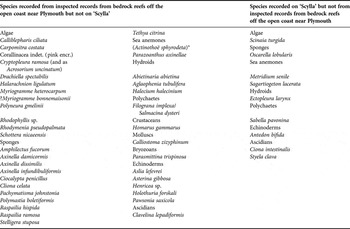
Comparisons of the communities that have developed on parts of ‘Scylla’ with natural hard substratum communities help to better understand the extent to which artificial reefs can replace or mimic natural reef communities. Such comparisons are, as pointed-out by Perkol-Finkel & Benayahu (Reference Perkol-Finkel and Benayahu2005), scarce. Our comparison of the conspicuous species present on natural bedrock reefs in the same area as ‘Scylla’ with those on different surfaces of the artificial reef is shown in Appendix 2. One hundred and twenty-two conspicuous species are listed in Appendix 2 of which 39 species recorded on bedrock reefs had not been recorded from ‘Scylla’ by the end of the study. Nine species were recorded on ‘Scylla’ but not the natural bedrock reefs. The species are listed in Table 1.
Species recorded in inspected records from open coast bedrock reefs near Plymouth but not on ‘Scylla’ and species recorded on ‘Scylla’ but not on open coast bedrock reefs. ( )*, one unconfirmed record on ‘Scylla’. Records from ‘Scylla’ are to 18 March 2009.

Species that were most notably absent from ‘Scylla’ included many sponges, especially axinellid sponges and some cushion sponges, and the yellow cluster anemone Parazoanthus axinellae that also do not occur on shipwrecks in the area that are more than 60 years old (personal observations). The abundance of some species on ‘Scylla’ was still low by the end of the study compared to on rock or shipwrecks. Colonization by the sea urchin Echinus esculentus had been slow and numbers remained low on ‘Scylla’ by the end of the study. However, on wrecks that are surrounded by sand (such as the Maine off Bolt Tail), sea urchin numbers are also very low. The same situation occurs for the sea cucumber Holothuria forskali which has not yet been seen on ‘Scylla’ and is sparse on wrecks surrounded by sediment. The absence of encrusting coralline algae is notable but some of the algae not recorded on ‘Scylla’ are ones that typically occur in the upper circalittoral zone and might not be expected to be present in the lower infralittoral conditions on the decks of the reef: Myriogramme heterocarpum, Polyneura gmelinii and Rhodymenia pseudopalmata. The conclusion by Perkol-Finkel et al. (Reference Perkol-Finkel, Shaskar and Benayahu2006) that even after a century an artificial reef will mimic its adjacent natural communities only if it possesses structural features similar to those of the natural surroundings, seems likely to apply also to artificial reefs in temperate waters but, furthermore, there may be species that are long-lived and slow growing or that have short larval dispersal times that should not be expected to colonize.
The species recorded from ‘Scylla’ but not on the rock reefs used in comparison are ones that, nevertheless, occur on rock reefs in different conditions. For instance, Metridium senile occurs on shipwrecks in the area and on offshore wave or tide-exposed rock reefs. Antedon bifida occurs in small numbers on some offshore reefs but, as with Ectopleura larynx, is abundant on some reefs in Plymouth Sound. Oscarella lobularis has been seen on reefs in Plymouth Sound but nowhere in the abundance that it has been seen on ‘Scylla’. The fleshy red seaweed Scinaia turgida occurs on disturbed substrata such as cobbles. The occurrence on ‘Scylla’ of sometimes large amounts of the leathery sea squirt Styela clava, not normally seen outside of Plymouth Sound (‘Scylla’ is about 12 km from the Plymouth Sound breakwater), is notable. However, one individual has been seen (by K. Hiscock) on the wreck of the ‘Rosehill’ to the west of ‘Scylla’. Ascidians generally have short dispersal distances but there have been several settlement events for Styela based on appearance of small ‘fresh’ individuals on ‘Scylla’. The absence of Clavelina lepadiformis and the ‘late arrival’ of Stolonica socialis, both commonly seen on rock reefs, may also be due to poor larval dispersal for those species.
Species expected but not yet seen or in low abundance on ‘Scylla’
Species that are commonly seen on wrecks in the area out of Plymouth but not yet observed on ‘Scylla’ include the sandaled anemone Actinothoë sphyrodeta (although there is a possible sighting), the yellow cushion sponge Cliona celata, the painted topshell Calliostoma zizyphinum and the cotton spinner Holothuria forskali. Numbers of lobster, Homarus gammarus, on wrecks in the area are low but, as a species particularly looked for by divers, it is remarkable that none had been reported from ‘Scylla’. Some species that occur abundantly on steel wrecks in the area out of Plymouth were still scarce on ‘Scylla’ by the end of 2008: Caryophyllia smithii, Echinus esculentus and all of the wrasse species. More unusual/scarce species that have colonized steel wrecks elsewhere out of Plymouth include the Weymouth carpet coral Hoplangia durotrix, the southern cup coral Caryophyllia inornata, the pink sea fingers Alcyonium hibernicum and the football seasquirt Diazona violacea, but none of those species have yet been seen on ‘Scylla’.
Comparison with other studies of artificial reefs
COLONIZATION AND SUCCESSION
Our account of the types of species colonizing ‘Scylla’ and the length of time taken for the community to reach a composition that appeared stable is broadly similar to that of other long-term studies of artificial reefs. Species with larvae or spores in the water at the time of placement are likely to settle almost immediately and be conspicuous after a few days or weeks (tube worms, barnacles and hydroids on ‘Scylla’, on the basalt reef described by Leewis & Hallie, Reference Leewis, Hallie, Jensen, Collins and Lockwood2000 and from concrete structures off the west coast of central Italy: Nicoletti et al., Reference Nicoletti, Marzialetti, Paganelli and Ardizzone2007). Some mobile species such as fish, crustaceans and echinoderms may also encounter and colonize the reef very soon after placement. However, a study of colonization and succession of major groups of organisms on four offshore installations in the North Sea (Whomersley & Picken, Reference Whomersley and Picken2003), suggested a much slower rate of colonization on some structures than on ‘Scylla’ with hydroids and tube worms generally abundant from the first year but anemones (Metridium senile is specifically mentioned) appearing or becoming abundant only after three to five years and soft corals (Alcyonium digitatum) appearing in the third to fifth year. On the ‘Gannet Alpha’ platform, M. senile and A. digitatum began to recruit in the second year.
Method of colonization might not always be as expected. We believe that Metridium senile reached ‘Scylla’ as larvae but Leewis & Hallie (Reference Leewis, Hallie, Jensen, Collins and Lockwood2000) observed that the anemone (presumably as an anemone) had been transported to the reef they were studying on currents.
Comparison of the rate of increase in number of taxa and eventual total number of taxa recorded on ‘Scylla’ with other artificial reefs needs to take account of depth to the reef and turbidity (and therefore whether or not algae colonize), geographical location (some biogeographical areas are naturally richer/poorer in species), structural complexity of the reef and on method of study. Jensen & Collins (Reference Jensen and Collins1995) illustrate colonization on concrete blocks by about 90 species during the first year (June 1989 to June 1990), rising to about 220 species during the second year and reaching about 240 species after 30 months: a much higher rate of colonization than for ‘Scylla’. Furthermore, their species numbers were for macro fauna and flora and did not include smaller species associated with animal and algal turfs. Based on detailed information (J. Mallinson, personal communication), whilst tube worms, barnacles and solitary ascidians made a rapid appearance (as on ‘Scylla’), so too did wrasse and gobies which were very slow to colonize ‘Scylla’, whilst foliose algae were also much quicker to colonize in Poole Bay and the variety was higher than that recorded on ‘Scylla’.
As for total numbers of species recorded on artificial surfaces, after about five years on the seabed, the MV ‘Robert’ off Lundy had been colonized by 222 recorded plant and animal taxa (Hiscock, Reference Hiscock1981), after 30 months, the concrete and fuel ash blocks in Poole Bay by about 240 plant and animal taxa (not including small species associated with turfs) and very thorough sampling from ten shipwrecks in the Belgium part of the North Sea had recorded 224 animal species (V. Zintzen, personal communication) (compared to 127 species or higher taxa identified by Leewis et al. (Reference Leewis, van Moorsel, Waardenburg, Jensen, Collins and Lockwood2000), from 21 shipwrecks in the adjacent waters off Holland). Taking account of the different methods used and such features as higher turbidity in the North Sea, the total species count seems similar for the different reefs although the variety of species colonizing the Poole Bay reef was much higher than for ‘Scylla’.
SIMILARITY OF COMMUNITIES ON ‘SCYLLA’ WITH OTHER ARTIFICIAL REEFS
How ‘predictable’ are the types of community likely to develop on artificial reefs such as ‘Scylla’? Studies of shipwrecks in the southern North Sea by Leewis et al. (Reference Leewis, van Moorsel, Waardenburg, Jensen, Collins and Lockwood2000) distinguished six communities: Metridium senile; tube dwelling amphipods; Halichondria panicea, Hydractinia species—Cuthona nana; Campanularidae–Tubularia [=Ectopleura] larynx; Psammechinus miliaris; Mytilus edulis. Assemblages on different parts of ‘Scylla’ could be identified with all of those communities except Hydractinia species—Cuthona nana but the Mytilus edulis community never developed to any significant density and was extremely short-lived, whilst the Psammechinus miliaris community lasted only the first winter and early summer of 2005 before, it is believed, wrasse predated them: species not abundant in the North Sea. The records of Zintzen et al. (Reference Zintzen, Norro, Massin and Mallefet2008a) from North Sea shipwrecks suggest a very similar community to that which has developed on ‘Scylla’ characterized most conspicuously by Metridium senile and by Tubularia [=Ectopleura] larynx and Tubularia indivisa. Asteria rubens, Sagartia sp. and Pomatoceros triqueter were also important characterizing species as they were on ‘Scylla’ but the southern North Sea wrecks also had Diadumene cincta, a species mainly restricted to variable salinity conditions in the Plymouth area. Mytilus edulis, which colonized ‘Scylla’ early in 2004 but failed to establish, was common on the North Sea wrecks as was Psammechinus miliaris and Aequipecten opercularis, both of which were abundant in the first year on ‘Scylla’. The turf fauna of inconspicuous species on the North Sea wrecks was, as on ‘Scylla’, dominated by a very high abundance of amphipod species, especially tubicolous species and passive suspension feeders. Conspicuous species abundant on ‘Scylla’ but not on the North Sea wrecks were Alcyonium digitatum, Cellepora pumicosa and large solitary ascidians, although A. digitatum was mentioned as on offshore wrecks in the North Sea.
There are regional differences in steel wreck/reef communities even in south-west England waters. For instance, the MV ‘Robert’ off Lundy (Hiscock, Reference Hiscock1981) had a high abundance, as did southern North Sea wrecks, of Ross worm Sabellaria spinulosa which were scarcely present on ‘Scylla’. The ‘Robert’ was visually dominated by a turf of erect Bryozoa, which have been notable as very scarce on ‘Scylla’, as they are on rock reefs and wrecks in the area. However, wrecks in Bigbury Bay to the east of Plymouth have a higher colonization by erect branching Bryozoa than ‘Scylla’ or other wrecks and rocks near to ‘Scylla’. In the Plymouth area, many steel wrecks are dominated by barnacles, especially Verruca stroemia, which, although present widely on ‘Scylla’ were not conspicuously dominant. Brittle stars, Ophiothrix fragilis, are a conspicuous feature of some wrecks in Mounts Bay Cornwall (personal observations) as they were on the North Sea wrecks but were in small numbers and highly cryptic on ‘Scylla’.
The dominant and characteristic species present on ‘Scylla’ by the end of the study corresponded, with few exceptions, to those listed as characterizing species of the ‘Circalittoral fouling faunal communities’ biotope ‘Alcyonium digitatum and Metridium senile on moderately wave-exposed circalittoral steel wrecks’ (Connor et al., Reference Connor, Allen, Golding, Howell, Lieberknecht, Northen and Recker2004). However, Actinothoë sphyrodeta, one of the five most characteristic species in the biotope, had not yet colonized ‘Scylla’ whilst another anemone, Sagartia elegans, which was common on ‘Scylla’, is not listed as a characteristic species of the biotope. Elements of another biotope in the same biotope grouping, ‘Ascidiella aspersa on circalittoral artificial substrata’, could also be identified on ‘Scylla’.
SEASONAL VARIATION AND STOCHASTIC CHANGE IN SPECIES PRESENT
Whilst Figure 2 gives some record of variation in abundance of species and Appendix 1 information on particular species present on ‘Scylla’, observations are descriptive rather than quantitative. Changes in the occurrence and abundance of tubularian hydroids on ‘Scylla’ were similar to those recorded by Zintzen et al. (Reference Zintzen, Norro, Massin and Mallefet2008b) for Tubularia indivisa on a North Sea shipwreck where species richness in the associated community ranged from 15 to 42 through the year. Changes were not only seasonal but related to predation events, particularly of sea slugs on tubularian hydroids.
Impact of TBT anti-fouling paint
Our study has revealed that, more than 20 years after TBT paint was applied to ‘Scylla’, it is still effective in maintaining the hull clear of fouling. This lack of colonization by both sessile and mobile species on TBT coated areas suggests that whole organism effects are related to avoidance of poisonous areas or the death of early stages of settled organisms. Nevertheless, the observation that tube-building amphipods have settled (in a very minor way) on coated areas and, in turn, seem to facilitate other organisms such as tubularian hydroids settling may mean that eventual colonization is a possibility. No literature has been found describing colonization on TBT coated surfaces.
It is notable that species had settled right up to TBT coated parts of the hull and that rust blisters were observed to provide locations where species could settle and form ‘oases’ of life surrounded by lethal or unpalatable paint. Hydroids appeared to thrive on such areas and may benefit if their predators, nudibranch sea slugs, cannot cross the paint.
The measurement of TBT levels in organisms (one each of Asterias rubens, Metridium senile, Tubularia sp., Ciona intestinalis and Alcyonium digitatum) collected from ‘Scylla’ as a part of required monitoring (Snelling, Reference Snelling2006) recorded levels that ranged from 18–218 g/kg 15 months after the vessel had been placed. After two years, similar results were obtained although one sample of Alcyonium digitatum taken from the lower part of the hull (closest to TBT coated areas) contained 780 g/kg TBT. Further work is needed to identify the concentration of TBT in organisms and how far away from the painted areas there are or may be both lethal and sublethal effects on both large conspicuous species and on smaller turf-dwelling organisms.
Sampling methods
The authors realize that, ideally, there would have been a systematic and well-designed programme of recording and sampling to catalogue the colonization of the reef. However, the results described here inform scientific knowledge of such matters as recovery potential, maturity times and connectivity distances for species and were obtained by structured opportunistic observation and sampling. Nevertheless, some approaches were not successful and included that some records made by recreational divers had to be discarded as they could not be validated by images or by parallel records by reliable recorders. A significant issue seemed to be that non-scientist divers would identify to the nearest species illustrated in a photographic guide rather than indicating that something was unidentifiable or turning to a more comprehensive source to aid identification.
Informing environmental protection and management
The study of colonization of ‘Scylla’ described here contributes to our understanding of ecosystem processes that are relevant to assessing likely recovery rates of damaged marine ecosystems. However, a much longer period of observation than our five years will be needed to assess whether species that are believed not to recruit to new surfaces or to be very slow growing or that reproduce infrequently will eventually colonize. One of the last major colonizers in the five years of study was, arguably, the most significant: the sea fan Eunicella verrucosa is a protected species in Britain and easily damaged by mobile fishing gear. The ‘Scylla’ study shows that, if there are populations nearby, it can recruit readily but most likely not every year.
The observation that TBT anti-fouling paint continued to be effective in preventing colonization is a significant matter for consideration in any future placement of discarded vessels and it would be informative, for environmental protection and management, to understand better how TBT is affecting species on ‘Scylla’ and if TBT from the vessel is affecting the surrounding area.
Our study has shown that, although a diverse community has developed on ‘Scylla’, it is distinctly different to nearby natural rock reefs and, in particular, it lacks species that are considered rare, scarce or threatened, notably the branching and cushion sponges. Whilst artificial reefs are often seen as enhancing biodiversity in an area or as helping to restore degraded ecosystems, artificial surfaces do not appear to attract some of the rare, scarce and threatened species colonizing rock reefs, and should not be seen as a replacement for natural surfaces.
ACKNOWLEDGEMENTS
The project to place ex-HMS ‘Scylla’ on the seabed was undertaken by the National Marine Aquarium (NMA) in Plymouth with funding from the South West of England Regional Development Agency. Their initiative and that of their predecessors, the Artificial Reef Consortium, has enabled this study. We are grateful to the University of Plymouth Dive Centre for collection of scraped samples in September 2006 and to Emma Delduca of Unicomarine for assistance with sorting the samples. The ‘Settling on Scylla’ project, which sought records of colonization from divers, was initiated by the Marine Biological Association in collaboration with the NMA and the volunteer recording project ‘Seasearch’. Amy Bugg and Judith Oakley collated early results. Jenny Mallinson summarized the early settlement on the Poole Bay reef for us. Dr Nick Pope provided valuable advice on TBT contamination and effects. All of the contributors of records, the charter boat skippers and dive clubs that have (knowingly or unknowingly) helped us to collect information used to compile this paper are thanked.
Appendix 1
Species recorded from ex-HMS ‘Scylla’. Dates when species were first observed or sampled and notes on expansion, growth and loss are given. Records from the sampling exercises undertaken during the week 4 to 8 September in 2006 are given the date 08/09/2006. Samples were taken from nine locations and identified species were recorded only as ‘present’. Taxonomy including vernacular names is from the World Register of Marine Species (www.marinespecies.org) in January 2009 with additional vernacular names from Wood (Reference Wood2007). Species names are given alphabetically within the taxonomic levels they are usually separated to. Records of abundance are approximately to the SACFOR (Superabundant, Abundant, Common, Frequent, Occasional, Rare) scale (Connor & Hiscock, Reference Connor, Hiscock and Hiscock1996) except that some species have been transitory and an abundance is only given in ‘Notes’. Specimens from the sampling in September 2006 are held by Unicomarine. Images of species used for identification are deposited in the Data Archive for Seabed Species and Habitats (www.dassh.ac.uk) and further specimens and pressed algae are held by K. Hiscock.

There is a record of Ostrea edulis from samples collected in September 2006 but shells of that species persisted from the vessel's tenure in Portsmouth and the species has not been seen alive in situ. The record has not been included.
Appendix 2
Comparison of conspicuous species present on natural bedrock reefs from locations off the coast east of Plymouth and on surfaces of ‘Scylla’ by the end of 2008 (see Appendix 1). (Data from tables 12 & 13 of Hiscock & Moore (Reference Hiscock and Moore1986), from surveys undertaken by Devon Wildlife Trust in 1996 and from personal observation in the same period as the ‘Scylla study.) P, present, no record of abundance, usually a single record; ( ), seasonal abundance. Species recorded as Rare in one habitat only have been excluded. Species names were those current in www.marinespecies.org on 30 July 2009. Abundances are approximately those given in Appendix 9 of Hiscock (Reference Hiscock1996).