INTRODUCTION
Despite global awareness of the importance of tropical ecosystems, the rate of deforestation in the Amazon region remains high. Although satellite images show that Amazon deforestation decreased by more 84% from 2004 to 2012 (Instituto Nacional de Pesquisas Espaciais 2013), the last decade has also shown that forest clearing processes are highly reactive to a variety of factors and that increase or decrease of deforestation rates could occur rapidly (Malingreau et al. Reference Malingreau, Eva and de Miranda2012). Forest clearing still bears pronounced large-scale environmental, social and economic impacts (Laurance Reference Laurance2000). Its effects on climatic and hydrological systems (Cochrane et al. Reference Cochrane, Alencar, Schulze, Souza, Nepstad, Lefebvre and Davidson1999; Nepstad et al. Reference Nepstad, Capobianco, Barros, Carvalho, Moutinho, Lopes and Lefebvre2000, Reference Nepstad, Carvalho, Barros, Alencar, Capobianco, Bishop, Moutinho, Lefebvre, Lopes Silva and Prins2001), carbon reservoirs and emissions (Fearnside Reference Fearnside2003; Soares-Filho et al. Reference Soares-Filho, Nepstad, Curran, Coutinho Cerqueira, Alexandrino Garcia, Azevedo Ramos, Voll, McDonald, Lefebvre and Schlesinger2006), river sediments (Farella et al. Reference Farella, Lucotte, Louchouarn and Roulet2001), landscapes (Metzger Reference Metzger2003) and biodiversity (Fearnside Reference Fearnside1999) have been discussed widely.
Although the causes of deforestation are numerous and complex, land conversion to agriculture remains one of the main forces leading to the loss of the Amazon forest (Margulis Reference Margulis2004; Pasquis & de Oliveira Reference Pasquis and de Oliveira2007; Le Tourneau & Bursztyn Reference Le Tourneau and Bursztyn2010). During the last 40 years, thousands of families have migrated to government planned rural settlements in the Amazon to practice agricultural and subsistence activities (De Mello & Théry Reference De Mello and Théry2003). Along with ranchers and large producers, small-scale famers have played a significant role in the deforestation dynamics and the expansion of the agricultural frontier (Pasquis & de Oliveira Reference Pasquis and de Oliveira2007; Demaze Reference Demaze2008; Le Tourneau & Bursztyn Reference Le Tourneau and Bursztyn2010).
Slash-and-burn represents the most common family farming practice in the rural Amazon (Cochrane Reference Cochrane2003). After having manually cut a plot of forest, small-scale farmers burn dried vegetation residues in order to clear their land, to subsequently establish short-cycle crop fields (rice, beans and cassava) or alternatively pastures (De Sartre et al. Reference De Sartre, Albaladejo, Martins, Veiga and Grimaldi2005; Farella Reference Farella2005). Decomposing nutrient-rich ashes resulting from the burnt forest biomass serve as fertilizer by temporarily increasing soil pH and base cation levels (Nye & Greenland Reference Nye and Greenland1964; Fabian et al. Reference Fabian, Kohlpaintner and Rollenbeck2005; Farella et al. Reference Farella, Davidson, Lucotte and Daigle2007). At the small scale and on a scarcely populated territory, slash-and-burn can be an efficient agricultural practice to enrich nutrient-depleted tropical soils.
However, demographic densification has led to extensive use of this technique, causing high pressures on the environment (Cochrane Reference Cochrane2003). Indeed, the important emissions accompanying biomass burning are increasingly influencing geochemical cycles (Fabian et al. Reference Fabian, Kohlpaintner and Rollenbeck2005; Filoso et al. Reference Filoso, Martinelli, Howarth, Boyer and Dentener2006), and nutrient stocks are affected by volatilization, ash-particle export and leaching (Mackensen et al. Reference Mackensen, Hölscher, Klinge and Fölster1996; Sommer et al. Reference Sommer, Vlek, Sá, Vielhauer, de Fátima Rodrigues Coelho and Fölster2004). More specifically, losses of soil total nitrogen (N) and carbon (C) (Hölscher et al. Reference Hölscher, Ludwig, Moller and Folster1997; McGrath et al. Reference McGrath, Smith, Gholz and de Assis Oliveira2001; Murty et al. Reference Murty, Kirschbaum, McMurtrie and McGilvray2002), available N (Neill et al. Reference Neill, Piccolo, Cerri, Steudler and Melillo2006; Farella et al. Reference Farella, Davidson, Lucotte and Daigle2007), cations (Cochrane & Sánchez Reference Cochrane, Sánchez and Hecht1982) and phosphorus (P) (McGrath et al. Reference McGrath, Smith, Gholz and de Assis Oliveira2001) typically occur after deforestation. In addition, soil erosion (Roulet et al. Reference Roulet, Lucotte, Saint-Aubin, Tran, Rheault, Farella, de Jesus Da Silva, Dezencourt, Sousa Passos, Santos Soares, Guimaraes, Mergler and Amorim1998; Podwojewski et al. Reference Podwojewski, Janeau and Leroux2008) and increases in soil density (McGrath et al. Reference McGrath, Smith, Gholz and de Assis Oliveira2001; Murty et al. Reference Murty, Kirschbaum, McMurtrie and McGilvray2002) are often observed. The rapid loss of fertility in Amazonian soils after deforestation fuels the need to clear new plots of forest by small-scale farmers to ensure their very subsistence (Farella Reference Farella2005; Pasquis & de Oliveira Reference Pasquis and de Oliveira2007).
In the Tapajós region (Pará State, Brazil), recent colonization movements have caused important demographic, cultural and environmental transformations related to the intensification of the exploitation of the territory in recent decades (Grupo de Trabalho Interministerial 2006). Furthermore, slash-and-burn cultivation is favoured because of the particular climatic conditions prevailing in Central Amazon, which has relatively less precipitation than other areas of the basin (Salati Reference Salati, Prance and Lovejoy1985; Cochrane Reference Cochrane2003; Fitzjarrald et al. Reference Fitzjarrald, Sakai, Moraes, Cosme de Oliveira, Acevedo, Czikowsky and Beldini2008), with possible enhanced consequences on the soil properties.
Research previously conducted in the Tapajós region indicated that soil physicochemical properties were strongly affected during the first 5 years after slash-and-burn, and in a differentiated way according to soil texture (Farella et al. Reference Farella, Davidson, Lucotte and Daigle2007). The burning per se proved more important in explaining these changes than other land uses such as pasture, fallow or crops, which were implemented following slash-and-burn. Although Farella et al. (Reference Farella, Davidson, Lucotte and Daigle2007) showed that the perturbation seemed more pronounced at an early stage following deforestation, a lack of data for a shorter time frame prevented researchers from highlighting the processes occurring at this crucial initial period. In the present study, it was thus postulated that soil physicochemical properties would be affected from the very first year upon burning. Changes were expected especially at the soil surface, where the effect of slash-and-burn cultivation is more pronounced (Farella et al. Reference Farella, Davidson, Lucotte and Daigle2007). Moreover, it was assumed that soil texture would play a significant role in the observed impacts, as reported in other studies in the region (Farella et al. Reference Farella, Lucotte, Davidson and Daigle2006, Reference Farella, Davidson, Lucotte and Daigle2007; Béliveau et al. Reference Béliveau, Lucotte, Davidson, do Canto Lopes and Paquet2009). The current research thus aimed to analyse the effects of slash-and-burn on soil physicochemical properties after 1 year of cultivation in a context of subsistence small-scale farming. In order to reach this objective, the same plots were sampled before disturbance and 1 year after, in five communities located in a region 150 km northsouth along the Tapajós River, allowing a characterization of soil dynamics at a regional scale.
MATERIALS AND METHODS
Study region
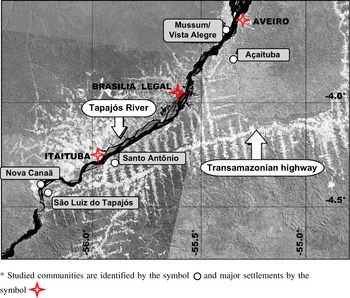
This study was carried out in the lower Tapajós River basin (Fig. 1), located in the State of Pará (Central Amazon, Brazil). Soil sampling took place along a 150 km segment of the river, between the municipalities of Aveiro and Itaituba (all sites were located between 03°40′–04°28′S and 56°12′–55°21′W, and their altitude varied from 14 to 123 m asl). The study was part of the Caruso research project conducted by a joint Canadian and Brazilian team working on the relationships between mercury (Hg), human health, land use and the environment.
Location map of the study area. * Studied communities are identified by the symbol and major settlements by the symbol.

The study region has relatively low precipitation compared with the Western and Eastern Amazon (Fitzjarrald et al. Reference Fitzjarrald, Sakai, Moraes, Cosme de Oliveira, Acevedo, Czikowsky and Beldini2008). The landscape is characterized by various types of rain forests mixed with some areas of savannas (Embrapa Amazônia Oriental 2007a ). In many areas, the natural vegetation has already been widely altered, and secondary forests (capoeiras) and pastures are very common (Embrapa Amazônia Oriental 2007b ). Soils of the area are predominantly classified as Oxisols and Ultisols (according to the USDA system) (Soil Survey Staff 1999) or Latossolos and Argissolos (according to Brazilian classification) (Embrapa Amazônia Oriental 2007c ). These soils, which developed on the Alter-do-Chão geological formation, have highly weathered mineral horizons consisting mostly of iron and aluminium oxide-rich clays (Roulet & Lucotte Reference Roulet and Lucotte1995; Roulet et al. Reference Roulet, Lucotte, Saint-Aubin, Tran, Rheault, Farella, de Jesus Da Silva, Dezencourt, Sousa Passos, Santos Soares, Guimaraes, Mergler and Amorim1998) as well as a thin and weakly differentiated organic horizon (H. Poirier, personal communication). These soils have been weathered for millions of years by intense precipitation and marked climatic variations, which has resulted in nutrient and mineral depletion as well as high acidity (Jordan Reference Jordan, Prance and Lovejoy1985).
Data collection
Data collection was done in the riparian communities of São Luiz do Tapajós, Nova Canaã, Santo Antônio, Açaituba, Mussum and Vista Alegre, in the Tapajós River basin (Fig. 1). Sampling campaigns were done in collaboration with the local population, according to the landowner's willingness to participate and to the availability of sites. Study sites had to correspond to specific requirements: they had to be easily accessible primary forest plots planned for slash-and-burn before the next rainy season and for subsequent cultivation for at least 1 year. Based on these conditions, sampling sites of c. 1 ha (100 m ×100 m) were selected in 26 small-scale farms (hereafter termed ‘sites’).
Soil samples were first collected from the selected primary forest sites in August 2004, during the dry season corresponding with the beginning of the slash-and-burn period. This sampling period was chosen because at that time farmers had made their decisions as to which area of their land would go into cultivation for the coming year, which was a determinant for site selection. One year after the beginning of cultivation following slash-and-burn, a second sampling campaign was performed during the next dry season in September 2005. The exact same sampling sites could be found again using global positioning system (GPS) and with the help of participating farmers, since the first sampling emplacements were identified with a tag they had maintained. At that time, the sites, which were under cultivation, were composed mainly of young (<8 months) bitter cassava (Manihot esculenta), sometimes accompanied by rice (Oryza sativa L.) and maize (Zea mays L.). With the exception of these crops, soils appeared almost naked and often still covered by ash. Samples collected in 2005 were taken 30 cm away from the holes previously dug in order to obtain two sets of soils that were similar in nature. For various reasons (selected forests that had not been cleared, sampling sites not clearly identified or unavailability of landowners), five of the initial sites were not re-sampled during the second field campaign.
Three representative points per site were chosen in each of the participating farm, at the centre of the study sites. Sampling points were 30–50 m apart, depending on the size of the plot. After having removed litter at the soil surface (leaves and branches), soil samples were taken from each point at three depths (0–5, 20–25 and 50–55 cm) with a 100 cm3 AMS stainless steel soil core sampler (AMS, American Falls, Idaho, USA). These sampling depths were chosen in the light of previous research considering physicochemical dynamics in the soil profile carried on in the study region, as several pedological and geochemical properties and processes (e.g. % C, C/N, total Hg, Hg mobility, fine particle loss and erosion) have been shown to change drastically for the first 5–6 cm under the surface upon a perturbation caused by slash-and-burn (Roulet & Lucotte Reference Roulet and Lucotte1995; Roulet et al. Reference Roulet, Lucotte, Saint-Aubin, Tran, Rheault, Farella, de Jesus Da Silva, Dezencourt, Sousa Passos, Santos Soares, Guimaraes, Mergler and Amorim1998; Farella et al. Reference Farella, Lucotte, Davidson and Daigle2006; Béliveau et al. Reference Béliveau, Lucotte, Davidson, do Canto Lopes and Paquet2009). Furthermore, past studies carried out in the similar environments and soil types to those sampled in the present study have found that these soil physicochemical properties generally remain in the same range throughout the soil profile for depths beyond 30–35 cm, up to >1 m under the surface (Roulet et al. Reference Roulet, Lucotte, Saint-Aubin, Tran, Rheault, Farella, de Jesus Da Silva, Dezencourt, Sousa Passos, Santos Soares, Guimaraes, Mergler and Amorim1998). Hence, in the present study, sample collection at the 50–55 cm horizon seemed sufficient to reflect undisturbed conditions. In addition, complementary samples were also collected at 20–25 cm in order to highlight possible intermediate dynamics.
Each sample was collected in duplicate. One of each pair was put in a freezer in the research boat in the hours following the sampling and kept frozen in order to interrupt N mineralization caused by microbial activity. During international travel, the samples were kept frozen with ice packs and quickly transferred to the Montreal laboratory freezer (−20 °C) until analysed for nitrate (NO3) and ammonium (NH4). The other duplicate was air-dried to eliminate most of the soil moisture, and then oven-dried at 40 °C until constant weight, and was subsequently used for all remaining analyses. This sampling design allowed the effects of the burning and subsequent processes (such as ash fertilization, initial nutrient plant uptake, etc.) on soil properties to be highlighted, while also taking into account the influence of soil depth and natural soil textural gradient.
Analysis
All samples were taken back to Canada for laboratory analysis. Frozen samples were used for the extraction of available nitrogen (NO3 and NH4) with potassium chloride (KCl) 2 M, followed by colorimetry using the auto-analyser Traacs 800 of Bran & Luebbe (Norderstedt, Germany) (Maynard & Kalra Reference Maynard, Kalra and Carter1993). Unfrozen dried samples were weighed and bulk density (dry weight/100 cm3) was calculated. Samples were sieved through a 2 mm grid to remove small stones and vegetation, reduced to a fine and homogeneous powder with a 8000 M Mixer/Mill steel percussion grinder (of SPEX SamplePrep, Metuchen, NJ, USA) and finally, interstitial water was removed through freeze drying at −40 °C using a Labconco Freeze Dryer 4.5 (Kansas City, USA). The colour of the dried soil was determined using a Munsell Chart. A wide range of subtle nuances was observed, but all samples were classified in the yellow-red Munsell sheets. A part of each sample was kept un-processed for granulometric fractionation.
Available cations such as calcium (Ca), magnesium (Mg), potassium (K), manganese (Mn), aluminium (Al) and iron (Fe) were extracted with barium chloride (BaCl2) and measured by atomic absorption (ARL 906AA, GBC Scientific Equipment, Melbourne, Australia) with acetylene–air flame, except for Ca and Al, which were analysed with acetylene–protoxyde flame, according to procedures described by Hendershot et al. (Reference Hendershot, Lalande, Duquette and Carter1993). Soil pH was determined using a glass electrode after a 1:4 dilution in water. Iron and Al oxy-hydroxides associated with clay particles (referred to hereafter as Fecdb and Alcdb) were extracted with citrate–dithionate–bicarbonate and also measured by atomic absorption (Lucotte & d'Anglejan Reference Lucotte and d'Anglejan1985). Four forms of P were determined after a sequential extraction from the most available to the more recalcitrant: exchangeable (Pex), orthophosphates extracted with citrate–dithionate–bicarbonate and associated with clays (Pcdb), apatite (Papa) and organic (Porg), and then measured by colorimetry (Traacs 800 auto-analyser of Bran & Luebbe, Norderstedt, Germany), according to the method elaborated by Lucotte & d'Anglejan (Reference Lucotte and d'Anglejan1985). In the present paper, the abbreviations Pex, Pcdb, Papa and Porg are used to qualify the different forms of P. Total C and total N were determined by combustion with the Carlo-Erba elemental analyser (NC 2500 model, Milan, Italy) (Verardo et al. Reference Verardo, Froelich and McIntyre1990).
Furthermore, a wet fractionation method was developed to divide the un-processed samples into three distinct groups of differently sized particles (0–63 μ m, 63–210 μ m and 210 μ m–2 mm sieves), in order to determine soil texture from weighed dried fractions. Indeed, in the present study region, several studies have found a relationship between Hg content and particles <63 μ m (Roulet et al. Reference Roulet, Lucotte, Saint-Aubin, Tran, Rheault, Farella, de Jesus Da Silva, Dezencourt, Sousa Passos, Santos Soares, Guimaraes, Mergler and Amorim1998; Farella et al. Reference Farella, Lucotte, Davidson and Daigle2006), as well as with other physicochemical variables (Farella et al. Reference Farella, Davidson, Lucotte and Daigle2007). Moreover, in the present study sites, these soil fractions were associated with differentiated dynamics regarding Hg mobility, which was related to cation input following slash-and-burn (Béliveau et al. Reference Béliveau, Lucotte, Davidson, do Canto Lopes and Paquet2009). Throughout the present paper, soil fine particles measuring 0–63 μ m will be referred to as FP, roughly representing classical clay and silt fractions grouped together.
Soil granulometry, Fecdb, Alcdb and the four forms of P were assessed on one sample randomly selected from among the three soil replicates from each site and limited to the upper two horizons (0–5 and 20–25 cm). In order to ensure the validity of the results, replicates and analytical blanks were included in each protocol. Soil pH determination and cation extraction were performed at the Montréal Biodôme, whereas all the other analyses were carried out at the GEOTOP-UQAM laboratory.
Statistical analyses
In order to study the impact of slash-and-burn cultivation on soil physicochemical properties, data from the 21 sites in small-scale farms that were sampled in the initial state and re-sampled after deforestation were used for statistical analyses.
Inferential statistics were used to examine the current data for a given sampled horizon and a given soil texture. For soil textural characterization in the initial state, Student's t-tests or Wilcoxon tests were used according to data distribution. Then, because the study focused on temporal variations of soil properties following slash-and-burn cultivation, where values at the deforested sites (t 2) depend on values at the initial, forested sites (t 1), paired analyses were used. When variables were normally distributed, multivariate analyses of variance (MANOVAs) were used to compare mean concentrations and to assess whether significant changes had occurred in samples collected before and after slash-and-burn. When normal distribution was not reached for some variables, non-parametric statistical tests for paired data were carried out. For all statistical analyses, significance was determined at P < 0·05. All statistical analysis was performed using JMP 5.1 software (SAS Institute 2003).
Soil classification
The soil fine fraction plays a key role in numerous geochemical and pedological dynamics (Brady & Weil Reference Brady and Weil2002). Fine particle content was thus chosen as a discriminant variable to sort samples into ‘fine-grained’ and ‘coarse-grained’ categories, assuming that samples belonging to the same group would behave in a similar way following deforestation and soil cultivation (Farella et al. Reference Farella, Davidson, Lucotte and Daigle2007). Classification trials were carried out with pre-defined fine-grained and coarse-grained groups composed of samples classified according to varied thresholds, where the proportion of fine grains varied from 0·30 to 0·50. At each trial, a stepwise discriminant analysis involving all physicochemical variables being studied was performed. These tests allowed determination of which pre-defined groups had the lower number of misclassified samples, which led to the adoption of the 0·35 FP threshold to define two distinct textural classes. In the present paper, samples containing proportions of <0·35 FP are hereafter referred to as ‘coarse-grained soils’ and those containing >0·35 FP as ‘fine-grained soils’.
RESULTS
Initial physicochemical properties of forest soils
An initial soil characterization of the sites studied was performed in order to determine whether the soil properties of forest sites would follow any particular gradient along the geographic distribution of sampled areas (along the Tapajós River). However, hierarchical analyses carried out with some variables indicated that the soil variability occurred mostly between the sampled farm sites within each of the five community areas, showing that no particular pattern associated with a regional distribution existed and that strong soil heterogeneity prevailed. Hence an approach based on soil texture was adopted.
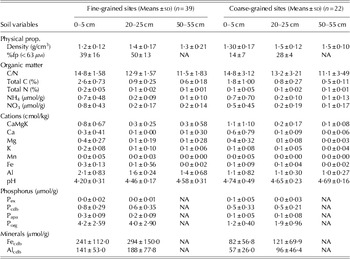
Forest soil properties were distinct according to fine- and coarse-grained textures, especially at the soil surface (Table 1). Indeed, at the 0–5 cm horizon, 15 out of 20 variables of interest in the present study (density, pH, NO3, K, Fe, Al, total C, total N, FP, Pex, Pcdb, Papa, Porg, Fecdb and Alcdb) differed significantly (P < 0·05) according to soil texture, compared with ten variables at the 20–25 cm horizon. Before slash-and-burn, indicators of soil organic matter showed higher values in fine-grained sites for total C, total N and NO3 levels. While significantly higher K levels were found in surface horizons of fine-grained sites, Ca concentrations were, surprisingly, slightly higher in coarse-grained soils. This was reflected in a higher sum of bases (although not statistically significant) in the latter sites. Moreover, fine-grained soils contained two times more available Al and Fe than coarse-grained soils.
Initial soil physicochemical properties before slash-and-burn

Student's t or Wilcoxon tests were used according to data distribution.
NA = Not analysed.
In undisturbed sites, the sum of all measured P forms (Pex, Pcdb, Papa and Porg) at the soil surface was 5·3 μmol/g in fine-grained soils and 1·9 μmol/g in coarse-grained soils. For both soil textures and horizons, the organic P was the major form found. Indeed, at the soil surface, Porg represented c. 4·2 μmol/g for fine-grained sites (0·79 of total P) and 1·2 μmol/g (0·63 of total P) for coarse-grained sites. However, Pex values in fine-grained soils were <0·02 μmol/g (<0·01 of total P) and 0·1 μmol/g (0·05 of the total P) in coarse-grained soils. Most P forms showed significantly higher values in fine-grained soils, especially the Porg content (which was highly correlated with fine particle content (R 2 = 0·34 P < 0·001)) and to a lesser extent the Pcdb and Papa contents. In contrast, Pex was higher in coarse-grained soils. Moreover, Pcdb was correlated with Fecdb and Alcdb at all soil depths and for both soil textures. When combining both soil textures together, the correlation was significant with Alcdb (R 2 = 0·15 P < 0·05) and it was even more pronounced with Fecdb (R 2 = 0·26, P < 0·001). The Fecdb and Alcdb concentrations were correlated as well with FP content (R 2 = 0·25, P < 0·001 and R 2 = 0·33, P < 0·001, respectively), which was not a surprise since fine-grained soils contained two to three times more of these minerals than coarse-grained soils (241 compared with 81·2 μmol/g of Fecdb, 141 compared with 57·2 μmol/g of Alcdb).
Overall, for both soil textural groups, most initial values generally tended to remain constant or to decrease in subsurface horizons, except for some variables (Fecdb, Alcdb, density and FP), which did increase with depth. Furthermore, physicochemical differences according to texture tended to diminish with depth for most variables (Table 1). Indeed, in contrast to what was observed at the surface horizon, distinction according to soil texture was not as pronounced in deeper horizons for Pex, Pcdb, NO3, NH4, and the sum of bases, Ca, Mg, K and Fe.
Effects of the first year of slash-and-burn cultivation on soil physicochemical properties
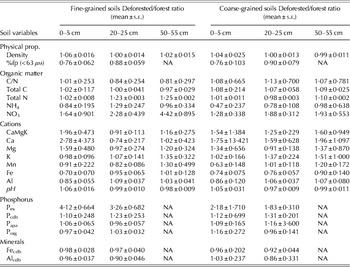
Table 2 summarizes the changes occurring in soil properties following deforestation, presented by soil texture and by horizon. In order to represent these changes, indicators (‘deforested site/forest site ratio’, hereafter termed ‘ds/fs ratio’) of the combined effect of slash-and-burn and of the first year of cultivation on individual soil characteristics were calculated. The latter were obtained by dividing the mean values, for each variable, of deforested sites by the mean values of undisturbed forest sites, for a given depth and a given texture.
Changes in soil physicochemical properties after slash-and-burn cultivation (deforested/forested sites ratios)

NA = Not analysed.
Soil physical properties
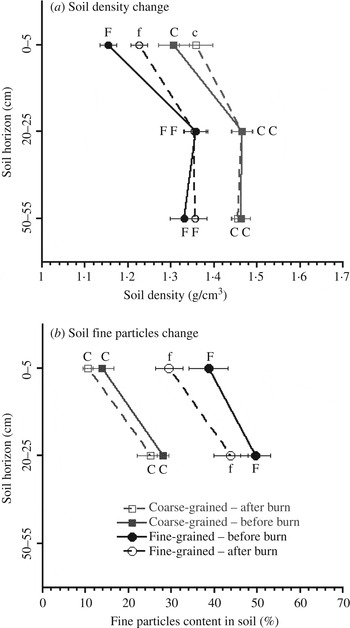
Both soil types showed a statistically significant increase in density at the soil surface after slash-and-burn cultivation, but no noticeable density change occurred in deeper horizons (Fig. 2(a)). Coarse-grained sites, which were denser before disturbance (1·31 g/cm3 compared with 1·15 g/cm3 at the soil surface for fine-grained sites), had a less important – but still significant – surface density increase (ds/fs = 1·04, paired t-test=P < 0·05) than fine-grained sites (ds/fs = 1·06, P < 0·001). Moreover, fine-grained and coarse-grained sites both lost soil fine particles, especially in the top horizons (Fig. 2(b)). Fine-grained sites, with significant FP losses both at 0–5 cm (P < 0·01) and at 20–25 cm (P < 0·05) were more affected than coarse-grained sites. Indeed, a significant inverse relationship (R 2 = 0·51, P < 0·001) existed between fine particle content from forested soils and fine particle loss following deforestation.
Changes in soil physical properties following slash-and-burn cultivation. Error bars=sd. Letters are used to illustrate the significance of change for each soil depth following deforestation, for both fined-grained (F) and coarse-grained (C) soils. Within each soil textural class, capital letters (F or C) indicate that after burn values were not significantly different than before burn values, whereas lower case letters (f or c) mean that after burn values changed significantly when compared with before burn values.

Soil available cations, pH, phosphorus and minerals
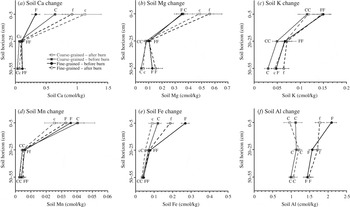
Generally, surface soils of both textures were characterized by available base cation enrichment after the first year of slash-and-burn cultivation. However, the intensity of the effects of deforestation in the soil profile was different depending on soil texture. At the surface, the sum of base cations (which is mostly driven by Ca concentrations) in fine-grained sites almost doubled (from 0·83 to 1·62 cmol/kg), whereas it increased by 50% in coarse-grained sites (from 1·12 to 1·73 cmol/kg). The Ca/Mg/K enrichment at the soil surface was especially distinct in fine-grained sites, with a ds/fs ratio of 1·96, whereas that in coarse-grained soils was only 1·54 (Table 2). Moreover, the specific dynamics occurred for individual cation variations in the soil profile following slash-and-burn. For example, a significant increase in Ca levels was observed in all coarse-grained soil horizons (P < 0·05 for all depths), but was limited in fine-grained soils to the surface horizon (P < 0·001) (Fig. 3(a)). In contrast, the increase in Mg concentration occurred in both soil textures but was only significant (P < 0·05) for fine-grained soils at both 0–5 and 50–55 cm (Fig. 3(b)). There was little change in K concentration at the surface, but there was a significant K increase (P < 0·05) at 50–55 cm (Fig. 3(c)). In contrast, available Mn levels, which were extremely low in undisturbed soils, tended to decrease for both soil types, except in the deeper horizon. The decrease was significant in fine-grained soils at 20–25 cm (P < 0·001), and in coarse-grained soils at 0–5 cm (P < 0·05) (Fig. 3(d)).
Soil available cation changes following slash-and-burn cultivation. Error bars=sd. F or C indicates that post-burning values were not significantly different than pre-burning values, whereas f or c means that the change was significant.

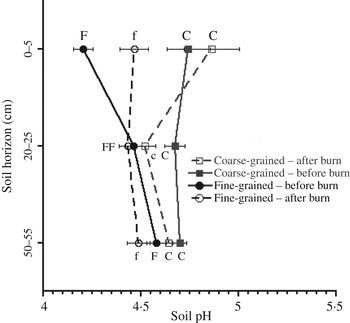
Both soil textures suffered a significant loss of available Fe at the surface (P < 0·001 for fine-grained and P < 0·05 for coarse-grained soils, respectively), and the trend was still visible at the 20–25 cm horizon, especially in coarse-grained soils (Fig. 3(e)). However, while available Al levels decreased significantly at the surface in fine-grained soils (P < 0·05), there was a slight Al enrichment at 20–25 cm (which was significant in fine-grained soils, P < 0·05) and at 50–55 cm for both soil textures (Fig. 3(f)). Soil pH increased slightly at the soil surface (significantly for fine-grained soils, P < 0·05) but it did not change noticeably in deeper horizons (Fig. 4).
Soil pH changes following slash-and-burn cultivation in fine-grained and coarse-grained soils. Error bars=sd. F or C indicates that post-burning values were not significantly different than pre-burning values, whereas f or c means that the change was significant.

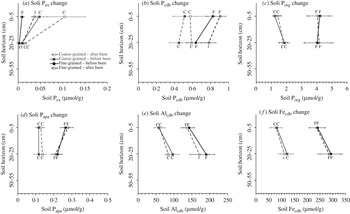
Distinct responses to slash-and-burn cultivation were also observed for the different forms of P. Exchangeable P increased for both soil textures, but the change was only significant in fine-grained sites (P < 0·001 and <0·05 for the 0–5 and 20–25 cm horizons, respectively) (Fig. 5(a)). The Pcdb levels also increased for the 0–5 and 20–25 cm horizons in both soil textures (Fig. 5(b)), and this was significant for fine-grained soils at 20–25 cm (P < 0·05). In contrast, Porg and Papa (Figs 5(c) and (d)) levels did not vary noticeably. Finally, Alcdb and Fecdb levels almost always decreased in deforested sites (except Alcdb, which showed a slight but not significant increase at the soil surface in coarse-grained sites). Although decreases were not particularly marked, they appeared significant (P < 0·05) at 20–25 cm in fine-grained sites for Alcdb, and in coarse-grained sites for Fecdb, respectively (Figs 5(e) and (f)).
Changes in soil P and minerals following slash-and-burn cultivation. Error bars=sd. F or C indicates that post-burning values were not significantly different than pre-burning values, whereas f or c means that the change was significant.

Soil organic matter
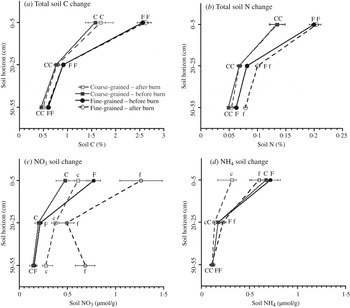
There was a highly significant correlation between C and N variations following slash-and-burn cultivation, especially at the soil surface (R 2 = 0·68, P < 0·001). While C:N ratio decreased following deforestation in fine-grained subsurface horizons (ds/fs ratio = 0·84 at 20–25 cm and 0·81 at 50–55 cm, P < 0·001), a significant increase was noted in coarse-grained soil surface horizons (ds/fs ratio = 1·08, P < 0·05) and at 20–25 cm (ds/fs ratio = 1·13, P < 0·05). Moreover, although total C change was not generally marked, a slight overall increase (ds/fs ratio = 1·08) was observed in coarse-grained sites (Fig. 6(a)). However, total N did not vary on deforested coarse-grained sites, whereas there was a significant total N increase at soil subsurface for deforested fine-grained sites (P < 0·001 for both 20–25 and 50–55 cm) (Fig. 6(b)).
Organic matter changes following slash-and-burn cultivation. Error bars=sd. F or C indicates that post-burning values were not significantly different than pre-burning values, whereas f or c means that the change was significant.

Furthermore, contrasting dynamics were observed between the two forms of available nitrogen, NH4 and NO3. There was a significant NO3 increase (Fig. 6(c)) in all fine-grained site horizons (P < 0·05 for 0–5 cm; P < 0·001 for 20–25 and 50–55 cm). In these sites, NO3 increased more in soil subsurface horizons than in the top horizon, as shown by increasing ds/fs ratios with depth (1·64, 2·28 and 4·42 from top to deep horizons). However, in coarse-grained sites, the increase was not significant at 0–5 cm, but was significant in deep horizons (P < 0·001 at 20–25 cm and P < 0·05 at 50–55 cm). Topsoil NH4 levels generally decreased after slash-and-burn and the first year of cultivation, particularly in coarse-grained soils where surface NH4 decreased by >50% (Fig. 6(d)). While this nutrient loss at the soil surface was marked (P < 0·05 for both fine-grained and coarse-grained sites), changes in deeper horizons were less pronounced, except for the significant rise (ds/fs ratio = 1·29, P < 0·05) observed at 20–25 cm for fine-grained soils.
DISCUSSION
Vegetation plays a crucial role for nutrient levels and recycling in tropical soils. While some soil properties (FP, exchangeable Al and pH) are mostly influenced by large-scale factors such as climate, precipitation and parent material, others (base cations, C and N) are largely impacted by small-scale variations related to vegetation and land use. In undisturbed areas, the soil surface horizon is directly influenced by land cover (tree fall, biological activity and organic matter accumulation) (Holmes et al. Reference Holmes, Kyriakidis, Chadwick, Soares and Roberts2005), which was reflected in the present study by higher organic matter indicators (total C and N, NH4 and NO3), sum of base cations (Ca/Mg/K) and P concentrations (especially in fine-grained sites) at the forest soil surface.
Physical, chemical and biological properties of tropical soils are frequently affected by forest conversion to agriculture (Murty et al. Reference Murty, Kirschbaum, McMurtrie and McGilvray2002). Oxisols and Ultisols, which represent 0·75 of Amazonian soils and which were predominant in the present study area, are weakly resistant to disturbance and quite vulnerable to erosion (Cochrane & Sánchez Reference Cochrane, Sánchez and Hecht1982). Moreover, some soil nutrients, namely Ca, Mg, K, C and N, are specifically influenced by changes in land-cover, topography and humidity (Holmes et al. Reference Holmes, Kyriakidis, Chadwick, Soares and Roberts2005) and remain in soils for only a short period of time after perturbation before being lost by runoff, leaching or harvesting (Nye & Greenland Reference Nye and Greenland1964; Juo & Manu Reference Juo and Manu1996; Sommer et al. Reference Sommer, Vlek, Sá, Vielhauer, de Fátima Rodrigues Coelho and Fölster2004).
Short-term ash fertilization
Since 0·60–0·95 of tropical forest nutrients are found in aerial biomass (Herrera Reference Herrera, Prance and Lovejoy1985), the decomposition of falling leaves and branches ensures continuous nutrient regeneration in Amazonian soils. However, after forest clearing, the interruption of forest nutrient recycling into the soils as well as the lack of soil protection eventually affects the system's fertility (Juo & Manu Reference Juo and Manu1996; Vielhauer et al. Reference Vielhauer, Denich, Sá, Kato, Kato, Brienza and Vlek2001; Asner et al. Reference Asner, Townsend, Bustamante, Nardoto and Olander2004; Sommer et al. Reference Sommer, Vlek, Sá, Vielhauer, de Fátima Rodrigues Coelho and Fölster2004). Indeed, nutrient levels in short-cycle cropping systems generally decrease following the initial short-term fertilization resulting from slash-and-burn (Nye & Greenland Reference Nye and Greenland1964; Cochrane & Sánchez Reference Cochrane, Sánchez and Hecht1982; Juo & Manu Reference Juo and Manu1996).
Moderate cations input and reduced soil acidity
Slash-and-burn is accompanied by the release of base cations (that are stocked in the forest biomass), which consequently contribute to the increase of soil pH and nutrient levels (Cochrane & Sánchez Reference Cochrane, Sánchez and Hecht1982). In the present study, an increase of base cations at the surface of deforested soils was observed, consistent with previous research (Hölscher et al. Reference Hölscher, Ludwig, Moller and Folster1997; McGrath et al. Reference McGrath, Smith, Gholz and de Assis Oliveira2001; Klinge et al. Reference Klinge, Araujo Martins, Mackensen and Fölster2004; Markewitz et al. Reference Markewitz, Davidson, Moutinho and Nepstad2004; Sommer et al. Reference Sommer, Vlek, Sá, Vielhauer, de Fátima Rodrigues Coelho and Fölster2004; Silva et al. Reference da Silva, da Silva and de Melo2006; Farella et al. Reference Farella, Davidson, Lucotte and Daigle2007). Moreover, when contrasting the two soil textures, cation levels following deforestation differed between fine-grained and coarse-grained sites, which were probably related to the higher cation exchange capacity of the finer texture (Brady & Weil Reference Brady and Weil2002).
However, cation concentration changes in the current study sites were not as pronounced as those observed in previous research projects. For example, while Farella et al. (Reference Farella, Davidson, Lucotte and Daigle2007) observed a 550% increase for the sum of Ca, Mg and K, at fine-grained sites and a 400% increase at coarse-grained sites surface horizons, the cation input ratios in the present study were 196 and 154%, respectively, following deforestation. But the magnitude of the cation changes varies among studies, and some other authors did not find significant changes in soil Ca and K following slash-and-burn (Numata et al. Reference Numata, Chadwick, Roberts, Schimel, Sampaio, Leonidas and Soares2007). Generally, the somewhat moderate increase in Ca/Mg/K concentrations in the analysed samples seemed to be related to low Ca enrichment, as well as to unchanged surface K levels. This could be partly related to volatilization, as described in past studies (Mackensen et al. Reference Mackensen, Hölscher, Klinge and Fölster1996; Sommer et al. Reference Sommer, Vlek, Sá, Vielhauer, de Fátima Rodrigues Coelho and Fölster2004).
As for the pH, no pronounced change was observed for combined soil textures, as opposed to the frequent increase in soil pH that is usually found following forest conversion to annual crop cultivation systems (McGrath et al. Reference McGrath, Smith, Gholz and de Assis Oliveira2001; Klinge et al. Reference Klinge, Araujo Martins, Mackensen and Fölster2004) or pastures (Desjardins et al. Reference Desjardins, Lavelle, Barros, Brossard, Chapuis-Lardy, Chauvel, Grimaldi, Guimarães, Martins, Mitja, Müller, Sarrazin, Tavares Filho and Topall2000; Müller et al. Reference Müller, Guimarães, Desjardins and Mitja2004; Silva et al. Reference da Silva, da Silva and de Melo2006; Numata et al. Reference Numata, Chadwick, Roberts, Schimel, Sampaio, Leonidas and Soares2007). A small, but significant pH increase was found only at the soil surface in fine-grained soils, but the same overall trend nevertheless appeared in coarse-grained soils. Although not an important change, this slight pH increase was sufficient to lower the Al and Fe availability, thus diminishing toxicity for plants established in the latter sites.
Change in phosphorus bioavailability
Variations observed after slash-and-burn followed a trend related to the bioavailability of its forms, the most bioavailable ones increased the most whereas the recalcitrant forms remained unchanged. Readily available P (Pex), which is related to ash input to soils, changed the most, especially in fine-grained sites at the soil surface. This form of P followed similar dynamics to that of Ca/Mg/K, reflecting the importance of ash fertilization and associated soil acidity reduction for better P availability (Farella et al. Reference Farella, Davidson, Lucotte and Daigle2007). Phosphorus cycling is mostly regulated by litter fall and plant turnover (Markewitz et al. Reference Markewitz, Davidson, Moutinho and Nepstad2004), but a combination of soil property changes can enhance the release of some P forms, temporarily increasing its availability to the biota (Asner et al. Reference Asner, Townsend, Bustamante, Nardoto and Olander2004). However, the massive P increases occurring after slash-and-burn are generally followed rapidly by an important subsequent loss of the nutrient (McGrath et al. Reference McGrath, Smith, Gholz and de Assis Oliveira2001; Asner et al. Reference Asner, Townsend, Bustamante, Nardoto and Olander2004).
Except for Pex, other P forms were hardly affected at deforested sites. Indeed, no noticeable Pcdb change occurred, except in fine-grained subsurface horizons. As expected, Pcdb values were correlated with soil FP content, as this form of P is adsorbed on clays. As reported in previous studies (Roulet et al. Reference Roulet, Lucotte, Saint-Aubin, Tran, Rheault, Farella, de Jesus Da Silva, Dezencourt, Sousa Passos, Santos Soares, Guimaraes, Mergler and Amorim1998; Farella et al. Reference Farella, Davidson, Lucotte and Daigle2007), it can be supposed that its increase in the subsurface horizons was linked to fine particle migration. Furthermore, Pcdb was also correlated with Alcdb and Fecdb, which is not surprising as Fe and Al oxides play an important role in P fixation and immobilization (Rao et al. Reference Rao, Friesen, Osaki and Pessarakli1999). Finally, the more recalcitrant P form (Porg) did not vary significantly during the first year of slash-and-burn cultivation. Its availability is usually related to organic matter and nitrogen (Asner et al. Reference Asner, Townsend, Bustamante, Nardoto and Olander2004; Silva et al. Reference da Silva, da Silva and de Melo2006), as well as to carbon and soil texture (Farella et al. Reference Farella, Davidson, Lucotte and Daigle2007; Numata et al. Reference Numata, Chadwick, Roberts, Schimel, Sampaio, Leonidas and Soares2007). However, in the present study, while Porg was highly correlated with fine particle content, no correlation was found with C for any soil texture.
Effects on organic matter content and mineralization processes
Limited changes in total C and total N pools
Initial total C levels in undisturbed sites differed significantly according to soil texture, as usually found in the literature (Alfaia et al. Reference Alfaia, Ribeiro, Nobre, Luizão and Luizão2004; Asner et al. Reference Asner, Townsend, Bustamante, Nardoto and Olander2004; Farella et al. Reference Farella, Davidson, Lucotte and Daigle2007). Total C and total N levels did not change much following slash-and-burn and forest conversion to agricultural land, in contrast to what has been observed in previous studies (McGrath et al. Reference McGrath, Smith, Gholz and de Assis Oliveira2001; Murty et al. Reference Murty, Kirschbaum, McMurtrie and McGilvray2002; Mainville et al. Reference Mainville, Webb, Lucotte, Davidson, Betancourt, Cueva and Mergler2006). However, the current results are consistent with data presented by Hölscher et al. (Reference Hölscher, Ludwig, Moller and Folster1997). It is likely that a 1-year period after disturbance was too short to affect C and N pools significantly. Usually, a rapid C loss is observed in soils after deforestation (Desjardins et al. Reference Desjardins, Lavelle, Barros, Brossard, Chapuis-Lardy, Chauvel, Grimaldi, Guimarães, Martins, Mitja, Müller, Sarrazin, Tavares Filho and Topall2000; Murty et al. Reference Murty, Kirschbaum, McMurtrie and McGilvray2002), due to the fact that most of the C contained in above-ground biomass is not returned to the soil after slash-and-burn and is consequently lost from the ecosystem (Markewitz et al. Reference Markewitz, Davidson, Moutinho and Nepstad2004), and that decomposition of the organic matter pool occurs in the absence of forest litter inputs. However, depending on land management, diverse dynamics can exist (Murty et al. Reference Murty, Kirschbaum, McMurtrie and McGilvray2002; Müller et al. Reference Müller, Guimarães, Desjardins and Mitja2004), as was the case in the studied coarse-grained sites.
The significant increase in N in the 20–25 and 50–55 cm horizons of fine-grained sites, which led to lower C:N ratios, could be linked to the decomposing underground forest biomass in the soil profile, causing soil organic matter enrichment (Klinge et al. Reference Klinge, Araujo Martins, Mackensen and Fölster2004). However, no similar pattern could be found for coarse-grained sites, where decomposition processes could be slower. There is generally a strong correlation between N and C changes (Murty et al. Reference Murty, Kirschbaum, McMurtrie and McGilvray2002), which indeed occurred in the present study, especially at soil surface. Since C loss is often greater that N loss following deforestation, cultivated soils usually have lower C:N ratios than forest soils (Murty et al. Reference Murty, Kirschbaum, McMurtrie and McGilvray2002). However, in the present study this was only the case in fine-grained sites subsurface horizons. These lowered C:N ratios were related to the significant increase in N in the subsurface of horizons of fine-grained sites, which may be more related to accelerated root decomposition (confirmed by the NH4 and NO3 trends), than to C loss.
Temporarily stimulated nitrification process
The decrease in NH4 levels observed at the current study sites following slash-and-burn cultivation could be related to an increase in organic matter mineralization after deforestation, stimulating nitrification processes (Brown et al. Reference Brown, Anderson, Woomer, Swift, Barrios, Woomer and Swift1994). Indeed, NH4 loss occurred at the soil surface, whereas an increase in NO3 occurred in the same horizon. Moreover, more efficient nitrification was also reflected by an overall significant decrease of NH4/total available N ratio following slash-and-burn. This shift to NO3 dominance over NH4, also observed in previous studies (Wick et al. Reference Wick, Veldkamp, De Mello, Keller and Crill2005), could indicate the opening of the soil N cycle, eventually resulting in an increase of NO3 leaching (Neill et al. Reference Neill, Piccolo, Cerri, Steudler and Melillo2006). Since there is basically no total N input into the soil following deforestation, the NO3 increase observed in the present study was probably largely caused by temporarily stimulated nitrification processes. In addition, NO3 uptake is limited to crop nutrition in the absence of a forest cover during the first year upon slash-and-burn (Hölscher et al. Reference Hölscher, Ludwig, Moller and Folster1997; Neill et al. Reference Neill, Piccolo, Cerri, Steudler and Melillo2006), as illustrated by a NO3 increase that was more important than the associated NH4 depletion in fine-grained study sites. However, NO3 concentrations would then probably decline, as agricultural systems have a lower capacity to retain this nutrient than forests. Indeed, the deep and permanent root network of forested ecosystems usually contributes to an effective nutrient cycling and to reduced leaching (Alfaia et al. Reference Alfaia, Ribeiro, Nobre, Luizão and Luizão2004).
Rapid nutrient loss by leaching
Nitrate is extremely mobile and is leached very easily; even without disturbance. Amazonian soils are characterized by a very low NO3 retention capacity (Farella et al. Reference Farella, Davidson, Lucotte and Daigle2007). In deforested soils, NO3 mobility is enhanced because of litter reduction, higher mineralization rate (caused by increased temperature of uncovered soil) and erosion due to precipitation during the rainy season (Wick et al. Reference Wick, Veldkamp, De Mello, Keller and Crill2005). As in several other cases (Sommer et al. Reference Sommer, Vlek, Sá, Vielhauer, de Fátima Rodrigues Coelho and Fölster2004), deforested sites in the present study seemed to undergo a leaching of NO3. Hence, its increase was actually less marked at the soil surface of deforested sites than in deeper horizons, suggesting that there was a downward movement of the nutrient, followed by its accumulation in subsurface soil horizons.
In a similar way, the rather unchanged K concentrations observed at the soil surface of deforested sites contrasted with increased concentrations deeper in the soil profile. Indeed, the comparison of ds/fs ratios for the three-sampled horizons indicated a clear K migration from top to lower horizons in deforested sites, especially in coarse-grained soils. These results suggest that K leaching occurred at the current study sites, even more than what was discussed previously for NO3 mobility. Other authors have reported similar K leaching, as reflected by surface K losses in deforested sites (Juo & Manu Reference Juo and Manu1996; Klinge et al. Reference Klinge, Araujo Martins, Mackensen and Fölster2004; Farella et al. Reference Farella, Davidson, Lucotte and Daigle2007) and even in agroforestry systems (Alfaia et al. Reference Alfaia, Ribeiro, Nobre, Luizão and Luizão2004). Indeed, in contrast to most other cations, K is an extremely mobile element (Markewitz et al. Reference Markewitz, Davidson, Moutinho and Nepstad2004), influenced by local transport patterns (Holmes et al. Reference Holmes, Kyriakidis, Chadwick, Soares and Roberts2005).
Marked soil compaction and erosion
The current results showed that significant erosion processes have already begun in the short time frame of 1 year from slash-and-burn of the primary forest. Indeed, a significant loss of fine particles had already occurred, both types of soils having lost c. 24% of their initial surface FP. Additionally, the 12% FP loss observed at the 20–25 cm horizon in fine-grained soils, although not as marked as surface loss, was still significant. Soil density increase was also significant at the surface of the current study sites, which is not a surprise as the absence of vegetation cover is indeed usually accompanied by increased soil density and compaction, and by enhanced erosion (McGrath et al. Reference McGrath, Smith, Gholz and de Assis Oliveira2001; Murty et al. Reference Murty, Kirschbaum, McMurtrie and McGilvray2002; Müller et al. Reference Müller, Guimarães, Desjardins and Mitja2004; Numata et al. Reference Numata, Chadwick, Roberts, Schimel, Sampaio, Leonidas and Soares2007). Furthermore, high precipitation in the absence of forest cover also triggers the deterioration of soil structure (Valentin & Janeau Reference Valentin and Janeau1990). Since the soil's fine fraction plays a key role in aggregation complexes and in soil structure, the erosion of FP can enhance compaction and density increase, as observed in the current results. Moreover, since FP are involved in most soil chemical processes and as nutrient bonding occurs on their adsorption sites, the loss of FP also affects soil fertility (Lü et al. Reference Lü, Fu, Chen, Liu and Wei2007).
Exceptional drought enhancing effects on soil properties
Extreme droughts can increase the vulnerability of tropical forest to burning (Nepstad et al. Reference Nepstad, Carvalho, Barros, Alencar, Capobianco, Bishop, Moutinho, Lefebvre, Lopes Silva and Prins2001; Cochrane Reference Cochrane2003). The present study took place during the exceptional drought that had marked many parts of the Amazon at the beginning of 2005. That year, a rigorous dry season coupled with a shorter, warmer and drier rainy season resulted in a diminution of the soil, litter and organic moisture, which favoured fire activity in many areas (Marengo et al. Reference Marengo, Nobre, Tomasella, Cardoso and Oyama2008). These particularly dry conditions probably resulted in increased fire intensity leading to more complete biomass combustion (Marengo et al. Reference Marengo, Nobre, Tomasella, Cardoso and Oyama2008), which could have enhanced impacts of soils and ecosystems.
CONCLUSION
The experimental design of the present study, consisting of soil sampling before the burning of primary forest and 1 year after, at the exact same sites and at the same period of the year during the dry season, showed that soils were rapidly impacted within the first year of cultivation following forest burning. In spite of a moderate (but significant) nutrient enrichment related to the input of burnt forest biomass, the results of the present study indeed showed early signs of soil degradation such as active erosion processes through fine particles migration as well as leaching of specific nutrients.
The regional dimension of the present study highlighted the prevailing importance of undisturbed forests soil texture for soil properties variability at initial state, as well as for their physicochemical responses to deforestation. Since soil dynamics seemed to be strongly related to textural specificity rather than to a geographical gradient along the Tapajós River, it can be assumed that the trends arising from the current research could be extended to other regions with similar soil types and textures. Moreover, the present study provides a good contribution to the understanding of the slash-and-burn impacts in other areas that, like the Tapajós region, are characterized by a less humid Amazon climate and by an active colonization front.
The present study thus drew the attention to the short-term impacts of slash-and-burn practices which, in addition to their widely known medium and long-term impacts on the ecosystems, also rapidly affect soil fertility, and consequently, agricultural sustainability. Early and significant soil disturbances such as, for example, fine particle losses and nutrient leaching observed at the current study sites have to be kept in mind as much as global and long-term effects when land-use decisions are taken. In a region where slash-and-burn is often the most economically and technically feasible way to obtain a productive land, adequate policies are needed in order to help small-scale farmers, facing dilemmas often opposing conservations practices and production needs, to reduce their need to deforest for their subsistence.
The authors sincerely thank the communities of São Luiz do Tapajós, Nova Canaã, Santo Antônio, Mussum, Vista Alegre and Açaituba who made this study possible. Many thanks to the field assistants and research boat staff, as well as to Isabelle Rheault, Sophie Chen and Agnieska Adamowicz for their assistance in laboratory analyses. Special thanks to Cynthia Patry and to all Caruso members. The authors gratefully acknowledge the financial support of the Inter-American Institute for Cooperation on Agriculture (IICA), the Canadian International Development Research Centre (IDRC), the UQAM Institute of Environmental Sciences, the Montréal Biodôme and the GEOTOP-UQAM.