Introduction
Trauma has always been a global medical and public health issue. As the most common source of traumatic cases, traffic accidents cause 1.35 million deaths per year and more than 50 million people have different degrees of injuries.1 The mean incidence of traumatic limb injury per major earthquake was 68.0%.Reference Missair, Pretto and Visan2 In these non-fatal wounded, severe limb damage will inevitably lead to amputation, which can cause a serious burden on individuals, their families, and the society.Reference Bondurant, Cotler and Buckle3
Currently, there is no golden standard or complete evaluation indicator for amputation. Doctors usually use the mangled extremity severity score (MESS)Reference Johansen, Daines and Howey4 or the mangled extremity syndrome index (MESI)Reference Gregory, Gould and Peclet5 to guide whether or not an injured extremity should be amputated. However, because of their massive indicators, and each has rules which are difficult to distinguish, the usage in clinical practice is not high.Reference Jie, Jin-Sheng and Peng6
Usually, the front-line hospitals during disaster relief are the first disposal units for the injured patients. However, their limited medical equipment and treatment capacity, compared to the high-level trauma centers, make it quite difficult for the doctors to use the above scores and to find the most important indicators for limb salvage versus amputation under an urgent circumstance; hence, there are certain limitations in these standards.Reference Bosse, Mackenzie and Kellam7,Reference Ly, Travison and Castillo8 Meanwhile, the condition of the injured limb gets worse due to improper or delayed treatment. The Trauma Center of Southwest Hospital (Shapingba District, Chongqing, China), a Level I trauma center, receives the traumatic patients from many referral hospitals in the southwest region of China. A total of 165 patients with severe trauma injuries in the Southwest Hospital Trauma Center from January 2013 through December 2018 were retrospectively analyzed by comparing the cases of amputation and the cases of severe limb injury without amputation. The aim of this study was to find the most important indicator(s) for limb amputation in order to prevent further damage and salvage the injured limbs in the lower-level trauma centers, or at the scene of disaster relief.
Method
Study Design
This is a retrospective case-control study based on medical records. Referring to the indicators of the existing MESS and MESI scales, patient age, timing of diagnosis, peripheral vascular disease (such as hypertension and diabetes), severe craniocerebral injury, neurovascular lesion, fracture with bone defect, wound contamination, and shock were set as factors to do the binary regression analysis and to find out which factors were the most significant. After that, the 79 amputation cases were counted by types of causes, and further analysis was developed based on the conclusions obtained.
Data Sources and Patient Selection
Patients with severe trauma from January 2013 through December 2018 were searched for in the electric medical records system of the Southwest Hospital (affiliated with The Third Military Medical University; Shapingba District, Chongqing, China), which has a first-level trauma center and records their details. The cases where the patients received amputation surgery in this trauma center were defined as “amputation cases.” A total of 79 cases of amputation were obtained as the case group after the cases where the patients’ limbs were completely disconnected or had undergone amputation surgery already were excluded. Meanwhile, the cases where the patients had significant skin and muscle tissue damage at the time of diagnosis, but avoided amputation surgery, were defined as cases without amputation. Among them, 86 cases were selected as the control group by a completely random sampling method. The International Classification of Diseases (tenth revision) codes were used to diagnose patients,9 and the timing of diagnosis refers to the time from injury to hospitalization in the trauma center. Every operation of amputation is determined by a senior associate professor or above, according to the limb activity and general condition.
Ethical Approval and Consent to Participate
The study was submitted for review to the Southwest Hospital Ethics Committee and approved. The study was a retrospective chart review and patient personal data were strictly held anonymously, and confidential information was protected from disclosure.
Outcome Measures
The primary outcome of this study were the key factors affecting amputation. The secondary outcomes were the proportion of different causes to amputation cases, and certain cases which were abnormal but meaningful.
Statistical Analysis
All the data analysis was operated by IBM SPSS Statistics software, version 25.0.0 (SPSS Inc.; Chicago, Illinois, USA). Numerical variables such as age and time of diagnosis were expresses as mean (SD). The risk factors were described as odds ratio (OR) with 95% confidence interval (CI). The t-test was used to compare the means of the two groups in age and time of diagnosis. The chi-square test was used to compare the proportion of the two groups in sex and causes of injury. The binary logistic regression model with the method of “Forward: LR” was used to analyze the effective factors in both groups. To transform the numerical variables into categorical variables, the ages were divided in to three sub-groups, which were: less than 30 years old, 30 to 50 years old, and more than 50 years old; the timing of diagnosis was recorded as one for every six hours (ie, one = zero to six hours; two = seven to 12 hours; and so on), and all cases over 24 hours were uniformly represented by five. Being statistically significant in all analysis means that the P value was less than .05.
Results
Patients Characters
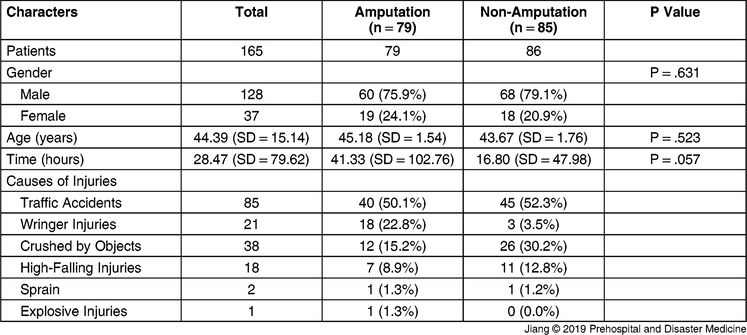
In this study, 185 cases were analyzed in total. Of them, 79 were amputation cases while 85 of them were non-amputation. The average age of patients in the amputation case group was 45.18 (SD = 13.75) years, which had no significant difference with 43.67 (SD = 16.36) years in the control group (P = .523; >.05; Table 1). The difference of the sex ratio in both groups was not statistically significant (P = .631; >.05). The timing of diagnosis in the amputation group (41.33 [SD = 102.76]) hours was more than that in the control group (16.80 [SD = 47.98]) hours.
Patients Characters and Basic Data

Risk Factors Analysis
In the binary logistic regression model, neurovascular lesion was associated with amputation significantly (OR = 2303.652; 95% CI, 89.204 to 59490.451; P = .000; <.005). Time phase was also statistically significant (OR = 3.422; 95% CI, 1.495 to 7.830). Getting treatment every six hours later, the situation of having to amputate was more likely to occur. Other factors didn’t show statistical significance.
Causes of Injury
Of the 79 patients who took amputation surgery, 40 patients were injured in a traffic accident, so this was the main reason and accounted for 50.6% of the total. Machine strangulations were the second major causes. In total, 18people were injured because of that, and this accounted for 22.8%. Only 12 patients, accounting for 15.2%, were crushed by heavy objects, which lead to severe damage of limbs. Besides this, seven cases (8.9%) were from high-falling injuries, and there was one case of sprain and one case of explosive injury (Table 1).
Special Case Analysis
In the cases of amputation, one patient was admitted to the primary hospital because of a sprain of the knee joint. There existed no severe vascular nerve damage or traumatic performance, but the thrombosis due to the contusion of the popliteal artery lead to severe lower limb ischemia, which made the amputation surgery necessary.
In the non-amputated cases, there were 16 patients with neurovascular lesion. They had an examination at an early stage, so that their blood vessels were repaired or their limbs received decompression by incision in time. As a result, they kept their injured limbs. The mean time of diagnosis was 5.25 (SD = 2.54) hours, which was significantly less than that of the patients in the amputation group (P = .003).
Discussion
Through this retrospective case-control study, it is known that severe vessel and nerve damage is the most significant factor that leads to amputation, which should then be the concern by medical staff in primary trauma centers, or at the scene of disaster relief. Other factors didn’t show statistical significance, but it does not mean that they are meaningless and they can’t be ignored in the process of treatment. Secondly, those patients whose limbs were salvaged with severe injuries of vessels and nerves are worthy of consideration, and doctors should be more vigilant in patients who suffered amputation but did not get injured severely. The certain cases such as sprains, slight crush, or impact injured are the most likely to be overlooked. Although they have no serious trauma, the vascular contusion is easy to form a thrombus, and the limbs will get ischemic necrosis, which leads to amputation; patients with such injuries should be especially cautious. Portable ultrasound or computed tomography angiography may be used to check the condition of the blood vessels early and to detect arterial rupture or thrombus to treat them as early as possible, which can save the injured limbs to a great extent. These detective methods are simple to undertake, and can be well-used in primary hospitals or at the scene of disaster relief. If there are proper conditions to do surgery, exploration of vessels and nerves should also be performed immediately.
As is already known, road traffic injuries are the world-wide leading cause of death among young people aged between 15 and 29 years.1 According to this cases analysis, traffic accidents are the main reasons accounting for 50.6% of total amputation cases. In the absence of major disasters or wars, the main cause of serious trauma is traffic accidents. As a developing country, traffic accidents in China are still frequent, and it is inevitable that amputation will occur in a car accident where limbs have been seriously damaged. Therefore, focus should be on prevention, education, and strict traffic legislation from the perspective of social and traffic safety to reduce traffic accidents. On the other hand, to make the trauma patients receive treatment as soon as possible, the government should optimize the emergency evacuation system and shorten the delivery time of patients as much as possible.
Crush syndrome and osteofascial compartment syndrome caused by crush are quite common, especially when earthquakes occur. In this case, if the intrafascial pressure can’t be reduced as soon as possible, the muscle and nerve will become ischemic necrosis.Reference Perron, Brady and Keats10 When the primary trauma center or the medical team of disaster relief initially receives such patients, the earlier reduction is done, the more likely disease can be prevented from getting worse. When the “5P Signs” (ie, Pain, Pallor, Pulselessness, Paresis, and Paresthesia) occur in the affected area of a patient with a history of crushing, the doctor can consider it the osteofascial compartment syndrome early and cut through the decompression extensively. Ulmer et al concluded that the sensitivity of diagnosis based on clinical manifestations was low (13%–19%) after their analyzing a large number of clinical cases. The accuracy rate of diagnosis was only 25% when one clinical symptom appeared, and can reach more than 93% when the symptoms were more than three.Reference Ulmer11 Therefore, it is very difficult to ask medical staff to make correct judgments and decisions based on clinical manifestations only in an urgent situation, but they can be equipped with the slit catheter or the side-ported needle for measurement of intracompartmental pressure. It’s convenient and accurate for early treatment and it won’t delay the timing of treatment.Reference Moed and Thorderson12
In general, traumatic patients in the first-level trauma center are transferred from the primary hospitals. For patients with a fracture, it is usually fixed with a splint or plaster in primary hospitals, but the crush syndrome is often caused or aggravated due to the over-tightening of the splint during operation, or the swelling of the limb after the plaster is fixed.Reference Danner, Partanen and Partanen13 Medical staff should also take these basic treatments seriously to protect patients from iatrogenic injury.
Clinically, many patients with severe limb injuries and their families have a strong willingness to salvage the limb. Akula, et al also mentioned that the initial limb salvage treatment was accepted by most patients and their families.Reference Akula, Gella, Shaw, McShane and Mohsen14 However, in many cases, the patients not only faced longer-term treatment, but also aggravated the economic burden and wasted medical resources. It is more likely to expand the region of amputation operation or even cause serious complications which can threaten the safety of life.Reference Jain, Glass and Ahmadi15,Reference Williams, Bools and Adams16 Therefore, the medical staff should grasp the indications and make detailed communication with patients and their families.
As the main cause of serious trauma, traffic accidents should be solved fundamentally, and they need to focus on prevention, education, and strict traffic legislation from the perspective of social and traffic safety to reduce traffic accidents.
Limitation
There are still many shortcomings in the research: (1) the study may not be valid outside the study population, because the selected patients are from the same one trauma center; (2) the study outcome of amputation depended upon the decision of individual physicians and was subject to potential selection bias; (3) there was variation in injury types between the two study groups (ie, wringer and crush injuries), which may impact the comparability; and (4) for peripheral vascular disease (such as hypertension and diabetes), which is one of the indicators, many patients do not know their medical history, and the nursing records during hospitalization are not enough for diagnosis, so the offset of the data is inevitable.
Conclusion
With analysis and statistics, it’s found that neurovascular lesion is the most decisive indicator leading to amputation. Attention should be paid to the conditions of nerves and vessels, no matter how serious the patients with extremity trauma are. For primary hospitals and disaster relief sites, if the situation is urgent, the neurovascular condition can be prioritized to determine the way of disposal and portable ultrasound or computed topography angiography can help. In all kinds of rescue situations, medical staff should attach great importance to timing of disposal and to try to protect the injured limbs as much as possible.
Conflicts of interest
none