Kawasaki disease is a disorder of acute, systemic vasculitis that predominantly affects infants and young children. The most serious complication of Kawasaki disease is the occurrence of coronary artery lesions, which can include myocardial infarction, formation of coronary artery fistulae,Reference Kawasaki 1 coronary artery dilatation, and/or coronary artery aneurysm.Reference Newburger, Takahashi and Gerber 2 Although the clinical picture is clear, the pathogenesis of Kawasaki disease remains unknown.
Interleukin-27 belongs to the Interleukin-6/ Interleukin-12 cytokine family and is a heterodimeric cytokine that is composed of the Epstein–Barr virus-induced gene 3 and Interleukin-27p28.Reference Boulay, O’Shea and Paul 3 It is located on chromosome 16 (16p11).Reference Pflanz 4 Interleukin-27 has been previously and paradoxically reported to exert both anti- and pro-inflammatory effects, in addition to a role during the acute phase to infections.Reference Ihle 5 – Reference Sonobe 7 To date, we have reported that the serum Interleukin-27 levels are increased in Kawasaki disease patients, suggesting that Interleukin-27 may be involved in Kawasaki disease.Reference Si, Wu, Gao, Feng, Liu and Yi 8
Single-nucleotide Polymorphisms have been proposed as next-generation biomarkers for use in the identification of gene loci associated with various disease and their complications. Recently, Interleukin-27 polymorphisms have been associated with several types of diseases. For example, recent work has found an association between the Interleukin-27p28 (−964 a/G) Single-nucleotide Polymorphisms rs153109 in a Korean population and susceptibility to both asthma and inflammatory bowel disease.Reference Li 9 However, there have been no reports regarding the association between Interleukin-27 Single-nucleotide Polymorphisms and Kawasaki disease. Given this, we sought to investigate the role of eight Interleukin-27 Single-nucleotide Polymorphisms in a cohort of Chinese children with Kawasaki disease.
Materials and methods
Patient recruitment
We enrolled 100 patients with Kawasaki disease from the Children’s Hospital of Chongqing Medicine University in Chongqing, China. All enrolled patients met the criteria proposed by the Japanese Kawasaki Disease Research Committee. 10
Echocardiography was obtained either within 2 weeks of the onset of the study or immediately before intravenous immunoglobulin administration. Coronary arterial lesions were defined by an internal arterial diameter >3.0 mm (<5 years) or >4.0 mm(⩾5 years), or if the internal diameter of a segment was at least 1.5 times that of an adjacent coronary artery. An arterial diameter ≥4 mm is defined as an aneurysm.Reference Nakano, Ueda, Saito and Nojima 11 Patients with Kawasaki disease were divided into two groups according to the presence (45 patients) or absence (55 patients) of coronary arterial lesions. Patients with coronary arterial lesions were then subdivided into two groups depending on the extent of coronary arterial lesions. Coronary arterial lesion severity assessment was visualised using echocardiography or coronary artery angiography along with dilatation and/or evidence of ectasia and aneurysms.
All blood samples were drawn before intravenous Immunogloblin therapy in the Kawasaki disease group. The majority of blood samples were collected in the 1st week of illness. Serum was harvested from all samples and then frozen at −80°C until later assessment.
Sample collection and processing
Venous blood samples were obtained from both patients and healthy patients. For biochemical analyses, blood samples were allowed to clot at room temperature, and then immediately centrifuged to separate the serum. Serum was then kept at −80°C until later assessment. For molecular studies, blood samples were collected in ethylene diamine tetra acetic acid tubes to prevent the coagulation of blood samples.
DNA extraction and genotyping
Genomic DNA was extracted from patients’ whole blood samples using a Qiagen DNA Extraction kit (Qiagen, Duesseldorf, Germany) according to the manufacturer’s instructions. The extracted DNA was subsequently sent to the Huada Gene Research Institute (Wuhan, China) for direct DNA sequencing. A MassARRAY system (Sequenom) was used to select eight Interleukin-27 Single-nucleotide Polymorphisms: rs17855750, rs40837, rs26528, rs428253, rs4740, rs4905, rs153109, and rs181206. DNAstar software (DNASTAR Corp., Madison, Wisconsin, United States of America) was used to compare the resulting DNA sequencing diagrams and find related polymorphism sites.
Statistical analyses
Clinical phenotypes, including white blood cell counts, platelet counts, red blood cell counts, haemoglobin levels, platelet count, C-reactive protein, and erythrocyte sedimentation rate, were each analysed as a quantitative trait. We presented the data as mean ± standard deviation for the general values. Statistical significance of the differences between the continuous variables was evaluated by Student’s t-test or the Mann–Whitney test. All eight Single-nucleotide Polymorphisms were assessed for Hardy–Weinberg equilibrium using χ2 statistics. Comparisons between genotype and allelic frequencies were also evaluated using χ2 statistics. The association between Interleukin-27 gene polymorphisms and Kawasaki disease risk was estimated by computing odds ratios and 95% confidence intervals from a multivariate logistic regression analysis. All statistical analyses were performed using SPSS 17.0 software (SPSS Inc., Chicago, Illinois, United States of America). In addition, haplotype constructions and Mendelian linkage disequilibria were analysed using both the online computer platform SHEsis and Haploview software (http://analysis. bio-x.cn/myAnalysis.php).Reference Shi and He 12 Haplotypes with frequencies >3% in both the combined cases and controls were examined. A value of p<0.05 was regarded as statistically significant.
Results
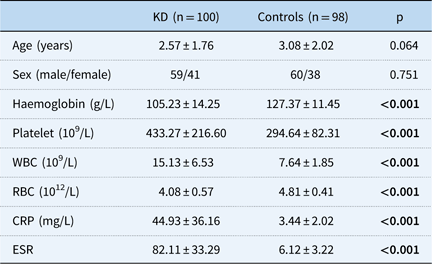
As shown in Table 1, platelet count, white blood cell counts, C-reactive protein, and erythrocyte sedimentation rate were higher in Kawasaki disease patients compared with controls (p<0.001), whereas red blood cell counts and haemoglobin levels were significantly lower in Kawasaki disease patients compared with controls (p<0.05).
Comparison of the general characteristics of Kawasaki disease (KD) patients and control patients.

CRP=C-reactive protein; ESR=erythrocyte sedimentation rate; RBC=red blood cell counts; WBC=white blood cell counts
p Value is for comparison between patients and controls. The bold value is: P<0.001
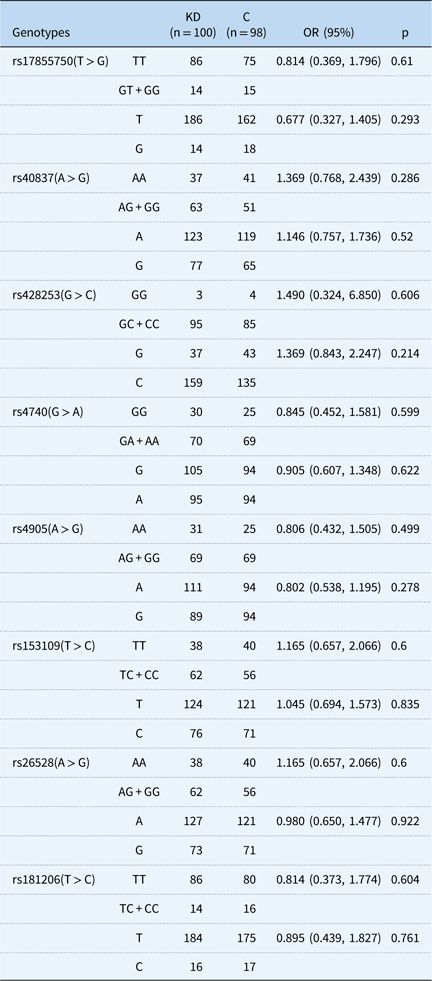
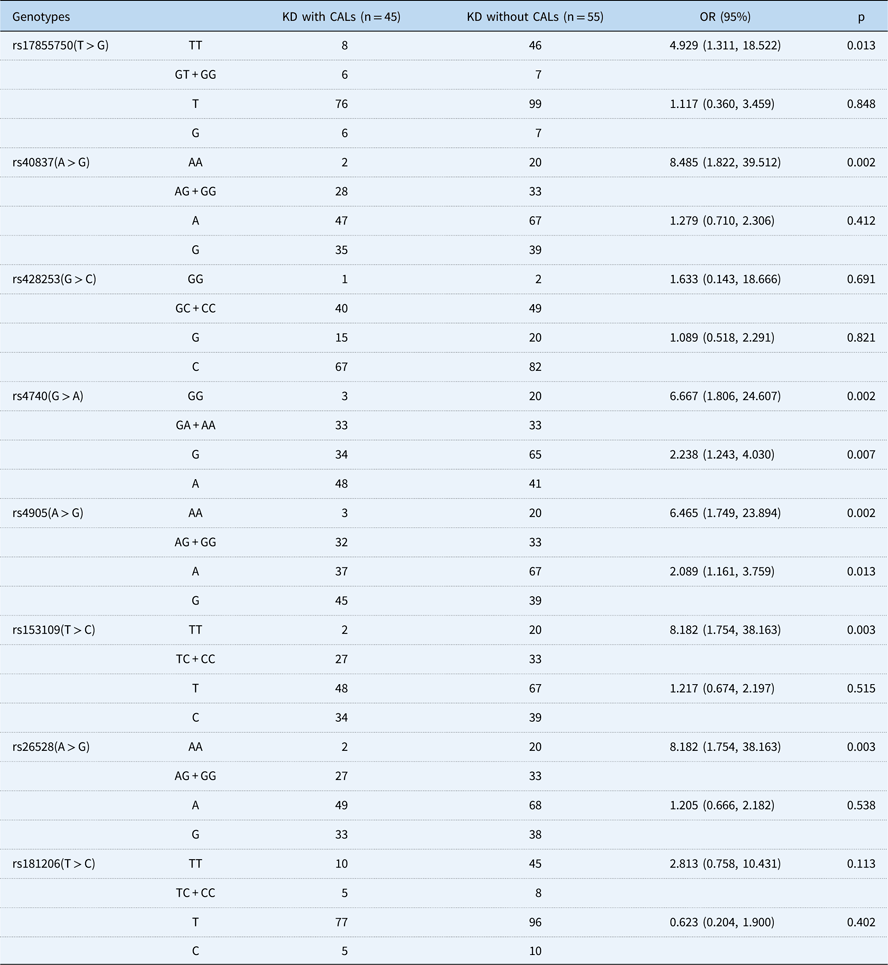
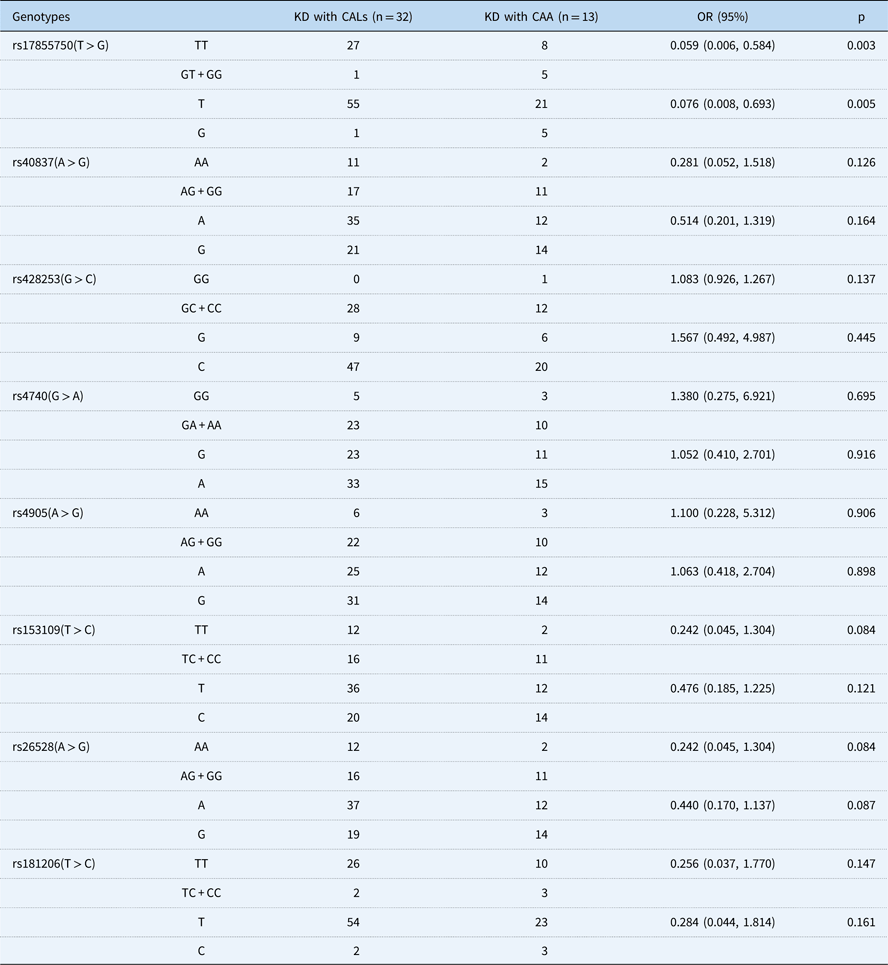
We first investigated genetic associations between the eight selected Interleukin-27 Single-nucleotide Polymorphisms and susceptibility to Kawasaki disease. The genotype frequencies for these eight Single-nucleotide Polymorphisms in the Kawasaki disease control groups are listed in Table 2. There were no significant differences between children with Kawasaki disease and control patients. In the Kawasaki disease patient group, the genotype frequencies of Single-nucleotide Polymorphisms were compared between those with normal coronary arteries and those with coronary arterial lesions (Table 3). Results indicated significantly increased frequencies for the following polymorphisms when comparing Kawasaki disease patients with coronary arterial lesions with those Kawasaki disease patients without coronary arterial lesions: rs17855750 (T>G) (OR=4.929, 95% CI=1.311–18.522, p=0.013), rs40837(A>G) (OR=8.485, 95% CI=1.822–39.512, p=0.002), rs4740 (G>A) (GG to GA+AA: OR=6.667, 95% CI=1.806–24.607, p=0.002; G to A: OR=2.238, 95% CI=1.243–4.030, p=0.007), rs4905 (A>G) (AA to AG+GG: OR=6.465, 95% CI=1.749–23.894, p=0.002; A to G: OR=2.089, 95% CI=1.161–3.759, p=0.013), rs153109 (T>C) (TT to TC+CC: OR=8.182, 95% CI=1.754–38.163, p=0.003), and rs26528 (A>G) (AA to AG+GG:OR=8.182, 95% CI=1.754–38.163, p=0.003). In addition, and as shown in Table 4, there were significantly decreased frequencies for the polymorphism rs17855750 (T>G) (TT to GT+GG: OR=0.059, 95% CI=0.006–0.584, p=0.003) in Kawasaki disease patients with coronary arterial lesions when compared with Kawasaki disease patients with coronary arterial aneurysm.
Genotype frequencies of polymorphisms of the interleukin-27 gene in Kawasaki disease (KD) patients and control patients.

C=control group; CAA=coronary artery aneurysm; CALs=coronary artery lesions; OR=odds ratio
p Value is for comparison between patients with KD and control patients
Genotype frequencies of polymorphisms of the interleukin-27 gene in the groups with coronary artery lesions (CALs) and without CALs.

C=control group; CAA=coronary artery aneurysm; KD=Kawasaki disease; OR=odds ratio
p Value is for comparison between patients with KD with CALs and without CALs
Genotype frequencies of polymorphisms of the interleukin-27 gene in the groups with coronary artery lesions (CALs) and CAA.

C=control group; CAA=coronary artery aneurysm; KD=Kawasaki disease; OR=odds ratio
p Value is for comparison between patients with KD with CALs and with CAA
Discussion
To our knowledge, this is the first study to examine the association between Interleukin-27 polymorphisms and the risk of Kawasaki disease. To this end, we investigated the association between Interleukin-27 gene polymorphisms and the development of coronary arterial lesions in a group of Kawasaki disease patients. In our study population, we found no significant differences in Interleukin-27 gene polymorphisms between Kawasaki disease and control patients. However, our analysis identified a statistically significant association between Interleukin-27 polymorphisms rs17855750, rs40837, rs26528, rs4740, rs4905, and rs153109 and an increased risk of coronary arterial lesions in Kawasaki disease children. Interestingly, we found that the Interleukin-27 polymorphism rs17855750 might also be associated with an increased risk of coronary arterial aneurysm in children with Kawasaki disease. Collectively, our data are the first to suggest that Interleukin-27 polymorphisms may have an important role in the progression of coronary arterial lesions and coronary arterial aneurysm in children with Kawasaki disease.
Interleukin-27 is a heterodimeric cytokine composed of two domains: one encoded by the EBI3 gene and the other encoded by the Interleukin-27p28 gene. The rs17855750, rs181206, rs40837, and rs26528 polymorphisms are located in the promoter region of Interleukin-2 p28, whereas the rs428253, rs4740, and rs4905 polymorphisms are located in the promoter region of Interleukin-27 EBI3. The EBI3 subunit was first identified in 1996 from a subtractive hybridisation screen of genes expressed in Epstein–Barr virus-transformed B-cell lines.Reference Devergne, Hummel and Koeppen 13 A computational approach was then used to identify novel α-helical cytokines of the Interleukin-6 family, leading to the recognition of the Interleukin-27p28 subunit as the partner for EBI3.Reference Pflanz, Timans and Cheung 14 Past work has investigated relationships between Interleukin-27 polymorphisms and other diseases, finding no associations between such polymorphisms and immune thrombocytopaenia, oesophageal cancer, or type 1 diabetes.Reference Zhao, Zhang, Xue, Xu and Fang 15 – Reference Santos, Melo, Crisostomo, Fukui, Matioli and Silva 17 In our results, allelic and genotypic frequencies in Interleukin-27 variants did not differ between patients and controls. Although this work showed that Interleukin-27 polymorphisms did not differ between Kawasaki disease patients and health controls, previous work from our lab has suggested that Interleukin-27 serum levels are elevated in Kawasaki disease patients when compared with healthy controls.Reference Si, Wu, Gao, Feng, Liu and Yi 8 When taken together, these combined results suggest that Interleukin-27 serum levels may not be directly associated with Interleukin-27 polymorphisms.
We found decreased frequency of the rs17855750 TT/ GT+GG genotype in Kawasaki disease patients without coronary arterial lesions when compared with Kawasaki disease patients with coronary arterial lesions. In addition, the rs17855750 TT/ GT+GG genotype and T/G allele were observed in Kawasaki disease patients with coronary arterial aneurysm, but not in Kawasaki disease patients with coronary arterial lesions. This suggests that Interleukin-27 rs17855750 may play a role in Kawasaki disease patients in the risk of developing coronary arterial aneurysm. To this end, recent studies have reported that rs153109 contributes to an increased risk of cancer – e.g. bladder cancer.Reference Zhou, Zhang and Tang 18 Given this, our findings indicate that it might also be a risk factor in other diseases.
In this study, Interleukin-27 rs428253 (G>C) and rs181206 (T>C) were not significantly different across groups, suggesting that rs428253 (G>C) and rs181206 (T>C) may not have an important role in the development of Kawasaki disease.
The potential effect of different Interleukin-27 polymorphisms in inflammatory, allergic, and neoplastic conditions is possibly explained by the environment-dependent dual anti- and pro-inflammatory effects that Interleukin-27 can exert.
To date, we have reported an association between serum Interleukin-27 levels and Kawasaki disease. Although there was no association between Interleukin-27 gene polymorphisms and Kawasaki disease, serum Interleukin-27 levels have been shown to be increased in Kawasaki disease patients when compared with controls.
One major limitation of this study was its relatively small sample size. Future analysis of a larger Kawasaki disease patient group is needed to verify the results presented here.
In conclusion, we found that the Interleukin-27 Single-nucleotide Polymorphisms rs17855750 (T>G), rs40837 (A>G), rs4740 (G>A), rs4905 (A>G), rs153109 (T>C), and rs26528 (A>G) were associated with susceptibility to coronary arterial lesions and coronary arterial aneurysm in children with Kawasaki disease. In particular, rs17855750 (T>G) may be associated with the development of coronary arterial aneurysm in Kawasaki disease patients. After verification by larger-scale studies, some of the selected Interleukin-27 Single-nucleotide Polymorphisms identified here may be candidates for future therapeutic approaches.
Acknowledgements
The authors thank Zhiming Li for his guidance in the statistical analyses.
Financial Support
This study was funded by National Natural Science Foundation of China under grant no. 81270412 and National Natural Science Foundation of China under grant no. 81500273.
Conflicts of Interest
All authors declare that they have no financial or non-financial conflict of interest.
Ethical Standards
All procedures performed were in accordance with the ethical standards of the institutional research committee and with the 1964 Helsinki declaration and its later amendments or comparable ethical standards.