Introduction
Canadians are living longer, but in many cases they face complex health challenges, usually in the form of multiple chronic diseases. These complex health conditions in seniors, which are often poorly studied and characterized, represent a challenge for professionals in identifying optimal treatments or options. This concern was clearly expressed during the “Speaking of Aging Tour” that the Canadian Institutes of Health Research (CIHR) Institute of Aging undertook in 2012. The goal of this consultation was to identify gaps in knowledge and where new research was most needed as well as transfer of existing knowledge to best care practices health services organisations. Information was gathered through a process of web consultation (with 840 respondents) followed by a series of in-person consultations carried out in 16 cities across nine provinces, gathering the feedback and opinions of more than 600 stakeholders. Attendees included researchers, health professionals, policy makers, industry representatives, and representatives of seniors associations. These stakeholders identified the research needed to address the challenges faced by the aging community of Canada and allowed to propose the Institute of Aging 2013–18 Strategic Plan (http://www.cihrirsc.gc.ca/e/documents/IA_Strategic_Plan_En_v5jul13.pdf).
One of the most commonly cited and important challenges identified in the “Speaking of Aging Tour” concerned the late-life portion of the life course trajectory. The expression late-life refers to more than the period that is commonly referred to as end-of-life (see Insert 1); the latter is the object of much research reported in the literature. Late-life is a broader concept used to describe the later stages of life that lead to the end-of-life in the life course trajectory. Throughout this late-life period, individuals and their support systems are often confronted with numerous health and social issues that have an impact on their well-being and contribute to their frailty (Bergman et al., Reference Bergman, Ferrucci, Guralnik, Hogan, Hummel, Karunananthan and Wolfson2007; Clegg, Young, Iliffe, Rikkert, & Rockwood, Reference Clegg, Young, Iliffe, Rikkert and Rockwood2013).
Late-life care options are little understood and poorly studied. It is important, however, to gain insight into these to integrate end-of-life care practices into treatment choices such that seniors benefit from an optimal quality of life in the latter stages of their life course trajectory. Complicating the determination of what is an optimal quality of life in this population is the current lack of clarity on which health care outcomes are most relevant in late-life. Moreover, a limitation of currently described health care outcomes is that they have been often formulated without involving those living with such complex health conditions (Upshur, Kuluski, & Tracy, Reference Upshur, Kuluski and Tracy2014).
An additional challenge is how to provide appropriate support to health care professionals and caregivers advising those at late-life who are deciding on which treatment options to pursue, including when to consider and receive palliative and end-of-life care. A person-centred approach, rather than the traditional “best practice” approach to treatment decisions, is an important element of this support.
The issues surrounding late-life were incorporated within the CIHR Institute of Aging 2013-18 Strategic Plan: Living Longer, Living Better (http://www.cihr-irsc.gc.ca/e/documents/IA_Strategic_Plan_En_v5jul13.pdf).
Within Priority 4 of the Plan (“Health Care and Services that Combine and Integrate Continuity, Innovation and Efficiency”), one of the main issues identified is the availability and the need for evidence to support late-life issues and care decisions – including their ethical and legal dimensions – for the person, the family, health professionals, and policy makers.
The importance of providing older people with high-quality late-life, palliative, and end-of-life care makes it imperative to take concrete steps in this area. It is essential to derive better approaches (models and programs) – for supporting families, clinicians, caregivers, and clinicians – that take late-life and end-of-life issues into consideration in an inclusive environment that facilitates informed decisions. Unfortunately, many of these issues concern care and treatment options which are associated with high degrees of uncertainty regarding potential benefits, harms, and so on.
Additionally, the questions regarding late-life issues are included in the Strategic Plan’s Priority 5 (“Ensuring the Conditions for a Positive Impact on Older People’s Health and Wellness”). Two of the issues emphasized in this priority relate to empowerment of individuals to secure, first, the conditions they need to maintain better health and wellness across the life trajectory and, second, optimal training programs for the health workers and health professionals; both with an emphasis on issues in late-life.
The availability of new knowledge cannot have a positive impact on quality of life without its adoption by health care users and providers. The scarcity of programs and models for empowering people to secure the conditions they need to maintain better health and wellness in the course of aging highlights the need to produce new knowledge on this approach. Priority must be given to activities and strategies to promote health literacy and empowerment throughout the trajectory of aging. These activities and strategies will enable older people to access accurate information, take ownership of it, and use it to manage their health on a preventive as well as curative basis.
Population aging has profoundly altered the health care sector. Training programs for future health care workers, professionals, and administrators, along with continuing education programs, must be adjusted to accommodate these changes.
Lack of Evidence to Guide Late-life Interventions
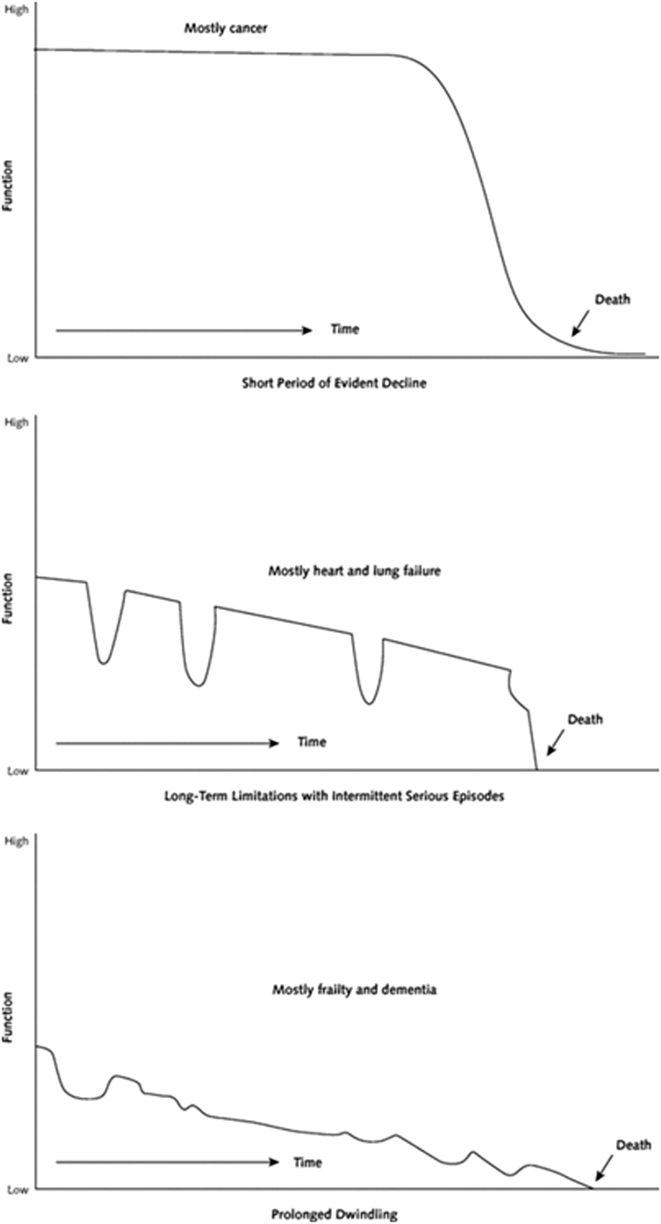
The literature contains very little high-quality evidence to inform health or social care professionals, and policy makers, regarding the late-life period and if such high-quality evidence exists in the field of geriatric medicine, it has not yet been implemented or disseminated sufficiently. Despite extensive literature on interdisciplinary teams, both clinical practice guidelines and “best practices” are limited in their application and, in their recommendations, have often neglected the needs of seniors with medically complex conditions. A review by Lorenz, Lynn, and Dy (Reference Lorenz, Lynn and Dy2008) reported that most of the available evidence for late-life guidelines is essentially targeted at end-of-life issues in health conditions whose outcome is usually predictable, such as those in untreatable cancer conditions (see Figure 1). The authors underscored a specific absence of knowledge with respect to those individuals living with long-term limitations associated with complex chronic diseases, or to those coping with long-term deterioration such as in dementia. One could question however, if the challenge is limited to a lack of knowledge, or to a lack of implementation of existing knowledge, or a combination of both.1
Trajectories of late-life illness (from Lorentz et al., 2008). Copyright © American College of Physicians. All rights reserved

To address this challenge, the CIHR Institute of Aging embarked on a series of stakeholder consultations to better understand the research required by health and social care professionals to provide optimal evidence-based treatment or for decision making or late-life individuals living with the challenges and limitations of major health conditions. To prevent a duplication of efforts, to leverage available resources, and to prepare for possible coordinated funding opportunities, CIHR conducted these consultations in partnership with a newly funded Network Centre of Excellence Technology Evaluation in the Elderly Network (TVN).
Technology Evaluation in the Elderly Network
TVN (Technology Evaluation in the Elderly Network) was funded as a national Network Centre of Excellence (NCE) in July 2012 to identify and address knowledge gaps in the care of seriously ill, frail elderly adults. TVN’s mission is to improve the care of seriously ill, elderly patients and support their families and caregivers through the development, rigorous evaluation, and ethical implementation of health care technologies and interventions across all settings of care – from acute and critical care to community care, including palliative and end-of-life care. Funding research is a core activity for TVN, but the development and training of highly qualified personnel, and knowledge translation, exchange, and mobilization are also recognized as key components of its mandate.
TVN is a multi-sectoral network bringing together academics, industry, health care providers, community organizations, and health care decision makers, all collaborating to mobilize the academic, private, public, and non-profit sectors to generate and implement multifaceted solutions to the complex issue of care for the seriously ill, frail elderly adult.
Late-Life Issues – CIHR and TVN Stakeholder Exchange Meetings
Six exchanges were held across Canada in 2013–14 with close to 100 potential stakeholders to help both the CIHR Institute of Aging and TVN in refining research priorities and shaping future research funding opportunities in relation to late-life issues.
Stakeholder feedback was structured around the following five themes presented at all of the stakeholder exchange meetings on late-life issues.
1. Identifying the optimal approach/care for older adults with complex health conditions (management of multiple chronic diseases or conditions) that characterize the later phases of the life course trajectory.
2. Identifying outcome measures for good quality of care or well-functioning systems targeting persons in late-life.
3. Defining the best methods and approaches to training health care professionals and others to best face, support, and accompany those in late-life.
4. Defining the best ways to support caregivers of those in late-life.
5. Addressing questions relative to how to prepare for late-life issues (public health approach and communication on later life considerations) and attitudes towards discussing these issues.
Feedback and Input Received from the Stakeholder Exchanges
The discussions and exchanges between stakeholders that were held at each of the meetings resulted in an improved understanding of the needs, gaps, and key elements to consider in late-life issues.
More specifically, CIHR and TVN received the following feedback and discussion to address questions related to late-life issue grouped on recommended approaches and themes.
Empowerment and Patient-Centred Approaches
The importance of patient-centred care approaches and empowerment for older adults in late-life and their caregivers was articulated across all consultations. It was further expressed that disease-specific approaches could be limiting in populations with complex co-morbidities.
Key elements discussed included the need to do the following:
• Connect treatment and care across a continuum, and with the inclusion of caregivers, patients, and health care professionals in the care continuum.
• Focus on symptom reduction, increasing quality of life and function as an outcome.
• Consider with the patient and caregiver when it is appropriate to intervene, when to start advanced-care planning, and what constitutes a “good” end-of-life.
• Empower people to optimize health promotion including secondary and, mostly, tertiary prevention, regardless of age, in order to maintain the functional capacity of patients.
• Encourage healthy aging by including exercise and social engagement in long-term care facilities.
• Increase health literacy by increasing access to relevant literature and educational resources.
• Recognize cultural diversity, gender, and social determinants (including isolation) of health.
• Devise alternative approaches to keep late-life older adults in their home environment.
• Address the recognition of end-of-life in our society and acknowledge that aging, death, and grieving are natural processes.
• Acknowledge that for positive messaging – especially in regards to the stigma that accompanies individuals with dementia and with multiple co-morbidities – assumptions are often made on what older people want, usually without consulting them.
Co-morbidities and Multi-disciplinary Care Approaches
Given that most older adults in late-life have multiple co-morbidities, it is important to consider specialized teams to care for elderly adults with late-life issues. The TVN proposed that multi-disciplinary and interprofessional approaches could optimize care and resources, for instance, thereby minimizing visits to many different specialists.
Key elements discussed included the need to do the following:
• Acknowledge that end-of-life care and palliative care involving multiple chronic diseases are very different from palliative care for “single” diseases such as cardiovascular disease and cancer.
• Recognize that aging is an inclusive phenomenon, which includes individuals affected by HIV or mental disabilities such as Down syndrome in which the effects of aging are not necessarily closely related to chronological age.
• Better understand co-morbidities, and late-life issues in regard to long-term care facility treatment, the nursing aspect of caring for affected individuals, and how to optimize medical treatment as well as to look at the drug effects in individuals taking multiple medications for multiple conditions over a long period of time.
Novel Research Areas
As a result of medical advances, Canadians are living longer than ever. This presents new challenges and opportunities.
Key elements discussed included the need to do the following:
• Identify how to manage the health of Canadians throughout the trajectory of aging. Research encompassing a lifespan approach is thus required.
• Recognize that the late-life period with complex co-morbidities is a relatively new phenomenon, stemming from the increase in number of individuals reaching advanced old age.
• Understand the differences between end-of-life issues and late-life issues.
• Establish the best models to identify and measure relevant outcomes, from three perspectives: programmatic, individual, and health systems.
• Consider implementation research to link researchers with clinicians.
• Evaluate the safety and efficacy of medications that are taken for an extended period, in conjunction with other medications, especially as treatment efficacy is extrapolated to older age groups from results in younger age groups and in which complexity of medication regimens is not accounted for.
• Consider lessons learned from the advanced-care program in First Nations communities.
• Assess the best way to translate knowledge into practice for late-life issues and to make knowledge more accessible.
Interventions
How do we prepare for end-of-life issues? What can be offered and when? The participants in the six exchanges stated that there is a need to encourage discussions on end-of-life issues to take place earlier in the life course trajectory. In particular, the final consultation with stakeholders from geriatry emphasized the importance of transforming the already existant knowledge on these issues in the geriatrics field into adequate interventions and planning. In this respect, implementation research would be important to priorize and would allow for the identification, as it moves forward, of the specific gaps in available knowledge.
Key elements discussed included the need to do the following:
• Identify entry points for intervention: for instance, renewal of a health insurance card, or cessation of driving.
• Ensure that existing knowledge is made accessible: for instance, how to use the lessons learned from the advanced-care program in First Nations communities.
Health System
What is the capacity of the health care system for helping individuals achieve a good quality of life? The current care models need to be evaluated in this context. The right level of evidence that would be relevant to practice and that considers the high heterogeneity of this population is needed to evaluate impact and risk. Building on existing measures is ideal, and using innovative research on outcome measures will be appropriate.
Key elements discussed included the need to do the following:
• Ensure that health care models are inclusive of all perspectives (caregivers, patients, care providers).
• Develop metrics for high quality of care, and develop adaptations for patients with late-life issues.
• Consider the importance of technology for patient-informed care.
• Consider international best practices: for example, U.K. community-based care models were formulated with the goal to maintain older adults in their homes for as long as possible.
• Recognize the role of legislation.
• Conduct economic analyses to examine the cost of policies and to make the case for alternative approaches.
Develop Ongoing Training program
Training requires organizational change and change agents. Since late-life issues encompass multiple chronic diseases, training needs to be integrated and broad based, and include the trajectory of aging.
Key elements discussed included the need to do the following:
• Ensure strategies to increase utilization of knowledge.
• Encourage training to support shared responsibilities between care providers and caregivers.
• Develop an approach to training that fosters a more senior-friendly environment.
• Look to other countries for the existence of different training models that Canada might consider.
• Consider e-learning and evaluation of these technologies. Rural and remote locations have technologies already accessible, but they have been poorly evaluated.
Caregivers
There was consensus among stakeholders that in order to maintain the capacity of the patient, and increase their quality of life and functioning, the capacity of the caregiver must be maintained as well.
Key elements discussed included the need to do the following:
• Recognize the “sandwich generation” that often includes individuals in the workforce, and which looks after individuals at both ends of the age spectrum.
• Provide ethical support to caregivers in end-of-life decisions.
• Identify primary care models that incorporate and support caregivers before and after the patient’s’ death. This includes considering models for including the grieving process, and issues of bereavement.
• Identify what legislation might be applicable, including that affecting informal caregivers.
Participants at the stakeholder consultation sessions were very engaged, and we take this opportunity to thank them for having shared their ideas, thoughts, and expertise on late-life issues. Consensus was reached on a number of considerations that will help the CIHR Institute of Aging and TVN to take the most appropriate actions towards increasing the knowledge available to help Canadians who are facing late-life issues.
Towards Funding Opportunities to Provide Evidence to Inform Late-Life Issues
To address these issues involving the later stages of life, the CIHR Institute of Aging and TVN will adopt a coordinated approach. The Institute of Aging, guided by its Advisory Board, will devote part of its strategic initiative budget to encouraging and supporting research aimed at offering relevant evidence for late-life issues from the perspectives of patients, their families and caregivers, health professionals, the health care system, and society (ethics, policy, and legal aspects). TVN will continue to fulfill its mandate by further funding research and knowledge-synthesis research programs informed by the consultation process. The insights gained through the stakeholder exchanges will continue to assist TVN in setting a targeted program of knowledge creation, translation, and mobilization to improve care for frail older adults.
Conclusion
The Canadian population is inexorably aging, and, largely as a result of longevity gains, older people will continue to have a more complex health profile than that of their predecessors. To face this challenge, the CIHR Institute of Aging and TVN are poised to move forward to confront the complex questions related to the late-life issues that will ultimately improve the health and wellness of Canadians.
Insert 1
End-of-life issues are usually associated with a palliative-care approach, defined by the World Health Organization as an approach that improves the quality of life for both a patient and the patient’s family as they face problems associated with life-threatening illness, through the prevention and relief of suffering by means of early identification, assessment, and treatment of pain and other problems: physical, psychosocial, and spiritual.