Introduction
There have been a number of naturalistic studies describing psychiatric intensive care admissions both nationally (Beer et al. Reference Beer, Paton and Pereira1997; Brown and Bass, Reference Brown and Bass2004), internationally (Mitchell, Reference Mitchell1992; Koppelmans et al. Reference Koppelmans, Schoevers, van Wijk, Mulder, Hornbach, Barkhof, Klaassen, van Egmond, van Venrooij, Bijpost, Nusselder, van Herrewaarden, Maksimovic, Achilles and Dekker2009) and across London (Pereira et al. Reference Pereira, Sarsam, Bhui and Paton2005). This has given us a good understanding of the ‘typical’ PICU patient: male, young, with a diagnosis of psychosis and from an ethnic minority. A cross sectional study of PICUs across London in 2006 found that schizophrenia was the predominant diagnosis (in 66% of patients) and in that sample 8% were not transferred to the community or open ward but moved on to other provisions such as medium security or a long stay minimum secure provision (Pereira et al. Reference Pereira, Sarsam, Bhui and Paton2005).
A male preponderance in PICUs is universally described (Bowers et al. Reference Bowers, Jeffery, Bilgin, Jarrett, Simpson and Jones2008a). Are male and female patients on a PICU different? The evidence thus far is that men are more likely to require PICU than women. Whether men and women should be managed together on a PICU is contentious. The Department of Health guidelines in the UK are that mixed sex accommodation should be abolished (DoH, 2001: http://www.dh.gov.uk/en/Healthcare/EMSA/dh_124251) due to concerns about safety, privacy and dignity. In an inspection in 1998, the Mental Health Act commission found only a third of female patients on psychiatric wards had access to a self-contained facility for women (Ford et al. Reference Ford, Durcan, Warner, Hardy and Muijen1998). With fewer women requiring PICU care, the aim of single sex accommodation raises obvious practical difficulties for many trusts if there are not enough female patients to justify their own PICU.
Department of Health guidelines are that patients should stay on a PICU usually no more than 6–8 weeks (Department of Health, 2002). Bowers et al. (Reference Bowers, Jeffery, Bilgin, Jarrett, Simpson and Jones2008a) pointed out that reporting mean length of stay may lead to skewed figures as there are often large differences between mean and median stay. They concluded that most patients stay less than seven days but that there is a substantial number of longer staying patients, skewing the means. The reasons for patients staying a longer time on PICUs has not, to our knowledge, been researched despite this being both resource intensive and, it can be argued, not keeping with the philosophy of the aims of PICU care.
Aggression appears to be the most common reason for admission to a PICU (Crowhurst & Bowers, Reference Crowhurst and Bowers2002; Pereira et al. Reference Pereira, Sarsam, Bhui and Paton2005) and aggressive incidents after admission are commonly described (Walker & Seifert, Reference Walker and Seifert1994; Palmstierna et al. Reference Palmstierna, Huitfeldt and Wistedt1991; Vaaler et al. Reference Vaaler, Iversen, Morken, Flovig, Palmstierna and Linaker2011). Attempts have been made to predict aggressive incidents and some use of scales has been found to be helpful (Vaaler et al. Reference Vaaler, Iversen, Morken, Flovig, Palmstierna and Linaker2011). Men have been found to be responsible for the majority of incidents; forensic history and substance use predict violence (Vaaler et al. Reference Vaaler, Iversen, Morken, Flovig, Palmstierna and Linaker2011), whilst Muthukumaraswamy et al. (Reference Muthukumaraswamy, Beer and Ratnojothy2008) found a high number of previous admissions and auditory hallucinations predictive of violence.
South West London and St George's Mental Health Trust serves a large area of South London, across five boroughs (Wandsworth, Merton, Kingston, Richmond and Sutton). There are currently two PICUs in the Trust: Ward One, a ten male bed PICU, and Shamrock a seven bed mixed gender PICU. Women from all five boroughs are admitted to Shamrock only. Men from Kingston and Richmond are in the first instance admitted to Shamrock but may be admitted to Ward One if there is a history of inappropriate behaviour towards women. Men from Wandsworth, Merton and Sutton are in the first instance admitted to Ward One. Bed pressures on one PICU often mean that men are admitted to the alternative PICU.
Minimum secure provision in the Trust comprises of a mixed gender long stay rehabilitation ward and a minimum secure male forensic long stay ward. There is a forensic medium secure unit within the Trust with male and female wards. Both PICU wards had a 136 suite at the time of data collection.
The Trust serves a population of approximately one million people. The index of local deprivation varies between the Boroughs with 144 for Wandsworth (suggesting a high level of deprivation) to 309 for Richmond (a low level). In terms of ethnic mix within the boroughs, 22% of the Wandsworth population are from an ethnic minority, and 11% for Richmond; both lower than the current estimate in London of 35% (Wandsworth PCT, unpub. report, 2008: http://s3.amazonaws.com/zanran_storage/www.wandsworth-pct.nhs.uk/ContentPages/131028764.pdf).
Method
South West London and St George's Mental Health NHS Trust undertook a service review in 2010 of the PICU provision within the Trust. As part of the service review all the admissions for a one year period to the two PICUs within the Trust were examined; between April 2009 and March 2010. The data collection happened in July and August so that the outcome of admissions could be established.
Discussion with National Research Ethics Service and the local Research and Development office confirmed that this was service evaluation and did not require ethics approval. All data were anonymised.
Information regarding gender, age, primary diagnosis, ethnic group number of admissions and length of stay was recorded. The outcome destination of the patient was also recorded (open ward, rehabilitation ward, forensic ward or other). The primary diagnosis on the electronic notes system (rio) was recorded. The indication for admission to the PICU was documented and any untoward or aggressive incidents whilst on the PICU were recorded. This information was coded and a brief qualitative summary for each incident performed. For coding, the incidents were divided in to: physical aggression; verbal aggression; arson; weapon; sexual assault; sexual disinhibition; self-harm; absconding; hostage taking.
It was decided to analyse the data by subject rather than by admission so as not to skew the diagnosis, gender and ethnicity figures. Statistical analysis was done using SPSS version 19. Chi squared analysis was used for categorical data and Mann Whitney U tests for continuous skewed data. Regression analysis in the form of binomial logistic regression was performed to examine predictors of outcomes such as physical aggression and needing to move into a long term provision. All independent variables were entered simultaneously.
Results
Subjects
Over the study period 91 patients were admitted to the two PICUs in the Trust. Of these admissions, 74 patients were admitted once, 12 twice, seven three times, three four times and one patient had seven admissions. Men were much more likely to be admitted than women; 77 (85%) of the admissions were men and 14 (15%) were women.
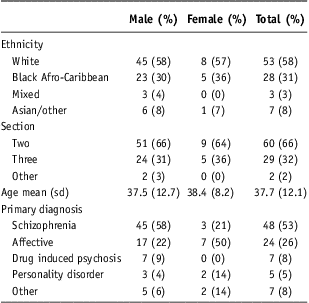
The characteristics of the subjects comparing men and women can be seen in Table 1.
Characteristics of subjects showing differences of the male and female populations by ethnicity, age, section and primary diagnosis
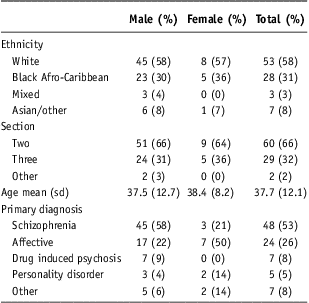
The primary diagnosis was overwhelmingly schizophrenia, with 48 patients (53%) having this diagnosis. Just over half of (58%) of the patients were white. The age range of subjects was 17–54. Women were slightly older than men; the mean age of women was 38.4 and men was 37.5; this was not a statistically significant difference (t = −0.360, p = 0.722, df 89). Because of the small number of women it was not possible to establish differences between men and women in terms of ethnicity and diagnosis.
Length of stay
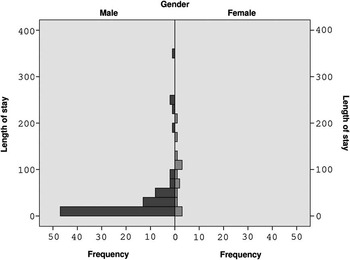
The mean length of stay was 42.8 days (SD 64.1) and the median 17 days. There was a marked difference between the length of stay of men and women (Fig. 1); the mean was 35.3 days (sd 62.2) for men and 83.9 days (sd 60.2) for women, median 14 days for men and 61 days for women. This was a significant difference (U = 254.5, p = 0.002). There was no difference in length of stay between the two wards (U = 856.0, p = 0.212). Seven of the women stayed on the PICU for more than seven months.
(Colour online) Mean length of stay for men and women.

Reasons for admission
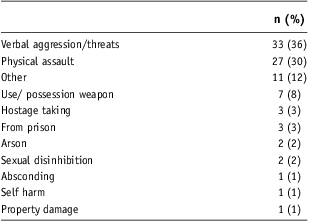
Reasons for admission can be seen in Table 2. Numbers for women were too small to establish any differences between men and women in terms of reason for admission. The most common reason for admission to the PICU was verbal threats or verbal aggression (36%); it was often documented that these patients had a history of physical aggression when unwell.
Reasons for admission to the PICUs
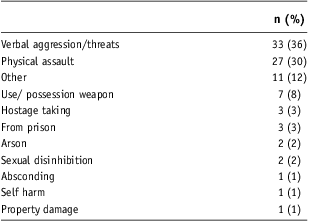
27, or 30%, of patients were violent prior to the admission; five to police, nine to the public or family members but the majority (13) were aggressive towards staff and other patients on the open wards. Other reasons for admission included carrying a weapon, arson, sexual disinhibition or sexually inappropriate behaviour and absconding. One male patient was admitted seven times mainly because of repeated absconding; he was the only patient admitted because of absconding over the time period.
Incidents on the PICU
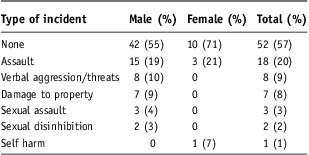
There were five incidents of sexually disinhibited or inappropriate behaviour, all in men. Examples included exposing themselves to or trying to inappropriately touch female staff members. Table 3 illustrates how all incidents were divided by gender.
Incidents on PICU by gender
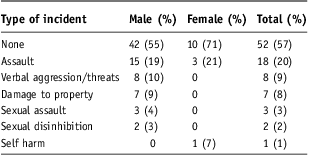
Whilst on the PICU 20% of patients committed an assault, 3% a sexual assault, 1% self-harmed, 9% were verbally aggressive and threatening. After going through the qualitative comments these were categorized into: serious aggression, weapon, hostage, physical assault, sexual assault and less serious aggression. 22, or 24%, of patients committed an offence considered to be serious by the researchers.
The independent variables gender, age, ethnicity, days on PICU and number of admissions were entered into binary logistic regression and none of them predicted aggressive incidents.
Next destination for the patients
The vast majority (83 or 91%) of the patients were discharged to an open ward. Six (7%) went to forensic wards, one (1%) to rehab and one patient (1%) directly to prison from the PICU. This group consisted of five men and three women. This difference between genders did not reach statistical significance (chi-square = 3.3, p = 0.069).
Independent variables entered into binary logistic regression were: number of admissions, incidents in the PICU (aggressive and sexual), ethnicity, gender and days on the PICU. The only predictor of requiring a higher level of security or long stay ward after logistic regression was length of stay on the PICU itself (p = 0.04, ExB 1.034, df = 1, SE 0.012).
Discussion
The study describes the pattern of use of the two PICUs in a large South-west London trust. It is an analysis of every patient requiring PICU admission throughout one year, from March 2009 to April 2010.
The main findings were:
• Men were much more likely to need PICU than women
• Women stayed longer on the PICU than men
• Aggression and sexually inappropriate behaviour was common but there were no demographic predictors of aggression
• the only predictor of requiring long term placement was having been a long time on the PICU
Limitations and advantages of the study
The main limitation of the study was the relatively small sample size, especially given the small number of women. The diagnosis was based on the electronic record of diagnosis and no further diagnostic instrument was used. This was for the purpose of simplicity and because secondary diagnoses were not always well documented; but meant that the complexities of co-morbid diagnoses could not be considered. The study was based at one London Trust so is of limited generalisability. The study had the advantage of examining one year's cohort which may be more representative than a cross sectional study. Although based in one Trust, it is a very large one serving a population of a rich demographic and ethnic mix.
Gender differences
One of the key areas under examination was whether differences would be found between male and female patients in terms of diagnosis and reasons for admission, admission and discharge variables, incidents on PICU and predictors of aggression. The present findings show that there are some considerable differences in the way male and female patients use the PICUs in this Trust. Many more men than women were admitted throughout the year, a finding that has been reported in a large number of previous studies describing the demographics of PICU patients (Bowers et al. Reference Bowers, Jeffery, Bilgin, Jarrett, Simpson and Jones2008a). The data at the Trust had never been examined in detail and the difference between numbers for men and women was a surprise to the authors. Few authors have ventured an explanation as to why the male to female ratio on PICUs can be as high as 5:1, as found here. One explanation could be that primary care and mental health services ‘upstream’ to PICU are failing in the capacity of early case recognition and intervention for men. There is some evidence (Krakowski et al. Reference Krakowski, Volavka and Brizer1986) that women are less likely to be aggressive; as aggression is the primary reason for PICU admission this will presumably go some way to explaining the differences.
Whilst the median length of stay for men and women on the PICU was similar, the mean length of stay for women was pushed up by a group whose admission lasted more than three months. Half of the women admitted stayed for longer than three months. It has previously been noted that most PICU admissions are for less than a week (Bowers et al. Reference Bowers, Jeffery, Bilgin, Jarrett, Simpson and Jones2008a). It has been suggested that prolonged length of stay on PICU may be due to inability or refusal of local services to accept patients or inappropriate acceptance of referrals to PICU (Michalon & Richman, Reference Michalon and Richman1990). Our finding that a substantial number of female PICU patients are long-stay patients has not been noted previously, and may reflect local variation rather than a national gender trend (especially as there is no Trust forensic minimum secure forensic provision for women). However, it is known that women in medium secure settings tend to have committed less serious offences than men (Lart et al. Reference Lart, Payne, Beaumont, Macdonald and Mistry1999), suggesting that the problem of a lack of minimum secure provision may not be a localised one. It is increasingly recognised that women are a special group within the criminal justice system with a disproportionate increase in women incarcerated in recent years despite their high levels of vulnerability and mental health problems (Hale, Longford Lecture, 2005: http://www.longfordtrust.org/lecture_details.php?id=10) and there may be parallels in secure psychiatric settings.
No data are available regarding national minimum secure bed numbers and how many there are available for women. There has been some suggestion from the literature that women in secure settings are more likely than men to have a diagnosis of personality disorder (Long et al. Reference Long, Webster, Waine, Motala and Hollin2008) but no differences in diagnosis were found between men and women in this study; small numbers may have influenced this.
The patients on the PICUs were more likely to from an ethnic minority (42%) than both the local population and London generally (22% Wandsworth, 35% London). This has been reported and discussed elsewhere (Bowers et al. Reference Bowers, Simpson, Nijman and Hall2008b; Feinstein & Holloway, Reference Feinstein and Holloway2002).
Once on the PICU, there were no differences in terms of incidents or of outcomes between ethnic groups.
Reason for admission
The reason for admission, as has been found in many other studies, was predominantly aggression. It is worrying to note how many assaults there were on members of the public or family members. There were no demographic or clinical predictors of violence, in particular there were no differences by ethnicity; numbers were too small to investigate differences by gender.
Conclusion
It has long been noted that although women are not a minority, they are often minoritised, and there is ongoing debate about the need for development of psychiatric services to meet the gender-specific needs of women (Kohen, Reference Kohen2001). If replicated, this study suggests that there may be a group of women patients who are currently receiving long-term care in PICUs, which seems inappropriate given that the model of PICU is to provide short term care for acutely disturbed patients for up to eight weeks (Department of Health, 2002). A better understanding of this patient group might lead to the development of services better able to meet their medium and long-term mental health needs. Are women being housed in PICUs inappropriately because of lack of provision?
This study is the first to observe that male and female patients use psychiatric intensive care units in remarkably different ways, suggesting that research towards the development of gender-specific units may be warranted.
Acknowledgments
We would like to acknowledge the following people: Dr Mary Harty, Dr Martin Humphrey, Roz Plowright and Peter Nash who were all involved in the original service evaluation. Dr Sarah White gave advice regarding statistical analysis.