Introduction
Even though wild relatives and traditional varieties of crops could serve as potential sources of new genes and offer untapped wealth of novel traits against upcoming biotic and abiotic threats (Tanksley and McCouch, Reference Tanksley and McCouch1997; Dillon et al., Reference Dillon, Shapter, Henry, Cordeiro, Izquierdo and Lee2007), the attention given to wild sorghum conservation in Ethiopia has been nearly negligible. Moreover, very limited research (Ayana et al., Reference Ayana, Bekele and Bryngelsson2001; Tesso et al., Reference Tesso, Kapran, Grenier, Snow, Sweeney, Pedersen, Marx, Bothma and Ejeta2008; Adugna and Bekele, Reference Adugna and Bekele2013a; Adugna et al., Reference Adugna, Snow, Sweeney, Bekele and Mutegi2013a) has investigated the population structure and mating systems, yet these are important steps on the effort towards the conservation and use of these valuable genetic resources. Determining the level of gene flow between crops and their wild relatives under their natural environmental conditions is also critical for conserving wild germplasm (Ellstrand et al., Reference Ellstrand, Prentice and Hancock1999; Jarvis and Hodgkin, Reference Jarvis and Hodgkin1999).
Africa is the largest producer (41.2%) of sorghum in the world with 25.7 million tonnes of grain contribution (FAOSTAT, 2013). Ethiopia shares 17% of the total sorghum production (4.34 million tonnes) and 7% of the area coverage (1.84 million hectares) in Africa (FAOSTAT, 2013). Due to the increasing deployment of genetically modified (GM) crops in developing countries (James, Reference James2014), scientific risk assessment of gene flow from transgenic plants and their impact on conventionally bred crops and crop–wild relatives is needed to establish adequate biosafety regulations and measures. For example, it is important to understand the level of outcrossing, fitness of crop–wild hybrids and seed dormancy and longevity traits under current field conditions. Assessment of gene flow and its consequences should also include studying the species biology such as sexual compatibility, presence of related species, seed dispersal, fecundity and dormancy (Van Deynze, Reference Van Deynze2011) since seeds and pollen are the vehicles of gene dispersal and movements in plant species.
Although centres of diversity of crop species are often mentioned in discussions of risk assessment for GM crops (Gepts and Papa, Reference Gepts and Papa2003; Haygood et al., Reference Haygood, Ives and Andow2003), limited work has been done so far to address the issue of gene flow under field conditions in sorghum in the centre of origin, Ethiopia (Adugna et al., Reference Adugna, Snow, Sweeney, Bekele and Mutegi2013a). To date, no transgenic sorghum is under commercial production, but it is under development for improving the nutritional traits (Zhao, Reference Zhao, Xu, Li, Xue and Weicai2007) as there is evidence that biofortification of sorghum can enhance total and bioaccessible provitamin A carotenoid levels (Lipkie et al., Reference Lipkie, De Moura, Zhao and Ferruzzi2013). The Africa Biofortified Sorghum (ABS) Project developed the first transgenic sorghum (‘Golden sorghum’), which has high levels of pro-vitamin A and aminoacids (lysine and threonine) and low phytate (http://biosorghum.org/abs_tech.php, accessed 14 January 2016). As part of a project on risk assessment of transgenic sorghum in Africa, separate reports have been published (Adugna, Reference Adugna2013; Adugna and Bekele, Reference Adugna and Bekele2013a, Reference Adugna and Bekeleb; Adugna et al., Reference Adugna, Snow, Sweeney, Bekele and Mutegi2013a, Reference Adugna, Sweeney and Bekeleb; Adugna and Bekele, Reference Adugna and Bekele2015). This paper intends to compile and present in a summarized form the major findings and recommendations on risk of crop–wild gene flow in the crop–wild–weed Sorghum bicolor complex in Ethiopia based on indirect estimates.
Materials and methods
Study of geographical distribution and in situ phenotypic diversity
To study the geographical distribution, phenotypic and simple sequence repeat (SSR) diversity, the range of co-occurrence and gene flow between wild/weedy and cultivated sorghum, survey was made in October and November in 2008 and in 2009 to five geographical regions of Ethiopia belonging to eight of the 32 major agroecologies.
All of the three subspecies of S. bicolor (L.) as described by de Wet (Reference de Wet1978): subsp. bicolor, subsp. drumonddii and subsp. verticilliflorum were considered for the study. Seed from a total of 600 wild and weedy and 160 cultivated sorghum samples representing 30 and eight populations, respectively, were collected after in situ phenotypic measurements were recorded. Post-harvest data were also recorded from the seed in the laboratory. Detail procedures including area map are available in Adugna and Bekele (Reference Adugna and Bekele2013a) and Adugna (Reference Adugna2014).
Population genetic structure, gene flow and genetic diversity in wild and cultivated sorghum using SSR markers
Genomic DNA extraction
Out of the 38 total populations (760 individual plants) sampled, genomic DNA samples were collected in situ from 19 wild (380 individual plants) and eight (160 individual plants) cultivated sorghum populations. DNA was extracted in two steps: in situ collection of leaf squashes from live plants using the Whatman FTA cards and Whatman chromatography paper in Ethiopia, and sample purification following the manufacturer's procedure and optimized for sorghum by Adugna et al. (Reference Adugna, Snow and Sweeney2011) in Aronoff J. Laboratories, Ohio State University.
Polymerase chain reaction (PCR) and SSR fragment detection
PCR were run using 12 sorghum microsatellite loci that were previously mapped (Brown et al., Reference Brown, Hopkins, Mitchell, Senior, Wang, Duncan, Gonzalez-Candelas and Kresovich1996; Taramino et al., Reference Taramino, Tarchini, Ferrario, Lee and Pe1997; Bhattramakki et al., Reference Bhattramakki, Dong, Chhabra and Hart2000; Li et al., Reference Li, Yuyama, Luo, Hirata and Cai2009) and represented all of the ten sorghum linkage groups. These loci were selected based on high polymorphism and compatibility for multiplexing. Three loci (Sb6-342, Sb4-15 and Sb5-236) failed to amplify in many samples from four of the 19 wild populations (populations AW, H-2, T-1 and W-7) and hence were excluded from the final analyses. Thus, this report is based on the nine SSR loci, which were highly polymorphic across all the populations. PCRs followed the QIAGEN® multi-master mix kit protocol for SSR multiplex. The details of the procedures of PCR and fragment detection using ABI 3100 Genetic Analyzer (DNA sequencer) are found in Adugna et al. (Reference Adugna, Snow, Sweeney, Bekele and Mutegi2013a, Reference Adugna, Sweeney and Bekeleb). To verify the repeatability of allele scoring, samples of a well-studied sorghum inbred line, BTx623, were included. To exclude the possible effects of imprecise DNA fragment sizes due to stuttering, large allele drop out, or null alleles on genotyping, the software Allelobin (Prasanth et al., Reference Prasanth, Chandra, Jayashree and Hoisington2006) was used to classify observed SSR allele sizes into representative discrete allele sizes using a variation of the least-squares minimization algorithm of Idury and Cardon (Reference Idury and Cardon1997).
Estimation of multilocus outcrossing rate in wild sorghum
This experiment comprised seven populations from diverse geographical regions (Abuare, Bisidimo, Gibe, Hagereselam, Humera, Kobo and Mandura). Seeds from each of the 20 plant samples in each of the seven populations were grown in separete pots in the green house. DNA samples were collected following the method mentioned above from eight individuals in each pot representing a family. Therefore, a total of 1120 progeny plants (7 populations × 20 individuals × 8 progenies) were assayed. In addition, 140 maternal plants were included (Adugna et al., Reference Adugna, Sweeney and Bekele2013b).
Estimation of fitness of wild × crop F1 hybrids
In 2010, 46 crosses were made among 23 wild and two cultivated sorghum lines. Of these, seven F1 crop–wild hybrids were selected based on availability of adequate seed. A total of 16 entries including hybrids, their cultivated and wild parents were organized in a randomized complete block design with five replications. The details are found in Adugna and Bekele (Reference Adugna and Bekele2013b).
Data recording and statistical analyses
SSR polymorphism and analysis of genetic diversity
Different measures of diversity were analysed in both the cultivated and the wild sorghum using two or more population genetics software programs (Adugna et al., Reference Adugna, Snow, Sweeney, Bekele and Mutegi2013a). Shared alleles distance matrix (Jin and Chakraborty, Reference Jin and Chakraborty1994) was used to construct unweighted pair-group method using arithmetic averages (UPGMA) clusters for the various populations using PowerMarker, and the resulting UPGMA trees were viewed using TreeView 1.6.6 (Page, Reference Page2001, available at, http://taxonomy.zoology.gla.ac.uk/rod/rod.html). The tree was transferred to Interactive Tree Of Life v2 web-based program (Letunic and Bork, Reference Letunic and Bork2011) to get the finish.
Population structure and gene flow
Of the 38 total populations previously studied, 20 including 12 wild and eight cultivated sorghum populations, which were collected in sympatric ranges were used for this study. In this paper, the wild sorghum populations were given codes ‘W’ and the cultivars ‘C’. Accordingly, wild populations from Gibe geographical region were from W1 to W3, populations from Pawe from W4 to W7, and populations from Wollo were from W8 to W12. Similarly, the cultivars from Gibe were from C1 to C2, from Pawe were C3 to C4, those from Wollo were from C5 to C8.
F statistics (F ST) was computed using FSTAT software to see the pattern of population structure among the different wild and cultivar populations. In order to estimate the level of divergence between wild and cultivated sorghum, F ST was computed by grouping the whole data set into wild and cultivated using FSTAT (Goudet, Reference Goudet2002). Detection of probable introgression was visualized using STRUCTURE, a Bayesian model-based clustering method. The detailed procedures are found in Adugna et al. (Reference Adugna, Snow, Sweeney, Bekele and Mutegi2013a). To study the distribution of the components of variance within and among the 12 wild sorghum populations, the eight cultivar populations, and crop–wild combinations, analysis of molecular variance (AMOVA) was performed using Arlequin v 3.1 (Excoffier et al., Reference Excoffier, Laval and Schneider2005). Indirect estimate of gene flow was computed based on the number of migrants per generation (N m) using Wright (Reference Wright1951) fixation index (F ST) as follows:
 $$N_{{\rm m =}} \displaystyle{{1 - F_{{\rm ST}}} \over {4F_{{\rm ST}}}}.$$
In situ outcrossing rate in wild sorghum
The extent of multilocus outcrossing rate was estimated in seven wild sorghum populations using multilocus mating system program [MLTR for windows revised version 3.3 (Ritland, Reference Ritland2008) accessible at ‘http://genetics.forestry.ubc.ca/ritland/programs.html’]. It was estimated both at the population level and at the family level based on the mixed mating model of Brown and Allard (Reference Brown and Allard1970). The significance of the multilocus outcrossing rates of the different populations was tested using Wilcoxon paired-match test using GenStat Software 15th ed. Moreover, the presence of biparental inbreeding was tested as a difference between multilocus and multilocus outcrossing rates. The detail is available in Adugna et al. (Reference Adugna, Sweeney and Bekele2013b).
Fitness of wild × crop F 1 sorghum hybrids
Data on phenotypic traits were recorded at the three main life history stages: juvenile survival, adult phenological and fecundity/fertility following Burke et al. (Reference Burke, Carney and Arnold1998). To assess variation among the genotypes (parents and crosses) all measured variables were subjected to analysis of variance and mean separation by Duncan's Multiple Range Test (DMRT) using SPSS Release 17.0. Two methods were followed to estimate the level of fitness: mid-parent heterosis and direct comparison of relative fitness. Relative fitness of the hybrids and their parents was computed following the procedure of Song et al. (Reference Song, Lu, Wang and Chen2004).
Results
SSR polymorphism, population genetic structure and relationships among wild and cultivar populations
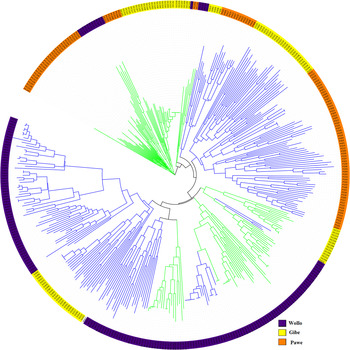
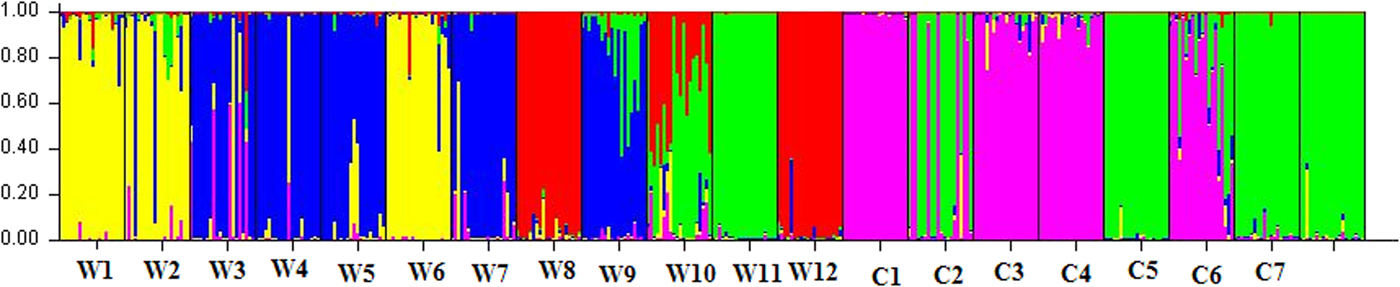
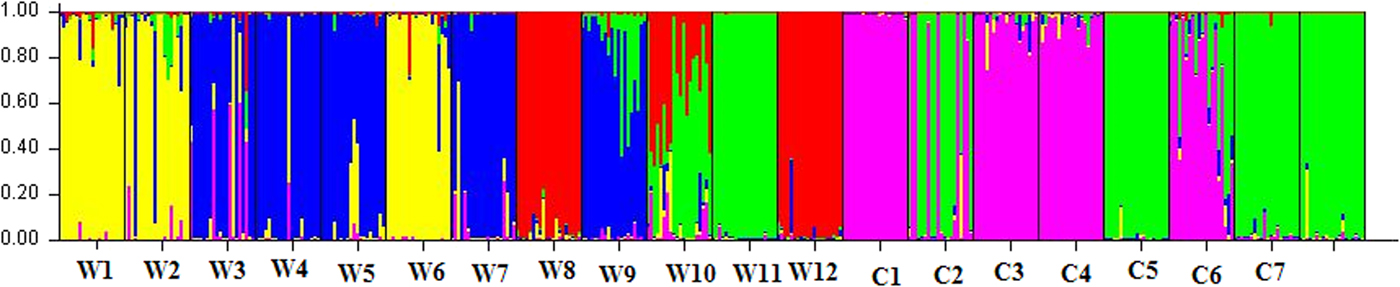
The nine polymorphic SSR loci produced a total of 177 alleles from 540 individual samples pooled from the wild and cultivated sorghum. The wild populations had a total of 165 alleles, of which 117 (71%) were rare. The cultivated sorghum also had 97 alleles, of which 64 (66%) were rare. The polymorphism information content in the pooled crop–wild samples ranged from 0.63 (SbKAFGK1) to 0.92 (Sb1-1) with a mean of 0.79. Evanno et al. (Reference Evanno, Regnaut and Goudet2005) analysis predicted four clusters when it was run for all of the 27 populations (Adugna et al., Reference Adugna, Snow, Sweeney, Bekele and Mutegi2013a), but it predicted five optimal clusters when it was run for 20 populations (12 wild and eight cultivated) (online Supplementary Fig. S1), which were collected in similar areas in the three geographical regions. In Figs 1 and 2, some wild populations in Wollo geographical region were found to cluster together with the adjacent cultivar populations. Overall, the results suggest that wild populations showed some level of relatedness with the cultivars, which was more in Wollo region.
UPGMA clustering of wild and cultivated sorghum populations from three geographical regions (represented by three outer colour ranges) where they co-occur (internal clades and nodes, Green = cultivated, Blue = wild).

STRUCTURE bar graph of the 12 wild and eight cultivated sorghum populations at k = 5. Wild populations: W1–W3 Gibe, W4–W7 Pawe, W8–W12 Wollo. Cultivated populations: C1–C2 Gibe, C3–C4 Pawe, C5–C8 Wollo (see online Supplementary Table S1). In the bar graph, each individual plant is represented by a single line, which has one or more colours, depending on whether it shared alleles or not with other individuals in the populations.
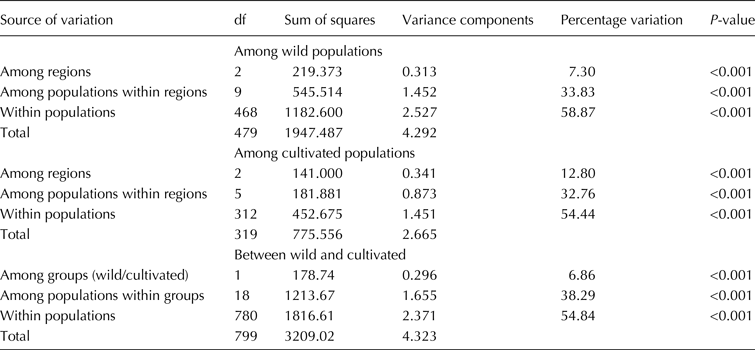
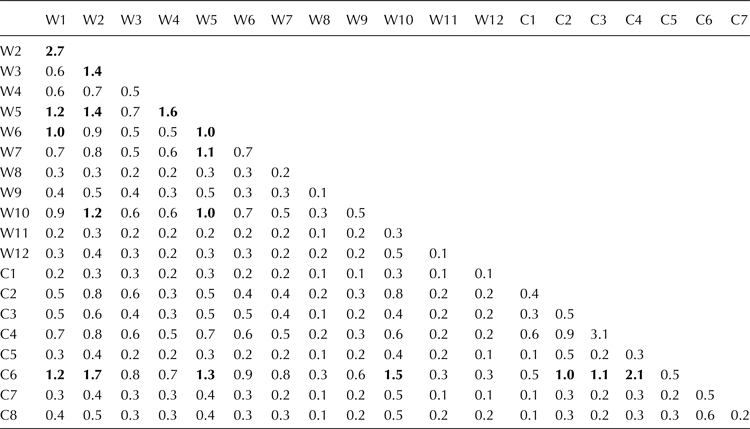
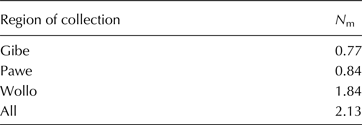
The genetic differentiation displayed in the wild populations was very great (F ST = 0.374). To some extent the differentiation was associated with the geographic distance as some of the adjacent populations were more related than the remote ones. AMOVA confirmed that 7.30, 33.83 and 58.87% of the variation were due to among the regions, among populations within the regions, and within the populations, respectively (Table 1). This shows that gene flow among the wild sorghum populations was very limited (N m = 0.43). But it was higher in some adjacent wild populations (Table 2). Similarly, 12.80, 32.76 and 54.44% of the variation in the cultivars was found to be due to regions, among populations within regions, and within populations, in that order (Table 1). Further, AMOVA of the wild and cultivated sorghum showed that 6.86, 38.29 and 54.84% of the variation was due to groups (crop/wild), among populations within groups, and within populations, respectively. The genetic structure of the wild sorghum populations was generally not affected by their geographical origins. Consequently, only a few populations revealed such kind of geographical clustering (Fig. 1). Table 3 shows regional estimates of crop–wild gene flow as measured by the number of migrants per generation (N m). Hence, Wollo region had the highest crop–wild gene flow (N m = 1.84) of all the three regions of collection. The overall gene flow estimates between the crop and the wild was found to be higher (N m = 2.13) than that in the wild (N m = 0.43) and in the cultivars (N m = 0.89).
Global AMOVA among wild populations and among cultivated populations collected from three regions, and between the wild and cultivated groups as a weighted average over loci

Matrix representing the number of migrants per generation (N m) as an indirect measure of gene flow among wild, among cultivar and among crop–wild populations (W stands for wild and C for cultivar). N m values of ≥1 are in boldface.

Regional crop–wild sorghum gene flow estimated from the number of migrants per generation (N m)

Estimation of in situ outcrossing rate in wild/weedy sorghum
Populations originated from different geographical regions showed significantly different (P = 0.016) multilocus outcrossing rate. The range of multilocus population outcrossing rate (t m) was found to be from 0.33 (Humera/Donkey) to 0.65 (Abuare), with average 0.51. But in some families (family outcrossing rate), the value was in the extreme range of 0–100%. Mating between related individuals (Biparental inbreeding) was also observed in all populations with variable magnitude. The single locus outcrossing rate (t s) was consistently smaller than that of the multilocus outcrossing rate (t m) in all of the seven populations studied.
Morphology and fitness of wild × crop F 1 hybrids of sorghum
There were significant differences among the crop–wild hybrids and their parents for juvenile survival traits (seed germination and emergence). Early and complete laboratory seed germination and field seedling emergence were considered better fitness for juvenile survival traits. In general, hybrids emerged later in the field than their parents though some of them were observed to have better mean laboratory germination than their wild parents. Most of the hybrids showed better parent heterosis for plant height, but they had significantly smaller number of tillers than their wild parents. All of the hybrids were found to have leaves, which were larger in number and wider in size. They were also observed to have larger number of seeds (higher fecundity) than both of their parents. Generally, mid-parent heterosis was observed in all the traits studied, except for days to seedling emergence and number of tillers per plant (online Supplementary Table S2).
Comparison of the relative performance of the crop and wild parents with their hybrids (relative fitness) showed superioriority of the hybrids for plant height and number of seeds per panicle. But cultivar parents had higher fitness for leaf characters (flag leaf length and width, and leaf number) than both the wild and the hybrids. Wild parents had the lowest fitness for these characters, but their fitness was higher for number of tillers per plant. Therefore, hybrids had lower juvenile survival fitness, but higher reproductive fitness than their wild parents.
Discussion
Analysis of genetic diversity and population genetic structure in wild and weedy sorghum
Wild sorghums were found to exist in Ethiopia in sympatric and allopatric ranges to the cultivated sorghum in a wide range of geographical regions and agroecological zones. They are mostly common in the lowlands (<1600 m) and in the intermediate altitudes (1600–2000 m) of Ethiopia where most of the sorghum production takes place (Adugna and Bekele, Reference Adugna and Bekele2013a). These regions are characterized by mixed crop–livestock production farming systems. However, the abundance varies with region of collection. Accordingly, the Benishangul Gumuz region, which is found in Northwestern Ethiopia bordering Sudan harboured more wild sorghum populations. The possible reasons for higher abundance may be the availability of more undisturbed areas such as high natural forest coverage, the high temperature and rainfall, a characteristic of the Savanah climate that favours their adaptation and the small livestock population in the region (Adugna and Bekele, Reference Adugna and Bekele2013a). Depite this high abandence, the diversity was lower in this region than others, which may indicate recent introduction of wild sorghum to the area.
Both phenotypic and SSR assays confirmed the presence of high diversity in the wild sorghum, but the divergence among the sampled populations was also high. There was little structuring of the diversity due to the geographical classifications of the collection sites, but agroclimatic grouping was stronger. Moreover, there were similar patterns of population grouping using UPGMA dendrograms and STRUCTURE bargraphs. Gene flow among the wild/weedy sorghum populations was also very low. One possible reason for low gene flow could be the famers’ practices of removing weedy sorghum before flowering and/or seed setting and feeding to their animals, which limits outcrossing (Tesso et al., Reference Tesso, Kapran, Grenier, Snow, Sweeney, Pedersen, Marx, Bothma and Ejeta2008; Adugna et al., Reference Adugna, Snow, Sweeney, Bekele and Mutegi2013a). Long distance seed movement of weedy sorghum (seed mediated gene flow) with the crop seeds is possible as all of the farmers do not equally remove them after flowering. However, as their maturity seldom synchronizes, the weedy sorghum that escaped removal matures earlier than the crop and the chance of harvesting together is rare. Thus, the most likely vehicles of local gene flow via seed movement are livestock dung (or manure) and farm implements.
Evidence for crop–wild gene flow and persistence
Different indirect estimates suggested the likelihood occurrence of geneflow between the wild/weedy and the cultivated sorghum. One evidence was the existence of phenotypically intermediate forms (putative hybrids) between the two congeners. These forms were reduced seed shattering, bold grains similar to the cultivated sorghum, unusually compact panicles and reduced awn in the putative crop–wild hybrids. These are domestication traits and largely show that the direction of the gene flow was from the cultivated towards the wild/weedy by subsequent introgression. Moreover, our observation confirmed that the dormancy and persistence of the seeds of these putative hybrids in the soil was lower than the truely wild types.
Another evidence was that SSR-based UPGMA and STRUCTURE analyses from shared alleles distance revealed that some of the wild sorghum populations clustered with the cultivated populations, which suggests that wild populations were closely related to the cultivars. Crop–wild sorghum relationship (gene flow) was found to be the strongest in Wollo (North) geographical region of all the studied populations. Gene flow in the crop–wild–weed S. bicolor complex is a natural occurrence, but in our observation, it was not to the extent that disrupts the existing diversity. The diversity was shown to be higher in the wild than in the cultivated sorghum, which was similar to previous reports (Aldrich et al., Reference Aldrich, Doebley, Schertz and Stec1992; Casa et al., Reference Casa, Mitchell, Hamblin, Sun, Bowers, Paterson, Aquadro and Kresovich2005). On the other hand, Barnaud et al. (Reference Barnaud, Deu, Garine, Chantereau, Bolteu, Koida, McKey and Joly2009); Sagnard et al. (Reference Sagnard, Deu, Dembélé, Leblois, Touré, Diakité, Calatayud, Vaksmann, Bouchet, Mallé, Togola and Traore2011) and Mutegi et al. (Reference Mutegi, Sagnard, Labuschagne, Herselman, Semagn, Deu, de Villiers, Kanyenji, Mwongera, Traore and Kiambi2012) studied gene flow at a local scale in Cameroun, in Mali/Guinea and in Kenya, respectively. They all reported that the levels of genetic diversity between cultivated and wild sorghum was similar and was attributed to crop-to-wild gene flow. Unfortunately, we did not use crop-specific markers to identify the level of crop–wild outcrossing, but the field observation showed that wild sorghum flowers earlier than the cultivated (Adugna and Bekele, Reference Adugna and Bekele2013a). However, due to profuse tillers with extended flowering time in the wild, it is likely to have some level of overlapping in flowering, which permits outcrossing and gene flow. Still the other evidence of gene flow could be the moderate divergence (F ST = 0.105) between cultivated and wild sorghum collected from the same areas, which resulted in higher number of migrants per generation (N m = 2.13), an indirect measure of gene flow. This was in agreement with the results of Cui et al. (Reference Cui, Xu, Magill, Schertz and Hart1995) and Casa et al. (Reference Casa, Mitchell, Hamblin, Sun, Bowers, Paterson, Aquadro and Kresovich2005).
Wild sorghum seeds persist in the soil longer than the cultivated sorghum (Adugna, Reference Adugna2013). Even though crop seeds were shown to survive for very short period of time in the soils, once crop genes (including transgenes) are transferred to the wild, their genes can survive longer via the wild.
Low fertility of the early generation crop–wild hybrids has been considered to be the limiting factor for unsuccessful introgression in interspecific crosses (e.g. Weis, Reference Weis, Poppy and Wilkinson2005). This also determines gene flow between crops and weedy relatives (Raybould and Cooper, Reference Raybould and Cooper2005). However, being intraspecific, the cross-compatibility between the cultivated and the wild relatives of sorghum is high and improved offspring fitness (heterosis) is common (De Wet, Reference de Wet1978). In the present study, it has been observed that there were no fitness costs in the hybrids with regard to the measured traits, which may have implications on introgression and spread of crop genes (including transgenes) to the wild relatives and non-transgenic crop cultivars.
Implications for germplasm conservation and use
The study has shown that pollen mediated gene flow occurs and has already occurred in Ethiopia as there are no barriers for hybridization to occur between the two congeners (Adugna and Bekele, Reference Adugna and Bekele2013b). Moreover, high outcrossing was observed among the Ethiopian wild sorghum populations. This high outcrossing can have implications for crop genes (including transgenes) to spread in the wild sorghum pool. Furthermore, the crop–wild hybrids were found to be fitter than their wild parents for the measured fitness traits. The seeds of these hybrids were also found to persist longer in the soil than the crop (Adugna, Reference Adugna2013).
The high diversity including higher level of private allelic richness in the wild/weedy sorghum can be a potential resource for future crop improvement, which needs to be conserved. However, in spite of the fact that many wild populations grew in close proximity to the crop, evidence for gene flow between the cultivars and wild populations that were sampled was not so extensive to the level that it can erode the diversity, which was contrary to the findings of Mutegi et al. (Reference Mutegi, Sagnard, Labuschagne, Herselman, Semagn, Deu, de Villiers, Kanyenji, Mwongera, Traore and Kiambi2012). On the other hand, the possible crop–wild gene flow may lead to introduction of unwanted effects of transgenic sorghum into the environment affecting the wild pool. As it has been repeatedly reported and has been used as a rule of thumb, one migrant individual per generation (N m = 1) is the appropriate gene flow to maintain genetic diversity and to prevent the population from drift (e.g. Varvio et al., Reference Varvio, Chakraborty and Nei1986; Mills and Allendorf, Reference Mills and Allendorf1996; Wang, Reference Wang2003). Depending on the behaviour of the inserted gene and the environment, the fitness and competitiveness of the crop–wild hybrid may be enhanced. Therefore, in situ conservation, which allows evolutionary changes to continue and to maintain the high natural outcrossing and other life history traits in the wild/weedy sorghum, would help to conserve the available high diversity in the wild pool. To date, there is no transgenic sorghum under commercial production, but successful greenhouse trials have been conducted in the USA, South Africa and Kenya through the ABS Project and field trials are expected to be conducted in Kenya and Nigeria in Africa (http://biosorghum.org/abs_tech.php, accessed 13 January 2016). Therefore, this study could serve as an early warning of the potential risks that could affect the natural environment. On the other hand, the better adaptation of wild sorghum to the environments, which are extreme to the cultivated sorghum, may be an opportunity to utilize these resources under a changing climate.
Supplementary Material
The supplementary material for this article can be found at http://dx.doi.org/10.1017/S1479262116000204.
Acknowledgements
The study was supported by the grant from Biotechnology and Biodiversity Interface (BBI) programme of the USAID to Professor Allison A Snow, Department of Evolution, Ecology and Organismal Biology, The Ohio State University.