The impact of hurricanes on tropical forests has been well documented in recent decades, with hurricane disturbance hypothesized to be a leading contributor to maintenance of the high diversity of trees in lowland tropical rain forests (Frangi & Lugo Reference FRANGI and LUGO1991, Vandermeer et al. Reference VANDERMEER, GRANZOW DE LA CERDA, BOUCHER, PERFECTO and RUIZ2000). Hurricanes have a heterogeneous impact both on landscapes and tree species (Liu & Fearn Reference LIU and FEARN2000, Walker et al. Reference WALKER, SILVER, WILLIG and ZIMMERMAN1996). Damage to trees can take many forms, from leaf loss to stem snapping to uprooting, and is variable across the landscape due to topography, wind speed, direction and tree density (Walker Reference WALKER1995).
The landfall of strong hurricanes has risen in recent decades (Holland & Webster Reference HOLLAND and WEBSTER2007), with hurricanes along Nicaragua's Caribbean Coast exceeding the once every 100 y that Boucher (Reference BOUCHER1992) predicted. Hurricane Ida made landfall on the Caribbean Coast of Nicaragua on 3 November 2009 as a Category-2 hurricane with winds of 130 km h−1. In much of the area it struck, trees were toppled, broken or otherwise damaged, leaving a landscape similar to that found after Hurricane Joan (Category 4) in 1988 (Vandermeer et al. Reference VANDERMEER, MALLONA, BOUCHER, YIH and PERFECTO1995), albeit on a smaller scale.
Because wood density plays a role in a species' ability to withstand the strong winds of hurricanes (Walker et al. Reference WALKER, VOLTZOW, ACKERMAN, FERNANDEZ and FETCHER1992), denser trees are more likely to survive storms and experience less damage (Curran et al. Reference CURRAN, BROWN, EDWARDS, HOPKINS, KELLEY, MCCARTHY, POUNDS, SOLAN and WOLF2008, Putz et al. Reference PUTZ, COLEY, LU, MONTALVO and AIELLO1983). In the lowland rain forests of Nicaragua, Dipteryx oleifera Benth. (Fabaceae; syn. Dipteryx panamensis (Pittier) Record & Mell) stands out as one of the largest trees (often emergent) and has extremely high wood density (Clark & Clark Reference CLARK and CLARK1987). Its wood density of 0.745–0.96 g cm−3(Chave et al. Reference CHAVE, COOMES, JANSEN, LEWIS, SWENSON and ZANNE2009, Dryad Digital Repository: doi:10.5061/dryad.234) is higher than any of the other emergent trees found in the region (King Reference KING1996). Dipteryx oleifera ranges from Nicaragua to Ecuador (http://biogeodb.stri.si.edu/herbarium/species/18177/?search_key=D.oleifera).
We report the impact of Hurricane Ida on D. oleifera trees in a forest near the Caribbean Coast of Nicaragua. We had performed a census of all D. oleifera trees at two locations in 2009. One of these was severely impacted by Hurricane Ida in November 2009 and censused again in 2010 to assess the damage to known D. oleifera trees. This study represents the first survey of D. oleifera both before and after a hurricane and demonstrates the resistance of D. oleifera to hurricane damage.
The Kahka Creek Nature Preserve (12°40.182ʹ N, 83°42.905ʹ W) is located within the nationally protected Rio Wawashang Nature Reserve in the Southern Atlantic Autonomous Region (RAAS) near the Caribbean Coast of Nicaragua. The Preserve contains 600 ha of primary and secondary lowland rain forest that receives 2500–4000 mm of rain annually with a dry season ranging from January to April. The forests at Kahka Creek have a high number of D. oleifera with densities around 7–10 trees ha−1 > 25 cm diameter above buttresses. A total of seven 1-ha plots were established in May and June of 2009. In each plot, every specimen of D. oleifera with an estimated trunk diameter > 25 cm above the buttresses was recorded. We used a handheld GPS unit (Garmin GPSMap 60CSX) to determine the coordinate location of each specimen.
In November 2009, Hurricane Ida struck the Nicaraguan coastline and caused widespread damage. The Kahka Creek Nature Preserve suffered severe damage and a number of its large trees were felled. The research team returned to the Kahka Creek forests in July 2010 to assess the effects of the hurricane on D. oleifera trees and other large trees. Four of the original seven plots were re-surveyed. All of the resampled plots had similar, flat topography and similar wind exposure from the hurricane. Each of the previously recorded D. oleifera trees in those plots was relocated using the handheld GPS. We experienced no difficulty finding trees from the previous survey based on GPS location, indicating that the GPS accuracy was high even under a closed canopy in 2009, and others have used the same model GPS unit in closed-canopy research with similar results (Caillaud et al. Reference CAILLAUD, CROFOOT, SCARPINO, JANSEN, GARZON-LOPEZ, WINKELHAGEN, BOHLMAN and WAL2010). In the 2010 survey, to assess the survival of other species, every standing tree with a trunk diameter (dbh or diameter above buttresses for trees with buttresses) of > 25 cm was also recorded for the second survey. Hurricane damage for all trees was then assessed using a scale of 0–4, with 0 representing no damage, 1 representing minimal damage (a few small branches broken off), 2 representing moderate damage (multiple medium-sized branches broken off), 3 representing severe damage (many significant branches broken off, damage is apparent from a great distance) and 4 representing a dead tree. A Fisher Exact test was calculated on the distribution of trees into the five categories to compare damage to D. oleifera and other species of tree using R.
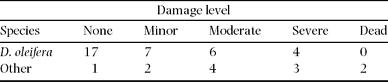
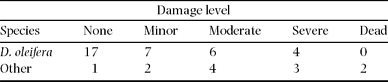
In the 4 ha censused in both 2009 and 2010, there were a total of 34 D. oleifera trees (density of 8.5 ha−1). None of the 34 D. oleifera trees from the initial survey were toppled or killed by Hurricane Ida (Table 1). Half of the 34 trees showed no visible damage from the hurricane, despite much of the rest of the forest being toppled. In comparison, there were only a total of 12 trunks of other species still standing, and only one of these showed no damage. Most trees of other species were toppled into the piles of trees and could not be censused. Most of these trees were simply uprooted but a few had their stems snapped. The distribution of standing trees into damage categories for D. oleifera compared with other species was significantly different (Fisher Exact Test, two-sided, P = 0.012).
Categorical damage estimates for Dipteryx oleifera (n = 34) and standing trees (n = 12) of other species from July 2010 surveys of 4 ha of forest damaged by Hurricane Ida in 2009.
The survival of the entire populations of D. oleifera trees in the 4 ha surveyed illustrates clearly that D. oleifera is a hurricane-tolerant tree. This study is the first to demonstrate with pre- and post-hurricane surveys the ability of D. oleifera to withstand hurricanes. This ability may allow D. oleifera to grow to emergent size in areas where hurricane or strong wind damage are likely to occur.
Dipteryx oleifera is a slow-growing, shade-tolerant tree as a sapling in the forest understorey (Clark & Clark Reference CLARK and CLARK1987, Ruiz et al. Reference RUIZ, BOUCHER, RUIZ-MORENO and INGRAM-FLÓRES2009). The slow-growth strategy allows the tree to build extremely dense wood as it grows, thus developing the ability to withstand disturbances. Shade-tolerant species have higher survival of hurricane damage than non shade-tolerant, likely because the shade-tolerant life history is accompanied by higher wood density (Uriarte et al. in press, Zimmerman et al. Reference ZIMMERMAN, EVERHAM, WAIDE, LODGE, TAYLOR and BROKAW1994). Furthermore, over time, repeated hurricane disturbances may lead to an increased abundance of shade-tolerant species (Uriarte et al. Reference URIARTE, CANHAM, THOMPSON, ZIMMERMAN, MURPHY, SABAT, FETCHER and HAINES2009). Dipteryx oleifera trees also have wide buttresses, but buttressed roots have been shown to have limited impact on storm survival (Curran et al. Reference CURRAN, BROWN, EDWARDS, HOPKINS, KELLEY, MCCARTHY, POUNDS, SOLAN and WOLF2008, Walker et al. Reference WALKER, VOLTZOW, ACKERMAN, FERNANDEZ and FETCHER1992). High wood density may create an advantage in growing to immense size in hurricane-prone regions.
Death of hurricane-damaged trees can occur several years after a hurricane hits (Walker Reference WALKER1995), therefore it is possible that our numbers overestimate the survival of D. oleifera trees. Some of the trees in the severe (n = 4) and moderate (n = 6) categories may experience delayed mortality. However, we were unable to estimate the tree death category for other species because we only counted standing stems. If the density of trees > 25 cm dbh before the hurricane was 100 trees ha−1, we had only ~12 trees ha−1 still standing. Roughly, there were approximately 88 trees of ‘other species’ in the dead and fallen category that we could not count due to the post-hurricane landscape of piled logs. Because of the pre-hurricane surveys, we can state that there were zero D. oleifera in this category.
Because hurricanes are unpredictable, there are rarely baseline data to estimate tree survival. In this project, we had completed a census of D. oleifera trees prior to Hurricane Ida's arrival. This avoids the error of underestimating a particular species because several individuals of the species may be buried at the bottom of the massive log piles that hurricanes create. Our results indicate that D. oleifera is a hurricane-tolerant tree and suggest that this may give it an advantage in becoming an emergent tree in hurricane-prone forests.
ACKNOWLEDGEMENTS
We thank Miguel Ruiz Galeano and Don Tito at the Kahka Creek Rainforest Preserve in the Rio Wawashang Nature Preserve in Nicaragua. Clifford Hebbert assisted in field work and tree identification. We are also grateful to the Ministry of the Environment and Natural Resources (MARENA) for their support of our research project. This research was supported by the National Science Foundation Coupled Natural and Human Systems Program under the grant Globalization and the Connection of Remote Communities: Environmental Implications (CNH-0815966) to D. B. Kramer.