I. INTRODUCTION
Superaustenitic stainless steel exhibits superior resistance to localized and stress corrosion as well as outstanding mechanical properties. Reference Kim, Kim, Lee, Park, Shin and Kim1,Reference Mori and Bauernfeind2 In particular, its superior corrosion resistance to localized corrosion has been attributed to the high concentration of Cr, Mo, and N. As its pitting resistance equivalent number (PREN = % Cr + 3.3% Mo + 30% N) is approximately 50, Reference Kim, Kim, Lee, Park, Shin and Kim1 it has been regarded a good alternative to Ti alloys. Nevertheless, its superior corrosion resistance can be aggravated when the steel is welded by autogenous gas tungsten arc welding (GTAW). Reference Kim, Kim, Lee, Park, Shin and Kim1 Generally, the welding of stainless steels essentially leads to compositional heterogeneity, Reference Gooch3–Reference Banovic, Dupoint and Marder5 resulting in the precipitation of various intermetallic phases. Reference Nam, Park, Na and Kang6–Reference Jang, Kim, Lee and Park8 Consequently, a steel weld can be more susceptible to localized corrosion. The first aim of this study was to clarify the corrosion initiation site in the weld, employing the electrochemical polarization technique and three-dimensional-atom probe (3DAP) analysis.
The high corrosion resistance of austenitic stainless steel has been attributed to the formation of a passive film acting as a protective barrier against a corrosive environment, including Cl− ions on the steel surface. Reference Marcus and Olefjord9,Reference Qvarfort10 Such a passive film, however, is often susceptible to pitting or crevice corrosion by the local breakdown of passivity at some chemical or physical heterogeneities, such as intermetallic compounds enriched with Cr and Mo, solute-segregated grain boundary, or non-metallic inclusion. Reference Kim, Kim, Lee, Park, Shin and Kim1,Reference Nilsson and Wilson11–Reference Ravindranath and Malhotra14 Because most engineering alloys have such defects, the pits tend to initiate at the most susceptible sites and propagate to local sites. Pitting corrosion has frequently been observed in stainless steel with a variety of inclusions because the inclusion can act as an initiation site for pitting corrosion. Reference Frankel15–Reference Webb, Suter and Alkire19 Several theories have been proposed to clarify the corrosion mechanism regarding the pitting initiation behavior at the inclusion. In particular, in the case of MnS, Cr may substitute for Mn to form (Mn, Cr)-sulfide, leading to a Cr-depleted zone around the inclusion. Reference Williams and Zhu20 Wranglen et al. Reference Wranglen18 have suggested that the inclusion dissolves more easily than the surrounding oxide film, promoting localized corrosion. Smialowska et al. Reference Szklarska-Smialowska21 have proposed an alternative explanation in that there are micro-cavities between the inclusion and steel matrix, and the cavities can act as a pre-existing micro-pit on the steel surface. Despite several proposed mechanisms, the precise role of the inclusion on localized corrosion has not been fully understood. As the pitting corrosion of stainless steel is closely associated with the property of a passive film formed on the steel surface, the initiation of corrosion at the inclusion should be analyzed with respect to the discontinuities of the passive film around the inclusion on the steel surface. For this reason, the present authors have paid particular attention to the observation of passive film around the inclusion utilizing high resolution transmission electron microscopy (HR-TEM). In addition, a potentiodynamic polarization test was conducted in chloride containing solution to evaluate the corrosion resistance of two types of austenitic stainless steel with different levels of oxide inclusion.
Furthermore, the influence of two types of alloying elements of Cu and Al was evaluated. Firstly, the influence of Cu addition on stainless steel has been investigated by a number of researchers. Reference Yamamoto, Ashiura and Kamisaka22–Reference Pardo, Merino, Carboneras, Coy and Arrabal25 It is known that the addition of Cu to austenitic stainless steels enhances the resistance to uniform corrosion in sulfuric acid, which is based on the suppression of anodic dissolution by the noble metallic Cu enriched on the surface film of the steels in sulfuric acid. Reference Yamamoto, Ashiura and Kamisaka22,Reference Kim and Park23 On the other hand, Jeon et al. Reference Jeon, Kim, Lee, Park, Kim, Kim and Park24 showed that the addition of Cu can lead to an increase in the number and area of numerous (Mn, Cr, Fe) oxides and oxy-sulfides due mainly to an increase in the activity of Cr and results in a decrease in pitting resistance in duplex stainless steel. Moreover, Pardo et al. Reference Pardo, Merino, Carboneras, Coy and Arrabal25 have reported that the addition of Cu to austenitic stainless steel favors pit nucleation but inhibits its growth. However, the precise effects of Cu on the localized corrosion resistance of superaustenitic stainless steel weld have not been clarified. Moreover, there is a limited number of studies Reference Gurram, Adepu, Pinninti and Gankidi26,Reference Zhang, Fan, Xu, Li, Xiao and Jiang27 on the effects of the small addition of Al up to 0.25 wt% on the localized corrosion resistance of high alloyed stainless steel in a chloride environment. Therefore, for a clearer understanding on this subject, this paper presents the electrochemical polarization measurements and 3DAP analysis.
II. EXPERIMENTAL
A. Materials preparation
The materials tested in the present study were superaustenitic stainless steel containing 23–25 wt% Cr-6–7 wt% Mo-20–22 wt% Ni. The steel samples were cold-rolled to 0.79 mm in thickness. Then the tungsten inert gas (TIG) welding process was applied to the samples by performing bead-on-plate welding with a heat input of 0.375 kJ/cm. The detailed welding conditions are reported elsewhere. Reference Kim and Hong28
B. Electrochemical polarization test
An electrochemical polarization test was conducted to identify the corrosion initiation site in the weld. As indicated in previous study, Reference Kim and Hong28 a clear identification of the corrosion initiation sites can be hardly achieved by using the simple immersion test based on ASTM G48. 29 Therefore, the pre-exposure process in the 1 M NaCl + 0.5 M HCl solution at 70 °C for 10 min followed by the electrochemical polarization measurement was used. The polarization was conducted in a deaerated 1 M NaCl + 0.5 M HCl solution. Prior to each experiment, the specimens were polished mechanically up to 1200 grit and rinsed with distilled water. The detailed experimental conditions can be found elsewhere. Reference Kim and Hong28
A potentiodynamic polarization experiment was also carried out to analyze the influence of oxide inclusion, as well as Cu and Al alloying elements on the localized corrosion resistance of tested steels. Based on the experimental conditions indicated in Ref. Reference Kim, Kim, Lee, Park, Shin and Kim1, the potential was applied and scanned potentiodynamically at a scan rate of 1 mV/s from an initial potential of −0.67 VSCE to the potential at which the current density reached 5 mA/cm. Reference Mori and Bauernfeind2
C. Microstructural observations and compositional analysis
After the electrochemical test, the microstructure and compositional around the intermetallic phase were examined by field emission scanning electron microscopy (FE-SEM), HR-TEM, and 3DAP. In particular, a recent study Reference Kim and Hong28 has revealed that there is a limitation in identifying the change in elemental composition within a very narrow area using the TEM-energy dispersive spectroscopy (EDS) line profile. For this reason, the analysis of the elemental composition within a very narrow area was newly supported by 3DAP.
To clarify the effects of oxide inclusion on the corrosion behavior, two types of steel weld with high cleanliness and low cleanliness steel were used. The mean area fraction of the inclusion in the two tested steel welds was measured using an image analyzer. The morphology and composition of the oxide inclusion in the low cleanliness steel before and after the corrosion test were analyzed by FE-SEM and EDS.
HR-TEM was used for the cross-sectional observation of the passive film around the inclusion. For this, the specimens were polished mechanically up to 1200 grit and rinsed with distilled water. The specimens were then kept at vacuum desiccator. Then, the protection deposition using a 150 nm thick platinum (Pt) coating was applied to the specimen. The bulk specimen with a 10 µm width and 1 µm thickness was obtained by machining with a focused ion beam (FIB). The bulk specimen was then placed on a grid used for the TEM observation. Fine milling operation by an ion beam was additionally performed to make the specimen fine enough for TEM observations.
In particular, 3DAP was utilized to analyze the elemental profile around the surface in the steel weld containing Al.
III. RESULTS AND DISCUSSION
A. Identification of the corrosion initiation site and effect of the σ-phase
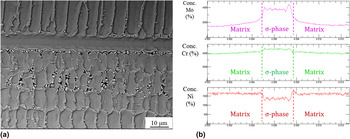
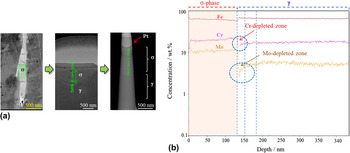
From the surface morphology of the steel weld after the immersion test in reference to ASTM G48, 29 which can be illustrated in Fig S1, it is found that the corrosion damage is too severe to analyze the corrosion mechanism. For this reason, an electrochemical polarization test involving the pre-exposure process was used using a methodology reported elsewhere. Reference Kim and Hong28 After the electrochemical evaluation, the surface was analyzed by FE-SEM in back scattered electron (BSE) mode, as shown in Fig. 1(a). It is clear from the analysis that the localized corrosion was initiated preferentially around the 2nd phase particle, which is expressed as a bright color in the interdendritic area. For a clearer understanding, the electron probe microanalysis (EPMA) was additionally performed, and the results are demonstrated in Fig. 1(b). It reveals that the 2nd phase particles characterized as a typical σ-phase with a tetragonal structure in a previous investigation Reference Kim and Hong28 were enriched by Cr and Mo and depleted by Ni. Considering these results, the localized corrosion attack observed in the weld is caused mainly by the difference in composition of Cr and Mo between the σ-phase and matrix. This can be supported by the 3DAP analysis, which was found in Fig. 2. Around the σ-phase, the Cr and Mo depleted zones were clearly formed. The depletion phenomenon was somewhat different from that determined by TEM in a previous investigation Reference Kim and Hong28,Reference Kim and Hong30 in that the Mo depletion phenomenon was identified accurately in the present study. As the diffusion length of the solute element is proportional to the square root of the diffusivity of the element, Reference Kim and Hong28,Reference Porter and Easterling31 the slow diffusion kinetics of Cr and Mo in the γ-matrix could lead to restricted diffusion length, resulting in a narrow depleted region.
(a) FE-SEM image exhibiting the surface morphology of the specimen obtained by the electrochemical technique and (b) EPMA around the σ-phase.

(a) Sample preparation for the analysis of 3DAP and (b) atomic distribution of Fe, Cr, and Mo around the σ-phase.

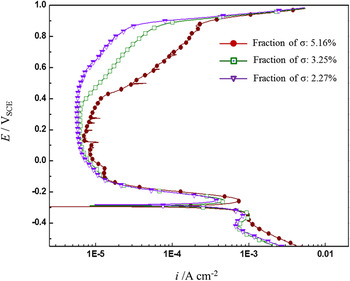
To confirm the detrimental influence of the σ-phase on the resistance to localized corrosion of the steel weld, three types of samples with different volume fractions of σ-phase in the microstructure were evaluated using an electrochemical polarization test, and this can be found in Fig. 3. The fractions of σ-phase in the microstructure after the heat treatment conducted at 1180 °C for 30 s, 60 s, 90 s are 5.16, 3.25, 2.27, respectively, meaning that the σ-phase is gradually dissolved by the additional heat treatment. From the polarization measurement, it is evident that the decrease in the fraction of σ-phase in the microstructure by the additional heat treatment resulted in higher corrosion resistance.
Potentiodynamic polarization evaluation of the three types of steel weld with different volume fraction of σ-phase in the microstructure.

B. Effect of oxide inclusion
The inclusion contained in the steel weld has a spherical shape with a diameter of up to 15 µm, which can be identified in Fig S2 showing the optical microscopy and SEM images of the oxide inclusion distributed in weld metal of the steel with low cleanliness. This can also be found in our previous report. Reference Porter and Easterling31 The EDS analysis suggested that the inclusions are mostly (Mg, Al)-oxide, which is suspected to be a spinel-type inclusion of MgAl2O4. On the other hand, the inclusion was barely observed in the steel with high cleanliness. The mean area fraction of the inclusion in the two tested steels (high cleanliness steel: 0.02%, low cleanliness steel: 0.4%) was measured quantitatively using an image analyzer. From the EDS analysis, it appears that the composition of the inclusions was similar in the two steels tested. Considering the fact that the oxide inclusions were distributed in base metal as well as weld metal, it is obvious that the formation of inclusion was not associated with the welding conditions, and the manufacturing process of the steel was not properly controlled and optimized.
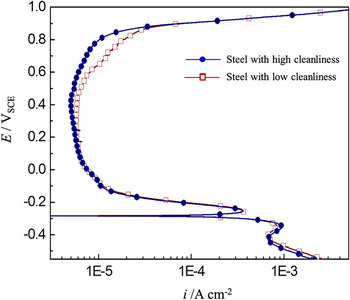
It is considered that the metallurgical inhomogeneity in the stainless steel, caused by the presence of coarse-sized inclusion, leads to increased susceptibility to pitting corrosion of the steel. Figure 4 presents the potentiodynamic polarization curves of the two steels tested in an acidic chloride environment. As the steels are classified as high-alloyed austenitic steel, the overall trend of the polarization curves showed a similar pattern. However, the passivation current density at which the potential exceeds 0.2 VSCE between the two tested steels was different. This suggests that the passive film formed on the steel containing a higher density of coarse-sized inclusion is less stable, and the steel is more susceptible to localized corrosion than the steel with high cleanliness. It is also suggested that the pitting corrosion associated with the inclusion can be initiated at a potential of approximately 0.2 VSCE during anodic polarization.
Potentiodynamic polarization curves of the two tested steels with high and low cleanliness, respectively. Reference Porter and Easterling31

As mentioned in the Introduction, the detrimental effect of oxide inclusion on the localized corrosion of various types of stainless steel has been explored, and several theories have been provided to explain the precise role of the inclusion on the corrosion initiation behavior of the steel. Nevertheless, it is unclear even today due mainly to the difficulty in analyzing a passive film with only a few nanometers thick. Therefore, the present authors have focused our attention on clear observations of the cross-sectional morphology of the passive film around the inclusion, by HR-TEM, and a reasonable mechanism is proposed based on the experimental evidence.
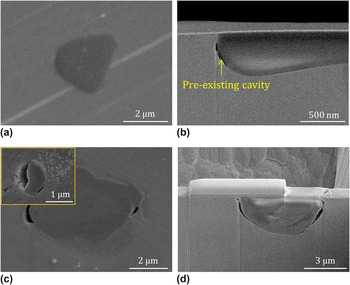
Figure 5 presents the surface and cross-sectional morphology of the inclusion contained in the steel with low cleanliness employing FIB and SEM. Figures 5(a) and 5(b) show the morphology of the steel before the electrochemical corrosion test; Figs. 5(c) and 5(d) present the morphology of the steel after the corrosion test. Firstly, it is interesting to observe a pre-existing cavity in the interfacial area between the inclusion and steel matrix even before the corrosion test. This could be caused by the difference in the thermal expansion coefficient between the spinel type of MgAl2O4 (8–9 × 10⁻⁶ °C−1) Reference Kaprálik32 and the austenitic stainless steel (19–20 × 10−6 °C−1). Reference Khatak and Raj33 The pitting was concluded to have initiated around the inclusion from the observation of the inclusion after the corrosion test. In addition, it can be inferred that the pitting could propagate more easily via the pre-existing cavity in the interfacial area. Although the cross-sectional morphology exhibiting pitting corrosion propagated around the inclusion cannot be observed clearly due to the presence of Pt coated for the subsequent HR-TEM observations, it is evident that the pitting hole with a large diameter of approximately 500 nm is open to aggressive ionic species.
Surface morphology of the inclusion contained in the sample with low cleanliness (a) before and (c) after the corrosion test, and cross-sectional view around the inclusion (b) before and (d) after the corrosion test. Reference Porter and Easterling31

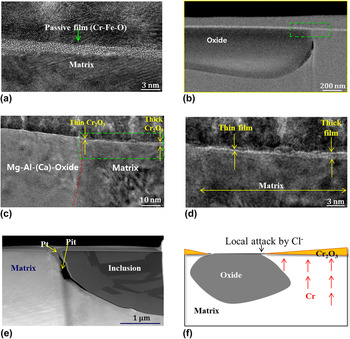
The cross-sectional morphology was observed utilizing the HR-TEM to gain further insight into the property of passive film around the inclusion. Figure 6(a) shows that a thin passive film with an approximate thickness of 3 nm is normally formed on the steel surface. On the other hand, Figs. 6(c) and 6(d) show that the film thickness decreases as it approaches the inclusion. In addition, the EDS analysis showed that the compositional ratio of Cr and O with respect to Fe(Cr(0.32)*O(0.27)/Fe(0.40) = 0.22) in the passive film around the inclusion was much lower than that (Cr(0.41)*O(0.39)/Fe(0.19) = 0.84) in the passive film formed normally on the steel surface. These suggest that the 3 nm thick passive film cannot be continued homogeneously on the steel surface due to the presence of inclusions. Therefore, the local region covered by a very thin film with a smaller Cr content can be attacked easily by aggressive ionic species such as Cl− ions. The resultant pitting propagation of steel in the chloride environment can be observed clearly, as shown in Fig. 6(e). The restricted growth of the passive film around the inclusion in the steel weld could be attributed mainly to the hindrance of Cr-diffusion around the inclusion to the surface of steel weld. A simple schematic diagram of the proposed mechanism is depicted in Fig. 6(f). As this mechanism is based partly on our speculation, further study with supporting evidence will be needed.
(a) Cross-sectional view of the passive film formed on the steel; (b) cross-sectional morphology of the inclusion observed by SEM; (c) magnified view of the cross-sectional morphology, marked in (b); (d) magnified view of the passive film, marked in (c); (e) pitting morphology around inclusion after corrosion test; (f) schematic diagram of local corrosion around the inclusion. Reference Porter and Easterling31

C. Effect of alloying elements of Cu and Al
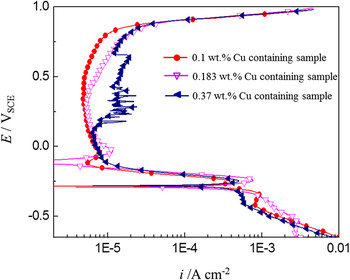
To examine the effects of Cu on the resistance to localized corrosion of the steel weld, three different samples containing 0.1, 0.183, and 0.37 wt% Cu, respectively, were tested by electrochemical polarization measurement. Smuk et al. Reference Smuk, Nenonen, Hänninen and Liimatainen34 have indicated that Cu particles in the stainless steel could prevent the motion of the σ/γ2 interface boundaries, and the δ → σ phase transformation could be suppressed. However, the addition of Cu up to 0.37 wt% had no effect on the reduction in the volume fraction of the σ-phase, which can be found in Fig. S3. Figure 7 presents the potentiodynamic polarization measurements of the three different samples with different amounts of Cu. It is evident that the addition of Cu to the steel weld decreases the localized corrosion resistance in a chloride environment. The current spike for the formation and repassivation of meta-stable pits increased with increasing Cu content in the experimental alloys. Similar behavior was also reported by Jeon et al. Reference Jeon, Kim, Lee, Park, Kim, Kim and Park24 From their study, with the addition of Cu exceeding 1 wt%, the number and area of numerous oxides and oxy-sulfides in the microstructure increase, which results in a significant decrease in the resistance to pitting corrosion. From the present study, however, a smaller amount of Cu below 0.4 wt% has no significant effect on the fraction of oxide inclusion. As the electrochemical potential of Cu is much higher than that of Fe, the enrichment of metallic Cu on the surface could lead to the local dissolution of Fe, suggesting that the difference in electrochemical potential could facilitate the local galvanic interaction.
Potentiodynamic polarization measurement of the three different samples with different content of Cu.

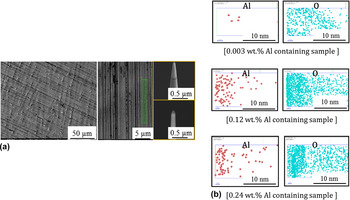
The addition of Al to the stainless steel is expected to lead to the formation of an Al-based oxide layer with a protective nature on the steel surface, which could contribute to the improvement of corrosion resistance. However, the addition of a small amount of Al below 0.25 wt% does not have any discernible effect on the corrosion resistance, which can be found in Fig. S4. Although the 3DAP analysis identified in Fig. 8 has demonstrated that Al is enriched in a form of Al2O3 at the outermost layer on the passive film, it could not contribute effectively to enhancing the corrosion resistance in the chloride environment. Our previous study based on atomic distribution in 3DAP also revealed that the outermost layer is Al-based oxide and Cr is mainly located right below the layer. Further work considering a larger amount of Al contained in the steel weld will be reported in the near future.
(a) Sample preparation for the analysis of 3DAP and (b) atomic distribution of Al and O around the steel surface.

IV. CONCLUSION
The influence of a variety of metallurgical factors, σ-phase, oxide inclusion, and alloying elements of Cu and Al, on the electrochemical corrosion behavior of superaustenitic stainless steel weld was investigated. The major findings are as follows:
-
(1) Localized corrosion is initiated preferentially around the σ-phase precipitated in the interdendritic area of the steel weld. The 3DAP analysis clearly showed that the formation of a σ-phase leads essentially to a local depletion area of Cr and Mo around the phase. Therefore, the welded zone of steel is still susceptible to localized corrosion in spite of its high concentration: 23–25 wt% Cr and 6–7 wt% Mo.
-
(2) The steel weld containing coarse-sized inclusion characterized as a spinel-type of (Mg, Al)-oxide is more susceptible to pitting corrosion, as evidenced by the higher passivation current density during an anodic polarization measurement. HR-TEM indicated that the thickness of the passive film decreased as it approaches the inclusion, and the region can be attacked preferentially by the aggressive ionic species.
-
(3) The addition of Cu to the steel weld decreases the localized corrosion resistance in the chloride environment. As the Cu content in the experimental alloys increases, the current spike for the formation and repassivation of meta-stable pits increases. Because the electrochemical potential of Cu (+0.342 V) is much higher than that of Fe (−0.447 V), it is expected that the enrichment of metallic Cu on the surface leads easily to the local dissolution of Fe, suggesting that the difference in electrochemical potential could facilitate a local galvanic interaction.
-
(4) The addition of up to 0.25 wt% Al had no significant effect on the corrosion resistance in the chloride environment despite the presence of an Al-based oxide layer (Al2O3) on the outermost surface.
Supplementary Material
To view supplementary material for this article, please visit https://doi.org/10.1557/jmr.2017.65.
ACKNOWLEDGMENTS
This paper was supported by Sunchon National University Research Fund in 2016.