Introduction
Establishing clear linguistic and cultural boundaries plays a significant role in the legitimisation of minority languages and cultures (Jaffe Reference Jaffe, Johnson and Ensslin2007; Heller Reference Heller2011; Pietikäinen & Kelly-Holmes Reference Pietikäinen and Kelly-Holmes2011). As Pietikäinen (Reference Pietikäinen and Coupland2016) notes, for emancipatory critique in supporting minority language rights to work, sociolinguistic boundaries need to be fixed (Pietikäinen Reference Pietikäinen and Coupland2016:268). That is why demarcating the ‘authentic’ boundaries of minority languages is often clearly visible in the discourse of language and cultural revitalisation projects. But in the current globalised context, these emancipatory discourses ‘tend to conflict with the hybrid, mixed and changing multilingual practices and identities that characterized the lived reality of many minority language speakers’ (Pietikäinen Reference Pietikäinen and Coupland2016:273–74). Among them, multiple identities are increasingly more habitual (Moriarty & Pietikäinen Reference Moriarty and Pietikäinen2011; Pietikäinen, Kelly-Holmes, Jaffe, & Coupland Reference Pietikäinen, Kelly-Holmes, Jaffe and Coupland2016) as minority language speakers live in a world where mobility and global flows are blurring the notions of language and culture as fixed and monolithic (Heller Reference Heller2011).
However, minority communities have their own internal debates on sociolinguistic boundaries. The emergence of new speakers, due in part to the effectiveness of revitalisation policy practices, has generated new tensions about what counts as ‘authentic’ or ‘legitimate’ language, always linked to who are considered ‘authentic’ and ‘legitimate’ speakers (O'Rourke & Walsh Reference O'Rourke and Walsh2015). In these debates, the language of those who are perceived as the native elite of minority languages is counterposed to those with more hybrid and complex sociolinguistic trajectories (O'Rourke & Ramallo Reference O'Rourke and Ramallo2013). Language activism and language revitalisation policies themselves repeatedly contribute to these ideological tensions by reproducing a dominant monolingual ideology where ‘legitimate’ speakers are defined as having ‘full linguistic competence’ of a ‘pure’ or traditional variety (Jaffe Reference Jaffe2015:166).
Speakers of small languages have to manage these apparently contrary ideological flows in their everyday life, and this makes them particularly reflective about language, in a society-order that is itself more reflective than ever (Giddens Reference Giddens1991). Moreover, the intense metacultural and metalinguistic activity of revitalising initiatives promotes their reflexive linguistic awareness (Pietikäinen et al. Reference Pietikäinen and Coupland2016).
Nowadays, in what Pietikäinen & Kelly-Holmes (Reference Pietikäinen and Kelly-Holmes2011) call the Performance Era of minority language policy, these ideological tensions are often addressed by means of transgressive creative and humoristic practices. Indeed, Coupland (Reference Coupland, Lacoste, Leimgruber and Breyer2014b) defends the idea that such practices are a major indicator of the reflexive quality of Late Modernity. The practices are included in what Pietikäinen (Reference Pietikäinen and Coupland2016) terms carnivalesque critique, borrowing from Bakhtin the idea that ‘carnival celebrated temporary liberation from the prevailing truth and from the established order’ (Bakhtin Reference Bakhtin1986:10). These are playful and ironic critiques that can be found in popular culture, such as graffiti, media mash-ups, comic strips, and political and social parodies, and often, in the minority context, they are aimed at the revitalizing activity itself. They ridicule and disturb fixed categories and boundaries, often to shed light on the absurdity of fixed relations between language, culture, and nationality in the proposals and discourses of the policy agents (Pietikäinen Reference Pietikäinen and Coupland2016:272).
A good example of this playful and ironic critique is the character Jon Gotzon that I analyse in this work. Jon Gotzon engages in parody on the radio programme DidaGaztea, broadcast by the Basque public media EITB and aimed at young people. Jon Gotzon is a hyperbolic and parodic stylisation of a new Basque speaker. He challenges ‘authentic’ and ‘native’ Basque-speaking styles in his syncretic bilingual stylisation and parodic discourse. Jon Gotzon also merits attention because he brings new metalinguistic and metacultural perspectives into focus, on what is Basque, on who is Basque, and on what is Basque culture. In this research, I explore the way this parody makes use of carnivalesque strategies in order to question fixed ideological hierarchies of Basqueness and to break down sociolinguistic boundaries in a playful and creative way. But, based on recent work on ideological struggles over language in minority language media (Jaffe Reference Jaffe2000, Reference Jaffe2015; Woolard, Ribot, & Soler Reference Woolard, Ribot; and Soler2014; Pietikäinen et al. Reference Pietikäinen and Coupland2016; among others) and in Basque media in particular (Urla Reference Urla2012), the study also seeks to analyse the language ideological positions that Jon Gotzon's parodic stylisation reveals with respect to the Basqueness authenticity framework in force in Basque media. I use language ideologies in a broad sense, as proposed by Kroskity: ‘language ideologies are beliefs, or feelings, about languages as used in their social worlds’ (Kroskrity Reference Kroskrity and Duranti2005:498). And I take from the sociocultural perspective proposed by Irvine the idea that language ideologies are ‘the cultural system of ideas about social and linguistic relationships, together with their loading of moral and political interests.’ (Irvine Reference Irvine1989:255).
Boundaries and transgression in Basque media
Basque speakers have experienced the need for legitimisation of their language and culture. Basque went through a fairly rapid language shift process to Spanish and French in the twentieth century. In Spain, during the Franco dictatorship (1936–1975), the language was forbidden to be used in public. Spanish dominated in education, commerce, and public life, while Basque survived as a home language, mostly in rural and fishing communities. By the second half of the twentieth century, Basque was associated with backwardness and provincialism.
The Spanish Constitution of 1978 allowed Basque to be declared an official language in the Autonomous Community of the Basque Country and later on in Navarre. Since that time, the reclaiming of Basque has blossomed into a movement that permeates all facets of Basque society and culture (Urla Reference Urla2012). Over the past four decades the efforts of the Basque Government to revitalize Basque have included a corpus policy in which delimiting the ‘authentic’ boundaries of Basque has been probably the most important task. We can even say that, frequently, the differences between Spanish and Basque have even been highlighted, and variation and overlap often erased (Irvine & Gal Reference Irvine, Gal and Kroskrity2000).
Basque speakers are good examples of reflective minority speakers mentioned above, just as the Basque context is a good example of the complex new ideological circumstances of minority communities (Pietikäinen et al. Reference Pietikäinen and Coupland2016). Basque speakers experience multiple linguistic practices in their global and technological everyday life, and these blur the linguistic borders with the outside world. But, at the same time, internal boundaries, such as those between ‘authentic’ and ‘nonauthentic’ Basque speakers, seem to be more well-defined than ever before, particularly among young people. Today, in the Basque Autonomous Community, 71.4% of people between sixteen and twenty-four are Basque speakers (Basque Government 2016:7). Of those, 53.9% are in the group of new Basque speakers, that is, they are speakers that have studied Basque in an academic context (Basque Government 2016). These new speakers often feel like they are not ‘authentic’ Basque speakers (Ortega, Urla, Amorrortu, Goirigolzarri, & Uranga Reference O'Rourke and Walsh2015). In general, there is a widespread belief among new and native Basque speakers that only generational transmission guarantees the option of being an ‘authentic’ speaker of Basque (Lantto Reference Lantto2015; Ortega et al. Reference Ortega, Urla, Amorrortu, Goirigolzarri and Uranga2015; Urla, Amorrortu, Ortega, & Goirigolzarri Reference Urla, Amorrortu, Ortega, Goirigolzarri, Ferreira and Bouda2016).
Furthermore, in many academic and institutional discourses, new Basque speakers have often been seen as transgressors of the generational chain continuum. According to those discourses, young speakers’ Basque is not good enough; their models of use have gone off course, through interference and error. Sometimes, the normalisation agents themselves also appear to view as unavoidable the harmful effect of hybridity among new Basque speakers. The 2005 report The quality of Basque, by the Advisory Council on Basque of the Basque Government, is an eloquent example of this kind of discourse, as the following words clearly show: ‘adding to the number of Basque speakers brings with it, to some extent, a decline in quality, especially through the corruption of Spanish’ (Advisory Council on Basque 2005:19). According to the policy report, eradicating language hybridization should be one of the main objectives of Basque language policy.
However, as Urla points out, only four years later, the 2009 report of the Advisory Council shows that the strategies and priorities of the past are not written in stone. After an extended debate among groups in civil society, the 2009 report (Advisory Council on Basque 2009) recognizes the symbolic and practical contribution of new speakers and even passive speakers in the revival of Basque, and it proposes that the term quasi-euskaldun ‘quasi Basque’, used in previous survey and census counts, should be dropped (Urla Reference Urla2012:208–209). Furthermore, the latest Basque Government plan encourages a more fluid understanding of the Basque speaker (Advisory Council of Basque 2016).
With respect to broadcast media, ‘authentic/nonauthentic’ Basque style categories have been topics of debate in order to define what language media should use, as well as to choose ‘appropriate’ presenters, particularly in the Basque public media. This is probably because of the idea that minority media professionals must be ideal speakers and their speech a model to follow. In particular, during the early years of the public media EITB in the 1980s and 1990s, a native Gipuzkoan-speakingFootnote 1 person was considered almost the only ‘legitimate’ presenter. As for the language model for media, linguistic homogeneity and unity were the guiding linguistic ideological principles in the language policy of Basque state media at that time. The Basque media was dominated by an ideology of linguistic prescriptivism where language itself was conceived of as an isolated system that could be kept pure and maintained. The intention to purify was manifest in a concern with purging Spanish grammatical influences (Urla Reference Urla2012:81), and code-switching and borrowing from Spanish were regarded as legacies of the political and cultural domination of Basque (Urla Reference Urla2012:176).
This language policy, however, has changed considerably in recent years and there are increasingly clearer signs of diversification within EITB media productions (Elordui Reference Elordui, de Bot, Grenoble, Lane and Røyneland2019), with respect to the profile of the media professionals and also the linguistic model employed. Gaztea radio is probably the best example of that transformation. Since 2006 Gaztea has constructed its own young media identity as a strategic response to its young Basque audience. In the new policy, young vernaculars are core resources for Gaztea when negotiating the professionals’ media identities in order to attract young people from different areas of the Basque country, including the urban young. In general, the use of a ‘mixed street language’ is considered by Gaztea's managers as a way of encouraging a relationship of authenticity and similarity to the style of young Basques (Elordui Reference Elordui2018). Similar stylistic principles have predominated in the design of TV reality shows for young people such as Gu ta gutarrak ‘We and our things’, broadcast between 2014 and 2017, and also in Gure Kasa ‘Our way’, the current show for young people on ETB1, the Basque-speaking EITB TV channel.
But in the case of EITB state media, humour has also been the space in which to first cross boundaries. Framing a performance as humorous grants performers the potential to break with conventions in the comedy show Wazemank (2005), in which actors not only used vernacular and informal registers but also parodied well known icons of Basque culture life, and made fun of the excesses of language regulation, correctness and norms that characterised the early Basque language-revival movement (Urla Reference Urla2012:107).
The parodic character Jon Gotzon that I analyse in this article, even so, marked a turning point in Basque performance history, a point at which it became possible to laugh about Basque and Basqueness through a syncretic combination of Basque and Spanish. When Jon Gotzon was created around 2003, it was the first time that vernacular practices such as code-switching and borrowing, common in everyday talk, were used in a Basque performance. Even today Jon Gotzon can be considered a transgression within the whole Basque performance panorama, in which avoiding syncretism is still a shared basic principle, a general commitment of Basque planned media as a whole.
Methodology
In my analysis of Jon Gotzon's parodic stylisation I have used a methodological triangulation, following the guidelines Coupland suggests as a means to analyse the stylisation of performance (Coupland Reference Coupland, Holmes and Hazen2014a). The data has been drawn from an audio selection of the radio parody show. I have included twenty audio recordings between 2005 and 2018. The selection of recordings took into account different eras in the long history of the character and a diversity of sections. I tried to consider examples of different ideological debates in which Jon Gotzon took part. For this article, the examples I have chosen are drawn from several sketches taken from the radio shows Basetxea Jon Gotzon (2005), Tribuaren Bergak (2014), and the current Jongik nola, jo cómo mola (2018). I have assembled these together with the video sketch Jon Gotzon gaztetan (2011). The latter selection was chosen with the aim of showing Jon Gotzon's audio-visual characterisation, thereby also including in the analysis aspects of his visual multimodality.
I have completed the analysis by using ethnolinguistic material drawn from the interviews I conducted with DidaGaztea professionals between May 2014 and June 2018. I first considered material from interviews with Mikel Fernández, the actor who plays Jon Gotzon. I discussed with him topics related to the creation of the character and its history and also to the criteria of stylisation and the linguistic debates in which the character takes part. The interviews also tried to meet the aim of confirming my interpretation of the intended meaning of the selected parody sketches. In order to know about the evolution of the stylisation and ideology of the Jon Gotzon character, my interviews with Edurne Garmendia, another DidaGaztea presenter, were particularly fruitful. Edurne Garmendia offers a counterpoint to Jon Gotzon's performance. She frequently corrects the Jon Gotzon's ‘Spanishisms’ during the show. Garmendia's interview was key in understanding the double-voicedness in the interpretation of the show's sketches. For the purpose of understanding Jon Gotzon's ideological transgression, it was also essential to know the language policy framework of Jon Gotzon's parody. With that goal in mind, I interviewed the director of EITB radios, Odile Kruzeta, and the director of Gaztea, Jon Lamarka.
Finally, I have taken into account Gaztea's audience by analysing the findings of studies on language attitudes carried out on Basque youth, with special interest in the research focusing on new speakers of Basque (Lantto Reference Lantto2015; Ortega et al. Reference Ortega, Urla, Amorrortu, Goirigolzarri and Uranga2015; Urla et al. Reference Urla, Amorrortu, Ortega, Goirigolzarri, Ferreira and Bouda2016). Those results are important to understand the ideological structures and views taken into account in the audience design of this parody.
Jon Gotzon's parodic stylisation: An analysis of the radio sketches
The idea for the character of Jon Gotzon emerged around 2003. The actor Mikel Fernández explained to me in one of our interviews that the source of inspiration for the character was a politician in the Partido Popular (PP), a Spanish nationalist right-wing party. In several Basque sociocultural contexts at that time, the ‘incorrectness’ of the PP politician's use of Basque was made fun of, and it was this politician who was the forerunner to the character of Jon Gotzon. In that initial version of Jon Gotzon, the character was called Piturri. As Edurne Garmendia explained to me in an interview, that name was too close to the name of the politician and it was suggested that it should be changed. The name was thus changed to Jon Gotzon Aldaparena, a literal translation into Basque of the Spanish Juan Angel de la Cuesta.
Jon Gotzon, as noted above, stylises a new Basque speaker from Burgos (a non-Basque speaking area) who came to the Basque Country, learned Basque, and has lived since then in the Basque-speaking community. Initially, characters such as Txomin Planet and Basetxea Jon Gotzon appeared in some fictional radio sketches that were independent short sketches in a morning magazine. Around 2010, when the DidaGaztea programme began, Jon Gotzon became an established voice on the radio show and nowadays, together with four other voices, he makes up the main group of presenters on DidaGaztea. DidaGaztea is a morning entertainment show aimed at young people. It is broadcast throughout the Basque Country from 7:00 am to 12:00 pm from Monday to Friday. The show has a mixed structure. It follows the format of a music radio show playing pop music, but it also includes the daily news, interviews, radio contests and comedy.
Hyperbolic and grotesque stylisation
The main feature of Jon Gotzon is that, in many ways, he is a transgression. First, with this character, the show challenges established sexuality norms in Basque media: partly because Jon Gotzon is constantly bringing to light sex-related topics, but also through the fact that Jon Gotzon is openly gay. He also challenges heterosexual morality, for instance, through a repeated use of sexual innuendo with men invited to be on the show. Jon Lamarka, the coordinator of Gaztea, explains the sexual dimensions of Jon Gotzon's characterisation like this: ‘He's a queen, he doesn't hide his sexuality. He has permission. He can be politically incorrect because we acknowledge his nature… He is a natural provocateur’ (Lamarka, 24/05/2018).
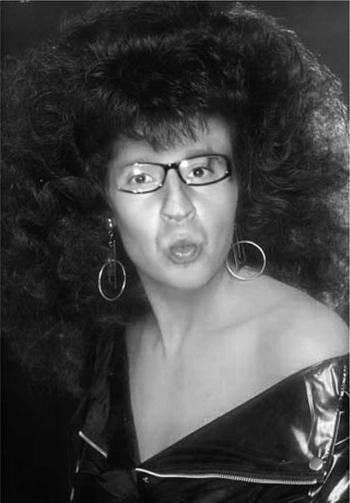
Since Gaztea developed its social media presence around 2009, Jon Gotzon has had to develop a visual image. The image shows Jon Gotzon always in disguise, with the use of wigs, goggles, and fancy clothes with flashy colours. His style matches the image described by Odile Kruzeta, of a snobbish urbanite: ‘an urbanite, sophisticated, and a little bit snobbish; he has an amazing look and is always ready to party’ (Kruzeta, 28-05-2018). But Jon Gotzon's character also includes some features of what Bakhtin terms grotesque realism, consistent with a linguistic characterisation that I explain below. According to Bakhtin (Reference Bakhtin1986), one of the fundamental tendencies of the grotesque image of the body is to show two bodies in one. He provides the example of the famous Kerch terracotta collection, where we can find figurines of senile pregnant hags and the old hags are laughing. And, he explains, ‘This is a typical and very strongly expressed grotesque. It is ambivalent. It is pregnant death, a death that gives birth. … From one body a new body always emerges in some form or other’ (Bakhtin Reference Bakhtin1986:26). Without reaching that extreme, Jon Gotzon's image is also ambivalent and ambiguous, especially his sexual image. A good example of this is his profile photo on Facebook (see Figure 1). But, in general, Jon Gotzon's disguise can always be related to metamorphoses and to a violation of boundaries, in his eccentric postures and comic gestures, and also in his dress style: he dresses in a pantsuit that we associate with a formal style but it is sky blue and dotted with pink flowers.
Jon Gotzon's profile photo on Facebook.

Regarding his language characterisation, Mikel Fernández constructs a character who speaks Basque, but who continuously switches to Spanish in order to carry out several referential, social, and rhetorical functions. Yet Jon Gotzon gives us enough information to infer that his identity is fictionalised and hyperbolic. Among other things, his Spanish origins are revealed in an outlandish and exaggerated way: he uses a very obvious Spanish accent and frequently focuses on those features of Basque that are targets of prescriptivists: a good example is his always overstated incorrect pronunciation of sibilants in Basque, to which prescriptions about correct Basque constantly refer. But his hyperbolic character is also revealed by his overuse of codeswitching, and also because there is a close relationship between the use of the code-switching and what Bakhin describes as ‘degradation’ and ‘down to earth’ grotesque discourse. Jon Gotzon always switches to Spanish, for instance, when talking about sex or bodily processes.
We can see an example of that stylisation in a sketch from a recent radio show, Jongik nola, jo cómo mola (04/06/2018). In the radio sketch, Jon Gotzon is chatting with Julen Telleria, Edurne Garmendia, and Ainhoa Vitoria. Julen Telleria introduces the section by mentioning the strange fluctuations in the weather. Then Jon Gotzon takes to the microphone to give advice about the appropriate clothes to wear with that weather.
(1) Radio stetch of Jongik nola, jo cómo mola (JT: Julen Telleria, JG: John Gotzon, EG: Edurne Garmendia; Spanish words in bold; English words underlined; invented words in italics)


In this radio sketch the comic character and the entire humour of the piece is constructed on the basis of hyperbolic and grotesque discourse strategies. Jon Gotzon's high squeaky voice is used to stylise the character of a gay man. The subjects selected for the radio show Jongik nola, jo cómo mola also conform to homosexual stereotypes. In this piece Jon Gotzon speaks about fashion. Moreover, he constantly transgresses the typical norms about sex on a public radio station: on the one hand, because Jon Gotzon stylises gayness in an ostentatious and effeminate way and, on the other, because of the repeated references made to sexually related themes. There are also repeated references to ‘dirty’ biological processes such as the case in example (1), when he says orduan te va a sudar más DENAK ‘you're going to sweat more, all of you’ (line 8), with the emphasis on the last word denak ‘all of you’, here making it obvious that he is linking it to sexual parts of the body.
Several linguistic features contribute to the stereotype of Jon Gotzon as a new speaker of Basque: His prosody is a much emphasised Spanish one, as noted before. The most obvious phonetic feature of the new Basque speaker is the common tz- pronunciation: for example, in a word like exijitzen ‘demands’ (line 9), he uses the palatal [ʧ] pronunciation instead of the apico-alveolar [ts] of standard Basque, probably seeking a resemblance to the palatal ch pronunciation of Spanish. Moreover, the verb-first word order, that is also a constant target of Basque prescriptivism, is one of the main morphosyntactic stylistic features of Jon Gotzon. An example of this feature can be found in da izerdia ‘it's sweat’ (line 4) instead of verb-last izerdia da, the more common Basque word order.
But, as I said earlier, the most striking feature of Jon Gotzon's linguistic stylisation is his constant use of codeswitching. The switches can involve random words in some cases, such as baina hor dago un resol ‘but there's a glimmer of sun over there’ (line 8); but there are also whole intersentential switches, Vamos por pasos, oreka sortu behar dugu horretarako ‘Let's go step by step, we have to find some balance for this’ (line 6), and also intrasentential switches such as pues porque zure lanak edo lekuak exijitzen du un poquito de… ‘well, because your work or place demands a little…’ (line 9). Another example of the use of language hybridization as a tool of humour is the consistent creation of funny neologisms from Spanish calques: for instance, erreguzki ‘glimmer of sun’ (line 8) and narru aniztasun ‘different leathers’ (line 9) in example (1).
The urbanite, sophisticated, and snobbish Jon Gotzon of today, as described by the director, Kruzeta, makes use of English as a relevant feature of his linguistic stylisation: starting with the title of the radio section, ‘Fashion’, and followed by the consistent use of English words like ‘rain’ and ‘casual’ (line 9) in his speech. The use of English is linked to the criticism of class consciousness and of the snobbishness of some urban Basque classes, which is also a key feature of Jon Gotzon's critical discourse in recent years.
Double-voicedness
As Bakhtin (Reference Bakhtin, Holquist and Emerson1981) explains, in stylising, the performer makes another's voice their own and that, together with a shared linguistic consciousness with the audience, makes stylisation different from style.
Every authentic stylization, as we have already said, is an artistic representation of another's language. Two individualized linguistic consciousnesses must be presented in it: the one that represents (that is, the linguistic consciousness of the stylizer) and the one that is represented, that is stylized. Stylization differs from style proper precisely by virtue of its requiring a specific linguistic consciousness (the contemporaneity of the stylizer and his audience), under whose influence a style becomes a stylization, against whose background it acquires new meaning and significance. (Bakhtin Reference Bakhtin, Holquist and Emerson1981:362)
In Jon Gotzon's parody, two individualized linguistic consciousnesses are presented: one that represents Mikel Fernández, the styliser's linguistic consciousness, and another that is represented or stylised, the linguistic consciousnesses of the character Jon Gotzon.
Unlike in a simple stylisation, parodic stylisation introduces into the discourse a new semantic aim, contrary to the image that may be taken from an initial form, or often in opposition to it (Bakhtin Reference Bakhtin, Holquist and Emerson1981, Reference Bakhtin1986). That double-voicedness is, in Bakhtin's opinion, the chief feature of parodic stylisation: ‘It serves two speakers at the same time and expresses simultaneously two different intentions: the direct intention of the character who is speaking, and the refracted intention of the author. In such discourse there are two voices, two meanings and two expressions’ (Bakhtin Reference Bakhtin, Holquist and Emerson1981:324). In Jon Gotzon's parody, too, we have the character's comic voice, the voice of an ‘outsider’ in the community that is nowadays urbanite and snobbish. The parody exaggerates the difficulties he has in understanding the Basque-speaking world and Basque itself, and transforms this into a cause for humour. The other presenters taking part in the parody also laugh at his shortcomings when it comes to communicating in Basque. They correct him for the things he says badly and frequently reveal his clumsiness (especially Edurne Garmendia).
Yet, at the same time, one can hear another critical voice in Jon Gotzon's parody that talks to the Basque-speaking community. In fact, as Bakhtin (Reference Bakhtin, Holquist and Emerson1981) explains, the two voices in Jon Gotzon's parody are constantly arguing, in a constant dialogue: ‘these two voices are dialogically interrelated, they—as it were—know about each other; … it is as if they actually hold a conversation with each other’ (Bakhtin Reference Bakhtin, Holquist and Emerson1981:324). For instance, with respect to grammatical correctness and academic norms, Jon Gotzon's response to those who criticise ‘incorrectness’ in his talk is to use parody, and this parodic attitude towards purist norms is evident in many of the sketches. Even in his constant use of hyper-pure invented words we can understand that he is challenging those who, in his opinion, fall into purity, for example, in the word creations found in (1): erreguzki ‘glimmer of sun’ (line 8) and narru aniztasun ‘different leathers’ (line 9). Through this critical voice, then, Jon Gotzon challenges attitudes he takes to be rigid, ideas that in his opinion are rooted in an old-fashioned view of Basque culture. He also calls into question preestablished, ‘unchangeable’, and essentialist features of Basque identity.
That first image of an ‘outsider’ that is ridiculed can be clearly seen in the second example below. It is a video sketch entitled Jon Gotzon gaztetan ‘Young Jon Gotzon’, and Jon Gotzon himself presented it on the television show Gu ta Gutarrak in 2011.Footnote 2 The video portrays Jon Gotzon in his student days, when he began to learn Basque, and it also reveals the change between the early Jon Gotzon and the more urbanite and sophisticated one of 2011. That early Jon Gotzon's stylisation is based on the stereotype of a right-wing person in the Basque Country. He presents us with a person who has a conservative look, in both the choice of his style of glasses and in his choice of style of clothes. His hand gestures call to mind a gay stereotype. He portrays a speaker who is still at the beginning stage of learning Basque. One could say that it is a caricature of someone who has been pushed to study Basque based on an interest in getting a certification in it.
(2) Video sketch (T: Teacher, JG: John Gotzon)

At that time Jon Gotzon was incapable of even producing one correct sentence in Basque: he exclusively uses Spanish word order in simple sentences, naiz Jon Gotzon ‘Jon Gotzon I am’ (line 10), for example; there is constant code-alternation in his speech, such as euskara ikasi quiero ‘I want to learn Basque’ (line 11), 2013 tendré nola que nola «titulo» euskaraz? ‘ In 2013 I will, have to … how is ‘certification’ in Basque?’ (line 13); and he shows a complete lack of being able to use Basque phonetics. For example, when the teacher corrects his pronunciation, he once again pronounces it Go[θ]on (line 4), demonstrating a difficulty in pronouncing the Basque apico-alveolar [ts]. His lack of knowledge about Basque morphosyntactic structures is used as a source of comedy in this sketch, for example, when the teacher asks him to introduce himself (in Basque the concept of ‘self’ is translated as ‘head’) and he replies sólo burua? ‘only my head?’ (line 6).
Yet, as noted above, behind this caricature one can sense another critical voice. That voice criticises the imposition of one single view of Basqueness and presents other kinds of Basque identities that can be viewed as hybrid identities. In example (3), taken from the show Basetxea Jon Gotzon (26-05-2005), the performance is based on rhetorical identities or voices that can be identified easily in a Basque-language sociocultural context. The narrator's stylisation suggests it is Julian Iantzi, a well-known television presenter. Jon Gotzon's teacher Isabel fulfils the role of a Basque teacher that wants to raise Jon Gotzon's linguistic consciousness. Based on the stylisation of his classmate Alex, we infer that he is a serious student with language consciousness. Alex is a disciplined student that tries to use correct Basque. Jon Gotzon is his antithesis. He portrays a student that does not agree with rules and is constantly challenging them.
(3) Radio sketch (N: Narrator, B: Bertsolaria, JG: John Gotzon, A: Alex (classmate), TP: Theme prompter)

In the story told in the sketch in (3) there is a festival going on in the town where the reality show is. Right there at the beginning, the sound of the txalaparta is heard continuously. The students and teacher go into town to enjoy the festive atmosphere. Jon Gotzon goes with them too. Then a bertsolaritza session is heard. Jon Gotzon's teacher and all of his classmates enjoy the session and are applauding. Jon Gotzon shows that he is completely bored by saying ‘Ohhh! Boooooring’ (line 3). In the background the theme prompter can be heard. The theme suggested by the bertsolaris is the communication between some young people and Civil Guards. On hearing the topic, Jon Gotzon says ‘How boring!!’ (line 6), revealing he is uninterested in this type of political issue that he suggests is a constant topic in bertsolaritza performance. The teacher asks him to be quiet and in answering, Jon Gotzon leaves no doubt as to his negative attitude. He starts shouting ‘I'm bored!’ (line 8), repeating it over and over again and more and more loudly.
In this example, as in many others in the selected audios of the corpus, Jon Gotzon criticises several icons of Basque identity and culture in a playful way: the bertsolaritza practice, its topics, and the veneration of this cultural practice are ridiculed. But it is just one example, and in the same sketch, we can find many other examples of critiques of what are understood as essential components in the tradition of Basque culture, such as txalaparta music or rural sports. In this sketch it is the ‘outsider’ voice that is talking, and it ridicules well-known icons of Basque culture, for example, when Jon Gotzon criticises the fact that, in the same festival, they played the song Sarri, Sarri by the band Kortatu, which for a broad section of Basque speakers carries important ideological significance and which Jon Gotzon calls outdated.
The last example of the critical face of Jon Gotzon also shows the other side of the double-voiced mask. It is from a radio series that Jon Gotzon started in 2014. The series was called Tribuaren Bergak ‘The dicks of tribes’. The name of the comedy show, Tribuaren Bergak, is filled with parodic echoes and reverberations of Tribuaren Berbak ‘The words of tribes’, a TV programme that was presented by a well-known comedian and sociolinguist, Kike Amonarriz, in which Amonarriz addressed subjects related to Basque and Basqueness in an informative and entertaining format. In Jon Gotzon's show, the topic of the sketch was the word ‘tribe’, clearly showing his struggle with the voice and social intentions of Kike Amonarriz because for Jon Gotzon, there were other kinds of tribes that are not linked to a prototypical Basque identity. He described weirdos, emos, rastas, snobs, hipsters, and heavy metal fans. He also described ‘typical’ Basque tribes, such as members of Basque nationalist parties, but often to emphasise the contradictions in the nationalist discourse in defining what being Basque is. During the 2014 elections to the European Parliament, for instance, Jon Gotzon described the Basque tribes based on political parties. In example (4) below, the show's word was peneuvera (a female member of the Basque Nationalist Party, PNV). Jon Gotzon explains to the other presenters in the show what the basic features of a peneuvera are, but at the same time he uses the time to reveal what the difference is between the cosmopolitan image the PNV members want to show in an electoral campaign (‘They present us with a multicultural campaign, they seem just like a black or a Chinese woman, saying “I am Basque” and that gives them a diverse image, right?’) in contrast to what a real peneuvera is, in Jon Gotzon's opinion.
(4) Radio sketch

In describing a peneuvera, he imagines a person who is totally rooted in the prototypical essentialist values of Basque culture: ‘the jertzale is from the comfortable Basque middle class, and as such, well, well dressed, an educated person, believes in superstitions, so, well, those of her ancestors, she can be religious, a lot of Gernikako Arbola [the Tree of Gernika, a traditional Basque national icon], she likes roots, she likes feeling Basque, Guridi's farmhouse [a reference to a famous old zarzuela by a renowned Basque composer], or anyone's’ (line 3). The parody evidences, therefore, on the one hand, a tolerant, diverse, and cosmopolitan image of what being Basque is, which the nationalists want to present in the context of the European electoral campaign; on the other hand, the parody underlines the difference between that image and what Jon Gotzon considers a Basque nationalist person really is: far from that cosmopolitan view of the electoral campaign, it is a person anchored in the roots of old Basque tradition.
Overall, the analysis of the sketches above shows us a parodic stylisation based on a hyperbolic and grotesque use of language and the body. On the one hand, the strategic double-voicedness used reveals the voice of a critical outsider that we can see as hysterical and intolerant of Basque culture and language standardisation activities. But, on the other hand, there is another voice that talks to the Basque community and, in using humour, criticises the imposition of a single and inflexible perspective of Basqueness by calling into question heteronormative assumptions related to that Basqueness view. This latter voice reveals other kinds of Basque identities that are far from the traditional view of Basqueness. It makes jokes about iconic and easily recognized characters in the Basque sociocultural context, and satirises Basque and nationalist icons by taking up a nonserious stance towards topics that have conventionally been treated as serious and sacred in the Basque sociocultural context.
Discussion: Strategic ambivalence in an authorised transgression
Jon Gotzon's stylistic practice is a transgression, a violation of the general rules of EITB; clearly, it is a departure from the intended exemplary role of EITB in Basque revitalisation policy. As Coupland (Reference Coupland, Mortensen, Coupland and Thogersen2017:95) points out in the case of the Welsh Madamrygbi persona, any syncretic mode of language use is transgressive, and in this particular case, using Spanish and Basque as combined resources for making meaning is transgressive in Gaztea, where a Basque-only rule is in force. But Jon Gotzon's character is an authorised transgression. Jon Lamarka's words make this clear when talking about Jon Gotzon: ‘As he is not a hardcore native speaker from Ataun, he can have another perspective… he is always breaking taboos and myths and he has a license to criticise’ (Lamarka, 24/05/2018). This authorisation is closely linked to the fact that Jon Gotzon is a parody. That is the paradox of parodic discourse: ‘the paradox of its authorized transgression of norms’ (Hutcheon Reference Hutcheon2000: 4). But, as in carnival, transgressing also has its limits: ‘it can do so only temporarily and only within the controlled confines authorized by the text parodied the confines dictated by “recognizability”’ (Hutcheon Reference Hutcheon2000:75). This limit is clearly stated by Jon Lamarka in one of our interviews: ‘Only Jon Gotzon has permission to use euskañol. If he encourages others around the table to do so, then we have a problem’ (Lamarka, 28-05-2014).
Acknowledging a transgression constitutes a recognition of the rule, and it demonstrates that the rule is in force (Hutcheon Reference Hutcheon2000). Hutcheon (Reference Hutcheon2000) reminds us that transgression and its limits depend on each other. Again, Gaztea's director makes this point very clear when I interviewed him in 2018: ‘We come into a normal situation and if people listen to Gaztea, it will be a very broad spectrum. We open the door to euskañol but place boundaries. I don't like it if all of a sudden everyone starts turning to Spanish. I don't say todo vale [‘anything goes’ in Spanish]. I'm against that.’ (Lamarka, 24/05/2018).
Parody is seen by the Gaztea professionals as a space of freedom. In Lamarka's opinion, transgressive and playful parodies create a tolerant space for young people, in the face of a policy in the educational sphere that stigmatises any practice that transgresses the monolingual norm. Gaztea professionals speak in terms of de-dramatising the lack of linguistic competence of new speakers, as has been also observed in other humoristic performances in the Corsican and Irish cases (Jaffe Reference Jaffe2000; Atkinson & Kelly-Holmes Reference Atkinson and Kelly-Holmes2011). Odile Kruzeta also sees Jon Gotzon as an initiative to de-dramatise the privileged space Spanish has in the Basque sociocultural context: ‘What he's saying is that it's also there. He de-dramatises situations and I think that de-dramatising among our serious people is a good thing’ (Kruzeta, 28-05-2018).
According to Bakhtin (Reference Bakhtin and Emerson1984), the symbolic inversion typical of carnivalesque humour helps liberate audiences from social norms and encourages them to reflect on and ultimately reject their fears. That is also the view of the Gaztea professionals. They understand that the space of freedom created by this parody is shared by their audience, in particular by those that do not feel that they are legitimised Basque speakers. Based on Gaztea's audience data, many young urban Basque speakers make up Gaztea's audience, and some of them only speak Basque with great difficulty. The Gaztea management envisages that this section of its audience empathises with the character of Jon Gotzon. According to Lamarka, Jon Gotzon brings to light the complexes and feelings of inferiority of many new Basque speakers. He sees in this parody the value of dismissing the fear and embarrassment new Basque speakers can feel in front of natives: ‘I think so, … there is there some kind of way of expressing the fear of new Basque speakers. They have spent years studying Basque but then when they are faced with a native Basque speaker they start in Basque and, geez, … all their complexes are laid bare.’ (Lamarka, 24/05/2018). The actor Mikel Fernández confirms this too, based on in his perception of what appeals to the audience, and he points out the fact that Jon Gotzon has even less linguistic skill than those young listeners, and yet he reclaims his Basqueness publically.
This is the view of the professionals, and it is true that Jon Gotzon's performances are probably open to multiple interpretations depending on the social and ideological positioning of the audience. Some of them will see it as a biting parody of a new speaker and some as a new speaker to identify with. But, without any doubt, most of them will empathise with his position against monolingualism and linguistic purity and with the transgressive stance Jon Gotzon reveals when he complains about the ‘gatekeepers’ of language.
Jon Gotzon dislocates and disturbs totalizing ideas of what is Basque, who is Basque, and what is Basque culture, and he makes use of some carnivalesque strategies to achieve this goal. First of all, Jon Gotzon's parodic key is built on exaggeration and excess. As Hill points out when talking about ‘mock Spanish’, exaggeration allows performers to distance themselves from the words and register they are using, thereby establishing it as the ‘other's voice’ (1993:147). From that distance Jon Gotzon transgresses boundaries of taste, decorum, and aesthetics in his hyperbolic and grotesque use of the language and the body. He thus challenges the ‘seriousness’ of the social, political, and cultural frameworks invoked, creating a carnivalesque and permissive atmosphere. Part of the humour achieved by the hyperbolic characterisation comes from his use of codeswitching: Jon Gotzon's stylistic practices resemble the mixed language codes of a new speaker but, no doubt, he uses codeswitching and other forms of linguistic hybridity because people often laugh at them (Woolard et al. Reference Woolard, Ribot; and Soler2014).
However, as Woolard points out, a phenomenon like codeswitching is highly unlikely to be used without considerable social significance (Woolard Reference Woolard1995:225), and this is even more the case in a prescriptive minority language media context. Jon Gotzon constantly mixes Basque and Spanish linguistic recourses, but he regards himself as a total Basque-speaker in the performance. Alongside that, he creates an identity that may be dissonant with a closed and restricted conceptualisation of Basqueness. One can understand his demands for recognition of a multiple identity, as Woolard proposes for Catalan comedies: ‘This would accord with sociolinguistic understanding of code-switching as a way of claiming more than one valued identity simultaneously’ (Woolard Reference Woolard1995:228).
The ambivalence in Jon Gotzon's parody is certainly strategic. First of all, it helps to be more open to different sensibilities among the audience and also to be able to perform within EITB policy constraints. Unquestionably, in the Basque sociocultural context, there are still many very strong ideological tensions today. But, particularly in the first decade this parody was on air, there were serious limitations in addressing some of the topics of this parody in a public context.Footnote 3 On countless occasions, the one possible way to bring this critical reflection to the public has been through ‘carnivalization’ (Pietikäinen Reference Pietikäinen, Kelly-Holmes, Jaffe and Coupland2016:274).
But that multiple identity function Woolard associates with codeswitching is probably the main strategic aim of the double-voicedness of Jon Gotzon's parody. Laughter shakes up the authoritative and rigid notion of boundaries, and through parody it makes room for a multiplicity of voices. The strategic ambivalence is linked in that way to a capacity for parody of self-reflexivity that I mentioned above. By introducing a multiplicity of voices, Jon Gotzon's parody depicts the view of the others, which certainly helps us to see ourselves. That is, in fact, one of the most important values of parody in Bakhtin's view. By talking from an ‘outside’ voice, Jon Gotzon challenges bertsolaritza for being boring, and, in doing so, he also criticizes the imposition of one single model of Basqueness. I was able to confirm this interpretation in the interviews with the actor Mikel Fernández in June 2018 when talking about certain young people who impose the single model view: ‘[Bertsolaritza] is a kind of young person with an uptight profile: if you're a Basque speaker here and you use Basque… you must invariably like bertsolaritza’.
One can also note in the section Tribuaren Bergak of the radio show this critique of one single model of Basqueness. In Bakhtin's terms, we can understand Tribuaren Bergak as a hidden polemy (Bakhtin Reference Bakhtin and Emerson1984:195): the others’ discourse, that of Tribuaren Berbak, is not itself reproduced in the show, it is merely implied, but the entire structure of Jon Gotzon's speech would be interpreted very differently if there were not a reaction to the programme's implied words and themes. In Jon Gotzon's section, several topics are raised, but above all it is stated that other kinds of identities make up the ‘Basque-language tribe’. More than that, Jon Gotzon calls for real diversity when he reveals the contradictions of Basque nationalism in showing a very multicultural outside image in contrast to what he considers the essentialist and conservative reality of Basque nationalist ideology. With that goal, he transgresses some taboos, for instance when he transforms sacred Basque icons, such as Gernikako Arbola ‘The tree of Gernika’, into a cause for laughter.
Concluding remarks
Jon Gotzon's parody is doubly coded in ideological terms: it both legitimizes and subverts that which it parodies. As Hutcheon (Reference Hutcheon1989) notes, parody ‘may indeed be complicitous with the values it inscribes as well as subverts, but the subversion is still there and it does not mean that the critique is not effective’ (Hutcheon Reference Hutcheon1989:116). In fact, the ambivalence of Jon Gotzon's double-voicedness emerges as a strategic critical tool in the creative mediation of linguistic ideological tensions in the Basque context. The ideological struggle among double voices in the Jon Gotzon's parody is not of Basque against Spanish. As Urla (Reference Urla2012) proposes when talking about the use of ‘the language of street’ in the Basque free-radios of the 90s, the struggle in this parody is also ‘a struggle from within to imagine a plurality of ways of being euskaldun (Basque)’ (Urla Reference Urla2012:179). Like the Sami case described by Halonen & Pietikäinen (Reference Halonen and Pietikäinen2017), a humorous performance is used in Jon Gotzon's show to mock Basque protectiveness of their culture and language and, in this way, to destabilise essentialised notions of identity and language. Particularly in the first sketches, and more in Basetxea Jon Gotzon in 2005, Jon Gotzon was clearly reclaiming diversity within ‘Basqueness’ and introducing more ‘mixed’ ways of being Basque. Codeswitching is a resource for achieving that goal, and it takes on new meanings by being related to values including solidarity and disaffection from institutional and mainstream ideological views. Jon Gotzon's syncretic stylistic choice reflects and implicitly validates the abundant language mixing among Basque youth.
Parodic strategies are particularly valuable when overt critique is not permissible (Hill Reference Hill1993), and that was certainly the case in the early 2000s when Jon Gotzon was created. This parody can be considered a catalyst for an ideological restructuring or sociolinguistic change in the Basque media. Jon Gotzon is not the first and not the only character showing an antinormative stance in mainstream Basque media. We can find examples of that antinormative stance in more marginal media, for example, in Basque free radio stations in the 90s (Urla Reference Urla1995), and also in media products of EITB such as Wazemank. There we can find vernacular dialect use indexing an antinormative stance (Urla Reference Urla2012). But Jon Gotzon's parody is the first and only one to laugh about Basque and Basqueness through a syncretic combination of Basque and Spanish. Even in subversive and alternative media such as the free radios of the 90s, Urla notes that, compared to Latino performers who seek to blur boundaries with their artful uses of Spanglish, in Basque free radios ‘it appears that Basque youth have more of an investment in retaining the boundary between Basque and Spanish even in the irreverent speech’ (Urla Reference Urla1995:257).
Jon Gotzon's parody crosses that boundary. Humour allowed Gaztea's professionals to use a stigmatized and ‘prohibited’ hybrid form and publicly engage with social tensions by rendering explicit the inherent hybridity in Basque social interaction. In that playful way they also crossed sexual identity boundaries in relation to Basque culture. Jon Gotzon relies on gender parodic ambiguity to ridicule and disturb fixed gender categories and boundaries, and in that way he challenges the gender binarism and heteronormativity that characterizes many Basque cultural expressions: for instance, in the critique of bertsolaritza or rural sports we can also see a criticism of cultural domains that privilege masculinity. Jon Gotzon's gayness challenges and refuses the normative masculinity often associated with the defender of the Basque nation and culture (Echeverria Reference Echeverria2001; Urla Reference Urla2012).
Jon Gotzon has changed a lot in these last fifteen years, but he maintains the double voice. The snobbish cosmopolitan ‘outsider’ is now the source of laughter but, through his humoristic play, it forces us into self-reflection and to question a number of assumptions about the authenticity framework in which Basqueness has been traditionally placed. Even more importantly, it forces us to think about the way that overly restrictive definitions of Basqueness can leave many young Basque speakers out of that implicit authenticity scheme. From Jon Gotzon's parody, but also from the reflections of the Gaztea professionals in the interviews, we can draw the conclusion that, seeking complicity with their audience, they have felt the need to question sociolinguistic boundaries, and have chosen to do so within a permissible playful performative framework and in a humoristic creative way.
Like Coupland's comments about Madamrygby in Wales (Coupland Reference Coupland, Mortensen, Coupland and Thogersen2017:95), Jon Gotzon's parody shows that ‘inauthenticity’ is assuming new metacultural value. The ‘inauthentic’ parodic voice of Jon Gotzon has held a privileged position in Gaztea in order to question overly restrictive definitions of Basqueness, including the narrowness of its heteronormative identity framework, a key topic in public discourse in Basque culture today (Egaña Reference Egaña2014). Today's Basque media creates a new ideological framework, a framework that is much more reflexive and fluid vis-à-vis these linguistic and identity boundaries. The metacultural reflexive power of Basque parodies, such as Jon Gotzon and others (Urla Reference Urla2012), have perhaps been as significant to promote consciousness as the importance Bakhtin once attached to parody: ‘It frees human consciousness, thought, and imagination for new potentialities. For this reason great changes, even in the field of science, are always preceded by a certain carnival consciousness that prepares the way’ (Bakhtin Reference Bakhtin1986:49).