



No CrossRef data available.
Article contents
Forever Nearing the Finish Line: Heritage Policy and the Problem of Memory in Postwar Beirut
Published online by Cambridge University Press: 15 August 2005
Abstract
Between 1976 and 1991, central Beirut, repository of centuries of historic structures, was substantially destroyed by civil war. In 1994, a private company known by its French acronym Solidère was created by government decree and given the task of reconstructing the center of Beirut. Despite political problems, the Solidère project brought the hope of social recovery through economic renewal; yet progress should not come at the cost of memory.
How can Beirut, destroyed, be a site of both recovery and erasure? Even though traditional legal and political discourses acknowledge that cultural heritage holds a powerful position in reconstruction, there are few tools for capturing its functions. Using heuristics originally employed in archeology and art history, this article addresses psychological aspects of reconstruction by discussing contemporary Lebanese art. If culture is defined not only as what people do but how they make sense of what they have done, the enormity of the political problems of post–civil war reconstruction become clear. National governments hoping to consolidate authority would do well to consider how best to approach public places resonant with emotionally charged memories.
Policymakers should consider the complex benefits of negative heritage in drafting laws that will enable its protection. Legal reform carried out with the goal of balanced heritage policies that accommodate negative heritage is key for postconflict urban spaces. By acknowledging the weight of the past, such policies would also bolster confidence in the emergent government and the political process.
Information
- Type
- Research Article
- Information
- Copyright
- © 2005 International Cultural Property Society

BERUIT: AN INTRODUCTION
Between 1976 and 1991, central Beirut, a repository of centuries of historic structures, including important monuments from the Ottoman and French colonial periods, was substantially destroyed by civil war. The war saw violence between sectarian groups, including Shiites, Sunnis, Greek Orthodox, Greek Catholics, Maronite Catholics, and Druzes, and the city space was drawn up into sectarian enclaves. Although the fighting engulfed the entire country, the devastation of Beirut's city center has come to symbolize the destruction of Lebanese society; its ruined buildings and infrastructure are the primary locus of the history of the conflict. As the commercial heart of the country, the city center was the space where Lebanon's many religious and ethnic groups could engage in a neutral setting. This shared public space was destroyed physically and socially by snipers, shelling, mortar attacks, and gunfights between rival militias. Further damage occurred during the Israeli bombing and siege of the city in the early 1980s and was heightened by the armed interventions of various foreign powers. Former commercial and civic buildings, formerly the scene of intercommunal commerce and social interaction, were transformed into militia headquarters. The city's roads and infrastructure sustained severe damage.
When the fighting finally ended in 1991, Lebanon faced the problem of how to rebuild its once-flourishing capital. Rather than taking on this monumental and emotionally charged task itself, the postwar government delegated responsibility for reconstruction to a private entity, the Lebanese Company for the Development and Reconstruction of Beirut Central District S.A.L. (better known by its French acronym Solidère), with controversial ties to leading politicians, including the billionaire former prime minister, Rafik Hariri. Significantly, several of the primary stakeholders in Solidère are believed to have participated in the demolition of parts of the Beirut Central District, or BCD, during breaks in the fighting, which critics say lends an air of war profiteering to the reconstruction effort. Since becoming the official redevelopment authority, Solidère has sought to remake, not repair, the central city space.
The story of Solidère embodies major themes in Lebanese governance: private and personal influence, the cult of capitalism, and a weak state unwilling, if not unable, to perform its regulatory functions. The legal framework for the Solidère project, Law 117, was put in place on December 7, 1991, by the outgoing Lebanese government; it amends the constitution and cedes to a private development authority the power of eminent domain. While this legal mechanism is roughly analogous to the Redevelopment Authorities used to revitalize decaying urban areas in the United States, it poses unique problems in a postwar setting in which sectarian divisions continue to dominate and where the redeveloping entity is functionally run by the prime minister under a different guise. The reconstruction of downtown Beirut is an object lesson in the politics of reconstruction and governmental accountability in postconflict situations; in this sense, the formal and legal process of reconstruction is as important as the substantive questions of historic preservation or urban planning that have been made and partially fulfilled.
In this case, and in every war-torn city in recovery, the legal and political fields have been the first to address these issues. But these traditional schools of thought have failed to address a psychosocial problem: how can Beirut, destroyed, be a site of both recovery and erasure?
Using heuristics originally employed in archeology and art history, this article addresses the psychological aspects of reconstruction by discussing contemporary Lebanese art that takes as its subject memory, loss, and architecture in the postwar setting. Discussions about cultural heritage often tap into deep aquifers of unexamined emotions, regardless of the discipline or forum in which the discussion takes place.1
For a North American example, see Judge Bauer's unusual rhetorical strategy in the celebrated Kanakaria Mosaics case, in which he begins his opinion with a lengthy quotation from Byron's The Siege of Corinth. Autocephalous Greek-Orthodox Church of Cyprus v. Goldberg, 917 F.2d 278, 279 (7th Cir. 1990).
The examination of the reconstruction leads to a set of policy considerations for incorporating a broader notion of heritage that could accommodate the remembrance of national trauma, with the understanding that should the region remain stable, Solidère would likely fulfill its vision of complete redevelopment by 2018. Despite the fact that significant political changes would be necessary to gain popular and governmental support for a remembrance initiative as suggested in this article, the value of the thought experiment persists: to accept the status quo as an economic and political necessity would mean acquiescence to Lebanon's willed postwar amnesia. Unfortunately, a majority of the buildings in the BCD that survived the shelling and bullets have already been razed by the very corporation entrusted with redevelopment of the area. Whereas 265 key structures have been identified as worthy of preservation, including religious and public buildings, a more inclusive program of urban planning, including secular and private buildings, is necessary for the psychic healing of Lebanese society. While it may be too late to incorporate a more expansive vision of urban planning into the BCD, there are many private and residential structures elsewhere in the city that might benefit from a frank assessment of the issues at stake. In time, the cultural management of postwar Beirut may prove as important as the reconstruction of its roads and electricity grid.
The Solidère project has brought the hope of social recovery through economic renewal to the Lebanese; this article does not suggest that Lebanese society should remain psychologically frozen in the war years or shun economic growth. It is problematic to equate the level of violence inflicted by the loss of culture and the loss of human life in a war. Progress, however, should not come at the cost of memory. Absent the painful process of examining recent history and the role of the Lebanese in the violence that consumed their country, the danger of repeating the mistakes that led to the war looms large.
LEGAL FRAMEWORKS: LAW 117 AND THE PRIVATIZATION OF RECONSTRUCTION
The dubious legislative history of the private company Solidère, headed by the onetime prime minister of Lebanon, billionaire Rafik Hariri, is rarely discussed in media accounts of Beirut's comeback, but an overview helps clarify the political stakes in the project. After the first major episode of fighting in 1975–76 destroyed the Beirut Central District, the government created the Council for Development and Reconstruction (CDR) to assume the role formerly held by the ministry of planning. The council had commissioned a plan from the Atelier Parisien d'Urbanisme (APUR) based on discussions between private and public organizations interested in the reconstruction effort. Jad Tabet, a prominent Lebanese architect, characterized the goal of the APUR 1977 plan as “remolding” the center “into a meeting place for the various communities, thus expressing sentiments of national consciousness to reinforce Lebanon's unity.”2
Tabet, “Towards a Master Plan for Post-War Lebanon,” 91.
Makdisi, “Laying Claim to Beirut,” 667.
The government's APUR plan, although technically in effect throughout the war, was never implemented, so its relative merits and flaws will remain theoretical. Instead, private entities profited from the lack of governmental controls between 1983 and 1994; ironically, most of the city center was demolished by these would-be developers during ceasefires and lulls in the violence. The unsanctioned dynamiting of the BCD, which was termed cleaning up, began in 1983, and only an outbreak of fighting in 1984 stopped the demolition.4
Makdisi, “Laying Claim to Beirut.”
Llewellyn, “The Big Build-Up.” Sunday Times, January 29, 1995.
Makdisi, “Laying Claim to Beirut”; Tabet, “Towards a Master Plan for Post-War Lebanon.”
For example, see Salaam, Al- I'amar Wa-Al-Maslahah Al-‘Ammah Fi Al-‘Imarah Wa-Al-Madinah; Corm, Al- I'amar Wa-Al-Maslahah Al-‘Ammah Fi Iqtisad Ma-Ba'da-Al-Harb Wa-Siyasatuhu.
Gavin, Beirut Reborn.
Law 117 provides the framework for Solidère by modifying the earlier amendments to the 1977 law that created the Council for Development and Reconstruction.9
Full text available at 〈http://almashriq.hiof.no/lebanon/300/340/342/law_no91-117.html〉 (retrieved on March 7, 2005).
Stewart, “Economic Recovery and Reconstruction in Postwar Beirut,” 487.
See Beyhum, “Fi taqyim wa naqd al-martakazat al-dustouria wa al-qanounia,” 87–8.
Advertising section, New York Times, November 22, 1993.
Solidère represents the hope for rebirth of rich Beirut, and there hasn't been much left for ordinary Lebanese. While Solidère glistens … much of Beirut sits in poverty. People living in the downtown area were unceremoniously removed to make way for Solidère; many families still inhabit their bombed-out homes; and the Palestinian refugee camps, which include Sabra and Chatila, notoriously massacred by the Christian Phalange under Israeli guard in 1982, are poorer than ever.13
Viner, “48 Hours.” The Guardian, March 6, 1999.
In addition to the perceived extralegal reclamation of the BCD by private war profiteers, the reconstruction produced anxiety about the postwar government's ability to protect individual property rights. Under the law, the Council for Development and Reconstruction is charged with administering those property rights.14
Lebanon does not have an analogue to the “Sunshine Laws” of the Federal Advisory Committee Act, the American statute whose application limits the influence of private interests on advisory bodies. 2-7 Administrative Law § 7.07. Transparency and faith in the government remain a source of anxiety for citizens.
Sarkis, “Territorial Claims,” 114.
Omar Daouk, cited in Tim Llewellyn, “The Big Build-Up.” Sunday Times, January 29, 1995.
Llewellyn, “The Big Build-Up.” Sunday Times, January 29, 1995.
In the spirit of collective avoidance surrounding the war, the Lebanese seem to have suppressed the memory of political resistance to Solidère's literal and legal occupation of the field. In a prescient 1997 essay on urban narrative and spatial identity in Beirut, Saree Makdisi observed that “we are losing sight of how [Solidère] came to be the only option, how other options were foreclosed long before the reconstruction effort officially began, how the whole process has been presented … as an accomplished fact.”18
Makdisi, “Laying Claim to Beirut,” 665.
NEGATIVE HERITAGE AND CULTURAL MANAGEMENT
How do cultures negotiate the memory of trauma such as genocide or civil war? To grasp the complex posture Beirutis have taken towards reconstruction, this article borrows Lynn Meskell's term negative heritage, and the French historiographer Pierre Nora's concept of lieux de mémoire or realms of memory to discuss how collective memory and place intersect. These analytic tools help illustrate how the intangible culture of violence is mediated through physical spaces such as buildings, monuments, and landscapes.19
Meskell, “Negative Heritage and Past Mastering in Archaeology;” Nora, Realms of Memory.
Negative heritage is used to capture those cultural symbols and spaces that through trauma have become the repository of negative memory in the collective imagination. Negative heritage can encompass conflicting kinds of memory, because each instance of it possesses a twin potential: the interpreting society can “mobilize … [it] for positive didactic purposes” (as in the case of the Auschwitz memorial); or it can be erased, if it resists “cultural rehabilitation and incorporation into the national imaginary” (as in the case of Nazi and Soviet statues and architecture).20
Meskell, “Negative Heritage and Past Mastering in Archaeology,” 558.
The literal deconstruction of the downtown area created a sort of pilgrimage site described by architect Brian Hanson in 1999 as “the most radical of projects, a sacred nothing which people still flock to see.”21
Hanson, “Redrawing Beirut's Geography of Fear.”
Solidère has been actively eradicating the urban landscape of downtown Beirut. Since becoming the official developer, the company has employed a logic of refashioning the central city space. While the restoration work Solidère has done is admirable, it is striking that many buildings that could have been saved were torn down. Even structures from the French colonial period, whose visual vocabulary Solidère employs, were destroyed. A well-documented example was the demolition of a nineteenth-century rococo police station in Martyrs' Square, which Prime Minister Hariri had initially promised to rebuild. The replacement of authentic, potentially troubling relics of prewar buildings with safe, neutral simulacra of colonial styles is a recurring theme in the BCD. Solidère's efforts have left religious buildings magnificently restored but isolated among a wasteland of car parks and empty lots, lonely monuments to a lost society. Removed from their urban context, these buildings have become historical sites, not places of living remembrance. Meanwhile, original colonial structures have been cannibalized. Costa Domani, a leading member of the Association pour la Protection des Sites et Anciens Murs de Liban, noted that much of the fine building material used in the older Italianate villas and palaces has turned up at flea markets. He observes pessimistically that
Anything in Lebanon is tied to money value—not sentimental or architectural value. The land is the thing that is valuable—anything built on the land has no value whatsoever. Those who have made money have done so through land speculation. To safeguard old houses, you need a change in people's thinking.22
Costa Domani, APSAL, as quoted in Robert Fisk, “Architecture: Building a new Lebanon ravages its Ottoman Treasures.” The Independent (London), November 26, 1997.
There are multiple ironies to the past mastering of the BCD. On a material level, the aversion to remembering and contemplating the causes of the war (which provided the political will for the deconstruction of the city center) resulted in the unearthing of a treasure trove of archeological finds that were hastily excavated prior to the major rebuilding phase. But even these long-buried objects were powerful sites of negative history, as prominent journalist and longtime resident of Beirut Robert Fisk observes:
Perhaps it is this pattern of calamity [multiple earthquakes and fires, revealed in the archeological evidence of the downtown excavations] that makes the Lebanese so frightened of their history. They have still not examined the reasons for the civil war that ended four years ago—the Beirut newspapers refer to that conflict and its 150,000 dead as al-hawadess, “the events”—and this unwillingness to deal with the demons of history has manifested itself in one of the most exciting archaeological digs in recent Middle East history.23
Fisk, “Lebanese recoil as the demons of their history are unearthed; The city's destruction in the civil war provided a great chance to unlock the past, but not everyone has welcomed it.” The Independent (London), March 1, 1995.
On a political level, there is great concern that the representation of artifacts from time periods “claimed” by religious groups could be used as legitimate claims to cultural, and therefore political, dominance. Fadl El-Shalak, head of the CDR, admits, “We are frightened of our history because we are not united in our understanding of it.”24
As quoted in Robert Fisk, “Lebanese Recoil,” cited in the previous note.
The second sobering irony is that the posture of forgetting and its desire to clean up through demolition risks the reconstitution of the conditions that led to the civil conflicts of the 1860s, 1958, and 1975–91, and, ultimately, a reenactment of the social trauma. The desire to make culture anew has the unfortunate effect of suppressing trauma; the danger is that it may facilitate the reexpression of the violence it seeks to forget. For this reason, both the metaphysical and physical aspects of reconstruction must inform the reform and creation of cultural heritage policies in Lebanon.
THE NEW FACES OF THE PAST
How is memory expressed in terms of architecture and urban planning? Historiographer Pierre Nora's term “lieux de mémoire” helps define sites in which we find “a residual sense of continuity of memory; places in which memory is crystallized.”25
Nora, Realms of Memory, Introduction.
Lieux de memoire arise out of a sense that there is no such thing as spontaneous memory, hence we must create archives, mark anniversaries, organize celebrations, pronounce eulogies, and authenticate documents because such things no longer happen as a matter of course.26
Nora, Realms of Memory, 8.
When the realms of memory are physically erased, spontaneous memory triggered by their visual consumption is no longer possible. The rupture or trauma experienced by a society in a civil war renders both spontaneous and constructed memory difficult, painful, or psychically impossible. The eradication of these physical traces of memory—in the Beiruti case, perhaps as literal an occurrence of negative heritage eradication as the destruction of a tall building prized by militias for having an excellent sniper range—leaves a space open for reworking of cultural narratives. In the case of Solidère, large numbers of viable structures were obliterated to make way for a refashioned, commercial space. The result is a lovely, well-planned representation of a Beirut that literally never was: a finely crafted site one might expect at Disney World, cast in terms of other, more orderly spaces and times:
Solidère is the glamorous, exciting side of the reconstruction; it's the part which aims to recapture the spirit of Beirut in the 60s, when (as people tell you) it was known as the Paris of the Middle East (for its sophistication) and little Lebanon was the Switzerland of the Middle East (for its mountains and banks).27
Viner, “48 Hours.” The Guardian, March 6, 1999.
By providing a sanitized and safe vision of a happy, prosperous past, the Solidère architects are producing a nostalgia whose commercial and tourist value is as significant as it is repressive of more personal, troubled memories. Solidère Chairman Nasser Chamma'a's 1995 proclamation that “We are preserving what is worth preserving,” (emphasis added)28
Llewellyn, “The Big Build-Up.” Sunday Times, January 29, 1995.
Solidère's slogan “Beirut: Ancient City of the Future” makes explicit the focus on the twin prerogatives of ultramodernity and reverence for the distant past. A significant number of edited studies by major Lebanese architects, economists, and urban planners were published in Arabic and French outlining salient objections to Solidère in legal, practical, and aesthetic terms.29
Examples include Tabet, I'amar wa'l Al-Maslaha Al-‘Ammah Fi Al-Turath Wa-Al-Hadathah; Corm, Al- I'amar Wa-Al-Maslahah Al-‘Ammah Fi Iqtisad Ma-Ba'da-Al-Harb Wa-Siyasatuh. In French, see also, Beyhum, Reconstruire Beyrouth.
Harvey, “A War Shattered City.” The Times (London), March 13, 1999.
The effect of selective erasure is only partial, however, and in Beirut it has fed an aesthetic movement obsessed with memory and its policies. The public discourse around the reconstruction efforts has been reflected significantly, and to a certain extent shaped by, the work of a number of artists, many of whom are graduates of the architecture program at the American University in Beirut.31
These include Walid Saadek, Akram Zaatari, Joana Hadjithomas, Jalal Toufic, and others affiliated with the Fondation Arabe pour l'Image (Arab Image Foundation). For details, see 〈http://www.fai.org.lb/〉 (retrieved on December 11, 2003).
As quoted in Wilson-Goldie, “Liberties.” Daily Star, March 20, 2004.
As reconstruction moves forward and iconic spaces are set to be rebuilt, the overt politics of remembrance are surfacing in the Lebanese press. Public outcry at the proposed demolition of signature works, such as Joseph Philippe Karam's Modernist mixed-use “Bubble Dome” (officially known as the Beirut City Center Building or BCCB) have resulted in successful, if only short-term, solutions. Solidère has agreed to freeze the sale of the site for only five years, making the rehabilitation temporary. Although the building was never officially an art space, young people have used the old, disused movie theater as an alternative cultural venue for the last decade, and it is hoped that this generation will prove loyal to the space. Termed an “object lesson in the city's tempestuous political history,” the BCCB, also popularly known as the Bubble, the Blob, and the Egg, will be renovated by postmodern architect Bernard Khoury, who plans to preserve its artillery-scarred surface—“bullet pocks, mortar holes, crumbling plaster and all”—wrapped in wire mesh, and surround it with permanent red scaffolding, giving it, in Khoury's words, “the permanent feel of a construction site.”33
Spindle, “Returning to Beirut.” The Wall Street Journal, June 25, 2004; Wilson-Goldie, “Beirut's icon of modernist architecture set to be revamped.” Daily Star, July 2, 2004.
The Bubble overlooks Martyr's Square, a mercantile space completely razed during the war. Solidère is sponsoring an international design competition for the rebuilding of the Square. The site of execution of early Lebanese nationalists by the Ottomans, it became the endpoint of the Green Line, which separated Christian from Muslim Beirut throughout the war. In a prescient statement to the press, Solidère's manager of urban development, Angus Gavin, observed that “It's the only place where all the groups in the city really came together. That has to happen again; if [downtown] works, it means the idea of a multireligious, multiethnic society is back in business.”34
As quoted in Spindle, “Returning to Beirut,” cited in the previous note.
Leftly, “Foster, Gehry and Moneo invited to redesign Beirut.” Building, May 7, 2004. For contest details, see 〈http://www.beirutmartyrssquare.com〉/
Wilson-Goldie, “A Spectacle of Anticipation.” Daily Star, September 1, 2004.
INTANGIBLE NEGATIVE HERITAGE: THE ATLAS GROUP ARCHIVES
If the Lebanese civil war was fought on some level over different constructions of the nation,37
For an excellent eye-witness account of the social, economic, and political history of the period, see Fisk, Pity the Nation.
Whereas the limitations of using a piece of art as a heuristic for examining public policy are obvious, the advantages in the case of the redevelopment of the fetishized heart of Beirut are numerous. Because the official process amounts to the erasure and calculated imposition of a system of buildings, it makes explicit the will to forget the trauma of the immediate past. The swift, systematic razing of the downtown area and the construction of elegant but historically ersatz structures proves this point. By rebuilding in the architectural idiom of a modified French mandate–past, the current memory regime articulates nostalgia for a time before the civil wars of 1975–91, when Lebanon was a financial center commonly referred to as “the Paris of the Middle East.” Yet this carefully manicured vision is being contested in the realm of intangible heritage: namely, performed multimedia works of art.
The Atlas Group is an imaginary, nonprofit research foundation founded by Walid Raad in 1999 in Beirut to explore the contemporary history of Lebanon and, in particular, some of the unexamined dimensions of the Lebanese wars (1975–1991).38
Walid Raad is a media artist and assistant professor of art at Cooper Union (New York) 〈http://www.cooper.edu/art/faculty.html〉 His works include textual analysis, video, performance, and photography projects. Representative samples of his work can be seen at 〈http://www.theatlasgroup.org/〉 (retrieved on December 9, 2003).
Sweet Talk can be found at 〈http://www.theatlasgroup.org/data/TypeAGP.html〉; Missing Lebanese Wars can be found at 〈http://www.theatlasgroup.org/data/TypeA.html〉 (retrieved on December 9, 2003); see also Abdallah and Awada, “Missing Lebanon Wars.”
In Sweet Talk, Raad presents photographs of “every street, storefront, building, and other spaces of national, technological, architectural, cultural, political, and economic significance,” beginning in 1973 and continuing “to this day.” He claims that his imaginary foundation (the Atlas Group), has “recruited dozens of men and women” to take these photographs, which are often blurry, unreadable as images, and labeled with fictitious addresses. Raad has discussed and presented these images at public lectures and at academic conferences40
Raad presented his fictitious archive during the Lebanese history panel of the Building City and Nation conference in Beirut (July 1999). Ironically, a number of historians walked out of his performance in protest.
Raad's piece Missing Lebanese Wars takes a less literal approach to memory. He presents the work of a deceased Lebanese archivist who catalogued the activities of prominent historians of the Civil War. In particular, he claims that they all went down together each week to the Hippodrome to bet. They wouldn't bet on the horses, however; they wagered on how far from the finish line the winning horse would be in the newspaper photo (see figure 1). In Raad's memoryscape, the photographer's trip wire is always set too early, so that the winning horse is never photographed at the finish line. Raad's fictitious group of gambler-historians trade bets on just how far before the finish line the photographer will snap the shot. This provides an apt metaphor for the repercussions of a given set of narrative strategies, the forever unknown ending of the national history; by focusing our attention on the partisan historians' wagers, Raad directs us to ponder the suspension of history sometime just before the end of the race, or the end of a political era. As with the photographer at the Hippodrome, the trip wire of national memory is forever set at an anterior moment crafted through nostalgic images and structures. This anterior suspension helps elide the events of the war from the national narrative; no one has yet won or lost the race, and no one will ever be forced to.
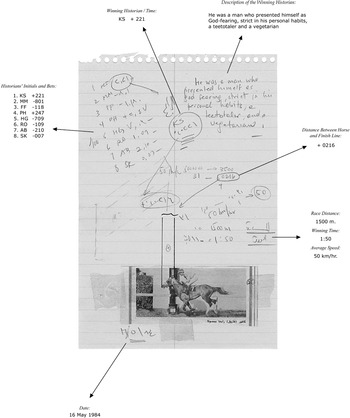
Missing Lebanese Wars, plate 137 (1991–2001). File: AG_AGA_Fakhouri: 137. Color Print, 25 × 30 cm. Copyright © The Atlas Group/Walid Raad and Fadl Fakhouri.
Yet negative heritage is stubborn. The poem with which this article begins was composed by Nadia Tueni in 1972, prior to the outbreak of the war.41
Amyuni, “The Image of the City,” 31.
POLICY CONSIDERATIONS AND RECOMMENDATIONS
Policymakers will do well to consider the complex benefits of negative heritage in drafting laws that will enable its protection. As one commentator notes, the years of vicious bloodshed, violence, kidnappings, and massacres “created a profound trauma that will take rather more than a few multinational retail outlets to cure.”42
Taylor, “Laughter in the Dark.” The Independent, June 3, 2004.
In Lebanon, public awareness of symbols of cultural heritage is acute. Policymakers operating in and around state and municipal bureaucracies can best serve their constituencies by addressing the psychosocial aspects of postwar Beirut. The legal regime in Lebanon is characterized by a number of pressing problems that reach far beyond issues of cultural heritage law, yet which affect it directly.43
For a concise background of the pratfalls of reconstruction, see Adwan, “Corruption in Reconstruction.” Lebanese Transparency Association Report, December 7, 2004.
For a detailed discussion of the implementation of the CHUD-financed project, see Ball-Lechgar, “Inner City Revival.” Lebanon Opportunities, April 2004.
While a detailed analysis of Lebanese public policy lies beyond the scope of this article, attention to two areas would likely result in improvement of the current situation. Certain legal and social issues must be addressed for the government to ensure a minimum threshold of positive public reception. The existing laws affecting urban planning, preservation, and housing must be revisited if larger buildings with the potential for economically diverse and integrated residential and commercial use are to be saved on the periphery of the BCD. Current zoning laws encourage the demolition of larger spaces (zoning categories one and two), since the total built-up area allowed is far greater if the existing building is demolished than if the original structure remains. Tax incentives, such as the one passed in June 2004 giving landlords who perform maintenance on their properties a 5% income-tax deduction, should be supported as a way to encourage smaller investors to rehabilitate, rather than demolish, otherwise functional war-era buildings. Such incentives would help preserve the architectural heritage of the neighborhoods bordering the BCD, which are now under scrutiny for redevelopment.45
Ball-Lechgar, “Old vs. New.” Lebanon Opportunities, July 2004.
Land-use and housing regulations need urgent attention if negative heritage sites are to be maintained for public use and consumption. The current rental law (No. 159/92, also known as the Free Contracts Law) discourages maintenance of older tenant-occupied buildings. Since rents are stabilized at pre-1992 prices, the offers of Solidère or other investors who will pay top dollar for land are tempting to property owners who might be mobilized to protect the heritage of their neighborhoods under less dire economic situations. A draft rent law has been hotly debated for more than two years, with both landlords and tenants permanently dissatisfied, perhaps because the real issue is not about rent as much as a crisis in affordable housing stock.46
“New Rent Law: A Problem or a Solution?” Judicial and Regulatory Outlook, Information International Monthly, July 2002, available at 〈http://www.information-international.com/iimonthly/issue1/judicial.html〉 (retrieved on December 9, 2004); see also Tayyar. “Lebanon's Real Estate Sector.” International Market Insight, December 12, 2002, available at 〈http://strategis.ic.ca/epic/internet/inimr-ri.nsf/en/gr112464e.html〉 (retrieved on December 9, 2004).
Khayat, “Beirut is for Everybody.” Daily Star, May 21, 2004; see also Khayat. “Beirut's Urban Planning.” Daily Star, May 7, 2004.
Preservation laws are similarly retrograde. The Directorate of Antiquities protects only structures built prior to 1701, under the Antiquities Law and the Urban Code. Yet opportunities for revision are forthcoming, since the World Bank CHUD project (which will revitalize historic sectors of Baalbek, Byblos, Tyre, Tripoli, and Saida) includes a mandate to bring future heritage-related practices within the UNESCO codes of conduct.48
Ball-Lechgar, “Inner City Revival.” Lebanon Opportunities, April 2004.
Ball-Lechgar, “Old vs. New.” Lebanon Opportunities, July 1, 2004.
In tandem with legal reform, lawmakers should focus on revising and consolidating the administrative bodies currently responsible for implementing laws affecting cultural heritage. Admittedly, Solidère is a powerful and unaccountable quasigovernmental development agency with the ability to seize land for public use. The Lebanese government could consolidate the various administrative entities that currently oversee cultural heritage sites and policy, to make them more effective and give them more equal footing when negotiating with Solidère. Journalist Lisa Ball-Lechgar explains the current system:
At the moment, two separate departments handle the administration of sites and their promotion: the Directorate of Antiquities (DGA) reports to the Ministry of Culture, while the Directorate for the Operation of Archeological Sites and Museums comes under the Ministry of Tourism. This means that it is often not clear who is responsible for each service, leading in turn to not enough money being spent on areas such as site security and preservation.50
Ball-Lechgar, “Inner City Revival.” Lebanon Opportunities, April 2004.
Social issues, while posing more diffuse difficulties, are no less crucial to the ultimate success of reconstruction. These should include educational and informational programs that encourage continued civic participation and public discussion of Beirut's urban and social history and the reconstruction efforts. Past initiatives supported by the French and British cultural centers have included well-attended public presentations, design conferences, and panel debates on the politics and aesthetics of reconstruction.51
Wilson-Goldie, “Liberties.” Daily Star, March 20, 2004; Medlej, “Reconstruction of Beirut.” Daily Star, February 4, 2004.
There are no completely happy endings in narratives of nation building. Yet with awareness of the psychosocial dimensions of urban planning in postwar Beirut, the mobilization of negative heritage can bring positive didactic, psychological, and even financial aspects to the collective experience of national reconstruction. For policymakers, artists, and urban planners alike, the national goal must be, in the words of architect and conservationist Mona Hallak, to “honor what this place was, and what we lost.”52
As quoted in Wilson-Goldie, “Breaking in Beirut's Brand New Art District,” Daily Star, July 29, 2004.
CONCLUSION
If war is hell, then reconstruction is a psychological and financial purgatory. In war-damaged urban areas that have experienced prolonged civil wars, it is also a tricky political process. Major world cities have been or are being destroyed through armed civil conflicts, and it appears that the global community will face the challenges of reconstruction repeatedly in the coming decades. The legal and economic aspects of reconstruction are often debated, but it is rare that reconstruction discourse openly addresses the problem of promoting a postwar culture of peace and national inclusiveness. It is vital to discuss the reconstruction of public space and monuments in particular, not only because traditionally they are the sites of commerce, but also the places where the social relations we call culture are mediated. If we define culture not only as what people do, but how they make sense of what they have done, we begin to grasp the enormity of the political problems of post–civil war reconstruction. National governments hoping to consolidate authority would do well to consider how best to approach public places resonant with emotionally charged memories. A successful approach to reconstruction can aid in governmental authority by making explicit a public commitment to the rights of all citizens, regardless of past trauma.
References
Abdallah, Ziad, and
Farah Awada.
“Missing Lebanon Wars: A Project by Walid Raad.”
Public Culture
11
(1999):
i–iv.Google Scholar
Al-Radi, Selma.
“In the Aftermath of Civil War: Cultural Heritage in
Lebanon.”
The Getty Conservation Institute Newsletter
11(1)
(1996).
http://www.getty.edu/conservation/resources/newsletter/11_1/news2_1.html
(accessed December 9, 2003).Google Scholar
Amyuni, Mona Takieddine.
“The Image of the City: Wounded Beirut.”
Alif: Journal of Comparative Poetics
7, Spring
(1987):
27–51.Google Scholar
Beyhum, Nabil.
“Fi taqyim wa naqd al-martakazat al-dustouria wa
al-qanounia” [A Critical Appraisal of the Legal and the
Constitutional Aspects]. In
I'amar Beirut wa'l fursa al-da'i'a [The
Reconstruction of Beirut and Lost Opportunity], edited by
Bahadin Al-Basat,
Ziyad Aql,
Nabil Beyhum,
Tony Choueri,
Georges Corm,
Kamal Hamdan,
Biyar Khoury,
Assem Salaam,
Taufic Shanbour, and
Jad Tabet,
27–37.
Beirut:
Dar Rami al-Khal,
1992.
Beyhum, Nabil, and
Maison de l'Orient Méditerranéen (Lyons,
France).
Reconstruire Beyrouth : Les Paris Sur Le Possible
[Reconstructing Beirut: Wagering What is Possible]
Table Ronde Tenue À Lyons Du 27 Au 29 Novembre 1990
[Round Table held in Lyons, France November 27–29,
1990],
Études Sur Le Monde Arabe; No 5.
Lyons, France:
Maison de l' Orient Méditerranéen,
1991.
Corm, Georges.
Al- I'amar Wa-Al-Maslahah Al-‘Ammah Fi Iqtisad
Ma-Ba'da-Al-Harb Wa-Siyasatuh [Reconstruction and the Public
Interest in the Post-War Economy and Politics].
Beirut:
Mu'assasat al-Abhath al-Madiniyah, Dar al-Jadid,
Mu'assasat Ford,
1995.
Fisk, Robert.
Pity the Nation: Lebanon at War.
London:
Deutsch,
1990.
Gavin, Angus, and
Ramez Bahige Maluf.
Beirut Reborn: The Restoration and Development of the Central
District.
London:
Academy Editions; Distributed by National Books Network,
1996.
Hanson, Brian.
“Redrawing Beirut's Geography of Fear.” Rev. of
Projecting Beirut.
Building Design
March 19, 1999:
20.Google Scholar
Makdisi, Saree.
“Laying Claim to Beirut: Reconstruction, Urban-Development,
Urban Narrative and Spatial Identity in the Age of Solidere.”
Critical Inquiry
23
(1997):
660–705.Google Scholar
Meskell, Lynn.
“Negative Heritage and Past Mastering in
Archaeology.”
Anthropological Quarterly
75
(2002):
557–74.Google Scholar
Nora, Pierre.
Realms of Memory.
New York:
Columbia University Press,
1996.
Salaam, A'sim.
Al- I'amar Wa-Al-Maslahah Al-‘Ammah Fi Al-‘Imarah
Wa-Al-Madinah [Reconstruction and the Public Interest in Architecture
and the city].
Beirut:
Dar al-Jadid, Mu'assasat al-Dirasat al-Madiniyah,
Mu'assasat Ford,
1995.
Sarkis, Hashim.
“Territorial Claims: Architecture and Post-War Attitudes
Toward the Built Environment.” In
Recovering Beirut, edited by
Samir Khalaf and
Philip S. Khoury,
101–127.
New York:
Brill,
1993.
Stewart, Dona J.
“Economic Recovery and Reconstruction in Postwar
Beirut.”
Geographical Review
86
(1996):
487–504.Google Scholar
Tabet, Jad.
“Towards a Master Plan for Post-War Lebanon.”
In
Recovering Beirut: Urban Design and Post-War Reconstruction,
edited by
Samir Khalaf and
Philip S. Khoury,
81–100.
Leiden:
Brill,
1993.
Tabet, Jad.
I'amar wa'l Al-Maslaha Al-‘Ammah Fi Al-Turath
Wa-Al-Hadathah: Madinat Al-Harb Wa-Dhakirat Al-Mustaqbal (Reconstruction
and the Public Interest in Heritage and Modernity: City of War and
Memories of the Future).
Beirut:
Mu'assasat al-Abhath al-Madiniyah,
1996.

Missing Lebanese Wars, plate 137 (1991–2001). File: AG_AGA_Fakhouri: 137. Color Print, 25 × 30 cm. Copyright © The Atlas Group/Walid Raad and Fadl Fakhouri.
 You have
Access
- 14
- Cited by