1. Introduction
Grammaticalization is often said to involve gradual change (Givón Reference Givón1979, Hopper Reference Hopper, Traugott and Heine1991, Bybee, Perkins & Pagliuca Reference Bybee, Perkins and Pagliuca1994, Haspelmath Reference Haspelmath1998, Bybee & Hopper Reference Bybee and Hopper2001, Denison Reference Denison and Laurel2001, Brems Reference Brems2003, Traugott Reference Traugott, Joseph and Janda2003). However, the interrelation of grammatical factors in the gradual process of grammaticalization is controversial, and it requires further serious investigation (Heine Reference Heine, Joseph and Janda2003: 600). In this paper, we examine four cases of grammaticalization (English quantificational nouns, Japanese subordinating conjunction markers, Cantonese coverbs, and Japanese deverbal postpositions) and address the following questions: (i) how syntax and semantics interrelate in the gradual process of grammaticalization, especially with respect to phenomena known as ‘decategorialization’; (ii) why changes may occur independently in syntax and semantics; (iii) why grammaticalization takes place among existing grammatical categories (instead of creating completely novel categories); (iv) why syntactic changes often follow from semantic changes; and (v) why syntactic properties may be retained for many years following semantic change, allowing for mismatch within the synchronic system. In response to the first three questions, we propose that the parallel architecture of grammar, as proposed in Sadock (Reference Sadock1991), shapes the structure of language both synchronically and diachronically and that it sheds light on the nature of the gradual change in grammaticalization.
The ways in which grammatical factors interact in grammaticalization have been actively discussed, but the issue is far from being fully resolved. Some propose that semantics and syntax change together (Lehmann Reference Lehmann1982, Bybee et al. Reference Bybee, Perkins and Pagliuca1994, Hopper & Traugott Reference Hopper and Traugott2003, Traugott Reference Traugott, Joseph and Janda2003). For example, Bybee et al. propose that ‘the development of grammatical material is characterized by the dynamic coevolution of meaning and form’ (1994: 20). Sometimes, it is proposed that syntactic change is independent of semantic change (Lightfoot Reference Lightfoot1979) or that any order of changes is possible (Newmeyer Reference Newmeyer1998). More often, it is suggested that semantics changes faster than syntax and that semantic change helps drive syntactic change (Timberlake Reference Timberlake and Charles1977, Fleischman Reference Fleischman1982, Lehmann Reference Lehmann1982, Brinton Reference Brinton1988, Heine et al. Reference Heine, Caudi and Hünnemeyer1991, Rubba Reference Rubba and William1994, Haspelmath Reference Haspelmath1999, Harris Reference Harris, Joseph and Janda2003, Heine Reference Heine, Joseph and Janda2003, Traugott Reference Traugott, Joseph and Janda2003, Bisang Reference Bisang, Walter and Nikolaus2004).
While maintaining the possibility that different orders of changes are possible (Newmeyer Reference Newmeyer1998: 248–251), our investigation focuses on cases of the last type, where semantics changes faster than syntax. Through the analysis of four case studies, we show that semantic change can occur in the absence of syntactic change, leading to cases of ‘mismatch’ between syntax and semantics. These mismatch cases appear to involve partial ‘decategorialization’ (Hopper & Traugott Reference Hopper and Traugott2003: 106–115), since some but not all of the grammatical properties of the original category are lost. Although not unusual, these cases are especially instructive because they underscore the need to consistently and systematically delineate the domains of syntax and semantics in the analysis of their interaction.
In Autolexical Grammar (Sadock Reference Sadock1991, Yuasa Reference Yuasa2005) and similar multi-modular theories such as Parallel Architecture (Jackendoff Reference Jackendoff2002, Culicover & Jackendoff Reference Culicover and Jackendoff2005), grammatical phenomena are systematically sorted out into syntactic and semantic modules. Some grammatical phenomena such as the binding of anaphors are treated as semantic, while other phenomena such as syntactic categories and case distinctions are treated as syntactic. An important aspect of our approach is that semantic constraints directly affect an item's distribution, independently of the syntax, to a much greater extent than in mainstream formal syntactic theories (e.g. Chomsky Reference Chomsky1995). Thus, we make a distinction between an item's distribution, which can be affected by a number of different factors including semantics, and its (purely) syntactic properties, which result specifically from its syntactic category, its morphosyntactic features, or other constraints within the syntax module.Footnote 2
Since the distribution of a given word or morpheme may be independently controlled by syntax and semantics, a multi-modular approach allows us to show that most of the effects of decategorialization in our data are due to semantic change and follow directly from constraints within the semantic system. Furthermore, we show that in the absence of syntactic reanalysis, syntactic properties of the source construction may be retained even when those properties no longer serve any semantic function. Thus, we argue that the appearance of partial decategorialization in our data follows from the independent effects of semantic change and syntactic retention.
The claim that syntactic change is completely independent of semantic change, as proposed by Lightfoot (Reference Lightfoot1979), is often criticized because such a claim ‘provides no reasoned account for the extensive evidence that grammaticalization affects similar classes of lexical items in similar ways across a wide number of languages’ (Hopper & Traugott Reference Hopper and Traugott2003: 75). We propose that while syntax and semantics form independent systems, categories whose representations are associated through correspondence rules across different levels of grammatical structure are categorial prototypes (Yuasa Reference Yuasa2005), and prototypical associations are more stable than non-prototypical ones and often preferred (the principle of Pressure for Structure–Concept Iconicity, Newmeyer Reference Newmeyer1998: 129f.). Therefore, while our analysis predicts each level of grammar to change independently, it also explains why certain semantic changes often lead, eventually, to certain changes in syntactic category or syntactic constituency.
The structure of this paper is as follows. In section 2, we present four case studies of grammaticalization from English, Chinese, and Japanese and show that semantic properties systematically change faster than syntactic properties. In section 3, we first outline the theoretical assumptions that we adopt in our analysis and then show how the parallel architecture of grammar together with the notion of prototype explains important aspects of the interrelation between form and meaning in gradual processes of grammaticalization. We discuss some of the implications of our analysis in section 4 and conclude the paper in section 5.
2. Four case studies of grammaticalization
2.1 English quantificational nouns
When occurring in the configuration [(Det) N of N], the English nouns lot, bunch, heap, and load are polysemous and multi-functional.Footnote 3 The nouns lot, bunch, and heap can denote either a grouping of individuals or a large quantity, as shown by the ambiguity of bunch in (1):
- (1)
(a) She gave me a bunch of bananas. (ambiguous)
(b) She gave me several bananas. (quantifier reading only)
As noted by Francis (Reference Francis1999) and Yuasa & Francis (Reference Yuasa, Francis, Elaine and Laura2003), the quantity sense of these nouns can be closely paraphrased using quantifiers such as many, much, or several, as in (1b).
Langacker (Reference Langacker1991), Francis (Reference Francis1999), Brems (Reference Brems2003), and Yuasa & Francis (Reference Yuasa, Francis, Elaine and Laura2003) note that the multi-functionality of these words in modern-day English is the result of ongoing processes of grammaticalization. In particular, the collective interpretation of these nouns has been extended to a more abstract quantificational meaning (semantic generalization), and some of the typical morphosyntactic and distributional properties associated with the head nouns of binominal noun phrases have been lost (decategorialization). An interesting aspect of these words is that they still retain at least some noun-like syntactic and morphosyntactic properties even in their quantificational usage. That is, it appears that semantic change has progressed at a faster rate than syntactic change, leaving us with a synchronic situation in which some uses of these words show mixed properties of nouns and quantifiers. In this section, we will discuss the diachronic development and synchronic properties of English quantificational nouns (henceforth QNs).
2.1.1 Diachronic development of English quantificational nouns
As is typical in grammaticalization, each word has its own peculiar history, and different QNs have developed in somewhat different ways. However, the general path of change is similar enough, and the current usage overlaps to such an extent, that we can treat them together as a class. Here, we will briefly describe the history of the word bunch to illustrate the diachronic development of English QNs.
During the Middle English period and beyond, the word bunch could refer to ‘a collection or cluster of things of the same kind, either growing together (as a bunch of grapes), or fastened closely together in any way (as a bunch of flowers, a bunch of keys)’ (OED). We will refer to this sense as the ‘bundle’ sense, as in (2a–b):
- (2)
(a) And for thy bed tak now ane bunche of stro.
(1593, CMEPV)Footnote 4(b) On his craven crest, A bounch of heares discolourd diversly.
(1590, OED)
A more general meaning referring to a group or collection of people or things (which are not necessarily bundled together) is also attested at around the same time. We will refer to this meaning as the ‘collective’ sense of bunch, as in (3a–b).
- (3)
(a) Two friars are bargaining for a bunch of cherubs.
(OED, 1832)(b) See what persons God hath picked out of all the bunch of the Prophets, Judges, and Kings.
(OED, 1622)
It was apparently this collective meaning that gave rise to the purely quantificational meaning that we find in modern-day examples such as (4a–c) from the Switchboard Corpus. Note that in (4a–b), bunch is used preceding a mass noun, and therefore cannot be interpreted in the collective sense of (3a–b) above.Footnote 5
- (4)
(a) I mean, he, he well he said he went up in the attic and looked around and he was like, oh my God, he says, looks like a bunch of spaghetti up there. (SC)
(b) Yeah, well, down by Lake Texoma there's a bunch of wooded area. (SC)
(c) … went through and interviewed a bunch of jurors in some of the big cases, and in many cases looking at what had, at the evidence afterwards as to whether the decision was right, went back to the jurors, uh, based on the deliberations. (SC)
We hypothesize that bunch underwent the following semantic extensions, both of which involve generalization of meaning (or semantic ‘bleaching’): bundle>collection>large quantity. In the first extension from bundle to collection, the meaning of ‘attachment’ is lost, and in the second extension from collection to large quantity, the meaning of ‘grouping’ is lost. Since the historical evidence is ambiguous, it is also possible that the quantity meaning is derived directly from the bundle meaning. In either case, Langacker (Reference Langacker1991: 88) offers a plausible description of the semantic changes that took place. He argues that the quantity meaning of bunch and similar nouns is likely to have developed through a process of metonymy whereby an attribute of the original object denoted by the noun has become its primary denotation. In the case of bunch, the typically large size or large number of items in the bundle or grouping has become the primary denotation of the word, and the original sense of spatial contiguity and attachment has faded. The shift in meaning then allows the word bunch to collocate with a wider range of nouns than before, including mass nouns as in (4a–b). Concurrent with this change in lexical semantic content was a change in semantic function: what had been the semantic head of a nominal expression came to function as a quantifier of the following noun. The details of this shift in semantic function are given in the following section.
2.1.2 Quantificational nouns in contemporary English
Sadock (Reference Sadock1990), Francis (Reference Francis1999) and Yuasa and Francis (Reference Yuasa, Francis, Elaine and Laura2003) discuss the grammatical properties of English QNs, showing that QNs are not fully grammaticalized: even the purest quantifier uses of words like lot, bunch, and heap retain some of the key syntactic properties of head nouns, suggesting that change has progressed more fully in semantics than in syntax. Like ordinary head nouns, QNs appear to occur in the typical head noun position of a binominal NP and may co-occur with determiners (5a–c), adjectives (rather than adverbs) (5c), PP complements (5a–c), and plural number marking (5d).
- (5)
(a) I know a lot of people who may watch the TV news in the evening but don't spend the time to actually read a newspaper. (SC)
(b) And there were a bunch of kids, you know, and a bunch of schools. (SC)
(c) I guess, uh, Barry Manilow comes to mind for some reason there's, there's not a whole lot of his stuff that I'm real crazy about, but he does have some things. (SC)
(d) But it's got lots of good recipes so I was thinking about trying to sell that on the side just for fun. (SC)
In contrast, ordinary quantifiers such as many, much and several cannot occur in these positions even though their meanings are similar:
- (6)
(a) *I know a many of people who may watch the TV news.
(b) *And there were a several of kids, you know, and a several of schools.
(c) *There's not a whole much of his stuff that I'm real crazy about.
(d) *It's got manies of good recipes.
Instead, these quantifiers must occur in adjective-like configurations in which they are modifiers of the following noun and are themselves modified by intensifying adverbs as in (7c) rather than adjectives. Number marking must be omitted (7d).
- (7)
(a) I know many people who may watch the TV news.
(b) And there were several kids, you know, and several schools.
(c) There's not very much of his stuff that I'm real crazy about.
(d) It's got many good recipes.
Thus, QNs pattern like head nouns in several respects and they are clearly distinct from adjectives or quantifiers in terms of their position in phrase structure.
In Yuasa & Francis (Reference Yuasa, Francis, Elaine and Laura2003), we show that QNs have a more limited distribution than ordinary head nouns, but we argue that these patterns are derivable from semantics without reference to syntactic structure. We claim that QNs differ from other common nouns in that they no longer function as the semantic head of the noun phrase but rather act as quantifiers of the following noun. We define semantic head of a noun phrase as the bearer of the referential index for the noun phrase, which allows the noun phrase to act as an antecedent for a pronoun or anaphor. Unlike the collective nouns from which they are historically derived, QNs do not bear any referential index. For example, the phrase bunch of bananas in (8a) can serve as an antecedent to the pronoun one only if bunch of bananas is interpreted as a unit (i.e., the bundle meaning) but not if bunch is interpreted as a quantifier of bananas. If bunch is interpreted as a quantifier, the pronoun one can then only refer to a single banana, in which case the noun bananas bears the referential index relevant for the interpretation of one.
- (8)
(a) Bill bought a bunch of bananas, but Fred actually picked one off the tree.
(b) Bill bought a box of chocolates, and Fred also bought one from the same store.
Although bunch here patterns syntactically with box in (8b), it is clear that the meaning of bunch is what ultimately prevents it from being the antecedent of one in a quantifier interpretation.
We understand this lack of a referential index to be derived from a more basic property of QNs – they lack a ‘criterion of identity’ (Baker Reference Baker2003: 101–109). Following Baker (Reference Baker2003), Sadock (Reference Sadock1990), and Gupta (Reference Gupta1980), we assume that common nouns (including abstract nouns) normally bear a ‘criterion of identity’ which sets a standard for determining whether two things are the same or not. For example, it makes sense to say that a glass contains the same water as it did yesterday because the noun water has a criterion of identity. However, it makes no sense to say that a bowl contains the same bunch as it did yesterday unless bunch is interpreted in its bundle sense rather than its quantity sense. The ability of nouns to act as antecedents to pronouns is derived from this more basic criterion of identity, according to Baker (Reference Baker2003: 125). Following Sadock (Reference Sadock1990: 271f.), we assume that nouns bearing a criterion of identity belong to the formal semantic category CN (‘common noun’).Footnote 6
This criterion of identity is also what allows nouns to be counted, measured, or quantified.Footnote 7 Again, we can see that QNs such as bunch lack this property. In (9), the noun bunches can only be understood in its bundle sense because the QN bunch cannot itself be quantified.
(9) Bill bought several bunches of bananas.
Having lost their criterion of identity, QNs have taken on the semantic category of quantifiers which specify the amount of some object or substance denoted by the following noun. Formally, they belong to the category Q-1, which means that they select a common noun (CN), bearing its own criterion of identity, as their argument (e.g., bananas in (9) above). Because they are semantically gradable, QNs also allow modification by intensifiers (Sadock Reference Sadock1990: 276f.). Just as gradable quantifiers such as many and much can be modified by intensifying adverbs such as very, too, and so, QNs can be modified by a few adjectives such as big and whole, which are capable of expressing an intensifying meaning. This is just what we would expect, given the syntactic requirement that nouns be modified by adjectives combined with the semantic requirement that quantifiers be modified by intensifiers.Footnote 8,Footnote 9
Before concluding this section, we must note two additional phenomena, PP-preposing and subject–verb agreement, which have sometimes been taken as evidence that QNs and other similar nouns are not syntactic heads, despite their other head-like properties.Footnote 10 Aarts (Reference Aarts2001: 264–266) argues that the syntactic head noun should allow preposing and coordination of its PP complement, but observes that QNs such as bunch do not allow this:
- (10)
(a) *I don't know many teachers there, but of students, I know a bunch.
(b) ??I know a bunch of students and of teachers.
However, we note that the ‘bundle’ interpretation of bunch shows a similar pattern in (11a–b):
- (11)
(a) *I didn't buy any bunches of grapes, but of bananas, I bought a bunch.
(b) ??I bought a bunch of bananas and of grapes.
These examples suggest that the source construction may have already imposed some restrictions on PP-preposing and (to a lesser degree) coordination.Footnote 11
The subject–verb agreement facts are challenging for any analysis of QNs. Brems (Reference Brems2003) points out that bunch in its ‘bundle’ interpretation, as in (12a), controls subject–verb agreement, while bunch in its quantifier interpretation, as in (12b), does not.Footnote 12
- (12)
(a) The fox, unable to reach a bunch of grapes that hangs too high, decides that they were sour anyway.
(b) There's now a whole bunch of studies from different cities that show the same thing.
(Brems Reference Brems2003: 293)
Brems takes examples such as (12b), for which the QN definitely does not control subject–verb agreement, to be ‘fully grammaticalized quantifier uses’ of the items under investigation (2003: 294).Footnote 13 Although we have already shown that QNs are not fully grammaticalized, such agreement facts appear problematic for our analysis, since subject–verb agreement is often assumed to be determined by the syntactic head.Footnote 14 The notion of syntactic head is not at all straightforward, however. In addition to the head-like properties of QNs shown in (5a–d) above, Wright & Kathol (Reference Wright, Kathol, John and Stephen2003: 380) observe that QNs act as heads with respect to noun–determiner concord despite the fact that they do not control subject–verb agreement. For example, even though the finite verb in (12b) agrees in number with the second noun, studies, the singular determiner a agrees with the singular QN, bunch.Footnote 15 This dissociation between subject–verb agreement and determiner–noun concord can be seen clearly in the following minimal pairs:
- (13)
(a) A bunch of bananas is on the table. (bundle sense)
(b) A bunch of bananas are on the table. (quantity sense)
(c) Tons of food was distributed to the orphanage. (quantity sense)
(d) Tons of food were distributed to the orphanage. (unit sense)
In (13a), the singular number on the verb forces us to assume the literal (‘bundle’) interpretation of bunch, whereas the plural number in (13b) allows only the quantifier interpretation. Similarly, the singular number on the verb in (13c) forces the quantifier interpretation of tons (a large amount), while the plural number in (13d) allows only the literal interpretation where ton is a unit of weight.Footnote 16
Working within an HPSG framework (Pollard & Sag Reference Pollard and Sag1994), Wright & Kathol (Reference Wright, Kathol, John and Stephen2003: 383–387) propose that the QN is the ‘base’ (in our terms, the syntactic head) which determines number concord and constituent structure within the noun phrase, but that the non-base (the second noun) exceptionally determines the external distribution and number specification of the phrase as a whole. This analysis thus relaxes the usual requirement for the base (syntactic head) of a phrase to determine its external distribution and allows items such as QNs to be lexically specified as ‘transparent’ with respect to phrase-level syntactic properties. Adapting this general idea to a multi-modular theory, we may suggest that the lexically-specified ‘transparency’ of QNs forces subject–verb agreement to be linked directly to the referential index of the noun phrase, and thus to be determined by the semantic head. According to this analysis, QNs are quantifiers in semantics, without any referential index of their own, but head nouns in syntax, bearing a syntactic index which determines number concord with the preceding determiner, if any. However, we acknowledge that it is difficult to determine conclusively whether subject–verb agreement is linked directly to the referential index or whether it is somehow mediated by the syntax.Footnote 17 Either way, it is clear that QNs retain many of the syntactic properties of head nouns and differ significantly from adjective-like quantifiers such as many and several.
We conclude that the semantic function of QNs has fully changed from head noun (CN, bearing a criterion of identity) to quantifier (Q-1, selecting CN as its argument), but that QNs have retained the syntactic category and (internal) phrase structure properties of the source construction.
2.2 Japanese subordinating conjunction markers
It is widely attested that nouns diachronically change into subordinating conjunctions (Heine, Claudi & Hünnemeyer Reference Heine, Caudi and Hünnemeyer1991: 118). For example, the English subordinating conjunction while originated as a noun hwile, which means a length of time, and became a subordinating conjunction through grammaticalization (Traugott & König Reference Traugott and Heine1991, Hopper & Traugott Reference Hopper and Traugott2003).
In the present section, we examine Japanese subordinating conjunction markers, as shown in (14).Footnote 18
- (14)
(a) Inazuma-ga hikat-ta-totan-ni, kaminari-ga ochi-ta.lightning-nom flash-past-as.soon.as thunder-nom rumble-past‘As soon as lightning flashed, a peal of thunder broke.’
(b) Sanzan kangae-ta-ageku-ni, shigoto-o yame-ta.thoroughly think-past-finally.after job-acc quit-past‘After I thought about it thoroughly, I quit my job.’
Interestingly, while they still retain some noun-like syntactic properties, these markers no longer have the normal semantic function of nouns. Hence, just like the English quantificational nouns discussed in the previous section, we suggest that the semantic properties of these subordinating conjunction markers have changed much faster than their syntactic properties.
2.2.1 Origin of Japanese subordinating conjunction markers
There is a variety of subordinating conjunction markers in Japanese, and some markers such as totan ‘as soon as’ originated as nouns (Muraki Reference Muraki2005). Initially, totan meant ‘moment’ or ‘instance’ (Nihon Kokugo Daijiten 1935).
(15) Gyoji osae-te, tadaima-no-wa, totan-no ware-nite, shobu-shire-zu-to mooshi-keru.referee weigh.in-ptcp right.now-gen-cont instance-gen draw-because winner-know-neg-comp say-evi‘The referee weighed in and evidently said that as for the one just now, it was an instant draw and there is no winner.’ (Joruri, Hakoneyama-gassen)
These original meanings of totan such as ‘moment’ or ‘instance’ are no longer transparent in the current usage. Hence, unlike the Japanese nouns for ‘moment’ such as shunkan, totan does not occur freely in this sense in contemporary Japanese.
(16) Sono shashin-wa doroboo-ga shinnyuu-su-ru shunkan/*totan-o torae-te i-ru.the picture-top burglar-nom break.in-do-pres moment-acc capture-ptcp be-pres‘The picture captures the moment when the burglar tries to break in.’
Another subordinating conjunction marker, ageku ‘finally after’, also originated as a noun, and it initially meant the last fourteen-syllable verse of a Japanese poem, haiku and renga (Koojien 1976). When ageku refers to a final fourteen-syllable verse, it can still function as a regular noun, allowing modification by genitives or adjectives, as shown in (17a–b), and pronominal coreference, as shown in (17c).
- (17)
(a) saigo-no ageku-made yoku utawareteiru utalast-gen last.14.syllable.verse-till well read poem‘a poem that reads well till the very last fourteen-syllable verse’
(b) Ii hokku-to ageku-no jookengood first.17.syllable.verse-and last.14.syllable.verse-gen condition‘conditions for a good first seventeen-syllable verse and last fourteen-syllable verse’
(c) Sono uta-no ageku-wa yoku dekite iru kara, sore-o kaki-naosu-hitsuyoo-wa ari-masen.that poem-gen last.14.syllable.verse-top well made is because it-acc write-correct-necessity-top have-neg‘Because the last fourteen-syllable verse of the poem is written well, it does not need to be rewritten.’
However, when used as a subordinating conjunction marker, the behavior of ageku differs significantly from that seen in (17) above.
2.2.2 Subordinating conjunction markers in contemporary Japanese
As pointed out in Yuasa Reference Yuasa1998, Yuasa & Francis Reference Yuasa, Francis, Elaine and Laura2003, and Yuasa Reference Yuasa2005, the current properties of these subordinating conjunction markers are peculiarly mixed, and they deviate from those of both prototypical nouns and subordinating conjunction markers in contemporary Japanese. For example, although these subordinating conjunction markers originate as nouns, they have lost their criterion of identity and no longer function as head nouns bearing a referential index and belonging to the category CN in semantics. Rather, they have become predicates which express how the main proposition and the subordinate proposition relate to each other. Following Yuasa (Reference Yuasa2005: 160), we assume that they belong to the semantic category M(Prop)-1. That is, they are predicates which select one internal argument (the subordinate proposition) and modify the proposition expressed by the main clause.Footnote 19
Unlike regular nouns, these subordinating conjunction markers can neither be modified by adjectives (18) nor function as the antecedent of a pronoun (19).
- (18)
(a) ketteiteki-na shunkan/*totandecisive moment/as.soon.as‘the decisive moment’
(b) *subarashii [yoku kangae-ta ageku]wonderful well think-past finally.after‘(intended) *wonderful [after I thought it through]’
- (19)
(a) Doroboo-o tsukamaet-ta totan-ni, nagu-rare-te, sore-o mattaku omoidas-e-na-i.burglar-acc capture-past as.soon.as hit-pass-ptcp it-acc at all remember-can-neg-pres‘As soon as we caught the burglar, I was hit, and I cannot remember it (=the fact that we caught the burglar, ≠the moment).’
(b) Yoku kangae-ta-ageku-ni kimemashi-ta. Sore-ga yo-katta-no-des-u.well think-past-finally.after decide-past it-nom good-past-nomz-be-pres‘After I thought it through, I made my decision. It (=the fact that I thought it through, ≠ageku) was a nice thing to do.’
As in the case of English QNs, the inability of these subordinating conjunctions to act as antecedents to pronouns follows from the fact that they have no criterion of identity. The semantics of these markers also prevents them from being modified by adjectives. Although this semantic restriction on modification is caused by a lexical property of these subordinating conjunctions, it is not idiosyncratic. Rather, it is the direct result of a systematic change in semantic category.Footnote 20
In the following examples, it may appear that these subordinating conjunctions can be modified by a demonstrative determiner.
- (20)
(a) Suzuki-ga 3-ji-ni kaette ki-ta. Sono/*ano tootan-ni ame-ga futte ki-ta.Suzuki-nom 3-o'clock-at return come-past that/that as.soon.as rain-nom fall come-past‘Suzuki came home at 3:00. Soon after that (=after Suzuki came home at 3:00), it started raining.’
(b) Sasaki-wa monku-o iitsuzuke-ta. Sono/*ano ageku-ni kaette shimat-ta.Sasaki-top complaint-acc continue-past that/that finally.after go.home have-past‘Sasaki continued complaining. After that (=after Sasaki continued complaining), he went home.’
However, we claim that the occurrence of the demonstrative sono ‘that’ in these examples is permitted because the demonstrative is used here pronominally to refer to a proposition. In (20a–b), the demonstrative sono does not modify totan and ageku, but rather it refers to the proposition given in the previous sentence. As also shown in (20a–b), not all demonstratives can refer to a proposition, and the examples become ungrammatical if totan and ageku occur with other demonstratives, such as ano.
Although these subordinating conjunction markers have lost their criterion of identity in semantics, they still retain noun-like properties in syntax. Three sources of evidence are as follows. First, when adjectival nouns occur before these subordinating conjunction markers, they have to take the pre-nominal form, as shown in (21). In (22), we show that adjectival nouns normally take the pre-nominal form -na before a noun and have the sentence-final form da at the end of sentence or before a regular subordinating conjunction marker.
(21) ?Kuruma-ga hidoku fuchoo-na/*da ageku-ni, keetai-made koshoo shi-ta.Footnote 21 car-nom extremely poor.condition while cell.phone-even break.do-pastorgsents ‘While my car has been in extremely poor condition, even my cell phone broke!’
- (22)
(a) kiree-na hanabeautiful flower‘beautiful flower’
(b) Hana-ga kiree-da kara, kai-mashoo.flower-nom beautiful because buy-shall‘Let's buy these flowers, because they are beautiful.’
Second, these subordinating conjunction markers allow a case alternation (ga-no conversion) which occurs only in a clause headed by a noun. In (23a), the nominative ga optionally alternates with the genitive no in a relative clause. As shown in (23b), this does not happen in a regular subordinate clause. However, the subordinate clause headed by totan in (23c) does allow this alternation.
- (23)
(a) [kodomo-ga/no suki-na] nekochild-nom/gen love cat‘the cat that the child loves’
(b) [Kodomo-ga/*no suki-da-kara] neko-o kaimashi-ta.child-nom/gen like-because cat-acc adopt-past‘We adopted a cat, because my child likes them.’
(c) [Inazuma-ga/no hikat-ta-totan-ni] kaminari-ga ochi-ta.lightning-nom/gen flash-past-as.soon.as thunder-nom rumble-past‘As soon as lightning flashed, a peal of thunder broke.’
Third, subordinating conjunctions such as totan and ageku can optionally occur with a dummy postposition, -ni, which does not contribute to the meaning of these subordinating conjunctions. An example is given in (23c) above. This parallels regular nouns, which are normally followed by postpositions to indicate grammatical relations. In summary, it seems that these subordinating conjunctions still retain some noun-like properties in syntax, while the meanings of the original nouns are lost.
Some other subordinating conjunction markers also originated as nouns and went through a similar process of grammaticalization. For example, Ono (Reference Ono and Ronbunshuu1953) proposes that the marker kara ‘because’ was originally a noun meaning blood relation. Although there seems to be some disagreement among researchers as to exactly what the noun kara meant, Matsumura (Reference Matsumura1969: 361) concludes that all of the analyses to date uniformly suggest that the subordinating conjunction maker kara started as a noun. In Manyoshuu (8th century), we find examples where the marker functions as a subordinating conjunction marker while retaining some noun-like properties in syntax (Konoshima Reference Konoshima1983: 117). In (24), the marker kara follows the genitive marker -no and precedes the postposition -ni, although it semantically relates the main proposition with the subordinate proposition.
(24) Asu-yori-wa tsugite kikoemu hototogisu hitoyo-no kara-ni koiwatarukamo.tomorrow-from-cont ceaselessly be.heard cuckoo one.night-gen reason-of long‘From tomorrow, the voice of the cuckoo will be heard. Because of this one night, I while away in longing …!’Footnote 22 (Manyooshuu 18: 4069)
Yamaguchi (Reference Yamaguchi1980) reports that cases like (24) had disappeared by the Medieval Period. As shown in (25) below, the marker kara no longer retains any of the original noun-like properties in contemporary Japanese: (i) neither the pre-nominal form of adjectival nouns nor the genitive marker -no can precede kara; (ii) other postpositions cannot follow kara; and (iii) ga-no conversion does not take place within a subordinate clause headed by kara. These points are illustrated in (25a–c).
- (25)
(a) [Sore-*no/da kara] ashita kite kudasai.it-gen/be because tomorrow come please‘Because of that, please come tomorrow.’(a′) Sono hon-wa [ninki-*na/da kara] motto chuumon shimashi-ta-yo! the book-top popular because more order do-past-sfp ‘I order more copies of this book, because it is so popular.’
(b) *Sono hon-wa [ninki-da kara]-ni motto chuumon shimashi-ta-yo!the book-top popular because-at more order do-past-sfp‘I order more copies of this book, because it is so popular.’
(c) [Sono hon-ga/*no ninki-da-kara] ano hon–mo[indent]ure–ru[indent]daroo.hon-mo ure-ru daroo.the book-nom/gen popular-be-because that book-also sell-pres will‘Because this book is popular, that book will also sell.’
What distinguishes the subordinating conjunction marker kara from the markers such as totan or ageku, which we have discussed in this section, is that kara seems to have already passed the stage where the properties of prototypical nouns and subordinating conjunction markers are mixed, so that it can now be considered a fully grammaticalized subordinating conjunction. On the other hand, markers such as totan or ageku are still on their way to being grammaticalized to subordinating conjunction markers from nouns, and hence their categorial status is not straightforward, since syntax and semantics do not change at the same rate.
2.3 Cantonese coverbs
The term ‘coverb’ is used in Chinese linguistics to refer to a set of transitive verbs that have preposition-like relational meanings and typically occur in serial verb constructions with one or more other verbs. Here, we will discuss a subset of coverbs in Cantonese for which the coverb phrase (i.e., the coverb plus its object) precedes and modifies the main VP of the clause in an asymmetrical serial construction (cf. Matthews Reference Matthews, Alexandra and Dixon2006). In (26), for example, the coverb phrase hai go gaan sezilau ‘at that office’ (with coverb hai) precedes and modifies the main VP gin haak ‘see client’.Footnote 23
(26) Keoidei jigaa hai go gaan sezilau gin haak.they now at that cl office see client‘They are meeting clients in that office right now.’
Coverbs are derived historically from transitive verbs and many of them are still homophonous with main verbs in modern Mandarin (Li & Thompson Reference Li and Thompson1981, Hwang Reference Hwang2000) and Cantonese (Matthews & Yip Reference Matthews and Yip1994, Ansaldo Reference Ansaldo1999, Matthews Reference Matthews, Alexandra and Dixon2006). For example, the Cantonese coverb hai ‘at’ in (26) can also be used as the main verb of the clause in the sense ‘be at’, as in (27).
(27) Keoidei jigaa hai go gaan sezilau.they now at that cl office‘They are in that office right now.’
Although coverbs have developed preposition-like functions as VP modifiers, they retain most of the categorial properties of verbs even in their coverb usage (Matthews & Yip Reference Matthews and Yip1994: 60–62, Francis & Matthews Reference Matthews, Alexandra and Dixon2006). As in the case of English quantificational nouns, it appears that grammaticalization has progressed more fully in semantics than in syntax, resulting in the appearance of mixed verbal and prepositional properties. In this section, we will elaborate on the diachronic development and synchronic analysis of Cantonese coverbs.
2.3.1 Diachronic development of Cantonese coverbs and semantic change
Lord's (Reference Lord1993) cross-linguistic study of historical change in serial verb constructions shows that multi-verb constructions indicating two or more distinct events or sub-events are commonly reanalyzed as referring to a single event. Concomitant with this is the gradual development of certain verbs into prepositions, conjunctions, complementizers, or affixes when used in serial contexts. Although Lord's data are primarily from West African languages, she notes that the same kinds of processes are found in Chinese. Specifically, the constructions in which Chinese coverbs occur are derived from ‘the typical patterns of logical and/or chronological serialization in Chinese’ (Y. C. Li Reference Li1980: 276), and coverbs are currently in historical transition from verb to preposition status (Li & Thompson Reference Li and Sandra1974, Hwang Reference Hwang2000).
Coverbs originated as transitive verbs with a range of different meanings indicating motion, location, path, direction, and other relational notions. Each verb has its own developmental path, and different verbs have developed into coverbs at different points in the history of Chinese (Y. C. Li Reference Li1980, Hwang Reference Hwang2000). Furthermore, some coverbs have grammaticalized more fully than others, resulting in individual variation among verbs (Li & Thompson Reference Li and Sandra1974: 274, Hwang Reference Hwang2000: 71). However, a group of them share the same basic word order and semantic function in current usage, occurring in the V1 position of an asymmetrical serial verb construction of the form [V1 NP1 V2 (NP2)] and functioning as modifiers of the main verb, V2. We will consider these verbs together as a class, and we will refer to the construction described above as the coverb construction, keeping in mind that some items traditionally called coverbs occur in other serial constructions instead of, or in addition to, this one.
With the exception of tung4 ‘with’ (< ‘to be similar’) and jau4 ‘from’ (< ‘to follow’), which today can only be used as coverbs, verbs such as bong1 ‘for’ (< ‘help’), deoi3 ‘toward’ (< ‘to face’), gan1 ‘with’ (< ‘to follow’), and doi6 ‘for, in place of’ (< ‘to replace’) co-exist with homophonous main verbs bearing the original source meanings in modern-day Cantonese (Matthews & Yip Reference Matthews and Yip1994: 60–62, Matthews Reference Matthews, Alexandra and Dixon2006, Li & Thompson Reference Li and Thompson1981: 368f.). The lexical meanings of Cantonese coverbs are similar to the original source meanings, although in some cases the meanings have generalized to some extent. For example, the coverb use of gan1 ‘with’ has lost the sense of motion inherent in the original meaning of ‘follow’, and can be used as in (28) in situations that do not involve motion.Footnote 24
(28) A-Man gan go go sinsaang hok kam.Ah Man follow that cl teacher learn piano‘Ah Man is learning the piano with that teacher.’
In other cases, it is difficult to identify any change at all in the verb's lexical content. For example, there is scarcely any difference between hai2 in (29a), which retains the relevant source meaning (‘to be at’), and (29b), which illustrates the coverb usage (‘at’).
- (29)
(a) Keoi hai ukkei. (hai2 as main verb)s/he at home‘She is at home.’
(b) Keoi hai ukkei tai dinsi. (hai2 as coverb)s/he at home watch television‘She watches television at home.’
Lexical content must, however, be distinguished from the semantic function of coverbs within the coverb construction. While the lexical meaning of some verbs has remained the same, there is a clear difference in the semantic function of coverbs in the context of the coverb construction in (29b), as opposed to the simple transitive construction in (29a). When used as the main predicate of a transitive clause, verbs such as hai2 ‘to be at’ license an external argument in subject position and an internal argument in direct object position. Formally, they are two-place predicates which belong to the category F-2 (Sadock Reference Sadock1991: 25).Footnote 25 When occurring in V1 position of the coverb construction, however, coverbs belong to the semantic category M(F-1)-1.Footnote 26 That is, coverbs lack an external argument of their own, and function together with their objects as modifiers of the predicate expressed by the verb phrase. Therefore it is the main verb (e.g., tai2 ‘watch’ in (29b)), not the coverb, that semantically licenses the external argument in subject position.
The fact that the coverb phrase can be omitted without changing the basic propositional content of the clause indicates that coverbs are in fact modifiers of the following VP. For example, if we omit the coverb phrase in (29b), hai ukkei ‘at home’, the sentence still denotes an event of watching television. However, if we omit the main verb phrase, tai dinsi ‘watch television’, we are left with the sentence in (29a), which denotes an event of being at home. Furthermore, the behavior of coverbs with respect to sentence adverbs shows that they do not license an external argument of their own and therefore do not denote a distinct event predicated of the subject. In (30a) below, the adverb hou2 siu2 ‘rarely’ modifies the single event of watching television at home. Example (30b) shows that the coverb construction does not allow an additional sentence adverb modifying hai2 uk1kei2 ‘at home’. Thus this sentence is unacceptable for the same reason as its English translation: the adverbs seng4jat6 ‘always’ and hou2 siu2 ‘rarely’ cannot sensibly be interpreted as modifying the same event.Footnote 27 In contrast, hai2 ‘to be at’ is the main verb of a subordinate clause in (30c), thus licensing its own external argument and allowing modification by its own sentence adverb.
- (30)
(a) Keoi hou siu hai ukkei tai dinsi.s/he very little at home watch television‘She rarely watches television at home.’
(b) *Keoi sengjat hai ukkei hou siu tai dinsi.s/he always at home very little watch television‘*She rarely watches television always at home.’
(c) Seoijin keoi sengjat hai ukkei, daanhai hou siu tai dinsi.although s/he always at home but very little watch television‘Although she is always at home, she rarely watches television.’
Thus, in the context of the coverb construction, the coverb serves the preposition-like function of licensing additional, optional information about the event denoted by the main verb (for example, its location), and only the main verb phrase is actually predicated of the individual denoted by the subject (cf. Butt Reference Butt, Miriam and Tracy1997: 14).
According to Pulleyblank (Reference Pulleyblank1995: 47), coverbs developed in the context of the ‘free serial verb construction’ – a construction consisting of a sequence of two or more VPs sharing the same syntactic subject and expressing separate (but temporally, causally, or otherwise related) events. In terms of semantics, each VP contributes a distinct proposition predicated of the individual denoted by the shared subject. In Classical Chinese (551–221 bc), this free serial verb construction had coordinate syntax and could optionally occur with the conjunction ér ‘and’ between the last two conjuncts (1995: 45). The coverb construction, which also already existed in Classical Chinese, differed from the free serial verb construction in that one VP modified the other VP and did not express a separate event. In addition, the modifying VP had to contain one of a limited number of verbs with preposition-like meanings, and the conjunction ér ‘and’ was not normally used between the two conjuncts (Pulleyblank Reference Pulleyblank1995: 47). Thus, the coverb construction in Classical Chinese already had the argument structure properties described above for modern Cantonese. Footnote 28 The coverb construction has become further limited in modern-day Mandarin and Cantonese in that normally the modifying VP (the coverb phrase) must precede the main VP, just like other adverbial modifiers (1995: 48). While it is unclear from the historical records whether the coverb construction actually developed directly from the free serial verb construction, we follow Pulleyblank's (Reference Pulleyblank1995) suggestion that this was a very plausible source.
Thus, it appears that the semantic development of coverbs involved a change in argument structure such that a serial verb construction expressing two or more distinct events predicated of the same subject was reanalyzed as a coverb construction expressing a single event modified by a phrase denoting location, path, benefactive, or similar notions. In some cases, there was also a generalization of the verb's lexical meaning. However, as we discuss in the following section, the basic syntactic structure of the coverb construction – sequential VPs with a shared (syntactic) subject – has been retained from the source construction.
2.3.2 Syntax of coverbs in contemporary Cantonese
With respect to their syntactic and morphosyntactic properties, Cantonese coverbs are much like other transitive verbs. As noted above, their occurrence in a serial verb construction apparently derives from the ability of any verb to occur in a ‘free serial verb construction’ expressing two or more events predicated of the same subject (Pulleyblank Reference Pulleyblank1995: 47). Although coverb phrases no longer express a distinct event, Francis & Matthews (Reference Matthews, Alexandra and Dixon2006) show that the Cantonese coverb construction consists of a sequence of two VPs sharing the same subject. In addition, they argue that coverbs are in fact still verbs (not prepositions) with respect to their syntactic category. We will summarize the relevant arguments briefly here.
First of all, Cantonese coverbs occur in V1 position of the coverb construction, a kind of serial verb construction. Other serial verb constructions in Cantonese, such as those indicating sequences of events, occur with the same [V NP V (NP)] pattern, as in example (31):Footnote 29
(31) Lei sik-zo faan fan-gaau.you eat-asp rice lie-sleep‘Eat and go to bed.’ (Matthews Reference Matthews, Alexandra and Dixon2006: 78)
Secondly, coverbs act as verbs with respect to A-not-A question formation – a method of forming yes-no questions in which the first syllable of the verb is reduplicated, and the negative particle m- ‘not’ is inserted between the two reduplicated syllables. The following examples in (32) show that A-not-A reduplication can occur on either the coverb or the main verb in a coverb construction:Footnote 30
- (32)
(a) Lei tung-m-tung ngodei sik faan aa?you with-not-with us eat rice prt (coverb)‘Will you be eating with us?’
(b) Lei tung ngodei sik-m-sik faan aa?you with us eat-not-eat rice prt (main verb)‘Will you be eating with us?’
Finally, although aspect is usually marked on the main verb (V2) of a coverb construction, coverbs in V1 position allow aspect marking as well as a range of post-verbal particles indicating notions such as modality and quantification, as shown in (33a–c). Semantically, aspect takes scope over the entire sentence, regardless of the position of aspect marking in V1 or V2.
- (33)
(a) Ngo tung-gwo keoidei king-gai. (aspect marking)I with-asp them chat‘I've chatted with them.’
(b) Ngo m tung dak keoidei king-gai. (modal dak)I not with mod them chat‘I can't chat with them.’
(c) Ngo tung saai keoidei king-gai. (saai quantification)I with all them chat‘I chat with all of them.’
In addition to their verbal properties, however, coverbs also have some preposition-like properties. First, coverb phrases are optional adjuncts to the following VP, and occur in the same pre-verbal position as VP-modifying adverbs. For example, the coverb phrase gan go go sinsaang ‘with that teacher’ in (34a) can be omitted entirely, or replaced by an adverb such as jicin ‘formerly’ in (34b). However, we note that this position is indistinguishable from the first VP position in a ‘free serial verb construction’ expressing a sequence of events.
- (34)
(a) A-Man (gan go go sinsaang) hok kam.Ah Man follow that cl teacher learn piano‘Ah Man is learning the piano with that teacher’
(b) A-Man jicin hok kam.Ah Man formerly learn piano‘Ah Man was learning the piano before.’
Secondly, coverbs generally do not allow ‘stranding’ of their objects under A′-movement (topicalization or relativization). As shown in (35), for example, the object of the coverb tung ‘with’ cannot be moved from its position following the coverb unless a resumptive pronoun is used (35b–c).Footnote 31
- (35)
(a) Ngo tung A-John m suk.I with A-John not familiar (basic coverb construction)‘I’m not familiar with John.’
(b) *A-John, ngo tung m suk.A-John I with not familiar (topicalization with gap)‘John, I'm not familiar with.’ (intended)
(c) A-John, ngo tung keoi m suk.A-John I with 3sg not familiar (topicalization with resumptive pronoun)‘John, I'm not familiar with him.’
Some authors have taken similar evidence from Mandarin to indicate that at least some items traditionally categorized as coverbs are in fact prepositions (e.g., Li & Thompson Reference Li and Sandra1974, Y. A. Li Reference Li1990, Zhang Reference Zhang1990, McCawley Reference McCawley1992, Huang Reference Huang1998). However, apart from stranding, Cantonese coverbs display all of the typical syntactic and morphosyntactic properties of verbs. Thus, Francis & Matthews (Reference Matthews, Alexandra and Dixon2006) argue that preposition-like properties of coverbs can be attributed to two factors that are independent of syntactic category: (1) the semantic status of coverb phrases as VP modifiers; and (2) an island constraint which bars extraction from a VP functioning as an adjunct to another VP. Although a semantic account of the extraction facts is quite plausible (cf. Culicover & Jackendoff Reference Culicover and Jackendoff1997), there is no clear evidence to determine whether the island constraint applies in syntax or in semantics. If the constraint is syntactic, then coverb phrases must be treated as syntactic adjuncts, in which case a coverb phrase differs in its syntactic function from the first VP of the source construction, which was a coordinate VP. Nevertheless, since coverb phrases are clearly VPs (not PPs) in syntax and still occur in a position adjacent to another VP, it appears that most of the original syntactic properties of coverbs have been retained. Similar to the other cases discussed above, this situation can be understood as the result of semantic change in the argument structure of coverbs having occurred independently of any change in syntactic category.
2.4 Japanese deverbal postpositions
In this section, we present Japanese deverbal postpositions, which originated as verbs and became postpositions. This type of grammaticalization is frequently observed; the English word considering, for example, originated as a verb and can be used as a subordinating conjunction (Hopper & Traugott Reference Hopper and Traugott2003).
(36) Considering (*having carefully considered) you are so short, your skill at basketball is unexpected. (conjunction)
As shown in (37), considering can also be used as a verbal participle, but Hopper & Traugott point out that it differs from the subordinating conjunction considering in the following respects: (i) the participle considering can be modified by an adverb such as carefully; (ii) it allows past tense; and (iii) the interpretation of the covert subject is controlled by the matrix subject.
(37) [PRO Carefully considering/Having carefully considered all the evidence] the panel delivered its verdict. (participle)
In this section, we present similar cases from Japanese where some verbs become postpositions, and suggest again that the semantic properties of these deverbal postpositions change faster than their syntactic properties.
2.4.1 Verbal properties of Japanese deverbal postpositions
Some examples of Japanese deverbal postpositions are given in (38).
- (38)
(a) Koronbasu-wa Shikago-ni kurabe-te atataka-i.Columbus-top Chicago-to compare-ptcp warm-pres‘(lit.) Columbus is warm comparing it to Chicago.’‘Columbus is warmer than Chicago.’
(b) Kono gakkai-o Tokyoo-ni oi-te kaisai shi-mas-u.this conference-acc Tokyo-in place-ptcp hold do-pol-pres‘(lit.) (We) will hold this conference placing (it) in Tokyo.’‘(We) will hold this conference in Tokyo.’
These deverbal postpositions originated as verbs (Muraki Reference Muraki1991, Matsumoto Reference Matsumoto and Toshio1998, Iori et al. Reference Iori, Takanashi, Nakanishi and Yamada2001). First, the participial form of regular verbs is morphologically identical to these deverbal postpositions, as shown in (39).
- (39)
(a) Nihonjin-wa yoku Tokyoo-o Nyuuyooku-ni kurabe-te kangae-mas-u.Japanese-top often Tokyo-acc New York-to compare-ptcp think-pol-pres‘Japanese often think of Tokyo comparing it to New York.’
(b) Nimotsu-o soko-ni oi-te kochira-e ki-te kudasai.bag-acc there-at place-ptcp here-to come-ptcp please‘(After) having placed your bag there, please come here.’
Second, as Muraki (Reference Muraki1991) points out, these deverbal postpositions appear with the case markers or postpositions that the original verbs subcategorize for. For example, the verb meguru ‘to visit’, shown in (40a), is a transitive verb that subcategorizes for a theme marked by the accusative marker -o, and the corresponding deverbal postposition ~o megut-te ‘concerning/on’ contains the accusative marker -o. Similarly, the verb tsuku ‘to accompany’ subcategorizes for an internal argument marked by a dative marker -ni; hence the dative marker -ni is part of the deverbal postposition ~ni tsui-te ‘about’, as shown in (40b). As shown in (41), regular postpositions subcategorize for arguments directly, and no case markers intervene between the postposition and its argument.
- (40)
(a) Ohenro-san-no ikkoo-wa 88-kasho-no reejoo-o megut-te arui-ta. (participle)pilgrim-gen group-top 88-places-gen sacred.place-acc visit-ptcp walk-past‘The group of pilgrims walked and visited 88 sacred places.’(a′) Kono mondai-o megut-te ronsoo-ga oki-ta. (deverbal postposition) this issue-acc visit-ptcp debate-nom arise-past ‘Concerning/on this issue, a controversy arose.’
(b) Hahaoya-ga itsumo kodomo-ni tsui-te ku-ru. (participle)mother-mom always child-to accompany-ptcp come-pres‘The mother always comes accompanying the child.’(b′) Kore-ni tsui-te hanashi-te kudasai. this-to accompany-ptcp speak-ptcp please (deverbal postposition) ‘Please talk about this.’
(41) Daigaku-*o/*ni/Ø-kara kyonen sotsugyoo-shimashi-ta.college-acc/dat/Ø-from last.year graduation-do-past‘(I) graduated from college last year.’
Note that these case markers and postpositions that appear in deverbal postpositions are fossilized, and they no longer have semantic content.
Third, regular verbs have two participle forms, the direct form -te and the polite form -mashi-te. The polite form -mas normally occurs only with verbs, but these deverbal postpositions can also appear in both forms (Muraki Reference Muraki1991, Matsumoto Reference Matsumoto and Toshio1998).
- (42)
(a) Konkai-wa 30-kasho-o meguri-mashi-te, nokori-wa zehi tsugi mawari-ta-i-to omoi-mas-u.this.time 30-places-acc visit-pol-ptcp rest-top definitely next go-want-pres-comp think-pol-pres (participle)‘We visited 30 places this time, and we definitely want to go to the other places next time.’
(b) Kono mondai-o meguri-mashi-te ronsoo-ga oki-te ori-mas-u.this issue-acc visit-pol-ptcp debate-nom arise-ptcp be-pol-pres (deverbal postposition)‘Concerning/on this issue, a controversy arose.’
Although these deverbal postpositions originated as verbs and look very similar to verbs (in the participial form), they do not have all of the properties of normal verbs. In the next section we examine how the properties of deverbal postpositions differ from those of prototypical verbs.
2.4.2 Deverbal postpositions as postpositions
If we examine these deverbal postpositions closely, we find that they differ semantically from normal verbs in the participial construction. When used in the participial construction, these verbs are two-place predicates (of formal category F-2) which license an internal argument (a direct object) and an implied external argument (a PRO subject). Together with their arguments, they express a distinct proposition (a subordinate clause) which functions as a modifier of the proposition denoted by the main clause. When used as deverbal postpositions, however, they no longer have any external argument, and the phrase containing the deverbal postposition no longer expresses a separate event. Like Cantonese coverbs, they act as modifiers of the main predicate and belong to the semantic category M(F-1)-1.
These semantic changes have several consequences for the distribution of deverbal postpositions. First, deverbal postpositions can be paraphrased by ordinary postpositions such as yori ‘than’ and de ‘in’ (Muraki Reference Muraki1991).
- (43)
(a) Koronbasu-wa Shikago-ni kurabe-te/Shikago-yori atataka-i.Columbus-top Chicago-to compare-ptcp/Chicago-than warm-pres‘Columbus is warmer than Chicago.’
(b) Kono gakkai-o Tokyoo-ni oi-te/Tokyo-de kaisai shi-mas-u.this conference-acc Tokyo-in place-ptcp/Tokyo-in hold do-pol-pres‘(We) will hold this conference in Tokyo.’
Second, because deverbal postpositions lack an implied PRO subject, their interpretation is not affected by the matrix clause subject, as shown by the acceptability of both active and passive sentences in (44b–b′). In contrast, in a participial construction the matrix subject controls the covert PRO subject, thus rendering the passive sentence in (44a′) unacceptable.
- (44)
(a) Enjinia-wa [PRO buruupurinto-o soba-ni oi-te] shorui-o shirabe-ta.engineer-top blueprint-acc side-at place-ptcp document-acc check-past (participle)‘The engineer checked the document, having placed the blueprint beside him.’(a′) *Shorui-ga [PRO buruupurinto-o soba-ni oi-te] enginia-niyotte shirabe-rare-ta. document-nom blueprint-acc side-at place-ptcp engineer-by check-pass-past (participle)‘*The document was checked by the engineer, having placed the blueprint beside him.’
(b) Kono gakkai-o Tokyoo-ni oi-te kaisai shi-mas-u. this conference-acc Tokyo-in place-ptcp hold do-pol-pres (deverbal postposition) ‘(We) will hold this conference in Tokyo.’(b′) Kono gakkai-ga Tokyoo-ni oi-te kaisai s-are- ru. this conference-nom Tokyo-in place-ptcp hold do-pass-pres (deverbal postposition)‘This conference will be held in Tokyo.’
Third, unlike participial constructions, adverbs cannot modify deverbal postpositions (Matsumoto Reference Matsumoto and Toshio1998).
- (45)
(a) *Gakkai-o [umaku Tokyo-ni oi-te] kaisai su-ru.conference-acc nicely Tokyo-in place-ptcp hold do-pres (deverbal postposition)‘*(We) will hold this conference [nicely in Tokyo].’
(b) Hanako-wa [PRO bruupurinto-o imaku soba-ni oi-te] mokee-o tsukut-ta.Hanako-top blueprint-acc nicely side-in place-ptcp scale model-acc make-past (participle)‘Hanako made the scale model[, having placed the blueprint nicely beside her].’
Fourth, since aspectual expressions must take semantic scope over a proposition, and deverbal postpositions do not express a distinct proposition, deverbal postpositions do not occur with aspectual expressions such as -hajime ‘start’ (Muraki Reference Muraki1991).Footnote 32
- (46)
(a) *Tokyo-ni oki-hajime-teTokyo-in place-start-ptcp (deverbal postposition)
(b) [PRO osake-o mise-ni oki-hajime-te] liquor-acc store-in place-start-ptcp (participle)‘having started to have some liquor in the store’
Fifth and finally, while the event expressed in a participial construction can be understood to take place prior to the event expressed in a matrix clause, deverbal postpositions do not evoke such temporal relations.
- (47)
(a) Kono gakkai-o [Tokyo-ni oi-te] kaisai su-ru.this conference-acc Tokyo-in place-ptcp hold do-pres (deverbal postposition)‘(We) will hold this conference [in Tokyo].’
(b) Hanako-wa [PRO bruupurinto-o soba-ni oi-te] mokee-o tsukut-ta.Hanako-top blueprint-acc side-in place-ptcp scale-model-acc make-past (participle)‘Hanako made the scale model[, having placed the blueprint beside her].’
The event expressed in a participial construction, as shown in (47b), is often assumed to take place prior to the event expressed in the matrix clause. Hence, in (47b), the act of placing the blueprint beside her takes place before Hanako starts working on the model. On the other hand, the example in (47a) involves only one event, and so the deverbal postposition cannot evoke an event that takes place prior to the event expressed in the matrix clause.
In the previous sections, we have shown that Japanese deverbal postpositions show morphosyntactic similarities to regular verbs. However, these deverbal postpositions are semantically distinct from the participle form of regular verbs in that they fail to license an external argument and do not express an event distinct from the event denoted by the main clause. In this respect they are similar to Cantonese coverbs. We again conclude that semantic properties can change faster than syntactic properties in the process of grammaticalization.
3. A multi-modular approach to grammaticalization
In this section, we first briefly review the theoretical principles underlying our analysis and then discuss how these principles can help us understand the systematic nature of what is changed and what is retained in the four constructions discussed in section 2 above.
3.1 Theoretical principles
Our multi-modular approach posits separate generative modules or levels for syntax and semantics (Sadock Reference Sadock1991, Culicover & Jackendoff Reference Culicover and Jackendoff2005, Yuasa Reference Yuasa2005). The syntax module includes syntactic categories and relations (noun, verb, NP, VP, head, adjunct, complement, c-command, etc.), phrase structure rules, morphosyntactic features (e.g., case, number, person), while the semantics module includes semantic categories and relations (head, modifier, predicate, argument, operator, etc.) and co-reference relations such as control and binding. The major consequences of this approach are as follows: (i) a much smaller and simpler syntax as compared with derivational theories such as Minimalism (Sadock Reference Sadock1991, Jackendoff Reference Jackendoff2002, Culicover & Jackendoff Reference Culicover and Jackendoff2005, Yuasa Reference Yuasa2005); (ii) treatment of binding, control, and quantifier scope directly in semantics (Culicover & Jackendoff Reference Culicover and Jackendoff2005); (iii) a simple, straightforward account of ‘mismatch’ cases where there is an incongruity between syntax and semantics, but systematicity within each level (Francis Reference Francis1999, Yuasa & Francis Reference Yuasa, Francis, Elaine and Laura2003, Yuasa Reference Yuasa2005); (iv) the possibility of independent historical changes in syntax and semantics, as shown in our case studies. We emphasize that in a multi-modular approach, the distribution of a word or morpheme is not necessarily determined by syntactic constraints alone; semantic constraints can directly affect an item's distribution, independently of the syntax.
3.2 Analysis of semantic change and syntactic retention
The above case studies are in many ways compatible with mainstream cognitive and functionalist theories of grammaticalization (e.g., Bybee et al. Reference Bybee, Perkins and Pagliuca1994, Heine & Kuteva Reference Heine and Kuteva2002, Bybee Reference Bybee and Michael2003, Hopper & Traugott Reference Hopper and Traugott2003). Each of the changes that we have discussed is ongoing and gradual, and each one can be described as involving processes such as metonymy and semantic generalization, and as moving along a typical ‘unidirectional’ pathway from lexical item to grammatical item. For example, Cantonese coverbs and Japanese deverbal postpositions are derived from verbs, but have taken on some adposition-like properties. Hopper & Traugott (Reference Hopper and Traugott2003: 106–114) characterize such phenomena in terms of ‘decategorialization’ – the gradual loss of certain grammatical properties typically associated with the source category. We have shown, for example, that Japanese subordinating conjunctions can no longer occur in the full range of contexts available to ordinary nouns. Furthermore, these cases can be described synchronically in terms of ‘layering’ of polysemous items or constructions (Hopper & Traugott Reference Hopper and Traugott2003: 124–126). Cantonese coverbs, Japanese deverbal postpositions, and English QNs continue to co-exist with homophonous forms to which they are historically related.
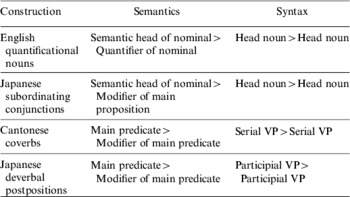
While mainstream grammaticalization theories contribute much insight into the development of these items and constructions, our multi-modular approach contributes an additional dimension to their analysis. In particular, this approach can provide a finer-grained and more systematic account of decategorialization and its synchronic consequences. In each of the four case studies we have examined, a semantic change has occurred, but syntactic properties lag behind the change of semantic properties.Footnote 33 The specific changes involved are summarized in table 1.
Semantic change and syntactic retention in four cases of grammaticalization

We can see from table 1 that syntax and semantics change independently and that these changes result in a mismatch between syntax and semantics. Specifically, the syntactic properties of one category are associated with semantic properties that are more typical of a different category. For example, a common noun functioning as the head of a noun phrase normally indicates an object or entity and has a criterion of identity. However, English QNs no longer have this semantic property, but rather quantify an object or entity expressed by another noun. Thus, they function semantically like quantifiers even though they retain many of the syntactic properties of countable common nouns.
Cases of mismatch such as these result in an unusual array of grammatical properties and are prime examples of decategorialization as described by Hopper and Traugott (Reference Hopper and Traugott2003: 106–115). What is often missing from discussions of decategorialization, however, is the highly systematic nature of what is changed and what is retained. We have shown that for all of these cases, most of the effects of decategorialization are a direct result of semantic change. For example, although Japanese subordinating conjunctions retain certain formal properties of nouns, they have lost their ability to be modified by adjectives and can only occur as the object of a single postposition -ni ‘at’ (which is semantically bleached in this context). In contrast, ordinary nouns can be modified by adjectives, and can occur with a wide range of postpositions. Similarly, English QNs have lost their ability to occur following numerals and definite determiners, and can only be modified by a small number of adjectives such as whole and big. Given a multi-modular view of grammar, the defective distribution of these constructions in comparison to the source constructions can be treated synchronically within the semantic system, with little or no reference to the syntactic system. For example, Japanese subordinating conjunctions fail to occur with adjectives because they are semantically incompatible with the existing adjectives in the language. Likewise, English QNs can only be modified by a few adjectives like whole and big because these are the only adjectives in English with the appropriate (intensifier) meanings.
Importantly, the four constructions discussed here, which are typologically and constructionally diverse, show similar patterns in terms of semantic and syntactic changes and display systematicity within the syntactic system independently of the semantic system. This suggests that a separate dimension of syntactic structure is needed to fully understand their behavior. In particular, we have shown that some of the syntactic properties that these constructions have retained have lost their semantic functionality, and appear to occur only to satisfy independently-needed syntactic constraints. For example, the determiner a and the preposition of in a QN phrase such as a lot of people have little if any semantic content, but function in the syntax to satisfy the constituent structure requirements of common nouns, which occur with determiners (when singular) and allow PP but not NP complements. Similarly, Japanese deverbal postpositions occur with the same case markers or postpositions that the original verb subcategorized for, even though these case markers and postpositions have become semantically bleached and no longer indicate any semantic relation of the deverbal postposition to its object. Thus, the case markers serve the purely syntactic function of satisfying the selectional requirements of the verb, and the requirement of transitive verbs in general to select case-marked complements.
In sum, most of the effects of decategorialization shown in our data can be attributed directly to constraints within the semantic system, given a view of semantics as a generative system with its own units and combinatoric principles. Similarly, the retention of syntactic properties such as categories, constituency, and case-marking even in the absence of semantic functionality can be attributed to constraints within the syntactic system.
4. Further issues in grammaticalization
The analysis presented in section 3 raises a number of questions regarding the nature of grammaticalization. This section briefly examines the implications of our study for four of these issues: (1) why syntactic changes typically follow from semantic changes; (2) why semantic change typically occurs before syntactic change and whether the reverse is possible; (3) why grammaticalization takes place among existing grammatical categories; (4) why syntactic properties can be retained for many years following semantic change, allowing for mismatch within the synchronic system.
4.1 Why syntactic changes typically follow from semantic changes
In many cases of grammaticalization, syntactic change catches up with semantic change, bringing form and meaning into closer alignment. Why should this be? One reason is frequency of use. In their cross-linguistic study of grammaticalization, Bybee, Perkins & Pagliuca (Reference Bybee, Perkins and Pagliuca1994) found that semantic generalization often leads to high frequency of use, which in turn leads to phonological reduction and morphological fusion. Such formal reduction can, in turn, lead to syntactic reanalysis. For example, English going to was originally restricted to contexts involving change of location, but was semantically generalized to mean future intention. This allowed for a wider range of uses and a higher frequency of use, resulting eventually in morphological fusion (going to>gonna). The beginnings of such a process can be seen in our example of English QNs: as a consequence of frequent use, the phrase a lot of can be pronounced as alotta in casual speech. Eventually, alotta could be reanalyzed as a single word functioning as a quantifier, thus resolving the current mismatch between syntax and semantics.
An additional factor favoring syntactic change is a phenomenon that Newmeyer (Reference Newmeyer1998: 129f.) calls PSCI – Pressure for Structure – Concept Iconicity. The basic idea is that languages tend to have predictable form–meaning correspondences to facilitate language processing and language acquisition. Such correspondences may take the form of categorial prototypes, as proposed by Yuasa (Reference Yuasa2005: 29) and Yuasa & Francis (Reference Yuasa, Francis, Elaine and Laura2003).Footnote 34 Thus, mismatch cases which violate the prototypical form–meaning correspondence may be more difficult to learn and process than constructions which conform to the prototypical associations, and therefore may be susceptible to change. For example, Cantonese coverbs have retained the syntactic properties of verbs even after taking on the semantic function of modifiers. To resolve this mismatch, we would expect coverbs to eventually lose their verbal properties and be reanalyzed as prepositions. Something like this has already happened to the item bei2 in Cantonese – an item which is sometimes called a ‘coverb’ but derives from a different type of serial verb construction and occurs following rather than preceding the main verb. The item bei2 is historically derived from the verb bei2, which means ‘give’, but it is equivalent to the English word to when used in a dative construction to introduce an indirect object:
(48) Ngo maai ga che bei lei.I sell cl car to you‘I sell the car to you.’
In this usage, bei2 cannot combine with any aspect markers or verbal particles and shows none of the verbal properties of the coverbs discussed here. Thus, the indirect object marker bei2 has arguably been reanalyzed as a true preposition (Matthews & Yip Reference Matthews and Yip1994: 407). However, unlike the case of English alotta, this item has not undergone phonological reduction or morphological fusion.Footnote 35 The principle of Pressure for Structure–Concept Iconicity can help explain syntactic change even in the absence of phonological reduction: items may undergo syntactic change to resolve a mismatch between syntax and semantics.
4.2 Semantic change before syntactic change and vice versa
The cases we have described so far involve semantically-driven grammaticalization (Brems Reference Brems2003). In each case, a semantic extension motivates changes in the distribution of a given item or construction which can (but need not) eventually lead to a complete syntactic reanalysis. According to Traugott (Reference Traugott, Joseph and Janda2003), such a situation is typical of grammaticalization: ‘A close investigation of historical texts points repeatedly to the occurrence of meaning change before syntactic reanalysis is possible’ (2003: 636). Why should this be the case? Simply put, interpretive (hearer-based) processes such as pragmatic inference, metonymy, metaphor, and argument structure reduction can apply to a given utterance without changing its form. However, once such semantic or pragmatic extensions have been conventionalized through repeated use, the distribution of an item changes to fit its new meaning.
Although semantically-driven grammaticalization seems to be the norm, the multi-modular approach espoused here is also compatible with the possibility of syntactically-driven grammaticalization. Indeed, Klamer (Reference Klamer2000) discusses cases which appear to involve syntactic change prior to semantic change. Whereas semantically-driven grammaticalization tends to be hearer-based, involving inferences that the speaker may or may not have intended, syntactically-driven grammaticalization tends to be speaker-based, deriving from a speaker's desire for economy in production and the tendency for loss of predictable information in discourse (Klamer Reference Klamer2000: 89). Specifically, Klamer (Reference Klamer2000) describes the development of quote markers and complementizers from report verbs in the Austronesian languages Kambera, Buru, and Tukang Besi. In Buru, for example, the item fen originated as a verb meaning ‘to say’ (and continues to have this usage) but has developed additional functions as a quote marker which precedes direct quotations and as a complementizer which precedes the clausal complement of a verb of speaking, thinking, or perceiving. Klamer argues that the historical change that brought about the new functions of fen and similar items involved morphosyntactic change followed by semantic generalization. Specifically, she observes that subject-marking pronominal clitics can be dropped in certain discourse contexts where the meaning of the subject is clear (e.g., she-say I go > say I go). She argues that this discourse-based pro-drop created a mismatch, such that there was a semantic argument not expressed by any syntactic constituent.Footnote 36 Klamer hypothesizes that the PSCI (the Semantic Transparency Principle, in Klamer's terminology) motivated the relevant historical changes. Specifically, this missing subject in syntax motivated a semantic change whereby the external argument of the report verb was eventually lost, bringing syntax and semantics again into closer conformity.
Klamer's (Reference Klamer2000) analysis of the grammaticalization of quote markers and complementizers from verbs of saying provides an example of syntactically-driven grammaticalization in the sense that loss of an overt syntactic constituent motivated the eventual loss of the corresponding semantic argument. This can be contrasted with semantically-driven grammaticalization, whereby an invisible semantic change helps motivate eventual changes in syntactic structure. We conclude that both kinds of change are possible consequences of PSCI, and both kinds are compatible with a multi-modular view of grammaticalization.
4.3 Why grammaticalization takes place among existing grammatical categories
Why does grammaticalization take place among existing grammatical categories instead of creating completely novel categories? Traugott (Reference Traugott, Joseph and Janda2003: 644) points out that in grammaticalization, creation of entirely new syntactic structure does not normally occur. More typically, items or constructions are extended to new semantic contexts associated with other existing items or constructions, but remain embedded within the syntactic restrictions of the original items or constructions. This tendency is clearly borne out in our data.
Drawing on the analyses of Lakoff (Reference Lakoff1987) and Goldberg (Reference Goldberg1995), Yuasa (Reference Yuasa2005: 32) suggests that mismatch cases are less taxing to human cognition than completely novel categories. For example, Japanese subordinating conjunctions such as totan or ageku are hybrids of prototypical nouns and prototypical postpositions, as shown in (49).
(49) syntax semantics
(a) Prototypical noun N common noun
(b) Prototypical postposition P modifier
(c) Mismatch (e.g., totan, ageku) N modifier
Note that while the correspondence of noun in syntax with modifier in semantics is idiosyncratic in (49c), their representations in syntax and semantics are those of prototypical categories. Lakoff (Reference Lakoff1987: 346f.) and Goldberg (Reference Goldberg1995: 69–72) claim that utilization of what is already familiar in grammar is common in language because it is an efficient use of cognitive resources. If grammar consists of parallel autonomous levels, categories like (49c) are much more economical than completely novel categories. Hence, we suggest that grammaticalization takes place among existing grammatical categories and results in mismatches, although such mismatches are less stable than prototypical categories and are subject to the PSCI.
4.4 Why are syntactic properties retained in the absence of semantic support?
Given the effects of frequency and the PSCI, we would expect the mismatch cases discussed in section 2 above to resolve themselves, bringing form and meaning again into close alignment. In particular, we would expect non-functional morphemes and structures to eventually disappear or become fused together with other morphemes. We have noted, for example, that a lot of may be phonologically reduced to alotta in casual speech. What is especially interesting about these cases, though, is that much of the original syntactic structure of these constructions has been retained over many years, despite its lack of semantic functionality. Why should this be? Newmeyer (Reference Newmeyer2005: 185–187) discusses three factors in the retention of the GEN–N word order in English, as in the phrase John's book, which also appear applicable to the current cases: (i) pressure of conventionality; (ii) functional differentiation between constructions (avoidance of synonymy); (iii) purely structural pressure, caused by the existence of neighboring constructions with the same syntactic properties.Footnote 37 We will discuss each of these in turn.
An obvious but nonetheless important factor in the retention of any construction is conventionality. Newmeyer states: ‘Except in unusual historical circumstances, one's grammar reflects to an extremely high degree the grammars of those in one's speech community. The factor that best explains why a person's grammar has the properties that it has is conventionality’ (Newmeyer Reference Newmeyer2005: 184). Undoubtedly, the most important reason people continue to use constructions with non-functional elements of structure is that they learn them from other speakers when they learn the language. Newmeyer (Reference Newmeyer2005: 185), following Croft (Reference Croft2000), points out that the force of conventionality is motivated both by pressure for social conformity and by the tendency for mental routinization. This, of course, does not explain why some constructions change and others are retained, but it must be acknowledged as a powerful force both in language acquisition and in language use by adult speakers.
A second factor which can help explain long-term retention of syntactically non-functional patterns is the tendency for languages to avoid complete synonymy. In the case of English QNs, Brems (Reference Brems2003) observes that QNs are not completely synonymous with ordinary quantifiers because they tend to have an expressive quality not present in ordinary quantifiers, and she argues that this expressive quality is derived from semantic features that were retained from the source construction. For example, she observes that the QN bunch tends to collocate with negative human nouns such as rednecks, no-hopers, bastards, and do-nothings. She attributes this to the semantic feature of ‘unruliness’ which is retained from the source construction and which originally pertained to a particular manner of arrangement among a collection of items. When used with the QN bunch, this sense of ‘unruliness’ has come to indicate a negative evaluation (or perhaps a sense of youthful vivaciousness, in the case of a bunch of lads) of the person or entity denoted by the following noun (Brems Reference Brems2003: 298). This semantic feature thus distinguishes bunch from otherwise comparable quantifiers such as several or many and may thereby contribute to the retention of the QN construction in which bunch occurs.
A third factor which may contribute to retention of these ‘mismatch’ constructions is purely structural pressure from syntactically similar constructions. Using a connectionist network to model learning and morphological change, Hare & Elman (Reference Hare and Elman1995) found that English irregular verbs are easier to learn and more likely to be retained over successive generations when they are among a cluster of verbs with a similar irregular form (e.g., sing–sang–sung, spring–sprang–sprung, ring–rang–rung) than when they are not (e.g., freeze–froze–frozen). The authors show that their network closely resembles what happened in the history of English, and they propose that similarity or lack of similarity to existing forms was an important factor in whether particular irregular verb forms were retained in English. While similar studies have not been conducted with respect to syntactic retention, we can plausibly apply the same idea to our case studies. The English QN construction, for example, is one member of a family of binominal NP constructions of the same form. Other examples include collective NPs (a bunch of grapes), partitive NPs (a cup of water), and abstract binominal NPs (the joy of cooking). Similarly, the Cantonese coverb construction is a member of a family of serial verb constructions consisting of two or more sequential VPs within the same clause (cf. Matthews Reference Matthews, Alexandra and Dixon2006). We hypothesize that the existence of several related constructions with the same syntactic constituent structure may help to reinforce retention of that structure even in cases where aspects of the structure fail to serve any obvious semantic function. Empirical confirmation of this hypothesis awaits further research.
As with any historical change, it is impossible to predict exactly which features will change and which will be retained. However, the three factors we have described here can at least help to motivate the patterns of syntactic retention that are shown in our data.
5. Conclusion
Our four cases studies have shown that semantic properties can change faster than syntactic properties in gradual processes of grammaticalization. We propose that this sort of change is best captured using a multi-modular, parallel-architecture framework (Sadock Reference Sadock1991, Yuasa Reference Yuasa2005), which allows changes to affect semantic structure independently of syntactic structure. Although grammatical categories normally conform to certain prototypical correspondences (Croft Reference Croft2001, Yuasa Reference Yuasa2005), our case studies show that the syntactic properties of one category can become associated with the semantic properties of a different category when an item undergoes semantic change, leading to an unusual pattern of distribution. Importantly, the relevant items and constructions still conform to the separate structural constraints of syntax and of semantics, despite the unusual combination of properties. These findings are important for theories of grammaticalization because they suggest that the cover term ‘decategorialization’ must be understood in terms of at least two separate processes: (1) the effects of semantic generalization on an item's distribution; and (2) the effects of frequency and Pressure for Structure–Concept Iconicity on an item's syntactic categorization. Our case studies show that the first kind of decategorialization effects can occur even in the absence of the second kind.