Introduction
Gynecologic cancer is associated with loss of sexual function and may hamper reproductive capacity (Ramondetta and Sills, Reference Ramondetta and Sills2004). Thus, a diagnosis of gynecologic cancer can have multidimensional negative effects on both physical health and emotional/psychological well-being. Gynecologic cancer raises not only physiological, psychological, economic, and social issues but also the possibility of death, all of which make it difficult to adjust to the disease (Linden et al., Reference Linden, Vodermaier and MacKenzie2012; Saso et al., Reference Saso, Jones and Bracewell-Milnes2017).
The term “adjustment” is used for the mental and behavioral adaptation mechanisms of individuals fighting with cancer (Watson et al., Reference Watson, Greer and Young1988). The individual with a life-threatening disease, experiencing loss and fear, enters into a process that they should adjust not only to the diagnosis of cancer but also the treatment phase (Greer and Watson, Reference Greer and Watson1987; Watson et al., Reference Watson, Greer and Young1988). Greer and Watson define the mental adjustment to cancer as the individual's responds to the diagnosis (Greer and Watson, Reference Greer and Watson1987). They classified responses to cancer in five categories including fighting spirit, helplessness/hopelessness, anxious preoccupation, fatalism, and denial (Greer and Watson, Reference Greer and Watson1987; Watson et al., Reference Watson, Greer and Young1988). Some people diagnosed with cancer focus on the uncertainty and feel anxious, while some people consider cancer as a challenge and give a positive type of response named “fighting spirit.” If the individual considers cancer as a loss and death as inevitable, then the individual gives the responses of “helplessness/hopeless” (Watson et al., Reference Watson, Greer and Young1988).
Disease as well as the meanings attributed to the disease may affect the responses. Responses to cancer and meanings attributed to cancer are in close relation with the individual's sense-making systems, values, and beliefs (Greer and Watson, Reference Greer and Watson1987; Watson et al., Reference Watson, Greer and Young1988). In this context, when faced with a diagnosis of a life-threatening disease and the associated feelings of loss and fear, coping mechanisms are activated that enable the individual to deal with the disease and to adhere to therapy. Religious coping mechanisms may be especially important at this time (Shaheen Al Ahwal et al., Reference Shaheen Al Ahwal, Al Zaben and Sehlo2016; Kaliampos and Roussi, Reference Kaliampos and Roussi2017; Ng et al., Reference Ng, Mohamed and Sulaiman2017; Sharif et al., Reference Sharif, Lehto and Nia2018). Religion is a coping mechanism people resort to overcome their problems in difficult times (Ramondetta and Sills, Reference Ramondetta and Sills2004; Ayten, Reference Ayten2015; Kaliampos and Roussi, Reference Kaliampos and Roussi2017). Religion increases the adjustment to disease by facilitating patience, the basic concept of acceptance (Albayrak et al., Reference Albayrak, Yıldırım and Kurt2019; Sharif and Ong, Reference Sharif and Ong2019). Additionally, the mutual features of religions are to contribute to mental health by attributing meaning to negative vital situations such as cancer and protecting people from being a captive of negative feelings such as stress and helplessness (Balboni et al., Reference Balboni, Paulk and Balboni2010; Ayten, Reference Ayten2015). Religion (may differ based on traditions, sects, and groups) generally gives advice to its members about protecting the body and soul (Al-Shahri, Reference Al-Shahri2016; Albayrak et al., Reference Albayrak, Yıldırım and Kurt2019). According to Qur'an, people are tested through diseases and death. The Muslim tradition wants its believers to preserve their beliefs and be patient while getting tested by God through a disease (Al-Shahri, Reference Al-Shahri2016; Sharif and Ong, Reference Sharif and Ong2019). Islam encourages receiving treatment in case of illness. Muslims are asked to keep praying and fighting with the disease (Al-Shahri, Reference Al-Shahri2016; Boucher et al., Reference Boucher, Siddiqui and Koenig2017; Albayrak et al., Reference Albayrak, Yıldırım and Kurt2019; Sharif and Ong, Reference Sharif and Ong2019). The qualitative study by Ahaddour and Broeckaert (Reference Ahaddour and Broeckaert2018) reported that religious approaches of Muslim women who were diagnosed with cancer such as thinking of the disease as a condition from God affected patients positively on coping with the problems caused by the disease (Ahaddour and Broeckaert, Reference Ahaddour and Broeckaert2018). Previous studies in the literature conducted with women with breast cancer reported that religious practices (prayer and meditation) contributed to the mental adjustment of women with cancer to the disease (Ng et al., Reference Ng, Mohamed and Sulaiman2017; Saso et al., Reference Saso, Jones and Bracewell-Milnes2017; Fradelos et al., Reference Fradelos, Latsou and Mitsi2018; Park et al., Reference Park, Waddington and Abraham2018; Karabulutlu et al., Reference Karabulutlu, Yaralı and Karaman2019). Also, studies conducted in Turkey have indicated that religious practices were common among gynecologic cancer patients (Nazik et al., Reference Nazik, Nazik and Api2012; Duman et al., Reference Duman, Yüksekol and Ozan2018).
Palliative care which is an approach improving the life quality of patients with life-threatening disease and their families is an important intervention for women with gynecologic cancer (Regn et al., Reference Regn, Robinson and Robinson2016). In palliative healthcare, the primary goals in gynecologic cancer care are to enable patients to use positive coping mechanisms and to sustain their adherence to therapy (Breitbart, Reference Breitbart2008). To understand and support patients, healthcare providers also need to be aware of how patients cope with difficulties and whether they obtain comfort and strength from their religious beliefs (Breitbart, Reference Breitbart2008). Healthcare providers who provide care to women with gynecologic cancer should provide care by being aware of the physical, emotional, and lastly spiritual difficulties of these diseases for women (Balboni et al., Reference Balboni, Paulk and Balboni2010). In this context, religiosity is an important factor for palliative care which has been attracting attention from cancer patients in the recent years (Al-Shahri, Reference Al-Shahri2016). There are evidences that religion is related to good mental health and plays a significant role on palliative care (Al-Shahri, Reference Al-Shahri2016; Braz Evangelista et al., Reference Braz Evangelista, Limeira Lopes and Geraldo da Costa2016; Meneguin et al., Reference Meneguin, Matos and Ferreira2018). However, no studies that examine the relation between religious attitude and mental adjustment to cancer in women with gynecologic cancer exist in the literature. Most of the studies that examine the relation between religious attitudes and mental adjustment to cancer of women with cancer were conducted with women with breast cancer (Ahmad et al., Reference Ahmad, Binti Muhammad and Abdullah2011; Fradelos et al., Reference Fradelos, Latsou and Mitsi2018; Zargani et al., Reference Zargani, Nasiri and Hekmat2018; Del Pup et al. Reference Del Pup, Villa and Amar2019; Sharif and Ong, Reference Sharif and Ong2019). These studies carried out on women with breast cancer have shown that women's using religious attitude as a coping strategy for their mental adjustment to cancer diagnosis and treatment was effective (Ahmad et al., Reference Ahmad, Binti Muhammad and Abdullah2011; Fradelos et al., Reference Fradelos, Latsou and Mitsi2018; Zargani et al., Reference Zargani, Nasiri and Hekmat2018; Del Pup et al., Reference Del Pup, Villa and Amar2019; Sharif and Ong, Reference Sharif and Ong2019). However, since breasts are not reproductive organs, breast cancer does not affect reproductive ability and sexuality in the same way or degree as gynecologic cancers do (Del Pup et al., Reference Del Pup, Villa and Amar2019). Therefore, the results from studies conducted with patients with breast cancer may not necessarily be applicable to women with gynecologic cancer, and it is still not known whether religious attitudes of women with gynecologic cancer ensure their mental adjustment to cancer. Therefore, the hypothesis of this study is that as the religious attitude levels of women with gynecologic cancer increase, their mental adjustment to cancer also increases. The results of this study can be a guide for healthcare professionals who provide palliative care to increase the adjustment of women with gynecologic cancer to the disease and how to support women with gynecologic cancer. This study was conducted to examine the relationship between the religious attitudes of Muslim women with gynecologic cancer and their mental adjustment to cancer.
Materials and methods
Study design and participants
This study was designed as a questionnaire-based descriptive relational study on gynecologic cancer patients.
The study consisted of gynecologic cancer patients receiving treatment in a gynecology clinic, an ambulatory chemotherapy unit, and an oncology unit of a university hospital in eastern Turkey between August 1, 2016 and August 1, 2017. The sample consisted of patients who had been diagnosed with gynecologic cancer at least 1 month earlier. Since gynecologic cancer, regardless of the type, affects womanhood, no specific type of gynecologic cancer was taken into consideration in sample selection.
The inclusion criteria were as follows: a confirmed diagnosis of gynecologic cancer, awareness of cancer diagnosis, aged 18 years or over, Muslim, no sight or hearing impairments, able to communicate in Turkish, and no known major psychiatric problem disorders (e.g., schizophrenia and major depression). All participants voluntarily agreed to participate in the study.
Throughout the study period, researchers investigated the records of 142 consecutive patients who had been diagnosed 1 month prior with gynecologic cancer and who were receiving treatment in the aforementioned clinics. All of the consecutive patients were invited to participate in the study. Of the 19 women excluded from the study, two had major depression, one was younger than 18 years, three could not communicate in Turkish, one reported that she was not Muslim, nine declined to participate, and three did not complete the questionnaires properly. Thus, the study was completed with 123 gynecologic cancer patients.
Data collection tools
The data were collected using three different forms, which were administered via face-to-face interviews.
Personal information form
The women's sociodemographic characteristics, such as age, education, occupation, economic status, marital status, and maternal status (i.e., number of children) and type of cancer, treatment type, and disease-related features, were determined using a form that was specifically developed for this study and based on a literature review (Balboni et al., Reference Balboni, Paulk and Balboni2010; Shaheen Al Ahwal et al., Reference Shaheen Al Ahwal, Al Zaben and Sehlo2016; Tsai, Chung, Chang, & Wang, 2016).
Religious Attitude Scale
The Religious Attitude Scale (RAS) for Muslims, which was developed and used by Ok, consists of the three dimensions (cognitive, emotion, and behavior) of attitudes defined in social psychology (Ok, Reference Ok2016). The RAS is based on a Likert-type scale, with eight items, six that are positive scored, and two negative scored. Each item includes the following options: not at all (1 point), a little (2 points), half the time (3 points), mainly agree (4 points), and completely agree (5 points). In calculating scale points, the average was computed. The lowest and highest scores that can be obtained on the scale are 1 and 5, respectively, with high scores signifying strong religious attitudes and low scores signifying low religious attitudes. The Cronbach's α coefficient of the scale is 0.90 (Ok, Reference Ok2016).
Mental Adjustment to Cancer Scale (MACS)
Watson et al. (Reference Watson, Greer and Young1988) developed the Mental Adjustment to Cancer Scale (MACS) to measure the psychological responses of cancer patients to the disease (Watson et al., Reference Watson, Greer and Young1988). A validity and reliability study of the scale for the Turkish population was conducted (Natan, Reference Natan2000). The scale has five subscales, which aim to measure the following five types of responses to cancer: fighting spirit (16 items), helplessness/hopelessness (6 items), anxious preoccupation (9 items), fatalism (8 items), and cognitive-avoidance (1 item). The scale is evaluated using subscales. The scale is a 4-point Likert scale, with responses ranging from “definitely does not apply to me” to “definitely applies to me.” There is no total score mean scores are calculated for each subscale. The scores obtained for each subscale vary depending on the number of items in that subscale. Higher scores signify that the response of that subscale is experienced more by the respondent. Since the subscale, “cognitive-avoidance”, in the Turkish scale consists of only 1 item, it does not yield reliable results (Watson et al., Reference Watson, Greer and Young1988; Natan, Reference Natan2000). Thus, the subscale “cognitive-avoidance” was not evaluated in the present study. In this study, the Cronbach's α coefficient value of the scale was determined as 0.82.
Data collection
The data were collected from the participants before their check-up or treatment during their visit to the clinic. As some participants had not completed any school education (i.e., they had not received basic education), one of the researchers of the study helped all the participants to fill out the forms. The written versions of questionnaire items were read aloud directly to the patients by the researchers. No comments were made by the researcher when reading the questions. On average, it took 20 min to complete the forms.
Ethical considerations
This study was approved by the Noninvasive Clinical Research Ethics Committee (No. 2016/232) and by the head physician of the hospital where the study was conducted prior to the commencement of the study. All the patients who participated in the study provided their informed consent. The study was conducted in accordance with the principles of the Declaration of Helsinki.
Statistical analysis
This study used SPSS v. 22 and PROCESS package to analyze the data. In the data assessment, descriptive characteristics were presented as number, percentage, and mean. Pearson's correlation analysis were used to analyze the relationship between mental adjustment to cancer and religious attitudes. Multiple linear regression analysis with the enter method was performed to identify the predictors of mental adjustment to cancer. Additionally, this study used moderation analysis to understand whether the power and direction of the correlation between the RAS scores and mental adjustment to cancer is related to the stage of illness. A value of p < 0.05 was accepted as denoting statistical significance.
Results
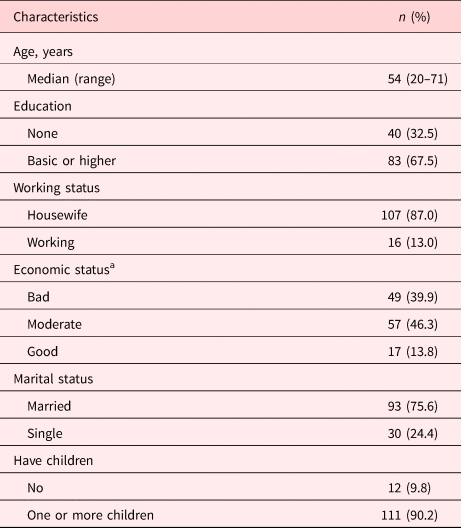
Table 1 shows the sociodemographic characteristics of the women who participated in the study. The mean age of the participants was 54 years (range: 20–71). Most of the participants had basic or higher education. The majority of the participants were housewives (87%) and had at least one child (90.2%). More than half were married, and 57% of the women perceived their income level to be moderate.
Sociodemographic characteristics (N = 123)

a According to the participants’ perception of income.
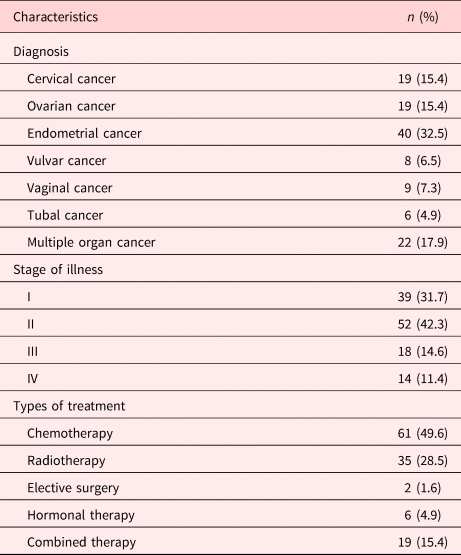
Of the study sample, 32.5% had been diagnosed with endometrial cancer, and almost half had a stage II disease. Most of the participants were treated with chemotherapy. In addition, 1.6% of the participants preferred surgical treatment due to their concerns about further progression of cancer (Table 2).
Disease-related characteristics (N = 123)

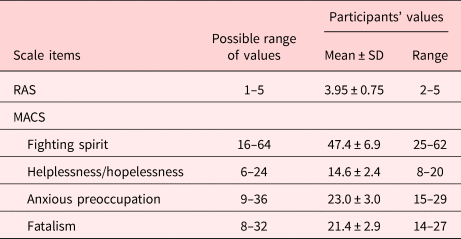
Table 3 shows the mean RAS and MACS scores of the participants.
Means and standard deviations for the RAS and the MACS subscales (N = 123)

Abbreviations: RAS, Religious Attitude Scale; MACS, Mental Adjustment to Cancer Scale.
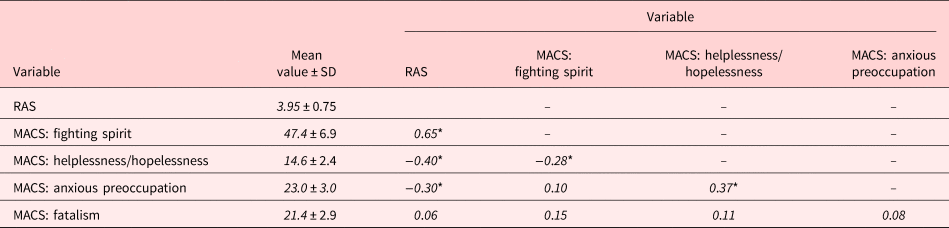
There was a positive correlation between the RAS score and the fighting spirit subscale of the MACS (r = 0.65, p < 0.001), as shown in Table 4. On the other hand, there was a negative correlation between the helplessness/hopelessness and anxious preoccupation subscales of the MACS and the RAS score (r = −0.40, p < 0.001; r = −0.30, p < 0.001, respectively). No correlation was found between the RAS score and the fatalism subscale of the MACS (p > 0.05) (Table 4).
Mean values and zero-order correlation among the observed variables (N = 123)

Abbreviations: MACS, Mental Adjustment to Cancer Scale; RAS: Religious attitude scale
* Pearson correlation: p < 0.05 (two-tailed test).
Based on the linear regression analysis, there was a significant correlation between religious attitudes and the coping strategies of fighting spirit, β = 0.58; helplessness/hopelessness, β = −0.409; and anxious preoccupation, β = −0.345. In contrast, the analysis showed that there to be no correlation with fatalism, β = 0.027. The interaction results revealed that the stage of illness moderated the relationship between religious attitudes and the coping strategies of fighting spirit (b = 1.256, p < 0.05) at 95% confidence level. It means the stage of illness weakened the positive relationship between religious attitudes and the coping strategies of fighting spirit. However, the stage of illness did not moderate the relationship between religious attitudes and other coping strategies such as helplessness/hopelessness, anxious preoccupation, and fatalism (b = 0.040, p > 0.05; b = 0.292, p >0.05; b = 0.322, p > 0.05, respectively).
Discussion
In this study, although a positive correlation was observed between the RAS score and the fighting spirit subscale of the MACS, a negative correlation was found between the RAS score and the helplessness/hopelessness and anxious preoccupation subscales of the MACS. In addition, no correlation was found between the RAS score and the fatalism subscale of the MACS.
In the literature, numerous studies have reported there to be a positive correlation between religion and physical and mental health (Shaheen Al Ahwal et al., Reference Shaheen Al Ahwal, Al Zaben and Sehlo2016; Ng et al., Reference Ng, Mohamed and Sulaiman2017; Fradelos et al., Reference Fradelos, Latsou and Mitsi2018; Sharif et al., Reference Sharif, Lehto and Nia2018; Karabulutlu et al., Reference Karabulutlu, Yaralı and Karaman2019). In one previous study, women who had been diagnosed with breast cancer or gynecologic cancer and who had completed their treatment reported that religion was their coping mechanism (Lauver et al., Reference Lauver, Connolly-Nelson and Vang2007). No study is available in the literature with relation between religiosity and mental adjustment to cancer in Muslim women with gynecologic cancer. The present study, therefore, is important in that it is the first to investigate this subject. The RAS score in the present study (3.95 ± 0.75) was similar to that reported by Yazgan and Demir (Reference Yazgan and Demir2019), in which cancer patients receiving chemotherapy in women with gynecologic cancer had an RAS score of 4.46 ± 0.46. Previous research has suggested that religion may help to decrease the risk of death or disease by forbidding harmful behaviors that could hinder treatment or by preventing behaviors that could contribute to diseases; examples include behaviors guided by religious orientation, such as ban on bad habits, ban on suicide, ban on alcohol consumption and smoking, obligation to take good care of the body with which God has entrusted you, performing/breaking ablution, and taking baths (Trevino et al., Reference Trevino, Balboni and Zollfrank2014; Shaheen Al Ahwal et al., Reference Shaheen Al Ahwal, Al Zaben and Sehlo2016; Tsai et al., Reference Tsai, Chung and Chang2016). Religion may motivate the individual to seek out a support group that can provide help when necessary. In addition, it may offer a perspective to the individual to develop attitudes that enable the person to face stressful life conditions (Bovero et al., Reference Bovero, Leombruni and Miniotti2016).
In this study, religious attitudes were shown to have a high “fighting spirit” response rate on the MACS. Patients that performed well on the fighting spirit subscale considered cancer a challenge, played an active role in the treatment and control of their disease, and were optimistic about the disease outcome (Religioni et al., Reference Religioni, Czerw and Deptała2018). In a quasi-experimental study, Kestenbaum et al. (Reference Kestenbaum, Shields and James2017) determined that cancer patients who had spiritual AIM interviews with priests had a higher fighting spirit response. Similarly, Johannessen-Henry et al. (Reference Johannessen-Henry, Deltour and Bidstrup2013) reported that religious beliefs increased patients’ positive coping responses like fighting spirit in cancer patients. Religious coping methods are associated with spiritual fighting and positive attitude in adjustment to cancer (Albayrak et al., Reference Albayrak, Yıldırım and Kurt2019; Sharif and Ong, Reference Sharif and Ong2019). It may be possible to state that fighting against disease based on a religious reference increases the mental adjustment to cancer. Turning onto religion, worship and prayer in front of life-threatening diseases such as cancer helps people to adjust to and cope with their current situation (Salsman et al., Reference Salsman, Pustejovsky and Jim2015; Ng et al., Reference Ng, Mohamed and Sulaiman2017; Saso et al., Reference Saso, Jones and Bracewell-Milnes2017;Fradelos et al., Reference Fradelos, Latsou and Mitsi2018; Karabulutlu et al., Reference Karabulutlu, Yaralı and Karaman2019). Religion increases the positive emotional situation of people by decreasing the effect of stressing events in life (Albayrak et al., Reference Albayrak, Yıldırım and Kurt2019; Sharif and Ong, Reference Sharif and Ong2019). Thus, a religion that suggests positive health behaviors (receiving treatment and natural and healthy nutrition) may be effective fighting against the cancer by preventing hopelessness. The results of the present study are compatible with those reported in the literature.
Patients faced with an uncontrollable situation, such as a terminal illness, may experience loneliness and negative feelings, such as helplessness and anger. Helplessness expresses the hopelessness of individuals who feel passive and weak due to the potential fatality of cancer (Religioni et al., Reference Religioni, Czerw and Deptała2018). In the present study, it was determined that having a religious attitude decreased the response of "helplessness/hopelessness" on the MACS. Similar to the results of the present study, Johannessen-Henry et al. (Reference Johannessen-Henry, Deltour and Bidstrup2013) stated that religious beliefs decreased the hopelessness/helplessness subdimension of negative coping methods. Previous studies have shown that people who have cancer may use a close relationship to God as a coping strategy to deal with difficult life situations (Seidmahmoodi et al., Reference Seidmahmoodi, Rahimi and Mohamadi2011; Trevino et al., Reference Trevino, Balboni and Zollfrank2014). In a study including Muslim patients, the patients considered their disease to be God's will and saw it as a means of self-examination (Seidmahmoodi et al., Reference Seidmahmoodi, Rahimi and Mohamadi2011). A study by Askay and Magyar-Russell (Reference Askay and Magyar-Russell2009) reported that people with strong faith felt that they managed their lives by handing over control to God. They considered that their disease was a catalyst for personal and mental development and believed that such development would lead to emotional recovery (Askay and Magyar-Russell, Reference Askay and Magyar-Russell2009). The feeling of being close to God can be an important psychological support and spiritual trust for religious people (Ahmad et al., Reference Ahmad, Binti Muhammad and Abdullah2011; Sharif and Ong, Reference Sharif and Ong2019). Because people in a time of crises look at God as a creature that protects them. Transferring the encountered distress to a higher power reduces pain and sorrow. Surrendering to a higher power against all incidents and knowing that control of everything is in the hands of a higher power reassure people. People trust and pray to God in difficult times (Ahmad et al., Reference Ahmad, Binti Muhammad and Abdullah2011; Soleimani et al., Reference Soleimani, Pahlevan Sharif and Yaghoobzadeh2016; Sharif and Ong, Reference Sharif and Ong2019). Thus, religious belief decreases the destructive effect of uncertainty, hopelessness, and helplessness (Perez and Rex Smith, Reference Perez and Rex Smith2015; Albayrak et al., Reference Albayrak, Yıldırım and Kurt2019; Sharif and Ong, Reference Sharif and Ong2019). Similar to the literature, the study states that women leave control to God as their religious attitude gets stronger; thus, the belief that God will make the best decision for them decreases the feeling of helplessness/hopelessness.
In the present study, all the participants were Muslim, and the high rate of religious attitudes among the Muslim women with gynecologic cancer resulted in lower response rates of “anxious preoccupation” on the MACS. Anxious preoccupation could be the result of anxiety about the status of the disease, uncertainty about the future, and possible cancer relapse (Religioni et al., Reference Religioni, Czerw and Deptała2018). Individuals who display a tendency of cooperating with God in coping likely feel less distressed about negative situations with which they cannot cope (Pargament et al., Reference Pargament, Koenig and Tarakeshwar2004). Additionally, Johannessen-Henry et al. (Reference Johannessen-Henry, Deltour and Bidstrup2013) stated that religious beliefs decreased the anxious preoccupation subdimension of negative coping methods in mixed cancer groups. In previous studies conducted with cancer patients, participants drew strength from their religious beliefs, and this helped them to cope with their disease (Tsai et al., Reference Tsai, Chung and Chang2016; Kaliampos and Roussi, Reference Kaliampos and Roussi2017; Karabulutlu et al., Reference Karabulutlu, Yaralı and Karaman2019). The results of the present study on this matter are compatible with those reported in the literature.
Each religious dimension has a different significance when it comes to matters of health and illness. Nurses should furthermore identify and acknowledge any valuable elements that have meaning for women and not ignore them but rather encourage their use if it is for the good of the patient.
Limitations
The present study was subject to several limitations. First, the present study was descriptive relational, the data refer only to a single point in time. Thus, inferences cannot be drawn about the impact of the variables studied on. Second, the present study was conducted in a Muslim population, whose religion may differ considerably from that in other countries. Third, this study was conducted in a single center and thus may portray a site-specific experience.
Conclusions
The results of this study have implications for the palliative care management of patients with gynecologic cancer. The study shows that religiousity played a central role in the mental adjustment to cancer of the patients with gynecologic cancer. So, continually addressing women's religious needs and enhancing use of these resources may be effective for improving mental adjustment to cancer in women with gynecologic cancer. Thus, religious attitudes should be considered in palliative care of women with gynecologic cancer.
Clinical and theoretical implications
The results has yielded additional support for the theory linking religiosity to enhance mental adjustment to cancer patients with gynecologic cancer. It is considered that the results in this study may contribute to enrich the perspective on health-related treatment, especially in palliative care through its implication for cancer treatment to enhance mental adjustment to cancer.
These results may also serve as a reference for palliative healthcare providers in their education and palliative healthcare practices. Palliative healthcare providers working with women with gynecologic cancer should evaluate the relations of the woman, as well as their strength of understanding and accepting the meaning of life, accept valuable elements having a meaning for her and not ignore them, and encourage her use if it is for the good of the patient. Clinical interventions aimed at increasing the mental awareness of patients and their comfort level regarding personal perspectives of death may help them to better cope with cancer. As part of the holistic approach to care, healthcare providers can and do honor mothers’ bedside rituals of praying and governed by this same ability and willingness, they should arrange for spiritual advisor visits and/or counseling during their treatment.
Acknowledgments
We thank all women who participated in this study.
Conflict of interest
The authors declared no potential conflicts of interest with respect to the research, authorship, and/or publication of this article.