INTRODUCTION
The Ambon scorpionfish Pteroidichthys ambonensis Bleeker, Reference Bleeker1856 is known from a distribution range reaching from eastern India and Indonesia to the Marquesas Islands, north to the Ryukyu Islands, south to New Caledonia. Outside this range, the species was recorded from Eilat, Israel, Red Sea in an unpublished doctoral dissertation of Frøiland (Reference Frøiland1972). The Red Sea record was cited but not discussed by various authors, but as Frøiland's specimen was not found and his description and illustration were insufficient to identify the species, Golani & Bogorodsky (Reference Golani and Bogorodsky2010) came to the conclusion that the record of Pteroidichthys amboinensis could not be confirmed.
The genus Pteroidichthys Bleeker, Reference Bleeker1856 is characterized within the scorpaenid fishes by the following combination of characters: head and body strongly compressed, but not extremely so; head large; body moderately elevated; bones of cranium strongly ossified; cranium with deep occipital pit; opercle with two distinct ridges that diverge at an acute angle, both usually strongly developed and bearing spines; skin at gill openings only narrowly connected to isthmus anteriorly, not broadly connected to isthmus; lateral line normal, continuing near base of caudal fin, distinct only anteriorly, posterior section indistinct; scales on body large, cycloid; lateral-line scales forming relatively complete tubes, that are posteriorly buried; dorsal-fin spines short, less than half of the body depth; dorsal-fin membranes deeply incised, but not nearly entire length of all spines; dorsal fin with relatively pronounced notch immediately anterior to last dorsal-fin spine; pectoral fins rounded; caudal fin elongate, rounded (Fowler, Reference Fowler1938; Poss, Reference Poss, Carpenter and Niem1999). It comprises a total of three species (Eschmeyer, Reference Eschmeyer2015): Pteroidichthys amboinensis Bleeker, Reference Bleeker1856 from the Indo-West Pacific; Pteroidichthys godfreyi Whitley, 1954 from Australia and Papua New Guinea; Pteroidichthys noronhai (Fowler, Reference Fowler1938) from the western Pacific.
Two specimens of Pteroidichthys amboinensis from the northern Red Sea were recently discovered; these specimens are described in the present paper. This finding is important, as a previously highly doubtful Red Sea record of this species can now be confirmed.
MATERIALS AND METHODS
Materials of Pteroidichthys amboinensis: HUJ 18341 (one specimen, 45.1 mm standard length (SL)), Eilat, Israel Gulf of Aqaba, Red Sea, Aharon Miroz, 2 April 1997, sand bottom with algae, 10 m depth SMNHTAU P.15619 (old number NS 2869) (one specimen, 57.4 mm SL), Eilat, Israel Gulf of Aqaba, Red Sea, C. Lewinsohn, 5 September 1966, beam trawl and dredge, 23–27 fms (42–49 m) depth.
Methods: biometrical counts and measurements follow Hubbs & Lagler (Reference Hubbs and Lagler1947); fin ray counts follow Fricke (Reference Fricke1983). All lateral-line scales are counted, including the posterior, indistinct section of the lateral line. The classification on the genus and species level follows Eschmeyer (Reference Eschmeyer2015), the family classification follows Laan et al. (Reference van der Laan, Eschmeyer and Fricke2014) and the references follow Fricke (Reference Fricke2015).
RESULTS
SYSTEMATICS
Class Actinopterygii Klein, 1885
Order Scorpaeniformes Risso, 1827
Family Scorpaenidae Risso, 1827
Genus Pteroidichthys Bleeker, Reference Bleeker1856
Pteroidichthys amboinensis Bleeker, Reference Bleeker1856
(Figure 1)
Pteroidichthys amboinensis Bleeker, Reference Bleeker1856: 34 (Ambon Island, Maluku, Indonesia; Manado, Sulawesi, Indonesia; syntypes: RMNH 5873, two specimens).
Lateral view of Pteroidichthys amboinensis, HUJ 18341, 45.1 mm SL, north beach, Eilat, Israel, Gulf of Aqaba, Red Sea, 10 m depth. Photograph © David Darom.

DESCRIPTION
Body compressed, moderately high; eyes protruding dorsally. Lower jaw slightly protruding; snout concave, occipital region concave. Elaborate antenna-like skin flap above eye, shorter filaments and dermal flaps on snout and chin; filaments on back and sides of body. Dorsal-fin spines XII, membranes between spines deeply incised, soft fin-rays nine. Anal-fin spines two, soft fin-rays six. Pectoral-fin rays 14–16. Caudal fin elongate, distally convex, principal fin-rays 12. Lateral-line scales about 30, longitudinal scale rows about 40.
Colour in life: head and body yellowish brown, sides marbled with silvery white. Eye dorsally and ventrally brown, anterior and posterior sections golden. Supraorbital tentacle brown, with four white bars and whitish tips of filaments. Dorsal fins brown, marbles with white, tips of spines golden brown. Caudal fin dorsally and ventrally brown, marbled with white, membranes golden in the centre.
In preservative, the colouration fades to light brown or beige.
DISCUSSION
Pteroidichthys amboinensis was first described by Bleeker (Reference Bleeker1856) from Ambon and Sulawesi in eastern Indonesia. It was reported from Chennai (Madras), India, Bay of Bengal by Rama-Rao (Reference Rama-Rao1980), and from Taiwan by Chen & Liu (Reference Chen and Liu1984), who also discussed the validity of the species. Kishimoto (Reference Kishimoto, Masuda, Amaoka, Araga, Uyeno and Yoshino1984) recorded the species from Iriomote-jima, Ryukyu Islands, Japan; Myers & Donaldson (Reference Myers and Donaldson2003) photographed it at Saipan, Mariana Islands. Randall (Reference Randall2005) reported a photograph of the species from Papua New Guinea and a specimen from Fiji; Fricke et al. (Reference Fricke, Kulbicki and Wantiez2011) recorded the species from Grande Terre, New Caledonia. Motomura et al. (Reference Motomura, Béarez and Causse2011) examined specimens from Wallis & Futuna and the Marquesas Islands in the South Pacific, and Allen & Erdmann (Reference Allen and Erdmann2012) also reported Bali and Komodo (their Philippines record was possibly based on Pteroidichthys noronhai, see below). Fricke et al. (Reference Fricke, Allen, Andréfouët, Chen, Hamel, Laboute, Mana, Tan and Uyeno2014) recorded Pteroidichthys amboinensis from Madang, Papua New Guinea.
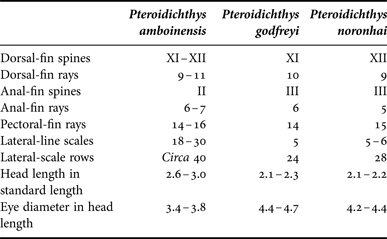
A record of Pteroidichthys amboinensis (non Bleeker, Reference Bleeker1856) from Nhatrang, Vietnam by Eschmeyer et al. (Reference Eschmeyer, Hirosaki and Abe1973) was based on the closely related species Pteroidichthys noronhai Fowler, Reference Fowler1938, which was considered as a separate, valid species by Poss (Reference Poss, Carpenter and Niem1999). Pteroidichthys noronhai is mainly distinguished from Pteroidichthys amboinensis by having three spines and five soft rays in the anal fin (vs two spines and six soft rays in Pteroidichthys amboinensis). Morphometric data of the species of Pteroidichthys are compared in Table 1.
Comparison of morphometric characters of species of Pteroidichthys.
The lateral line scales of Pteroidichthys amboinensis reported by different authors vary considerably. The reason for this discrepancy is that the lateral line is distinct only anteriorly, and posteriorly difficult to distinguish; therefore, some authors did not count the posterior scales. The lateral line scales are still useful to distinguish species in the genus, as the other two species only have 5–6 scales (vs at least 18 in Pteroidichthys amboinensis).
In an unpublished doctoral dissertation, Frøiland (Reference Frøiland1972) reported Pteroidichthys amboinensis from Eilat, Israel, Red Sea, based on a single specimen (TAU NS 2869, now SMNHTAU P.15619), without any detailed collection data, and with an insufficient description and drawing. Frøiland erroneously reported ten soft-rays in the second dorsal fin, seven soft-rays in the anal fin, 41 lateral-line scales, and missed in his illustration the deeply incised membranes of the first dorsal fin, the elongate caudal fin and details of the dermal tentacles, filaments and appendages on head and body. The Eilat record was cited but not discussed by Dor (Reference Dor1984) and Goren & Dor (Reference Goren and Dor1994). Golani & Bogorodsky (Reference Golani and Bogorodsky2010) could not confirm the record of the species from the Red Sea.
During the examination of scorpaenid fishes in the HUJ collection, the authors of the present paper discovered another specimen collected in 1997 which they identified as Pteroidichthys amboinensis; they also rediscovered the specimen SMNHTAU P.15619, which was apparently erroneously returned to HUJ rather than SMNHTAU by Ø. Frøiland, and which was also identified as Pteroidichthys amboinensis. Therefore, the Red Sea record of that species can now be confirmed.
The specimen HUJ 18341 was collected on a sand bottom with algae, at the north shore of Eilat, at a depth of 10 m, and after collection it was kept alive in an aquarium for a week. This well agrees with the general habitat of western Pacific Ocean specimens reported by Allen & Erdmann (Reference Allen and Erdmann2012), as solitary living among weed or on mud bottoms, in coastal bays or offshore trawl grounds, at 3–40 m depth. The specimen SMNHTAU P.15619 was collected a little deeper than the species is otherwise known, at a depth of at least 42 m.
The distribution of Pteroidichthys amboinensis appears to be disjunct, with a big gap between the northern Red Sea locality reported in the present paper and the Bay of Bengal at Tamil Nadu, India, north-eastern Indian Ocean, which is otherwise the westernmost known occurrence of the species. However, as the species is rare and also well camouflaged, it is easily overlooked and may be more widely distributed in the north-western Indian Ocean. In the Red Sea, other suitable habitats for this species may be found in the Gulf of Suez and in Eritrea. As the fish fauna of both regions is poorly known, it may have been missed so far, but is expected to be reported in future studies.
ACKNOWLEDGEMENTS
We would like to thank Aharon Miroz (Eilat, Israel) for collecting the HUJ specimen and bringing it to our attention, and to Dr David Darom (HUJ, Jerusalem, Israel) for the photograph of the specimen.