Introduction
Ambient temperature is an important factor which affects development, survival and fecundity of the rice leaf folder Cnaphalocrocis medinalis. The development of larvae and pupae became slower, and longevity of adults was shorter when rice leaf folders were reared at temperatures above 29 °C (Wu & Zhang, Reference Wu and Zhang1984). High temperatures also led to a decreased survival of larvae and pupae (Wu & Zhang, Reference Wu and Zhang1984). The fecundity of the rice leaf folder was dramatically impaired by high temperature, and only about 25%, and 6% of eggs could hatch at 33 and 36 °C (Chen et al., Reference Chen, Pan and Lei1981; Liao et al., Reference Liao, Huang, Fang and Liu2013). Additionally, temperature was a key factor in triggering migration behaviour of rice leaf folder populations (Zhang et al., Reference Zhang, Geng and Zhou1981a , Reference Zhang, Geng and Zhou b ). The critical temperatures for the northward and southward migration in China were 28.2 and 24 °C, respectively (Wu, Reference Wu1985).
Mating behaviour of insects is closely dependent on the ambient temperature. Mating frequency of Lucilia cuprina males increased with the rise of temperature from 15 to 30 °C, but declined as temperature exceeded 30 °C (Cook, Reference Cook1994). Short-term exposure to higher temperature (37 °C for 120 min or 40 °C for 90 min) greatly reduced mating frequency of Drosophila melanogaster (Krebs & Loeschcke, Reference Krebs and Loeschcke1994). The mating peak of Spodoptera exigua was postponed by 1.5 h at 30 °C and mating rate decreased by 50% at 40 °C, in comparison with these values at 25 °C (Wang et al., Reference Wang, Xu, Cui, Xu and Zhou2004). Mating durations of Lycosa malitiosa, L. cuprina, S. exigua and Callosobruchus chinensis were significantly shorter at higher temperatures than at lower ones (Cook, Reference Cook1994; Costa & Sotelo, Reference Costa and Sotelo1994; Wang et al., Reference Wang, Xu, Cui, Xu and Zhou2004; Katsuki & Miyatake, Reference Katsuki and Miyatake2009), as were the durations of mate-guarding of males in Japanese beetle Popillia japonica (Saeki et al., Reference Saeki, Kruse and Switzer2005). The rice leaf folder, a serious pest in China, usually occurs in rice fields from July to September in the Jiangsu Province, China, when the weather is the hottest in a year. Although it has been illustrated that high temperature inhibits survival, development and fecundity of this insect, the difference in the biological responses of male and female adults to heat shock is still unclear. Moreover, the physiological mechanism of high temperature suppressing fecundity is also ambiguous. Therefore, the survival, longevity, ovary development, copulation and fecundity of adults, and hatchability of eggs were studied when these adults were exposed to 36–41 °C for 5 h day−1 under different exposure durations (1–3 days). The mating behaviour, spermatogenesis and sperms transfer of males treated by heat stress were also examined. The results will illustrate the physiological mechanism of short-term heat shock on fecundity of the rice leaf folder. At the same time, it will support the monitoring and forecasting of this population in summer according to the ambient temperatures.
Materials and methods
Insects
Larvae of the rice leaf folder were collected from the Experimental Station of Nanjing Agricultural University in September 2010, Nanjing, China, and reared for three generations in a climate incubator at 25±1 °C, 80±10% RH and a 14L:10D photoperiod using rice leaves at tillering stage. The larvae were then reared on maize seedlings with 2–4 leaves using the method described in Liao et al. (Reference Liao, Huang and Liu2012). The newly emerged adults were used in this study.
Heat shock procedure
The maximum temperature between July and September in the years 2000–2011 in Nanjing fluctuated from 37 to 40 °C. The number of days with temperatures above 36 °C varied between 1 and 13 year−1 (fig. 1), and a high temperature event usually lasted for 1–3 days. Therefore, 36, 39, 40 and 41 °C were chosen as the high temperatures in the present study. The temperature in a climate incubator was gradually increased from 27 °C to a designated high temperature (36, 39, 40 or 41 °C) at 3 °C per 30 min, and then the high temperature was maintained for 5 h. Finally, the temperature was decreased at 3 °C per 30 min back to 27 °C. The same temperature procedure was operated in each heat shock day. The temperatures in the climate incubator were automatically recorded by a thermograph (Temperature & Humidity Data Logger S100-TH, Huato electronic CO., LTD, Shenzhen, China).
The maximum temperature and days in which the maximum temperature exceeded 36 °C between July and September of the 2000–2011 in Nanjing, China.

Heat shock of adults
The first experiment was to check the resistance of the rice leaf folder adults to high temperature of 39 and 40 °C. Two or three pairs of newly emerged female and male adults were put into a copulation container (diameter 105 mm, height 145 mm) which contained a thin layer of cotton wool dipped in 5% honey solution at the bottom to supply nutrients and high relative humidity for adults. The adults were exposed to 39 or 40 °C for 5 h day−1 from 10:00 am to 15:00 pm as above-mentioned procedure. During the rest time, the paired adults were kept at 27 °C. The heat shock lasted for 1–3 days. The adults exposed to 39 °C for 1, 2 and 3 days were 24, 21 and 27 pairs, respectively, and exposed to 40 °C, 21, 19 and 24 pairs, respectively. 32 pairs kept at 27 °C were the control (CK).
The second experiment was to explore the differences in the sensitivity to heat shock between female and male adults. The newly emerged females and males were separately reared in copulation containers, and then these adults were exposed to 36, 39, 40 or 41 °C using above-mentioned procedure. Seventy, 84, 77 and 86 females were exposed to 36, 39, 40 and 41 °C, respectively, and 68, 72, 80 and 59 males were treated. The females and males reared separately in copulation containers at 27 °C were controls (untreated adults). At the end of 3 days of heat shock, the female and male survivors were checked. Then, four mating combinations were designed: (1) treated female×untreated male (T♀×U♂), (2) treated male×untreated female (T♂×U♀), (3) treated female×treated male (T♀×T♂) and (4) untreated female×untreated male (U♂×U♀). Two or three pairs of female and male adults in a copulation container were considered as a repetition for a mating combination because the eggs laid by each female from two and three pairs were not significantly different. At 36 °C heat shock, 11 repetitions (33 pairs), 10 repetitions (30 pairs) and 12 repetitions (35 pairs) were performed for T♀×U♂, T♂×U♀ and T♀×T♂, respectively; at 39 °C, there were 10 repetitions (28 pairs), 8 repetitions (24 pairs) and 12 repetitions (36 pairs); at 40 °C, there were 10 repetitions (27 pairs), 7 repetitions (17 pairs) and 12 repetitions (34 pairs); at 41 °C, there were 6 repetitions (16 pairs), 6 repetitions (17 pairs) and 7 repetitions (18 pairs). Eleven repetitions (33 pairs) were carried out for the control (U♂×U♀). All the mating combinations were reared at 27 °C, and their survival and oviposition were checked every day. The dead females were dissected under a stereomicroscope (OLMPUS-SZ11) to distinguish the developmental levels of their ovary systems. The ovaries were classified into five grades (1–5) as described by Zhang et al. (Reference Zhang, Lu and Geng1979). The spermatophora in spermatheca of female was also observed. The number of spermatophora denotes the successful copulation frequency of a female. The hatchability of these eggs reproduced from four mating combinations was examined at 27 °C.
Observation of copulation behaviour
Adults exposed to 40 °C for 3 days as the above-mentioned method were paired according to the four mating combinations as above. Two or three pairs were put into a transparent copulation container and their mating behaviours were observed under 27 °C from 00:30 to 08:00 am (local time) using a 25 W red light lamp. The observation terminated when all the females or males died (this ranged from one to nine nights, although averaged three nights). The durations of each mating were recorded. Twenty-two, 20, 21 and 24 pairs of adults were observed for these four mating combinations T♀×U♂, T♂×U♀, T♀×T♂ and U♂×U♀, respectively. The frequency distributions of all the mating behaviours at different times within the night were analysed to explore the mating rhythm of adults. When the tested females died, they were dissected to count the number of spermatophora in the spermatheca to determine the frequency of successful mating. The females which did not detach from their mates were also recorded.
Spermatogenesis of heat shocked males
In order to illustrate the effect of heat shock on spermatogenesis, the newly emerged male adults were exposed to 40 °C for 1–3 days at 5 h day−1 using the above-mentioned method. After heat shock, the 4-day-old male moths were dissected, and their testes were removed under a stereomicroscope using fine forceps. The testes were placed into a drop of 0.7% saline water on a glass slide, and then crushed and smeared over the surface of the slide to distribute the sperm evenly. The sperm suspension was fixed 3 min by several drops of Carnaoy's solution (Loogene Biotechnology Co., Ltd), and stained 5–8 min using Giemsa solution kit (Nanjing Jiancheng Bioengineering Institute). Finally, the slide was washed with water and air-dried. The sperm bundles were stained purple to count easily under a microscope at 100× magnification. The lengths of sperm bundles were measured using the Cellsens Dimension V1.5 software (OLYMPUS Corporation). All the sperm bundles were artificially classified into four types according to their forms and lengths, (1) Spermatocyte: circular, diameter 20–60 μm; (2) shorter sperm bundles: length <200 μm, (3) middle-size sperm bundles: 200 μm≤length<400 μm and (4) longer sperm bundles: length≥l400 μm. Ten, eight, nine and eight males shocked for 0, 1, 2 and 3 days were measured, respectively.
Sperm transfer of heat shocked males
In order to clarify which part of the pathway was obstructed during the sperm transfer from male testis into female spermatheca, a virgin male exposed to 40 °C for 3 days at 5 h day−1 was paired with an untreated virgin female, and the mating behaviour was observed during the night from 00:30 to 8:00 am. When the mating finished, both the female and male were dissected to examine their reproductive systems. The testes, vesicula seminalis and ejaculation ducts of males were cut and collected carefully under a stereomicroscope, and the stained glass slides of sperms in these three organs were made by the above-mentioned method. All the sperm bundles on a glass slide were counted under a microscope. Additionally, the spermatophora in the spermatheca of the female was checked. A pair of untreated virgin male and female was used as a control. The samples of treated and untreated males in this experiment were 8 and 11, respectively.
Mating behaviour of the rice leaf folder usually occurs at approximate 2:30 am, therefore, the treated and untreated males before mating were also dissected at 2:00–2:20 am, and the sperm bundles in the testes, vesicula seminalis and ejaculation ducts were checked. The tested samples for both of the treated and untreated males were nine.
Statistical analysis
Adult longevity, levels of ovary development, copulation frequency of female, oviposition period, eggs per female, mating duration and the number of sperm bundles among different temperatures or mating combinations, and the number of spermatozoons among different durations of heat shock were analysed by a one-way ANOVA, and if there was a significant difference, the multiple comparison of means was performed using the Tukey HSD post-hoc comparisons method. Differences in survival between males and females, the number of sperm bundles between treated and untreated males were checked by a Student's t-test. The interaction effects of high temperature (36, 39, 40 and 41 °C) and mating combinations (T♀×U♂, T♂×U♀, T♀×T♂) on biological traits of adults were analysed by a two-way ANOVA. The χ2 test was used for comparing the number of mating, females not detached from males, females obtained spermatophora and total spermatophora in all tested females. All the data were directly used in statistical analyses except the survival rate of adults and hatchability of eggs, which were transformed by the arcsine square root method. These analyses were performed with SAS 9 software (SAS Institute Inc., 2002).
Results
Heat hardiness of adults
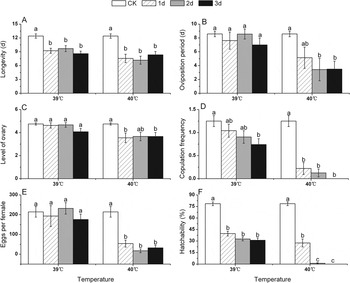
The heat shock of 39 °C for 1–3 days significantly reduced longevity (F=10.49, d.f.=3, 205, P<0.0001, fig. 2A) and copulation frequency of adults (F=3.17, d.f.=3, 100, P=0.0313, fig. 2D) and hatchability of eggs (F=90.25, d.f.=3, 32, P<0.0001, fig. 2F), but these heat shocks did not affect oviposition period (F=0.88, d.f.=3, 32, P=0.4594, fig. 2B), ovary development (F=2.27, d.f.=3, 100, P=0.0851, fig. 2C) and fecundity (F=0.47, d.f.=3, 32, P=0.7064, fig. 2E). All these biological parameters were not significantly different among or between 1, 2 and 3 days of heat shock (fig. 2).
Longevity (A), oviposition period (B), ovary development (C), copulation frequency (D), fecundity of adults (E) and hatchability of eggs (F) when adults were exposed to 39 and 40 °C for 0 (CK), 1, 2 and 3 days. Different alphabetic letters above the bars (±SE) show significant difference among shock durations (0–3 days) at P<0.05 level.

When adults were exposed to 40 °C, the longevity (F=13.01, d.f.=3, 89, P<0.0001, fig. 2A), oviposition period (F=3.30, d.f.=3, 30, P=0.0029, fig. 2B), ovary development (F=4.35, d.f.=3, 90, P=0.0066, fig. 2C), copulation frequency (F=37.97, d.f.=3, 86, P<0.0001, fig. 2D) and fecundity (F=21.16, d.f.=3, 30, P<0.0001, fig. 2E) of adults and hatchability of eggs (F=96.58, d.f.=3, 24, P<0.0001, fig. 2F) were significantly lower than that of the control. Moreover, the hatchability of eggs was significantly lower following 3 days of exposure than at 1 or 2 days. The females could not produce effective eggs when they were exposed to 40 °C for 3 days (fig. 2F).
Response of females and males on heat shock
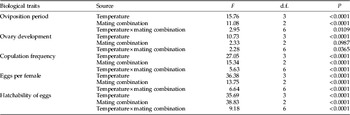
The biological traits of the rice leaf folder were influenced by high temperature, and the responses of males and females to heat shock were significantly different. There were significant interactions between high temperature and mating combination (table 1). The survival of females and males decreased significantly as the temperature increased from 27 to 41 °C (female: F=7.43, d.f.=4, 61, P<0.0001; male: F=16.34, d.f.=4, 54, P<0.001). Moreover, the survival of males was lower than that of females, and this difference became significant at 41 °C (t=2.1, d.f.=22, P=0.0477, fig. 3).
Survival (±SE) of female and male adults exposed to different high temperatures for 3 days. The different capital and lowercase alphabetic letters show significant difference among different temperatures at P<0.05 level for females and males, respectively.

Effects of high temperature (four levels) and mating combination (three levels) on the biological traits of the rice leaf folder.

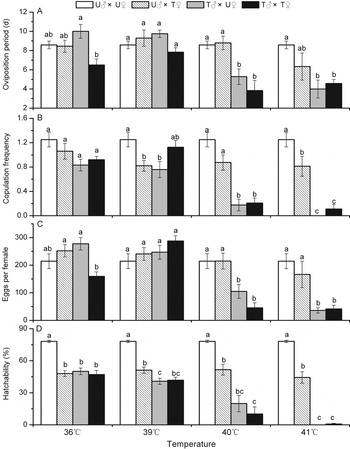
Under heat shock at 36 °C, the copulation frequencies of females in the four mating combinations were not significantly different (F=2.33, d.f.=3, 125, P=0.078, fig. 4B). Oviposition period and fecundity in these three mating combinations U♂×T♀, T♂×U♀ and T♂×T♀ were not significantly different to the control U♂×U♀ (fig. 4A and C). However, hatchability of eggs from U♂×T♀, T♂×U♀ and T♂×T♀ was significantly lower than the control U♂×U♀ (F=36.11, d.f.=3, 41, P<0.0001), and there were no significant differences among the three treated combinations (fig. 4D).
Oviposition period (A), copulation frequency (B), fecundity of adults (C) and hatchability of eggs (D) in the four mating combinations U♂×T♀, T♂×U♀, T♂×T♀ and U♂×U♀ which adults exposed to 36, 39, 40 and 41 °C. The different alphabetic letters above the bars (±SE) show significant difference (P<0.05) among the four mating combinations at the same temperature.

Under heat shock at 39 °C, oviposition period (F=0.94, d.f.=3, 39, P=0.4302, fig. 4A) and fecundity (F=3.39, d.f.=3, 39, P=0.1616, fig. 4C) among the four mating combinations were not significantly different. However, the copulation frequencies in U♂×T♀ and T♂×U♀ were significantly lower than in the control U♂×U♀ (F=4.44, d.f.=3, 114, P=0.0054), and T♂×T♀ was not different with the control and slightly higher than in U♂×T♀ and T♂×U♀ (fig. 4B). Hatchability of eggs from the U♂×T♀, T♂×U♀ and T♂×T♀ was significantly lower than the control U♂×U♀ (F=64.26, d.f.=3, 39, P<0.0001, fig. 4D). Moreover, hatchability in U♂×T♀ was significantly higher than that in T♂×U♀ (fig. 4D).
Under heat shock at 40 and 41 °C, the oviposition period (40 °C: F=10.17, d.f.=3, 37, P<0.0001; 41 °C: F=9.09, d.f.=3, 27, P=0.0003, fig. 4A), copulation frequency (40 °C: F=22.64, d.f.=3, 110, P<0.0001; 41 °C: F=27.08, d.f.=3, 77, P<0.0001, fig. 4B), fecundity (40 °C: F=12.10, d.f.=3, 37, P<0.0001; 41 °C: F=10.43, d.f.=3, 27, P<0.0001, fig. 4C) and hatchability of eggs (40 °C: F=55.88, d.f.=3, 37, P<0.0001; 41 °C: F=302.60, d.f.=3, 27, P<0.0001, fig. 4D) in T♂×U♀ and T♂×T♀ were significantly lower than that in U♂×U♀ and U♂×T♀. Furthermore, almost all the eggs from the mating combinations in which males were exposed to 41 °C did not hatch (fig. 4D). Results therefore indicated that male moths were more susceptible to heat stress than females.
Copulation behaviour of adults after heat shock
Mating behaviour of the rice leaf folder was impacted by heat shock of 40 °C. The total frequencies of mating that occurred in U♂×U♀ and U♂×T♀ were significantly higher than that in T♂×U♀ and T♂×T♀ (χ2=32.85, d.f.=3, P<0.0001). The number of females which could not detach from males after mating was significantly higher in U♀×T♂ and T♀×T♂ than that in U♀×U♂ and T♀×U♂ (χ2=26.12, d.f.=3, P<0.0001). The number of females obtained spermatophora was also higher in U♀×U♂ and T♀×U♂ than in U♀×T♂ and T♀×T♂ (χ2=55.80, d.f.=3, P<0.0001). The females in U♀×U♂ and T♀×U♂ obtained a spermatophora from each mating, but the females in U♀×T♂ and T♀×T♂ obtained only three and one spermatophoras from 15 matings, respectively (table 2). The duration of mating was significantly prolonged in T♂×T♀ (F=6.21, d.f.=3, 63, P=0.0009, table 2).
Parameters of mating behaviour of adults in the four mating combinations. The different alphabetic letters show significant difference among the four mating combinations at P<0.01.

Mating behaviour usually started at 2:00 am and ended at 5:30–6:00 am in U♀×U♂, T♀×U♂ and U♀×T♂, but the start time was 3:00 am in T♂×T♀ (fig. 5). The mating frequency and success rate of males exposed to a 40 °C heat shock were significantly reduced, and the mating duration notably prolonged (table 2).
Mating rhythm of the rice leaf folder adults in the four mating combinations at the second night after heat shock.

Spermatogenesis in males after heat shock
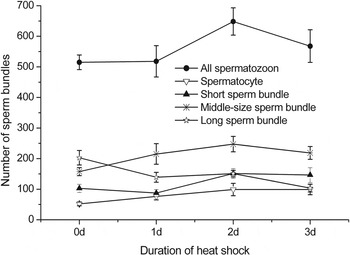
The number of all spermatozoons, spermatocytes and middle-size sperm bundles was not significantly different among or between different durations of heat shock (all spermatozoons: F=2.17, d.f.=3, 31, P=0.1121; spermatocytes: F=2.59, d.f.=3, 31, P=0.0702; middle-size sperm bundles: F=2.85, d.f.=3, 31, P=0.0534), but the number of short sperm bundles significantly increased as duration of heat shock increased, and long sperm bundles significantly decreased (short sperm bundles: F=3.57, d.f.=3, 31, P=0.0252; long sperm bundles: F=5.72, d.f.=3, 31, P=0.0031). Three days of heat shock at the adult stage did not restrict spermatogenesis, but the number of maturated sperms (long sperm bundles) was reduced (fig. 6).
Mean sperm bundles (±SE) in the testes of male adults exposed to 40 °C for 0–3 days.

Sperms transfer of heat shocked males
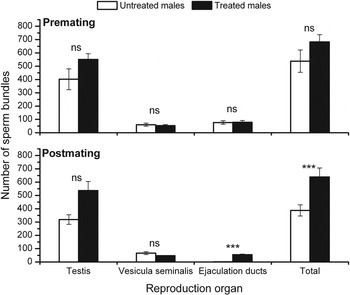
At premating, the number of sperm bundles in testes, vesicula seminalis and ejaculation ducts was not significantly different between treated and untreated males (sperm bundles in testes: t=1.66, d.f.=16, P=0.1158; in vesicula seminalis: t=0.48, d.f.=16, P=0.6411; in ejaculation ducts: t=0.11, d.f.=16, P=0.9170), and the total sperm bundles in these three organs did not differ (t=1.44, d.f.=16, P=0.1690). At postmating, the number of sperm bundles in ejaculation ducts and total sperm bundles in these three parts was significantly higher in treated males than that in untreated ones (in ejaculation ducts: t=13.89, d.f.=17, P<0.0001; total sperm bundles: t=3.34, d.f.=17, P=0.0039). However, the sperm bundles in the testes and vesicula seminalis proved not to be significantly different between treated and untreated males (in testes: t=2.61, d.f.=17, P=0.1644; in vesicular seminalis: t=1.53, d.f.=17, P=0.1445). The treated males could not normally ejaculate sperms into females, although the mating behaviours happened (fig. 7).
Mean sperm bundles (±SE) in testes, vesicula seminalis and ejaculation ducts and total sperms (±SE) in these three organs of treated and untreated males at premating and postmating. *** Means significant difference between treated and untreated males at P<0.001 level by Student's t-test.

Discussion
Heat shock suppresses population size
High temperatures in summer suppress the development of rice leaf folder populations. Heat shock at 36 °C for 3 days led to a slight increase in mortality of adults, but resulted in a significant decrease of egg hatchability. Under heat shock at 40 °C for 1 day, fecundity and egg hatchability significantly reduced. Moreover, at 41 °C, almost all eggs did not hatch. These results suggested that short-term high temperature exposures (for 5 h) at the adult stage would dramatically suppress the development of rice leaf folder populations. At the same time, high temperatures (>35 °C) caused a higher mortality (87%) of the first and second instar larvae in rice fields (Chen et al., Reference Chen, Pan and Lei1981). Larvae rearing at temperatures above 30 °C brought about a significant decrease in the effective rate of egg production, and all eggs produced by adult which was reared as larvae at 33 °C failed to hatch (Wu & Zhang, Reference Wu and Zhang1984; Liao et al., Reference Liao, Huang, Fang and Liu2013). The high temperature triggered migration behaviour of the rice leaf folder (Wu, Reference Wu1985) which consequently results in the decline of population size in rice fields. Lower relative humidity and high temperature conditions increased the mortality of eggs, and the eggs did not hatch under conditions of less than 50% RH and above 28 °C (Fang et al., Reference Fang, Liao, Qian and Liu2013). In summer, maximum air temperatures frequently exceed 30 °C, and even temperatures above 35 °C have been recorded in the Jiangsu Province, China. Undoubtedly, the high temperature and arid weather in summer exerts a strong stress on rice leaf folder populations.
Adults of the rice leaf folder exposed to 39 °C for 1–3 days (5 h day−1) produced a similar number of eggs as the control, but hatchability of eggs was only half of the control. When adults were exposed to 40 °C for 5 h, both the egg production and hatchability were only the one-third of the control (fig. 2E, F). Characterizing this high temperature effect on egg number and hatchability allows us to model population dynamics according to the degree and duration of the high temperature exposures experienced by adult rice leaf folders in summer. For example, if newly eclosed adults experience temperature of 40 °C, we can estimate that the populations will be in decline the next generation.
Different responses of male and female to heat shock
The responses of female and male adults of the rice leaf folder to heat shock are different. Males were more sensitive to heat shock than females. The survival of males was lower than that of females. Fecundity of females and hatchability of eggs significantly decreased if the females mated with heat exposed males, but fecundity of the heat treated and untreated females was not significantly different when they mated with untreated males. Survival rates of Ophraella communa females were significantly higher than that of males after short stress at any high temperature from 35 to 47 °C (Zhou et al., Reference Zhou, Guo, Min and Wan2011). In Frankliniella occidentalis, females were more tolerant to extreme temperature than males, with LTemp50 values of 40.2 and 38.5 °C after 0.5 h exposures for females and males, respectively (Li et al., Reference Li, Shi, Lu, Wang and Du2011). Females of Trialeurodes vaporariorum and Bemisia tabaci biotype B were more tolerant to high temperatures (≥39 °C) than males (Cui et al., Reference Cui, Wan, Xie and Liu2008). Male adults of flesh fly Sarcophaga crassipalpis exposed to 45 °C for 1 h failed to fertilize the eggs even when mated with untreated females. However, exposing females to 45 °C reduced total egg production by 15%, although the percentage of fertilized eggs did not change substantially (Rinehart et al., Reference Rinehart, Yocum and Denlinger2000). Of course, the responses of female and male adults to high temperature are dependent on insect species. The survival rates of Helicoverpa armigera females and males were not significantly different when exposed to 40, 42.5 and 45 °C for 2 h, and in most heat treatments, the average lifespan of males was longer than that of the females (Mironidis & Savopoulou-Soultani, Reference Mironidis and Savopoulou-Soultani2010). Fecundity of Bicyclus anynana was significantly higher when the males were exposed to 40 °C for 1 h as opposed to when the females were exposed (Janowitz & Fischer, Reference Janowitz and Fischer2011). In a parasitic wasp Aphidius avenae, female exposure to 36 °C for 1 h significantly reduced the fecundity, whereas male exposure had no effect (Roux et al., Reference Roux, Le Lann, van Alphen and van Baaren2010).
Variation in the response of males and females to heat shock could offer a physiological tactic for insect populations to withstand heat shock. Kingsolver et al. (Reference Kingsolver, Woods, Buckley, Potter, MacLean and Higgins2011) suggested that complex life cycles of insects were important for responses to climate change. Rice leaf folder populations would meet heat shock almost every year. We found that the effects of short-term heat shock on rice leaf folder populations were weaker if only the female adults were exposed than both the females and males were exposed. The different emergence dates of adults would allow some rice leaf folders to escape the hottest summer conditions, thus allowing populations to persist. In the Jiangsu Province, the rice leaf folder usually has several immigration peaks from other hotter regions, which means the occurrence period of adults in summer is usually very long, and a high temperature event usually only lasts 1–3 days. This greatly reduces the risk of all individuals suffering from heat shock. Although the sensitivity of females and males to high temperatures was different, adult longevity was not significantly different. The rice leaf folder does not directly use the asynchronism development of females and males to avoid the heat shock in summer.
Physiological mechanism of heat shock suppressing population size
Heat shock of adults significantly reduces the rate of egg fertilization in the rice leaf folder, and this kind of decline mainly resulted from the impacts of heat shock on mating behaviour and sperm transfer. The success rate of copulation decreased when males were exposed to 40 °C for 3 days, and a large number of females could not detach from males after copulation. Although the mating duration was significantly prolonged when the females and males were exposed to heat stress, the number of spermatophora in the spermatheca of females was significantly less. Heat shock inhibited the number of mating events attempted by males. In addition, many heat shocked females did not copulate, resulting in the laying of unfertilized eggs. In addition, we identified that females who mated with treated males produced unfertilized eggs. This result suggests that heat shock at 40 °C for 3 days may have resulted in male sterility of the rice leaf folder. Anisopteromalus calandrae male pupae exposed to 40 °C for 3 days caused sterility of adult males (Nguyen et al., Reference Nguyen, Bressac and Chevrier2013). Heat shock also induced male sterility in tropical populations of D. melanogaster (Rohmer et al., Reference Rohmer, David, Moreteau and Joly2004; David et al., Reference David, Araripe, Chakir, Legout, Lemos, Pétavy, Rohmer, Joly and Moreteau2005). Heat treatment also had indirect effects on male reproductive success of a springtail, Orchesella cincta (Zizzari & Ellers, Reference Zizzari and Ellers2011). In the current study, heat shock did not affect the spermatogenesis, but instead affected the sperm transfer during mating. The number of sperm in testes, vesicula seminalis and ejaculation ducts before mating was not different between the treated and untreated males. But there were more sperm in ejaculation ducts of the treated males than untreated ones after mating. This result showed that the treated males could not ejaculate sperm into females during mating. Heat shock obstructed sperm transfer in the rice leaf folder but not the spermatogenesis. This obstruction phenomenon has also been found in females of the adzuki bean beetle, C. chinensis, which received less spermatozoons at 33 °C than at 17 °C (Katsuki & Miyatake, Reference Katsuki and Miyatake2009). Short-term heat shock of adults remarkably suppressed mating behaviour and sperm transfer of the rice leaf folder, and consequently resulted in the unfertilized eggs. Additionally, the reduced oviposition periods of females exposed to 40 and 41 °C (figs. 2B and 4A) would combine with females not receiving sperm to further negatively impact on population growth.
Conclusion and prospect
Heat shock had serious sub-lethal effects on rice leaf folder adults, which combined to significantly suppress population growth in summer. Specifically, heat stress suppressed the fecundity of the rice leaf folder by inhibiting mating behaviour and obstructing the sperm ejaculation of males.
Climate warming in many regions is an undisputable trend, and has already impacted upon many insect populations. Hotter summer conditions in the Jiangsu Province of China would be unfavourable for rice leaf folder populations, and a decline of this pest in some tropical regions might be anticipated under future climate warming. However, the pest has great potential to adapt to heat shock, such as escaping heat stress by migration and dispersal behaviours. We have also found that the rice leaf folder could improve its fitness under high temperatures through the segregation of females and males in a chamber during the temperatures gradually increased (data unpublished). Interestingly, in the current study, we found that the copulation frequency was slightly higher when both female and male adults were heat shocked at 39 °C for 3 days (5 h day−1), compared with when only females or males were shocked (fig. 4B). The rice leaf folder adults might, therefore, relieve the impacts of heat stress via increased mating frequency. This means populations could still cause outbreaks, and may expand towards the northern rice fields of China under climate warming.
Acknowledgements
This study was supported by the Special Fund for Agro-scientific Research in the Public Interest of China (200903051). We thank the two anonymous reviewers and editor for the constructive comments for the discussion and the language improvement.