

Introduction
Lobbying plays a vital role in modern democracies, allowing interest groups, organizations, and individuals to intervene in policymaking processes beyond the sheer electoral moments. Vast theoretical and empirical research has developed around this subject, analyzing the relationship between lobbying and democracy (Bitonti, Reference Bitonti2020), the concept of lobbying influence (Lowery, Reference Lowery2013), the strategies of interest groups, or the conditions of their policy success (Baumgartner et al., Reference Baumgartner, Berry, Hojnacki, Kimball and Leech2009; Klüver et al., Reference Klüver, Braun and Beyers2015; Pritoni and Vicentini, Reference Pritoni and Vicentini2022).
In this scenario, growing attention in political science and law studies has been dedicated to lobbying regulation, while various regulatory frameworks on lobbying continue to be devised in different political systems in the world (Chari et al., Reference Chari, Hogan, Murphy and Crepaz2019).
However, some questions remain relevant from both a scientific and practical point of view. How can we define a lobbying regulation? What are the principles and the practices that should be pursued by a policy of lobbying regulation? And what is the lobbyists' stance on this matter?
Most reflections on this topic in the literature – as well as most of existing lobbying regulations – have thus far focused on the figure of lobbyists on one hand, and on the principle of transparency (disclosure of how lobbying is done by whom) on the other, with most comparative studies and indexes on lobbying regulations analyzing the stringency or the ‘robustness’ of formal legislations on lobbying mainly by appraising how much information on lobbyists and lobbying activities is produced and disclosed by the different regulations.
Expanding such traditional perspective, we advance a wider definition of lobbying regulation: as also recommended by important international organizations such as the Organization for Economic Co-operation and Development (OECD) and the Open Government Partnership (OECD, 2013; Open Government Partnership, 2017), a fuller perspective can focus not only on lobbyists but also on policymakers as equally important players of a lobbying environment, and can consider the role of institutional settings and norms in the configuration of how lobbying is done in a specific context, even beyond formal pieces of legislation.
In addition, the idea behind this article is that the predominant focus on transparency of both actual lobbying regulations and studies on them could represent a source of weakness for both. This idea relies on normative considerations derived from the theories of open government and deliberative democracy, and on empirical data collected through interviews with key players of the lobbying environment (professional lobbying consultancies).
By building on the philosophies of open government and deliberative democracy, we propose a more comprehensive framework of lobbying regulation, considering not only transparency but also two different policy goals/principles, namely the (fair) equality of access of stakeholders to policymaking and the public accountability of policymakers in their decisions. Such theoretical effort may pave the way for the development of a more sophisticated multidimensional tool of assessment (or index) of different lobbying regulations. While the actual construction of a new index lies outside the scope of this article, we aim to make the preliminary steps in that direction, clarifying the principles that should be included in such a tool as macro-dimensions of lobbying regulations.
On the empirical plan, we test such conceptual framework through an analysis of the perspective of lobbyists themselves on lobbying regulation, relying on in-depth semi-structured video interviews (with a mixed qualitative–quantitative approach) to key players – professional lobbying consultancies – enrolled in the lobbying register of the Italian Chamber of Deputies.
While professional lobbying consultancies are only one of the relevant players when debating lobbying regulation (next to other types of lobbying actors and to policymakers themselves), their perspective is worth of attention for various reasons: (1) they are the ‘usual suspects’ of lobbying regulation, usually targeted by even the weakest regulations (an example being the Register of Consultant Lobbyists set up in the UK by the Transparency of Lobbying, Non-Party Campaigning and Trade Union Administration Act of 2014Footnote 1); (2) they stand among the most prominent types of lobbyists in public debates on the matter (Mazzoni, Reference Mazzoni2013; Halpin and Fraussen, Reference Halpin and Fraussen2017); (3) as firms working (by definition) with multiple clients and in different policy processes, professional lobbying consultancies can be considered highly informed players (or ‘connoisseurs’, as put by Bunea and Gross, Reference Bunea and Gross2019) on the topic of lobbying regulation, as well as actors highly affected by such regulations almost on a daily basis.
Now, a potential bias could be acknowledged in our research object: in fact, analyzing the perspective of consultancies enrolled in a lobbying register may raise the objection that these specific subjects are more favorable or ‘committed’ to regulation as they are present in a non-mandatory lobbying register such as the one implemented by the Italian Chamber of DeputiesFootnote 2. However, our analysis does not intend to investigate whether consultancies are in favor of regulation or committed to more or less robust regulation; our aim is to analyze their perspective as concerns the principles/macro-dimensions through which one should assess lobbying regulation, and their support toward specific measures reflecting these principles. Thus, while future research may expand the analysis to different categories of lobbyists and policymakers, we believe that an in-depth investigation on the perspective of professional lobbying consultancies is useful and relevant in relation to our research objectives, and allows to shed further light on such a crucial category of lobbying actors.
What emerges from our analysis is that, beyond transparency, professional lobbying consultancies strongly support measures in line with the two other principles of lobbying regulation mentioned above, that is, equality of access and policymakers' accountability.
Our contribution is relevant to scholars working on lobbying regulation nationally and internationally, and to practitioners and policymakers aiming to understand how to widen their perspective on lobbying regulations, and how to design more comprehensive regulatory frameworks (often accused to present multiple flaws and loopholes at present).
The paper is structured as follows. In the next section (‘The literature on lobbying regulation’) we recall the relevant literature. In the third section (‘Not only lobbyists and not only formal laws’) we advance a wider definition of lobbying regulation. In the fourth section (‘Going beyond transparency: access and accountability’) we develop our normative argument on the principles of lobbying regulation. In the fifth section (‘Design and methodology of empirical research’) we present the design and the methodology of the empirical part of our study (also developing some considerations on the chosen tool, the video interviews), while in the sixth section (‘Empirical findings: the perspective of professional lobbying consultancies’) we present our findings. In the last conclusive section, we highlight the relevance as well as the limits of our findings, and we draw some consequences for future research.
The literature on lobbying regulation
Especially in relation to the legislation on lobbying approved in the United States at federalFootnote 3 and state levels, and later with national laws appearing in other countries (Chari et al., Reference Chari, Hogan, Murphy and Crepaz2019), various scholars have begun to analyze such regulations and to compare them.
In her seminal contribution, Opheim proposes the creation of an ‘index of lobby regulation’ to ‘measure the stringency with which states regulate organized lobbies’ (Opheim, Reference Opheim1991: 407), using 22 dichotomous indicators through which to read statutory provisions, concerning (1) the definition of a lobbyist (seven indicators), (2) the frequency and quality of disclosure (eight indicators), and (3) the oversight and enforcement of regulations (seven indicators).
Always referring to US states, a couple of years later another contribution (Brinig et al., Reference Brinig, Holcombe and Schwartzstein1993) attempted to create a rating of ‘restrictiveness’ of lobbying laws (with vaguer and not fully explicated criteria supporting a rate between 1 and 14 for each state), establishing an inverse connection with the number of registered lobbyists in each state according to a rational choice perspective.
As recalled by Newmark (Reference Newmark2017), also a number of organizations and think tanks have in time addressed the problem of rating or comparing lobbying regulations, once again focusing on the US context. Among them we find:
• the National Conference on State Legislatures, which collects the various states' legal provisions concerning the definition of lobbyists, their registration and identification, the reporting requirements, and the use of public fundsFootnote 4;
• the Sunlight Foundation, which in 2011 and 2015 scored US states ranging from 6 to −6, using an index of five indicators (lobbyists reporting activities, expenditure transparency, expenditure reporting thresholds, public accessibility of information on lobbyists, and disclosure of lobbyists compensations)Footnote 5;
• the Pacific Research Institute, which in 2010 published a report (Clemens et al., Reference Clemens, Kaszton, Rufer and Sucheski2010) ranking US states through a 0–37 scoring of lobbying disclosure laws (concerning who is required to register, government exemptions, the definition of public entities, thresholds relevant for exemptions, information regarding lobbyists and principals) and a 0–22 scoring of the public accessibility of information on lobbying;
• the Center for Public Integrity (CPI), which in 2003 began a series of reports (Hired guns) using an index of 48 indicators to assign a 0–100 score to state regulations, considering the definition of lobbyist (two questions), the individual registration (eight questions), the individual spending disclosure (15 questions), the employer spending disclosure (two questions), the electronic filing of registration and reporting (three questions), the public access of information on lobbyists (eight questions), the enforcement of rules (nine questions), and the presence of a ‘revolving doors’ provision (one question).
Just relying on the CPI index, the important research project advanced by Chari et al. with international comparisons of lobbying regulations (Chari et al., Reference Chari, Murphy and Hogan2007, Reference Chari, Hogan and Murphy2010, Reference Chari, Hogan, Murphy and Crepaz2019) leads to three classes of cases: lowly regulated systems (with a CPI score of 1–19), medium regulated systems (with a CPI score of 20–59), and highly regulated systems (with a CPI score of 60–100).
Other efforts in the direction of measurement and comparison were also made by Newmark, with a first article (Reference Newmark2005) and a second one (2017) where he proposes to construct a new measure of lobbying regulation concerning ‘who must register to lobby, what activities lobbyists can and cannot do, and what information must be disclosed’ (Newmark, Reference Newmark2017: 221), and by Holman and Luneburg (Reference Holman and Luneburg2012), who compared the US and Canadian regulations through 28 indicators and the European regulations through 21 indicators, concerning the registration itself (five items), the covered public officials (two items), the information disclosed (11 items), enforcement, Internet access of information and presence of a code of conduct (one item each)Footnote 6.
In addition to the literature formulating or using indexes of ‘stringency’ or ‘robustness’ of lobbying regulations (on which see also Crepaz and Chari Reference Crepaz and Chari2018), other reflections on this subject have concerned specific aspects of regulations. For instance, Lowery and Gray (Reference Lowery and Gray1997) and Ozymy (Reference Ozymy2010) investigated the effect of lobbying regulations respectively on the interest group population of the various US states (finding no evidence of such effects) or on their influence in legislation (finding a negative relation); Flavin (Reference Flavin2015) researched the relationship between strictness of lobbying regulation and political equality in US states (finding a positive effect between stricter regulations and higher political equality); Crepaz researched the causal dynamics that lead to the introduction of lobbying laws (Reference Crepaz2017) and the use that lobbyists make of the register in the Irish case (Reference Crepaz2020).
Others focused on specific national case studies (McGrath, Reference McGrath2008; Lumi, Reference Lumi2014; Crepaz, Reference Crepaz2016; Bitonti and Harris, Reference Bitonti and Harris2017) or on the single and yet quite relevant case of lobbying regulation in the European Union, analyzing the data in the Transparency Register (Greenwood and Dreger, Reference Greenwood and Dreger2013), or looking at the motives of the actors who choose to register (Năstase and Muurmans, Reference Năstase and Muurmans2018; Bunea and Gross, Reference Bunea and Gross2019).
Lastly, other contributions focused on the political reasons behind regulations (Veksler, Reference Veksler2015; Bunea, Reference Bunea2019), or shed light on the tight connection between the regulation of lobbying and other often neglected areas, such as political financing or conflicts of interest (Thomas, Reference Thomas1998).
In most of these scientific reflections (as well as in various lobbying regulations themselves), two potential weaknesses emerge: (1) an exclusive attention to formal pieces of legislation explicitly dedicated to lobbying and lobbyists, and (2) a clearly predominant focus on transparency and disclosure of lobbying activities.
We address these issues in the next two sections.
Not only lobbyists and not only formal laws
Lobbying is an activity that assumes some kind of interaction (or attempted interaction) between those who orchestrate some lobbying activity (we call these lobbyists, following the behavioral definition provided by Thomas and Hrebenar, Reference Thomas, Hrebenar, Harris, Bitonti, Fleisher and Binderkrantz2020) and those who are lobbied (policymakers, in the wide sense of public decision-makers). Consequently, all the factors that legally or practically shape the contours of this interaction can substantially fall under the theoretical umbrella of lobbying regulation.
In this regard, focusing exclusively on lobbyists and interest groups may be misleading (even more so when the focus is on consultant lobbyists, as in the UK law previously recalled). In fact, in order to delineate a more comprehensive analytical framework, it is possible to expand our view of the same concept of lobbying regulation, considering lobbyists, interest groups, and policymakers all part of the equation, and recognize that the latter (policymakers) play a role at least as important as the former.
Furthermore, as concerns the sources of lobbying regulation, it is worth highlighting how legal analysts and political scientists have in many cases limited their analyses to formal laws dedicated to lobbying or lobbyists, narrowly defining regulation as ‘a set of codified, formal rules which are passed by parliament and written in law (which is enforced)’ (Chari et al., Reference Chari, Hogan and Murphy2010: 4). However, this choice appears questionable when one considers the existence of other sub-legislative rules (e.g. internal regulations of ministries and parliaments) and norms (habits and customs, codes of conduct, or even the design of digital platforms used by governmental authorities for consultations and dialogues with stakeholdersFootnote 7) that equally aim to ‘channel’ or ‘steer’ the interaction between lobbyists and policymakers. Here we refer not only to lobbying registers (that sometimes are set up through non-legislative rules – that is the case of Italy or the Netherlands), but also to a variety of other measures (legislative or not) concerning the physical access to governmental buildings, political financing, the conflicts of interest of policymakers, the procedures of consultation with stakeholders, the regulatory impact assessments (RIAs) of policiesFootnote 8, the more or less institutionalized dialogues between governmental authorities and various interest groups, the legislative footprints of public decisions, the public agendas of policymakers; in a word, all the rules, norms, and frameworks that affect the interaction between policymakers and lobbyists and interest groups.
In consideration of the arguments developed above, lobbying regulation can be defined as the set of rules, norms, and frameworks that aim to shape how lobbying is done in a specific political system, regarding a wide range of topics and domains relative to the interaction between policymakers on the one hand and interest groups and lobbyists on the other.
Going beyond transparency: access and accountability
According to Lasswell and Kaplan's classic definition, a policy ‘is a projected program of goal values and practices’ (Lasswell and Kaplan, Reference Lasswell and Kaplan1950: 71). What are then the goal values (or principles)Footnote 9 and the practices that should be pursued by a policy of lobbying regulation?
As seen in the previous section, the literature on lobbying regulation has abundantly focused on transparency. Already years ago, Thomas noted how ‘the major value of lobby laws is in providing public information on who is lobbying whom. Public disclosure is the major element in all four types of regulations’ [he refers to the US lobbying laws for foreign agents and at federal, state, and local levels] (Thomas, Reference Thomas1998: 512). This focus emerges adamantly not only by looking at the type of indicators chosen by scholars and analysts to assess the robustness of lobbying regulations (mainly referring to what defines lobbyists, to their identification and to the disclosure of their activities in various ways, looking at the enforcement of such measures as well), but also by performing a simple semantic analysis of the public discourse on regulating lobbying, where a lexicon made of disclosures and public access to information on lobbyists and lobbying activities is used. The common theoretical reference here is the sunlight principle, famously expressed by the US Supreme Court Justice Louis D. Brandeis, who in 1913 stated that ‘publicity is justly commended as a remedy for social and industrial diseases. Sunlight is said to be the best of disinfectants; electric light the most efficient policeman’ (recalled by Holman and Luneburg, Reference Holman and Luneburg2012: 78).
However, various reflections have contributed to underline the instrumental character of transparency itself, and its contested relationship with other principles and values such as accountability, trust, privacy, fairness, legitimacy, or effectiveness (Heald, Reference Heald, Hood and Heald2006; Fox, Reference Fox2007; Etzioni, Reference Etzioni2010). Be that as it may, if lobbying regulation aims to generally shape the interaction between lobbyists and policymakers, what principles beyond transparency can get in the picture? The philosophical visions of open government and deliberative democracy can help on this account. Let's see how.
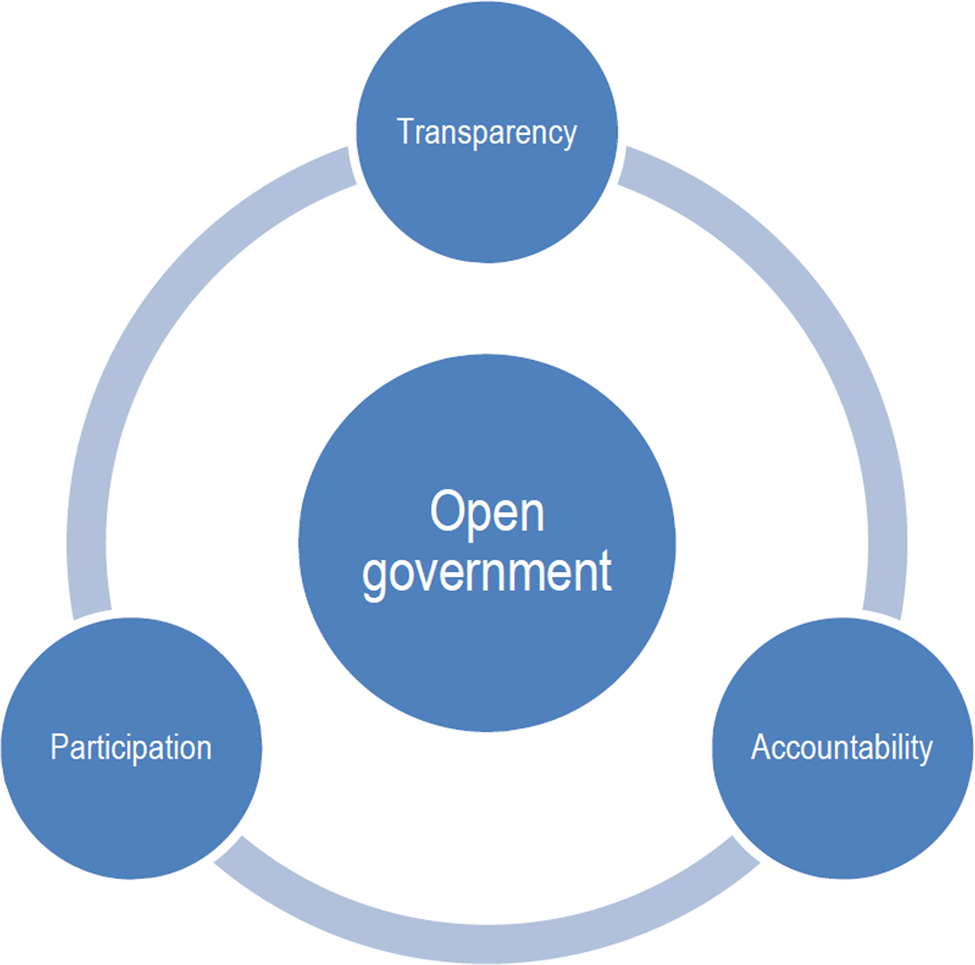
The vision of open government (Lathrop and Ruma, Reference Lathrop and Ruma2010) is centered around the idea of ‘opening’ the government by making it not only more transparent (primarily through open data), but also more democratically accountable (primarily through the public accountability and the integrity of policymakers) and inclusive (primarily through the participation/collaboration of citizens and stakeholders to the policymaking process). Such principles (see Figure 1) have been fostered in recent years by international organizations such as the Open Government Partnership and OECD, and continue to be variously pursued by public sector and civil society organizations throughout the world (OECD, 2016, 2021).

The accountability (and integrity) of policymakers emerges here as a moral and institutional liability to publicly justify public decisions and actions (Filgueiras, Reference Filgueiras2016), for instance by means of legislative footprints (short reports that account for the steps made in the discussion of laws or decisions, and for the reasons that led decision-makers to adopt a particular decision) and public agendas.
Participation is instead rooted in the ideas of inclusion, pluralism, and equality, envisioning a policymaking process where plural and diverse voices/stakeholders can have access with fair conditions of equalityFootnote 10, for instance through public consultations or participatory processes/platforms that contribute to lower the cost of access itself (Lathrop and Ruma, Reference Lathrop and Ruma2010; Noveck, Reference Noveck2018).
Furthermore, both the goals of accountability and participation can be more thoroughly pursued through digital means – digital innovation is indeed another cornerstone of the open government vision – for instance using digital platforms and online datasets, tools that facilitate access, publicity of information, and smart organization of both (Christensen, Reference Christensen2021; Gastil, Reference Gastil2021).
The vision of deliberative democracy is instead based on the potential of a consensus-oriented procedure of rational discussion (deliberation), where participants interact with each other by providing a public justification for their positions, discuss the various points of view only relying on the ‘unforced force of the better argument’ (Habermas, Reference Habermas1996: 306), try to clarify the terms of the issue to decide upon and if anything find a common ground for a shared solution (Bohman and Rehg, Reference Bohman and Rehg1997). As the diversity of the participants and the clear understanding of the issue at stake are two of the conditions of deliberative democracy, in the field of lobbying this could be referred to the public sphere of policymaking, to the inclusion (and to the fair conditions of equality of access) of diverse stakeholders in the policymaking process (through various channels of participation), and to the adequate assessment of policy issues and different positions, for instance through RIAs or, once again, through legislative footprints that allow every decision to be publicly accountable as for the reasons that led to its adoption, and for the arguments that were produced in the public discussion on such decision (Gutmann and Thompson, Reference Gutmann and Thompson2004; Gastil, Reference Gastil2021).
In consideration of the arguments developed above, a more comprehensive framework of lobbying regulation cannot be based only on transparency and disclosures, but should adequately consider the various institutional measures aiming to facilitate (1) the participation/access of stakeholders to policymaking, and (2) the public accountability of policymakers themselves.
Such wider perspective has been occasionally recalled by a few reflections already mentioned, for example, by Holman and Luneburg when distinguishing between systems that pursue transparency and accountability and systems that try to level the playing field facilitating access (Holman and Luneburg, Reference Holman and Luneburg2012: 77), or by Thomas when pointing out the distinction between the aim to monitor lobbying activities and the aim to actually regulate them, specifying ‘what a group and its lobbyists can or cannot do in their attempts to influence public policy’ (Thomas, Reference Thomas1998: 51). Nevertheless, to the best of our knowledge, no systematic effort of assessment of lobbying regulations has so far widened the perspective to all the principles and practices referred here.
Design and methodology of empirical research
On the empirical plan, we aimed to test such conceptual framework through an analysis of the perspective of lobbyists themselves (and more specifically of professional lobbying consultancies) on lobbying regulation, focusing on the following questions:
(1) what principles should shape lobbying regulation according to professional lobbying consultancies?
(2) what specific measures in their view are most relevant and necessary in an ideal regulation?
We chose to focus on a specific group of actors, that of professional lobbying consultancies, for the reasons already recalled in the introduction. Furthermore, we chose a case – Italy – that sees a combination of interesting conditions: (1) a thriving lobbying environment and an averagely mature professional development of the industry (Capano et al., Reference Capano, Lizzi and Pritoni2014; Bitonti and Harris, Reference Bitonti and Harris2017; Carloni and Mazzoni, Reference Carloni and Mazzoni2020); (2) the cultural influence of the European Union's ‘lobbying culture’, with many lobbying firms (more than 50% of our interviewees) enrolled in the EU Transparency Register and many interest groups affiliated to European supranational federations (Pritoni, Reference Pritoni2017); (3) a regulatory framework on lobbying still in its early stages, with the first fragmented examples of national lobbying registers adopted only experimentally and relatively recently (Petrillo, Reference Petrillo2019)Footnote 11.
We collected our data through in-depth semi-structured interviews with the top management (CEOs/partners) of the professional lobbying consultancies enrolled in the lobbying register of the Italian Chamber of Deputies in January 2021. The total number of subjects enrolled in the category of professional consultancies in such register at that moment was 26; we contacted them all via email or phone, asking to schedule an interview, underlining that all the data and the interviews would be treated anonymously, having a positive response rate for more than half of them (14)Footnote 12.
However small, our sample includes the top players, and covers all the ranges in terms of revenue (yearly revenue in euros: 3 over 5 million, 1 between 3 and 5 million, 6 between 1 and 3 million, 4 under 1 million) and size (number of employees: 2 over 40, 3 between 20 and 40, 5 between 10 and 20, and 4 under 10). All the respondents have their headquarters in Italy. As regards the representativeness of the sample, the respondents share similar characteristics with the non-respondents. The only potential bias concerns the country of origin of the consultancies, as we could not interview the only two non-Italian consultancies enrolled in the registerFootnote 13.
The interviews took place between April and June of 2021.
The chosen method was the video interview. Initially we had planned to conduct in-person face-to-face interviews, but the restrictions deriving from the spread of the COVID-19 pandemic convinced us that the video interview was the best option, similarly to what important research organizations and national institutes of statistics (see for instance the ANES survey in US or ISTAT in Italy) are currently doing, switching part of their traditional face-to-face interviews surveys to video interviews surveys.
The methodological literature on video interviews in social sciences is mostly focused on qualitative research (Archibald et al., Reference Archibald, Ambagtsheer, Casey and Lawless2019; Namey et al., Reference Namey, Guest, O'Regan, Godwin, Taylor and Martinez2020), mainly on the technique of focus groups (Lobe and Morgan, Reference Lobe and Morgan2021), while research on their use with quantitative approaches – especially triggered by the recent pandemic crisis – is still under development. However, our experience leads us to consider this technique as greatly promising and likely to be increasingly used in the future. Beyond the main focus of research, this study gave us the opportunity to test the combined use of video interviews with quantitative and qualitative approaches, allowing us to take a step forward in the appraisal of this tool. In fact, compared to in-person interviews, video interviews were cheaper and less time-consuming; compared to questionnaires by email, video interviews allowed the interviewer to make sure that the right person answered and that every question and answer was fully understood. Besides, the possibility to share the questionnaire on the video favored the negotiation between interviewers and interviewees, and web access made the interviewees feel more comfortable, as it allowed them to check some of the discussed items in real-timeFootnote 14. Furthermore, the fluidity of the probes showed that the face-to-face video interview can be easily compared to the face-to-face in-presence interview, representing a much better tool than an interview by email. In the end, what emerged as a remedy to the restrictions of the pandemic is likely to take hold in the future as a useful and convenient method in general.
In our interviews, we used a concurrentFootnote 15 and convergent mixed-method design model, consisting in a single-phase approach where the researchers collect both quantitative and qualitative data, analyze them separately, and then compare the results to see if the findings confirm or disconfirm each other (Creswell and Creswell, Reference Creswell and Creswell2018: 300)Footnote 16.
The questionnaire relied on closed-ended questions (whose answers have been analyzed through a data matrix) and open-ended questions (see Appendix)Footnote 17. The closed-ended questions, requiring to express strong support, mild support, mild opposition, or strong opposition to various items or sentences, were always asked in the same sequence, but with various follow-up questions and probes on the same topic of the batteries, aiming to control whether the interviewees actually understood the closed-ended questions, and to induce them to better clarify their answers, collecting more useful information on the topic investigated. Through this process, the interviewer and the interviewee engaged in a negotiation on the given closed-ended answer, allowing the interviewees to articulate a deeper reflection on each topic and giving them the opportunity to change the previous answer, choosing the one that best represented their position (in around 20% of the cases the choice of the answer previously given was changed). The negotiation phase has been crucial also to reduce the problem known as the ‘response set’, that is, the risk to get similar answers (Likert, Reference Likert1932), very common in populations composed of high-level extremely busy professionals such as lobbyistsFootnote 18. The choice to treat answers anonymously and in aggregated form was made to mitigate the problem of social desirability, allowing the interviewees to answer more freely.
In line with our first research question, we asked our interviewees to express their support toward the principles of
(a) transparency,
(b) equality of access to the policymaking process,
(c) accountability and integrity of policymakers.
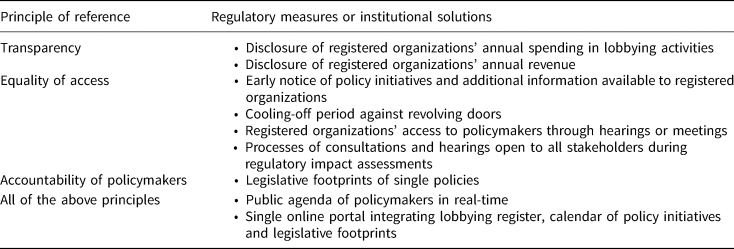
In line with our second research question, we asked our interviewees to express their support toward a series of regulatory measures or institutional solutions that could be considered connected or reflective of the three above-mentioned principles. More specifically, we discussed the items collected in Table 1.
Regulatory measures or institutional solutions discussed, reflective of specific principles

Empirical findings: the perspective of professional lobbying consultancies
As explained in the previous section, our first research question concerned the attitude of professional lobbying consultancies toward the principles of transparency, equality of access to the policymaking process, and accountability of policymakers.
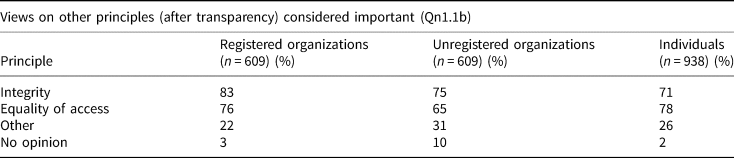
In this regard, despite the differences in context, scope, and methodology of research, we believe it can be useful to first recall the findings of the consultation conducted by the European Commission in 2016 on the EU Transparency Register (RPA, 2016), where one of the questions (Question 1.1b) was ‘It is often said that achieving appropriate lobbying regulation is not just about transparency, i.e. shedding light on the way in which lobbyists and policy-makers are operating. Which of the below other principles do you also consider important for achieving a sound framework for relations with interest representatives?’ (the European Commission then took the support for transparency for granted).
As evidenced by Table 2 (reporting the answers to that question from all the respondents) and by Table 3 (reporting the answers to that question only from professional consultancies), the support toward other principles beyond transparency is very high among the respondents to the consultation. In the case of the equality of access, support is expressed by 76% of all the organizations in the EU Transparency Register, and by 91% of professional consultancies/contract lobbyists.
Important principles in EU lobbying regulation after transparency
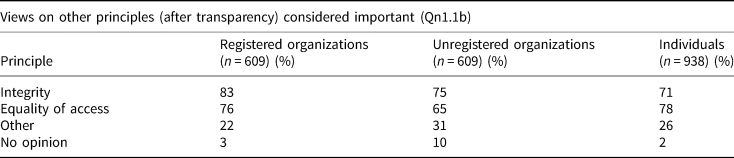
Note: Since more than one answer was possible, columns do not add up to 100%.
Source: Analysis of responses to the Open Public Consultation on the proposal for a mandatory Transparency Register. Final Report (RPA, 2016: 22).
Views on other principles (after transparency) considered important in EU lobbying regulation by professional consultancies

Source: Dataset of the responses to the Open Public Consultation on the proposal for a mandatory Transparency RegisterFootnote 19.
The answers of the professional consultancies enrolled in the lobbying register of the Italian Chamber of Deputies (Table 4) appear in line with their EU counterparts. In fact, the equality of access to the policymaking process is considered important by almost the totality of the respondents (93%), with transparency (here asked about explicitly) slightly behind (86%), while the accountability of policymakers is considered important by all the respondents (100%).
Views on principles considered important in lobbying regulation by professional consultancies enrolled in the lobbying register of the Italian Chamber of Deputies

Note: All the data come from the survey designed and conducted by the authors.
The sheer numbers attest how the conceptual framework developed here, highlighting the relevance of other principles beyond transparency in lobbying regulation, not only makes sense, but is strongly supported by those who are among the main targets of lobbying regulations, that is, professional lobbying consultancies/contract lobbyists.
Despite the huge attention that is generally given to transparency (see the literature recalled in section ‘The literature on lobbying regulation’), out of the three principles transparency is the (relatively) least supported one, while even total agreement was registered on the accountability of policymakers.
In the qualitative part of the interviews, relying on the follow-up questions and the probes, we could also better understand the reasons behind. In fact, transparency is valued in broad terms and especially for reputational reasons, but is deemed by many interviewees as a principle whose implementation might be easily bypassed, whose integral application could present various contraindications, or that is supported only as long as it applies to all the players involved in policymaking (all types of lobbyists and policymakers):
‘requiring to disclose every detail of what happens in the premises of the Parliament simply means to make everything bureaucratically burdensome for us and the policymakers, while the ill-intentioned will just meet outside and do what they want without problems’ (interviewee No. 4);
‘I am very supportive of transparency, and I'm willing to disclose all of my activities, but of course it needs to cover everybody in the same way, or it would result in a disadvantage for the few that really disclose everything’ (interviewee No. 11);
‘Transparency is crucial for lobbying, but not in the way it is meant to be. People think that transparency assures a certain degree of control over the activities of lobbying, but, unfortunately, this is only partially true. Instead, on the reputational level, transparency offers us (lobbyists) the possibility to state that we are not the bad ‘corrupted’ lobbyists depicted by movies, but we are just professionals doing a job that is crucial for democracy’ (interviewee No. 8).
A contraindication of transparency recalled by a few interviewees is the same illustrated for example by Fasone and Lupo (Reference Fasone and Lupo2015), who observe how applying total transparency to some political venues might push political actors to simply change the location of ‘real’ decision-making to other venues not covered by the same principle.
The accountability of policymakers is instead seen by most respondents as the natural completion to any transparency rule applying to them (lobbyists), also for ‘systemic’ reasons having to do with the disclosure of meetings involving both players (lobbyists and policymakers).
‘It is simply just that policymakers are accountable to the public. They are the public officials, so it makes sense that they should be held accountable even more than lobbyists’ (interviewee No. 1);
‘It would be important that policymakers became more accountable to the public. Policymakers have no duty to disclose their meetings, and some of them just prefer not to reveal their contacts with some lobbyists, not because a meeting was about something illegal or inappropriate, but simply because of the bad reputation that the profession of lobbying often has. If transparency was due from both sides there wouldn't be any opacity at all, and we would all be in an easier position’ (interviewee No. 10).
The reference here is to possible divergences or ‘awkward situations’ between lobbyists and policymakers when it comes to the reporting of meetings and the arising of potential reputational issues deriving from the (generally bad) public perception of lobbying, especially in front of some ‘aggressive’ press looking for something ‘rotten’ at all costs (Mazzoni, Reference Mazzoni2013).
The issue could have been more controversial when getting to the equality of access. Indeed, some professionals might consider the ability to gain access as one of the competitive assets of their job, where ‘only the best’ end up winning. This was not the case though, as almost all interviewees highlighted how, in the words of one of them,
‘if there were more equality of access for all, we could save much of our energy focusing on the more substantial part of the job, instead of losing so much time in contacting policymakers to simply try to get a meeting’ (interviewee No. 7).
A possible explanation, in this regard, is more systemic and has to do with the type of clients that use the services of professional consultancies, and with the typical imbalances that affect traditionally neo-corporatist systems, where only some big players enjoy easy access to policymakers (business groups, labor unions, state companies, etc.), and where all the other smaller interest groups might find it much more problematic. Further research on this aspect could concern the specific market of influence in interest group systems such as the Italian one, and the role of professional lobbying consultancies in them.
Be that as it may, the interviewees' varying support toward a series of regulatory measures or institutional solutions connected or reflective of the three above-mentioned principles can shed further light on their stance on the various dimensions of lobbying regulation.
As concerns the dimension of transparency, we asked our interviewees to express their position on the potential inclusion of two specific pieces of information in the lobbying register, namely registered organizations' annual spending in lobbying activities (estimates of ranges, like in the EU Transparency Register) and annual revenue. By summing those expressing strong and mild support toward the two measures we get to around 80% of our respondents, in both cases (Table 5).
Consultancies' position on including (a) organizations' annual spending in lobbying activities and (b) organizations' annual revenue in the lobbying register

Note: All the data come from the survey designed and conducted by the authors.
However, for many respondents, the condition to fully support such measures lies once again in the application of the rule to all organizations in the same way, without any unjustified ‘discrimination’.
‘Of course, this should be applied to all organizations, and not only to consultancies: there wouldn't be any justifiable reason for different treatments here’ (interviewee No. 11)
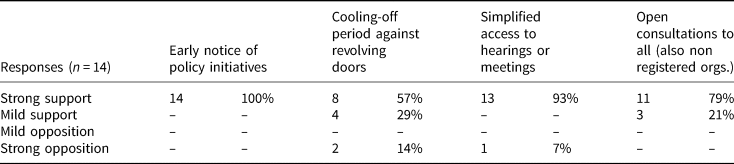
As concerns the dimension of the equality of access to the policymaking process, we asked our interviewees to express their position on four different institutional rules or practices that are generally considered to level the playing field for all lobbying actors or at least for those who choose to enroll in lobbying registers (Table 6).
Consultancies' position on various institutional rules/practices connected to the principle of equality of access to policymaking

Note: All the data come from the survey designed and conducted by the authors.
All the respondents (100%) strongly supported the idea of the early notice of policy initiatives (for instance through a mail alert sent to all organizations which have previously tagged their interest in a specific policy field) and the provision of policy-related additional information to registered organizations. This unanimity attests the great instrumental value that lobbying registers might bring with them, facilitating both lobbyists' and policymakers' activities, also representing, in the words of many of the interviewees, ‘a huge incentive to the registration itself’.
‘Our junior professionals spend much of their time monitoring the activities of the Parliament, looking for information about policies that could interest us. This is a very ‘mechanical’ work that is far from the more central activity of lobbying (providing information and different perspectives to policymakers), but we need to waste 70% of our time in doing so’ (interviewee No. 9).
More than 80% of respondents expressed support toward a cooling-off period against the practice of revolving doors, while an overwhelming majority expressed strong support for simplified access to policymakers for registered organizations through hearings or meetings and for an open process of consultations and hearings for all the stakeholders (also those not in the register) during the RIAs of laws and policies.
‘Revolving doors are a problem, definitely. Sometimes it can be very challenging to find a way to reach some policymakers, and the easier solution can be to hire former policymakers, paying them very much not because they are good lobbyists, but just for their connections’ (interviewee No. 3).
Similar stances can be found in the dimension of the accountability of policymakers (Table 7), with an overwhelming majority strongly supporting the idea of legislative footprints and other measures embodying multiple principles at the same time, such as the public agenda of policymakers in real-time or the creation of a single online portal integrating the lobbying register, the calendar of policy initiatives and the various legislative footprints.
‘It would be a dream to have such a digital portal! While some things already exist, to have everything in one place would make life quite easier for us. I'm quite skeptical we'll get there anytime soon though’ (interviewee No. 14);
‘The idea of the legislative footprint makes a lot of sense, as it brings full accountability for policymakers’ decisions. Besides, it would show how crucial the work of lobbying is in providing important information and different points of view to the policymaking process, things that policymakers need in order to make better decisions. In fact, consulting stakeholders allows policymakers to gather evidence, expertise and information (even only on the orientations of social groups or economic players) on the policy they discuss. The people need to understand that we (lobbyists) are fundamental to democracy. In legislative footprints, this would be made transparent and presented for what it is: a pluralistic democracy at work’ (interviewee No. 1).
Consultancies' position on various institutional rules/practices connected to policymakers' accountability and other open government values

Note: All the data come from the survey designed and conducted by the authors.
In conclusion, most professional lobbying consultancies enrolled in the register of the Italian Chamber of Deputies seem to strongly support the ‘opening’ of policymaking processes, considering the equality of access and the accountability of policymakers at least as important as transparency in lobbying regulation.
Conclusions
Lobbying is a complex and multi-faceted phenomenon. It involves a variety of actors, settings, rules, and practices. That is why in our contribution we adopted a wider definition of lobbying regulation, referring not only to formal legislation but also to norms and institutional practices, and focusing on policymakers as much as on lobbyists and interest groups.
After having highlighted the general predominance of the dimension of transparency in existing literature on lobbying regulation, we referred to the philosophical visions of open government and deliberative democracy to argue that other principles can be considered as well.
The principles we indicate are the fair equality of access of stakeholders to policymaking processes and the accountability of policymakers (in their public decisions). An inadequate consideration of these other principles is – we suspect – at the origin of many insufficiencies, flaws, and loopholes commonly reported in existing lobbying regulations, that often fail to pursue the ultimate goal of open, inclusive, and democratically accountable policymaking processes. Indeed, it can be difficult to tackle the most worrying risks around lobbying (regulatory capture, and undue influence of a few actors on policymaking) through regulations that pursue only the goal of transparency, as this ‘transparency mindset’ may sometimes even allow a sort of ‘adverse selection’ effect, with more stringent regulations not preventing some players to get out of the spotlight if they can, and resulting in overall more opaque lobbying environments, as pointed out by various authors (Etzioni, Reference Etzioni2010; Fasone and Lupo, Reference Fasone and Lupo2015). Moreover, problems such as regulatory capture and undue influence might be more effectively addressed through regulations shaping policymakers' accountability mechanisms and interest groups' levels of access to policymaking.
The empirical part of our study aimed to test such conceptual framework through an analysis of the perspective of a specific and relevant category of lobbyists – professional lobbying consultancies – on lobbying regulation, investigating what principles and rules/institutional practices (reflective of the various principles) can be considered most relevant in their view. The results indicate that, beyond transparency, professional lobbying consultancies enrolled in the Register of the Italian Chamber of Deputies (but similar stances have been highlighted for consultancies active in the EU context as well) strongly support (even more than transparency) the two other principles and the various regulatory measures embodying them, such as open processes of consultations and hearings on single policies (equality of access) or the legislative footprints of the various public decisions (policymakers' accountability).
These results can be relevant both to scholars aiming to assess lobbying regulations, and especially to policymakers aiming to find directions on how to design more comprehensive regulatory frameworks.
A few conclusive remarks can be added here on the limits of this study and on potential avenues for future research.
Firstly, we acknowledge that the pars destruens of this contribution somehow prevails over its pars construens, as this study highlights some limits of existing literature and regulations without proposing a new actual index or a precise set of specific indicators. However, we develop a conceptual framework that could pave the way in that direction, as the wider perspective we provide on the principles of lobbying regulation could serve as a landmark for the future construction of more comprehensive indexes, able to analyze and assess lobbying regulations according to various macro-dimensions beyond that of transparency and disclosures.
On the empirical level, a limit of our investigation is that it addresses only a specific type of actor (professional lobbying consultancies) in a specific environment (Italy, and partially the EU). That is why further research is needed to test some of our findings (for instance the strong support toward the value of equal participation) among other actors (different types of lobbyistsFootnote 20 and policymakers) and in other political systems (with different types of lobbying regulations), with extreme caution toward any temptation to generalize research results. Nonetheless, our findings may help to better refine the contours of a debate – that of lobbying regulation – that is often, in many political contexts, partial or even out of focus.
On the theoretical level, our conceptual framework is an attempt to integrate different bodies of literature (in our case those on lobbying regulation, open government, and deliberative democracy), but further integrations might be pursued with other strands of research, such as those related to better regulation frameworks, to the co-creation and the co-production of public policies, and to collective intelligence and crowdlaw.
Supplementary material
The supplementary material for this article can be found at https://doi.org/10.1017/ipo.2022.16.
Funding
This research received no specific grant from any public or private funding agency.
Conflict of interest
None.