Implications
The results obtained show that the growth trait is highly heritable in turkeys, and that birds can be selected for the growth trait as early as 12 weeks of age; it is also shown that random regression (RR) models are interesting models for studying such longitudinal data. Until now, in turkey only egg production has been analysed using RR, and as very limited information is currently available on turkey growth it could be interesting to use RR to study live body weight (BW). Furthermore, the use of RR maximises the cost-effectiveness of selection because it provides an opportunity to identify the optimum points for recording. Although BW is one of the important traits, breeding objectives should include all important traits. Consequently, before constructing a selection index for BW, there is a need to evaluate the genetic correlations between BW and the other traits under selection, that is, there is possibly a negative genetic correlation between growth and reproductive traits.
Introduction
To increase the profitability of producers, the main selection objective for most genetic programmes of turkeys is to produce birds that have high body weight (BW) at slaughtering (20 to 24 weeks of age). BW and its variation over time are affected by many processes and determined by various effects of genes depending on the age of individuals. Consequently, the genetic evaluation for growth trait can be based on the live weights measured at different standard ages during the growth period. Increases in the number of weights recorded per animal do not allow for the use of a multiple-trait (MT) model to analyse the traits because of the high number of parameters to estimate. Several models can be used to take into account the correlations between the different repeated measurements over time performed on the same animal but with a reduction of the number of parameters to be estimated: the structured antedependence model, which defines the observation at time t as a function of the previous observation (Jaffrezic et al., Reference Jaffrezic, Venot, Laloe, Vinet and Renand2004); the character process model, which focuses on modelling the covariance functions themselves (Pletcher and Geyer, Reference Pletcher and Geyer1999); and the RR model, which attempts to model the shapes of the functions of time for each component of the phenotype (mean, genetic additive value, permanent environment; Henderson, Reference Henderson1982). The RR has been considered by several authors as the most appropriate model for studying repeated measurements (Van Der Werf et al., Reference Van Der Werf, Goddard and Meyer1998). At present, it has been widely used for genetic estimations of longitudinal data in various species, for example in dairy cattle (DeGroot et al., Reference DeGroot, Keown, Van Vleck and Kachman2007), rainbow trout (McKay et al., Reference McKay, Schaeffer and McMillan2002), pigs (Huisman et al., Reference Huisman, Veerkamp and Van Arendonk2002) and sheep (Huisman et al., Reference Huisman, Veerkamp and Van Arendonk2002; Molina et al., Reference Molina, Menendez-Buxadera, Valera and Serradilla2007). In birds, the use of RR to estimate the genetic parameters of the growth trait is much more limited (Banos et al., Reference Banos, Avendaño and Olori2006; Tholon and Queiroz, Reference Tholon and Queiroz2006; Kranis et al., Reference Kranis, Su, Sorensen and Woolliams2007). Consequently, the objective of this study was to investigate the use of RR for the genetic analysis of BW in turkeys to estimate the relevant genetic parameters throughout the growth period.
Material and methods
Animal management
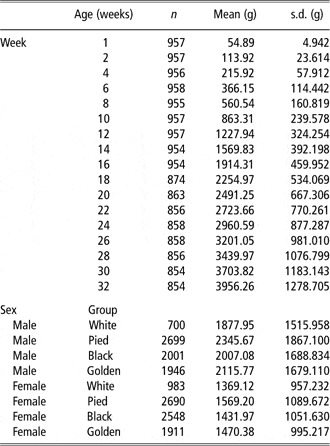
This study was based on a research turkey population. Animals were bred at the breeding station of indigenous turkeys located at Tatar, East Azerbaijan. After hatching, at 1-week of age, turkey chicks were allocated to four groups based on the colour of feathers (contemporary group). These groups included white, pied, black and golden colours. All birds were fed ad libitum until 2 months of age. Water was freely available to the chicks. Birds were kept in closed barns with concrete floors and controlled lighting (16 h/day). From 2 months to 32 weeks of age, birds were kept in individual cages. The dietary recommendation based on National Research Council (1994) was adjusted. Individual cages had hand-feeding supplies and nipple-water suppliers. Birds did not undergo a vaccination programme as the Tatar research station is located in an isolated region. The environmental temperature was maintained at 30°C to 32°C during the first week, and then was decreased gradually with the age of the birds at the rate of 3°C/week. From 12 weeks of age, the temperature was kept constant at 14°C to 17°C. The average survival rate for birds was approximately 88% at 32 weeks. Phenotypic evolution of the weight with age and mean weight by sex and contemporary group are given in Table 1.
Number of records, mean and s.d. for Turkey body weight at each week, sex and contemporary group levels

Genetic analysis
The pedigree consisted of 1520 individuals. Data consisted of 15 478 individual BW from 957 turkeys recorded at the first week of life and between weeks 2 and 32 by 2-week intervals. Before weighing, birds were fasted off feed for 4 to 5 h. All birds were weighed at appropriate weeks based on their hatching date. Two hatching dates accounted for all the birds of the population. In a first step of the analysis, the least square means method with the GLM procedure (SAS version 9.1, SAS institute Inc., Cary, NC, USA) was used to select the fixed effects affecting growth traits. The effects of age × sex and contemporary group were significant (P < 0.01). In a second step of the analysis, five models including the selected fixed effects and genetic effects were compared to determine which was the most appropriate for studying growth traits. In all models, the sex-specific pattern of animal growth over time was modelled using a cubic smoothing spline with knots at the first week of life and then 2-week intervals from weeks 2 to 32. Models differ in the way genetic and permanent environmental effects are included. The first four models are all sub-models of the following global model:

where y is the vector of observations, β is the vector of fixed effect (contemporary group) with the incidence matrix X, s is the vector of female (sf) and male (sm) overall spline parameters with length 2 × 15 and covariance matrix  with the incidence matrix Zs, u is the vector of direct genetic intercept (u1) and slope (u2) breeding value parameters for each animal in the pedigree with covariance matrix
 and incidence matrix Zu where A is the relationship matrix and ⊗ represents the Kronecker product, p is the vector of permanent environmental intercept (p1) and slope (p2) with covariance matrix
 with the incidence matrix W.
 is the vector of homogeneous random iid residuals.
Model 1 is a simple repeatability model, in which the global model includes the following constraints:  .
Model 2 only considers the slope for the direct genetic effect, that is, the global model with the following constraints:  .
Model 3 only considers the slope for the permanent effect, that is, the global model with the following constraints:  .
Model 4 is the global model.
To take into account the hypothetical influence of maternal effects on growth during the first weeks of life, model 5 included the maternal genetic effects in the global model over the 12 first weeks of life:  , where notations are the same as in the global model and m is the vector of maternal genetic effect: m1 for the 0 to 12-week period and m2 for the 12 to 32-week period with variance
 , Zm is the corresponding incidence matrix.
We also tried to fit three other models, all derived from the global model, considering a quadratic form for the permanent effect, direct genetic effect or both. None of these models reached convergence.
All data were analysed using the ASReml package version 2.0 (Gilmour et al., Reference Gilmour, Gogel, Cullis and Thompson2006).
Nested models were compared using the likelihood-ratio tests (only models 2 and 3 were not nested).
Heritability was estimated at each age as follows:
 and
 for models 1 to 4 and model 5 after 12 weeks and
 for model 5 during the 0 to 12-week period.
Approximate standard errors of heritability and genetic correlations were estimated using inverse of the average information matrix in Asreml.
Furthermore, to compare the results obtained with the RR models, BW at some ages were analysed using an MT model. The weight analysed included five blocks of multivariate traits as follows: block 1 – weeks 1, 2, 4, 6, 8 and 10; block 2 – weeks 8, 10, 12 and 16; block 3 – weeks 16, 18, 20, 22 and 24; block 4 – weeks 22, 24, 26, 28, 30 and 32; and block 5 (MT) – weeks 1, 2, 6, 16, 20 and 32. The direct additive genetic effect was included as the random effect, and the contemporary group and sex as fixed effects at each age. Models with more than six traits failed to converge.
Results and discussion
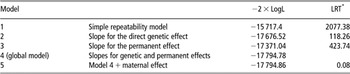
Model comparison indicated that the most parsimonious model that best fits the data is model 4 (Table 2). The fit improves significantly at each step from models 1 to 4, (models 1, 2 and 4 or models 1, 3 and 4, as models 2 and 3 were not nested). In contrast, the likelihood did not improve from models 4 to 5, indicating that there are no significant maternal effects. The relative influence of maternal effects is generally moderate in poultry. In turkeys, environmental maternal effects represented < 5.2% to 8% of the total variance of BW at 12 and 16 weeks of age, depending on the strains tested (Chapuis et al., Reference Chapuis, Tixier-Boichard, Delabrosse and Ducrocq1996). This result, in addition to the particularities of our pedigree (65% of the 334 dams were of unknown parents), may explain why we were not able to evidence any maternal effects. In our study, efforts to fit a polynomial quadratic led to failure to converge. Convergence problems while estimating variance components with RR have been mentioned previously (Anang et al., Reference Anang, Mielenz and Schuler2002).
LogL and LRT comparing different models with model 4

LogL = log likelihood values; LRT = likelihood-ratio test.
*value of the LRT in comparison with model 4.
Heritability
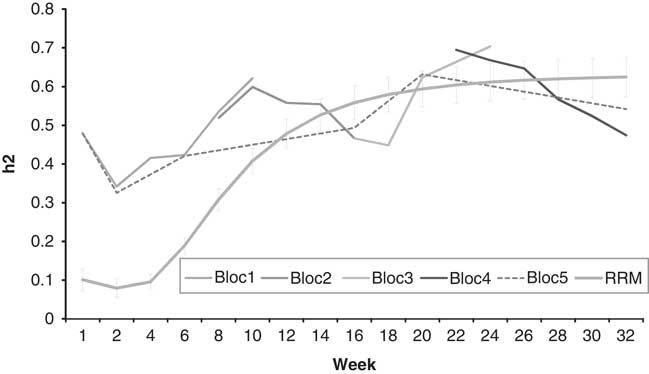
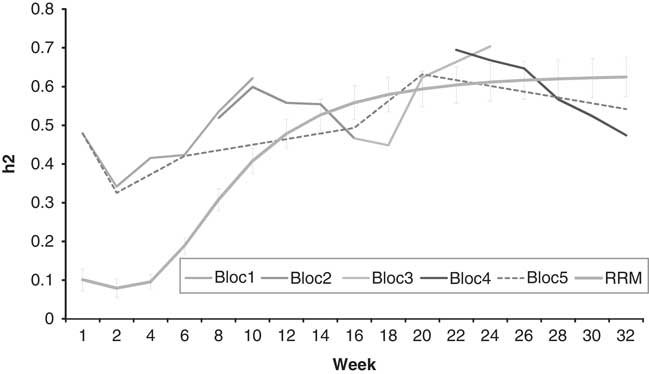
The estimates of heritability obtained with the global model are presented in Figure 1. Heritability increased over the trajectory and peaked at 0.60 around 20 to 32 weeks of age. The same trend (increasing heritability with age) has been reported in other bird species (Muscovy duck (Hu et al., Reference Hu, Poivey, Rouvier, Wang and Tai1999); partridges (Tholon and Queiroz, Reference Tholon and Queiroz2006)) and in mammals (wild ungulate; Wilson et al., Reference Wilson, Kruuk and Coltman2005). Nevertheless, the comparison of these results with those obtained with MT models suggest that the heritabilities found at the lowest ages (<10 weeks) with the RR are underestimated and therefore this trend should be overestimated. In fact, the heritabilities obtained at 10 weeks were in the same range with the two types of models, whereas they were much lower (on average three times less) with the RR than with the MT (block 5) model before 10 weeks. However, none of the MT models used the overall data set to estimate parameters. It should be noted that the standard errors for heritability estimates were lower for the first part of the trajectory and higher towards the end of the trajectory than those published by Fischer et al. (Reference Fischer, Gilmour and Van der Werf2004a). The published estimates for the heritability of BW in turkeys did not cover the period after 24 weeks of age. For example, Nestor et al. (Reference Nestor, McCartney and Harvey1967) summarised heritability estimates of BW as ranging from 0.36 to 0.42 in the different age groups from 0 to 24 weeks of age. Case et al. (Reference Case, Miller and Wood2010) reported values of 0.35 ± 0.02 for the heritability of BW at 15 weeks with the bivariate method. Chapuis et al. (Reference Chapuis, Tixier-Boichard, Delabrosse and Ducrocq1996) reported heritability estimates of 0.77 for female BW and 0.68 for male BW at 16 weeks of age. In the study by Nestor et al. (Reference Nestor, Anderson, Patterson and Velleman2006), the realised heritability of 16-week BW was 0.202, 0.130 and 0.166 for males, females and both sexes, respectively, during the last generations of selection. In addition, in other bird species such as chickens and Muscovy ducks, heritability of growth traits appears to be moderate or high (Mignon-Grasteau et al., Reference Mignon-Grasteau, Beaumont, Poivey and de Rochambeau1998). However, lower estimates of heritability were obtained with RR for the early ages of European quail, that is, 0.018, 0.001 and 0.012 at 1, 7 and 14 weeks of age, respectively (DioneIlo et al., Reference DioneIlo, Silva and Correa2006). Therefore, they did not recommend the selection of European quail for BW during the first 3 months of age.
Estimation of the heritability of turkey body weight performed week by week using random regression (RR) models and multiple-trait models (ages in weeks: block 1 – 1, 2, 4, 6, 8 and 10 weeks; block 2 – 8, 10, 12, 14 and 16 weeks; block 3 – 16, 18, 20, 22 and 24 weeks; block 4 – 22, 24, 26, 28, 30 and 32 weeks; and block 5 – 1, 2, 6, 16, 20 and 32 weeks).
Correlations
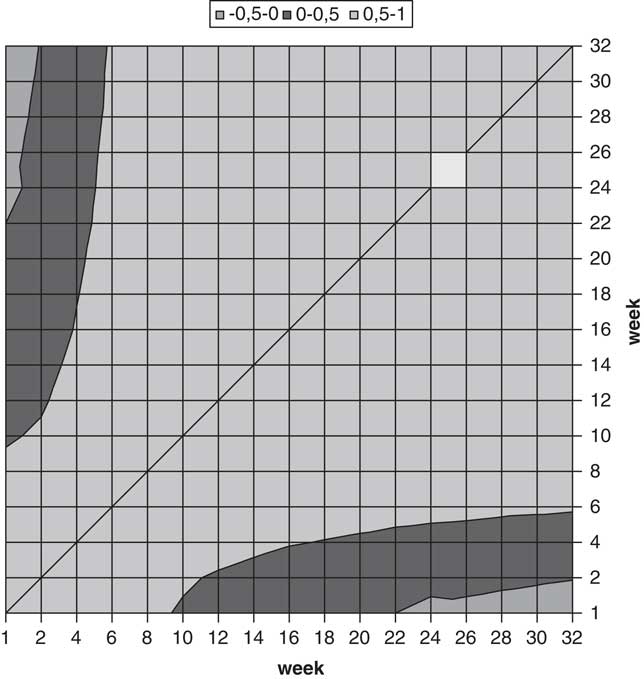
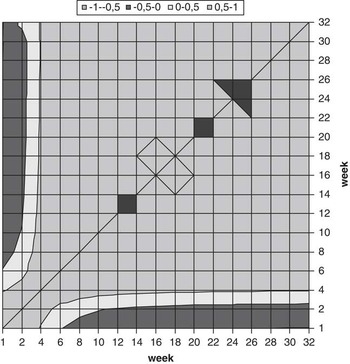
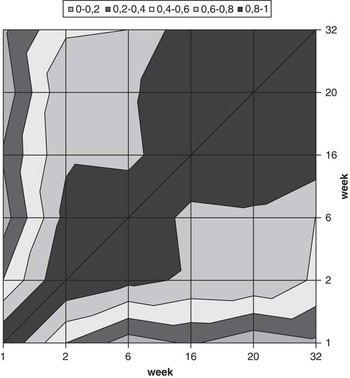
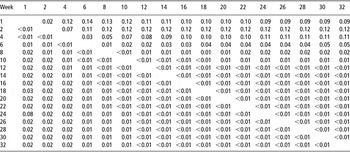
Phenotypic and genetic correlation estimates for BW from 1 to 32 weeks of age by RR and MT (block 5) are presented in Figures 2, 3 and 4, respectively. Standard errors for these estimates with RR are shown in Table 3. In general, genetic and phenotypic correlation estimates were higher between adjacent ages, and decreased markedly with the increase of distance between ages. These results indicate that all growth measurements for ages over 12 weeks correspond to the same trait (correlations of >0.99 in all cases). This trait is different from the growth traits at younger ages. Traits in younger ages also differ from each other, especially at the lowest ages (for instance, the correlation between growth traits at 2 and 4 weeks is 0.70). In other studies, it has been shown that the genetic control of weight at initial ages is different from that observed at later ages (Fischer et al., Reference Fischer, Van der Werf, Banks and Ball2004b; Wilson et al., Reference Wilson, Kruuk and Coltman2005; Szwaczkowski et al., Reference Szwaczkowski, Stanislaw, Stanislawska-Barczak, Badowski, Bielinska and Wolc2007; Costa et al., Reference Costa, De Melo Rodrigues, Packer, Ferreira de Freitas, Teixeira and Cobuci2008; El Faro et al., Reference El Faro, Cardoso and Albuquerque2008; Oliveira et al., Reference Oliveira, Lobo and Faco2010). The genetic correlations of BW measured between 14 and 24 weeks estimated with the multivariate method were 0.89 and 0.97 in US and UK turkey populations, respectively (Kranis et al., Reference Kranis, Hocking, Hill and Woolliams2006). These values are slightly lower than the one reported in this study (0.99 ± 0.002; Figure 3). Kranis et al. (Reference Kranis, Hocking, Hill and Woolliams2006) concluded that as the genetic correlations of turkey BW were all close to 1, it is possible to select for BW at as early as 14 weeks of age. However, our current data are in support of selection for BW even earlier at 12 weeks of age. As shown in Figure 3, negative genetic correlations were observed between 1 and >8 weeks of age, as well as between 2 and >12 weeks of age. The presence of negative additive genetic covariance between early-age and later BW traits is a little surprising, especially as the correlations obtained with the MT model between the same age groups are low but not negative (Figure 4) and no such results have been reported elsewhere. This result maybe due to the constraints of the RR, which can induce bias in the estimation as it seems to be the case for genetic variances at early ages. Similar issues have been reported when other traits are studied (test-day milk yield) using the RR (El Faro et al., Reference El Faro, Cardoso and Albuquerque2008).
Phenotypic correlation estimates for turkey body weight as a function of age from 1 to 32 weeks of age using random regression models.
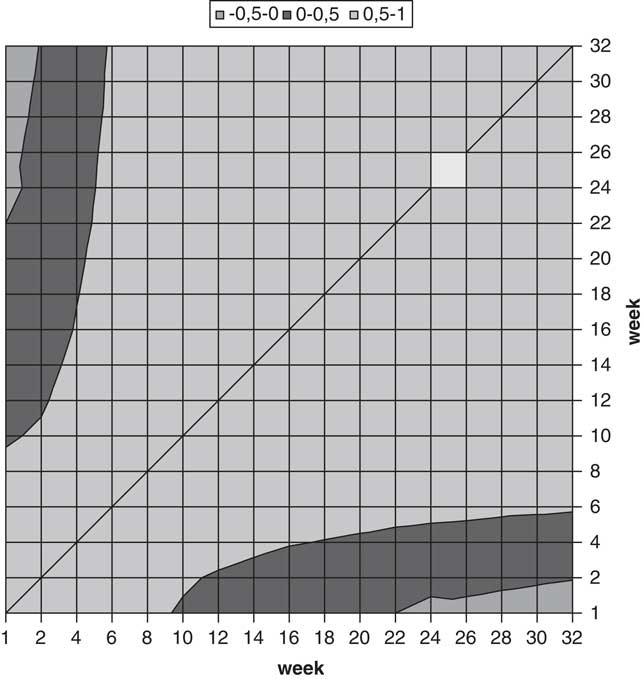
Genetic correlation estimates for turkey body weight as a function of age from 1 to 32 weeks of age using random regression models.

Genetic correlation estimates for turkey body weight using the multi-trait model with six traits at 1, 2, 6, 16, 20 and 32 weeks of age.

Standard error of genetic correlations (above diagonal) and of phenotypic correlations (below diagonal) using random regression model

In other species, RR has been used to estimate the genetic parameters of growth and egg production in quail (Akbas et al., Reference Akbas, Takma and Yaylak2004; DioneIlo et al., Reference DioneIlo, Silva and Correa2006), laying hens (Anang et al., Reference Anang, Mielenz and Schuler2002) and broiler chicken (Banos et al., Reference Banos, Avendaño and Olori2006; Wolc et al., Reference Wolc, White, Olori and Hill2009). Kranis et al. (Reference Kranis, Su, Sorensen and Woolliams2007) fitted RR for egg production in turkeys and illustrated that the use of RR for genetic analysis offered greater accuracy for prediction. Other published studies used a more traditional approach to modelling the repeated records of BW over time in turkeys (Nestor et al., Reference Nestor, Anderson and Patterson2000; Kranis et al., Reference Kranis, Hocking, Hill and Woolliams2006; Nestor et al., Reference Nestor, Anderson, Patterson and Velleman2008). The advantages of RR over traditional approaches include the ability to allow for easy interpolation between the ages at which recordings occurred, accurate prediction of selection responses and more efficient use of the data (Kirkpatrick and Heckman, Reference Kirkpatrick and Heckman1989; Albuquerque and Meyer, Reference Albuquerque and Meyer2001). Misztal (Reference Misztal2006) compared MT and RR models and concluded that RR was more accurate than repeatability or MT models. Huisman et al. (Reference Huisman, Veerkamp and Van Arendonk2002) obtained better results with RR in comparison with the traditional multivariate model. Fischer et al. (Reference Fischer, Van der Werf, Banks and Ball2004b) proposed that RR could be a good alternative to MT genetic analysis. Kranis et al. (Reference Kranis, Su, Sorensen and Woolliams2007) compared genetic parameter estimates using RR and MT models for egg production in turkeys and concluded that both models were equally effective to describe the dynamics of genetic variance over time. Nevertheless, as mentioned previously, the multivariate animal model showed convergence problems when more than six traits were included. However, our aim was not to perform an extensive comparison of the MT and RR methods.
In conclusion, in order to increase the growth rate of turkeys, birds could be selected at an earlier time point than the previously published 14 weeks of age. In other words, BW measurements up to 12 weeks of age would be sufficient for growth trait. This study investigated the use of RR for the genetic analysis of BW in turkeys. The RR models for BW in turkeys allow reasonable adjustment of data and an efficient use of available information. During the selection process of meat turkeys, it should be considered that growth at early ages is under the genetic control of different genes when compared with growth at older ages.
Acknowledgement
SAR thanks A. Gilmour for his help in the construction of the primary model for analysis. The authors are grateful to the anonymous reviewers for their helpful comments.