An outbreak of pneumonia-like illness due to a novel coronavirus named severe acute respiratory syndrome coronavirus 2 (SARS-CoV-2) appeared in Wuhan, China, in December 2019.Reference Lai, Wang, Wang, Hsueh, Ko and Hsueh1 The virus spread all over China and the world in a short period of time, and coronavirus disease 2019 (COVID-19) outbreak was declared as a pandemic on 11 March 2020 by World Health Organization.Reference Park2
The hallmark of this novel infection was acute respiratory distress syndrome, but then involvement of various systems has been reported in adults.Reference Huang, Wang and Li3,Reference Henry, Benoit and de Oliveira4 Initially, children were thought to be affected less severely than adults as they presented with milder symptoms compared to adults. The most common symptoms in children at admission were fever, sore throat, fatigue, nasal congestion, headache, cough, and gastrointestinal symptoms.Reference Cantarutti, Battista and Adorisio5–Reference Liguoro, Pilotto and Bonanni8 But later on, previously healthy children with a history of SARS-CoV-2 infection presented with multiple organ involvement and myocardial dysfunction. This severe systemic hyper-inflammation linked with SARS-CoV-2 infection was named multisystem inflammatory syndrome in children.Reference Cantarutti, Battista and Adorisio5,Reference Riphagen, Gomez, Gonzalez-Martinez, Wilkinson and Theocharis9 Although cardiac involvement is an important and troublesome component of the multisystem inflammatory syndrome in children, haemodynamically significant cardiac involvement during acute SARS-CoV-2 infection in children is rare.
Laboratory parameters and the utility of extended laboratory panels have been extensively studied in adults with COVID-19.Reference Ponsford, Burton and Smith10–Reference Parsons, Parsons and Balme12 One of the most extensively studied laboratory parameters in adults is cardiac biomarkers. Most studies in adults have reported significantly higher troponin levels in critically ill patients and proposed troponin as a predictor of poor outcome.Reference Imazio, Klingel and Kindermann13,Reference Demir, Ryan and Cirillo14 Although troponin has been extensively studied in the adult population, data about the role of troponin in children with COVID-19 are lacking.
While less was known about this novel disease and there were not any published guidelines in the early phases of the pandemic, institutions constituted their own policies. In our institution besides other laboratory parameters, high-sensitivity troponin T was routinely screened in all patients with a confirmed SARS-CoV-2 infection regardless of signs suggesting cardiac involvement from the beginning of the pandemics to 15 August 2020. After that date, we abandoned the routine troponin T screening since there was no clear benefit. In this retrospective study, we aimed to evaluate the efficacy and role of high-sensitivity troponin T in children with a confirmed SARS-CoV-2 infection.
Materials and methods
All of the children that were admitted to Ankara University Medical Faculty Pediatric Emergency Department and diagnosed as COVID-19 till the date of 15 August 2020 were evaluated retrospectively. The children whose nasal and pharyngeal swab specimens tested positive for SARS-CoV-2 nucleic acid by using real-time reverse-transcriptase polymerase chain reaction assay were diagnosed as COVID-19. Children with a known specific cardiac disease, any chronic diseases, any morbidity, using any specific medication, and diagnosed as multisystem inflammatory syndrome in children were excluded. The local ethics committee of Ankara University approved the study. (Date/No: 06.05.2021/i4-274-21).
The age, gender, and symptoms of all patients (fever, cough, dyspnoea, chest pain, palpitation, myalgia, diarrhoea, headache, fatigue, anosmia, dysgeusia, sore throat, arthralgia, nasal discharge, hoarseness, conjunctivitis, seizures) on admission were reviewed.
The laboratory data included C-reactive protein, high-sensitivity troponin T, and N-terminal pro-brain natriuretic peptide levels of patients with troponin positivity. Troponin T levels were measured in all patients within the first 24 hours of admission. The cut-off levels for high-sensitivity troponin T and C-reactive protein are 0.014 ng/ml and 5 mg/L in our institution, respectively. All of the patients with elevated troponin levels were also evaluated by a paediatric cardiologist. Electrocardiography and transthoracic echocardiography were performed on all patients with troponin positivity. N-terminal pro-brain natriuretic peptide levels of all patients with troponin positivity were also measured. The patients were classified into two groups according to troponin positivity and then were compared in means of symptoms. The correlation of troponin T levels with symptoms and echocardiographic findings were analysed.
Statistical analyses were performed by the SPSS 20.0 statistical package (IBM Corp., Armonk, NY, USA). Mean ± standard deviation, median (min−max), and percentage were used for descriptive statistics. The compatibility of the data to normal distribution was evaluated using the Shapiro−Wilk test. Intergroup evaluation of categorical variables was made using Pearson’s chi-square test. The correlations between parameters were evaluated using Spearman’s correlation analysis. The level of statistical significance was determined as p < 0.05.
Results
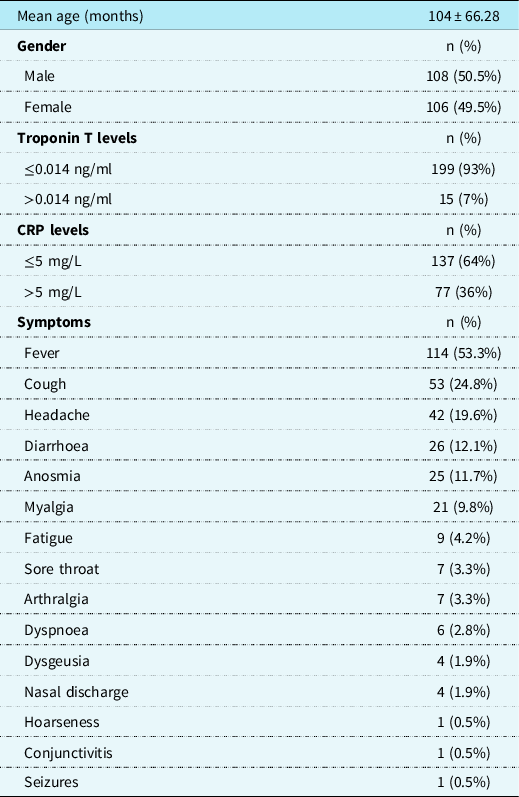
A total of 214 children with a confirmed SARS-CoV-2 infection were enrolled in this study. The demographic data, laboratory parameters, and symptoms of all patients are shown in Table 1. The youngest patient was 2 months old (range: 2–252 months). Forty-six (21.5%) of 214 patients were asymptomatic, and the COVID-19 polymerase chain reaction test was performed because of exposure to a COVID-19 case. The most common symptoms were fever, cough, and headache. None of the patients had any cardiac symptoms such as tachycardia without fever, chest pain, or palpitation, and no cardiac symptom or sign occurred during the follow-up period.
Demographic data, clinical symptoms, and laboratory parameters of the patients.

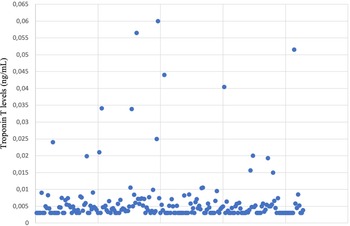
Troponin T levels were elevated in 15 (7%) patients. The mean duration of follow-up for patients with troponin positivity was 7.3 ± 3.19 months. Troponin levels showed a downfall trend in all of the patients except three of them in the second control. At the third control, all of the patients showed a downfall trend. The distribution of troponin levels of all patients is shown in Figure 1. The median age of troponin positive patients was 3 months (min: 2 – max: 204 months). The median age of troponin negative patients was 108 months (min: 3 – max: 252 months). Nine of the patients with troponin positivity were under the age of 12 months, whereas 6 were older than 12 months old. Troponin T positivity was significantly higher in patients under the age of 12 months (p < 0.001), and troponin T levels were negatively correlated with age. The N-terminal pro-brain natriuretic peptide levels of all patients with troponin positivity were within the normal range. The echocardiographic evaluation of all patients with troponin positivity was also normal, and there were not any electrocardiographic changes except sinus tachycardia which was attributed to the fever of the patient.
Distribution of troponin T levels of the patients.

Only one of the patients with troponin positivity was an asymptomatic patient who admitted due to COVID-19 exposure. The most common symptom in patients with troponin positivity was also fever which was observed in 11/15 of the patients. Dyspnoea and conjunctivitis were more commonly observed in patients with troponin positivity. The comparison of symptoms according to the troponin positivity is shown in Table 2.
Comparison of symptoms according to the troponin T positivity.

Pearson’s chi-square test
* p < 0.05
C-reactive protein levels were elevated in 77 (36%) of the patients in the whole group and 7 (46.7%) of 15 patients with troponin positivity. There was no significant difference between the groups in means of C-reactive protein levels.
Discussion
COVID-19 turned into a pandemic in a very short period of time and had devastating effects all over the world. By October 2021, there have been more than 200 million confirmed cases and more than 4 million cumulative deaths due to this novel disease.15
The clinical manifestations of children with COVID-19 are less severe than the adults and children present with milder or non-specific symptoms. Because of this in the early days of the pandemics, children were considered to be less affected by the disease, but later on, in children, a severe systemic hyper-inflammation syndrome presenting with multiple organ involvement was defined.Reference Cantarutti, Battista and Adorisio5,Reference Riphagen, Gomez, Gonzalez-Martinez, Wilkinson and Theocharis9 Gullu et alReference Gullu, Gungor, Ipek, Yurttutan and Dilber16 evaluated 320 children diagnosed as COVID-19 or multisystem inflammatory syndrome in children. This study included only five patients diagnosed as multisystem inflammatory syndrome in children, and the rate of asymptomatic patients was 9.4%. Fever (58.1%) and cough (29.7%) followed by sore throat and fatigue were the most common symptoms in this study. Another study evaluating children with SARS-CoV-2 infection, excluding patients diagnosed as multisystem inflammatory syndrome in children, reported the rate of asymptomatic infection in children as 15.8% and the most common symptoms as cough (48.5%), pharyngeal erythema (46.2%), and fever (41.5%).Reference Lu, Zhang and Du7 Liguoro et alReference Liguoro, Pilotto and Bonanni8 carried out a systematic review of 65 articles evaluating a total of 7480 children with SARS-CoV-2 infection and reported the most frequent symptoms as fever (51.6%) and cough (47.3%). The rate of asymptomatic patients in this study was around 20%. The rate of asymptomatic children was 21.5% in our study, and similar to the previous reports, the most common symptoms were fever (53.3%) and cough (24.8%). The most common symptom in patients with troponin positivity was also fever which was observed in 11/15 of the patients. Dyspnoea and conjunctivitis were more commonly observed in patients with troponin positivity.
As previously stated, the progression of SARS-CoV-2 infection is more severe and involvement of other systems is more common in adults. Laboratory parameters and the utility of extended laboratory panels have been extensively studied in adults with COVID-19 to understand the course of the disease and to find the predictors of outcome.Reference Ponsford, Burton and Smith10–Reference Parsons, Parsons and Balme12 Cardiac biomarkers have been extensively studied in adults because cardiac involvement is a common and serious complication of COVID-19 in adults.
Even though mechanisms of cardiac injury/involvement in patients with COVID-19 and multisystem inflammatory syndrome have been proposed, the exact pathogenesis is not clear.Reference Kim and Aronow17 The rate of acute myocardial injury in adults during COVID-19 was reported as 12%, being more frequent in severe disease.Reference Huang, Wang and Li3 Guo et alReference Guo, Fan and Chen18 reported that 27.8% of adult patients with COVID-19 had a myocardial injury which eventually lead to cardiac dysfunction and arrhythmias. Another meta-analysis reported the rate of cardiac involvement in adults with COVID-19 as 15% and also reported 4.74 times higher risk of having an acute cardiac injury in severe patients.Reference Vakhshoori, Heidarpour, Shafie, Taheri, Rezaei and Sarrafzadegan19 The frequency of troponin positivity was 13% in this study, and troponin levels were significantly higher in deceased subjects.Reference Vakhshoori, Heidarpour, Shafie, Taheri, Rezaei and Sarrafzadegan19 Moutchia et alReference Moutchia, Pokharel and Kerri20 also reported that troponin I levels were significantly higher in adult patients with severe COVID-19 and critically ill patients.
Although the role of troponin in this novel disease has been extensively studied in the adult population and troponin has been proposed as a predictor of the outcome, its role in paediatric COVID-19 is still unclear.Reference Ponsford, Burton and Smith10,Reference Kim and Aronow17,Reference Vakhshoori, Heidarpour, Shafie, Taheri, Rezaei and Sarrafzadegan19–Reference Stefanini, Chiarito and Ferrante21 Henry et alReference Henry, Benoit and de Oliveira4 performed a pooled analysis of laboratory abnormalities in children with COVID-19 and reported that creatine kinase-MB levels were increased in 1/3 of mild paediatric cases and suggested that cardiac troponins should be closely monitored in hospitalised children with COVID-19. Gullu et alReference Gullu, Gungor, Ipek, Yurttutan and Dilber16 evaluated the predictive value of cardiac markers in the prognosis of paediatric COVID-19 and reported that cardiac biomarkers could predict related morbidity and mortality. But in this study, 4 of the five patients diagnosed as multisystem inflammatory syndrome in children had previous CHDs that may affect the N-terminal pro-brain natriuretic peptide and troponin levels such as hypertrophic cardiomyopathy, coarctation of the aorta, ventricular septal defect, and pulmonary hypertension. In this study, cardiac biomarkers were significantly higher in patients diagnosed as multisystem inflammatory syndrome in children as expected. Most of the studies about the role and predictive value of the troponin in children with SARS-CoV-2 infection also include the patients diagnosed as multisystem inflammatory syndrome in children. In contrast to this, patients diagnosed as multisystem inflammatory syndrome in children were excluded from our study and we aimed to evaluate the role of troponin in previously healthy children just diagnosed as COVID-19. Troponin was positive in 7% of the patients, and most of the patients with troponin positivity were under the age of 1 year old. None of the patients with troponin positivity had echocardiographic or electrocardiographic abnormalities and N-terminal pro-brain natriuretic peptide levels of all patients were within the normal range. Cantarutti et alReference Cantarutti, Battista and Adorisio5 evaluated 294 children with active or previous SARS-CoV-2 infection including 46 patients diagnosed as multisystem inflammatory syndrome in children. When the patients with the multisystem inflammatory syndrome in children were excluded, N-terminal pro-brain natriuretic peptide and high-sensitivity troponin T levels were elevated in 8 and 2% of the patients, respectively. Electrocardiographic and echocardiographic abnormalities were detected in 18 and 5% of the same group of patients. The ratio of patients with elevated N-terminal pro-brain natriuretic peptide (83%) and high-sensitivity troponin T (63%) was significantly higher in patients diagnosed as multisystem inflammatory syndrome in children, as expected. Another study reported the rate of troponin positivity as 22% in a group of children diagnosed as COVID-19 and multisystem inflammatory syndrome in children, but in the same study troponin levels of all the children hospitalised because of mild COVID-19 were within the normal range.Reference Ben-Shimol, Livni and Megged22 Unfortunately, we were not able to evaluate the correlation between troponin positivity and hospitalisation, because in the early days of the pandemics in our institution most of the patients with COVID-19 were hospitalised irrespective of the severity of the disease even just for providing isolation but during the follow-up period none of these patients were diagnosed as multisystem inflammatory syndrome in children or none had a cardiac abnormality.
Troponin and CK-MB are widely used markers for detecting myocardial damage. These markers along with other laboratory parameters have been suggested to correlate with the severity of the disease both in adult and children with SARS-CoV-2 infection. This novel infection has a milder course in previously healthy children in comparison to adults except for multisystem inflammatory syndrome in children. The elevation and predictive value of cardiac markers in patients with the multisystem inflammatory syndrome in children are sensible but we believe that elevation in cardiac troponin during paediatric COVID-19 is not solely specific to SARS-CoV-2 infection and because of that its prognostic value in paediatric COVID-19 is limited. Although troponin elevation has been widely reported during COVID-19, it is still controversial whether it is due to indirect myocardial injury, myocarditis, or myocardial inflammation.Reference Imazio, Klingel and Kindermann13 A similar phenomenon existed during the 2009 pandemic, and elevation of cardiac biomarkers had been reported in adult patients with influenza A (H1N1) infection.Reference Ni, Guo and Chen23,Reference Pizzini, Burkert, Theurl, Weiss and Bellmann-Weiler24 Troponin is a strong and specific indicator of myocardial damage but it may also be elevated in other non-cardiac disorders.Reference Vakhshoori, Heidarpour, Shafie, Taheri, Rezaei and Sarrafzadegan19 Acute respiratory distress syndrome, mechanical ventilation, hypoxia, systemic inflammation, thrombosis, sepsis, and even tachycardia alone can increase blood troponin levels.Reference Kim and Aronow17,Reference Vakhshoori, Heidarpour, Shafie, Taheri, Rezaei and Sarrafzadegan19 Five of the patients with troponin elevation were around the age of 3 months old, and the other 4 were around the age of 2 months old. This may be explained by the natural tendency of infants to develop systemic reactions to infections. Also, none of our patients had any echocardiographic or electrocardiographic abnormality except sinus tachycardia which was attributed to the fever of the patient, and N-terminal pro-brain natriuretic peptide levels of all the patients with troponin positivity were within the normal range. Similar to our findings suggestive of indirect injury rather than myocarditis, Myhre et alReference Myhre, Prebensen, Jonassen, Berdal and Omland25 reported that adult patients with SARS-CoV-2 viraemia did not have higher concentrations of cardiovascular biomarkers. They also did not find an association between viraemia and troponin and suggested that myocardial injury in COVID-19 is indirect.
Herein, another important question is that “What should be considered as an elevated troponin in small infants?” Although this question was being asked by many paediatric cardiologists in routine patient care, till recently there were not any published reference ranges for high-sensitivity troponin T levels of small infants. But recently, new reference ranges for high-sensitivity troponin T levels of small infants have been published.Reference Jehlicka, Rajdl, Sladkova, Sykorova and Sykora26–Reference Lam, Higgins and Zhang28 The reported ranges in these studies were similar, and the reference ranges for small infants were above the routinely used adult upper reference limit. In this study, we used the routine laboratory range to determine troponin positivity. However, if the recently published reference ranges were used, the number of cases under the age of 1 year with troponin positivity would decrease from nine to one. As none of the children with troponin positivity had or developed cardiac disease during follow-up, this would not change our hypothesis that elevated troponin levels in paediatric COVID-19 patients without any cardiac complaints are mostly a sign of myocardial damage rather than being a sign or predictor of myocardial dysfunction. On the other hand, this fact would decrease the power of our study, but in any case while interpreting the result of this study it should be kept in mind that normal laboratory cut-off value was used for determining troponin positivity. In the same way, N-terminal pro-brain natriuretic peptide upper limit is higher than the routine laboratory upper limit in small infants, but this does not affect the results of our study because N-terminal pro-brain natriuretic peptide levels of all cases were within the normal range.
Study limitations
This study is subject to the usual limitations of a retrospective study. We were not able to evaluate the correlation between troponin positivity and hospitalisation, because in the early days of the pandemics in our institution most of the patients with COVID-19 were hospitalised irrespective of the severity of the disease even just for providing isolation. Prospective, community-based, sufficiently large, and long-term follow-up studies would yield more reliable and concrete data.
Conclusion
We believe that routine troponin screening does not yield much information in previously healthy paediatric COVID-19 patients without any sign of myocardial dysfunction. Elevated troponin levels may be observed but it is mostly a sign of myocardial damage which may also be observed in other viral infections rather than being a sign or predictor of myocardial dysfunction in this group of patients.
Acknowledgements
None.
Financial support
None.
Conflict of interests
None.
Ethical standards
The authors assert that all procedures contributing to this work follow the ethical standards of the relevant national guidelines on human experimentation and with the Helsinki Declaration of 1975, as revised in 2008, and has been approved by the ethics committee of Ankara University.