So much attention has been paid to the nineteenth-century exploration of Iran and IraqFootnote 1 that the achievements of the eighteenth century are often forgotten. Yet there are good reasons to devote more energy to an investigation of this period. In the first place, there were many individuals who made considerable contributions to the accumulation of knowledge about ancient sites and monuments at this time, yet whose work has been overshadowed by nineteenth-century figures like Rich, Rawlinson, Loftus, Layard, Botta and Dieulafoy, to name just some of the usual suspects. Secondly, the networks that facilitated the transmission of information exemplify the intellectual elasticity and ‘sociability’Footnote 2 of Enlightenment enquiry when, in spite of difficult modes of travel by sea and land, slow communications by courier, hostile environments, disease and war, discoveries were made, information transmitted, data analysed and publications printed in learned journals that reflect enormous tenacity and endeavour. The case presented here concerns, in the first instance, a report on Bīsotūn—Darius I's (r. 522-486 bce) famous monument in western Iran in which he depicts his vanquished opponents and recounts the story of how he came to power and crushed multiple rebellions—but, as will become apparent, the personal and professional entanglements of the principal dramatis personae were such, that it inevitably develops into an exposition of the Enlightenment ‘republic of letters’ in action in the middle decades of the eighteenth century.Footnote 3
A forgotten report on Bīsotūn from the early eighteenth century
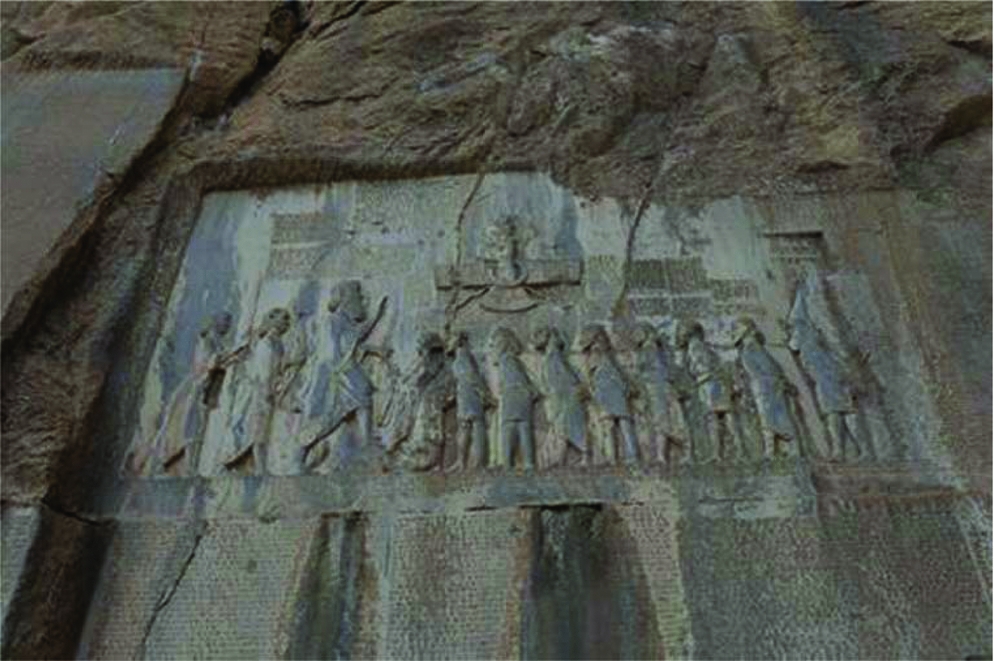
It is generally acknowledged that the first Western description of Bīsotūn (Fig. 1) was written by the Venetian nobleman Ambrosio Bembo.Footnote 4 Although drafted in 1674, Bembo's account―formerly in the possession of Abbé CelottiFootnote 5 and since 1964 in the James Ford Bell Library at the University of Minnesota―was not published until 1802.Footnote 6 Unaware of Bembo's work, C.F.C. Hoeck cited G.-A. Olivier's (1756-1814) account of his visit of 6 June 1796Footnote 7 as the first published description of Bīsotūn.Footnote 8 Almost a century later L.W. King and R. Campbell ThompsonFootnote 9 cited, in addition to Bembo, the description given by the Swiss traveller Jean Otter of his visit to Bīsotūn on 1–2 July 1734.Footnote 10 Additionally, they referred the reader to “the statements of other early travellers besides those quoted by Hoeck” mentioned in Sylvestre de Sacy's Mémoires sur diverse Antiquités de la Perse.Footnote 11 Although known to Sylvestre de Sacy,Footnote 12 another account of Bīsotūn, dating to either November 1729-May 1730 or May-August 1735, has gone largely unremarked in the history of scholarship on the site for over two hundred years.
Darius I's relief at Bīsotūn (photo: W. M. F. Henkelman).

On 4 March 1755 the tutor (from 1735) and later secretary (from 1752) of the Duc d'Orléans’ (1703-52) son, Louis Philippe I (1725-85),Footnote 13 Jean-Baptiste Bourguignon d'Anville (1697-1782) read a paper entitled ‘Mémoire sur un Monument très-ancien sculpté dans une montagne de la Médie’ before the Académie Royale des Inscriptions et Belles-Lettres which contained a detailed description of the Bīsotūn relief. Eventually published in 1761 (see below), the paper attributes the data contained therein to “une relation manuscrite du P. Emmanuel de S.t Albert, Carme déchaussé, & Vicaire apostolique à Bagdad. Cette relation que M. Bellet, docteur en Médecine, avoit reçûe à Constantinople du P. Emmanuel, & qu'il avoit présentée à seu M.gr le duc d'Orléans, a été donnée par ce Prince à M. d'Anville en 1743. M. d'Anville en a tiré la description du monument, dont il a fait part à l'Académie”.Footnote 14 This manuscript is listed in the catalogue of the library of Louis-Charles-Joseph de Manne (1773-1832), who inherited d'Anville's maps, manuscripts and drawingsFootnote 15 and began the publication of d'Anville's collected works in six volumes, only two of which had appeared by the time of his death,Footnote 16 as ‘Relation du voyage de Perse (par le P. Emmanuel de Saint-Albert, carme déchauss ét vicaire apostolique à Bagdad), in-fol. de 100 pages. Manuscrit. On lit ce qui suit, écrit de la main de d'Anville: “Ce voyage est du P. de Saint-Albert, etc., qui l'a communiqué, à Constantinople, à M. Bellet, docteur en médicine, lequel l'ayant présenté à Monseigneur le duc d'Orléans, ce prince m'a fait l'honneur de me le remettre ce 20 mai 1743”. Ce manuscrit est accompagné de la lettre d'envoi au prince et signé par M. Bellet”.Footnote 17 Unfortunately, it has not been possible to trace the manuscript beyond this reference.
Prior to Rawlinson's decipherment of the Bīsotūn inscriptionFootnote 18 the significance of the site was viewed in markedly different ways by its visitors. According to what we might call the ‘Persian premise’, embodied most famously in Nezāmi's poem Xosrow o Širin, the carving at Bīsotūn was the work of Farhad, the tragic lover of Širin, wife of the Sasanian emperor Xosrow II (570-628 ce). Based on Ballyet's account, supplemented by the evidence of Isidore of Charax and Diodorus Siculus who attributed the monument “at the mountain known as Bagistanon” to the mythical Assyrian queen Semiramis,Footnote 19 d'Anville demonstrated that the Bīsotūn monument predated the late Sasanian period, when Xosrow II reigned, and had to be dated much earlier. Because d'Anville's paperFootnote 20 has largely been ignored and was not—prior to the era of digitisation—universally accessible, an English translation of it is given here.
On a very ancient monument, sculpted into a mountain in Media
[p. 159] In a district of Media, bordering on Assyria, which today forms part of both Kurdistan and the area known as Irak-Ajami, or Persian Iraq, is a mountain called in Persian Bi-sutoun koh, or mountain without shoring or pillars. That which has given it this name, is the fact that it rises vertically to a very great height, and even seems to threaten to fall on a plain which, from the foot of this eminence, extends to the south. As the route leading from Bagdad to Hamedan skirts the mountain which meets it on the left, many modern travellers have mentioned the ancient sculptures carved into the rock there. However, among the descriptions given by them, none is as detailed as that which is found in a manuscript account [p. 160] by F[ather] Emmanuel de St. Albert, a Discalced Carmelite and Vicar Apostolic at Bagdad. This account, which M. Bellet, a doctor of medicine, received from F[ather] Emmanuel at Constantinople, and which he presented to Monseigneur the Duke d'Orléans, was given by this Prince to M. d'Anville in 1743. M. d'Anville extracted the description of the monument from this, which he presented to the Academy [4 March 1755]. Attached is a critical examination of the age of this monument and of the figures represented there. We are going to give an account of these various objects.
At a two-hours march beyond Kirman-shah, a town in which a Khan or Persian governor resides, on leaving the road at a river crossing, heading left towards the source of this river, which springs from a steep escarpment; after one and a half hours’ travel on a path cut by small streams, one comes across some ruins, and about 100 paces beyond one reaches an agreeably planted place of tall poplars. This area is only separated from the foot of the mountain by a canal, twelve to fifteen paces across, cut into the rock and in which the waters, gushing from the rock in abundance, reunite and appear as if halted at a distance of 100 paces, although they spread imperceptibly across the plain, and form a river several miles away. When one has crossed the canal on a small plank bridge, one finds with surprise a vault in the rock, roughly thirty feet deep, the same in height, and nearly half that in width. The facing appears highly polished. At the back, a large cornice reveals three projecting figures in bas-relief. The figure in the middle appears to be that of a king, his coiffure resembling a closed crown or the Median or Persian tiara. One assumes the figure on the left is a queen in her finery, and the third a high official. These three figures are standing and of a height slightly exceeding life-size. Below the corniche is a representation of a knight of gigantic proportions, fully armed and carrying on his shoulder a type of club: two of the horses legs [p. 161] project from the rock, the other two and a part of the club form part of it. The rest of what is contained in this vault is worked in bas-relief, representing elephants, camels and other animals, captives, shepherds with their flocks and various types of trophies. The worked appeared fine enough to Father Emmanuel to be in marble: which suggests rock of very hard and very compact quality.
Outside the vault, the rock is cut to form a steep slope and polished to a height of over thirty feet: one sees there two worthies in bas-relief, and a type of crown above the entrance. Advancing another ten or twelve paces further, by a very narrow path between the canal and the rock, one finds a second cavity of approximately the same height and width but not as deep. On a cornice resembling that of the first vault are three figures in very modest dress and attitude; and for this reason the Persians call them the three Calenders [qalandar, wandering ascetics, Sufis or dervishes] or Dervishes. The space below the corniche is filled with a long inscription, the character of which tends a bit towards Greek, but in a language which one judges to be different from those currently in use in Asia. Going beyond, and at a distance approximately the same as that which led to it, one finds the remains of a third similar area, with the head of a nude male in bas-relief. In the middle of the canal one sees a head like a nymph in the bath, the water seeming to cover the figure to just above the shoulders. It is not a mutilated figure, this part of which fell by accident into the water: because, in descending there, one sees the body of the figure at the base of the rock, in the position of a seated person taking a bath; and this is almost opposite the sculpted head on the upright part of the rock.
Such is the description for which one is indebted to Father Emmanuel, and which, as M. d'Anville announced, gives a more complete idea of the thing [i.e. the monument] than that which one read everywhere else. The locals recount long, ridiculous stories about these figures: generally they claim that they represent the king Khosrew and his beloved Shirin. The work is attributed to [p. 162] Ferhad, to whom all the great chiselled works, excavations in the mountains, belong in the opinion of the Orientals, just like the feats and deeds of arms belong to Rustem. One supposes furthermore that Ferhad had a great passion for Shirin who, notwithstanding the attachment which a great king had for her, was not indifferent to this passion according to some Persian historians. They maintain furthermore that Shirin lived in this region, and from this it follows that the ruins of an ancient castle, several days from Kirman-shah, bears the name Kasr-Shirin, palace or castle of Shirin. In the geography entitled Gehan numa, or Mirror of the World, written in Turkish by Kiatib-shelebi [Kâtip Çelebi], it is said, that on the side of Mount Bi-Sutoun that faces the sunset, there is a room cut into the rock, called Shebdizi-Khosrew; Shebdiz is the Persian name of Khosrew's horse and signifies that this horse was black or had a very dark coat.
But the monument which is the subject of this memoir is much older than the time of the two Chosroës [Xosrow], first and second, kings of Persia of the second dynasty, or the Sasanids, and whose reigns date to the VIth and VIIth centuries of the Christian era. Amongst several Khosrews, mentioned in Oriental histories, the one who figures the most is the first Chosroës, son of Cabades [Kawād], named Nushirvan in the histories and called el Adel or the Just; nevertheless it is the second Chosroës, son of Hormisdas [Ōhrmazd], or Khosrew-ben-Hormoz, called Parviz, by whom Shirin had been loved, if one can believe the Orientals. Some authors say that she was the daughter of the Greek [Byzantine] emperor, with whom Khosrew found sanctuary against the violence of a usurper; and this emperor was Maurice, who in effect received Chosroës as a fugitive, and who lent him assistance in regaining the throne; which prompted Chosroës to take up arms against Phocas, the murderer of Maurice. This relationship between Khosrew-Parviz and the second Chosroës, prevents the identification of this Khosrew with Perozes [Pērōz], based on the resemblance with the surname Parviz. Because the Persian king, known to Greek historians as Perozes, was the father of [p. 163] Cabades, and the grandfather of Chosroës I, grandfather of Chosroës II. Moreover, one is informed by Procopius, that Perozes died in a war against the Huns called Ephthalites, established in the country of Kharas'm [Khwarezm], to the east of the Caspian Sea; and one reads on the countrary, in the Persian historians, that this was parricide commited by Shirouieh, who killed Khosrew-Parviz in Modaïn [Madā’in], which conforms to that which is reported by the Greek historians, according to whom Chosroës II died by the crime of his son Siroës, in Ctesiphon. The name which is read Siroës by the Greeks, is the same as Shirouieh of the Persians; and that which the Orientals called Modaïn designates Ctesiphon, as well as Seleucia on the Tigris.
What makes it indisputable that our monument is older than the time of the Chosroës is that it is spoken of by authors who preceded the reign of these princes. Isidore of Charax, from whom we have an abbreviated description of the provinces of the Parthian empire, and of a route which leads there, knew both the place where the monument is located and the monument itself. Everyone knows that it was in overthrowing the throne of the Arsacids or Parthian emperors, that the Persians dominated the Orient for a second time: this revolution is placed, by F[ather] Pétau [Petavius],Footnote 21 in the year 226 of the Christian era, and Chosroes II was the twenty-second of the Persian princes whose domination followed that of the Parthians.
To prove that Isidore was speaking of the monument in question, let us follow this author on the route that he describes, beginning at Seleucia, which was situated some distance below Bagdad. From there, proceeding via Apolloniatis and Chalonitis, Isidore enters Media which is separated from these provinces by a mountain chain called Zagros in antiquity and Tag-Aïaghi today. The entrance to Media is a district which Isidore calls Κάρινα and which M. d'Anville recognizes in the name Kerin, on the route stretching from Bagdad to Hamedan, and at the descent of the mountain. Advancing then through the country in order to arrive at the capital, or Ecbatana, which is Hamedan, one finds again, without deviating [p. 164] from the main route, a town called Κόνϰοϐαρ by Isidore, and of which the name is Kenghever. The town of Kirman-shah, in the neighbourhood of which one is informed Mount Bi-sutoun rises, where the sculpted monument is located, occupies a position between places which were just mentioned. Now, following Carina or Kerin, and before Concobar or Kenghever, Isidore places a town on a mountain where can be seen, according to this author, the statue or image and the column or pillar of Semiramis: Σεμιράμιδεϛ ἄγαλμα ϰ᾽ϛύλη [καὶ στήλη]: thus an explicit mention of our monument is found in Isidore.
That which one must regard here as very positive is the identity of the place, the local circumstances of which permit no doubt. As for Semiramis, the writers of antiquity attribute such great things to this princess that it is not surprising that, lacking a full awareness of the monument, the authors and subject of which are shrouded in the obscurity of a very distant time, one ascribed to Semiramis that which belonged to another great personage, whose power equalled his dignity. Isidore of Chrax is not the only one to place Semiramis here; and one of the advantages of this discussion must be to determine the place which led to an account given by Diodorus Siculus.
This historian, after a detailed enumeration of the contribution of Semiramis to the embellishment of Babylon, says that this princess, at the head of a large army, having advanced into Media, arrived at a mountain called Bagistan, where she camped and had a garden planted, the perimeter of which was twelve stadia: from this mountain, he adds, which dominated a plain, rich in water which irrigated the surface of the garden. On one side of this delightful place, παραδεισοϛ or ferdous, as the Orientals say, Mount Bagistan arose steeply to a height of seventeen stadia. Having had the foot of the mountain cut perpendicularly, Semiramis had her image sculpted there, accompanied by one hundred persons behind her; she wanted the rock [p. 165] to be inscribed in Syrian characters, which, having piled up the baggage carried by the beasts of burden in her crew, she crossed [ascended], by this means, the entire height of the mountain from the plain to the summit.
The essential points of this account, those depending on the disposition of the site itself, can be recognised here with the greatest ease: the name of Bag-istan, the literal meaning of which would have been unknown to Diodorus, denotes precisely, in Persian, an area containing a garden. The same place, which the Persians named by the union of two words, bag, garden, and istan, region or district, which are proper Persian, is now called by the Turks, whose frontier is not far away, Taghi-bostan, which in the Turkish language signifies mountain of the garden. In Stephen of Byzantium, Βαγίϛανα is a town in Media, and Βαγίϛανον a mountain in the same country. The name of the town of Mount Bi-sutoun reads Βαπτάνα in Isidore of Charax; but the real lesson given by Stephen of Byzantium is that, in place of Baptana, one reads Bagistana. Elsewhere Diodorus, speaking of the route of Alexander from Susa to Ecbatana, mentions Bagistan as being in the most delightful country, the charms of which made it the playground of the gods themselves, and that the conqueror of Asia was curious to see it, in detouring a bit from the direct route; these are the terms of the historian. If in his text one reads here Βαγίϛαμνη in place of Βαγίϛανη, M. Wesseling [Petrus Wesseling, 1692-1764] has already noted the flaw in this reading.
As for the height of Mount Bagistan of seventeen stadia, reported by Diodorus, this stadium would be around fifty-four fathoms [54 x 632 ft. = 324 ft./98.75 m.], like those recognised by M. d'Anville in his memoir on the location and extent of Babylon.Footnote 22 Hamdallah, the mathematician, measured the perpendicular height of Mount Bi-sutoun, in the year 711 ah, or 1311/1312 of the Christian era, by the order of Algiaptu [Öljeitü], the penultimate of the Mongol princes of the race of Genghiz-kan who reigned in the provinces of Iran; and this height is given as four thousand pics. The natural measure of the pic is that of the length [p. 166] of the arm, from the olecranon or the point of the elbow, to the end of the hand or the index finger: because πῆχυϛ in Greek, and cubitus in Latin, are the same type of measure: and according to the proportions of a person of average size, neither too tall, nor too short, this natural measure is about seventeen inches. It is this which became the Attic cubit, and that which the Jews employed generally, independently of their legal and sacred cubit. If we apply this measure to the height of Mount Bi-sutoun, it results in nine hundred forty odd fathoms: seventeen stadia, on the basis of fifty-four fathoms, equal nine hundred twenty.
For the rest, the principal object of the present discussion consists of two points. The first is to show that the monument of Mount Bi-sutoun predates the time of Khosrew and of Shirin, contrary to the opinion of the Orientals: the second, and the more interesting, is to rediscover a place discussed in Isidore of Charax, and in an historian as highly regarded as Diodorus Siculus who, in treating Babylonia, claims to have relied on the memoirs of Macedonians, companions of Alexander on his expedition. A distinct and particular purpose was to examine whether the monument represented pertains equally well to Semiramis, whom these authors mention by name. If one assumes that the large equestrian figure, armed with a club and contained within the largest and most ornate of the two vaults carved into the rock, is the dominant figure, then it would seem to represent some conquering hero rather than Semiramis, even if this princess engaged in warfare herself and was celebrated for these conquests in history. In deciding this point, one would not wish to go back to the century of Ninus and of Semiramis, which would necessitate going beyond Cyrus: the location of the monument makes it more suitable to [look to] the Assyrian or Median monarchs than to a king of the Persians. The figure of a woman represented in the bath would have a strong relationship to the voluptuous life attributed by historians to Semiramis, and to the delights that she wanted to find in this place. [p. 167] The inscription, of which Diodorus makes an express mention, saying it was written in Syrian characters, is an object of great curiosity for scholars who at heart wish to penetrate the darkness of remote antiquity: these characters could have some relationship with those of the alphabet recently discovered by Abbé Barthélemy [Jean-Jacques Barthélemy, 1716-1795], and which in all probability merit a denomination more general than that in which the name Palmyrenians occurs. These various circumstances combine to recommend the monument, and more interesting than the sculptures of Nakshi-Rustem, near Tchehil-minar or Persepolis.
Written almost a century before Rawlinson's decipherment of the Bīsotūn inscription, neither d'Anville, nor Sylvestre de Sacy after him, were able to reach the scientifically correct determination of the monument's date and import, viz. that it was carved for the Achaemenid king Darius I (r. 522-486 bce). Nevertheless, with the aid of Ballyet's descriptions of both Bīsotūn and the nearby rock reliefs at Ṭāq-e Bostān, he was able to debunk the imputed Sasanian association of the monument, mediated through the fable of Xosrow and Širin. While this, in itself, may seem a somewhat modest achievement, the background story of the transmission of the Bīsotūn report constitutes a rich example of the sort of intellectual exchange characteristic of the Enlightenment and forms part of a much larger story of trans-national communication amongst an unlikely cadre of actors, all of whom were, in this case, French. Largely ignored for the past two centuries, it is, however, worthy of a place in the history of ancient Near Eastern scholarship. To appreciate the intellectual network through which the Bīsotūn report was transmitted it is necessary to investigate the dramatis personae named by d'Anville, i.e. the report's author (Ballyet), its courier (Bellet) and its eventual transmitter (d'Orléans).
The author
The author of the manuscript report on Bīsotūn was born in Marnay in the diocese of Besançon in Franche-Comté, where his father was a judge.Footnote 23 Christened Jean-Claude Ballyet (18 November 1702—4 April 1773), he adopted Emmanuel de S.t Albert (Saint-Albert) as his nom de religion after entering the Carmelite Order and is variously referred to as Emmanuel Ballyet, Balliet or Baillet. Ballyet attended the Saint Pancras (San Pancrazio) seminary for Carmelite missions in Rome and was ordained in 1726. Considered “very learned and ‘well bred”’,Footnote 24 Ballyet was expecting to be sent to Persia, and was about to sail, in 1728, at the age of 26, when he was instead appointed Pro-Vicar with “the duty of managing the government of the diocese of Babylon” under the Vicar Apostolic Monsignor d'Orea (F. Bernard Mary of Jesus [Belmone]) by the Sacred Congregation for the Propagation of the Faith (Sacra Congregatio de Propaganda).
Ballyet departed Rome in March 1728, and arrived in Baghdad in late September 1729.Footnote 25 His Catholic layman host was fearful of severe punishment should it be discovered that Ballyet had conducted a private mass in his house, at which point, realising that he needed fluency in Turkish in order to function in the Ottoman provincial capital, Ballyet “went to Hamadan in Persia where for 6 months he studied it before returning to Baghdad. . . .Fr. Emmanuel's residence in Hamadan must have been between November 1729 and May 1730”.Footnote 26 There he lived in a house built by François Piquet (1626-85) who had been Vicar Apostolic and was named Bishop of Babylon in 1674.Footnote 27 This provided Ballyet with his first opportunity to visit and study the monument and inscription at Bīsotūn.
Desirous of establishing a more permanent presence in Baghdad, Ballyet travelled from Basra on 12 June 1730, bound for Pondicherry in India where he arrived three months later. There he sought and obtained the support of the French Viceroy of the Indies and his Council, to whom Ballyet presented a petition. He returned to Baghdad in the French vessel Union with gifts for Ahmad Pasha, the Ottoman governor. Pleased with these and favourably influenced by Peter French, the English Resident (an Irish Catholic) at Basra,Footnote 28 Ahmed Pasha granted Ballyet permission to establish a house.Footnote 29 Consequently, in 1731 Ballyet bought a ruined house from a local Catholic named Ibn Krumi for 500 chami of Baghdad (c. 1000 francs) and erected a chapel dedicated to St Thomas on the site. According to Father Leander's account in Persia: Ovvero secondo viaggio in Oriente (Rome, 1757), “a large part of our House at Baghdad. . .was enlarged with 800 piastres which” French “gave to Fr. Emmanuel. . .as an alms-offering. . . .no missionary ever passed by Basra to whom he did not give an appropriate alms”.Footnote 30 Much later, in 1893, a different account was related in a letter written by an unnamed official of the U.S. consulate in Baghdad, according to whom, “The first bishop residing here was Emmanuel Baillet, a physician, who, having treated the Wali Achme Pasha, obtained permission from him to build a little chapel in 1731”.Footnote 31 Due to Ballyet's subsequent absence from the city, however, the first mass was not celebrated at St Thomas’ until 14 July 1734.Footnote 32
A letter written by Ballyet on 1 October 1731 to the Cardinal Prefect in Rome reported on the capture of Hamadan by the Turks with the sorry news, “Thus for a third time the poor mission at Hamadan is ruined”.Footnote 33 Two letters, dating to July and August 1732, attest to Ballyet having travelled to Constantinople for unstated reasons. It was during his absence from Baghdad, on 11 May 1733, that, as a result of Monsignor d'Orea's move to Lipari, Ballyet was named Vicar Apostolic of Baghdad. By mid-July he was en route to Baghdad, as a letter written at Sidon shows, but his progress was halted by an outbreak of cholera in Aleppo. By mid-September he had reached Aleppo but Nader Shah's blockade of Baghdad forced him to remain in Aleppo, where he still was as of March 1734.Footnote 34 He finally reached Baghdad sometime shortly before 3 May 1734.Footnote 35
Two years later, in May, 1736, Ballyet was again in Hamadan where he spent the next three months, overseeing repairs to the Carmelites’ house there. This was Ballyet's second opportunity to see Bīsotūn. He left Hamadan on 8 August, arriving back in Baghdad on 4 September 1736.Footnote 36 At the instigation of his Armenian rivals, who bitterly resented the fact that Ballyet had made conversions amongst their flock,Footnote 37 Ballyet and two other Catholic clergy in Baghdad were imprisoned in 1737 by Ahmad PashaFootnote 38 who also had the Carmelites’ house burned down.Footnote 39 Ballyet and his companions were only released after a bounty of 30,000 piastres was paid, 700 of which came out of Ballyet's own pocket.Footnote 40 After reporting this to Louis XV and his ambassador in Constantinople, Ballyet was named ‘consul of the French Nation’ by Minister of the Marine (Secretary of the Navy), Jean-Frédéric Phélypeaux, Count of Maurepas (1701–81), in May 1741,Footnote 41 “The King, judging that a commission as consul would be greatly to my protection”, as Ballyet later wrote.Footnote 42 The main purpose of the French consulates of Basra and Baghdad resided in “la correspondance des Indes en Europe par le désert et la Méditerranée” for, even if the overland caravan route was less important than it had once been, it still represented the fastest mode of communication between France and its eastern colonies.Footnote 43 As Masson noted, “A Bagdad, les Carmes étaient solidement établis et respectés. . . .Leur maison, assez commode, était l'asile préféré des voyageurs de passage”.Footnote 44
Following the death on 17 May 1742 of the Jansenist Bishop of Babylon, Dominique-Marie Varlet (1678-1742), who had been living in exile in the Netherlands, and after successful lobbying by Cardinal Pierre Guérin de Tencin (1679-1758) and the Provincial of the Carmelites in Paris,Footnote 45 Ballyet was named Bishop of Babylon. With no bishop in Iran, Ballyet had a choice of travelling to either India or Malta for his consecration. He chose the latter and was consecrated on 21 December 1743 at the cathedral of Malta, where he stayed for another ten months, until October 1744, travelling back to Baghdad via Cyprus,Footnote 46 Syria, the Druze region and Aleppo, from which he departed on 5 July 1746.Footnote 47 During this period he visited Constantinople, where the French ambassador gave him “letters of recommendation to the benevolence of the Pasha” of Baghdad.Footnote 48 On or around 7 October 1744,Footnote 49 at the monastery of Sidon, Ballyet presented the pallium to Cyril (Kyrillos) VI Tanas,Footnote 50 patriarch of the Melkite Greek Catholic Church which in 1724 had split from the Greek Orthodox Patriarchate of Antioch.Footnote 51 With this act Pope Benedict XIV thereby conferred Rome's approbation of Cyril's legitimacy.Footnote 52 Ballyet's delayed return was caused not solely by clerical duties but by the outbreak of war between the Ottoman Porte and Nader Shah in 1743, which lasted until 1746, during which time “il ne fut plus question du consulat de Bagdad”.Footnote 53 Having finally reached Basra in early 1747, he arrived in Baghdad in late May or early June of that year.
The war of succession in Austria pitted France against England, and Ballyet was tireless in his efforts to make Baghdad a commercial hub for the French in Asia, comparable to the factories maintained by the English and Dutch East India Companies.Footnote 54 As he said, “Les Français pourraient y avoir un magasin de drap, cochenille, indigo, papier et particulièrement de toutes espèces de dorure, fil d'argent et fil d'or, dont il se fait une grande consommation”.Footnote 55 Despite having tried to curry favour with the Ottoman authorities in Baghdad, however, Ballyet was far from immune to occasional outbreaks of hostility, particularly after the death of Ahmad Pasha.Footnote 56 On 31 July 1749, for example, his house was entered by a dozen or so government officers who removed his belongings and sealed his rooms. He and another French cleric, Père Constance, were imprisoned in chains for eight days,Footnote 57 and once more obliged to pay dearly for their liberty.Footnote 58 Desirous of more support from the French Company of the Indies, he waited in vain for assistance, effectively interdicted from travelling to the West by the lack of security on the road to Aleppo, as a letter of 26 March 1750 shows.Footnote 59 Thereafter we hear nothing of Ballyet for over three years. The first sign of life is a letter of 5 October 1753 sent to the Ministry of Foreign Affairs from Livorno where he was confined to quarantine for 39 days.Footnote 60 He reached Rome in late November.Footnote 61
In Rome Ballyet presented a report, dated 18 December 1753, to Pope Benedict XIV on the work and status of the diocese and mission of Baghdad/Babylon,Footnote 62 the size of which was estimated at c. 1,000 members.Footnote 63 Granted an audience of 90 minutes with the Pope, Ballyet was closely questioned on the Baghdad mission and the Ottoman persecutions that it had endured. On the Feast of the Epiphany he celebrated mass at St Peter's Cathedral and the Pope thanked him personally for a 19 year-old barrel of Cypriot wine and “quelques confitures des Indes” that Ballyet had given him.Footnote 64 Moved by Ballyet's Relation faite à Rome en 1754 à Notre Saint-Père le Pape Benoît XIV and informed that the congregation in Baghdad had not, since Varlet's time, transmitted any of its revenue to the church, the Pope convened a committee of four cardinals and sent a letter to Ballyet, in his own hand, presenting him with 2,500 Roman écus.Footnote 65
From Rome Ballyet proceeded to Paris where he arrived in early September. There he reminded the Secretary of State for Foreign Affairs (Antoine-Louis Rouillé, Comte de Jouy), that, in spite of the persecution he had suffered, he had managed to build a church and a large house “at Babylon”Footnote 66 which was serviceable for both religious and commercial purposes. Further, he asked for funding to re-establish the Vice-Consulate at Basra which had been closed for financial reasons. To fund this project he suggested that French vessels trading with India should be taxed 2 per cent of the value of their merchandise. He also lodged a written protest against the bishop of Isfahan who, unable to enter Iran, had requested permission to live in Basra. Ballyet objected that Basra was in his own diocese and he could not tolerate its excision from his area of jurisdiction.Footnote 67
During the course of the summer Ballyet repaired to Franche-Comté where he spent the next five months. On 14 August 1754 the mayor of Besançon informed the municipal council that he had given Ballyet a gift of 25 bottles of Burgundy and an unspecified quantity of champagne.Footnote 68 On 5 September 1754 the archbishop of Besançon, Antoine-Pierre II de Grammont (1685-1754) died. To cover the costs of the religious establishment in Baghdad, Ballyet had already requested an allowance from Louis XV, given that financial assistance from Rome was so unreliable.Footnote 69 Following Grammont's death, Louis XV named Ballyet Prior of Morteau, a small town between Besançon and the Swiss borderFootnote 70 and official French state records record that on 16 September 1754, “M. de Machault [Jean-Baptiste de Machault, 1701–94, comte d'Arnouville], Garde des Sceaux de France, Ministre & Sécretaire d’État ayant le Département de la Marine, présenta au Roi l’Évêque de Babylone, Consul de France à Bagdad”.Footnote 71
Ballyet departed once again for the East on 3 August 1755, armed with a letter and an “arme du travail le plus rare” for the Pasha of Baghdad. He travelled via Alexandretta and Aleppo, which he reached on 4 September. There he set about trying to fulfil one of his commissions, namely the purchase of horses for Louis XV's stables with funds provided by the Chamber of Commerce of Marseille. According to a letter of Machault's dated 30 December 1754, “Le roi a chargé M. l’évêque de Babylone, à son retour à Bagdad, de choisir six chevaux arabes et de les lui expédier. Le consul d'Alep est chargé de lui remettre les fonds que la Chambre du commerce est priée de lui faire parvenir”.Footnote 72 In a letter Ballyet announced that he had purchased a very beautiful two-and-a-half-year old from an Arab prince in Aleppo.Footnote 73
Because no caravans left Aleppo for Baghdad during the autumn Ballyet was unable to depart until 4 May 1756, arriving on 24 May.Footnote 74 The Pasha of Baghdad was honoured by the gifts (jewels for the Pasha's wife, a magnificent firearm [“un magnifique fusil”] for the Pasha) that Ballyet had brought to him from France, promising him his protection.Footnote 75 Although Masson suggested that, on his return to Baghdad, “l’évêque dut se contenter comme auparavant de jouer officieuse le rôle d'un consul sans avoir l'investiture de la Porte”,Footnote 76 matters looked much more favourable than they had ever done in the past. Ballyet continued purchasing horses for Louis XV, complaining in a letter that as the Turks and Arabs worked their horses so hard, it was extremely rare to find any four, five or six-year olds whose legs were not disfigured from battle. Another letter announces in a postscript that he had finally made the purchase of a seventh horse which he was dispatching together with four others the following day.Footnote 77
Ballyet also devoted some of his time to putting together a coin collection. Since France was now at war with England he was greatly occupied with French commercial interests which suffered as a result. He complained in February 1758 that he had not received a single communication from the French Foreign Ministry over the previous twenty months. Nor had he received any word from Rome. In fact, in the course of three years of service Ballyet received no more than six months of mission revenue.Footnote 78 He received a visit from a M. Pirault, a 33-year old medical graduate from Besançon who was married to one of his nieces and who had grand plans for commerce involving the French Company of the Indies’ establishments in Muscat, Basra, Baghdad and Aleppo, apparently oblivious to the war then raging between England and France.Footnote 79
As a result of Ballyet's efforts to obtain a post for him with the Company of the Indies, and at his own expense, Ballyet's nephew Nicolas-Joseph Ballyet visited him in Baghdad, hoping for orders to proceed to India which never came, resulting in his return to France in early 1763.Footnote 80 Letters from 1760–62 are full of Ballyet's ongoing efforts to claim the allowance that was rightfully his but which he felt had been diverted for other purposes, such as the payment of the debts of the Convent of Mont-de-Piété.Footnote 81 On 25 April 1763 Ballyet sent a letter to the Ministry requesting permission to travel to France for both health and professional reasons, which included his position as prior of Morteau. Permission to take leave finally arrived near the end of 1763 and in announcing his planned journey to his nephew, he bemoaned the fact that letters rarely arrived for him due to the scarcity of couriers and the theft of post en route.Footnote 82 A terse note to his nephew dated 16 April 1764 announced that on the preceding night all of Baghdad had revolted against the Pasha who was deposed, “c'est tout”.Footnote 83 A report on these events sent to the Ministry never arrived but three months later, in a letter to his nephew dated 17 June 1764, he enclosed a copy of his report to the French government “sur la révolution dont Ali-Pacha avait été victime le 16 avril précédent [1764]”.Footnote 84
On 18 April 1765 Ballyet finally set out for Paris. Upon reaching Damascus after an overland journey of 50 days, however, he and his servants were imprisoned by the Ottoman authorities, the governor demanding the ‘ordinary’ tribute of Christians, and was only released upon payment of 65 sequins.Footnote 85 Embarking on the Archipel, he narrowly escaped Turkish galiots that pursued his ship and at Corou in the Peloponnesus he was stopped and made to pay 7,500 livres in order to pass.Footnote 86 He did not reach Malta until 1 November and only arrived in Toulon in early February 1766. Proceeding to Morteau, Ballyet found himself in a long, drawn-out conflict with the Benedictines.Footnote 87 Despite this distraction, it may have been at this time that he had a coat of arms designed.Footnote 88
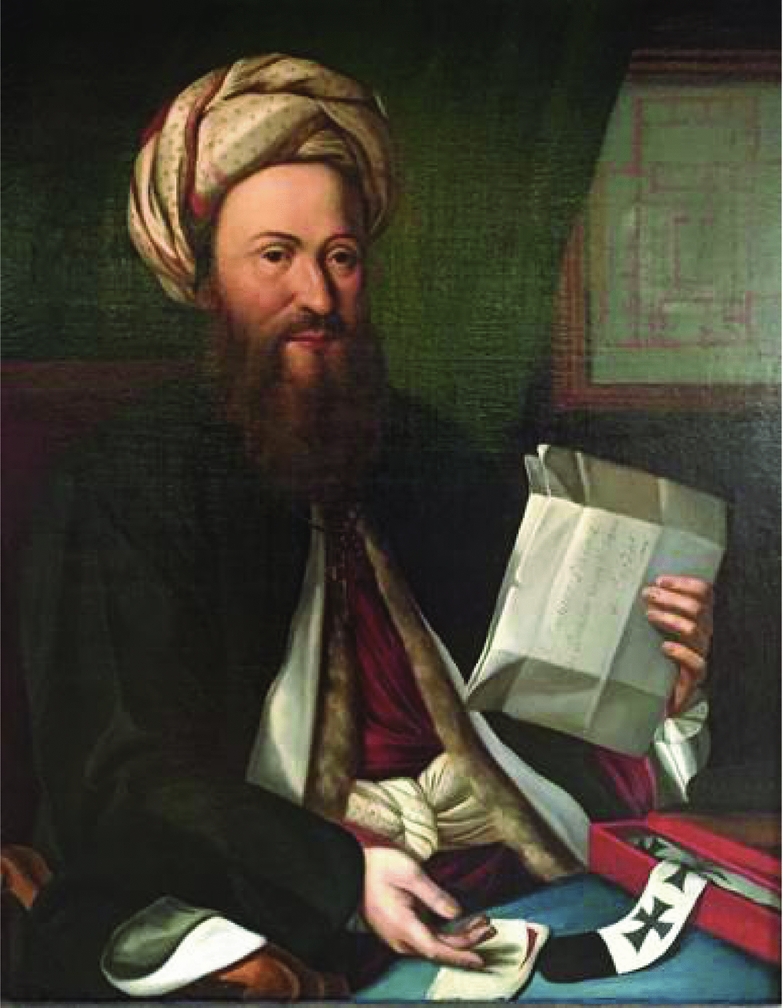
Thereafter Ballyet headed to Paris, arriving in July, where he continued to lobby for a position for his nephew.Footnote 89 Ballyet then returned to Besançon and proceeded to Lyon and Rome.Footnote 90 On 22 July he wrote to his nephew that he had had his portrait painted in three copies, one for M. Catton, one for Père Matthias and one for Père Symphorien, his elder brother.Footnote 91 A different portrait “vêtu à la turque et coiffé d'un turban, mais avec une croix pectoral” and, in his hand a letter, “A Monsieur l’évêque de Babylone, consul de France à Baghdad”, given as a gift by the Abbot Liquet,Footnote 92 hangs in the hôtel de ville of Marnay (Fig. 2). He departed from Marseille on 18 August 1766, arriving in Baghdad on 10 November. The 85 days it had taken him from Lyon was a new record, he wrote.Footnote 93 A letter from early 1771 reported that all was calm under the government of Karim Khan in Iran.Footnote 94 A letter to the new Minister of the Marine, the Count de Boynes, requested another period of leave, both to look after his affairs in Morteau and for his health,Footnote 95 but in a letter to de Boynes written on 15 September 1772 Ballyet noted that he did not think that he would make the journey until the following year and only then if circumstances permitted.Footnote 96 But on 1 March 1773 Ballyet died in Baghdad of the plague.Footnote 97 Thus we read, “Amongst the deaths were Monsieur Eduard Baillet, who was both Bishop of Baghdad and Consul to the French nation, and three priests, the only Europeans in the place”.Footnote 98 The plague of 1773 is thought to have killed two-thirds of Baghdad's inhabitants and reduced its population to less than 25,000.Footnote 99
Portrait of Jean-Claude Ballyet by an unknown artist in the Hôtel de Ville, Marnay, showing Ballyet holding a letter addressed to “Monsieur l’évêque de Babilone, consul de France à Baghdad”. Behind him is the plan of the church of Morteau, of which he was made Prior in 1752. Kindly supplied by Vincent Ballot, Mayor of Marnay (photo: Vincent Ballot).

Although hardly a household name, Ballyet appears in several sources relevant to the history of ancient Near Eastern archaeology. Omitting d'Anville's publication of 1761, perhaps the first writer of significance to mention Ballyet was the naval surgeon Edward Ives (1719-86). In 1758, while travelling from India to England via Iraq, Ives met Ballyet in Baghdad. He wrote, “Two reverend fathers, Fidelle an Italian, and Auge a Frenchman, paid us this morning also a visit, with the compliments of Emanuel the Roman bishop of Babylon. . .We therefore hastened to visit the bishop. . . .We found him a lively, well-bred, sensible man, between fifty and sixty years of age; very communicative, wishing to advise us for the best, but open enough to declare, he hardly knew how”.Footnote 100 Ives related an account of Ṭāq-e Bostān, which Ballyet described to him as “an antique pile of buildings called Kurman Shah, still to be seen at about twelve days journey between this place [Ctesiphon] and Ispahan; wherein is a great deal of sculpture in marble, with Basso and Alto Relieves, representing battles, trophies, arms, men, and camels; and one most remarkable horse whose body seems quite detached from the wall”. Ballyet also showed Ives his coin collection.Footnote 101
Ballyet had a keen interest in the identification of the ancient site of Babylon and figures in discussions of the identity of this problem from an early date. Citing Ballyet's manuscript report, apparently the same one that contained his remarks on Bīsotūn, d'Anville discussed Ballyet's architectural and epigraphic observations in 1755. He wrote, “Le P. Emmanuel de S.t Albert, Carme déchaussé & vicaire Apostolique à Bagdad, dans une relation manuscrite de son voyage au Levant, que je dois à seu M.gr le duc d'Orléans, parle pour avoir été sur le lieu, non seulement du monceau de ruines vû par Pietro della Valle, mais d'un autre grand vestige existant à l'opposite, & en même hauteur, l'Euphrate ayant son cours dans l'intervalle de ces deux restes d'anciens édifices. . . .Les caractères que le P. Emmanuel dit, dans sa relation, être imprimés sur les briques qui restent de Bâtisses aussi anciennes que peuvent être celles de Babylone, seroient pour les Savans qui veulent pénétrer dans l'antiquité la plus reculée, une matière toute nouvelle de méditation & d’étude”.Footnote 102 Several years later d'Anville also referred to Ballyet's manuscript in discussing his treatise on measures of distance, specifically citing Ballyet's observations on the lengths of the bricks used in the ancient structure presumed to have been the palace of Nebuchadnezzar at Babylon.Footnote 103 The following year Ballyet was credited with having established the correct identification of the site,Footnote 104 a view widely shared.Footnote 105
Ballyet has also been credited with having been the first European author to write about cuneiform. According to Léon Vaïsse, “Le premier monument de ce genre qu'on ait possédé en Europe parait être une brique qui fut envoyée des bordes de l'Euphrate au jésuite Kircher, à Rome, par Pietro della Valle. Le premier auteur qui ait écrit sur ce sujet est le P. Emmanuel de Saint-Albert, qui résidait à Bagdad au dix-septième [sic] siècle, et dont la relation manuscrite a été citée par d'Anville dans son Mémoire sur la position de Babylone. Les inscriptions que le P. Emmanuel avait vues et dont il parlait furent plus tard successivement visitées et en partie transcrites par notre compatriote Chardin, par le Hollandais Corneille le Bruyn et par le Danois Niebuhr”.Footnote 106 Here the writer's chronology is sadly confused, for having incorrectly attributed Ballyet to the seventeenth rather than the eighteenth century, he made the error of having Jean Chardin (1643-1713) follow rather than precede him in time.
As Ives noted, Ballyet had a coin collection. In 1802 this paragraph appeared in the English press: “There is now announced for sale at Paris a superb cabinet of medals, collected, during 40 years, in Asia, Africa, and Europe, by D. Ballvet [sic], ci-devant Bishop of Babylon, and French consul at Bagdad. This collection consists of nearly 6500 medals of gold, silver, and bronze, classed and arranged by the Bishop's nephew, Nicolas-Joseph Ballyet, a distinguished amateur of Besançon, to whom they descended by inheritance”.Footnote 107 Indeed, an historical description of Besançon published in 1860 identified Ballyet as “évêque et consul de France à Bagdad, savant antiquaire et numismate”.Footnote 108 A letter from the cleric Father Jacques Revest (1688-1761),Footnote 109 a member of the Ordo Minimorum (Order of the Minims) to the numismatist Guillaume Beauvais (1698-1773),Footnote 110 written at Marseille on 13 March 1756, mentions that, when Ballyet passed through Marseille in August 1755, he showed Revest his collection which contained more than 20,000 bronzes.Footnote 111 Another notice dating to 1802 adds, “Les personnes qui voudroient en traiter pourroient s'adresser, à Paris, au C. Yard, rue des Cinq Diamans, n.o 15; ou au C. Ballyet, à Besançon, lieu du dépôt des médailles. Ces derniers dépositaires et propriétaires actuels de cette rare et unique collection. On a déposé le seul exemplaire imprimé qui existe, des catalogues de ces médailles, chez le C. Millin”.Footnote 112 Some of these coins were acquired by Césaire Emmanuel Flavien Henrion Staal de Magnoncour (1801-75) and published by the distinguished French numismatist, Adrien de Longpérier who wrote, “Les médailles de la Syrie, et de la Perse surtout, sont en grand nombre et donnent une haute valeur au cabinet de M. de Magnoncour. Cette partie de la collection fut rapportée d'Asie par monseigneur Emmanuel Baillet, évêque de Babylone, qui, pendant trente années qu'il habita Bagdad, l'avait recueillie sur les lieux mêmes où les monnaies des Séleucides et des descendants d'Arsace avaient circulé”.Footnote 113 One account of notable numismatists and antiquarians in Franche-Comté qualified Ballyet's material as “une collection de médailles des rois Parthes”.Footnote 114
The courier
Isaac Bellet (1693-1780), often referred to as “médecin de Bordeaux”, or “médecin du Roi”, was once described as “a man of very general information”,Footnote 115 an assessment that recognises his varied interests as well as his public and private roles in a very complex life. Bellet came from an established family in Sainte-Foy-la-Grande. His father François (1663-1746) was a doctor while his paternal uncle Jules (1672-1752) was canon of Cadillac. As one local historian put it, all three produced “de savantes dissertations scientifiques, historiques et littéraires”.Footnote 116
Like his father, Bellet pursued a medical career, publishing a treatise on smallpox at the age of 28.Footnote 117 A bulletin dated to 7 January 1722 announced the “Agrégation d'Isaac Bellet”, i.e. his admission to the Collège des Médecins of Bordeaux,Footnote 118 analogous to membership in the Royal College of Physicians in London.Footnote 119 Three years later, on 30 August 1725, Bellet was elected membre associé of the Académie royale des Belles-Lettres, Sciences et Arts de BordeauxFootnote 120 and two years after that, on 20 November 1727, he was elected a syndic, i.e. a member of the Medicorum Burdigalensium aggregatorum collegium or “Collège des médecins” representing the medical profession in Bordeaux and its interests.Footnote 121 His meteoric rise continued. On 3 September 1729 Bellet was sent to Paris by the College to petition the ‘Premier médecin’ for his protection in order to conserve the ancient rights of the College and the public interest.Footnote 122 A further, public health-related honour was accorded Bellet on 21 July 1735 when he was named “inspecteur des eaux minérales de France”.Footnote 123
That Bellet moved in broader intellectual, not solely medical, circles is confirmed by the fact that he was mentioned twice by Montesquieu in his letters. In the first one, dated 7 May 1736 and addressed to the brothers Sarrau (Jean de Vésis/Vézis, d. 1739, and Isaac de Boynet, d. 1772),Footnote 124 Montesquieu recalls that they thanked M. le cardinal de Polignac for becoming patron of the Academy of Sciences of Bordeaux; “Melon a porté la parole, accompagné de MM. de Montesquieu, Mairan, Bellet père, Mazières et de Secondat, suivant l'ordre de leur reception”.Footnote 125 In the second, dated 2 July 1736 and written to one of his closest friends, Jean Barbot (1695-1771),Footnote 126 Montesquieu says, “Il me semble que vous vous êtes appliqué aux antiquités de Bordeaux; ainsi je vous prie de nous communiquer là-dessus vos lumières; peut-être que MM. Baritault et Bellet ont quelque chose de particulier là-dessus”.Footnote 127 It seems therefore safe to presume from the manner of Montsquieu's allusions that they knew each other.
But there was a political side to Bellet at this time as well. The catalogue of the library of Louis-Francois Delatour (1727-1807), one-time printer, librarian and secretary to the king, refers to “un mémoire manuscrit de Bellet, chargé par Louis XV de deux négociations secr. à Constantinople. Paris, 1738”,Footnote 128 bound in the same volume as a copy of “Hist. des négociat. pour la paix de Belgrade en 1739, par l'abbé Laugier”.Footnote 129 Given that Bellet's account was written in 1738, and Bellet was in France as late as the beginning of July 1736, according to the Montesquieu letters, his presence in Constantinople must have fallen sometime between the second half of 1736 and some part of 1738.
As noted above, Bellet's letter to the duc d'Orléans containing Ballyet's report on Bīsotūn was passed on to d'Anville on 17 May 1743. An extant letter from Bellet to the duc d'Orléans dated “Constantinople le 26 janvier 1742, au duc d'Orléans”,Footnote 130 places him there a year earlier, though we do not know for certain whether or not Bellet had returned to France in the interim, i.e. between 1738 and the beginning of 1742. The letter begins, “Le R. P. Emmanuel de Saint-Albert, Carme déchaussé et Vicaire apostolique à Bagdad, m'a remis la relation de son voiage d'Alep à Bagdad, Ispahan et Bassora. J'ai cru devoir en extraire ce qui avait rapport à l'ancienne Babylone. Comme il envoya ses recherches à M. Granger, qui était alors à Bassora, peut-être se sont-elles trouvés avec les autres mémoires de M. Granger et par ce moyen elles auront pu venir à la connaissance de Monseigneur (. . .) Je recevrai de Bagdad quelques briques des tours de Babylone avec l'empreinte des lettres (. . .) J'espere avoir l'honneur d'envoyer Monseigneur (. . .) un memoire sur l'origine de la langue turque, on y travaille actuellement (Archives de Chantilly, fonds Brottier, vol. 6, f. 1–3)”.Footnote 131 It is not clear from d'Anville's references to Ballyet whether the information on Babylon and Bīsotūn were contained in one and the same manuscript, communicated to Bellet, or in two separate ones.
Just as cryptic, moreover, is the reference in Bellet's letter of 1742 to Ballyet having sent his research to “M. Granger” while the latter was at Basra, for while Ballyet most definitely knew Granger, Granger died before ever setting foot in Basra. Born in Dijon, Jean (b. 1676) or François (b. 1687) Tortochot or Tortechot (d. 1737), better known as Granger,Footnote 132 was originally a surgeon. Active in Marseille and Toulon, he began working in 1721 for the Order of Trinitarians in Spain, treating plague victims, and in 1724 became chief surgeon of the Trinitarian hospital in Tunis. After leaving this post in 1728 and failing to secure a position as a regimental surgeon in France, he devoted himself to natural history, particularly botany. In 1730 he received a royal commission to investigate the flora and fauna of Egypt, arriving there on 6 August.Footnote 133 For two years he travelled widely in Egypt, Cyrenaica and Crete.Footnote 134 He returned to France in the autumn of 1732 and in July 1733, departed with a new royal commission to discover the Petrified Country “Pays Pétrifié” (located south of Benghazi)Footnote 135 and, over the next few years, travelled widely in the Mediterranean and North Africa. The autumn of 1735 saw him on Cyprus, after which he visited Palestine and Syria. A year later he was in Diyarbakir, Mosul and finally Baghdad, which he reached on 14 December 1736.Footnote 136 Granger spent the Christmas of 1736 with Ballyet and stayed in Baghdad until 14 February 1737 when he set out for Basra. Three days later, he died en route to his destination.Footnote 137 If Ballyet indeed shared his research with Granger, it must have been before his death, most probably while Granger was in Baghdad in 1736.
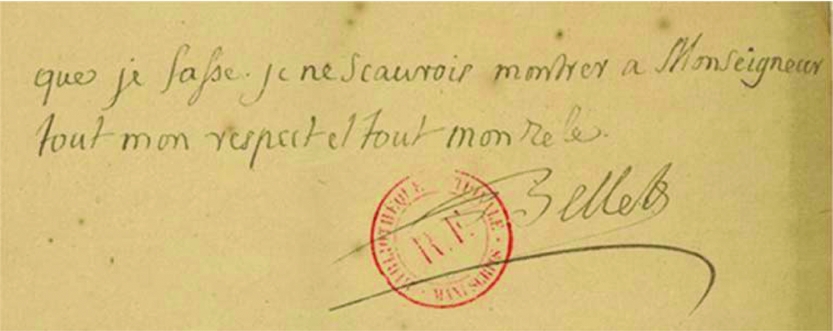
The connections between Bellet and the duc d'Orléans, and between the duc d'Orléans and d'Anville were obviously direct. It is not clear, however, whether d'Anville and Bellet had any direct contact. Among the geographical papers of d'Anville—now in the Bibliothèque Nationale in Paris—is a portion of an undated letter lacking the name of the addressee, almost certainly Louis, duc d'Orléans, but signed by Bellet (Fig. 3), in which Bellet wrote, “Dans les instructions qui m'ont été données par Mr Danville par ordre de Monseigneur” and, further on, “Jay trouvé icy un Drogman [dragoman, i.e. translator] qui a fait le voyage de georgie. je luy ay montré La carte que me donna Mr Danville”.Footnote 138 Taken literally, these statements suggest that d'Anville gave instructions and a map to Bellet on the orders of the duc d'Orléans, but it does not necessarily follow that these were transmitted directly, rather than via the duc d'Orléans.
Signature of Isaac Bellet on a document found amongst d'Anville's papers (d'Anville 1893b: fol. 166).

Bellet's presence in Constantinople on secret state business raises a host of questions. How did a doctor and Academician from Bordeaux, not to mention inspector of mineral water sources, come to be involved in secret negotiations on behalf of Louis XV, and to what did these relate? We know that earlier negotiations in Constantinople between France and the Ottoman Porte concerned the precarious position of Stanislaw I of Poland (Leszczyński), Louis XV's father-in-law. When these were terminated in 1735, “La France et la Turquie perdirent ainsi la seule occasion qu'elles aient eue peut-être pendant le XVIIIe siècle de sauver la Pologne”, and Russia stepped into the breach.Footnote 139 Efforts to create a French-Ottoman axis against Russian intervention were a failure. Also involved in behind-the-scenes negotiations at this time was Claude Alexandre, comte de Bonneval (known as Humbaracı Ahmed Pasha after his conversion to Islam), about whom much has been writtenFootnote 140 and who was, at the time, in the service of the Ottoman sultan. Although the only reference to Bellet's presence in Constantinople dates to 1738, he was clearly still involved in secret diplomacy as late as 1746. In his analysis of the role of the Marquis d'Argenson and the French Ministry of Foreign Affairs between mid-November 1744, and early January 1747, Edgar Zévort referred to a letter in his possession, dated 10 February 1746, sent by Bellet to d'Argenson.Footnote 141 The letter concerns d'Argenson's request to Bellet, that he (Bellet) write to Bonneval to express France's hope that the Ottoman army would move against the Russians. It begins, “Monseigneur, vous m'ordonnâtes d’écrire à M. le come de Bonneval, que la France verrait avec plaisir, que les Turcs fissent quelques mouvements contre les Muscovites, dans la vue de mettre la reine de Hongrie dans l'embarras de donner des secours aux Moscovites ou de les leur refuser: j'ai obéi ponctuellement à vos orders”. He went on to note, however, that Bonneval would never act simply on the basis of a letter from him (i.e. Bellet). He also noted, “si vous regardez les mouvements des Turcs contre les Moscovites comme une chose nécessaire, et que vous désirez qu'ils obligent les Moscovites à avoir recours à la reine de Hongrie, je penserais qu'il faut prendre d'autres mesures; et en ce cas j'ai l'honneur de vous présenter le Mémoire que j'ai fait par votre ordre sur la paix entre le sultan et le sophi dans lequel j'ai fait entrer ce qui m'a paru convenir au projet contre les Moscovites”.Footnote 142 Considering the fact that Bellet is never mentioned in the many accounts of Bonneval's involvement in the Franco-Ottoman political intrigues of this period, one is again left wondering how a doctor from Bordeaux came to be involved in such delicate affairs of state. One explanation, which may also account for why he was chosen to go to Constantinople in the first place, may perhaps be found in a letter sent by d'Argenson to Bellet, dated 25 December 1746. As Zévort noted, “Dans une lettre du 25 Décembre [1746], adressée au sieur Bellet, ancien médecin du comte de Bonneval qui entretenait avec lui d'actives relations, le ministre [D'Argenson] l'engage à pousser les Turcs à la guerre contre la Hongie”.Footnote 143 Not only does this reveal that Bellet had ‘active relations’ with Bonneval. More interestingly, it is the sole document known to me which identifies Bellet as “ancien médecin du comte de Bonneval”. This personal relationship, as Bonneval's physician, may account for why the French government sought to use Bellet in secret negotiations which concerned the balance of power involving France, Poland, Hungary, Austria and the Ottoman empire.
During the remainder of Bellet's life he seems to have had no further connection with either Ballyet or the world of diplomacy. By 1745 he was back in France. In that year Lettres sur le pouvoir de l'imagination des femmes enceintes appeared in Paris.Footnote 144 Although published anonymously, the book's author was recognised as early as 1770.Footnote 145 Furthermore, a copy inscribed “A Madame la présidente d'Aligre, de la part de son très humble serviteur, Bellet”, in the library of A.C. Danyan, surgeon and head of the Maternité in Paris, confirmed the work's authorship.Footnote 146 This study, more than any other, has ensured that Bellet's name is not forgotten today. Indeed, it is well-known to scholars of eighteenth-century medicine, psychology, health, gender and sexuality.Footnote 147 Although it has been suggested that Bellet met Tobias Smollett in 1765 while allegedly living in London,Footnote 148 this can be traced to a misunderstanding, pointed out by John Skinner,Footnote 149 deriving from the fact that, in 1765, Smollett favourably reviewed an English translation of Bellet's 1745 treatise.Footnote 150 There is otherwise no evidence that Bellet ever visited London.
Yet another side to Bellet's character was revealed in 1752 when he published, again anonymously, a translation of Sallust's history of the Catiline affair, accompanied by a translation of the Catilinarian orations of Cicero.Footnote 151 Bellet's authorship was soon found out and is mentioned in La France littéraire of 1769Footnote 152 and later by the French linguist Nicolas Beauzée (1717-1789) who referred to the “Histoire de la Conjuration de Catilina, par M. Bellet, médecin, & de l'Académie de Bordeaux”.Footnote 153
A year after the appearance of his Sallust and Cicero translations, Bellet's career took another twist. We read in a notice from the time, “BELLET (Isaac), retenue de médecin du roi n'ayant quartier pour servir près de S.M. que lorsqu'il sera appelé, 3 mars 1753”.Footnote 154 The medical establishment of Louis XV was large, consisting of a “premier médecin ordinaire”; eight “médecins ordinaires servant par quartier”; one “médecin du Roi n'ayant point de quartier”, i.e. the position held by Bellet; eight “médecins consultans”, one of whom was qualified as “first”; the royal opthamologist (“médecin oculiste du Roi”); and one “médecin ordinaire de la maison du Roi & du grand commun”.Footnote 155 Bellet held this appointment until 1771 when he resigned his position.Footnote 156 During this time we can place him at various residences in Paris, including the Hôtel de Broglie in the rue de l'Université, where he lived in 1760;Footnote 157 and in rue de la Sourdière, near the cul-de sac de la Corderie, where he is attested in 1769.Footnote 158
In 1768 Bellet published yet another work that gained him notoriety.Footnote 159 This was a study of a supposedly anti-venereal syrup that was widely known as “sirop de Bellet”, or Potus mercurialis Belleti,Footnote 160 the efficacy of which was commented upon widely by many natural philosophers and doctors. As one medical dictionary put it, “Il a fait beaucoup de bruit par son sirop antivénérien, composé d'acétate et de nitrate de mercure avec de l'alcool et du sucre.’Footnote 161 Commentaries on Bellet's syrup also provide a further detail of importance. At least two of them associate Bellet with Montpellier, one of them, dating to 1775, calling him “Docteur en Médecine de la Faculté Montpellier”.Footnote 162 This suggests that, after resigning his position as one of Louis XV's royal doctors, Bellet retired to Montpellier. In addition, a government notice lists Bellet as “médecin du Roi, pensionnaire sur les fonds des colonies 1773/1775” in a list of “Personnel colonial ancien (XVIIe-XVIIIe s.)”, under the Secrétariat d’État à la Marine, in the Archives nationales d'outre-mer.Footnote 163 The reference to a pension administered by the naval secretariat perhaps reflects Bellet's secret diplomatic service in Constantinople. Finally, the date of Bellet's death is disputed. As Bremond d'Ars noted, Larousse dated his death to 1778,Footnote 164 but this is contradicted by the fact that, on 15 April 1779, Bellet attended the marriage of the Chevalier de Beauregard.Footnote 165 A more precise date is suggested by a letter, now in the library of Reims, from Abbé Gabriel Brotier, librarian at the Collège Louis-le-Grand, dated 29 September 1780, to M. de la Cour, secretary to Louis XV, which reports on the illness and death of Bellet. This would suggest that Bellet died sometime shortly before this date.Footnote 166
The transmitter
Born at Versailles on 4 August 1703, son of Philippe II d'Orléans, regent of France at the time, and Françoise-Marie de Bourbon, Louis duc de Chartres (d'Orléans after his father's death), Prince of the Blood and later First Prince of the Blood (Prince du Sang and Premier Prince du Sang), was a learned and pious prince whose scholarly interests ranged widely, distinguishing him starkly from much of the French nobility of his time. Chateaubriand (1768-1848) called him “the only quite respectable head of the House of Orléans”;Footnote 167 the Marquis d'Argenson derided him as “neither a soldier, nor a statesman, but a man of ordinary capacity, and in small ways”, “a rabid pietist and misanthrope, who. . .never studied anything but theology, does not know men, and has never paid attention to public affairs”;Footnote 168 and his own father said of him, while still an adolescent and in front of the assembled company in the Palais-Royal, “Do you know, my son, you will never be anything but an honest man” (“Sachez, mon fils, que vous ne serez jamais qu'un honnête homme”),Footnote 169 seemingly relegating him to a position of insignificance, from a prince's point of view. Louis, who was an excellent dancer, is said to have exhibited excessive nervousness when playing jeu de paume and to have rarely participated in the hunt, having once been thrown from his mount when a stag charged him.Footnote 170 The art historian and critic Victor Champier (1851-1929) called him “complex, sickly, bizarre, insufficiently studied by historians” (“une figure complexe, maladive, bizarre, insuffisamment étudié jusqu'ici par les historiens”)Footnote 171 due to a paucity of accessible historical documentation.
Despite his own father's disparaging attitude towards him, Louis received a number of substantial appointments early in life. In 1718, at the age of only 15, he was accorded a place in both the Council of the Regency and the Council of War.Footnote 172 In 1719 he was made governor of Dauphiné and the following year he was appointed 41st Grand Master of the Order of St. Lazarus and Our Lady of Mount Carmel. In 1721 he became Colonel général de l'Infanterie (1721-30).Footnote 173 On 18 February 1723, after Louis XV's accession, Louis d'Orléans entered the Council of State, against his father's wishes. Drawing his sword in the heat of a violent argument, Louis promised his father that, if he were not admitted to the Council, then one of them would die. When his father said, “Who do you think you are?” (“Qui croyez-vous donc être?”), Louis replied, “Your son”, thus settling the point.Footnote 174
Louis’ father Philippe II died suddenly on 2 December 1723, and on 18 June 1724 the new duc d'Orléans married Margravine Auguste Marie Johanna of Baden-Baden, or Marie-Jean de Bade, as she was known (b. 10 November 1704 – d. 8 August 1726). In 1725 she bore him a son, Louis Philippe I, but she died the following year in childbirth. Perhaps as a diversion from this sorrow,Footnote 175 Louis turned more and more to religion—to prayer, to charitable works, to prolonged stays in the Abbaye de Sainte-Geneviève in Paris, for which he earned the sobriquets Louis le Génovéfain and Louis le Pieux—and to scholarship. A letter sent by Louis to the duc de Noailles, in 1730, requested permission to use his apartment at Sainte-Geneviève, knowing that Noailles was in camp, on military duty.Footnote 176 The idea of a total retreat from the world, although it may have occurred to him soon after his wife's death, did not take place for some time, and Louis remained deeply involved in affairs of state. Early in 1740, however, the Marquis d'Argenson wrote that “the Duc d'Orléans is seriously thinking of retiring from the world and living a monastic life. They give him two years to adopt that course, he having no ambition except for holiness. This will take place, they say, after the marriage of the Duc de Chartres [his son], or even before if that is long delayed”.Footnote 177 In the same year Louis appointed a priest to attend him at the Palais-Royal during bouts of illness.Footnote 178 A year and a half later, Louis had still not made his move. He “is at any moment on the point of retiring from the world. . . .The devout prince has more of madness than devotion. . . .Sometimes he talks reasonably and eloquently, but oftener he wanders from the point and falls into veritable unreason. . . .He thinks he has discovered that his tastes and his talents are for criticism and for the ancient oriental languages; he spends his time at Sainte-Geneviève discussing with certain erudite fathers Hebrew or Chaldaic passages, or the punctuation of a Hebrew verse. At present he is engaged in fixing the exact situation of the Garden of Eden”.Footnote 179
In 1742 Étienne Fourmont became his “Secrétaire ordinaire de ses Commandemens”,Footnote 180 succeeding his former tutor, Abbé Mongault.Footnote 181 While still resident at the Palais-Royal, Louis received instruction for a period of 15 months in Syriac and Greek from Auguste-François Jault (1700-1757), professor of Syriac at the Collège Royal,Footnote 182 referred to as “interprète du duc d'Orléans pour les langues orientales, et même pour l'hébreu et le syriaque”.Footnote 183
The date of Louis’ permanent removal to Sainte-Geneviève is not clear but probably occurred before his son's marriage on 19 December 1743.Footnote 184 Some have dated his move to 1741 after Louis XV rebuffed his request for periodic “conversations” in which he might impart “des choses sûres et secretes”, and indeed the register of Louis’ expenses shows that, in October of that year, a large quantity of textiles was purchased for the bed, curtains and doorways of his apartment in the abbey.Footnote 185 Furniture and a clock were also moved from the Palais-Royal to his new residence, where he remained until his death in 1752.
In 1746 Louis built a house for himself within the Abbey, in the rue Jean-Bordet, which contained a physics laboratory and a private natural history museum.Footnote 186 This later became the presbytery of Saint-Étienne du Mont.Footnote 187 He also purchased a piece of land adjacent to the abbey where he had several buildings put up as well as a pavilion housing his library, chemistry laboratory and collections of coins and engraved gems. The latter consisted of 1,383 specimens, formerly the collection of Pierre Crozat (1661-1740), which Louis had purchased in its entirety and which Pierre-Jean Mariette (1694-1774) had published in 1741.Footnote 188 The Crozat collection augmented a collection “déjà riche en monuments de ce genre”.Footnote 189 Louis’ engraved gem collection was later purchased by Catherine II of Russia and now forms part of holdings of the Hermitage Museum.Footnote 190
In an adjoining garden Louis cultivated exotic plants, with the help of the natural historian Jean-Étienne Guettard (1715-86), who was appointed by Louis in 1748 to study their medicinal properties and to mix remedies, the recipes of which he acquired from travellers and foreign medical experts.Footnote 191 In addition, after visiting Guettard's mineral collection, Louis had him transport his samples to his chemistry laboratory at Sainte-Geneviève in order to analyse them.Footnote 192 Louis also showed enormous interest in fossils, on which he received a report from Guettard,Footnote 193 and in the chemical composition of porcelain, and the presence of kaolin in France.Footnote 194
As a young man an interest in scholarship, particularly ancient languages, had been inculcated in Louis by his tutor, Nicolas-Hubert de Mongault (1674-1746), “homme de beaucoup d'esprit et d’érudition”.Footnote 195 Languages, he believed were the key to penetrating scripture.Footnote 196 Fourmont probably taught Louis both Arabic and Hebrew, and at his death, in 1745, Louis was in possession of Fourmont's copy of Meninski's Turkish-Arabic-Persian Thesaurus Linguarum Orientalium.Footnote 197 In addition, Louis also studied Aramaic, Syriac, Greek and Latin, and undertook translations and commentaries of sacred and other works on a grand scale. Although he bequeathed all of his manuscripts to the Dominicans, according them free rein to use and/or dispose of them as they saw fit, Louis XV intervened and on 31 March 1753 ordered that the manuscripts should be deposited, at least temporarily, in his own library. These arrived on 5 April 1753Footnote 198 and filled no fewer than 31, mainly folio size, volumes.Footnote 199 His works included, inter alia, translations of and commentaries upon the letters of Paul; translations of the Psalms; commentaries on Genesis, Isaiah and St Jerome; a translation of Deuteronomy; translations of John Chrysostom and Theodoret of Cyrus and a host of diverse dissertations. One of these, entitled ‘Observations sur le plan de M. d'Auvile de l'ancienne Jérusalem’,Footnote 200 undoubtedly refers to d'Anville's ‘Plan de la ville de Jerusalem ancienne et moderne’ from 1747. Champier, without providing any justification, queried whether the real authors of Louis’ manuscripts were not “d'obscurs pauvres diables comme ce Jault”, referring to his Syriac teacher.Footnote 201
Besides fostering the work of Guettard and d'Anville, Louis’ most lasting contribution to scholarship was the establishment in 1751 of a chair of Hebrew at the Sorbonne, or more precisely, “une chaire d’Écriture sainte pour expliquer le texte hébreu”. Reserving, for his lifetime, the choice of the incumbent to himself, Louis appointed Jean Baptiste Ladvocat (1709-65), librarian of the Faculty of Theology at the Sorbonne, “hébraïsant d'une profonde érudition, que le prince concerta la création d'une chaire d'hébreu en Sorbonne”,Footnote 202 as the first incumbent of the chair. As Cécile Leung wrote, “Though the Duc created the chair of Hebrew in 1751, six years after Fourmont's death, it is most probable that Orléans's conviction about the need for such a chair at the Sorbonne had been instilled by Fourmont, who had worked so hard for that cause”.Footnote 203 The testament establishing the chair was very specific in stipulating how Hebrew grammar was to be taught, and which books of the Bible, in what order, were to be read during the three year course of instruction.Footnote 204 Thus, it is no surprise to see that Ladvocat published a Hebrew grammar for the benefit of his students just a few years after assuming the new position.Footnote 205 The establishment of the chair of Hebrew in the year before Louis’ death was singled out for particular praise in his Bernard's funeral oration.Footnote 206
Given Louis’ well-documented patronage of the arts and sciences, it is noteworthy that an accusation of cultural vandalism was frequently levelled against him both during and after his lifetime. It was widely believed that, affronted by the depiction of nudity, Louis destroyed no fewer than forty paintings in the Palais-Royal. Champier's comparison of the inventory of paintings in the palace both during the lifetime of Louis’ father and at the time of Louis’ death, however, clearly shows that no such destruction occurred and indeed the number of paintings in the Palais-Royal increased during Louis’ lifetime rather than decreased.Footnote 207
Rousseau wrote of Louis d'Orléans, “Il possédait la sainte écriture mieux que personne au monde; il en savait toutes les langues, et en connaissait tous les textes. Les commentaires qu'il a faits sur saint Paul et sur la Genèse ne sont pas un témoignage moins certain de la justesse de sa critique et de la profondeur de son érudition, que de son zèle pour la gloire de l'Esprit saint qui a dicté ces livres: et la chaire de professeur en langue hébraïque qu'il a fondée en Sorbonne n'y sera pas moins un monument des lumières qui lui en ont fait apercevoir le besoin, que de la munificence chrétienne qui l'a porté à y pourvoir”.Footnote 208 In addition to these humanistic endeavours, however, Louis’ scientific spirit never left him. In his will he offered his body to science, if surgeons and doctors thought there was a point in conserving certain parts of his body, making injections or conducting any other sort of operation on his cadaver.Footnote 209
Conclusion
The ‘republic of letters’ and the Enlightenment in France have been discussed in countless books and articles, so much so that it may seem presumptuous to entertain the notion that there is anything in the case examined here, and its dramatis personae, that will be new to Enlightenment scholars, even if they may not have encountered Ballyet as a purveyor of antiquarian data or Bellet in a non-medical context. Yet the story of the transmission of Ballyet's description of Bīsotūn, which prompted this study, in many respects differs from the stock accounts of Enlightenment-correspondence and intellectual exchange. In the first place, all of the actors were French. Yet, as we triangulate them, it becomes immediately obvious that, with the exception of d'Anville and Louis d'Orléans, who had an ongoing professional relationship, the particular constellation formed by Ballyet, Bellet, d'Orléans and d'Anville was hardly an obvious one. Emmanuel Ballyet—Carmelite priest, Vicar Apostolic of Baghdad, Bishop of Babylon, indefatigable advocate for the Catholic faith and dogged traveller between Iraq, the Vatican and France—was a man of many parts, defending his church and congregation; aiding visitors to Baghdad; and pleading the cause of France's position in international trade and diplomacy, in spite of very real obstacles, including imprisonment, plague and revolution. His piety would undoubtedly have appealed to Louis d'Orléans, yet nothing suggests that they ever met. Indeed, Louis had been dead for two years by the time Ballyet had his audience with Louis XV in 1754.
Rather, it was Isaac Bellet, a doctor sent to Constantinople on a secretive mission of diplomacy involving France and the Ottoman Empire—which sought to draw the Porte into an alliance capable of checking Russia and aiding Louis XV's father-in-law, King Stanislaw I of Poland—who effected the communication of Ballyet's report to Louis d'Orléans. Mention has already been made of Pasha Bonneval, a go-between used by the French in seeking to advance its aims in the Ottoman court when it suited them, and of his relationship with Bellet, his former physician. Another person of interest who emerges, however, is the Marquis d'Argenson, whose letter to Bellet, as shown by Bellet's response, requested that he write to Bonneval in order to advance France's anti-Russian agenda. D'Argenson was certainly close to Louis d'Orléans—he became Louis’ chancellor on 20 December 1740Footnote 210—but of Bellet not a word appears in d'Argenson's diary and memoirs. Moreover, even if it had, the Bellet-d'Argenson correspondence that we know of concerned solely affairs of state, not of science and learning, and given d'Argenson's sceptical attitude towards Louis’ intellectual pursuits, it is hardly to him that one should look for a benevolent facilitator of the republic of letters.
Bellet, on the other hand, was in receipt of instructions from d'Anville, given either directly or indirectly via Louis d'Orléans, with whom we know he corresponded from Constantinople. The use made of the data that Ballyet provided, transmitted by Bellet to Louis, sheds new light on d'Anville's modus operandi. Lucile Haguet has called d'Anville an “armchair mapmaker”, noting the importance of the written and oral sources that he used since, as is well known, he never went much beyond the limits of Paris in his lifetime. While his library is not intact, a selection of his notes and letters received,Footnote 211 as well as his interviews with diplomats and travellers who passed through Paris,Footnote 212 give us valuable information on how he worked. Yet d'Anville was far more than an “armchair mapmaker”. While the 211 maps that he made during his career received enormous acclaim both while he was alive and after his death—one need only read Dacier's funeral oration on d'Anville's death for confirmation of thisFootnote 213—he was also the author of no fewer than 78 geographical treatises, which are no less impressive in exhibiting the formidable range of his learning and his willingness to apply the work of Greek and Latin authors, mediaeval Islamic geographers (Arabic, Persian and Turkish) and early modern European travellers (English, Dutch, French, Portuguese and Spanish) to problems of historical geography.Footnote 214 But nowhere in studies such as Haguet's is there any hint of the use made, with full acknowledgement, of reports such as Ballyet's, or of the fragile, yet ultimately successful, network of correspondence—subject to all the calamities that could befall a communication sent by courier from Constantinople to Paris—that effected their transmission. Given his relationship with Louis XV, it is highly improbable that Louis d'Orléans was a party to the secret diplomatic negotiations in Constantinople in which Bellet was involved. Even the Marquis d'Argenson, at the time of Bellet's visit to the East, was probably not in a position to have had anything to do with matters then being pursued. Later, as his correspondence with Bellet shows, that was not the case. But the transmission of antiquarian or archaeological information from Ballyet to d'Anville, involving Bellet and Louis d'Orléans as intermediaries, played a decisive role in three of d'Anville's studies—his papers on BīsotūnFootnote 215 and the location of Babylon,Footnote 216 and his monograph on surface measures in antiquityFootnote 217—and provided empirical data for the sort of hard, grafting work that underpinned every single map made by d'Anville, and every study published under his name. Dacier made a point of noting that the “liaisons qu'il avoit formées dans le cours de ses études géographiques, avec des gens de lettres de grande reputation”,Footnote 218 contributed to d'Anville's success and Lorraine Daston has remarked on “the new social status of intellectuals and their consequent plunge into a gregarious sociability, both with one another and with their betters” that marked the “republic of letters”.Footnote 219 But, as d'Anville's geographical papers show, his work involved countless hours of searching, reading, tabulating, eliminating—drudge work of the first order. This is the crucible in which so much scholarship of lasting value is forged. The nexus of Ballyet, Bellet, d'Orléans and d'Anville effected a transmission of knowledge in 1743 and an instance of scholarly distillation, reflection and utilisation of new data that culminated in d'Anville's paper to the Academy in 1755, three years after the death of Louis d'Orléans, that cannot be divorced from its social, economic, political and religious context. It sits squarely in a complex milieu that can be examined from many perspectives, offering us an intriguing case of information exchange and the creation of knowledge in the early eighteenth century that binds the eastern Ottoman empire and Iran to the French Enlightenment, via an ardent defender of the faith, an enigmatic doctor involved in secret political negotiations and a French nobleman. The gifted son of a tailor (d'Anville), a bright and ambitious doctor (Bellet), a devout Catholic priest (Ballyet) and a pious patron of natural philosophy, Biblical scholarship and ancient languages (d'Orléans), collide here like so many nuclear particles, sometimes without even realising it, in a manner which could scarcely have been scripted by a fiction writer. This case defies classification as either serendipity or chaos but this, too, is a side of the Enlightenment that should not be overlooked.