INTRODUCTION
Difficulty in determining the timing of colonization for many of the islands of Remote Oceania encourages continual reassessment and debate (e.g., Kirch Reference Kirch1986, Reference Kirch2000; Anderson Reference Anderson1991, Reference Anderson, Rockman and Steele2003; Spriggs and Anderson Reference Spriggs and Anderson1993; Kirch and Ellison Reference Kirch and Ellison1994; Anderson et al. Reference Anderson, Conte, Kirch and Weisler2003; Kirch and Kahn Reference Kirch and Kahn2007; Wilmshurst et al. Reference Wilmshurst, Hunt, Lipo, Anderson and O’Connell2011; Schmid et al. Reference Schmid, Dugmore, Foresta, Newton, Vésteinsson and Wood2018). This has led to sample selection strategies focused on dating short-lived terrestrial plants, especially fruits, seeds, and twigs recovered from clearly anthropogenic deposits (Wilmshurst et al. Reference Wilmshurst, Hunt, Lipo, Anderson and O’Connell2011; Allen and Hubert Reference Allen and Huebert2014). There remains considerable interest and value in the direct radiocarbon (14C) dating of terrestrial vertebrate remains. The voyagers that settled many of the islands of Oceania introduced domestic and commensal animals including dogs (Canis familiaris), pigs (Sus scrofa), chickens (Gallus gallus), and the Pacific rat (Rattus exulans). The presence of these taxa on a given island is direct evidence for a human presence. Therefore, the ability to reliably date the remains of these animals will contribute significantly to our understanding of the chronology of human activity in the region. Dating the faunal remains of introduced species is problematic (e.g., Anderson Reference Anderson1996, Reference Anderson2000; Athfield et al. Reference Athfield, McFadgen and Sparks1999; Holdaway Reference Holdaway1999; Hedges Reference Hedges2000; Petchey et al. Reference Petchey, Spriggs, Bedford and Valentin2015). Key sources of uncertainty include dietary variance and the calibration procedures used. This includes the selection of the appropriate calibration curve—IntCal, SHCal, Marine, or a mix of two or more curves—in addition to correcting for relevant local carbon reservoir offsets.
In this study we present a model-based approach to obtain accurate calibrated ages for a suite of AMS dates on dog remains excavated from Rakahanga Atoll in the Northern Cook Islands. Extending the model-based “paired sample” approach for estimating ΔR from archaeological materials (e.g., Macario et al. Reference Macario, Souza, Aguilera, Carvalho, Oliveira, Alves, Chanca, Silva, Douka, Decco and Trindade2015; Hadden and Schwadron Reference Hadden and Schwadron2019), we focus on “triads” of radiocarbon samples, groups of samples excavated from the same archaeological context, consisting of (1) a short-lived terrestrial plant; (2) a marine shell; and (3) gelatin extracted from a tooth from the dog of interest. The terrestrial, marine, and “mixed” reservoir sample dates are modeled together as a phase within a Bayesian chronological framework (Bronk Ramsey Reference Bronk Ramsey2009).
The model includes a priori information on parameters related to the potential for mixing between IntCal/SHCal/Marine calibration curves, as well as likely values for ΔR. In this manner, the modeled ages account for spatially and temporally specific mixed carbon reservoirs and offsets, as well as providing updated estimates for other model parameters (e.g., ΔR, %Marine, and %IntCal) that can be applied to additional samples from Rakahanga. Though dogs are the focus of the present case study, the method could be applied to dating the remains of any marine-influenced terrestrial vertebrate in Remote Oceania.
Chronology-Building in Oceania
Current data suggest that the first colonization of the islands of Polynesia began ca. 850 BC by pottery-bearing peoples voyaging out of the western Pacific (Burley et al. Reference Burley, Weisler and Zhao2012). These voyagers, referred to as the Lapita peoples, sailed eastward across the Pacific, founding settlements as far east as Tonga and Samoa in West Polynesia. Current models suggest that following a nearly 2000-year voyaging hiatus, the first human colonization of East Polynesia began at roughly AD 900 in the Southern Cook Islands (Sear et al. Reference Sear, Allen, Hassall, Maloney, Langdon, Morrison, Henderson, Mackay, Croudace, Clarke, Sachs, Macdonald, Chiverrell, Leng, Cisneros-Dozal and Fonville2020) and AD 1000–1200 in the Society and Gambier Islands (Wilmshurst et al. Reference Wilmshurst, Hunt, Lipo, Anderson and O’Connell2011; Stevenson et al. Reference Stevenson, Benson, Athens, Kahn and Kirch2017; Schmid et al. Reference Schmid, Dugmore, Foresta, Newton, Vésteinsson and Wood2018). Over the following centuries voyagers colonized much of the remainder of East Polynesia including Hawaii, New Zealand, and Easter Island (Wilmshurst et al. Reference Wilmshurst, Hunt, Lipo, Anderson and O’Connell2011; Dye Reference Dye2016; Schmid et al. Reference Schmid, Dugmore, Foresta, Newton, Vésteinsson and Wood2018).
Current and past debate regarding the timing of events in the Oceanic past often include issues related to the accuracy and precision of the chronometric datasets, largely derived from 14C dates on botanicals, soils, bones, and shells, and more recently, by U/Th dating of corals from archaeological contexts (e.g., Kirch et al. Reference Kirch, Steadman, Butler, Hather and Weisler1995; Wilmshurst et al. Reference Wilmshurst, Hunt, Lipo, Anderson and O’Connell2011; Burley et al. Reference Burley, Weisler and Zhao2012; Niespolo et al. Reference Niespolo, Sharp and Kirch2019). The reliability of these dates involves assessing both context and material type. The primary problems are summarized as follows:
-
1. A direct relationship between the dated sample and the event of interest—human activity—should be demonstrated. For this reason, dates from questionable contexts, such as dispersed charcoal or bulk sediments, are often considered suspect (Spriggs and Anderson Reference Spriggs and Anderson1993; Wilmshurst et al. Reference Wilmshurst, Hunt, Lipo, Anderson and O’Connell2011).
-
2. Certain materials have potential for large inbuilt ages, e.g., samples from long-lived trees, with the resulting dates reflecting an event some time prior to its use (or re-use) by humans. For this reason, dates on charcoals from long-lived tree species and unidentified charcoals are often considered suspect (Spriggs and Anderson Reference Spriggs and Anderson1993; Wilmshurst et al. Reference Wilmshurst, Hunt, Lipo, Anderson and O’Connell2011; Allen and Hubert Reference Allen and Huebert2014). This argument likewise extends to corals, which could have been collected and used by people many years after the organisms died.
-
3. The Southern Hemisphere (SH) is depleted in atmospheric 14C compared to the Northern hemisphere (NH), with the SH having a north-to-south gradient of roughly 1‰ per 10° of latitude, a difference of 36 ± 27 14C yr (Braziunas et al. Reference Braziunas, Fung and Stuiver1995). This creates additional uncertainty when calibrating terrestrial samples from Pacific locales, where many island groups straddle the division between the NH and SH requiring the researcher to make a decision as to whether to employ the IntCal, SHCal, or a “mixed” atmospheric calibration curve (Petchey et al. Reference Petchey, Allen, Addison and Anderson2009, Reference Petchey, Spriggs, Bedford, Valentin and Buckley2014).
-
4. Ocean waters are depleted in 14C relative to the atmosphere, meaning that samples of marine origin yield radiocarbon ages older than contemporaneous samples of terrestrial origin (Stuiver et al. Reference Stuiver, Pearson and Braziunas1986), necessitating the use of a separate calibration curve, e.g., Marine13 (Reimer et al. Reference Reimer, Bard, Bayliss, Beck, Blackwell, Bronk Ramsey, Buck, Cheng, Edwards, Friedrich, Grootes, Guilderson, Haflidason, Hajdas, Hatté, Heaton, Hoffman, Hogg, Hughen, Kaiser, Kromer, Manning, Niu, Reimer, Richards, Scott, Southon, Staff, Turney and van der Plicht2013). Differences in coastal geomorphology, ocean circulation, upwelling, and island geology produce localized deviations from the global-averaged marine reservoir age, requiring a local correction term (ΔR) which ranges in scale from decades to centuries in the Pacific Islands (e.g., Petchey Reference Petchey2019; Petchey and Kirch Reference Petchey and Kirch2019).
-
5. In island and coastal settings many terrestrial animals obtain dietary protein from both terrestrial and marine sources, including reefs. Their tissues, including the bone gelatin extracted for radiocarbon dating, represent a mix of terrestrial and reef/marine carbon reflecting the composition of the animals’ diets which would vary among individuals, species, and island populations (e.g., Petchey et al. Reference Petchey, Spriggs, Bedford, Valentin and Buckley2014). In other regions of the world, researchers have applied a Bayesian statistical approach to quantify the marine protein in diet (e.g., Fernandes et al. Reference Fernandes, Meadows and Dreves2015).
Oceanic Dogs and the Northern Cook Islands
Dogs are omnivorous animals, and the ethnohistoric and stable isotopic records support the assumption that the dogs of Remote Oceania consumed a combination of marine and terrestrial foods just as humans did (Cumming Reference Cumming1882: 69; Titcomb Reference Titcomb1969; Bay-Petersen Reference Bay-Petersen1983: 125; Allen and Craig Reference Allen and Craig2009; Richards et al. Reference Richards, West, Rolett and Dobney2009). It is likely that dogs in most settings scavenged scraps from human meals. Ethnohistoric accounts suggest dogs on different islands and in different contexts consumed different foods. Accounts of Hawaii, Samoa, and the Society Islands state that the dogs of tropical Polynesia ate a plant-based diet, often including breadfruit, coconut, and taro (Cumming Reference Cumming1882: 69; Titcomb Reference Titcomb1969: 6; Bay-Peterson Reference Bay-Petersen1983: 125). In New Zealand, it seems dogs were often fed fish (Forster Reference Forster1777:189). Atoll dogs in central Polynesia acquired their own food by hunting fish on the reefs using pack tactics (Hall Reference Hall1928: 53–54; Titcomb Reference Titcomb1969: 31). From these and other Pacific Island accounts, Oceanic dog diet ranged from vegetarian, to carnivorous, and everything in between, depending on the location. As dogs can survive on a range of diets it is likely that local ecologies and cultural norms dictated variations in dog diet in different islands and groups.
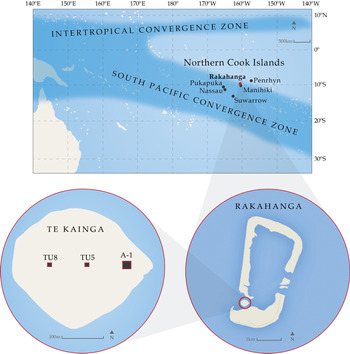
The Cook Islands (Figure 1) consist of 15 islands spread over 2,200,000 km2 of the South Pacific Ocean, lying between 8° and 23°S latitude and between 156° and 167° W longitude. The northern island group (Northern Cook Islands) consists of the coral atolls Rakahanga, Manihiki, Penrhyn, Suwarrow, and Pukapuka as well as the sandy cay Nassau. Current assessments point to human settlement of these islands after 1400 AD (Di Piazza Reference Di Piazza2005; Schmid et al. Reference Schmid, Dugmore, Foresta, Newton, Vésteinsson and Wood2018). Previous excavations on Pukapuka Atoll in the Northern Cook Islands led to some speculation over the antiquity of both humans and dogs in the island group. Radiocarbon dates on marine Tridacna shell from cultural contexts which contained dog remains returned the uncalibrated radiocarbon date range of 2240 ± 60 14C yr BP (Chikamori and Yoshida Reference Chikamori and Yoshida1988; Chikamori Reference Chikamori1998). Later, direct dating of the Pukapuka dog yielded an uncalibrated date of 240 ± 150 14C yr BP (Shigehara et. al Reference Shigehara, Matsu’ura, Nakamura and Kondo1993). Uncertainties regarding the marine contribution to the diet coupled with the low precision of the measured 14C age and the idiosyncrasies of the calibration curve during this period leave substantial doubt as to the true age of the Pukapuka dogs.
Rakahanga in reference to the current position of the South Pacific (SPCZ) and Intertropical Convergence Zones (ITCZ); Te Kainga in reference to greater Rakahanga; and the locations of the excavation units discussed herein (excavation units are not to scale). SPCZ and ITCZ locations based on Jaffrés and colleagues (Reference Jaffrés, Cuff, Rasmussen and Hesson2018).

Manihiki and Rakahanga (M&R) are coral atolls in the Northern Cook Islands located 525 km to the east of Pukapuka (Figure 1). Oral histories state that all of the inhabitants of M&R initially lived in a single village called Te Kainga on a small islet on Rakahanga. When resources ran low, the entire population is said to have voyaged 40 km to Manihiki, where they split into multiple villages. After some time, they returned to Rakahanga to reunite in the single village of Te Kainga. This process then repeated in a cyclical manner (Hiroa Reference Hiroa1932a). The first European contact on M&R seems to have occurred in 1606 AD, when Spanish explorer Pedro Fernandez de Quiros made landfall at Rakahanga. Numerous members of Quiros’ crew noted the presence of dogs on the island (Markham Reference Markham1923: 209–217; Kloosterman Reference Kloosterman1976: 12). By the time of European missionization (ca. AD 1849) dogs had been completely extirpated from M&R; later accounts state that dogs had never been present on the atolls of the Northern Cook Islands, suggesting that they were no longer a part of cultural memory (Hiroa 1932a: 83, Reference Hiroa1932b: 106; Beaglehole and Beaglehole Reference Beaglehole, Beaglehole and Bernice1938: 27).
Recent excavations at Rakahanga by Di Piazza (Reference Di Piazza2005) and the lead author in 2017 identified numerous dog remains. Many of the 33 dog skeletal elements identified by the lead author were in contexts with short-lived botanicals; others were in strata lacking these preferred dating materials. While initial dating efforts at Rakahanga focused on short-lived botanicals, the research design sought direct dates on the dog remains to avoid any possible ambiguity regarding their antiquity.
MATERIALS AND METHODS
In order to date the Rakahanga dog remains as accurately as possible, we developed a sampling strategy centered on three sample “triads.” Three archaeological contexts which contained multiple datable materials were targeted. The sample triads consisted of (1) a short-lived terrestrial plant; (2) a fragmentary marine bivalve shell; and (3) dentine extracted from a dog tooth. Each triad was selected from a unique context and each context was derived from a different excavation unit (Figure 1, Table 1). Te Kainga is a small (~300 m by 300 m) nearly circular islet on Rakahanga atoll. The stratigraphy of the low-lying TK001 site (Te Kainga) is complex and discontinuous. The strata therefore require direct dating to place into a chronological framework. Collecting triads from hearth features was not possible due to the rarity of finding all three materials in such a feature. Dog-bearing layers were considered cultural layers as dog presence is assumed to equate to human presence. Two of the three contexts (R-48 and R-60) consist of 20 cm levels of 50-cm-by-50-cm test units excavated at Te Kainga in 2017. R-48 was recovered from test unit 005 (TU5) near the center of Te Kainga, and R-60 was recovered from test unit 008 (TU8), on the western side of the islet. Both contexts were 60–80 cm below surface. R-60 also contained a pearl shell fishhook fragment. R-92 consists of a 10-cm level (~60–70 cm below surface) from unit A-1, a 2-m-by-2-m unit excavated on the east end of TK001 in 2017. This context contained three dog teeth as well as cut and drilled pearl shell artifacts. As each triad set is from a different unit and context, they are considered to be from different individual dogs, clams, and botanicals.
Results for Rakahanga sample triads.

Note: UGAMS suffix T=terrestrial sample; M=marine sample; D=dog sample. %Marine estimated from δ13C as described in text.
Sample Selection and Pretreatment
Charcoal samples from short-lived botanicals were used to help resolve issues related to the local atmospheric radiocarbon reservoir, as well as to refine local ΔR corrections. Samples consisted of the endocarp of coconut (Cocos nucifera) or Pandanus spp. drupes. These particular plant parts were selected following best practice protocols for dating botanicals in Polynesia (Allen and Huebert Reference Allen and Huebert2014). Both plants are grown and consumed by people on Rakahanga today and the parts selected for dating (endocarp and drupe) represent growth of one year or less. Botanical samples were pretreated according to an acid/base/acid (ABA) protocol and combusted at 900°C in an evacuated and sealed quartz tube in the presence of CuO to produce CO2 for AMS analysis (see AMS Methods section).
Pearl shell (Pinctada margaritifera) fragments were selected due to the prevalence of the species in archaeological context on Rakahanga. The meat of this bivalve was and is consumed on the atoll, and the shell was used to make fishhooks, fishing lures, adornments, and other items of subsistence and economic value. The shell selected was fragmentary, had no signs of human modification, and is here considered to be a product of food waste or debitage limiting concerns of inbuilt age. Shell samples were acid-etched with dilute HCl to remove the outer shell layer, which is most likely to be affected by secondary or diagenetic carbonates. Samples were reacted with 100% phosphoric acid in evacuated reaction vessels to produce CO2 for AMS analysis.
Domestic dogs (Canis familiaris) were identified with reference to the Zooarchaeology Comparative Collection at the Georgia Museum of Natural History. Teeth from three different contexts were selected for analysis. The sample selected from context R-48 (TU5) was an intact lower right adult canine, R-60 (TU8) was an intact upper left adult canine, and R-92 (A-1) was a fragmentary upper left adult second molar. Due to the provenience of the samples they are considered to be from different individuals. Gelatin was extracted from dentine following a modified Longin (Reference Longin1971) procedure that included an alkaline wash to remove humic substances. Gelatin samples were combusted at 575°C in evacuated and sealed Pyrex tubes in the presence of CuO to produce CO2 for radiocarbon dating by AMS.
AMS Methods
CO2 from botanical, shell, and gelatin samples were cryogenically purified from the other reaction products and catalytically converted to graphite using the method of Vogel et al. (Reference Vogel, Southon, Nelson and Brown1984). Graphite 14C/13C ratios were measured using 500 keV accelerator mass spectrometer at the University of Georgia Center for Applied Isotope Studies (Cherkinsky et al. Reference Cherkinsky, Culp, Dvoracek and Noakes2010). The sample ratios were compared to the ratio measured from the Oxalic Acid I standard (NBS SRM 4990). For shell samples, Carrara marble (IAEA C1) was used as the background, and travertine (IAEA C2) was used as a secondary standard. Stable isotope ratios were measured separately using a dual-inlet or elemental analyzer isotope ratio mass spectrometer (IRMS) and expressed as δ13C with respect to PDB and δ15N with respect to AIR, with an error of less than 0.1‰. The quoted uncalibrated dates are given in radiocarbon years before 1950 (years BP) and percent Modern Carbon (pMC) using the 14C half-life of 5568 years. The error is quoted as one standard deviation and reflects both statistical and experimental errors. The dates were corrected for isotope fractionation using the IRMS-measured δ13C values.
Bayesian Chronological Modeling
“Mixed” calibration curves are used in situations where a radiocarbon sample may reflect a mix of more than one carbon reservoir. For example, radiocarbon researchers around the world regularly use a mixed atmospheric/marine calibration curve for dating human or animal remains when the individual is suspected to have consumed a mix of terrestrial and marine foods (e.g., Petchey et al. Reference Petchey, Spriggs, Bedford, Valentin and Buckley2014; Fernandes et al. Reference Fernandes, Meadows and Dreves2015). More recently, Marsh et al. (Reference Marsh, Bruno, Fritz, Baker, Capriles and Hastorf2018) used a mixed atmospheric calibration curve (IntCal/SHCal) to account for the possibility of inter-hemispheric mixing of air masses in the tropics of South America, and a latitudinal gradient in atmospheric 14C concentration (Braziunas et al. Reference Braziunas, Fung and Stuiver1995). As noted by Marsh and colleagues (Reference Marsh, Bruno, Fritz, Baker, Capriles and Hastorf2018), IntCal and SHCal were constructed predominantly from samples from temperate latitudes (Hogg et al. Reference Hogg, Hua, Blackwell, Niu, Buck, Guilderson, Heaton, Palmer, Reimer, Reimer and Turney2013; Reimer et al. Reference Reimer, Bard, Bayliss, Beck, Blackwell, Bronk Ramsey, Buck, Cheng, Edwards, Friedrich, Grootes, Guilderson, Haflidason, Hajdas, Hatté, Heaton, Hoffman, Hogg, Hughen, Kaiser, Kromer, Manning, Niu, Reimer, Richards, Scott, Southon, Staff, Turney and van der Plicht2013), therefore a mixed IntCal13/SHCal13 calibration curve may be more appropriate for use in the tropics than either curve alone. Located at 10˚S, the tropical island of Rakahanga is positioned within the South Pacific Convergence Zone. The potential for atmospheric mixing between NH and SH air masses, and possible implications for radiocarbon dating, has been discussed by Petchey et al. (Reference Petchey, Allen, Addison and Anderson2009, Reference Petchey, Spriggs, Bedford, Valentin and Buckley2014: 237). Thus, the 14C content of the Rakahanga dogs may be influenced by atmospheric mixing, in addition to a mixed marine/terrestrial diet.
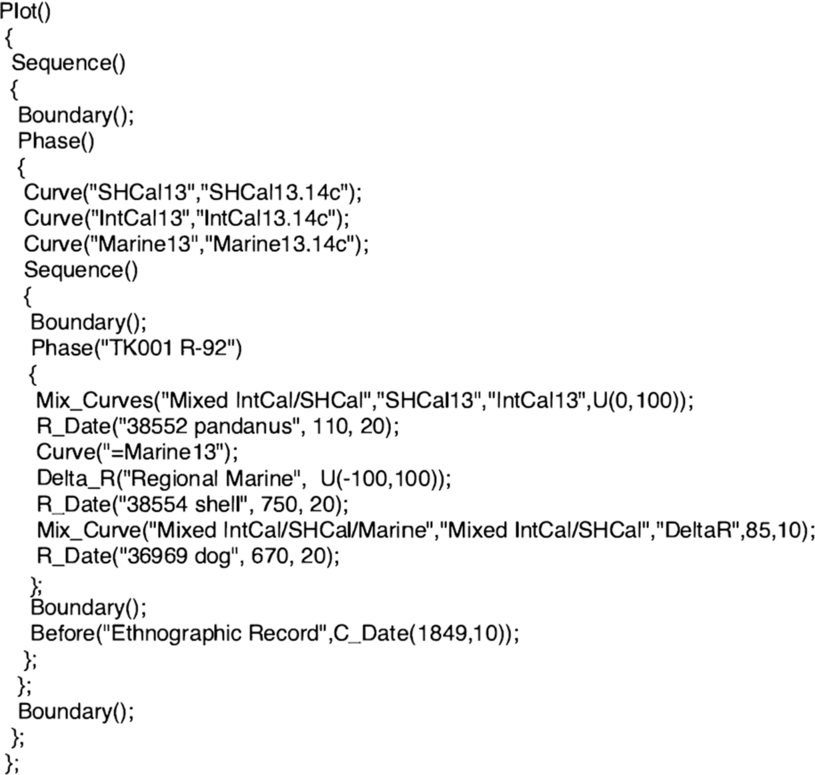
Here, we incorporate radiocarbon dates from purely terrestrial, purely marine, and mixed terrestrial/marine reservoirs, as well as parameters related to the possibility of mixing between IntCal13, SHCal13, and Marine13 calibration curves, within a Bayesian chronological framework. Models were run in OxCal 4.3 (Bronk Ramsey Reference Bronk Ramsey2009). Each sample triad was modeled as an independent uniform phase, nested within a larger phase with a TAQ of AD 1849, the year when missionaries arrived on the island, by which point dogs are thought to have been extirpated from the island group. A sample OxCal code is presented in Figure 2; full code is available as supplementary material. For botanical samples, we specified a mixed curve allowing %SHCal to take any value between 0 and 100, i.e., %SHCal ~ U (0,100). An updated estimate (posterior probability) for %SHCal is derived from the model data and other model parameters. Marine shell dates were assumed to be derived from a purely marine carbon reservoir. Petchey et al. Reference Petchey, Anderson, Hogg and Zondervan2008) report a ΔR = –2 ± 14 14C yr for the eastern portion of the Northern Cook Islands on the basis of known-age, “pre-bomb” shell specimens. To account for the added uncertainty related to temporal variations in ΔR, we specified a prior probability for ΔR ~ U(–100,100), allowing ΔR to take any value between –100 and +100 14C yr. By modeling these data together with the short-lived botanicals, an updated estimate (posterior probability) for ΔR is calculated as well.
Example OxCal code for Rakahanga sample triads.

Gelatin extracted from dog teeth was assumed to be derived from a mix of terrestrial and marine dietary protein. A new “mixed mixed” calibration curve was specified to calibrate each dog date: the IntCal13/SHCal13 mix and Marine13 (Figure 2). Stable isotopes of dog tooth gelatin were used to estimate the prior probabilities for the marine component of the mix (%Marine diet). Following Petchey et al. (Reference Petchey, Spriggs, Bedford, Valentin and Buckley2014), we used a linear mixing model for estimating the contribution of marine/reef protein to dog diet from bone collagen δ13C, using –20‰ and –10‰ as values for terrestrial and marine endmembers, respectively. An arbitrary value of ±10% was assigned for the uncertainty in the estimate of %Marine diet. Although we recognize that more sophisticated techniques for reconstructing diet from stable isotope data exist (e.g., Hopkins and Ferguson Reference Hopkins and Ferguson2012; software developed by Fernandes et al. Reference Fernandes, Millard, Brabec, Nadeau and Grootes2014), for our purposes the simple linear mixing model produces a sufficient first-approximation for the marine component of dog diet. Updated estimates for %Marine are included in model outputs as posterior probability distributions. The modeled “triads” thus account for multiple sources of uncertainty in calibrating terrestrial animal ages: atmospheric mixing; dietary sources; and ΔR offsets.
RESULTS AND DISCUSSION
Sample descriptions, stable isotope results, and measured 14C ages are presented in Table 1. The dog teeth yielded well-preserved gelatin, with yields ranging from 7–10%, and atomic C:N ratios within acceptable ranges (Ambrose Reference Ambrose1990). On the basis of δ13C gelatin, diets of dogs on Rakahanga were dominated by marine protein, with estimates ranging from 64–85% marine protein. In all three sample triads the measured 14C ages for dogs (denoted “D” in Table 1) were within 100 14C yr of associated marine materials (denoted “M”), but offset from associated terrestrial materials (denoted “T”) by ~200 14C yr or more, consistent with a predominantly marine source of carbon in dogs.
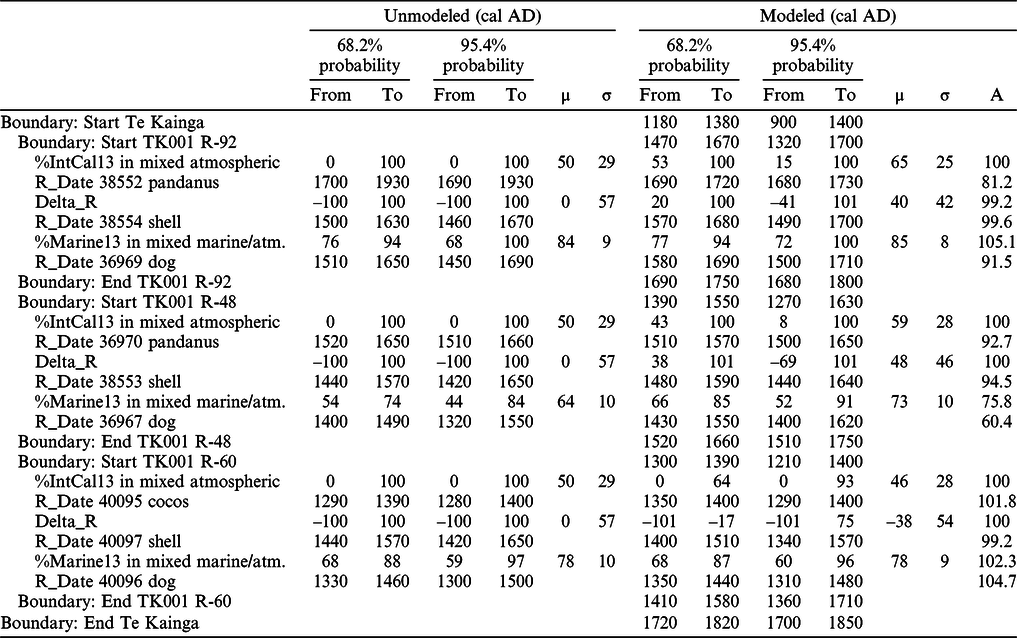
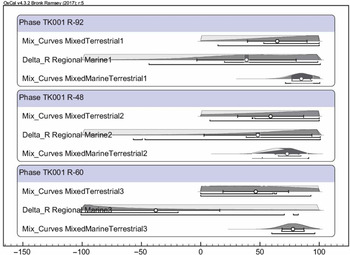
Results of the Bayesian chronological model are presented in Table 2 and Figure 3 (Modeled parameter values) and Figure 4 (modeled ages). The overall model offers OxCal diagnostic values (Amodel = 81.3, and Aoverall = 71.7) above the satisfactory threshold value of 60. The modeled local reservoir offsets at Rakahanga range from –38 to +48 14C yr (Table 2), larger in magnitude than those previously reported by Petchey and colleagues (Reference Petchey, Anderson, Hogg and Zondervan2008). Posterior probabilities for mean %IntCal13 for the atmospheric/terrestrial carbon reservoir are in the range of 46–65%; mean %Marine13 for the mixed dog diets range from 73–85% (Table 2 and Figure 3).
Model results for Rakahanga sample triads (Amodel = 81.3 Aoverall = 71.7).

Posterior probability for model parameters %IntCal13 (%), ΔR ( 14 C yr), and %Marine13 (%) with mean and sigma (open circle and whiskers) and 68% and 95% HPDs (brackets). Amodel = 81.3 Aoverall = 71.7.

Modeled calendar dates for Te Kainga village on Rakahanga with 68% and 95% HPDs (brackets). Amodel = 81.3 Aoverall = 71.7.

The 9 AMS dates place the starting boundary for the Te Kainga village at Rakahanga at cal. AD 1180–1380 (68.2% HPD). This range is earlier than the time frame of colonization for the Northern Cook Islands estimated by Schmid and colleagues (Reference Schmid, Dugmore, Foresta, Newton, Vésteinsson and Wood2018). Our starting boundary is however consistent with the general conclusion that many East Polynesian Islands were occupied at roughly AD 1150–1300 (Wilmshurst et al. Reference Wilmshurst, Hunt, Lipo, Anderson and O’Connell2011; Schmid et al. Reference Schmid, Dugmore, Foresta, Newton, Vésteinsson and Wood2018; Sear et al. Reference Sear, Allen, Hassall, Maloney, Langdon, Morrison, Henderson, Mackay, Croudace, Clarke, Sachs, Macdonald, Chiverrell, Leng, Cisneros-Dozal and Fonville2020). The model results place the earliest dog known on Rakahanga at cal. AD 1350–1440 (68.2% HPD), while the latest dog dates to cal. AD 1580–1690 (68.2% HPD) (Table 2 and Figure 4). As only a fraction of the excavated dog remains have been dated, it is unlikely that we dated the first and last pre-European dogs on the island. Additional direct dates on dog remains are needed to fully resolve the timing of introduction and extirpation of Polynesian domestic dogs in the Northern Cook Islands.
The results of this study indicate that by applying the methods described herein, researchers can identify an appropriate model for calibrating collagen-derived AMS dates for terrestrial fauna on a given island. Once this model is established for a location, the parameters can be utilized to model additional dates from terrestrial fauna recovered in context without other, more suitable, dateable materials. This allows researchers to establish or confirm the antiquity of importation and extirpation of domesticates on specific islands. While not aiming to determine first habitations, this method also provides a way to accurately date archaeologically visible human activity on individual islands by providing a means of modeling dates from human bones as well as the bones of the animals that people brought with them.
CONCLUSION
The archaeological excavations on Rakahanga produced a rich faunal assemblage which included remains of numerous domestic dogs, representing possibly the earliest examples of pre-European dogs found on East Polynesian atolls. Direct dating of dog remains is complicated by several factors, the most problematic being a mixed marine/terrestrial diet, combined with a potential for local offsets from both atmospheric and marine calibration curves. In this paper we demonstrated that robust age estimates can be obtained by (1) estimating the marine contribution to dog diet using gelatin stable isotope values, which are now routinely reported with 14C results; (2) focusing on sample triads consisting of short-lived botanicals, marine shells, and the dog bone of interest, all excavated from the same archaeological context, to constrain the marine and terrestrial offsets; and (3) combining these data along with other relevant a priori information in a Bayesian chronological model. For the case of Rakahanga, the model results suggest a “mixed–mixed” calibration curve for dogs, composed of ~75% Marine13, and 10% IntCal13, and 15% SHCal13. The resulting calendar age estimates place the earliest dog as yet identified in the Northern Cook Islands at cal. AD 1350–1440 (68.2% HPD), shortly after the initial habitation of the region. This suggests that dogs likely accompanied Polynesian voyagers as they settled new islands and created new societies.
ACKNOWLEDGMENTS
This research was completed through grants by the National Science Foundation: Grant Number 1738371 (Manihiki and Rakahanga: Persistence on the Margins of Oceania. National Science Foundation, Doctoral Dissertation Research Improvement Awards. Victor D. Thompson [P.I.] and Justin Cramb [co-P.I.]), the American Philosophical Society, the University of Georgia Graduate School, the University of Georgia Center for Archaeological Sciences, and the University of Georgia Department of Anthropology. Further thanks go to the University of Georgia Center for Applied Isotope Studies, especially Jana Carpenter and Hong Sheng, as well as Sara Lynn Cramb, Elizabeth Reitz, Lee Newsom, the Cook Islands Government, and the people of Manihiki and Rakahanga. The manuscript was significantly improved by the comments and suggestions of two anonymous reviewers.
Supplementary material
To view supplementary material for this article, please visit https://doi.org/10.1017/RDC.2020.80