Introduction
The literature on the outcome of common mental disorders is considerable, but it is patchy and variable, mainly because of diagnostic changes over the last 50 years. The general impression from many studies, originating in Eysenck's study (1952) is that about a third of those with neurotic disorders (i.e. a mixture of anxiety and depression) have a good outcome, a third an indifferent one, and a third do not improve at all. But since the 1960s the notion of neurotic disorder as a diagnosis has been discarded and its components separated into other categories; generalised anxiety disorder (GAD), panic disorder, social anxiety disorder, depressive neurosis or dysthymia and, more recently, post-traumatic stress disorder.
The reported longer-term outcomes of these individual disorders are not very different from those of the original neurotic disorder study (Eysenck, Reference Eysenck1952), with most studies showing around 50% of patients having residual symptoms after 10–15 year follow-up (Andersch & Hetta, Reference Andersch and Hetta2003; Chambers, Power, & Durham, Reference Chambers, Power and Durham2004; Klein, Shankman, & Rose, Reference Klein, Shankman and Rose2008; Rubio & López-Ibor, Reference Rubio and López-Ibor2007; Svanborg, Wistedt, & Svanborg, Reference Svanborg, Wistedt and Svanborg2008), and with poorer non-psychiatric outcomes (Remes et al., Reference Remes, Wainwright, Surtees, Lafortune, Khaw and Brayne2018; Roest, Zuidersma, & de Jonge, Reference Roest, Zuidersma and de Jonge2012). There is also genetic evidence that the similarities between these diagnoses are greater than their differences (Kendler, Reference Kendler1996). It is, therefore, reasonable to argue that the separation of the new diagnoses, despite their great popularity at the time (Klein, Reference Klein, Klein and Rabkin1981) has been of limited value and studies in which they are studied together are still justified.
One of the main deficiencies in all these follow-up studies has been the neglect of personality as an important prognostic variable. The notion of neurosis is inextricably associated with the personality characteristics of nervousness, the tendency to mood swings with recurrent depressive features, lack of self-confidence and self-esteem, a combination of pessimism and reluctance to take risks, and a tendency to engage with others in a dependent role. The general neurotic syndrome (GNS) (Tyrer, Reference Tyrer1985, Reference Tyrer1989) was formulated as the combination of mixed anxiety and depressive symptomatology (Tyrer, Reference Tyrer2001; Tyrer, Seivewright, Simmonds, & Johnson, Reference Tyrer, Seivewright, Simmonds and Johnson2001), dependent and obsessional personality features, and a history of a first-degree relative having similar symptoms. It was also postulated to have a negative impact on the outcome of anxiety and depression.
Although the name of GNS does not command wide acceptance, the concept of neuroticism, seldom defined adequately but involving both personality and symptomatic elements, is well established. GNS represents a formal acknowledgment of this in diagnostic form.
Randomised trial
Randomisation using a constrained system with allocation via sealed envelopes took place between 1983 and 1987. Details of the trial, including the results, have been published previously (Tyrer et al., Reference Tyrer, Seivewright, Murphy, Ferguson, Kingdon, Brothwell and Johnson1988). In planning the Nottingham Study of Neurotic Disorder, a study with both short and long-term outcomes it was considered appropriate to include assessments of personality status and the GNS as well as clinical symptoms.
The patients recruited were all seen in general practice psychiatric clinics in Nottingham between 1983 and 1987. These clinics were popular in the latter years of the 20th century as a means of extending community care and reducing psychiatric admissions (Tyrer, Reference Tyrer1984; Williams & Balestrieri, Reference Williams and Balestrieri1989), and they allowed people with all mental disorders to be seen at an earlier stage in their illness than would normally be the case.
A total of 210 patients were randomised to drug treatment (n = 84) (separated into the antidepressant, dothiepin [n = 28], the anti-anxiety drug, diazepam [n = 28], and placebo [n = 28]), cognitive behaviour therapy (n = 84), and self-help (n = 42). Treatments were given for 6 weeks and then tapered-off completely by the end of the trial at 10 weeks from randomisation. Inclusion criteria were (i) no active psychiatric treatment at entry, (ii) informed consent, (iii) a Diagnostic and Statistical Manual of Mental Disorders (DSM-III) diagnosis of either GAD, panic disorder or dysthymic disorder (or any mixture of these), determined by the administration of the Structured Clinical Interview for DSM-III (Spitzer & Williams, Reference Spitzer and Williams1983) and (iv) no history of other assumed independent psychiatric illness (schizophrenia, bipolar disorder or alcohol or drug addiction).
The null hypotheses in the original trial were that (i) there would be no differences in outcome between the three diagnostic groups, (ii) all randomised treatments would be equally effective and, (iii) personality status would have no impact on the outcome. The results at 10 weeks essentially supported the third of these hypotheses but not the first or the second (Tyrer et al., Reference Tyrer, Seivewright, Murphy, Ferguson, Kingdon, Brothwell and Johnson1988, Reference Tyrer, Seivewright, Ferguson, Murphy, Darling, Brothwell and Johnson1990). Patients with dysthymic disorder and those allocated to diazepam showed the least improvement, the latter finding consistent with the effects of rapid withdrawal (Murphy, Owen, & Tyrer, Reference Murphy, Owen and Tyrer1984).
Post-trial (follow-up) methodology
The primary outcome at 30 years was the absence of a DSM diagnosis of any affective (including anxiety) disorder. The 30-year hypotheses included the three above but also postulated that those with both anxiety and depressive symptoms (cothymia) and the GNS would have a worse outcome than others.
Assessments
In the original trial, the following observer and self-rating assessments were completed; (i) The Comprehensive Psychopathological Rating Scale (CPRS) (Åsberg, Montgomery, Perris, Schalling, & Sedvall, Reference Åsberg, Montgomery, Perris, Schalling and Sedvall1978), together with its subscales, the Montgomery & Åsberg Depression Rating Scale (MADRS) (Montgomery & Åsberg, Reference Montgomery and Åsberg1979) and the Brief Scale for Anxiety (BAS) (Tyrer, Owen, & Cicchetti, Reference Tyrer, Owen and Cicchetti1984) (all observer-rated), (ii) the self-rated Hospital Anxiety and Depression Scale (HADS) (Zigmond & Snaith, Reference Zigmond and Snaith1983) with its anxiety (HADS-A) and depression (HADS-D) components, (iii) the Personality Assessment Schedule (PAS) (Tyrer & Alexander, Reference Tyrer and Alexander1979), and the GNS scale (GNSS) (Tyrer, Reference Tyrer1989) (both observer-rated) with a score of 6 being the threshold for the presence of syndrome. The reliability of observer assessments was determined by training of all investigators at baseline and raters were not approved until kappa agreements of 0.8 or greater were achieved. Training in the personality assessments was carried out by PT in a similar fashion.
After the 10-week trial, the CPRS, MADRS and HADS were repeated at 16, 32, 52 and 104 weeks after entry by research assistants at face-to-face interviews, unaware of initial diagnosis or allocation. At 5 years, the assessment of services and treatment was made from case notes alone (Seivewright, Tyrer, & Johnson, Reference Seivewright, Tyrer and Johnson1998) and at 12 and 30 years, the assessments were repeated again by face-to-face interviews with HS, together with assessments of social function, the Social Functioning Questionnaire (SFQ) (Tyrer et al., Reference Tyrer, Nur, Crawford, Karlsen, MacLean, Rao and Johnson2005) and the Neurotic Disorder Outcome Scale (NDOS) (Tyrer, Seivewright, & Johnson, Reference Tyrer, Seivewright and Johnson2004), a composite measure of clinical, service and functional outcomes. A Global Outcome Scale (Seivewright et al., Reference Seivewright, Tyrer and Johnson1998) was also completed at 5, 12 and 30 years but this was computed mainly from records. Details of hospital and general practice records were examined in all patients up to 12 years but from patient report only at 30 years, but full details of these are not reported here.
Ethical approval for follow-up was granted by Northampton Research Ethics Committee (12/EM/0331).
Statistical analysis
For the present study, the designated clinical outcomes were the assessments at 12 and 30 years, and included the CPRS, MADRS, BAS, HADS-A and HADS-D scales, together with the NDOS (range: 0–10) and SFQ.
The flowchart of missing data in the cohort (Fig. 1) showed that at 12 years follow-up, 10 (4.8%) individuals missed outcome measures, and 54 (25.7%) missed outcome measures at 30 years in addition to death. Attrition analysis using logistic regression for the missing at 12 and 30 years did not find an association between the baseline personality status, DSM diagnosis, GNS and sex with missing likelihood except for older age (see ‘Results’ section). Characteristics of patients assessed at the baseline and follow-up years were similar (see Table 1 in ‘Results’ section). We hence assumed data were missing at random in the cohort. Being interested in the outcomes at 12 and 30 years in follow-up, we used multilevel models for repeated measures (Yang & Goldstein, Reference Yang, Goldstein, Engel and Reinecke1996) to estimate clinical outcomes at 12 and 30 years and compare them in different groups of patients. To increase statistical efficiency, we included outcome measures at 10, 16 and 32 weeks in addition to those at 1 and 2 years in the repeated measures model for comparing results at 12 and 30 years. We were able to include data of 207 individuals with six had one data point, nine had two data points, 7, 10, 26, 80 and 69 had three, four, five, six and full seven data points in the repeated measures model analysis. Analysis was separated into three components: (i) the long-term outcome of the randomised trial – the absence or presence of DSM diagnosis, (ii) the effect of the GNS and personality status on clinical outcomes and social function and (iii) the change in clinical outcomes by personality status over the 30-year period.
Flowchart of missing individuals for outcome assessments by follow-up time point.

Characteristics of subjects by follow-up period

a 178 cases for ICD-11 status, 189 for DSM III diagnoses and 185 cases for the rest.
b 86 cases for ICD-11 status, 89 for DSM III diagnoses and 88 cases for the rest.
c Five missing at baseline.
d Ten missing at baseline.
Raw differences in DSM diagnosis at 12 and 30 years were tested, respectively, using the χ2 test at each of the follow-up times. The joint differences at 12 and 30 years were estimated by multilevel bi-variate logistic regression model for two repeated measures and tested using the generalised Wald statistic that considered the correlations between the two-time points with adjustment for age and gender of patients. In the modelling analysis baseline GNS, personality status and DSM diagnosis were included as covariates. Using the same approach for the SFQ scale and NDOS, we used one-way analysis of variance (ANOVA) to compare raw means among levels of each of the covariates at 12 and 30 years follow-up time separately, and used a multilevel bi-variate linear regression model to join and adjust the analysis at 12 and 30 years.
For each of the clinical outcomes CPRS, MADRS, BAS, HADS-A and HADS-D, we compared raw means between levels of each covariate at 12 and 30 years using one-way ANOVA. We used multilevel growth models with random intercepts and slopes of time to estimate the effects of covariates with adjustment for age and gender, for outcomes at 12 years, 30 years and joint effects of the two-time points. The estimated difference was tested by the generalised Wald statistic.
The profiles of clinical outcomes by GNS levels, by personality status and by DSM diagnosis were displayed using raw means at baseline, 1, 2, 12 and 30 years.
We used IBM SPSS Version 19 for descriptive analysis and MLwiN V2.3 for the modelling analysis.
Results
The trial and follow-up samples
The demography and distribution of the original 210 patients as well as those available for follow-up and GNS status are shown in Table 1. There were no important differences in GNS distribution; 71 (34.6%) of the sample had the GNS. Two-thirds of the participants were female. A change was made in the diagnostic ordering after the initial trial. This came about after the hierarchical diagnostic system of DSM-III was shown to be an inappropriate interpretation of the data (Boyd et al., Reference Boyd, Burke, Gruenberg, Holzer, Rae, George and Nestadt1984). Examination of the Nottingham data, which recorded all DSM diagnoses within the neurotic spectrum, showed that most of the patients had both anxiety and depressive diagnoses. These mixed anxiety and depressed patients were then classified as cothymia (Tyrer, Reference Tyrer2001). In all subsequent analyses, we, therefore, used cothymia as an additional diagnostic group.
Of the initial 210 patients randomised, 65 had dysthymic disorder, 71 had GAD and 74 had panic disorder; analysis of the 206 using the revised data showed only 8 (4%) had pure dysthymic disorder with 71 (34%) having cothymia. For this reason, patients with dysthymic disorder were excluded in examining the effects of the initial diagnosis.
Attrition over 30 years
Over the 30-year follow-up period, there was natural attrition of the cohort. A total of 71 patients had died by 30 years and details of these have been reported by age of death being somewhat, but not significantly, earlier in those with personality dysfunction (Tyrer, Tyrer, & Yang, Reference Tyrer, Tyrer and Yang2021). Of these, 15 had the GNS. The rate of follow-up over the 30-year period was 75–94% (Table 1).
Of the 210 patients, at 5 years, 7 patients had died, 2 by suicide, at 12 years, 20 were not assessed (10 more had died) and at 30 years, 106 were not assessed and 54 more had died. The missing cases were only associated with elder age (p = 0.019 and p < 0.001) at the two follow-up periods, respectively, and not associated with sex, baseline GNS, first DSM diagnosis nor the severity of personality disorder in the logistic regression analysis for the likelihood of missing outcomes. The demographics and distributions of patients with these baseline conditions were similar at each follow-up time point (Table 1).
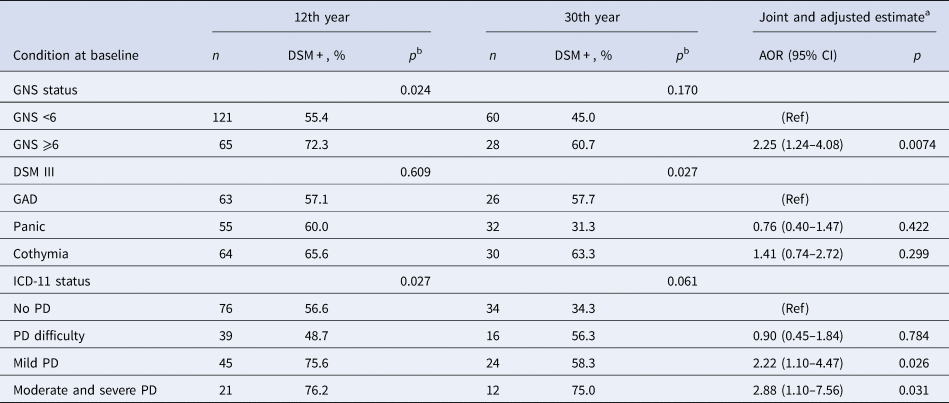
More than half of all patients had a psychiatric diagnosis at 12 and 30 years follow-up (Table 2). Those with the GNS and personality disorder had significantly higher proportions. A dose–response effect of personality dysfunction for the DSM diagnosis at 12 and 30 years was observed with linearity test χ2 at 5.41 (p = 0.020) and 6.78 (p = 0.009), respectively. The greater the severity of personality disturbance, the greater the risk of DSM positive results. The joint and adjusted odds ratio (AOR) indicated a clear two-level DSM result with no Parkinson's disease (PD) and PD difficulty patients at one level and patients with the rest PD status at a higher DSM positive risk level of 2.2–2.9 times than the former group. Patients with an initial diagnosis of panic disorder were more likely to recover to no disorder, but this was only shown at 30 years (p = 0.027).
Formal psychiatric diagnosis (DSM) at long-term follow-up points

a Odds-ratio of joint outcome for both 12 and 30 years adjusted for age and sex.
b Based on χ2 test.
Outcomes by baseline diagnostic status
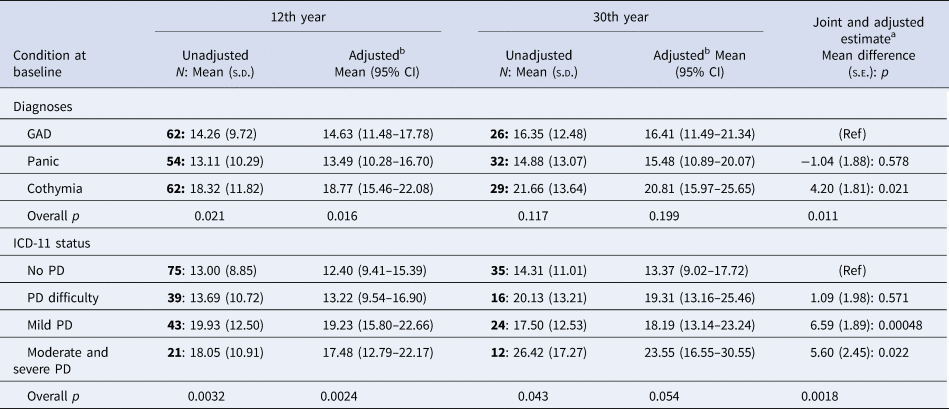
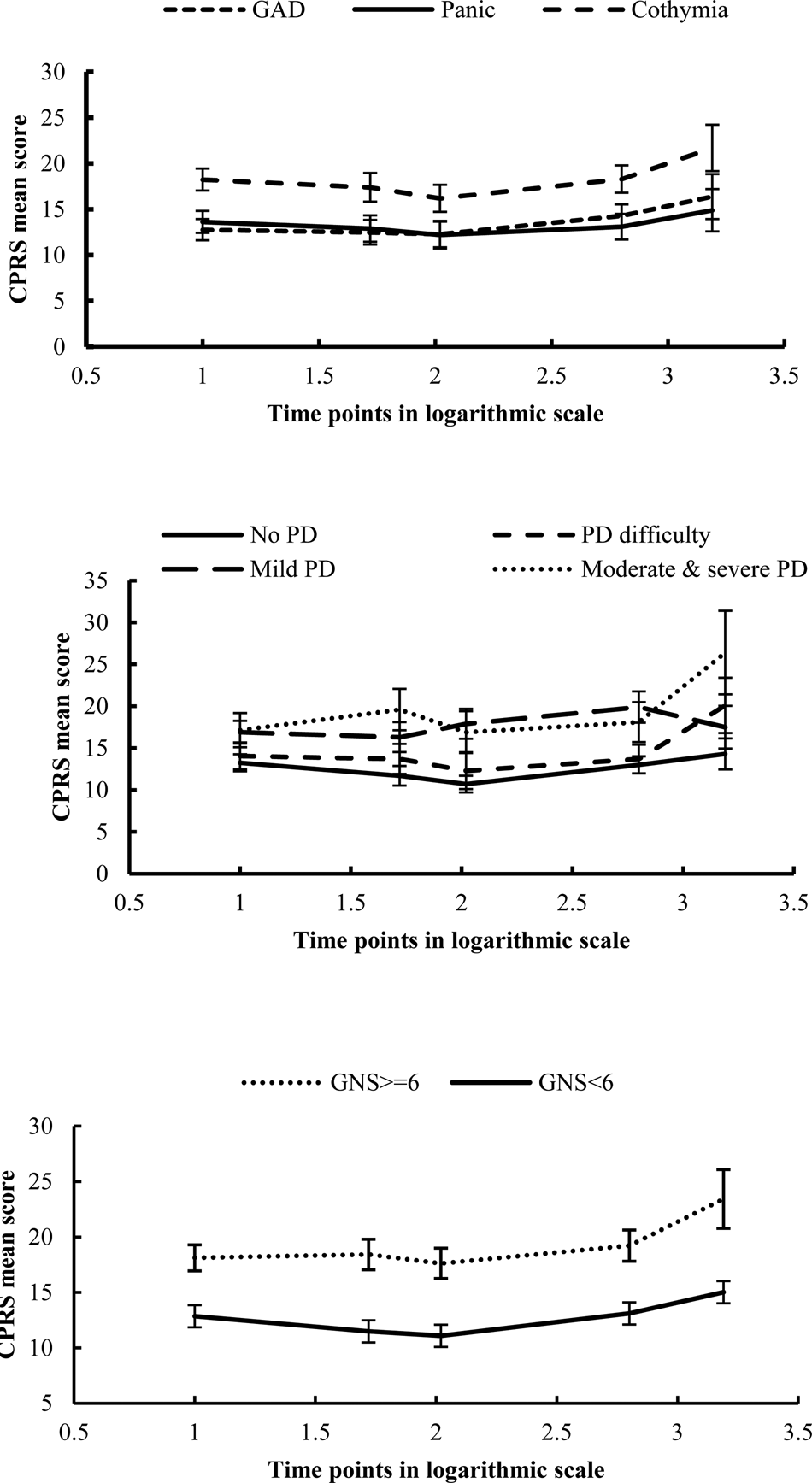
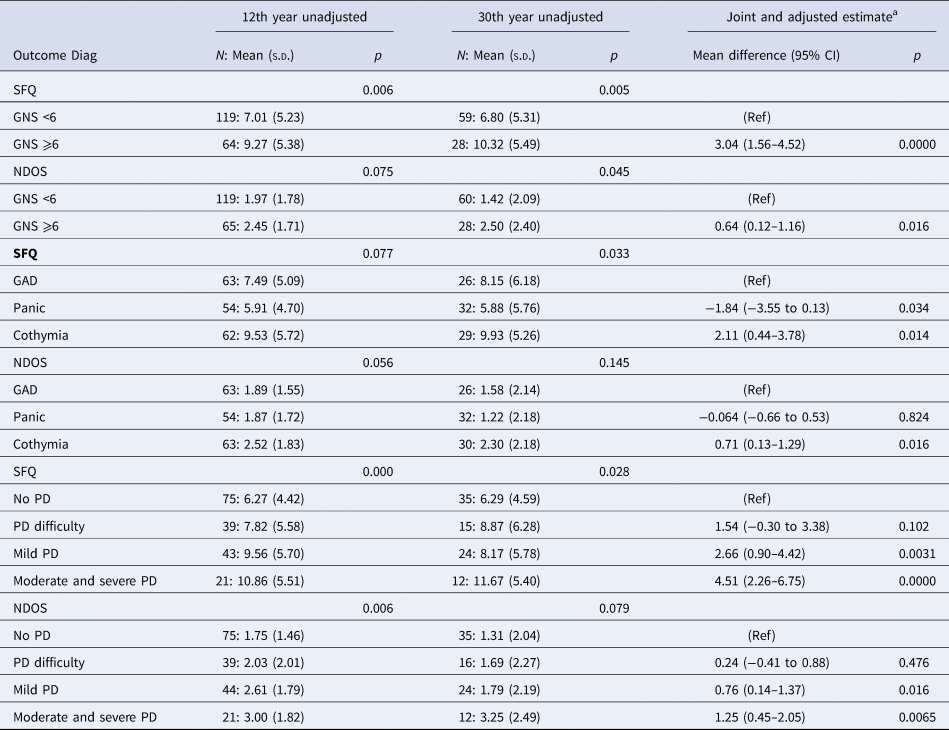
The outcome by the new division of diagnostic status showed a significantly worse outcome in those with cothymia at 30 years (Table 3 and Fig. 2), and a better outcome in patients with panic disorder at 30 years.
Total psychopathology scores (CPRS) at long-term follow-up points

a Joint outcome of 12 and 30 years, adjusted for age and sex, and conditional on measures of other time points.
b Adjusted for age and sex, and conditional on measures of other time points.
The bold values refer to the numbers in each group to help understanding of this the N.
Mean CPRS scores at follow-up times 10 weeks, 1, 2, 12 and 30 years with error bars by baseline conditions. The x-axis is shown on a logarithmic scale to allow better interpretation. NB. PD difficulty is not a personality disorder (see text).

Analysis by personality status
The assessment of personality status at baseline was made using the Personality Assessment Schedule (Tyrer & Alexander, Reference Tyrer and Alexander1979; Tyrer, Alexander, Cicchetti, Cohen, & Remington, Reference Tyrer, Alexander, Cicchetti, Cohen and Remington1979). This scores 24 personality variables, each on a 9 point scale, and converts these into an algorithm of the severity of disturbance. This is similar to the new ICD-11 severity classification of personality disorder (Tyrer, Reed, & Crawford, Reference Tyrer, Reed and Crawford2015) and in a previous study (Tyrer et al., Reference Tyrer, Crawford, Sanatinia, Tyrer, Cooper, Muller-Pollard and Weich2014) the baseline Nottingham data were reclassified independently by two observers into ICD-11 severity levels. The results showed that those with moderate or severe personality disorder had a poorer outcome than other levels of severity with the maximum differences being shown at 30 years (Table 3 and Fig. 2).
Analysis by GNS status
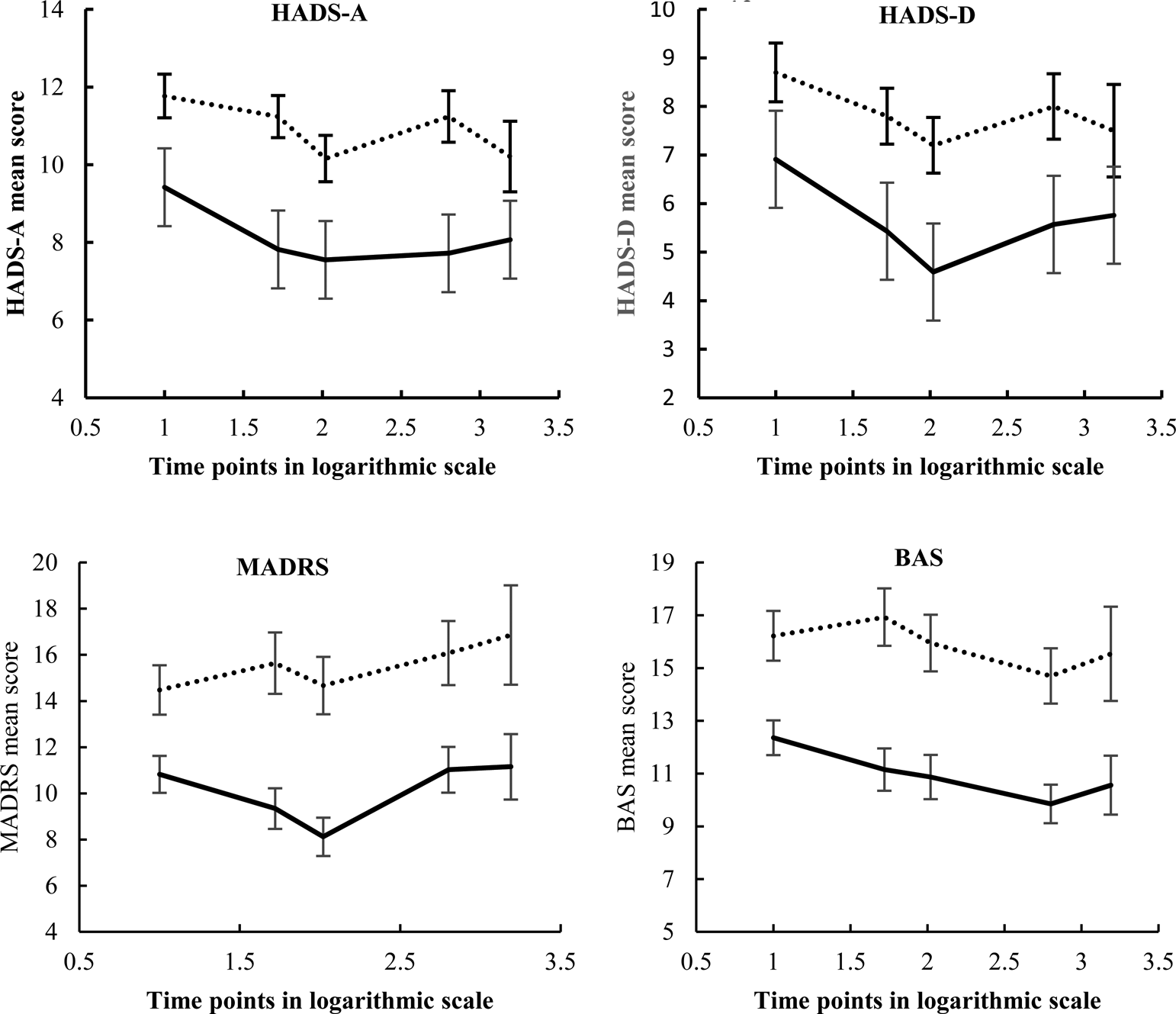
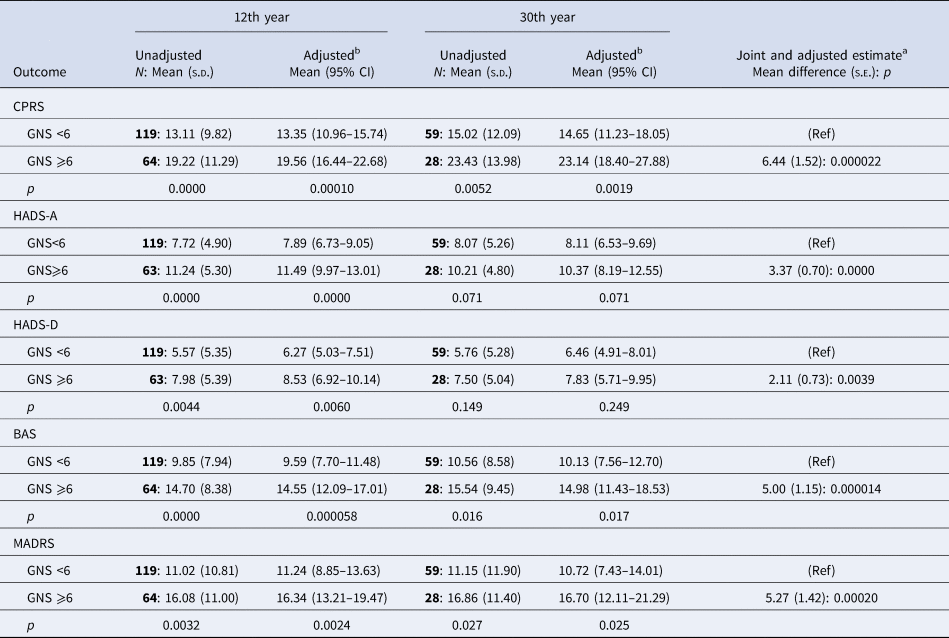
As the GNS includes both personality dysfunction and mixed anxiety depressive symptoms (cothymia), it might be expected to replicate the findings above. In general, this is borne out by the results. In general, those diagnosed with the syndrome had a poorer outcome on all clinical measures (Fig. 3 and Table 4) and this was particularly marked for total symptomatology with the CPRS (Fig. 2).
Clinical outcomes at follow-up times 10 weeks, 1, 2, 12 and 30 years by baseline GNS status with error bars (solid line for GNS <6 and dotted line for GNS ⩾6). The x-axis is shown on a logarithmic scale to allow better interpretation. Hospital anxiety and depression scale – anxiety items (HADS-A), hospital anxiety and depression scale – depression items (HADS-D), Montgomery & Åsberg depression rating scale (MADRS) and brief scale for anxiety (BAS).

Clinical outcome by GNS status at long-term follow-up points

a Joint outcome of 12 and 30 years, adjusted for age and sex, and conditional on measures of other time points.
b Adjusted for age and sex, and conditional on measures of other time points.
The bold values refer to the numbers in each group to help understanding of this the N.
Social and general functioning
Social and general functioning were assessed at 12 and 30 years follow-up but not at other times. The findings at these time points were consonant with the symptom changes over time. Patients with a baseline diagnosis of panic disorder had better functioning and overall outcome than other diagnoses and those with greater levels of personality disturbance, cothymia and the GNS had worse outcomes (Table 5).
Social function (measured by the SFQ and NDOS) at long-term follow-up points

a Estimation by bi-variate linear models and adjusted for age and sex.
Discussion
The main findings of this long-term study are unequivocal. Patients with mixed anxiety and depression (cothymia) and those with both a mood and personality disorder have a worse long-term outcome than those with a single mood disorder and no personality dysfunction. Of even more concern is the finding that most patients, apart from those with panic disorder in the latter period of study and those with no personality dysfunction, are generally unimproved at 30 years.
This paper does not include details of all the treatments given over the 30-year period. It should be added that none of the patients in this cohort received any of the existing treatments for personality disorder, most of which have been developed since the 10-week period of the trial (Bateman, Gunderson, & Mulder, Reference Bateman, Gunderson and Mulder2015). It is possible to argue that if personality status had been addressed in management the results may have been different. The combination of these mood and personality factors in the form of the GNS is also associated with a poor long-term outcome.
Because of the splitting of diagnosis that was initiated in 1980 by the introduction of DSM-III (American Psychiatric Association, 1980), the accumulating evidence that most patients with neurotic symptomatology have a poor outcome has been hidden by short-term studies prematurely suggesting lasting improvement in single disorders (Bandelow et al., Reference Bandelow, Sagebiel, Belz, Görlich, Michaelis and Wedekind2018; Hendriks, Spijker, Licht, Beekman, & Penninx, Reference Hendriks, Spijker, Licht, Beekman and Penninx2013; Nagy, Krystal, Charney, Merikangas, & Woods, Reference Nagy, Krystal, Charney, Merikangas and Woods1993), and failure to recognise that mixed anxiety–depression (cothymia) and personality traits are part of the neurotic syndrome (Hendriks et al., Reference Hendriks, Spijker, Licht, Beekman and Penninx2013; Hettema, Prescott, & Kendler, Reference Hettema, Prescott and Kendler2004; Reich, Schatzberg, & Delucchi, Reference Reich, Schatzberg and Delucchi2018). Consequently, the consensus has appeared to suggest that the outcome of anxiety and depressive disorders is generally good to variable, without recognising that the core of these conditions, the group that presents to psychiatric services, fares particularly badly in the long-term, irrespective of treatment. It is also a blind spot in our current classification system that mixed anxiety and depression (better classified as cothymia than the unfortunate acronym [MADD]) is under-recognised in clinical practice despite its obvious public health importance (Das Munshi et al., Reference Das Munshi, Goldberg, Bebbington, Bhugra, Brugha, Dewey and Prince2008).
The limitations of this study include a slightly lower follow-up rate at 30 years than at earlier times (largely because of death) and some doubts about the representativeness of the participants as they were recruited from general practice psychiatric clinics. However, of 220 patients considered eligible for the study over the recruitment period only 10 declined to take part. A strong argument can be made that this population better reflects the prevalence of common mental illness in the community (Ferguson, Cooper, Brothwell, Markantonakis, & Tyrer, Reference Ferguson, Cooper, Brothwell, Markantonakis and Tyrer1992), and the proportion of those with personality disorder in our study (34.8%) probably reflects a more accurate picture of prevalence than in psychiatric out-patients where rates are much higher (Beckwith, Moran, & Reilly, Reference Beckwith, Moran and Reilly2014). Those with personality disorder are also less likely to be referred to secondary care (Moran, Rendu, Jenkins, Tylee, & Mann, Reference Moran, Rendu, Jenkins, Tylee and Mann2001) but in general practice clinics, this barrier is removed.
The results also lead to a less robust but interesting conclusion that panic disorder, when present as a single diagnosis, has a better outcome than GAD but this only appears in the longer term. There have been few other direct comparisons between the outcomes of these conditions but one meta-analysis also suggests panic disorder has a superior outcome than GAD (Cuipers et al., Reference Cuipers, Gentili, Banos, Garcia-Campayo, Botella and Cristea2016).
As all assessments were carried out by extended face-to-face interviews by assessors unaware of initial diagnosis or treatment there is unlikely to be any bias due to prior knowledge.
The implications of these findings for practice are considerable. Despite the failure to regard the neurotic syndrome as a unity there has been increasing awareness from follow-up studies that when careful long-term follow-up is carried out the outcome of anxiety, depressive and mixed syndromes is poor and tends to be more marked when follow-up is longer (Andersch & Hetta, Reference Andersch and Hetta2003; Chambers et al., Reference Chambers, Power and Durham2004; Rubio & López-Ibor, Reference Rubio and López-Ibor2007) and this has not changed markedly despite apparent improvements in both psychological and drug treatments (Tyrer & Baldwin, Reference Tyrer and Baldwin2006; van Dis et al., Reference van Dis, van Veen, Hagenaars, Batelaan, Bockting, van den Heuvel and Engelhard2020). The interventions we provide at present are clearly not enough to lead to a significant amelioration of symptoms and better functioning. As the proportion of older people in almost all countries of the world is forecast to increase in the next 50 years the burden and suffering of many with common mental disorders are likely to increase and is likely to be aggravated by the COVID-19 pandemic (Holmes et al., Reference Holmes, O'Connor, Perry, Tracey, Wessely, Arsenault and Bullmore2020). We now need a radical change in our treatment policies. We suggest that amongst the most urgent of these is the need to address management of the personality dysfunction that shadows most patients' lives.
Acknowledgements
This study was an NIHR Clinical Research Network (CRN) Portfolio Study. It was supported by grants from the Mental Health Research Foundation, Jessie Spencer Trust, Greater Manchester NHS Trust, Nicola Pigott Memorial Fund, and the Trent Regional Health Authority. Sir Richard Doll was a trial adviser and gave core advice about outcome measures, Gene Paykel provided strong encouragement at the beginning of the study, and Robert Spitzer gave valuable diagnostic advice over the interpretation of comorbid data from the Structured Clinical Interview for DSM-III. We thank Paul Barczak, Judith Brothwell, Claire Darling, Brian Ferguson, Susan Gregory, David Kingdon, Siobhan Murphy and Nicholas Seivewright for their diligence in assessing participants, Stephen Tyrer, John Rees, Celia Timson and Ann Gell for trial coordination, and Sylvia Teale and NHS Digital for help in tracing patients and determining date and causes of death.
Role of authors
All authors approved the paper and helped in drafting. PT initiated the study and follow-up and the writing of the paper. HT coordinated the follow-up and carried out most of the later assessments, TJ carried out all the data analyses from baseline to 12 years when working at the Medical Research Council's Biostatistics Unit, Cambridge, and MY carried out the 30-year analysis with some interpretation from TJ.
Conflict of interest
PT was the Chair of the World Health Organisation's ICD-11 Revision Group for the Reclassification of Personality Disorders (2010–2017). The other authors have no relevant interests to declare.