Introduction
The rapid adoption of glyphosate-resistant crops since their introduction in 1996 and the heavy reliance on glyphosate for weed control since that time have selected for glyphosate-resistant weed species, and predominantly glyphosate-resistant Amaranthus species, in U.S. corn (Zea mays L.), soybean, and cotton (Gossypium hirsutum L.) production. Two of the best practices for herbicide-resistant weed management are to start with a weed-free field and to use multiple effective herbicide mechanisms of action (Norsworthy et al. Reference Norsworthy, Ward, Shaw, Llewellyn, Nichols, Webster, Bradley, Frisvold, Powles, Burgos, Witt and Barrett2012). Both of these practices can be achieved in soybean through the use of a PRE residual herbicide. The use of PRE residual herbicides has been shown to reduce the densities of glyphosate-resistant Amaranthus species in soybean (Bradley Reference Bradley2013; Legleiter et al. Reference Legleiter, Bradley and Massey2009; Schultz et al. Reference Schultz, Myers and Bradley2015), and their use has been increasing in recent years. For example, in 1996 the dinitroaniline herbicides were used on slightly more than 11 million ha, but by 2012 approximately 23 million ha were treated with these same herbicides (USDA 2016a). In 2006, only 31,752 kg of sulfentrazone were applied in the United States, whereas 9 yr later sulfentrazone use had risen to 1.1 million kg, making it the second most heavily used herbicide in soybean (USDA 2016b, 2017).
Flumioxazin and sulfentrazone are both PRE residual herbicides that are protoporphyrinogen oxidase (PPO) inhibitors and are commonly used in soybean production but have the potential to injure soybean, especially in cool, wet conditions. Soybeans are typically able to metabolize these herbicides, but in cool and wet conditions the plant’s metabolism slows and injury can occur (Wise et al. Reference Wise, Mueller, Kandel, Young, Johnson and Legleiter2015). The injury is often greatest following a heavy rain event; droplets of concentrated herbicide that were applied to the soil can splash up onto the soybean leaf causing necrotic lesions (Wise et al. Reference Wise, Mueller, Kandel, Young, Johnson and Legleiter2015). Previous research suggests that soybean cultivars respond differently to sulfentrazone (Dayan et al. Reference Dayan, Weete, Duke and Hancock1997; Hulting et al. Reference Hulting, Wax and Stoller1997; Swantek et al. Reference Swantek, Sneller and Oliver1998; Zhaohu et al. Reference Zhaohu, Walker and Wehtje1997). Dayan et al. (Reference Dayan, Weete, Duke and Hancock1997) found that the metabolic degradation of sulfentrazone in soybean is a major factor for imparting tolerance, as well as the differential intrinsic ability of each cultivar to overcome herbicide-induced peroxidative stress. According to Hulting et al. (Reference Hulting, Wax, Nelson and Simmons2001), the greatest indicator of soybean intolerance to sulfentrazone is soybean height, with some cultivars having height reductions up to 71% when treated with 280 g ai ha–1 PRE. However, very few seed companies rate their soybean varieties to tell consumers whether the variety is tolerant or susceptible to PPO-inhibiting herbicides.
Some of the first commercially available seed treatments were in a dust form, but these were hazardous to the applicator and often did not adequately coat the entire seed (Buttress and Dennis Reference Buttress and Dennis1947; Anonymous 2016b). A liquid form of seed treatment first became available in 1946 that increased uniform seed coverage, improved seed flow ability, and allowed for visual identification through coloring (Anonymous 2016b). In 1985, Bayer synthesized the insecticide imidacloprid, one of the first-generation neonicotinoids, and soon thereafter it was made available as an insecticide seed treatment in 1991 (Maienfisch et al. Reference Maienfisch, Brandl, Kobel, Rindlisbacher and Senn1999). Since that time, many other insecticides, fungicides, and nematicides have been introduced into the seed treatment market so as to protect crops from a variety of pests (Anonymous 2016b). The use of seed treatments has risen dramatically and is currently the fastest growing agriculture chemical sector (Anonymous 2013). In 1997, global seed treatment sales were estimated at US $700 million. By 2011, the seed treatment market was valued at US $2.43 billion, with fungicides accounting for 35% and insecticides accounting for 52%. By 2018, the global seed treatment market is expected to reach US $5.6 billion (Anonymous 2013). Many attribute this increase to growth in farm sizes, conservation, and no-tillage planting, all of which are likely to increase disease and insect problems, as well as earlier planting in cool wet conditions (Houghton Reference Houghton2004; Anonymous 2013).
The fungus Fusarium virguliforme O’Donnell & T. Aoki causes sudden-death syndrome of soybean, resulting in yield loss of up to 80% in susceptible varieties (Roy et al. Reference Roy, Hershman, Rupe and Abney1997). Fluopyram is a succinate dehydrogenase–inhibiting fungicide seed treatment currently on the market for the management of sudden death-syndrome in soybean (Kandel et al. Reference Kandel, Mueller, Legleiter, Johnson, Young and Wise2018; Wise et al. Reference Wise, Mueller, Kandel, Young, Johnson and Legleiter2015). It is known that this seed treatment can cause a “halo effect” on soybean, which manifests itself as a discoloration and necrosis on the tips of the cotyledons. This injury happens because the fungicide is systemic within the plant; it accumulates in the roots and cotyledons and causes phytotoxicity (Wise et al. Reference Wise, Mueller, Kandel, Young, Johnson and Legleiter2015). These conditions resemble the damage that can occur when PRE PPO herbicides are applied in cool wet conditions. Moreover, farmers and agribusiness industry consultants have reported greater phytotoxicity associated with fluopyram on soybean seedlings when certain PRE herbicides were applied to soybeans. Because of the increasing use of PRE herbicides for broadleaf weed control, this increased phytotoxicity is concerning to the farmers.
The objectives of this research were (1) to determine whether any interactions exist between varieties, PRE residual herbicides, and commercially available seed treatments in soybean; and (2) to determine whether any potential interactions lead to stand loss, height and/or biomass reduction, and yield loss.
Materials and Methods
Experimental Site Location and Design
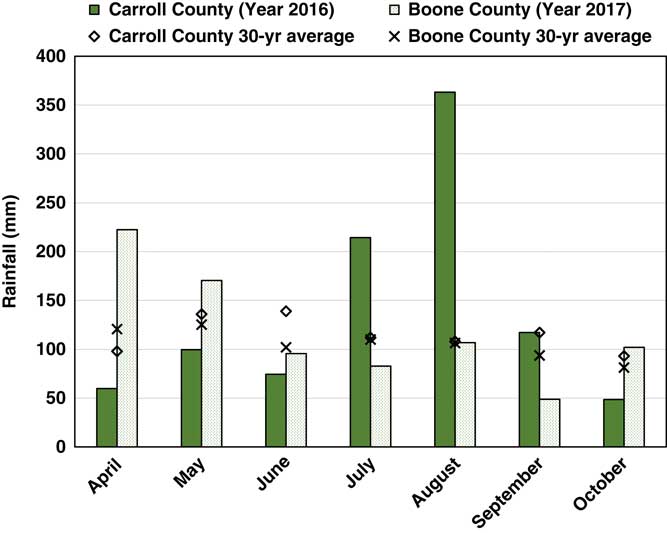
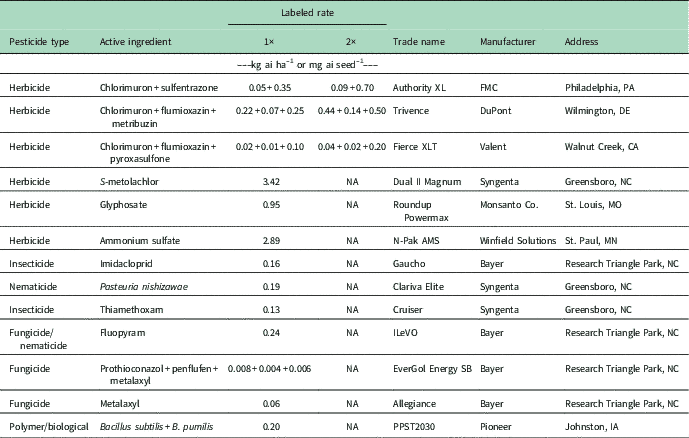
A field experiment was conducted in 2016 in Carroll County, Missouri (39.57°N, –93.33°W) and was repeated in 2017 at a site in Boone County, Missouri (38.90°N, –92.21°W). Both sites had been in a corn–soybean rotation for several years, and the previous year’s crop was corn. Glyphosate-resistant soybean seed were planted at a density of 370,000 seeds ha–1 in rows spaced 76 cm apart at the Carroll County and Boone County sites on May 6 and April 21 in 2016 and 2017, respectively. The soil at the Carroll County site was a Grundy silt loam and a Lagonda silty clay loam with organic matter of 3.2% and a pH of 5.9. The soil at the Boone County site was a Mexico silt loam with 2.2% organic matter, and a pH of 6.5. Monthly rainfall totals, as well as the 30-yr average for each site, are presented in Figure 1. Source and rates of all pesticides used in the experiments are presented in Table 1.
Monthly rainfall (mm) in comparison to the 30-yr average from April through October at the Carroll County (2016) and Boone County (2017) research locations. Data obtained from National Climatic Data Center (www.ncdc.noaa.gov).

Sources and labeled ratesFootnote a of materials used in the experiments.

a Abbreviation: NA, not applicable
The experiments were established as a randomized complete block design with six replications, with a factorial arrangement of two varieties, four seed treatments, and four herbicides. Individual plots measured 2 by 9 m. Two varieties of soybean were planted: Pioneer P34T07R2, a variety described as sensitive to PPO-inhibiting herbicides; and Pioneer P35T58R, a variety with tolerance to PPO-inhibiting herbicides (Anonymous 2016a). Seed of each variety were treated by the manufacturer with three separate seed treatment mixtures (STMs). With the exception of one treatment of each variety that received no seed treatment, all seed was treated with a standard treatment mixture of prothioconazol+penflufen+metalaxyl plus metalaxyl plus Bacillus subtilis+B. pumilis, in addition to being treated with either STM1 (imidacloprid), STM 2 (Pasteuria nishizawae+thiamethoxam), and STM3 (fluopyram+imidacloprid). The nontreated seed of each variety were included for comparison. Each variety and seed treatment combination received 1× and 2× rates (see Table 1) of PRE herbicide treatments: (1) chlorimuron-ethyl+flumioxazin+pyroxasulfone, (2) chlorimuron-ethyl+flumioxazin+metribuzin, and (3) chlorimuron-ethyl+sulfentrazone. A nontreated control was also included for comparison, and these plots were maintained weed-free with a PRE application of 1.71 kg ai ha–1 S-metolachlor (0.5× labeled rate) and hand weeding. The trial was maintained weed-free through applications of glyphosate (0.95 kg ai ha–1), and escapes were removed manually throughout the growing season. All herbicide treatments were applied with a CO2-pressurized backpack sprayer calibrated to deliver 140 L ha–1 with XR8002 flat-fan nozzles at 117 kPa at a constant speed of 5 km ha–1. All PRE herbicide treatments were applied at or just prior to planting.
Data Collection
Crop injury, stand counts, leaf area, plant height, and biomass were taken 30 d after emergence (DAE) in the two innermost rows of each plot. Crop injury evaluations were assessed on a scale of 0 to 100%, where 0 represented no crop injury and 100% was equivalent to complete plant death. Stand counts were assessed by counting the number of living plants in two 1-m lengths of the two innermost treated rows in each plot. Soybean plant height was recorded by measuring five representative plants from each plot from the soil surface to the top of the uppermost fully expanded trifoliate. These same five plants were harvested at the soil surface, and biomass readings were taken by drying plants for 5 d at 50 C in a forced-air oven (JPW Industrial Ovens and Furnaces, Trout Run, PA) and expressing biomass as a percentage of the nontreated control. Leaf area was determined with a Li-Cor 3000 Portable Area Meter (Li-Cor, Lincoln, NE) and expressed as a percentage of the nontreated control. The yield was determined by harvesting the two innermost soybean rows within each plot with a small-plot combine (Kincaid®, Haven, KS), and moisture was adjusted to 13%.
Statistical Analysis
All data were analyzed with PROC GLMMIX in SAS (SAS 9.4; SAS® Institute Inc. Cary, NC). Soybean varieties, herbicides, seed treatments, and year were considered as fixed effects, whereas replication was considered a random effect. Individual treatment differences were separated using Fisher’s protected LSD (α=0.05). Significant interactions were present between years (P≤0.05); therefore, all data are presented separately by year.
Results and Discussion
Injury
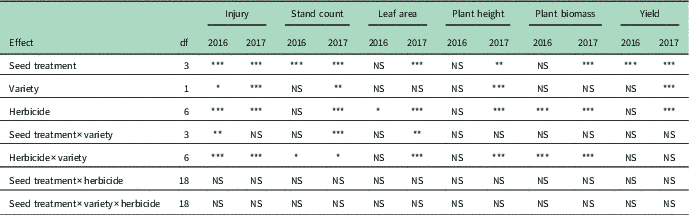
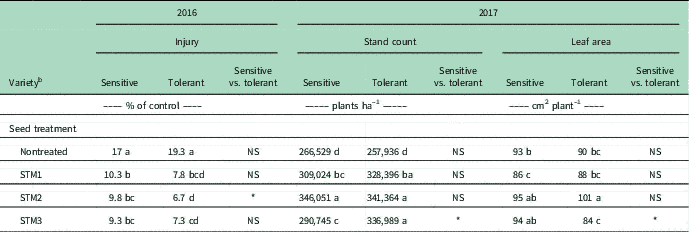
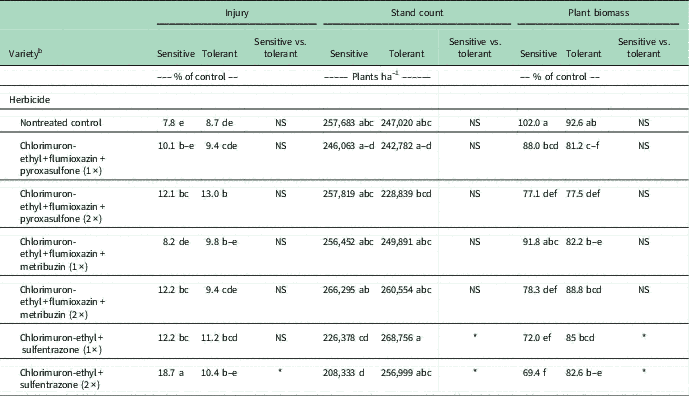
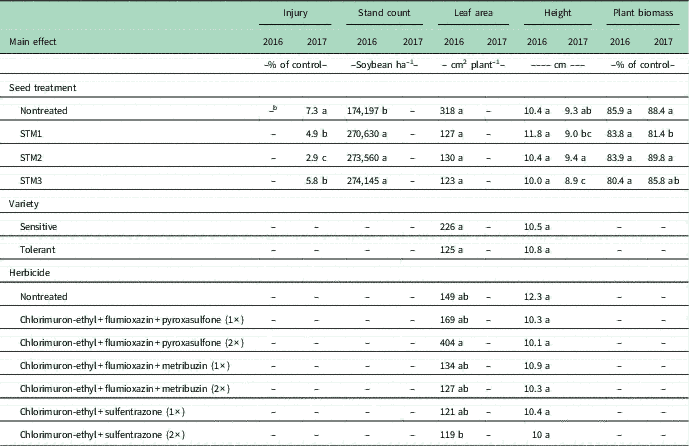
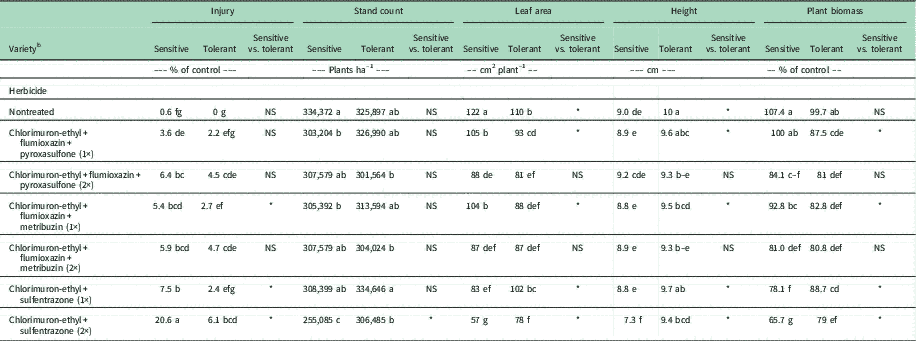
There was an herbicide×variety interaction for visible soybean injury during both years (P≤0.001), and a seed treatment×variety interaction (P≤0.01) for 2016 only (Table 2). No other interactions were present within each year. In 2016, when comparing the seed treatments across each variety, the nontreated control had the greatest injury for both varieties at 30 DAE (Table 3). This may be due to conditions that were ideal for seedling diseases. However, the STM2 treatment (Table 3) and chlorimuron-ethyl+sulfentrazone treatment at the 2× rate (Table 4) resulted in greater soybean injury at 30 DAE to the seedlings of sensitive soybean than tolerant soybean. When comparing the herbicide treatments across each variety, herbicide injury was highest with 2× rates of chlorimuron-ethyl+sulfentrazone and chlorimuron-ethyl+flumioxazin+pyroxasulfone in susceptible and resistant varieties, respectively (Table 4). The chlorimuron-ethyl+sulfentrazone treatment at the 2× rate resulted in highest injury (19%) to the sensitive variety, which was the highest injury observed from any herbicide treatment. As in 2016, when averaged across all varieties and herbicides, nontreated seeds led to greater soybean injury than the seeds that were treated with the STMs at 30 DAE in 2017 (Table 5). This is probably a result of conditions that were ideal for seedling diseases to form, and the nontreated seed suffered more injury than the treated seed. When comparing the herbicide treatments across each variety, similar to 2016, herbicide injury was greatest with the 2× rates of chlorimuron-ethyl+sulfentrazone in both susceptible and resistant varieties in 2017. Greater injury was observed in the sensitive variety compared to tolerant when treated with chlorimuron-ethyl+sulfentrazone at both rates and chlorimuron-ethyl+flumioxazin+metribuzin at the 1× rate (Table 6). Overall, more injury may have been observed in 2017 than 2016 as a result of higher amounts of early-season rainfall (Figure 1). Boone County received 163, 71, and 21 mm more rainfall in April, May, and June of 2017, respectively, than Carroll County in 2016 (Figure 1). Herbicides such as metribuzin and flumioxazin have been shown to injure soybean, and that injury can be enhanced with excessive moisture (Coble and Schrader Reference Coble and Schrader1973; Taylor-Lovell et al. Reference Taylor-Lovell, Wax and Nelson2001).
Summary of effects for the injury, stand count, leaf area, plant height, and biomass of soybean 30 d after emergence, and soybean yield at harvest in 2016 and 2017.Footnote a

a Abbreviation: NS, no significant differences at α=0.05.
*Significant differences at α=0.05; ** significant differences at α=0.01; *** significant differences at α=0.001.
Interaction effects of seed treatment×variety on soybean injury in 2016, and soybean stand count and leaf area 30 d after emergence in 2017.Footnote a

a Means in the same column followed by the same letter are not different, α=0.05.
b Abbreviation: NS, no significant differences at α=0.05; STM1, STM2, STM3, seed treatment mixtures (see text for details).
Interaction effects of herbicide×variety on soybean injury, stand count, and plant biomass 30 d after emergence in 2016.Footnote a

a Means in the same column followed by the same letter are not different, α=0.05.
b Abbreviation: NS, no significant differences at α=0.05.
*Significant differences at α=0.05.
Main effects of varieties, herbicides, and seed treatments on injury, stand count, leaf area, height, and biomass of soybean 30 d after emergence in 2016 and 2017.Footnote a

a Means in the same column followed by the same letter are not different, α=0.05.
b Values of response variables are represented by “–” due to significant interactions between main effects.
Interaction effects of herbicide×variety on soybean injury, stand count, leaf area, height, and biomass 30 d after emergence in 2017.Footnote a

a Means in the same column followed by the same letter are not different, α=0.05.
b Abbreviations: NS, no significant differences at α=0.05.
*Significant differences at α=0.05.
Soybean Density
There was an herbicide×variety interaction for soybean stand counts during both years (P≤0.05), and a seed treatment×variety interaction (P≤0.001) for 2017 only (Table 2). No other interactions were present within each year. In 2016, when averaged across variety and herbicide, there was a 36% reduction in soybean stand when seeds were not treated (Table 5). When comparing the herbicide treatments across each variety, chlorimuron-ethyl+sulfentrazone at both rates resulted in the lowest soybean stand count in the sensitive variety, whereas the tolerant variety did not show any significant stand reduction (Table 4). In 2017, when comparing the seed treatments across each variety, soybean stands were highest when both varieties (sensitive and tolerant) were treated with STM2 than with any other variety–seed treatment combination (Table 3). However, the STM3 resulted in further reduction of stand count up to 50,000 plants ha–1 compared to STM2––probably as a result of the seed treatment itself or possibly spatial variability within the experiment. Bradley et al. (Reference Bradley, Wax, Ebelhar, Bollero and Pedersen2001) reported that treatment of seed with fungicide protectants resulted in a 6% increase in soybean stand when compared to nontreated seed in a no-till situation. As in 2016, the stand counts were significantly lower when soybean seeds (sensitive or tolerant variety) were not treated with any STM in 2017. It was also observed that STM3 treatment resulted in greater stand reduction in sensitive variety than tolerant variety. Bradley (Reference Bradley2008) showed that in cool wet conditions, soybean seed treatments that contain fungicides such as azoxystrobin+metalaxyl and Bacillus pumilus GB34 can increase soybean stand by more than 14% and more than 7%, respectively, compared to nontreated seed. However, in warmer and dryer conditions, the seed treatments containing fungicides such as azoxystrobin+metalaxyl and Bacillus pumilus GB34 can decrease soybean stand by more than 16% and more than 4%, respectively, when compared to nontreated seed. When comparing the herbicide treatments across each variety, the majority of the herbicide treatments showed no significant reduction in stand of the tolerant variety (Table 6). However, chlorimuron-ethyl+sulfentrazone at the 1× rate resulted in the highest stand for both varieties, but the 2× rate resulted in significant stand reduction of the sensitive variety. Reiling et al. (Reference Reiling, Simmons, Riechers and Steckel2006) reported that soybean cultivars that are known to be sensitive to sulfentrazone can have up to a 20% stand reduction when sulfentrazone is applied PRE at twice the labeled use rate. When the same rate of sulfentrazone was applied to a cultivar that is tolerant to sulfentrazone, the stand was only reduced by 12%. Burnside (Reference Burnside1972) has also shown that herbicides sprayed at higher than labeled rates have the potential to reduce soybean stand (Burnside Reference Burnside1972; Swantek et al. Reference Swantek, Sneller and Oliver1998).
Leaf Area
No interactions (P>0.05) were present between seed treatment, varieties, and herbicides for soybean leaf area in 2016 (Table 2). In 2017, there were a seed treatment×variety (P≤0.01) and herbicide×variety (P≤0.001) interactions for soybean leaf area. In 2016, there were no differences in soybean leaf area between seed treatments and varieties (Table 5). However, chlorimuron-ethyl+sulfentrazone at the 2× rate resulted in the greatest reduction in leaf area; this result is consistent with injury and stand counts. In 2017, when comparing the seed treatments across each variety, few differences were observed between seed treatments except STM1 for the sensitive variety and STM2 for the tolerant variety (Table 3). STM1 resulted in the greatest reduction in leaf area for the sensitive variety, whereas STM2 resulted in the highest leaf area for the tolerant variety. However, the effects were not consistent among years. When comparing the herbicide treatments across each variety, all herbicide treatments caused leaf area reduction in both varieties compared to the nontreated control (Table 6). Chlorimuron-ethyl+sulfentrazone at the 2× rate resulted in the greatest reduction in leaf area for both varieties. Because the sensitive variety displayed more injury, it was to be expected that the sensitive variety would have a smaller leaf area than would the tolerant. The effects of treatment of chlorimuron-ethyl+sulfentrazone at the 2× rate were consistent in both years. Salzman and Renner (1992) also showed that herbicides such as metribuzin, when applied at 420 g ha–1, can reduce soybean leaf area by as much as 44%.
Plant Height
In 2016, no interactions (P>0.05) were present between seed treatment, varieties, and herbicides for soybean plant height; however, there was an herbicide×variety interaction (P≤0.001) in 2017 (Table 2). There were no differences between any of the factors in 2016 (Table 5). In 2017, when averaged across all varieties and herbicides, the STM3 seed treatment resulted in the greatest reduction in plant height (Table 5). Wise et al. (Reference Wise, Mueller, Kandel, Young, Johnson and Legleiter2015) indicated that seed treatments containing fluopyram are known to cause early-season injury to soybean, and one of those injury symptoms could be height reduction. When comparing the herbicide treatments across each variety, there was more soybean height reduction in the sensitive than in the tolerant variety (Table 6). In comparison to the nontreated, chlorimuron-ethyl+sulfentrazone at the 2× rate resulted in significant height reductions in both varieties, but this reduction was more evident in the sensitive (19%) compared to the tolerant (6%) variety. Dayan et al. (Reference Dayan, Weete, Duke and Hancock1997) reported that soybean cultivars respond differently to sulfentrazone, and height can be reduced by as much as 58% and 77% when exposed to 2× and 3× rates, respectively. Soybean cultivars respond differently to sulfentrazone, and soybean height is a better indication of injury than biomass (Hulting et al. Reference Hulting, Wax and Stoller1997; Swantek et al. Reference Swantek, Sneller and Oliver1998). Swantek et al. (Reference Swantek, Sneller and Oliver1998) showed that soybean height was reduced by as much as 48% in a susceptible variety and only 22% in a tolerant variety with 0.56 kg ai ha–1 sulfentrazone.
Plant Biomass
There was an herbicide×variety interaction for soybean biomass during both years (P≤0.001), but there were no other interactions present in either year (Table 2). When averaged across all variety and herbicide treatments, there were no differences in soybean plant biomass between various seed treatments in both years, but STM1 resulted in 5% to 9% reduction in plant biomass in 2017 (Table 5). In 2016, when comparing the herbicide treatments across each variety, all herbicide treatments reduced soybean plant biomass of the sensitive variety compared to the nontreated control (Table 4). However, only chlorimuron-ethyl+flumioxazin+ pyroxasulfone reduced the plant biomass of the tolerant soybean as much as 16% compared to the nontreated control. In 2017, the majority of the herbicide treatments reduced soybean plant biomass of both varieties compared to the nontreated control (Table 6). Chlorimuron-ethyl+sulfentrazone resulted in greater biomass reduction of the sensitive compared to the tolerant variety during both years (Table 4 and Table 6).
Soybean Yield
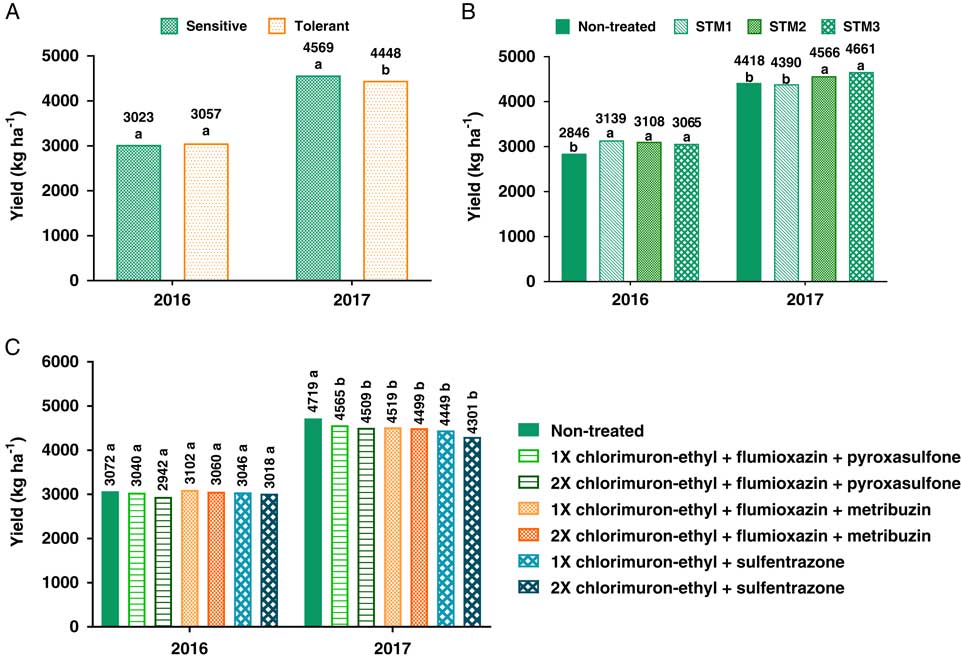
No interactions (P>0.05) were present between seed treatments, varieties, and herbicide treatments for soybean yield during both years (Table 2). In 2016, even though some injury was observed, as well as reduction in soybean stand and biomass, none of these effects resulted in differences in soybean yield among varieties (Figure 2A) and herbicide treatments (Figure 2C). However, when averaged across varieties and herbicide treatments, all seed treatments resulted in greater soybean yield compared to the nontreated control (Figure 2B). In 2017, however, there were significant differences in soybean yield due to varieties, seed, and herbicide treatments (Figure 2). Interestingly, the sensitive variety yielded 121 kg ha–1 more than the tolerant variety, indicating that the injury and reduction in soybean stand and biomass did not significantly influence soybean yield (Figure 2A). When averaged across variety and herbicide treatments, all seed treatments except STM1 resulted in significantly greater soybean yield compared to nontreated control (Figure 2B). For both varieties and seed treatments, the sulfentrazone-containing treatments at the 2× rate resulted in the highest yield losses (Figure 2C). Studies have shown that soybean cultivars respond differently to sulfentrazone applied PRE to soybean and that it can lead to significant yield reductions (Belfry et al. Reference Belfry, Shropshire and Sikkema2016; Reiling et al. Reference Reiling, Simmons, Riechers and Steckel2006; Swantek et al. Reference Swantek, Sneller and Oliver1998). Belfry et al. (Reference Belfry, Shropshire and Sikkema2016) reported yield losses of 32% in one cultivar of soybean and only 5% in another when 840 g ha–1 of sulfentrazone was applied PRE. Swantek et al. (Reference Swantek, Sneller and Oliver1998) also showed that different soybean cultivars react differently to sulfentrazone, and that yield can be reduced by as much as 28% when 560 g ha–1 of sulfentrazone is applied PRE.
Main effects of varieties (A), seed treatments (B), and herbicides (C) on soybean yield in 2016 and 2017. Within each year, the same letter above the column are not different, α=0.05.

The results from this research suggest that there is a larger interaction between herbicides and varieties than there is between seed treatments and varieties, or seed treatments and herbicides. Injury, stand count reduction, and plant height reduction was greater in the sensitive compared to the tolerant variety but did not affect soybean yield. Taylor-Lovell et al. (Reference Taylor-Lovell, Wax and Nelson2001) found similar results when studying soybean recovery from PRE applications of flumioxazin- or sulfentrazone-treated soils. The plants recovered from early-season injury and low stand counts to yield similarly to the nontreated control. In the current research, plant biomass was also reduced in the sensitive variety when treated with herbicide; however, no yield loss was observed. This is in contrast to results published by Swantek et al. (Reference Swantek, Sneller and Oliver1998), in which sensitive soybean cultivars utilized across two site-years had reduced biomass relative to nontreated controls and were associated with lower yields. The differences between the two studies could be due to improvements in soybean genetics over the last two decades, to environmental influences and stresses, or some combination of these. In this research, no seed treatment performed better or worse consistently during both years, even though it is known that fluopyram can cause early-season soybean seedling damage commonly referred to as the “halo effect” (Wise et al. Reference Wise, Mueller, Kandel, Young, Johnson and Legleiter2015). In the present study, early-season fluopyram damage did not affect soybean yield, and no interactions were observed between seed treatments and herbicides that led to yield loss, even when soybeans were planted in cool, wet, conditions and encountered 2× rates of these herbicides. However, we cannot rule out the possibility that differences in disease and/or insect pressure combined with abiotic stressors that vary between environments could influence these results.
The use of PRE-residual herbicides is recommended and driven largely by herbicide-resistant Amaranthus species. Even though PRE-residual herbicides like flumioxazin and sulfentrazone are capable of causing early-season soybean injury (Belfry et al. Reference Belfry, Shropshire and Sikkema2016; Hulting et al. Reference Hulting, Wax, Nelson and Simmons2001; Niekamp and Johnson Reference Niekamp and Johnson2001; Reiling et al. Reference Reiling, Simmons, Riechers and Steckel2006; Swantek et al. Reference Swantek, Sneller and Oliver1998), the results of this research indicate that this injury does not necessarily translate into yield loss. Additionally, no deleterious interactions were observed between these herbicides and several common soybean seed treatments. Ultimately the results of this research suggest it is more important for growers to know the tolerance of their soybean variety to PPO-inhibiting herbicides, such as sulfentrazone. Multiple studies and the results presented here indicate that PPO-tolerant soybean varieties were less sensitive to the herbicides than the sensitive soybean, based on most phenotypes analyzed (Dayan et al. Reference Dayan, Weete, Duke and Hancock1997; Hulting et al. Reference Hulting, Wax and Stoller1997; Swantek et al. Reference Swantek, Sneller and Oliver1998; Zhaohu et al. Reference Zhaohu, Walker and Wehtje1997). Unfortunately, few seed companies provide this kind of ranking. Because tolerance to PPO-inhibiting herbicides is important, it would greatly benefit growers to have seed companies share this information more freely.
Acknowledgments
Funding provided by the University of Missouri for this research is greatly appreciated. The authors would like to thank Meghan Biggs, Zach Trower, Eric Oseland, Derek Whalen, Shea Farrell, and Brian Dintelmann for technical assistance. No conflicts of interest have been declared.