INTRODUCTION
Numerous fundamental ideologies in ecology and evolution have arisen from investigating species distributions on islands. Perhaps the most controversial, is the role of chance in structuring ecological communities. One school of thought maintains that communities are structured in a predictable way, and that niche differentiation or species exclusions play an important role in community assembly dynamics (Chesson Reference CHESSON2000, Clements Reference CLEMENTS1916, Dornelas et al. Reference DORNELAS, CONNOLLY and HUGHES2006, Gause Reference GAUSE1934, Hutchinson Reference HUTCHINSON1959, Keddy Reference KEDDY1992, Silvertown et al. Reference SILVERTOWN, MCCONWAY, GOWING, DODD, FAY, JOSEPH and DOLPHIN2006, Tilman Reference TILMAN1985, Tuomisto et al. Reference TUOMISTO, RUOKOLAINEN and YLI-HALLA2003). However, an opposing argument suggests that communities are structured by chance events, which randomize species compositions (Connor & Simberloff Reference CONNOR and SIMBERLOFF1979, Gleason Reference GLEASON1917, Hubbell et al. Reference HUBBELL, FOSTER, O'BRIEN, HARMS, CONDIT, WECHSLER, WRIGHT and DE LAO1999). While this debate came about nearly a century ago, the extent to which species compositions are structured by chance is still a major theme in community ecology (Diamond Reference DIAMOND1975, Grace Reference GRACE1999, Grime Reference GRIME2001, Ricklefs & Lovette Reference RICKLEFS and LOVETTE1999, Zobel Reference ZOBEL1997).
In addition to islands, patterns of community composition have been analysed for forest fragments (Ehrlén & Eriksson Reference EHRLÉN and ERIKSSON2000, Jacquemyn et al. Reference JACQUEMYN, BUTAYE and HERMY2001), urban parks (Fernández‐Juricic Reference FERNÁNDEZ‐JURICIC2000) and freshwater ecosystems (Mouillot Reference MOUILLOT2007). However, in-depth studies on the structure of epiphyte communities are uncommon (Buckley Reference BUCKLEY2011, Johansson Reference JOHANSSON1974, Jüriado et al. Reference JÜRIADO, LIIRA, PAAL and SUIJA2009). Additionally, no studies have analysed the structure of plant communities living within epiphytic plants, which may act as foundation species in some environments. One such environment is on the vertical faces of the southern mountains of Lord Howe Island (hereafter LHI), a volcanic remnant in the South Pacific. Here, many individuals of the endemic birds’ nest fern Asplenium goudeyi D.L. Jones (Aspleniaceae) persist, and are utilized by plants that may otherwise not survive the harsh cliff environment.
Birds’ nest ferns capture plant material within the upright extensions of their fern fronds. This plant material is broken down into a nutrient-rich soil, which provides a medium for seeds to germinate in (Zhang et al. Reference ZHANG, NURVIANTO and HARRISON2010). Patterns in species composition and species richness of plant communities living within birds’ nest ferns may be influenced by fern size, age and fern isolation from a major propagule source. For one, plant taxa may establish more frequently in larger ferns as they are able to intercept comparatively more dispersers (Hinsley et al. Reference HINSLEY, BELLAMY, NEWTON and SPARKS1995, Ricklefs & Lovette Reference RICKLEFS and LOVETTE1999). Additionally, species establishment success may be higher in larger ferns because they are presumably older, contain more microhabitats, and have been exposed to dispersing propagules for a period of time (Paulay Reference PAULAY1994, Williams Reference WILLIAMS1964). Furthermore, species immigration rates should theoretically be highest in ferns closest to a major propagule source, which in this case is the forest at the base of the cliffs (MacArthur & Wilson Reference MACARTHUR and WILSON1967). Another major source of variation in plant community composition may arise from interspecific differences in species dispersal and establishment capabilities (Hubbell Reference HUBBELL2001, Hurtt & Pacala Reference HURTT and PACALA1995, Ozinga et al. Reference OZINGA, BEKKER, SCHAMINEE and VAN GROENENDAEL2004). For example, fleshy-fruited taxa generally have larger seed sizes, and are considered to be poor colonizers compared with wind-dispersed taxa (Howe & Smallwood Reference HOWE and SMALLWOOD1982). However, seed size scales positively with seedling size, and fleshy fruited taxa may be able to utilize resources more efficiently than wind-dispersed taxa once established (Jakobsson & Eriksson Reference JAKOBSSON and ERIKSSON2000). Thus, a colonization-establishment trade-off exists, and may influence plant composition patterns (Smith & Fretwell Reference SMITH and FRETWELL1974).
In this study, we examined plant communities living within birds’ nest ferns on LHI, and determined whether they exhibit any predictable patterns of community composition. First, we tested the hypothesis that plant community richness will be influenced by fern size and fern isolation from forest vegetation. Second, we tested whether patterns of community composition were a reflection of plant dispersal abilities by regressing species allocated to three dispersal modes against isolation from the forest vegetation. Lastly, we used an incidence function approach to test the hypothesis that plant assemblages will show no predictable patterns of community composition or species exclusions.
METHODS
Sampling
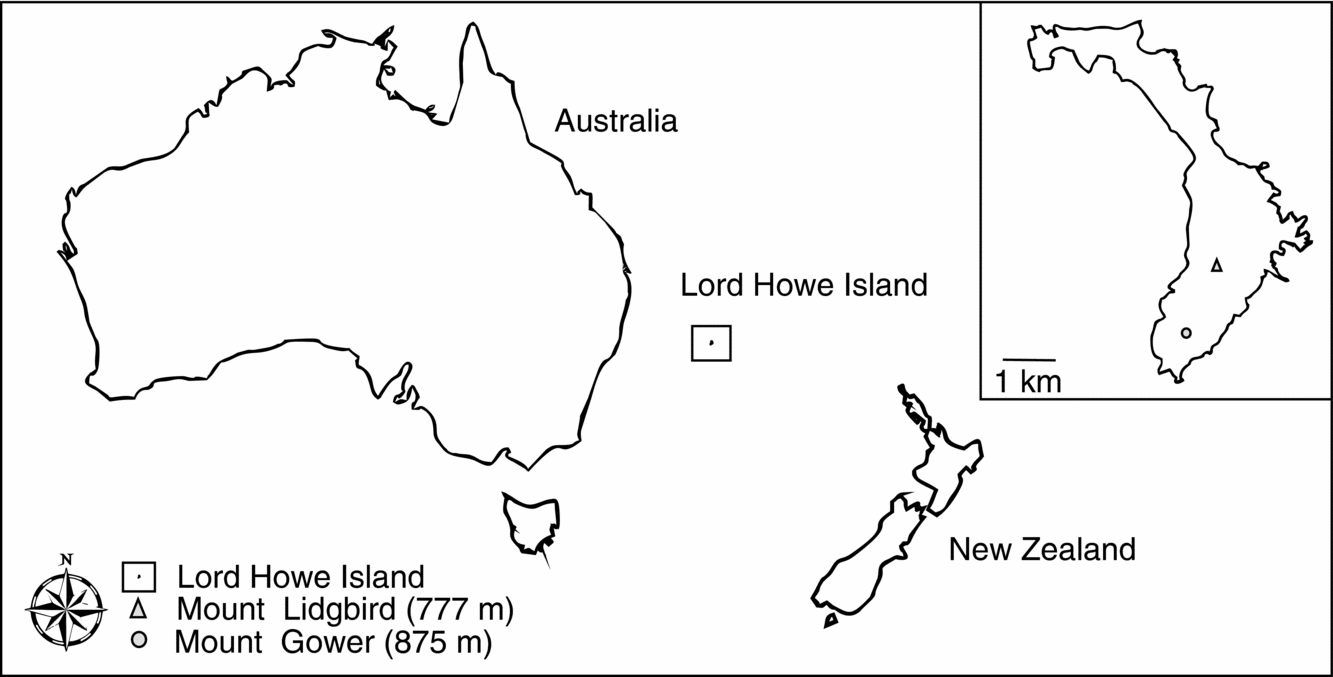
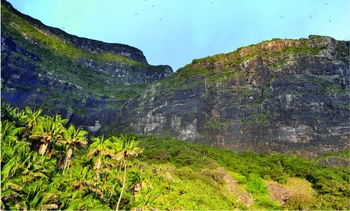
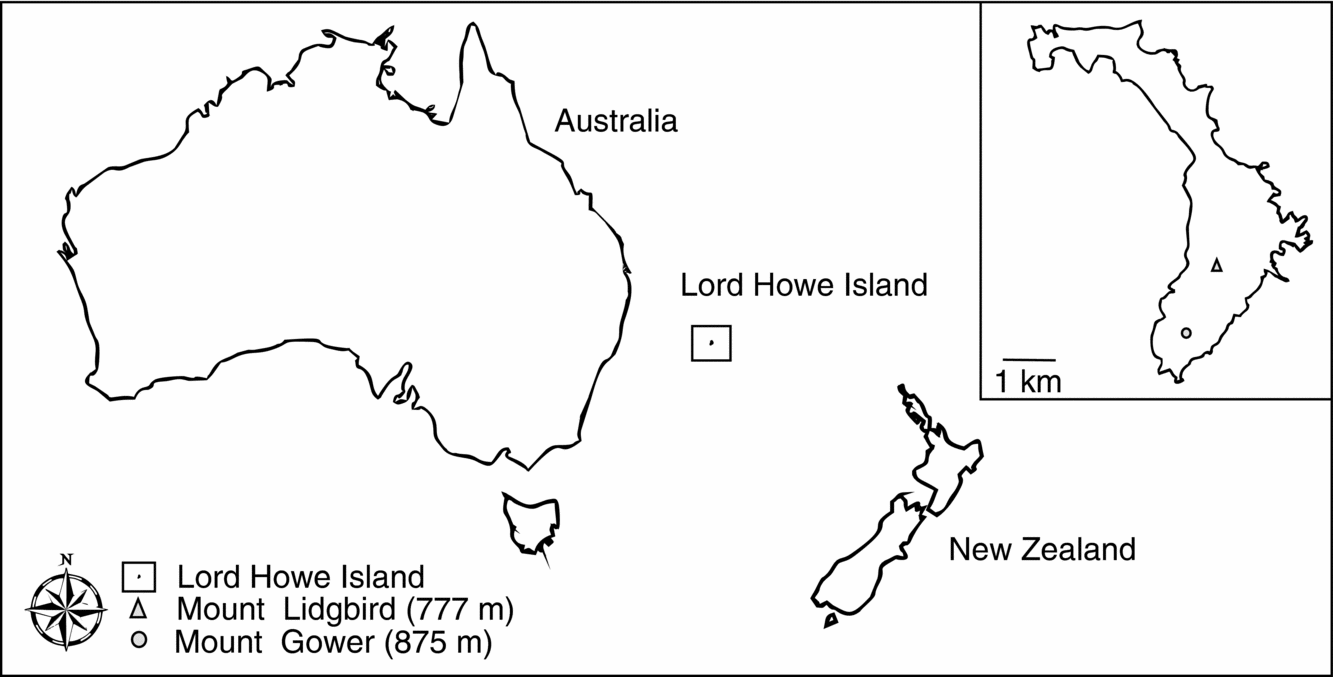
The study was conducted on LHI, a subtropical island in the south-west Pacific (31°54′S, 159°08′E; Figure 1). Maximum daily temperatures average from 18°C in the cooler months (May–September) to 25°C in the warmer months (November–April). Within the study area, precipitation averages 1500 mm per annum. Topography consists of two steep mountains in the south, which are composed of alkaline olivine basalt and hawaiites. The northern end of the island is primarily composed of calcerenite and coral sands (Pickard Reference PICKARD1984). Fieldwork was carried out over July 2014 on the western-facing slopes of Mount Lidgbird (Figure 2). Here, we sampled plant communities living inside 119 birds’ nest ferns within seven randomly marked 20-m-long transects. Short transects were used for safety purposes. At each fern, we recorded the presence/absence of plant taxa, fern size and fern isolation from the forest vegetation. We used a strict sampling criteria to ensure that plant taxa living within bird's nest ferns did not disperse via vegetative spread. For one, ferns that were not clearly separated from neighbouring ferns by at least 1 m were omitted. Likewise, ferns growing less than 1 m from any other vegetation, such as forest vegetation or vegetation growing directly on the cliff face were also omitted. Vegetation growing below the cliffs was reasonably homogeneous, thus we assumed that each plant community received colonizers from the same species pool. Birds’ nest ferns, which typically spend their entire life cycle within trees, were not abundant on forest vegetation growing close to the cliffs. As such, we believe that plants colonizing the cliff-dwelling ferns did not disperse from the forest-dwelling ferns. Woody plant taxa ranged in height from ~0.5 m (small or juvenile shrubs) to ~4 m (stunted forest trees). One exception was the kentia palm (Howea forsteriana), which on occasion exceeded the height of all other woody taxa. Shrubs and small trees were able to grow directly at the cliff base, while larger trees grew progressively further back. Plants that could not be identified in the field were collected and identified at the LHI museum herbarium.
Map of Lord Howe Island and its location in relation to Australia and New Zealand. The mountains on which Asplenium goudeyi reside, Mount Lidgbird and Mount Gower, are also shown. Scale is for Lord Howe Island only.
View of Asplenium goudeyi ferns perched on the western-facing slopes of Mount Lidgbird on Lord Howe Island. A large boulder bank and kentia palms (Howea forsteriana) are visible in the foreground.

Statistical analyses
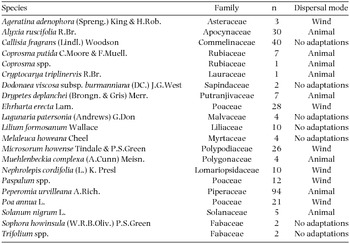
Generalized linear models assessed the relationship between fern size, fern isolation from the forest vegetation and plant community richness. We analysed patterns of community composition using the c-score metric (Stone & Roberts Reference STONE and ROBERTS1990). The c-score is simply the number of ‘checkerboard units’ between all species pairs in a matrix. A c-score that is significantly larger than randomized expectations is indicative of segregation among taxa (i.e. species co-occur less often than expected by chance). Conversely, a c-score that is significantly less than randomized expectations indicates aggregation among taxa (i.e. species co-occur more often than expected by chance). The observed c-score was compared to 5000 simulation replicates using fixed row and column totals and a swap algorithm (Gotelli Reference GOTELLI2000). We assessed if patterns in plant composition were related to plant dispersal abilities by regressing species divided into three dispersal modes against distance from the forest vegetation. Grasses, ferns and plants with pappus or wings were considered wind-dispersed; fleshy-fruited taxa were considered animal-dispersed; and plants with no specific adaptations for wind or animal dispersal were considered a separate category (Table 1). Finally, incidence functions were constructed for species that occurred 10 or more times using logistic regression. Incidence functions relate the probability of a species occurring in a plant community, with the overall species richness of combined plant communities (Diamond Reference DIAMOND1975). All statistical analyses were conducted in R version 3.1.2 (R Development Core Team, Vienna, Austria) with the add-on libraries bipartite version 2.04 (Dormann et al. Reference DORMANN, FRÜND, BLÜTHGEN and GRUBER2009), popbio version 2.4 (Stubben & Milligan Reference STUBBEN and MILLIGAN2007) and vegan version 2.0-10 (Dixon Reference DIXON2003).
Species and family names of plants living inside the epiphytic fern Asplenium goudeyi. The number of times each species occurred in a plant community and their mode of dispersal is also shown.

RESULTS
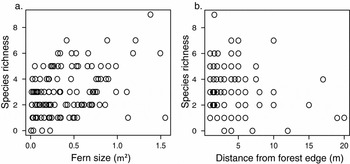
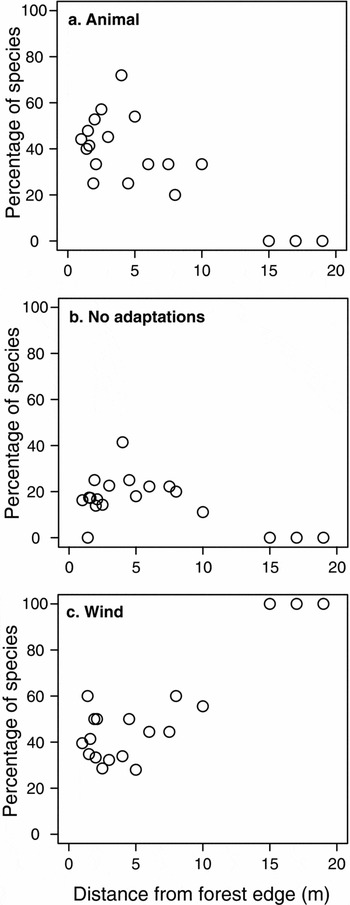
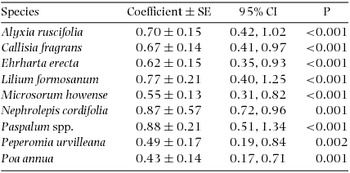
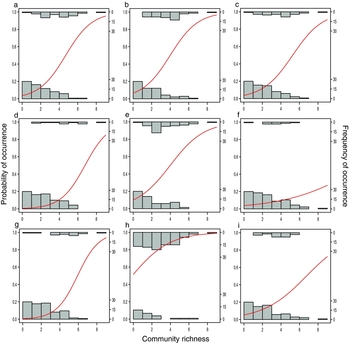
Generalized linear models showed a significant effect of fern size and fern isolation from the forest vegetation on plant community richness (GLM: F1 = 20.57; P < 0.001 and F1 = 6.13; P = 0.03 respectively; Figure 3). Patterns of community composition were not significantly different from randomized expectations as depicted by the c-score metric (CS = 2.73; ZS = 1.27; P = 0.11). Additionally, non-significant deviations from randomized expectations were found between dispersal modes; animal-dispersed taxa (CS = 0.28; ZS = −0.34; P = 0.42), wind-dispersed taxa (CS = 1.03; ZS = 0.90; P = 0.18), and taxa with no specific dispersal adaptations (CS = 0.51; ZS = −0.53; P = 0.29). The percentage of animal-dispersed taxa and taxa with no specific dispersal adaptations significantly decreased with increasing isolation from the forest vegetation (GLM: F1 = 27.7; P < 0.001 and F1 = 7.37; P = 0.01 respectively). Conversely, the percentage of wind-dispersed taxa in plant communities significantly increased with increasing isolation from the forest vegetation (GLM: F1 = 53.8; P < 0.001; Figure 4). In all cases, the probability of an individual occupying plant communities significantly increased with fern community richness (Table 2). Incidence functions, which were constructed using logistic regression, found no evidence for species exclusions (Figure 5).
The effect of fern size (a) and fern isolation (b) on species richness of plant communities living inside the epiphytic fern Asplenium goudeyi on Lord Howe Island.

Percentage of species from three dispersal modes; animal-dispersed (a), no specific dispersal adaptations (b) and wind-dispersed (c), plotted against Asplenium goudeyi isolation from forest vegetation on Lord Howe Island.

Results of the logistic regression model used to create incidence functions of species that occurred in 10 or more plant communities. The coefficient represents the log odds of a species occurring in a plant community for every increase in species richness. Standard error (SE), confidence intervals (CI) at the 95%, and significance (P) are also shown.

Incidence functions of species that occurred 10 or more times in Asplenium goudeyi ferns on Lord Howe Island. Incidence functions relate the probability of a species occurring in a plant community, with plant community richness. The red line represents the probability that a species will be present or absent at a particular measurement of community richness. The frequency at which each species was either present or absent at each measurement of species richness is depicted as a frequency histogram. The above frequency histogram is the number of times each species was present in a community, and the below histogram is the number of times each species was absent. Species used in this analyses were Alyxia ruscifolia (a), Callisia fragrans (b), Ehrharta erecta (c), Lilium formosanum (d), Microsorum howense (e), Nephrolepis cordifolia (f), Paspalum spp. (g), Peperomia urvilleana (h) and Poa annua (i).

DISCUSSION
Our results suggest that plant communities living within the bird's nest fern Asplenium goudeyi are structured by dispersal. Plant taxa with better dispersal capabilities were well represented in isolated ferns. Comparatively, poorer dispersers were lacking. Furthermore, patterns in community composition did not deviate from randomized expectations, which suggests that species interactions are less important in structuring plant communities. At the species level, individual species occurrences increased with plant community richness. This is consistent with the significant effect of fern size on plant community richness.
The effect of fern size on plant community richness follows one of the most general rules in ecology; the species-area relationship. Like other debris-capturing epiphytes birds’ nest ferns increase their catchment area with age (Karasawa & Hijii Reference KARASAWA and HIJII2006, Reich et al. Reference REICH, EWEL, NADKARNI, DAWSON and EVANS2003). Larger ferns are able to intercept comparatively more dispersing propagules simply by chance. In addition, a greater amount of organic debris may be intercepted, which eventually decomposes into a nutrient-rich humus (Zhang et al. Reference ZHANG, NURVIANTO and HARRISON2010). Similarly, the effect of fern isolation on plant community richness is consistent with another well-documented pattern in ecology (Kadmon & Pulliam Reference KADMON and PULLIAM1993, Laan & Verboom Reference LAAN and VERBOOM1990, MacArthur & Wilson Reference MACARTHUR and WILSON1967, Van Dorp & Opdam 1987). Isolation effects may arise from interspecific differences in species colonizing or establishment capabilities, propagule limitations and establishment limitations.
Dispersal limitations, produced by interspecific differences in plant dispersal abilities, may explain why not all ferns were occupied by the same species (Ehrlén & Eriksson Reference EHRLÉN and ERIKSSON2000). Fleshy-fruited taxa generally have larger seeds, and isolation from a major propagule source can limit species dispersal (Dettki et al. Reference DETTKI, KLINTBERG and ESSEEN2000, Sillett & Goslin Reference SILLETT and GOSLIN1999). Moreover, selection pressures on insular taxa have further reduced dispersibility by selecting for larger seed sizes (Kavanagh & Burns Reference KAVANAGH and BURNS2014). Exotic species, which make up 67% of all wind-dispersed plants, do not have the same selection pressures acting on reduced dispersibility as insular taxa. Furthermore, wind-dispersed taxa tend to have smaller seeds, which come in greater quantities. As such, wind-dispersed taxa make efficient colonizers (Nathan Reference NATHAN2006), and were well represented in isolated ferns. Dispersal limitations may be lessened by the presence of neighbouring ferns. Neighbouring ferns may act as agents of dispersal, not only increasing the rate of colonization, but also reducing extinctions in plant communities that have experienced disturbances (Ruchty et al. Reference RUCHTY, ROSSO and MCCUNE2001). Species with the ability to spread vegetatively, such as N. cordifolia, M. howense and C. fragrans, were assumed to be dispersed by wind to A. goudeyi ferns. However, without long-term observation of plant communities, we cannot definitively say that dispersal via vegetative spread did not occur. Nevertheless, ferns growing less than 1 m from neighbouring vegetation were omitted in an attempt to exclude dispersal via vegetative spread. As observed in previous studies, vegetation may grow directly on cliff faces in areas where soil has accumulated (Yuan et al. Reference YUAN, FANG, FAN, CHEN, WANG and YANG2006). Thus, the uncommon occurrences of vegetation growing directly on the cliff face rather than within birds’ nest ferns may be an additional source of colonizers. While these occurrences were mainly grasses, incidences of M. howeana, A. adenophora and S. nigrum were also noted.
The regime shift from animal-dispersed plant taxa to wind-dispersed taxa as isolation from the forest vegetation increased may be a result of propagule limitations, here defined as the failure of seeds to reach suitable fern establishment sites (Tilman Reference TILMAN1994). For one, birds’ nest ferns may contain insufficient resources to mature plant taxa, particularly trees and shrubs (Stephenson Reference STEPHENSON1981). Moreover, exposure to the elements and lack of food may discourage pollinators and dispersers from leaving the protection of the forest. Propagule limitations may be lessened for plant communities growing closest to the forest vegetation simply because there is access to a greater variety of colonizers, pollinators and dispersers. Additionally, propagule limitations may be lessened for annual plants, particularly smaller-seeded species, which have a colonization advantage simply because they mature before perennials.
Non-significant patterns of between-fern variation in community composition were observed, which suggests that species interactions play a lesser role in structuring plant communities. However, individual species occurrences increased with plant community richness, which may result from resident plants facilitating the establishment of later-colonizing species. The importance of facilitation by resident species in low resource or harsh environments is frequently observed (Bertness & Hacker Reference BERTNESS and HACKER1994, McAuliffe Reference MCAULIFFE1984, Valente et al. Reference VALENTE, ETIENNE and PHILLIMORE2014). Similar observations on the coexistence of ecologically distinct species in cliff habitats have been made on escarpments throughout the British Isles (Cooper Reference COOPER1997, Hepburn Reference HEPBURN1943, Jarvis Reference JARVIS1974). Dominant species may be suppressed in cliff habitats due to frequent disturbances. For one, rock falls and high winds may dislodge species from plant communities or restrict species from attempted establishment. Additionally, disturbances may create new microsites that cater for less dominant species (Cooper Reference COOPER1997).
This study highlights the importance of birds’ nest ferns in providing suitable establishment sites for plants that may otherwise not persist in a cliff environment. Interspecific differences in species dispersal abilities explains the regime shift from animal-dispersed taxa in non-isolated communities to wind-dispersed taxa in isolated communities. Additionally, the lack of species exclusions suggests that species interactions are less important in structuring plant communities. Disturbances and facilitation by other plants may prevent competitive species from becoming dominant. We conclude that plant communities growing inside bird's nest ferns show no predictable patterns of community composition, and are strongly influenced by species dispersal abilities.
ACKNOWLEDGEMENTS
We thank the Wellington branch of the New Zealand Federation of Graduate Women and Victoria University for funding, Ian Hutton and Leon Perrie for assisting plant identification and the Lord Howe Island Board for permitting this research. We also wish to thank Ian Turner and two anonymous reviewers for constructive comments on the manuscript.