Primary hemiepiphytes are plants which germinate as epiphytes on a host tree and send roots to the ground (Williams-Linera & Lawton Reference WILLIAMS-LINERA, LAWTON, Lowman and Nadkarni1995). Although hemiepiphytes never maintain a metabolic connection with hosts, direct access to nutrients in the soil enables woody hemiepiphytes to reach large sizes and cause physical damage to their hosts. Even if hemiepiphytes cause no damage by constriction, they are still a mechanical burden that the host must bear (Harrison Reference HARRISON2006, Lawton & Williams-Linera Reference LAWTON and WILLIAMS-LINERA1996). Some hemiepiphytes known as stranglers are able to support themselves after the death and decomposition of the host (Lawton & Williams-Linera Reference LAWTON and WILLIAMS-LINERA1996). Because strangler hemiepiphytes typically achieve large sizes they may kill their host or break the establishment site before reaching maturity or being able to live independently.
In the last three decades the ecology of hemiepiphytes and their influence on the structure and dynamics of the forest canopy have been extensively studied, but most studies focused on Ficus (Harrison Reference HARRISON2006, Lawton & Williams-Linera Reference LAWTON and WILLIAMS-LINERA1996, Todzia Reference TODZIA1986). Here we studied a remarkably abundant but poorly known strangler hemiepiphyte, Coussapoa microcarpa (Schott) Rizzini (Cecropiaceae), to investigate how the density, size structure and establishment sites of C. microcarpa vary over a small spatial scale in an altitudinal gradient in the Brazilian Atlantic Forest. Because of the large size achieved by C. microcarpa and the increasing mechanical pressure exerted upon hosts during its development, we also tested for ontogenetic differences related to the establishment site, the characteristics of which could act as filters for the establishment of C. microcarpa on the forest canopy.
The study was carried out at the Ilha do Cardoso State Park, a 15 000-ha land-bridge island reserve located on the southern coast of the state of São Paulo, south-eastern Brazil. The island has a hilly topography, with peaks with 800 m asl in the central region, and flat, coastal sand plains varying from 3 to 10 m asl (Avelar et al. Reference AVELAR, GALVãO-BUENO, GIULIETTI, FILHO, ANDRADE-LIMA and GEVERTZ1995). The regional climate is humid, without a marked dry season, with an average annual rainfall of 2260 mm and average monthly temperature between 19.8 °C and 28 °C (Brazilian climate database, www.bdclima.cnpm.embrapa.br).
Submontane (i.e. above 50 m asl; 75% of the island's area) and lowland (coastal sand plain) forest areas sampled were approximately 1 km away. In both areas the forest canopy is 20–35 m high, with greater abundance of emergent trees in the submontane forest. The number of tree species is greater in submontane (174) than in lowland forest (104) areas, though the most abundant families are the same in both areas: Myrtaceae, Fabaceae, Rubiaceae and Euphorbiaceae (Melo & Mantovani Reference MELO and MANTOVANI1994). A recent study in another Atlantic forest area revealed that the tree community at these two forest types indeed differ in species composition and species richness (Sanchez et al. Reference SANCHEZ, PEDRONI, EISENLOHR and OLIVEIRA-FILHO2013).
Coussapoa is a Neotropical genus with 46 species, of which at least half are hemiepiphytes (Berg et al. Reference BERG, AKKERMANS and VAN HEUSDEN1990, Williams-Linera & Lawton Reference WILLIAMS-LINERA, LAWTON, Lowman and Nadkarni1995). Coussapoa microcarpa is a strangler hemiepiphyte widely distributed in the Brazilian Atlantic Forest (Caiafa & Martins Reference CAIAFA and MARTINS2010) where their fruits are eaten by birds and primates (Bueno et al. Reference BUENO, GUEVARA, RIBEIRO, CULOT, BUFALO and GALETTI2013, Galetti et al. Reference GALETTI, PIZO and MORELLATO2011). The development of descending roots in C. microcarpa during the hemiepiphytic phase typically involves only one taproot descending towards the ground in a straight line. This taproot normally produces perpendicular branch roots, which strangle the trunk or branches of the host in a vice-like hold. In young individuals, the taproots are morphologically different from the roots of other sympatric hemiepiphytes, as they exhibit a structure similar to a crest running along its length, allowing its identification even without observing the canopy.
Three trails summing 2.11 km were sampled, two of them (with approximately 500 and 460 m) were in the lowland forest, and one (with 1.15 km, 220 m asl) in submontane forest. Hemiepiphytes were sampled within a 10-m area on each side of lowland trails and in a 7-m band on each side of the submontane trail, providing a total sample area of 3.43 ha. All C. microcarpa individuals found within the plots whose roots had already reached the ground were recorded. Some individuals located outside of the plots (to a maximum distance of 10 m) were also sampled but not included in the density and population structure analyses; they were only used for analyses involving establishment sites.
From each individual sampled, we recorded the following data: (1) host and hemiepiphyte girth at breast height, which was further converted to diameter at breast height (dbh); (2) height at which the hemiepiphyte established (HE), and maximum height of hemiepiphytes (HHe) and hosts (HHo). We also calculated the height of hemiepiphyte establishment relative to host's height by the ratio between HE and HHo; (3) establishment site of the hemiepiphyte according to four categories: fork, trunk, branch, or the dead part of a broken limb (snag); (4) the substrate in the establishment site (only for young individuals of C. microcarpa to minimize the possibility that changes in the composition of the substrate at the establishment site have occurred since the hemiepiphyte establishment) was categorized as host bark, tangled roots of vascular epiphytes, organic debris or moss; (5) breaking of establishment site. We used two indications to confirm that the establishment site was broken after the establishment of hemiepiphytes: breakage, or the presence of a scar below the establishment site of the root or stem of the hemiepiphyte, and detachment of the hemiepiphyte root from the host trunk indicating that the hemiepiphyte had slipped after breakage of its establishment site; (6) if the individual had reached the free-living stage; (7) diameter of the hemiepiphyte stem 10 cm above the establishment site (DHeES), and (8) diameter of the host at the establishment site (DHoES). The measurement of DHoES for individuals established in forks was made below the bifurcation, while for individuals established in snags DHoES was measured at the branch or trunk where the hemiepiphyte was established. Whenever the establishment site was visible from the ground, the measurement was made from the ground using a transparent ruler held at 50 cm from the observer. The measurement was then transformed into real diameter using the equation RD = (0. 53 + 1.66 × DES) × DM, where RD is the real diameter, DES is the distance between the ruler and the hemiepiphyte establishment site, and DM is the diameter measured with the ruler. This equation was previously calibrated with a cylinder of known diameter measured at eight different distances (1–18 m).
Measurements were taken from the ground with a clinometer reading and a known distance from the host tree. When this was not possible (e.g. clinometer data unreliable when viewing angle was larger than 60° or lack of visibility), either the host tree or its neighbour was climbed, and measurements of hemiepiphytes and hosts were taken directly. For several reasons (e.g. lack of security for tree climbing), it was not possible to collect data on establishment site for all individuals. Therefore, sample sizes vary for each analysis.
We did not observe fruiting individuals with DHeES values < 11 cm. Hence, we defined as immature or young all individuals with DHeES < 11 cm, and as reproductive or adults individuals with DHeES >11 cm.
We compared means with parametric ANOVA except when data did not meet the normality and homoscedasticity premises, when Wilcoxon tests were used. To correlate the diameter of the host and the diameter of the hemiepiphyte at the establishment site we used a Spearman correlation test. The frequencies of occurrence of the different establishment sites for young and adults were compared with a G test. All the analyses were conducted in the R environment, version 2.12.
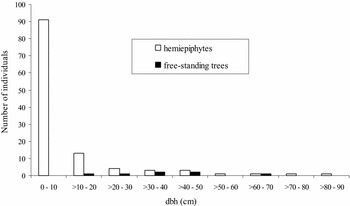
We sampled 145 individuals of C. microcarpa: 73 in the submontane (62 inside the plots) and 72 in the lowland forest (63 inside plots), 5% (seven individuals) of which were observed at the free-standing stage. Most hosts had only one C. microcarpa, but seven hosts sheltered two and one host had three individuals. The density of C. microcarpa was uncommonly high (on average 36.5 ind. ha−1; submontane: 36.9 ind. ha−1, lowland: 36.2 ind. ha−1) for a forest site and was more than four times higher than the densities of all six species of hemiepiphyte Ficus recorded in the study site (8.2 ind. ha−1; Coelho Reference COELHO2005). Only in savanna habitats have higher hemiepiphyte densities been recorded (Athreya Reference ATHREYA1999, Gautier-Hion & Michaloud Reference GAUTIER-HION and MICHALOUD1989, Putz & Holbrook Reference PUTZ and HOLBROOK1986, Todzia Reference TODZIA1986). There were 26 adults inside the plots, resulting in a density of 7.6 adults ha−1. The population exhibited a reverse-J pattern in the distribution of dbh classes, with approximately 85% of the individuals in both areas concentrated in the first size class (Figure 1).
Distribution of diameter at breast height (dbh) among individuals of Coussapoa microcarpa in the hemiepiphyte (N = 118) and free-standing stages (N = 7) at the Ilha do Cardoso State Park in Brazil.

The two forests did not differ in relation to height (submontane: 25 ± 8.9 m, range = 8.8–42.5 m, N = 48, lowland: 23 ± 6.2 m, range = 8.9–40.9 m, N = 50; W = 1391, P = 0.17) or diameter (submontane: 58 ± 27.4 cm, range = 17–149 cm, N = 65, lowland = 53 ± 28.7 cm, range = 11–188 cm, N = 61; W = 2208, P = 0.21) of hosts, 84% of them taller than 16 m and 70% larger than 40 cm dbh, indicating that C. microcarpa mainly occurs on forest canopy trees. Considering only hosts > 35 cm dbh (87% of the submontane forest sample) and that there are c. 133 trees with dbh > 35 cm in 1 ha of submontane forest (Melo & Mantovani Reference MELO and MANTOVANI1994), we concluded that approximately 26% of the potential hosts actually sustain C. microcarpa. Indeed some plants do not seem to be suitable hosts for C. microcarpa, especially plants with smooth trunks and branches, and plants with defoliating bark, such as several Myrtaceae species. Only a single C. microcarpa individual was observed on a Myrtaceae, which nonetheless is one of the most abundant families in submontane forest (Melo & Mantovani Reference MELO and MANTOVANI1994).
The most common establishment site was forks (33%, N = 64), followed by branches (31%), and snags (28%). Eleven hosts were broken at the establishment site, likely as a result of the development of the strangler roots. In 55% of cases (N = 20) the substrate at the establishment site was bark, followed by organic debris (25%), roots of epiphytes (15%), and moss (5%), suggesting that C. microcarpa, at least after the epiphytic phase, can survive in substrates with low water retention capacity such as the host bark.
Except for seedlings growing on rotten trunks in clearings, and five individuals at the hemiepiphytic phase established below 5 m, there was no establishment in the understorey. The establishment height did not differ between young and adults (11.6 ± 4.37 m and 12.6 ± 4.39 m, respectively, Nyoung = 41, Nadults = 22; F = 0.769, df = 1, P = 0.61), but it did differ between the two forest types (lowland: 12.0 ± 4.1 m, N = 53, range = 3.2–20.1 m, submontane: 14.2 ± 5.0 m, N = 48, range = 4.9–30.8 m; F = 6.27, df = 1, P = 0.01). Coussapoa microcarpa established itself exclusively in the upper two thirds of the total height of the hosts in submontane forest, while in lowland forest it also occurred in the lower third of hosts (ratio between the height of the establishment site and host's height in lowland: 0.53 ± 0.17, N = 49, range = 0.14–0.89, submontane: 0. 60 ± 0.16, N = 44, range = 0.32–0.96; F = 3.48, df = 1, P = 0.065). For this reason the average establishment height in submontane forest was greater than in lowland forest, despite the similarity in host size between the two forest types. Water availability is the main limiting factor for the establishment of hemiepiphytes (Hao et al. Reference HAO, SACK, WANG, CAO and GOLDSTEIN2010, Holbrook & Putz Reference HOLBROOK and PUTZ1996), and forest canopy may be particularly harsh in terms of humidity (Benzing Reference BENZING1990). We hypothesize that orographic effects causing the cooling of moist air masses coming from the coast make the submontane forest more humid than lowland forest, thus permitting higher establishment sites in the canopy by C. microcarpa in submontane forest.
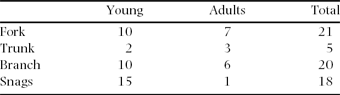
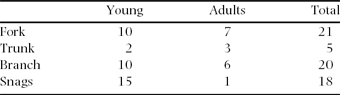
The diameter of the host and the diameter of the hemiepiphyte at the establishment site were positively correlated (rs = 0.60, N = 54, P < 0.001). The diameter of establishment sites was narrower for young than adult hemiepiphytes (young: 29 ± 18.7 cm, N = 36, adults: 47 ± 32.3 cm, N = 18; W = 474, P = 0.005). Because breakage of hosts at the establishment site often occurs, this difference suggests a filter acting upon the persistence of young individuals of C. microcarpa according to which only individuals established in host sections large enough to sustain the hemiepiphyte growth are able to reach maturity. Michaloud & Michaloud-Pelletier (Reference MICHALOUD and MICHALOUD-PELLETIER1987) have reached similar conclusions. They noted a high frequency of hemiepiphytic Ficus spp. whose establishment site had signs of breakage and showed that breakage is less likely when the establishment site is on large branches, probably because the host is able to resist the increasing pressure exerted by the hemiepiphyte during its development. An additional filter for C. microcarpa persistence on forest canopy is related to the establishment site itself. Some establishment sites (e.g. snags) are more frequently occupied by young than adults (G = 8.86, df = 3, P = 0.03; Table 1), showing that the best sites for seedling establishment are not necessarily the best sites for their development, a common phenomenon in the dynamics of plant populations in general (Jordano & Herrera Reference JORDANO and HERRERA1995).
Establishment sites of Coussapoa microcarpa per ontogenetic stage at the Ilha do Cardoso State Park in Brazil. The sum of the categories young and adults is lower than the total because in some cases it was not possible to measure the diameter of the hemiepiphyte stem above the establishment site which was used to define the ontogenetic stage.
In sum, we noted that the occupation of the forest canopy by C. microcarpa, especially in what concerns establishment height, differ in a relatively small spatial scale, between two adjacent forest types differing in altitude and likely humidity. We also noted ontogenetic differences in canopy occupation by C. microcarpa; young and adults differed in establishment sites. The diameter of establishment sites of young was narrower than the diameter of establishment sites of adults, which points out to a limiting factor (diameter of establishment site) regulating the establishment of C. microcarpa.
ACKNOWLEDGEMENTS
The staff of Ilha do Cardoso State Park for logistical support. Marcelo Carvalho and Luiz Alberti for helping in the field. Robert Lawton and two anonymous reviewers for critical comments on the manuscript. A grant by PROPe/UNESP made possible the English translation. The Brazilian Research Council (CNPq) granted a scholarship to LFMC. MAP receives a research grant from CNPq.