Introduction
The vast maritime region of Island Southeast Asia (ISEA) spans over 4000km from east to west and encompasses more than 10 000 islands divided between Malaysia, Brunei, the Philippines, Singapore, Indonesia and Timor-Leste (Figure 1). During the Metal Age of ISEA, which, on current evidence, is thought to have begun around 2500 years ago, artefacts made of cupreous metals and manufactured in Mainland Southeast Asia, such as the Dong Son drums, entered maritime exchange networks and travelled throughout this vast region. Other metal objects were produced within ISEA. The prehistoric contexts of initial metal use and production in ISEA, however, are poorly known and rarely dated, particularly in the islands east of Wallace's Line, which have received little or no archaeological investigation; even on islands where research has been carried out, evidence for ancient metal artefacts is sparse or absent. Wallace's Line is the biogeographic boundary that separates the ecozones of Asia and Australasia. The islands to the east of Wallace's Line have not been connected to continental Asia or Greater Australia (the Pleistocene landmass that combined present-day Australia, New Guinea and the Aru Islands) during the human time frame; thus, maritime crossings were always necessary to reach these islands. Timor is one of the best archaeologically studied islands east of Wallace's Line, although the few metal artefacts known come mostly from undated contexts. In this article, we report the recent discovery of two Dong Son drums from Timor-Leste, and assess them in the context of other cupreous metal artefacts found on the island (Figure 2). We also discuss the depiction of elaborately shaped socketed axes in the rock art of Timor-Leste. While undated, these images appear to elucidate the role and significance of socketed axes and perhaps, by inference, other rare metal items. Together they provide direct evidence for Timor's involvement in extensive exchange networks before the arrival of Europeans on the islands from the sixteenth century AD.
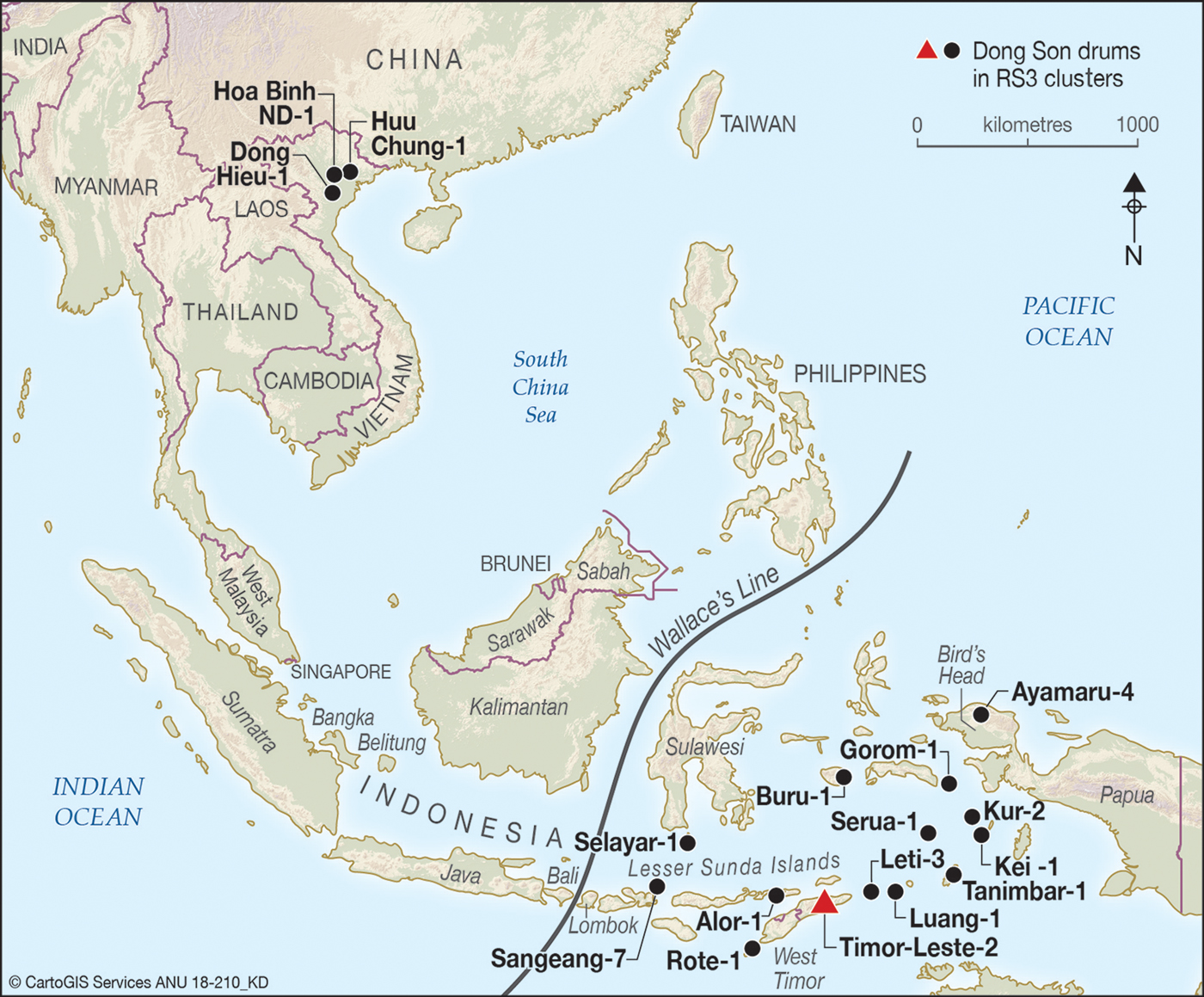
Map of Mainland and Island Southeast Asia showing the location and number of Dong Son drums in the RS3 cluster. New finds from Timor-Leste are shown by the red triangle (modified from Calo Reference Calo2014).

Map of Timor showing the location of archaeological sites and places mentioned in the text.

Socketed axes, weaponry and items of personal ornamentation made of copper or bronze have also been found in Indonesia and the Philippines (Heekeren Reference Heekeren1958; Calo Reference Calo2014). The oldest securely dated metal items discovered to date are the socketed axes deposited as grave goods in supine burials in Gua Harimau, Sumatra. The oldest of these axes is dated from association with human bone to around 2500 years ago (Fauzi et al. Reference Fauzi, Oktaviana, Budiman. and Simanjuntak2016: 254–56).
Today, ISEA hosts some of the world's largest active metal mines (Pryce et al. Reference Pryce, Calo, Prasetyo, Bellwood and O'Connor2018). Bronson (Reference Bronson, Glover, Suchitta and Villiers1992) recorded the geological presence of copper ores in Sumatra, Java and West Timor, with lead in Sumatra and tin in West Malaysia (Peninsular Malaysia), Bangka and Belitung. The locations of mines and prehistoric manufacturing activity across Indonesia in general, and for Timor-Leste in particular, are, however, extremely limited. An early report (van Es Reference van Es1921) describes traditional copper mining and smelting that made use of a crucible and a furnace near Noil Toko, and also an ancient copper mine near Tanini, both of which are in the western part of the island of Timor. A copper source in West Timor is currently under prospection for modern exploitation. Thus, it appears that the Lesser Sunda Islands (Figure 1) have the potential to yield evidence for prehistoric copper and bronze manufacturing. Mould fragments for casting axes have been found occasionally on islands east of Java, indicating local production of cupreous metal goods (Bellwood Reference Bellwood and Barnard1976; Calo Reference Calo2014: 140). On stylistic grounds, however, it is probable that the two drums reported in this article were manufactured somewhere on the Asian mainland, rather than in the islands.
The Island Southeast Asian Metal Age
Dong Son drums (also known as Heger I drums) were the finest and most elaborate bronze objects made by the Dong Son culture (Heger Reference Heger1902; Calo Reference Calo2014: 6). They were cast using the lost-wax technique and have two parts: the tympanum and the mantle. The mantle has a tripartite form, with a bulging upper part, a cylindrical middle part and a lower flared foot, giving the drums a ‘waisted’ shape (Bernet Kempers Reference Bernet Kempers1988: 46). Dong Son drums are thought to have originated during the last few centuries BC at production centres in southern China (especially the provinces of Guangdong, Guangxi, Guizhou and Yunnan) and northern Vietnam (Calo Reference Calo2014: 35). The drums were traded along river and sea routes throughout Mainland Southeast Asia, as far as Burma, Thailand and West Malaysia (Spriggs & Miller Reference Spriggs and Miller1988; Calo Reference Calo2014). Their main distribution in ISEA is through southern Indonesia, from Sumatra eastwards through the southern Indonesian islands (particularly Java and the Lesser Sunda Islands) to Papua. So far, they have not been found in the Philippines and are uncommon in Indonesian Borneo (Kalimantan); only a single example is known from Malaysian Borneo (the states of Sarawak and Sabah) (Calo Reference Calo2014: fig. 2.1).
The most recent study of Dong Son drums across Southeast Asia is by Calo (Reference Calo2014: 10), who examined the stylistic features and distributions of around 400 specimens. She divides them into five clusters “based on shared style, chronology, casting technique and context in relation to the region where they were found” (Calo Reference Calo2014: 2). Thirty-one drums from eastern Indonesia belong to her ‘Region Specific Cluster 3’ (RS3), and are suggested to date to between the late second and sixth centuries AD (Calo Reference Calo2014: 15, 16, 107–109, 125) (Figure 1).
Calo's model for drum dispersal suggests a two-step process for the eastern Indonesian examples, with drums initially moving from the Vietnamese and Chinese centres of production to the islands, via a mainly maritime route, around the third to fourth centuries AD (Calo Reference Calo2014: 3 & 108). The homogeneity of the eastern Indonesian drums indicates that this may have been a short-lived dispersal event (Calo Reference Calo2014: 113). A second, subsequent step involved what Calo terms “a series of inter-island trade networks controlled by local seafaring traders which would have accounted over time for their final destinations” (Calo Reference Calo2014: 109, 113). This would have taken place after the fifth century AD—into the late first and possibly through into the early second millennium AD (Calo Reference Calo2014: 109).
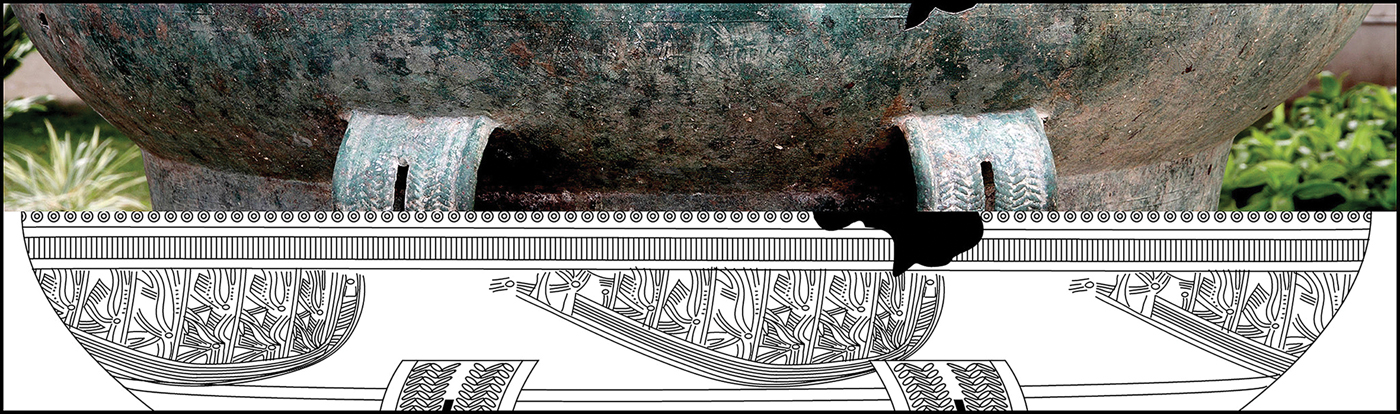
In terms of decoration, the Dong Son drums in the RS3 cluster are distinguished by a number of features, including: their large size (approximately 0.8m in height with a tympanum 1.1m in diameter); four modelled toads equally spaced around the upper edges of the drums; and incised schematised human figures with high feather headdresses processing around the tympana, and standing in boats around the drums’ upper sides (Calo Reference Calo2014: 16 & 110). Notably, the warrior figures on the eastern Indonesian RS3 drums are more abstract than those on many older drums found to the west and are sometimes almost unrecognisable as figurative images.
The functions of Dong Son drums are elusive. Scenes on some drums found in Vietnam (e.g. the Ngoc Lu drum; Bellwood Reference Bellwood2017: fig. 9.2) depict them being used as musical instruments in what appear to be rituals and ceremonies. In southern Vietnam and Java, upturned drums have also been found as containers for human burials or used as lids for wooden burial urns (e.g. Calo Reference Calo2014: fig. 2.78 for Phu Chanh in southern Vietnam). Such mortuary usage, however, may have been secondary. Whatever their original functions, Dong Son drums had clearly become prestige objects by the time that they reached the eastern islands of Indonesia. There they probably entered separate local exchange networks, and their onward journeys to their final locations may have taken long periods of time. Hence, the drums’ dates of manufacture and the dates at which they entered the archaeological record could be significantly different. The next section provides a brief summary of archaeological research in Timor-Leste, including cupreous metal artefact finds, as context for the drums.
Archaeological research in Timor-Leste
The island of Timor—the largest within the Lesser Sunda chain—has a long history of archaeological research. The first excavations were conducted in 1935 by Alfred Bühler and Fritz Sarasin from the Museum für Völkerkunde in Basel, Switzerland. They undertook eight excavations—seven in the former Dutch province (now West Timor) and one in a rockshelter near Baguia, located in what today is Timor-Leste (Sarasin Reference Sarasin1936: 15). They made no mention of finding metal artefacts in their excavations.
In the 1930s, the Portuguese military recovered five human burials with grave goods at Alas, in the central mountains of Timor-Leste (then Portuguese Timor). The associated artefacts included gold, silver and bronze personal ornaments, as well as local earthenwares, and ceramic wares imported from China, Thailand or Vietnam. The report contains an unsupported suggestion that the metal ornaments might have Dong Son associations (Ramos & Rodrigues Reference Ramos and Rodrigues1980: 56). As no clear archaeological contexts were described, however, the metal artefacts could well be considerably more recent.
Led by Portuguese anthropologist António de Almeida, the Timor Anthropological Mission (Missão Antropológica de Timor) conducted further archaeological research and excavations in Timor-Leste between 1953 and 1963. The published accounts of this fieldwork lack information on the excavation methods employed or detailed stratigraphic descriptions; no mention of metal objects is made (Almeida Reference Almeida1954, Reference Almeida1960, Reference Almeida and Solheim1967, Reference Almeida1994; Cinatti Reference Cinatti1963; Corrêa et al. Reference Corrêa, de Almeida and França1964; Almeida & Zbyszewski Reference Almeida, Zbyszewski and Solheim1967; Lucas et al. Reference Lucas, Cardim, Neto and Almeida1992). No other references to metal objects being recovered from sites in Timor exist in the relevant literature from this period (e.g. Oudheidkundig Reference Oudheidkundig1940: 12–13).
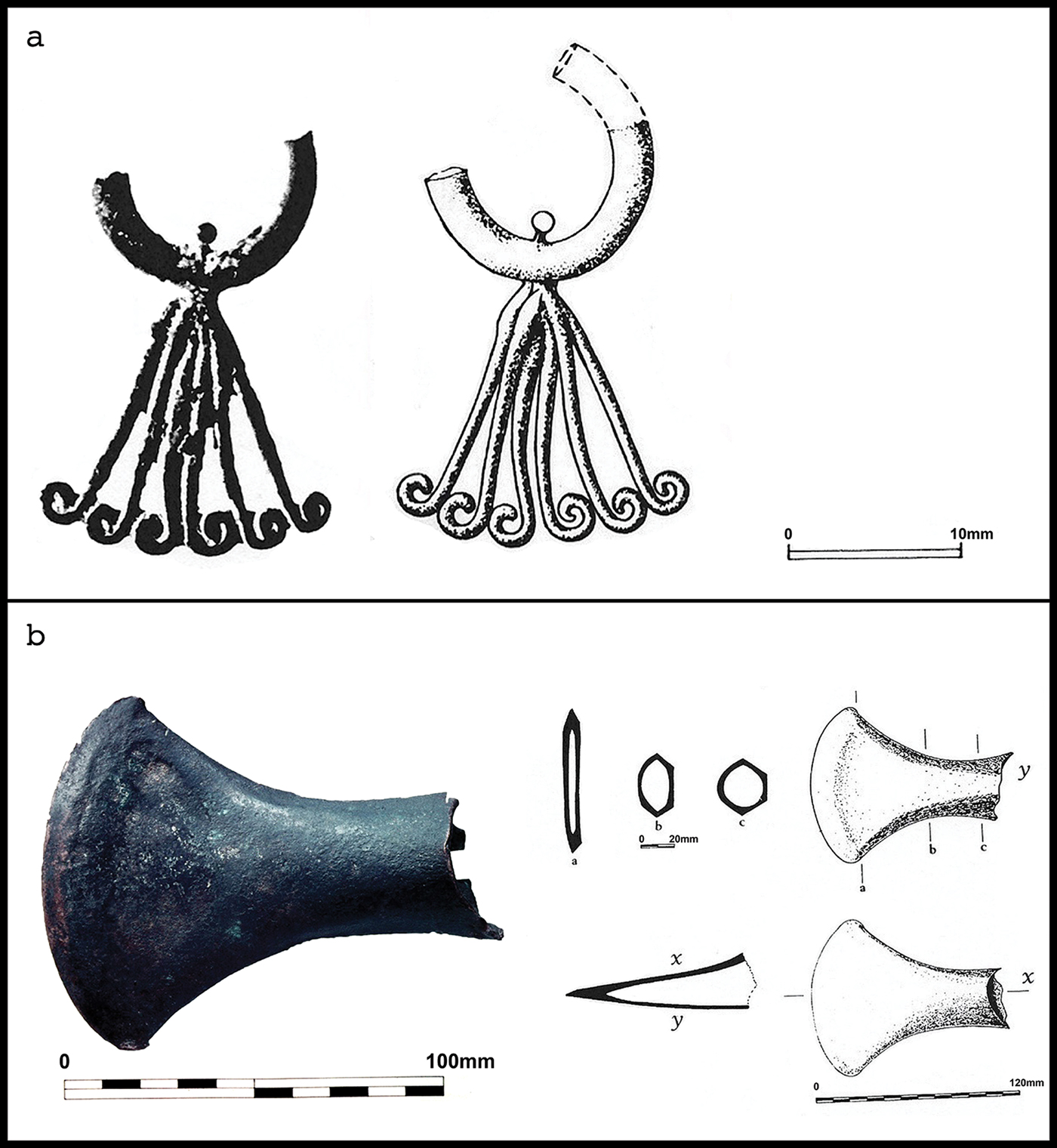
Ian Glover was the last archaeologist to work in Timor-Leste prior to the Indonesian invasion, which took place in December 1975. He conducted three fieldwork seasons, between 1966 and 1967, locating and excavating a number of archaeological sites (Glover Reference Glover1969, Reference Glover, Mulvaney and Golson1971, Reference Glover and Strong1973, Reference Glover1977, Reference Glover and Taddei1979, Reference Glover1986). Glover's historical synthesis, which represents the first comprehensive cultural and chronological sequence for Timor's prehistory, was mainly drawn from his cave and shelter excavations on the Baucau Plateau and in the Venilale region. At Uai Bobo 1 cave in Venilale, Glover found part of a copper or bronze ring with soldered-on attachments. He interpreted this as an earring; it represents the only prehistoric metal object from all of his excavated sites (Figure 3a) (Glover Reference Glover1986: 130 & 153).
a) Copper or bronze wire ornament from Uai Bobo 1 (Glover Reference Glover1972: pl. 7.4); b) the socketed axe found in a cave in Baucau (Glover Reference Glover1972: pl. 3.23).

The ring came from Horizon IIIc, and was closely associated with charcoal dated to 2190±80 BP (ANU-237: 2340–1935 cal BP at 95.4%, OxCal 4.3, SHCal13; Glover Reference Glover1986: 130; Bronk Ramsey Reference Bronk Ramsey2009; Hogg et al. Reference Hogg, Hua, Blackwell, Niu, Buck, Guilderson, Heaton, Palmer, Reimer, Reimer and Turney2013). In another cave, Baucau 1, Glover collected a bronze axe lying on the ground's surface, which he attributed to the “Dong Son or Southeast Asian Bronze Age” (Glover Reference Glover1972: vol. II, appendix VI: 30–35, 1986: 22) (Figure 3b). Despite its broken socket, the shape of the axe blade shows a strong similarity to some Metal Age bronze axes found in Java and Sulawesi and from Gua Harimau in Sumatra (Heekeren Reference Heekeren1958: figs 2–3; Glover & Syme Reference Glover and Syme1993; Fauzi et al. Reference Fauzi, Oktaviana, Budiman. and Simanjuntak2016).
Little or no archaeological research took place during the years of Indonesian occupation, which lasted from 1975–1999. In 2000, archaeological investigations were resumed in the new nation of Timor-Leste by a joint team from The Australian National University and James Cook University in Australia (O'Connor Reference O'Connor2002; O'Connor et al. Reference O'Connor, Spriggs and Veth2002). Since then, several archaeological excavations have been undertaken, at a diverse range of sites, including fortified settlement sites, open shell middens, caves and rockshelters—some of these associated with rock paintings and engravings (O'Connor Reference O'Connor2003, Reference O'Connor2007; Spriggs et al. Reference Spriggs, O'Connor, Veth, Kallen and Karlstrom2003; Veth et al. Reference Veth, Spriggs and O'Connor2005; O'Connor et al. Reference O'Connor, Aplin, St Pierre and Feng2010a & Reference O'Connor, Barham, Spriggs, Veth, Aplin and St Pierreb, Reference O'Connor, McWilliam, Fenner and Brockwell2012; Brockwell et al. Reference Brockwell, O'Connor, Litster and Willan2016; Hawkins et al. Reference Hawkins, O'Connor, Maloney, Litster, Kealy, Fenner, Aplin, Boulanger, Brockwell, Willan, Piotto and Louys2017). No further metal artefacts, however, have been recovered from stratified contexts.
The two Dong Son drums from Timor-Leste
In 2014, a fragment of the tympanum from a large bronze drum was documented by a team from the Timor-Leste Department of Museums, General Directorate of Culture, Ministry of Education and Culture, in the village of Daudere (Figures 2 & 4), located around 2km west of Lautem in a meander of the Raumoko River.
The tympanum fragment from Daudere (drawing Gil Alves).

According to community members interviewed in 2014, the fragment was found in 1999 in an old cemetery located on a hillside south of the village. Today, it is regarded as an heirloom and is kept in a sacred house in the village. Only the central part of the tympanum survives, depicting a low-relief, 10-pointed star surrounded by concentric decorative zones, filled either with incised circles or with close-set (comb-like) parallel lines. Tympana decorated only with circles and comb patterns are quite rare in the published corpus, although there is one undated example from Meo Vac in Ha Tuyen Province, northern Vietnam (Vietnamese Institute of Archaeology 1990: 235). Further investigation of the Daudere findspot—the location of which is known to community members (Abílio da C. Silva pers. comm.)—may yield additional fragments of the drum.
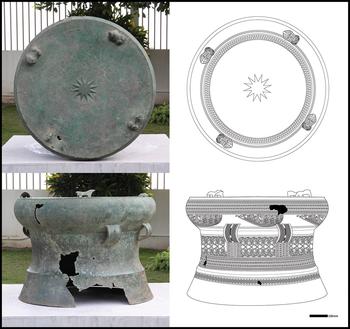
In May 2015, Avelino Gaio, the Timor-Leste Regional Officer of Culture in Baucau, was informed that another, more complete bronze drum had been found near the village of Ai-Lemi Isi. The object had been excavated by a local villager the previous year and was being curated in a sacred house within the village. The drum was purchased by the Government of Timor-Leste to avoid sale to an overseas collector; it now belongs to the National Collection of Timor-Leste in Dili (Figure 5).
The Ai-Lemi Isi Dong Son drum in Dili (height: 0.77m; depth: 1.08m) (photograph © NVO, drawings by Nuno Costa.).

Ai-Lemi Isi is located north of the main village of Baucau, on an uplifted coralline terrace overlooking the north coast of Timor, about 1.3km from the sea and at 296m asl. In June 2015, the first author, who was then an employee of the Timor-Leste General Directorate of Culture, was taken by local villagers to inspect the original findspot of the drum. There, a 2 × 2m area was excavated to a depth of approximately 1.3m to search for the original burial location. This excavation confirmed the findspot of the drum, identifying the clearly visible negative imprint in the soil where the drum had been removed. Moreover, further small fragments of the drum were recovered from the backfill sediment, along with a small number of plain and incised earthenware sherds and a few pieces of glazed ceramic of probable European origin. It is unclear if any of the sherds were contextually or temporally associated with the drum; they may have been inadvertently introduced into the burial context when the hole was backfilled following the removal of the drum. Permission for further excavation is currently being negotiated with the landowners and the Government of Timor-Leste.
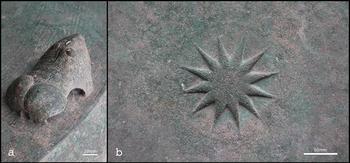
On the basis of its four toads and the extremely schematic boat and warrior parade scenes on its sides, the Ai-Lemi Isi drum belongs quite clearly to Calo's RS3 group (Figures 6–7). The drum is nearly complete, although missing a part of the base and most of one of the toads on the tympanum (Figure 5). The markings indicating where the toads were soldered to the tympanum are clear in the area of the damaged toad. Unusually, the centre of the tympanum appears to be mostly undecorated. There is, however, the faint trace of a concentric band around the outside of the 12-point star, and a worn but definite concentric band of decoration inside the toads (Figure 6 a & b). The tympanum is severely worn and it is possible that there was further decoration that has been lost.
a) Detail of a toad on the outer edge of the tympanum; b) detail of the central 12-point star/sun motif on the Ai-Lemi Isi drum (© NVO).

Lateral view of the upper side of the Ai-Lemi Isi bronze drum showing details of schematised boats and feathered men (drawing by Nuno Costa).

RS3 drums have been found in many islands of the Lesser Sunda group, Maluku and nearby, including Sangeang, Selayar, Alor, Rote, Leti, Luang, Tanimbar, Kei, Serua, Gorom, Buru and Papua (Figure 1). We can now add Timor to this list. Calo (Reference Calo2014: 108) notes that three drums that fit stylistically within the RS3 cluster occur in northern Vietnam, possibly suggesting their place of manufacture.
The Metal Age in Timor-Leste as inferred through rock art
Timor-Leste has a rich corpus of rock art. In the 1960s, Portuguese anthropologists Cinatti (Reference Cinatti1963) and Almeida (Reference Almeida and Solheim1967) documented the first rock art sites in the Tutuala region of Timor-Leste. Glover (Reference Glover1972, Reference Glover1986) later identified a few more caves containing rock art on the Baucau Plateau. Since 2000, more than 30 new rock art sites have been located—mostly in the Tutuala region at the eastern end of the island (O'Connor Reference O'Connor2003; Arifin & Delanghe Reference Arifin and Delanghe2004; Lape et al. Reference Lape, O'Connor and Burningham2007; O'Connor & Oliveira Reference O'Connor and Oliveira2007; Forestier & Guillaud Reference Forestier, Guillaud, Klokke and Degroot2013; O'Connor et al. Reference O'Connor, Louys, Kealy and Mahirta.2015, Reference O'Connor, Mahirta, Tanudirjo, Ririmasse, Husni, Kealy, Hawkins and Alifah.2017; Galipaud et al. Reference Galipaud, Kinaston and Guillaud2016). Although the Timor rock art described here has not yet been directly dated, O'Connor and colleagues have found similarities between some of the rock art motifs and those depicted on the Dong Son drums and bucket-shaped bronze vessels known as situlae, as well as rock art panels that feature people using metal axes and other weapons. Thus, the implication is that the Timorese art may date from 2500 BP onwards (O'Connor Reference O'Connor2003; O'Connor & Oliveira Reference O'Connor and Oliveira2007; O'Connor et al. Reference O'Connor, Louys, Kealy and Mahirta.2015, Reference O'Connor, Mahirta, Tanudirjo, Ririmasse, Husni, Kealy, Hawkins and Alifah.2017).
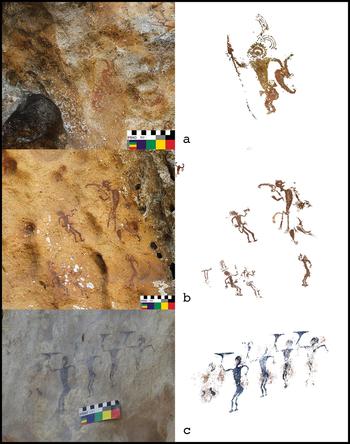
At Moa Mimi Raka shelter, one panel depicts a figure with an elaborate headdress who holds a candrasa—a bronze ceremonial axe, as portrayed in Heekeren (Reference Heekeren1958: figs 5–6)—in one hand, and a probable metal-tipped spear in the other (Figure 8a). Another panel in the same shelter shows a candrasa used for decapitation—the larger figure at the top right of the panel holds the candrasa in its left hand and a severed human head in its right (Figure 8b).
Painted rock art showing ceremonial axes in use: a) in Moa Mimi Raka, a figure with an elaborate headdress holds a candrasa (a bronze ceremonial axe, as portrayed in Heekeren (Reference Heekeren1958: figs 5–6)) in one hand, and a probable metal-tipped spear in the other; b) a headhunting scene from Moa Mimi Raka 1 depicting a candrasa being used to sever a human head; c) a group of figures at Ile kere kere in a procession holding candrasas very similar in shape to the crescent-shaped axe in the Metropolitan Museum of Art (accession number: 2000.284.49).

Scenes of decapitation by individuals holding what appear to be bronze axes are also depicted on the sides of Dong Son drums from the Asian mainland—for example, on a drum from the second-century BC Nanyue tomb in Guangzhou, China (Bellwood et al. Reference Bellwood, Cameron, Van Viet and Liem2007: fig. 14).
The decapitation scenes described above can be interpreted as images of head hunting, a practice that was widespread in the Indonesian islands—including Timor—into historical times (Middlekoop Reference Middlekoop1963; Hoskins Reference Hoskins1996; McWilliam Reference McWilliam and Hoskins1996). It seems to have had a predominantly ritual/ceremonial function, and was linked with the perpetuation of life and fertility. Schulte-Nordholt (Reference Schulte-Nordholt1971: 365), for example, stated that in Timor “the headhunting raid and marriage, death and life are inseparably linked”. Headhunting was also used to structure, reinforce, display and defend hierarchical relationships between communities and individuals. Ethnographic accounts describe ritual performances, which included dancing and incantation by male raiding parties prior to taking the heads, followed by whole community celebrations on their successful return (Hoskins Reference Hoskins1996). The axe in the headhunting scene at the Moa Mimi Raka shelter features the same flamboyantly curved blade and asymmetrical socket as an axe held in the Metropolitan Museum of Art in New York (accession number: 2001.433.472) and a find from East Java illustrated by Bernet Kempers (Reference Bernet Kempers1988: 595, pl. 22). At the Ile Kere Kere shelter, a group of four figures is depicted as if in a procession or ceremony, holding candrasas raised above their heads (Figure 8c). These axes are reminiscent of a larger, crescent-shaped socketed axe with a flatter blade, also in the Metropolitan Museum of Art collection (accession number: 2000.284.49).
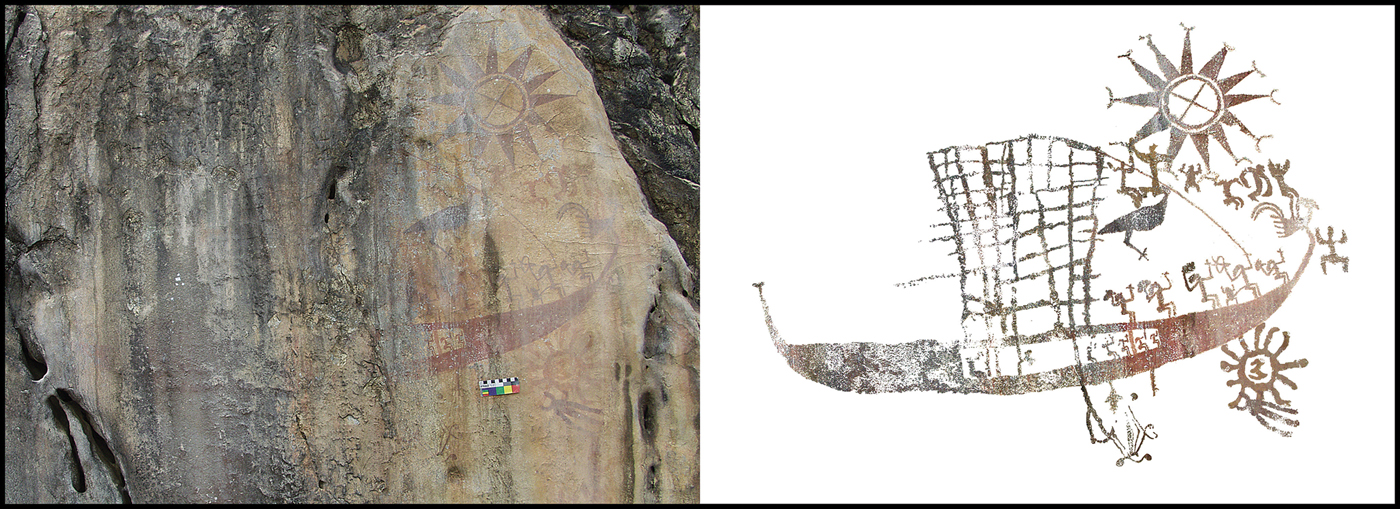
While the feathered warriors shown on Dong Son drums from Vietnam often carry axes, those portrayed in the rock art in Timor-Leste are much more elaborate, resembling the flamboyantly shaped axes found in Sulawesi and elsewhere in eastern Indonesia (Calo Reference Calo2014). The eastern Indonesian axes share a range of distinctive forms that are unknown in Mainland Southeast Asia or western Indonesia. They appear to have been a local development and were probably manufactured in ISEA (Calo Reference Calo2014: 141). The Timor-Leste paintings do not appear to depict unhafted heirloom axes, but rather, they celebrate the use of these objects during events of significance in life or death, such as raiding, headhunting and ceremony. Similarly, the seated warriors shown in association with the large boat at the Lene Cece shelter in Tutuala, with their elaborate feather headdresses and weapons (Figure 9), have affinities with the warrior figures depicted on Dong Son drums (Lape et al. Reference Lape, O'Connor and Burningham2007). The depiction of such activities on the Lene Cece boat, however, is much more realistic than on the upper sides of the Ai-Lemi Isi drum, or other RS3 cluster drums. This perhaps indicates that the Lene Cece artists had seen such warrior vessels in action, rather than simply copying images of the boats from the drums. Finally, the 12-point sun/star motif with triangular rays painted at the upper right of the Lene Cece boat bears a striking resemblance to the raised star on the tympanum of the Ai-Lemi Isi drum.
Painted art at Lene Cece shelter includes a Dong Son-style boat with feathered warriors seated on the deck and inside the hull, and a 12-pointed sun/star as seen on the tympanum of the drum from Ai-Lemi Isi in Figure 5.

Conclusions
Dong Son drums were widely traded or exchanged throughout ISEA, to as far east as the Bird's Head of Papua (Figure 1). Although examples have been previously recovered from Alor and Roti—both adjacent to Timor—the place of Timor in the exchange network has, until now, remained uncertain. The discovery of two buried Dong Son drums—one almost complete—close to the north-east coast of Timor-Leste indicates that the islanders participated in exchange networks well before the arrival of Europeans in the region. The Timor drums closely match Calo's RS3 cluster of eastern Indonesian drums, with the near-complete Ai-Lemi Isi drum showing decoration including boats, highly abstract feathered warriors and four toads on the tympanum. The drum from Daudere comprises only the incomplete percussion surface of the tympanum, but based on the size of the surviving fragment, the drum probably grouped with the RS3 cluster. The outer rim, which might once have supported toads, is missing, although the central raised star and some decoration survive. Investigation and dating of the burial contexts of these two discoveries should be a future priority. Although excavation will not tell us about the date at which the drums were manufactured, it may well inform us about the contexts of their final deposition.
While little is known about the role of bronze objects such as the drums and the elaborately shaped axes on the islands of the Wallacean Archipelago, scenes reproduced in the rock art of Timor-Leste suggest that the bronze axes had a prominent role in ritual performance and ceremony, including headhunting. Although no axes have been recovered from archaeological contexts in Timor-Leste, direct dating of the rock art has the potential to elucidate the timing of the arrival of these and other cupreous metal objects on the island.