Introduction
Globalization, which has been broadly characterized as a ‘progressive increase in the scale of social processes from a local or regional to a world level’, has ironically only ever been experienced by individuals in a local context.Footnote 1 The interpenetration of the local and the global, otherwise termed ‘glocalization’ (by Roland Robertson, among others), is perhaps most evident in the commercial sphere.Footnote 2 Take, for example, the first commercially available pet food, produced in Britain around 1860. When its pioneer, the American James Spratt, sought to market his ‘fibrine dog cakes’ (dog biscuits), he chose two distinct but inter-related marketing strategies. The first emphasized the quality of their ingredients, especially ‘pure fibrine, the dried, “unsalted”, gelatinous parts of prairie beef ’.Footnote 3 The exotic origins of the biscuits’ meat (reinforced in another advertisement which depicted an American Indian buffalo hunt) underlined a reassuringly expensive quality. So too did the second strategy, a welter of endorsements from the great and good. In several advertisements, extracts were published from commendatory letters written by the Kennel Club and the Royal Kennels at Sandringham. These recommendations, aimed at well-to-do customers who owned gundogs or packs of hounds, carried weight abroad, where German and Austrian magazines featured advertisements for Spratt's biscuits, ‘which every sportsman in England uses’.Footnote 4
These two strategies – one emphasizing the global sourcing of quality ingredients, the other a set of local endorsements from persons of quality – exemplify the interpenetration of these two scales of commercial activity, while simultaneously demonstrating that globalization and glocalization were processes involving cultural and social factors. This article explores these phenomena in two port cities of the eighteenth-century British Atlantic world (Bristol and New York), focusing primarily on animals. Animals are an increasingly prominent feature of scholarship on the early modern era, but have yet to make a substantial impression on the urban history of the period, particularly that of global cities.Footnote 5 For example, the leading history of animals in colonial America, Virginia DeJohn Anderson's Creatures of Empire (2004), only fleetingly mentions animals in urban settings, no doubt due to the absence of large conurbations on the Atlantic seaboard before 1700.Footnote 6
The following discussion has two principal aims. The first is to assess the usefulness of ‘glocalization’ as a concept in the study of early modern global cities, using human–animal interactions as a test case. A portmanteau term that combines ‘globalization’ and ‘local’ to highlight their interpenetration, this label was originally a Japanese marketing term from the 1980s but has drifted from its commercial moorings into the humanities and social sciences, where it has proven influential in the fields of cultural critique, sociology and geography. Debate has centred on whether the local is threatened by or is an intrinsic part of the global; whether their interpenetration is a force for homogenization or heterogenization (or both); how such processes interact with government, be it at a local, regional, national, supranational or fully international level; and whether glocalization is a tool of neo-liberal economics or can work to rectify global inequalities. Some have argued that globalization amounts to a set of forces that ultimately crush local cultures, while others have pointed out that once global and local cultures interact beyond the most superficial level, neither exists as a pure entity – if ever they did – meaning that the ‘glocal’ is all that remains. ‘Glocality’ has therefore been interpreted as the local experience of the global; glocalization is globalization refracted through the local.Footnote 7
Such a perspective on glocalization builds (indeed, depends) upon the sophisticated ways in which ‘globalization’ has been used by historians of the pre-modern world. One crucial discussion has centred on ‘archaic’ and ‘proto-globalization’, initiated by Tony Hopkins and the late Chris Bayly in an influential 2002 collection. For both of these scholars, globalization is a broad, imbricated phenomenon that extends far beyond its contemporary, primarily economic connotation. Bayly, furthermore, viewed it as more a heuristic device than a description of linear social change, and he used a notion of ‘archaic’ globalization to account for medieval and early modern global – principally Eurasian – flows of ideas, beliefs, goods and peoples in a world of fluid political entities, circumscribed geographical horizons (for him, the Americas and Australiasia played no part in this phase of globalization) and cosmic (or religious) priorities. ‘Proto-globalization’, on the other hand, involved the Atlantic and Pacific worlds, and branched out into more familiar conceptual territory while retaining significant aspects of its ‘archaic’ predecessor, particularly its emphasis on the role of cities. During this phase, the reconfiguration of the state system following the Treaty of Westphalia (1648) interacted with the growth of financial services and pre-industrial manufacturing to produce an expansion in the scale of capitalist modes of production and consumption, and was culturally and institutionally marked by the spread of European empires.Footnote 8
The second aim of this article is to explore the reciprocal influence of human–animal interactions and the development of global cities. For the period after 1800, this story has already been told; it is one of a ‘great separation’ in which urban animals were increasingly excluded, marginalized, or cordoned off in zoos or the home in the name of urban sanitation or animal welfare. The ‘great separation’, moreover, was no mere epiphenomenon of the making of the modern city: it was an inherent aspect of this project. But these processes had their limits, as the categories of animals to be excluded, marginalized or enclosed depended on a large number of factors: even the quintessential ‘domesticated’ animal, the dog, might be a favoured pet, a working animal, a low-status cur or an abject stray. Furthermore there existed a large number of ‘liminal’ animals that were neither entirely ‘wild’ nor ‘domesticated’, but which lived in cities and ate anthropogenic food sources yet were beyond human control (e.g. rats, foxes or pigeons).
There was no such systematic effort in the early modern era to remodel urban space in order to exclude animals. Their influence on the pre-modern city was therefore profound, whether as pets, food, labour, entertainment or nuisances. In these and other roles, animals created a demand for dedicated pet shops, merchants and tradespeople; influenced practices and spaces of commerce, slaughter and butchery; worked in transport, haulage, security and pest control, and promoted the import of fodder into and export of manure out of urban areas; profoundly shaped a burgeoning entertainment industry, running the gamut from individual animal exhibitions in taverns and coffee houses to dedicated menageries and, by 1800, extensive zoological gardens; and stimulated the production of urban regulations and new bodies of nuisance law. These processes, while common to most pre-modern cities, were primarily local in scale, some – travelling entertainers, for instance – were national or even international. Few were global.Footnote 9
Those that were are the subject of the first section below, which examines animal influences on early modern cities that either involved social and cultural aspects of globalization (such as the differential management of animal nuisances in European empires) or were part of global trade (horse-breeding and pets). The second section moves to consider the influence that the global trade in one animal commodity – fur – had on port cities and the larger polities and cultures of which they were a part. By exploring aspects of cultural and economic glocalization in more depth, this section investigates how global trade helped to construct particular localities. Overall, this article will shed light on the role of animals and their relations with humans in processes of early modern glocalization and will show how animals were key actors in shaping the early modern global city.Footnote 10
Globalized animals in the early modern city
The very ubiquity of animals in early modern cities has obscured the ways in which they partook of early forms of globalization. Yet global contacts are implicit in many aspects of human–animal relations in the urban environment during this era. One of the clearest examples is provided by the spread of disease and immunity. Animals acted as disease vectors – most notoriously the black rat (rattus rattus) and its flea (xenopsylla cheopis) in the case of bubonic plague – which interacted with global commercial networks to ensure that diseases spread rapidly across large distances. Furthermore, dense urban populations meant that diseases introduced by animal vectors rapidly reached epidemic proportions. Conversely, animals also helped Europeans to acquire immunities that were not possessed by indigenous Americans, which rendered the Columbian exchange particularly lethal, especially in urban Mesoamerica, for example the Aztec capital Tenochtitlan.Footnote 11
Related to epidemic disease were the nuisances and dangers posed by animals. Many of these were familiar issues for any urban environment, but with global empires came new challenges, species and ways to deal with them. Indeed, animal nuisance regulations act as a useful index of the differential glocalization of urban human–animal relations. To be sure, both Bristol and New York shared the concern to promote sanitation and reduce the number of stray creatures. They both employed scavengers to keep their streets clean and to dispose of rubbish and animal waste, which could then be sold on.Footnote 12 Pounds were also kept in town and country for stray and wandering beasts; these could only be reclaimed on payment of a fee that in New York went both to the pound-keeper and to the individual who captured the animal.Footnote 13
Rewards were one way in which efforts to tackle animal nuisances manifested global currents in local settings, not least because they reflected and influenced tensions between communities brought together as a result of empire. Bristol had rules dating back to the Middle Ages against roaming pigs and the careless disposal of human and animal waste, and while these were later placed on a statutory footing involving hefty fines, informants seem not to have been entitled to any reward.Footnote 14 In New York, on the other hand, they almost always received at least half of any fine or proceeds from the sale of confiscated livestock. This difference had much to do with maintaining friendly relations with native peoples in an insecure and distant colony: as elsewhere in British America, New Yorkers allowed their animals to graze in any unenclosed space, which made for strained relations between settlers and Indians.Footnote 15
But as the English became more secure in New York after their takeover in 1664, their policy towards rewarding informants and pest exterminators became more invidious. In the Duke's Laws of 1667, ‘Indians’ were entitled to recompense if settlers’ cattle damaged their crops, to assistance in erecting protective fencing and to the same sum awarded to settlers in return for the head of a wolf or wolves. But in one of its first acts, the New York Assembly in 1683 reduced this sum for ‘Indians’, who were to receive 12s for an adult wolf and 6s for a pup. Despite the complaint that wolves ‘have lately encreased very much’, these bounties were reduced still further in 1692, and the continual failure of the law to encourage the eradication of wolves in sufficient numbers resulted in the raising and partial equalization of rewards in 1702. However, several of New York's counties continued to discriminate against ‘Indians’.
Of course, global encounters were not limited to humans, and the species deemed pests could widely differ from one place to another. New York featured a much larger range of troublesome wild animals than in Britain, including ‘Bear[s], Wolves,…and Skunks’.Footnote 16 The author of this list might well have added wild cats, their kittens, foxes, squirrels, crows and blackbirds, all of which were targeted in provincial legislation of 1708 that mandated their destruction and offered rewards.Footnote 17 That this animal hit list was scaled back within five years, rehabilitating squirrels and birds, not only testifies to the growing popularity of these species as pets, but also suggests that such legislative exuberance was as much a matter of cultural perceptions of wildness as of actual depredations inflicted on colonists’ livestock.Footnote 18
Additionally, those species common to Bristol and New York, such as pigs, were deemed pests for different reasons that also reflected global factors, amongst which were health and physical security. If the concern of Bristol's Grand Jury in 1696 was common, that ‘health…[is] endangered by the noisome smells occasioned by the vast number of swine that are kept in most parts here’, the harsh measures against wandering pigs in New York were a product of its particular vulnerability to attack from imperial rivals.Footnote 19 Complaints about hogs uprooting defences at the tip of Manhattan Island date from before 1664, but penalties became markedly harsher during the brief period of Dutch reconquest in 1673–74. In August 1673, any hogs found roaming south of the city's Fresh Water Pond (today's Worth Street, well to the north of the city until the mid-eighteenth century) were to be confiscated. Within two months, the penalty for animals found in the fortification at the southern tip of Manhattan was a fine of twice the value of the animal in addition to its confiscation. Only once the city was returned to English rule after the Third Anglo-Dutch War were these regulations relaxed.Footnote 20
Also important for New York's security was another familiar species, the horse, the breeding, racing and trading of which were activities that participated in global currents – particularly trade – and had a range of local manifestations. In 1670, a New York court banned the possession of horses and their sale to Indians, on the basis that they ‘do Truck for & buy horses of Christians for their owne use which in tyme may prove very dangerous & pjudiciall to his Majesties Subjects in these parts’.Footnote 21 The same court extended to Long Island the encouragement of horse breeding by the government, already in place in the late 1660s, ‘not so much for ye divertisement of ye youth alone but for ye Encouragem[en]t of ye bettering ye breed of horses’.Footnote 22 The poor quality of the colony's horses was a serious problem given both the local need for these animals and the small but lucrative part played by exports of horses in the colonial economy. In 1720 alone, almost 100 horses were exported from New York to four Caribbean destinations. To be sure, race meets were organized in the Old World for purposes other than sheer entertainment, and in later years newspapers advertised the availability of stallions to cover mares, as private individuals sought to harness the reproductive potential of their animals.Footnote 23 But New York's first newspaper was published only in 1725, and the need to secure a valuable breed of horses in the meantime led the government not only to promote race meets but also to mandate in 1718 the gelding of small wild-roaming horses as a form of genetic insurance.Footnote 24
A final aspect of glocalized human–animal relations in early modern cities was a burgeoning global trade in pets, recently studied by Ingrid Tague, Christopher Plumb and others.Footnote 25 They draw attention to the increasing popularity of pet-keeping during this period, which led to a thriving small animal trade that spawned a number of associated industries, but they concentrate almost exclusively on London. New York and Bristol, on the other hand, offer valuable perspectives on these phenomena. As elsewhere, for example, canaries were imported from Germany and advertised for sale in these cities, and their popularity led wire-drawers and pin-makers in these cities to diversify into the production of bird cages.Footnote 26 By the mid-eighteenth century, caged birds were common pets among all social ranks although this appears to have been an especially urban phenomenon, at least in Bristol: according to Carl Estabrook, almost all the probate inventories that mention caged birds were for houses within the city.Footnote 27 A further indication that the trade in birds had come of age in this period was the existence of advertisements which, like those for Spratt's biscuits, emphasized the quality of merchandise, especially in comparison to cheaper vendors. Richard Buffin, for instance, sold canaries in Bristol in the late 1780s and advised purchasers to beware of street vendors, ‘as they generally sell Hens for Cocks, he having had several complaints from persons that have bought Birds on the Exchange, who thought they were his; (he living there) but he is determined to sell none but what will be warranted on his word’.Footnote 28
In addition, New York was itself an important source of animals. In 1726, duty was paid on nine of what customs returns laconically termed ‘Birds, Singing’ arriving in London from New York, and George Edwards obtained birds from the city, later described in his Gleanings of Natural History (1758–64).Footnote 29 Other species exported from New York included squirrels, a popular eighteenth-century pet. One mother wrote in 1741 to her son in London proudly boasting that she would send some (American) ‘flying ones [Glaucomys volans or sabrinus]…Next Spring’.Footnote 30 This trade in living creatures, as well as nuisance management and the racing and breeding of horses in New York and Bristol, were all important local manifestations of global processes in which animals influenced urban life and development. But it was the trade in a particular form of animal remains, of which New York was also a key source, that exercised the most profound influence on the global cities that took part in it.
Fur, freedom and fashion
Global cities have been characterized by one theorist of glocalization as ‘key sites for the coordination of global commodity chains’, while others have argued that ‘glocalization…reveals the way in which the very creation of localities is a standard component of globalization’.Footnote 31 This section explores both of these phenomena with particular reference to the trade in fur, particularly of the North American beaver (castor canadensis), one of the most important commodities in the northern British Atlantic world. The hunger for fur was a powerful engine of European colonization in North America, and led to a substantial trade that spread north to the Arctic and west to the Pacific over three centuries from 1600.
The fur trade was global from the outset. Furs were imported from Europe and America; they were often re-exported to Russia (or China, as the Pacific became a major source of furs at the turn of the nineteenth century) for processing; and fur products were exported worldwide.Footnote 32 The trade's global status was marked in the early modern era by the involvement of all the major European maritime powers. Dutch, English, French and Scottish colonial projects were initiated to win a share of the fur trade, and their common focus in northern North America meant that global links were manifested even within a single locale.Footnote 33 Almost all fur trapping and hunting was undertaken by Indians, who traded with the Dutch, English and French for textiles (mostly blankets), rum, firearms and wampum. The superior quality of English goods, particularly the first two articles, led Indians to bring their furs (and other trading commodities, including animals) to New York rather than New France.Footnote 34 As a result, a substantial trade in furs was conducted between these colonies throughout the first half of the eighteenth century. Apart from a brief period during the 1720s when New York's governor, William Burnet, attempted to prohibit the trade with Canada, this commerce continued despite French efforts to prevent it.Footnote 35
The city of Albany was an especially important centre of the fur trade; the city's grandees, who were overwhelmingly Dutch, jealously guarded this status and were granted a charter in 1686 conferring a monopoly on the fur trade. However, the elimination of competition from other provincial towns came at a price. New York City had already been awarded a series of monopolies – on the Hudson River carrying trade (1670), on exports (1678) and finally in 1684 the city was made the province's sole port of entry – that prevented Dutch fur traders in Albany from making a profit on the shipping of their wares.Footnote 36 Profits from the fur trade were most often produced not by the price of furs in Europe, which were rarely substantially larger than those in America once transportation costs and customs were included, but from a mark-up on the goods for which furs were traded. Gains from this trade became increasingly difficult for all but the English/British and their colonists to make, first because these were the only people permitted to own and operate shipping under the Navigation Acts, and later because these acts became more restrictive when fur was ‘enumerated’ in 1722.Footnote 37 This measure, apparently directed against New York (where the Albany Dutch were still sending sizeable cargoes of fur directly to Holland), meant that furs had to pass through Britain before they could be shipped elsewhere. These interactions between Europe's main maritime powers, even within the confines of a single region, highlight both the global nature of the fur trade and the limits of early modern, ‘mercantilist’ globalization.
The role of global cities in this commerce was pivotal yet remains obscure. In America, New York was easily the most important maritime city to be involved in the fur trade: it was the only official port of entry in a colony whose dominance over all its competitors in British America (with the sole exception of Hudson Bay, ‘actually not a colony but a fur preserve’) is apparent from Figure 1.Footnote 38 The range of furs sent from New York to Bristol and London was considerable and in a given year (1725) included black bear, beaver, cat, fisher, fox, martin, mink, muskrat, otter, raccoon and wolf. The predominance of beaver over other furs is clear: in 1725, over £6,050 worth of beaver was imported by Britain from New York for £1,210 worth of other furs.Footnote 39
Imports of fur to England/Great Britain from British America, 1700–60. The years 1709 and 1739 are included because of inadequacies in the data for some colonies in the years 1710 and 1740.
Sources: Lawson, Fur, App. E, 108; TNA CUST3/12.

More ambivalent is the tale told by customs figures about the relative importance of metropolitan cities in the fur trade. In the 1720s, the proportion of ships entering London bearing furs from New York (13.2 per cent) was almost the same as that entering Bristol (12.6 per cent), yet the actual value of imports was far more unbalanced.Footnote 40 The New York fur trade was somewhat volatile in the second half of the 1720s, possibly as a result of enumeration, which boosted the outports’ share in the trade (see Table 1). Yet at no point did the value of New York fur shipped to ports outside London reach even 11 per cent of the total; the fact that the total tonnage of shipping in Britain's outports consistently exceeded that in London makes this contrast even more stark.Footnote 41 Taken together, the rough parity in the proportion of ships carrying furs to Bristol and London and the vast difference in the value of the furs imported suggests a picture of small-scale fur trading between New York and Bristol, and a larger, bulk trade with the capital. This corresponds with the impression conveyed by the detailed customs records for New York surviving from the first decade of the century, during which most of the city's principal fur merchants, men like Stephen De Lancey, Rip Van Dam and Abraham Wendell, regularly shipped their product to Bristol, albeit in small amounts.Footnote 42
Britain and the New York fur trade, 1720–30. Except where indicated, figures are value of imports/exports rounded to the nearest £ sterling.

Note: ‘Fur’ includes the categories used in Lawson, Fur (badger, bear, beaver, beaver cut, cat, coney, coney wool, fisher, fitch, fox, hare, leopard, marten, mink, musquash, otter, panther, rabbit, raccoon, tiger, weasel, wolf, wolverine, woodchuck); ‘woollens’ includes all the categories grouped under the heading ‘woollen goods’ in the customs returns, plus blankets, blanketry and woollen goods by value.
Sources: Lawson, Fur, Apps. A and E, 87–92, 108–9; TNA CUST3/22-30, 82.
But Bristol's advantageous location may have enabled it to punch above its weight in two ways. First, the narrow profit margins on the sale of furs in Britain encouraged merchants to steal a march on their competitors by shipping to the western city. This is exactly what happened in 1735, when the Albany merchant Philip Livingston sent three hogsheads of furs to his London partners Storke & Gainsborough via Bristol in order to beat the main New York fleet of fur ships that would arrive in London that autumn.Footnote 43 Second, not only did Bristol's hinterland produce many of the woollens used in the Indian trade, but her merchants readily procured textiles from as far north as Yorkshire to feed the New York market. This secured for Bristol a standing in the woollen export trade that was widely recognized: one New Yorker commented in 1724 that Bristol was ‘the Port from whence the greatest part of the Goods for the Indian Trade are exported’.Footnote 44
Customs records indeed show that, quite unlike their limited role in the fur import business, ports outside London had a significant stake in the export of woollens to New York. Their share in this trade fell below 20 per cent only in the mid-1720s when London's output reached three (1724) and then five (1726) times its 1720 level. Overall, the outports represented 26 per cent of this trade over the decade, an average that rises to just over 30 per cent when the anomalous years 1724–26 are excluded (see Table 1). Although it is not possible to disaggregate these figures to arrive at Bristol's precise contribution, it seems safe to assume it was substantial, given that Bristol attracted on average almost 40 per cent of the total tonnage landing at British outports from the American mainland colonies in the 1720s.Footnote 45
This global trade worked to create localities in a number of different domains. At its broadest, the fur trade helped to establish and consolidate a transnational culture that featured common clothing fashions and shared political ideas. The primary use of beaver fur in Europe was for the manufacture of hats, which were symbolic markers of wealth and status, in addition to being eloquent media of communication. Sumptuary rules and complex codes of etiquette (‘hat honour’) governed who was entitled to wear what sort of hat, how they were to behave and use it and even from what material it should be made.Footnote 46 Although formal sumptuary laws to regulate clothing were repealed by parliament in 1604, would-be citizens of Bristol had to swear, as late as the 1670s, that they would ‘not take or wear the Livery or cloathing of any Lord, Gentleman, or other person, but only your own, or your crafts…so long as you shall be dwelling within this City’.Footnote 47 The material from which hats were made was one of the clearest indications of the expense of the item, and hence of the wealth and status of its wearer. Beaver fur, which made a particularly luxurious felt, was the most expensive of all, although it came in various grades and could be mixed with other furs to produce a less costly hat. Beaver fur hats were fashionable for an extraordinary length of time, from the turn of the seventeenth to the latter part of the nineteenth century, when the collapse of North American beaver populations made silk and velvet more popular materials.Footnote 48
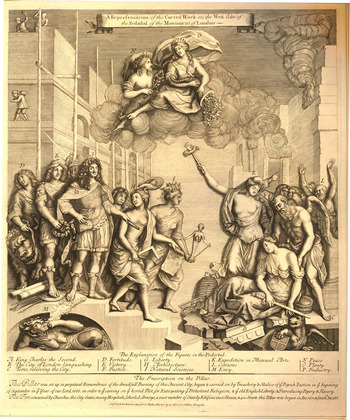
The beaver hat offers a rich example of cultural glocalization thanks to the potential of clothing to convey political ideas. Freedom and liberty have been communicated using headwear since antiquity and are themselves quintessentially ‘glocal’ ideas: they have pretensions to universality but are subject to a potentially vast number of local variations.Footnote 49 Two such variations are noteworthy here. First, the range of hats used to symbolize freedom expanded in the early modern era to incorporate a wide-brimmed hat, which signified a patriotic Dutch notion of liberty over the course of the 80-year struggle for independence from Spain.Footnote 50 Before the development in the mid-eighteenth century of the felt manufacturing process known as carroting, such a hat would almost certainly have been made from beaver fur given its resilience and shape-holding properties.Footnote 51 Second, this icon travelled across the Channel in the second half of the seventeenth century to supplement other headwear as a symbol of freedom in England. Its Dutchness was understated before 1688 in favour of an international Protestantism: the presence of this icon on the pedestal of the monument to London's Great Fire of 1666 (a memorial constructed during the Third Anglo-Dutch War to commemorate an event that occurred during the Second; see Figure 2) would be otherwise inexplicable. With the rehabilitation of Anglo-Dutch relations after 1688 the wide-brimmed hat became a symbol of the Williamite order, which partly explains its disappearance concurrent with that of the Jacobite threat after 1746.Footnote 52
A Representation of the Carved Work on the West Side of the Pedestal of the Monument of London (pub. John Bowles [c. 1723–37]). The figure ‘Liberty’, who holds a broad-rimmed hat in her left hand, is labelled G.
© The Trustees of the British Museum.

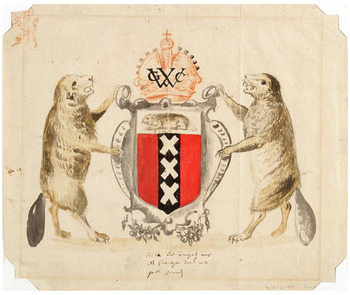
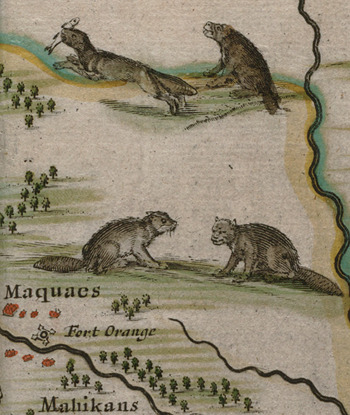
The fur trade inaugurated a powerful set of associations between New York and beaver that helped to create locality at a provincial or colonial level. Depictions of beavers and furs are ubiquitous in the iconography of New Netherland and New York, whether in maps, prints, flags or seals. The seal of New Netherland, which dates from 1630, features a beaver surrounded by wampum, and a rejected draft of a proposed coat of arms for New Amsterdam (Figure 3) even contains two beavers rampant, in place of the lions present in the arms of Amsterdam. New York's seal and arms have contained beavers since before the English conquest, and early modern cartography almost uniformly depicted beaver in the vicinity of the Hudson River. This trend originated with the earliest French cartography of the St Lawrence region and was soon followed by Dutch and English mapmakers. For example, Joan and Willem Janszoon Blaeu's map of New Netherland and New England in their Theatrum Orbis Terrarum (1635) and Francis Lamb's Map of New England and New York (1676) featured more beavers than any other animal (see Figure 4).Footnote 53
Proposed coat of arms for New Amsterdam, New Netherland (c. 1630), watercolour drawing, 30.5 x 36.2 cm., Drawing Collection, 1885.5, New-York Historical Society.

Detail from W. and J. Blaeu, ‘Nova Belgica et Anglia Nova’, in Toonneel des Aerdrycx, oft Nieuwe Atlas, 6 vols. (Amsterdam, 1658), vol. II, sig. ‘America E’. Note the proximity of the bottom pair of beavers to Albany (Fort Orange) and the Hudson.
Courtesy of Erfgoed Leiden en Omstreken.

The frequent use of place names as a shorthand for their most famous product(s) was another aspect of the construction of locality at the hands of the global fur trade. Many of the textiles shipped to New York were named after towns with which they were historically associated, such as ‘osnaburgs’ (after Osnabrück in Germany) or ‘strouds’ (a versatile woollen cloth that could be made into blankets, leggings and skirts), named after a town in Gloucestershire less than 50 kilometres from Bristol. As the two principal sources of furs in British America, ‘New York’ and ‘Hudson's Bay’ became metonymically linked to the quality of furs they sent to Britain.Footnote 54 Hudson's Bay fur was thought to be of superior quality, such that it alone was deemed sufficient to supply the market for fancy (i.e. garment) fur. As one pamphlet put it in 1752, ‘the Beaver imported from New-York, and the other Colonies in America, not being fit for Garments, very little (if any) of it was ever exported [from Britain] till within these Two Years’.Footnote 55 Both the quality and method of sale – in large auctioned lots – of Hudson's Bay fur effectively set a benchmark price, beneath which was pegged that of New York's exports. Associated with a lower-quality product yet so prominent that it was the only colony this pamphlet's author saw fit to name explicitly, New York arguably suffered as well as prospered from its close identification with beaver. But it did not have to suffer long: its share of the fur trade was in terminal decline by the early 1750s, at which point fur's share in New York's total exports had dipped below 25 per cent for the first time since 1700. The conquest of Canada accelerated this decline, and by the outbreak of the American Revolution fur constituted just 2.1 per cent of New York's total exports.Footnote 56
Until that time, the global fur trade continued to make its mark on the very fabric of New York City itself. One of its oldest and most important thoroughfares remains Beaver Street, which was paved in 1693 and was part of the route along which those sentenced to public whipping by the city's Court of General Sessions were forced to walk.Footnote 57 Other New York City landmarks were named after beavers (Beaver Lane, Beaver Path) or places associated with the fur trade, such as Albany or Oswego. As part of Burnet's efforts to restrict the fur trade with New France, a trading post was established in the 1720s on the shores of Lake Ontario at Oswego; by the late 1730s, a major market on Broadway, the street leading from it to the Hudson River and a landing on the riverbank were all named after Oswego. In addition, piers, wharves and landings were named after these places, as were several vessels either constructed or registered in the city. Indeed, on more than one occasion, vessels named ‘Beaver’ played an important part in the history of New York City, as when a ship of that name arrived in 1691, bringing the Leisler Rebellion to an end.Footnote 58
A wide range of agents, human and animal, were involved in glocalizing the fur trade, but perhaps the most significant part was played by Indians. In particular, their sophisticated understanding of fashion helped to shape glocalization both in America and Britain. Indians were canny consumers, and their desire for strouds was tempered by a discerning taste that would accept only those products that fulfilled their exacting standards. European traders sent their suppliers exact specifications of the strouds that would sell: Philip Livingston in the 1730s asked for red or blue strouds, and stipulated that there ought not to be too many visible white threads in the blue. In 1738, he complained to his partners Storke & Gainsborough that many of the textiles that had arrived in March on the Oswego Packet had poor ‘Collours & flours [flowers] which prevents their Sale[; they] should be gay & lively Collours’.Footnote 59 John Peloquin, a Bristol merchant who had lived for several years in New York, responded to his customers’ requirements by shipping a load of ‘striped blanketry’ on the Margaret and Mary, which left Bristol in mid-August 1725 and arrived in New York in early November.Footnote 60 It is clear that British merchants went to considerable lengths to ensure that their trading commodities suited local tastes and were disappointed when their products fell short of the mark.
More than merely streetwise consumers, Indians understood the nature of global economic mechanisms as they sought to influence consumer patterns back in Europe to their own advantage. Complaints about the prices of European goods were constantly made by the Iroquois sachems, but when speaking to New York's Lieutenant-Governor John Nanfan in July 1701, they made a striking suggestion:
Pray let goods be sold as cheap as formerly…Let the Beavers come to their old price again, and let the great Custom upon them in England be taken off. We do give you ten Beavers to send to the King, praying H.M. to make a Beaver-hat of them, and then we hope all his good subjects will follow his example, and were [wear] Beaver hatts again, as the fashion was formerly.Footnote 61
On this occasion, the price of European goods was inflated due to a temporary change in fashion away from beaver hats as well as a recession that affected the hat industry; the beaver imported in previous years remained abundant and was selling at a low price. Eight months earlier, the governor of New York, Lord Bellomont, had written to London complaining that ‘the market is so low for beaver in England that ’tis scar[c]e worth the transporting’. His pessimism seemed justified, as beaver fur imports from North America fell from over £12,000 in 1699 to under £4,000 in 1702.Footnote 62
Fully aware of the economic complexities of their situation, the Iroquois asked for both a reduction in duty and an increase in the price of beaver. Recognizing that the former might be in the grant of the British authorities but not the latter, they suggested a marketing strategy that is, if not entirely modern, then certainly part and parcel of modern globalized commerce: they proposed a celebrity endorsement. Indians clearly understood both the power of highly visible figures to influence fashion and the global links between the fur trade and the hat industry. Furthermore, this example shows that Indians themselves sought to encourage glocalization of the commodity they produced: aware that their furs had been consumed in Britain primarily through the manufacture of hats, they sought to revive this industry over and above others that might use beaver fur. They therefore hoped to influence global commerce such that the goods they wished to purchase were made more affordable. The commercial awareness of their Indian trading partners would not have surprised contemporaries such as Philip Livingston, who expressed concern in 1736 that word of the high price of beaver in London would reach his native clients, who might begin to charge more for their pelts.Footnote 63
Conclusion
To revisit the two aims outlined at the outset – to assess ‘glocalization’ as an analytical concept for studying early modern global cities, and to explore the reciprocal influence of human–animal relations and the development of these cities – a number of overlapping themes emerge from the foregoing discussion. Interpreting ‘glocalization’ as the local experience of global processes or currents, chief amongst which (according to Bayly's ‘proto-globalization’) were European commercial and imperial projects, raises two themes in particular. The first is empire; more specifically, the issue of imperial security. Animals were at the heart of questions of external and internal security. The need to defend vulnerable imperial outposts from external threats meant that what at other times would have been a mere nuisance or inconvenience (e.g. pigs rooting in defensive earthworks) became a deadly threat. They were also central to matters of internal security, and legislation concerning rewards for pest extermination or limitations on horse ownership manifested these issues by instituting discrimination against native populations. Yet the role and autonomy of Indians in the fur trade was a strong counter-current to this trend, which reinforces the now familiar message that early modern (or ‘proto’) globalization is far from a rehashed ‘rise of the West’ narrative.
The second theme is commerce, and this article has explored how two global cities in the British Atlantic world shaped and were shaped by the fur trade. One, New York, was the principal export centre for furs, a role that influenced both its culture and urban landscape, not least the onomastics of its streets and marketplaces. The other, Bristol, was a key export centre for the woollen goods that were the stock-in-trade for European traders in New York. Although Bristol imported comparatively few furs from New York, it did import other animals alive and dead (including a shipment of dried rattlesnakes in 1750), and pet-keeping was a particularly urban phenomenon in the city.
Other (related) themes hove into view when we interpret ‘glocalization’ as the manifestation of globalization creating locality. One concerns the nature and perception of ‘wildness’ and its association with British America, both in metropolitan and colonial circles. An overstimulated sense of wildness was probably what lay at the heart of the New York statute of 1708 that mandated the destruction of a large range of fauna. Thankfully, a more sober view prevailed within a few years, but animals remained strongly associated with New York on a symbolic level. Beavers littered the iconography and cartography of this colonial space, and their pelts helped to shape a common fashion for the beaver hat and fashion a shared ideology from its political applications.
Indeed, ‘glocalization’ is perhaps clearest when it comes to the increasingly strong associations between places and products. Not merely were New York and Hudson's Bay associated with furs of varying quality, but the fur trade probably had an influence on metropolitan places too. It is likely, for example, that it contributed to normalizing the term ‘stroud’ by stimulating demand for this product.Footnote 64 Such a process is arguably the beginning of the homogenization that Bayly and Hopkins have argued is key to modern globalization. ‘Glocalization’ is thus a useful concept for approaching the more heterogeneous early modern world, its urban spaces, and for unearthing the traces of their complex global and local entanglements.