INTRODUCTION
The dendrometric characterization of individual forest trees has been an important issue to estimate wood volumes for industry and to perform forest inventories. However, dendrometric techniques have been poorly applied in agriculture due to the minimum use of wood up to now. New challenges in agriculture lead to the application of these techniques in order to calculate the wood in fruit trees and relate biomass to the amount of CO2 captured from the atmosphere through photosynthesis during its growth (Francis, Reference Francis2000). Evaluation of Life Cycles and waste materials can also be done with those techniques (Bessou et al., Reference Bessou, Basset-Mens, Tran and Benoist2013). Volume of trees is necessary when applying remote sensing techniques, either spectral images or Light Detection and Ranging (LiDAR) (Andersen et al., Reference Andersen, Reutebuch and McGaughey2006; Persson et al., Reference Persson, Holmgren and Soderman2002).
The hypothesis of this work is based on a reasonable proportionality between the different elements of natural systems, when they are in equilibrium. Therefore, the amount of matter in the different structures of the plum trees will be related, maintaining a balanced proportionality, which would be characteristic of the species, climatic conditions and cultivation practices (Velázquez-Martí et al., 2014). The study of methods to calculate the biomass would allow further analysis to establish the relations with useful information to manage the orchards, such as residual biomass predictions or inputs and yield estimations.
The difficulty in determining the direct volume in fruit trees leads to allometric relations (Olson and Rosell, Reference Olson and Rosell2013) and they were applied by Deckmyn et al. (Reference Deckmyn, Evans and Randle2006) to model of wood development. Dendrometric parameters were related to the amount of residual material obtained from pruning in olive trees, almond trees, vineyards and citrus trees (Velázquez-Martí et al., Reference Velázquez-Martí, Fernández-González, López-Cortes and Salazar-Hernández2011a, b, c, Reference Velázquez-Martí, Fernández-Gonzalez, López-Cortés and Callejón-Ferre2013). Velázquez-Martí et al. (Reference Velázquez-Martí, Estornell, López-Cortés and Martí-Gavila2012, Reference Velázquez-Martí, López-Cortés and Salazar2014) developed allometric equations to evaluate wood in whole trees of citrus and olive trees. Estornell et al. (Reference Estornell, Velázquez-Martí, López-Cortés, Salazar and Fernández-Sarría2014) used allometric equations from dendrometry to relate wood volume and height of olive tree plantations and airborne discrete-return LiDAR data. All these studies were carried out in Europe; however, different varieties of plants, diversity among climates and differentiated types of crop management increase the importance of carrying out studies with other species growing in other ecosystems.
Ecuadorian areas where plum tree is cultivated, with permanently warm weather (air temperature usually between 14 °C and 23 °C, rainfall ranging between 1500 and 2500 mm per year), dispersed ownership structures, small size of farms and small planting area per tree, require a specific analysis. The development of new methodologies could allow the accurate estimation of variables associated with the crown, such as primary production (fruit and timber) and tree vigour (Maltamo et al., Reference Maltamo, Eerikainen, Pitkanen, Hyyppa and Vehmas2004). Some studies reported the importance of knowing crown characteristics for predictions of growth, waste materials (residual wood), fertilizer inputs, irrigation or pesticides (Doruska and Burkhart, Reference Doruska and Burkhart1994; Garcia-Tejero et al., Reference Garcia-Tejero, Durán-Zuazo, Arriaga and Muriel-Fernández2012). Knowledge of existing biomass and its relationship with crown sizes is needed for planning the plantations, as well as the logistics for fruit harvesting or pruning management. In addition, it would serve as a tool for characterizing and cataloguing plots in biomass surveys (Gracia et al., Reference Gracia, Velázquez-Martí and Estornell2014; Pérez-Arévalo et al., Reference Pérez-Arévalo, Callejón-Ferre, Velázquez-Martí and Suárez-Medina2015; Velázquez-Martí and Annevelink, Reference Velázquez-Martí and Annevelink2009).
This research was focused on the development of equations to predict actual volume and total biomass contained in plum trees (Prunus domestica L.) from an adapted dendrometry, and the estimation of residual biomass coming from pruning of orchards cultivated in Imbabura, Ecuador.
MATERIALS AND METHODS
Study area
In the first stage, 50 trees were sampled in two areas of Imbabura, Ecuador to obtain mathematical models; 25 trees in the area ‘Antonio Ante’ (UTM X: 810913, Y: 10039425 (WGS 84), 2400 AMSL); and other 25 trees in the area ‘Pimampiro’ (UTM X: 172965, Y: 44442 (WGS 84) 2350 AMSL). Both areas have air, temperature ranging between 11.3 °C and 21.2 °C and rainfall is about 1100 mm per year in both sectors.
In the second stage, 15 additional trees were selected in each location in different plots to test and validate the models obtained. Plants were between 4- and 12-years old. The rows of trees were separated 4 m and trees were spaced between 2.5 m and 4 m. Therefore, each tree had on average 12 m2 of growing area (4 × 3 m2).
Dendrometric analysis of branches
The aim of first dendrometric analysis was to obtain methods to calculate the volume of branches based on easily measurable parameters; such as, basal diameter and length. In order to achieve this goal, two approaches were used: the determination of form factors, and regression functions.
Form factor (f) is defined by equation 1 as the ratio between the actual volume of the branch (V branch) and the volume of revolution, taken as reference model (V model) a cylinder, paraboloid, cone or neiloid. In principle, the form factor is a characteristic of the species and the diameter class. However, there was a statistical variability for each determination and the average, the standard deviation, kurtosis and skewness coefficients were determined.
 $$\begin{equation}
f = \frac{{{V_{{\rm{branch}}}}}}{{{V_{{\rm{model}}}}}}
\end{equation}$$
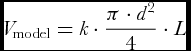
A total of 30 branches of each tree (10 of the first stratum, 10 of the second stratum and 10 of the third stratum) were sampled (Supplementary Figure S1, available online at https://doi.org/S001447971600079X). The diameter of each branch was measured every 10 cm and the actual volume of each portion of 10 cm length was calculated using equation 2, which is a truncated cone equation. The whole volume was calculated as the sum of each portion between two sections, using equation 3. The model of branch volume was performed by applying equation 4 from the base diameter (d) and length (L) of the branch.
 $$\begin{equation}
{V_{\rm{i}}} = \frac{1}{3} \cdot \pi \cdot h \cdot \left( {{R^2} + {r^2} + R \cdot r} \right)\\
\end{equation}$$
 $$\begin{equation}
{V_{\rm{branch}}}= \sum\limits_1^i {{V_i}}\\
\end{equation}$$
 $$\begin{equation}
{V_{\rm{model}}} = k \cdot \frac{{\pi \cdot {d^2}}}{4} \cdot L
\end{equation}$$
Regression functions were proposed to relate volume of the branch (equation 3) from basal diameter and branch length. Then, other 30 branches were evaluated with the proposed models (equation 4 and regression model). Deviations between direct measures of volume (equation 3) and the estimated by the models were evaluated through paired samples test based on Student distribution. This was carried out with Statgraphics Centurion XVI software v.16.1.17 (32 bits) of StatPoint Technologies Inc. (USA).
Models to quantify wood biomass of the whole tree
In order to calculate the volume of woody biomass in the whole plant two methods were developed. First, occupation factor was analyzed, followed by the development of regression models for predicting the volume from crown diameter, stem diameter and plant height. Occupation factor is defined as the ratio between the actual volume of all branches of the crown and the apparent volume of the crown. Apparent volume is obtained as a volume of revolution calculated from crown diameter and crown height. Cylinder model was analyzed as a volume containing both the branches and the gaps between them. Palaboloid, cone and neiloid are proportional to the cylinder.
For estimating the actual volume of sampled plum trees crown, branches were measured by applying the equation of regression model obtained in the previous dendrometric analysis. Branch measures were carried out by layers (strata). The stratum 1 corresponds to the branches sprouted from the stem. The number of branches of this stratum is usually low (3–4 branches), with their diameters being the highest. The stratum 2 is formed by the branches originated in the stratum 1 and the following strata are formed by the branches sprouted from the previous layer. All the branches of the stratum 1 (layer) were measured. The volume of woody biomass of next strata was calculated, selecting a sample of several representative branches of each. The mean of the volume of sampled branches in each stratum was multiplied by the number of branches, and the total volume of each stratum was calculated separately. In other words, the number of buds or ramifications in successive strata was counted.
Generally, the last stratum contains very small branches. For this reason, it was not possible to evaluate it with the method previously described. In this case, several external central branches and another from the top of the crown were cut of each sampled tree, and their volumes were determined by submerging them into water. Then, the obtained volume was multiplied by the number of branches of the external stratum. Regression functions were also calculated to relate crown volume from crown diameter (Dc) and tree height (H).
In order to validate occupation factor and volume crown function, other 30 trees were evaluated. Deviations between actual volume and the estimation by the models were evaluated by means of paired samples test based on Student distribution. This was carried out by means of Statgraphics CenturionXVI software.
Pruning residues calculation
A total of 60 trees were pruned and evaluated in both areas. Before pruning, measurements of stem diameter, crown diameter and tree height were taken. Subsequently, the pruning was carried out by removing branches to increase light availability inside the crown and induce new sprouting. The branches affected by diseases were also thinned. The weight of cut branches were measured doing bundles and using a dynamometer or scale. In addition, 22 representative branches were stripped, obtaining the percentage of the leaf mass. Leaves were weighted just after cutting, and dry matter was estimated taking into account the relative water content. Subsequently, regression models were applied to relate the amount of residues and plant size. Then, 30 additional trees were evaluated to validate the model.
Characterization of biomass
Higher heating value, moisture content, elemental composition (C, H, N, O, S and Cl) were measured for each sample as well as the proximal analysis (%ash, %fixed carbon and %volatile gases) was done. The calorific value was measured by a LECO AC-500 isoperibolic calorimeter. The weight percentage of carbon (C), hydrogen (H), nitrogen (N) and sulfur (S) was measured by a LECO TruSpec CHNS analyzer. Chloride was measured from water condensate in the calorimeter vessel by potentiometric titration using AgNO3. %ash and %volatile evaluations were based on the weight difference after dry biomass heating in an oven at 550 °C for 1 h (to evaluate ash) and 940 °C for 4 min (to evaluate volatile). Fixed carbon is given by 100 − (%ash − %volatile). The characterization of the biomass materials was conducted according to the standards shown in Table S1.
RESULTS AND DISCUSSION
Dendrometric analysis of branches
Statistical description of the measured variables in branches is shown in Table S2. All parameters have a skewness and kurtosis coefficient between −2 and 2. This fact indicates that variables followed a Gaussian normal distribution, with mean and standard deviation being obtained. Therefore, they can be used in regression models without restrains. The volume model with form factor closer to one represents better the shape of the branch. It can be observed that the model closest to one is the paraboloid and the branch shape tends to this geometry.
In the variance analysis of the regression models, the p-value was less than 0.01 for all variables (Table 1), which means a significant relationship between variables (diameter and length of the branch) and the volume. The high standard deviation can be explained by the high data variability caused in part by the dissimilar diameter of measured branches. Both methodologies, form factor application and regression model allowed the calculation of the branch volume from its base diameter and length with enough accuracy (Table 1).
Models for calculating biomass of Plum tree.

V branch is the wood volume of the branch (cm3); d branch is the diameter of the base (cm); L branch is its length (cm); V tree is the wood volume of the tree (cm3); Dc is the diameter of the crown (cm); H is its tree height (cm); B residue is the dry weight of residues per tree obtained from pruning (kg); Dt is the stem diameter (cm); R 2 is the determination coefficient; MAE is the mean absolute error; σx is the standard deviation of the error.
In the method validation, the deviations between predicted values using form factor and the volume measured from equation 3 were lower than 1.5%. The paired samples test showed no significant difference between actual volume (equation 3) and the calculated by form factor (p = 0.56). On the other hand, the method by regression model gave differences lower than 0.8% (Table 1). The good fit of function to obtain branch volume allowed measuring easily the woody biomass in the crown by strata. These equations usually give very good fit and some examples can be found in Sajdak and Velázquez-Martí (Reference Sajdak and Velázquez-Martí2012) or Sajdak et al. (Reference Sajdak, Velázquez-Martí, López-Cortés, Estornell and Fernández-Sarría2014) for other tree species.
Wood volume in the crown
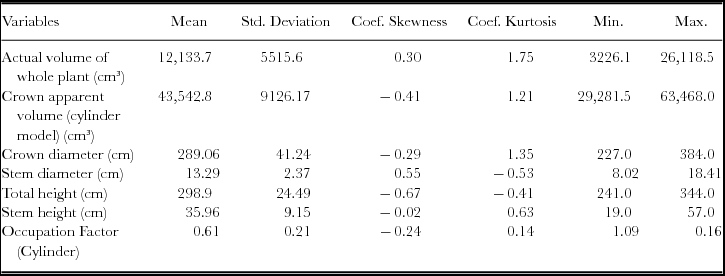
According to the values of skewness and kurtosis coefficients, all parameters related to crow structure follow a normal distribution (Table 2). Methods developed to predict biomass volume were obtained for trees with crown diameter ranging between 2.3 and 3.8 m and total height between 2.4 and 3.4 m. These are the usual sizes of productive trees and the obtained model is likely useful for bigger trees after validation. In smaller trees, biomass calculation is less interesting, and the proposed models can be less consistent.
Statistical summary of the parameters studied in the whole plant.

The obtained average of occupation factor was 0.61 cm3 dm−3 with 0.21 cm3 dm−3 of standard deviation. This parameter establishes the relationship between the apparent volume of the plant (woody materials and hollow contained therein) and actual biomass volume. Similar values were obtained previously for citrus trees (Velázquez-Martí et al., Reference Velázquez-Martí, Fernández-Gonzalez, López-Cortés and Callejón-Ferre2013) and olive trees (Velázquez-Martí et al., Reference Velázquez-Martí, López-Cortés and Salazar2014).
A representative plum tree biomass distribution is shown in Figure S2. The stem volume only represents around 2% of the total biomass, and the crown volume around 98%. This is quite different when compared to olive trees, which have the biggest amount of biomass in the stem (Velázquez-Martí et al., Reference Velázquez-Martí, López-Cortés and Salazar2014). Focusing on the crown volume, the highest percentage of biomass is concentrated in the stratum 3. There is a symmetric trend in the crown biomass distribution, which is the highest in the centre, and then decreases towards the strata 1 and 5. This fact was already observed in citrus trees (Velázquez-Martí et al., Reference Velázquez-Martí, Fernández-Gonzalez, López-Cortés and Callejón-Ferre2013). It should be noticed from the analysis that the stratum 5 located in the periphery of the crown contains small branches. Although their number is high, it does not represent a significant biomass.
A regression model was directly obtained from crown diameter and crown height to obtain the whole volume of the tree (Table 1); the variance analysis provided p-values for independent variables lesser than 0.01. It is observed that the best model provided a R 2 = 0.74, which means that it explained 74% of the variability of the volume of woody biomass contained in the plant. For this model, the standard deviation of differences between observed and predicted values was 3115 cm3 and the mean absolute error was 2328 cm3. Regarding the model validation, deviations between the volume predicted by regression model and the actual volume measured in each tree were lower than 5.8% (Table 1).
The average moisture content of green material was 51% and the average density of dry material was 0.66 ± 0.07 g cm−3. With 46% of C, considering the relation 3.67 (44/12) between CO2 and C content, the CO2 sequestrated in the materials is 1.11 Mg m−3 wood material
Pruning residues calculation
The average weight of the dry woody residues without leaves obtained from pruning reached 2.34 ± 0.97 kg per tree, which means around 2.0 ± 0.8 Mg biomass per hectare every year. High dispersion in this measure can be caused by pruning style, area per tree, irrigation, light, temperature and others. To fit the best regression model that describes the relationship between residual biomass from pruning, simple and quadratic equations from combinations of crown and stem diameter and tree height were tested as explanatory variables. The best fit was obtained with crown diameter and stem diameter, with p-value lower than 0.01 for all variables and R adjusted 2 of 0.81 (Table 1). Estimations of the amount of pruned woody biomass had maximum deviations of 6.7%, and the average percentage of leaves in the residues was 15% biomass.
Characterization of biomass
The characterization of the biomass revealed a calorific power of 18.13 MJ kg−1 dry matter, which means that the available energy per hectare is about 35 MJ every year and serves as a reference for energy balance studies. Proximate analysis of plum wood showed at 79.8 ± 9.2% volatiles and 2.1 ± 0.3% ash. Elemental analysis of the wood pointed to 46.5 ± 1.2% C, 6.1 ± 0.5% H, 46.3 ± 1.2% O, 0.6 ± 0.3% N, 0.06 ± 0.02% S and 0.02 ± 0.01% Cl. Cl, S and N contents are lower than the limits established by the standard EN 14691-part 4, which fix the conditions for chips used as biofuels in %ash<3%, %N<1%, %Cl<0.05%, %S<0.1%.
CONCLUSIONS
Two methods were developed for calculating the branch biomass of plum trees from simple measurements, such as base diameter and length. Branch volume can be calculated from volume of a cylinder of reference, multiplying by a form factor or by the application of the regression models, which provide better fit. Biomass was then calculated by using density. In addition, two approaches can be also followed for estimating the wood biomass of whole tree from crown diameter, stem diameter and tree height. First, a regression model was calculated; second, the actual volume of a tree was calculated considering the volume of a solid of revolution and an occupation factor. Applying the density to this volume, the total biomass of a tree was obtained.
Most of biomass was concentrated in the plum crown (98%) and biomass stem accounted 2% of total. Considering crown strata, the central one had the highest percentage of biomass (40%). According to the thermochemical characterization of plum wood, the residual biomass from pruning can be used as chips for bioenergy. The results obtained in this study are the first step of a new research line in which these data can be correlated to LiDAR and lead to a simple, fast and accurate way of predicting biomass. LiDAR technology is an active remote sensing system that registers ground elevation measurements and vertical vegetation structures.
Acknowledgements
The authors appreciate the financial support provided by the ECUMASA, Red ecuatoriana para la investigación del aprovechamiento energético de la biomasa.
SUPPLEMENTARY MATERIAL
For supplementary material for this article, please visit https://doi.org/S001447971600079X