INTRODUCTION
Interdisciplinarity has been defined in many ways, but at its simplest it refers to any interaction between the different disciplines. Interest in interdisciplinary approaches to environmental issues became prominent with the rise in the 1960s and 1970s of concerns about the global environmental crisis, and recognition of the need to harness social science expertise alongside ecological expertise in order to address these concerns. Several new disciplines and sub disciplines focusing on the environment were established or consolidated in the social sciences and humanities from this time onwards, including environmental economics, environmental anthropology, environmental education, environmental law, environmental history and environmental psychology. Meanwhile, in the applied natural sciences such as wildlife management, growing emphasis was placed on their ‘human dimensions’ (Gigliotti & Decker Reference Gigliotti and Decker1992), defined by Jacobson and McDuff (Reference Jacobson and McDuff1998) as ‘a variety of people-oriented management considerations and a cross-disciplinary range of inquiry’. However progress in integrating natural and social science perspectives has been disappointingly slow (for example see Touval & Dietz Reference Touval and Dietz1994; Noss Reference Noss1997; Meffe Reference Meffe1998; Mascia et al. Reference Mascia, Brosius, Dobson, Forbes, Horowitz, McKean and Turner2003). Part of the reason for this is that as the ‘traditional’ academic disciplines have become consolidated, each discipline has developed its own traditions, theoretical and methodological approaches, technical language and institutional structures, leading to substantial conceptual, institutional, political and practical barriers to bridging disciplinary boundaries (Klein Reference Klein1990; Morse et al. Reference Morse, Nielsen-Pincus, Force and Wulfhorst2007; Szostak Reference Szostak2007; Youngblood Reference Youngblood2007; Dillon Reference Dillon2008; McWilliam et al. Reference McWilliam, Hearn and Haseman2008).
Disciplinary traditions are reproduced through the training of each new generation of disciplinary adherents, and thus training is a fundamental factor determining the potential for interdisciplinary exchange. The need to broaden academic training in environmental conservation from its traditional natural science base in order to equip students with ‘real-world, interdisciplinary problem-solving skills’ was recognized as far back as the 1950s (Muir & Schwartz Reference Muir and Schwartz2009) and has been debated particularly intensively over the past twenty years. However, the debate has been hindered by some very disparate notions of what constitutes interdisciplinarity in environmental conservation and its relationship to ‘real-world’ problem-solving. This paper attempts to clarify these issues and assess progress. Given the extensiveness and diversity of the literature it focuses primarily on the ‘meta-discipline’ of conservation biology, which has been the subject of particularly intensive debates about the nature and extent of interdisciplinary content that is desirable (Jacobson & Robinson Reference Jacobson and Robinson1990 in Jacobson & McDuff Reference Jacobson and McDuff1998; see also Touval & Dietz Reference Touval and Dietz1994; Noss Reference Noss1997; Lidicker Reference Lidicker1998; Meffe Reference Meffe1998; Meffe et al. Reference Meffe, Noss and Jacobsen1998; Rivas Reference Rivas1998; Erikkson 1999; Orr Reference Orr1999; Rosa & Machlis Reference Rosa and Machlis2002; Mascia et al. Reference Mascia, Brosius, Dobson, Forbes, Horowitz, McKean and Turner2003; Perez Reference Perez2005; Fox et al. Reference Fox, Christian, Cully-Nordby, Pergams, Peterson and Pyke2006; Buscher & Wolmer Reference Buscher and Wolmer2007; Kroll Reference Kroll2007; Knight et al. Reference Knight, Cowling, Rouget, Balmford, Lombard and Campbell2008; Muir & Schwartz Reference Muir and Schwartz2009).
The specific objectives of the paper are to: (1) analyse debates about the nature of ‘interdisciplinarity’ in conservation biology; (2) examine the status of interdisciplinary training in current academic programmes in conservation biology; and (3) propose kinds of interdisciplinary or other non-natural science training that could be prioritized for inclusion in the curriculum. The following sections will examine each of these in turn. In addition to making use of the broad theoretical literature on interdisciplinarity, the review is based on systematic online searches on Web of Science and Scopus using the keywords ‘conservation’ and ‘training’ for papers published between 2000 and 2010; supplementary searches of recent publications (from 2008) using broader keyword combinations (‘conservation’ or ‘environment’ and ‘interdisciplinary’); and a separate search of the journal Conservation Biology using the keywords ‘interdisciplinary’ and ‘training’.
DEFINING INTERDISCIPLINARITY IN CONSERVATION BIOLOGY
Interdisciplinarity has been defined in many different ways and categorized according to many different criteria (see Klein Reference Klein1990 for a comprehensive account). The most widely used system of categories is based on the level of integration between the different disciplines, and includes ‘multidisciplinarity’, which involves the use of two or more disciplines in parallel; ‘interdisciplinarity’, where different disciplinary perspectives inform one another, and ‘transdisciplinarity’, in which individual disciplines are merged to such an extent that disciplinary boundaries are no longer discernible. A second form of categorization is concerned with the type of interaction between the disciplines. This may involve a temporary collaboration between researchers from different disciplines in order to address a specific practical problem; the temporary or permanent adoption of a specific method or concept from one discipline by another; a progressive convergence of different disciplines in terms of both subjects and methods; or the emergence of a new, fundamentally distinct ‘interdiscipline’ in its own right (Klein Reference Klein1990; Barry et al. Reference Barry, Born and Weszkalnys2008). A third type of categorization is concerned with the conceptual and institutional distance between the different disciplines involved; thus interdisciplinarity involving a natural science discipline and a social science discipline is considerably ‘broader’ than that involving two closely related natural science disciplines (Huutoniemi et al. Reference Huutoniemi, Klein, Bruun and Hukkinen2010). Debates in environmental conservation have focused primarily on broad interdisciplinarity spanning the natural and social sciences, and this is the focus of this paper. Lastly, different interdisciplinary approaches can be categorized according to the purpose for which interdisciplinary approaches are developed. Conceptual interdisciplinarity is concerned with synthesizing a unified body of theoretical knowledge, whereas instrumental interdisciplinarity is concerned with solving practical problems that cannot be addressed by any single discipline (Klein Reference Klein1990, pp. 37–38; de Groot & de Wit Reference De Groot and de Wit1999; Marzano et al. Reference Marzano, Carss and Bell2006). The academic ‘meta-discipline’ of conservation biology emerged in the 1980s specifically to develop broad interdisciplinary approaches to real-world problem-solving (Meffe Reference Meffe1998; Noss Reference Noss1999), and thus the emphasis is on instrumental rather than conceptual interdisciplinarity. Conservation biology has been described both as a crisis discipline (Redford & Sanjayan Reference Redford and Sanjayan2003; Czech Reference Czech2006; Bradshaw et al. Reference Bradshaw, Brook and McMahon2007) and as a mission-driven discipline (Meine et al. Reference Meine, Soule and Noss2006), with the ‘mission’ to halt or at least slow the global rate of loss of biodiversity. Many of the early conservation biologists were field biologists who recognized that their natural science expertise was of limited use in addressing the drivers of biodiversity loss, many of which were social, political and economic rather than biological.
However again, progress in developing interdisciplinary approaches has been frustratingly slow (Touval & Dietz Reference Touval and Dietz1994; Noss Reference Noss1997; Meffe Reference Meffe1998; Eriksson Reference Eriksson1999; Siebert Reference Siebert2000; Mascia et al. Reference Mascia, Brosius, Dobson, Forbes, Horowitz, McKean and Turner2003). In part, this is due to the general barriers to bridging disciplinary divides that have been described above. However in part it is also reflects a lack of consensus on what form or level interdisciplinarity in conservation biology should take, and more fundamentally, on the scope of the new meta-discipline in terms of the non-natural science topics and skills that should be included. There is an enormous list of non-natural science disciplines, thematic areas and skills that are relevant to conservation. Relevant disciplines include statistics, geography, education, economics, psychology, sociology, anthropology, law, social policy, politics, development studies, international relations, history and philosophy; the list is clearly far more extensive than could be covered in depth in any one degree programme. More specific academic fields in the social sciences and humanities include common pool resource theory; rational decision-making; cultural perspectives on the environment; political ecology; conservation and livelihoods; the role of traditional ecological knowledge in natural resource management; natural resource governance; participation and representation; international environmental law and policy processes; and many more (Jacobson & Robinson Reference Jacobson and Robinson1990; Touval & Dietz Reference Touval and Dietz1994; Jacobson & McDuff Reference Jacobson and McDuff1998; Bonine et al. Reference Bonine, Reid and Dalzen2003; Scholte Reference Scholte2003; Perez Reference Perez2005; Van Heezik & Seddon Reference Van Heezik and Seddon2005; Muir & Schwartz Reference Muir and Schwartz2009). However several authors have surveyed the views of non-academic practitioners on training needs rather than listing academic fields, reflecting a widespread view that training should aim principally at preparing students for professional practice rather than at producing more ‘little professors’ (Noss Reference Noss1997). In one such survey, the top training needs were identified as conservation biology, monitoring and evaluation, fundraising, project design, policy analysis, enterprise development and economics, representing a mix of vocational and academic themes (Bonine et al. Reference Bonine, Reid and Dalzen2003). Similarly, Muir and Schwartz (Reference Muir and Schwartz2009) listed 37 themes, including vocational skills (clustered into core competencies, programme management, decision-making, outreach and policy implementation), and also more academic topics (research fundamentals, conservation research skills and use of the social sciences). In order to check whether academics would prioritize different skills from non-academic professionals, Muir and Schwartz (Reference Muir and Schwartz2009) used this list as the basis for a questionnaire survey of both academics and non-academic professionals who were alumni of the University of California Davis Graduate Group in Ecology. Not surprisingly, academics gave slightly higher rankings to research fundamentals, conservation research skills and use of the social sciences, whereas practitioners gave slightly higher rankings to policy implementation. However overall there was broad agreement, with both groups giving the highest ranks to core competencies such as writing skills and critical thinking. Additional vocational skills mentioned by other authors include teamwork, strategic planning and programme implementation, monitoring and evaluation; leadership, negotiation and conflict management, understanding and analysis of policy and lobbying skills, and critical thinking.
However it is clear that if too much material is squeezed into a single degree programme, then there is a danger that students may end up as ‘jack of all trades, master of none’ (Lau & Pasquini Reference Lau and Pasquini2008); they may gain a superficial knowledge about many things but no in-depth knowledge about any of them. Specifically, many authors have expressed concern that the essential core of training in the natural sciences and in statistics may be displaced by the long list of other items that have been put forward as essential components of training (for example Noss Reference Noss1997; Lidicker Reference Lidicker1998; Meffe et al. Reference Meffe, Noss and Jacobsen1998; Brewer Reference Brewer2003; Brewer & Gross Reference Brewer and Gross2006; Millspaugh & Millenbah Reference Millspaugh and Millenbah2004, Kroll Reference Kroll2007; Muir & Schwartz Reference Muir and Schwartz2009). There has been some discussion of the possibility of extending the length of degree programmes in order to allow more material to be covered, but this would be extremely difficult in institutional terms (Lidicker Reference Lidicker1998; Meffe et al. Reference Meffe, Noss and Jacobsen1998). As a partial solution, Van Heezik & Seddon (Reference Van Heezik and Seddon2005) reported that some Masters degrees include a second year of coursework rather than a thesis and therefore have extra class time for social science material. However the lack of a thesis project cuts out the valuable opportunity for students to gain experience, under supervision, of developing and carrying out an independent (potentially cross-disciplinary) research project.
In summary, the literature reveals a significant lack of consensus on the degree to which the discipline of conservation biology should broaden from its roots in the natural sciences and also on the type of non-natural science content that is needed, especially in terms of the balance between training in the social sciences and professional skills training. For many conservation biologists, the natural sciences are and should remain the primary focus of the academic discipline, and non-natural science content is needed only so far as it relates directly to professional practice. From this perspective, the need for substantive training in social science theory is debatable. However others point to the need for building competence in the social sciences alongside the natural sciences and developing genuinely interdisciplinary approaches, both in order to inform practice and also to consolidate the academic discipline itself (for example Mascia et al. Reference Mascia, Brosius, Dobson, Forbes, Horowitz, McKean and Turner2003).
INTERDISCIPLINARITY IN CURRENT TRAINING PROGRAMMES
In addition to debating what might be desirable in training, several authors have carried out surveys to determine the level of interdisciplinary content in current training programmes and training materials. However, again, there is a lack of consistency in the way in which interdisciplinarity and the related concept of human dimensions are defined. Niesenbaum and Lewis (Reference Niesenbaum and Lewis2003) identified ‘interdisciplinary’ content in nine conservation textbooks by searching for a set of 35 keywords. The list of keywords included three mainstream social science disciplines (education, economics and politics) and some major social science concepts such as culture, community and poverty, but there were also many practical management terms (such as planning, regulation and conflict management) and other terms that gave no indication of any particular disciplinary perspective or technical insights, let alone cross-disciplinary interaction (namely United Nations, World Bank or corporation). They also analysed the curricula of 26 conservation biology training programmes, identified from information on the Society for Conservation Biology (SCB) website (URL http://www.conbio.org/) and the 2001 US News and World Report on America's best colleges (URL http://colleges.usnews.rankingsandreviews.com/best-colleges) for ‘interdisciplinary’ content. Five themes were used to indicate interdisciplinary content (policy, economics, sociocultural aspects of conservation, case studies and advocacy) and it was found that whilst almost all courses included some content related to these themes, it was often only as an add-on in the final session of a natural science based component of the programme or module. Niesenbaum and Lewis (Reference Niesenbaum and Lewis2003) concluded that ‘interdisciplinary’ aspects tended to be marginalized rather than integrated throughout, leading them to state that interdisciplinarity is being ‘ghettoized’.
Other authors have used more specific definitions of interdisciplinarity. Van Heezik and Seddon (Reference Van Heezik and Seddon2005) surveyed interdisciplinary content in two-year graduate programmes in the closely related disciplines of wildlife management and conservation biology in the USA, the UK and Australia in 2002–2003, using a definition of interdisciplinarity as (1) ‘human dimensions and sociopolitical issues (for example environmental policy, ethics, planning, regulations, human ecology, public education and community relations)’ and (2) interpersonal skills, including ‘communicating about the environment and conflict resolution’. Between 70% and 80% of the programmes included in the study contained some ‘interdisciplinary’ content (Van Heezik & Seddon Reference Van Heezik and Seddon2005). Again, however, ‘interdisciplinarity’ appears to refer to any non-natural science material and to be dominated by vocational aspects. There is little indication of the extent of social science content, let alone content that integrates perspectives from different disciplines.
Van Heezik and Seddon (Reference Van Heezik and Seddon2005) tentatively concluded that interdisciplinary content had increased compared to earlier studies. However, of the earlier studies that Van Heezik and Seddon (Reference Van Heezik and Seddon2005) cited, Gigliotti and Decker (Reference Gigliotti and Decker1992) assessed coverage of ‘human dimensions’ alone (which they stated was present in 28% of 79 colleges and universities offering wildlife management programmes in the USA), whereas Cannon et al. (Reference Cannon, Dietz and Dietz1996) assessed coverage of ‘human interaction skills’ in a broader range of graduate programmes in the biological and agricultural sciences, and reported that it was present in just under 50% of 85 graduate programmes. Thus the different studies are comparable neither in terms of the type of content assessed nor in terms of the disciplines or geographical areas sampled, making it impossible to make any rigorous comparisons between them.
A small number of papers report specifically on training programmes aimed at conservation professionals from developing countries. Developing country training was recognized as a priority for the conservation ‘mission’ as long ago as the 1980 World Conservation Strategy (in Wemmer Reference Wemmer1993) and, since then, much progress has been made in the provision of such training, especially in Latin America and the Caribbean (Rodriguez et al. Reference Rodriguez, Simonetti, Premoli and Marini2005, Reference Rodriguez, Rodriguez-Clark, Oliveira-Miranda, Good and Grajal2006; Mendez et al. Reference Mendez, Gomez, Bynum, Medellin, Porzecanski and Sterling2007), although coverage is patchy and some countries in these regions still have no such training. However, where there is information on the social science component or integrative interdisciplinary approaches, in most cases the coverage appears to be very limited indeed. Bonine et al. (Reference Bonine, Reid and Dalzen2003) surveyed academic training programmes in the USA, UK, Brazil, Peru, Madagascar and Indonesia aimed at developing country professionals and concluded that ‘truly interdisciplinary university conservation education is still rare, and nonexistent in most countries’. Scholte (Reference Scholte2003) and Scholte et al. (Reference Scholte, Groot and Mayna2006) reported in more detail on curricula at the three leading African regional wildlife colleges, namely the College of African Wildlife Management in Mweka (Tanzania), the Ecole pour la Formation des Spécialistes de la Faune in Garoua (Cameroon) and South African Wildlife College (SAWC) in South Africa. The three colleges are described as ‘virtually without competition for mid-career professional wildlife management training’ and they are also important training grounds for conservation professionals. Scholte (Reference Scholte2003) and Scholte et al. (Reference Scholte, Groot and Mayna2006) reported that the curriculum at both Mweka and Garoua was dominated by biology and ecology, although it had broadened considerably in disciplinary scope following evaluations in the 1990s. By contrast, the SAWC diploma programme was dominated by non-natural science elements, to the extent that training in biology and ecology was almost lacking (although it should be borne in mind that since the students were mid-career professionals they may already have had some natural science training). The SAWC diploma consisted of modules that were designed independently by the visiting experts who delivered them, rather than as part of a centralized curriculum. A similar focus on non-natural science elements was present in work placements at Garoua, the one part of the programme where the subjects were selected by students and their employers rather than as part of the centralized curriculum (Scholte Reference Scholte2003). Thus the findings at both Garoua and SAWC raise the possibility that allowing flexibility rather than imposing a centrally designed curriculum makes programmes less conservative in terms of non-natural science coverage.
The continued predominance of the natural sciences in training is also present in developed countries. In Van Heezik and Seddon's (Reference Van Heezik and Seddon2005) study, the five most common topics present in the curriculum were biostatistics, conservation biology, habitat issues, conservation genetics and remote sensing and geographical information systems (GIS). Similarly responses to a survey from a small, self-selected sample of the SCB membership on undergraduate programmes in conservation biology indicated that a raft of natural science-related topics were taught in over 50% of programmes, including island biogeography theory, population genetics, restoration ecology, gap analysis, the design of nature reserves and ecosystem management, and quantitative assessment and data analysis (White et al. Reference White, Fleischner and Trombulak2000). The only non-natural science topics reported in over 50% of programmes were the history of conservation, values and ethics, political process and policy, written and oral communication skills, and ‘integration of course concepts with local issues’. Thus concerns about the displacement of natural science training seem to be largely unfounded (other than possibly in the case of SAWC described above). Rather, it is the social sciences that appear to have very limited coverage in most cases. This is further supported by a survey of graduate students at MSc and PhD level at the annual Student Conference on Conservation Science at Cambridge University in 2007, which found that students themselves felt that their current training in the social sciences was inadequate (Fisher et al. Reference Fisher, Balmford, Green and Trevelyan2009).
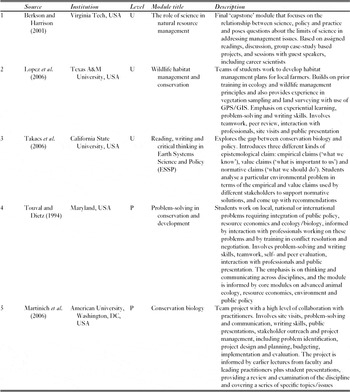
Much of the literature described above focuses on the scope of curricular content rather than on integration of different disciplines. However in addition to this, several papers present pedagogical techniques that are potentially relevant. The different techniques include (1) integrated problem solving and critical thinking (Touval & Dietz Reference Touval and Dietz1994; Meffe Reference Meffe1998; Millspaugh & Millenbah Reference Millspaugh and Millenbah2004; Perez Reference Perez2005; Kainer et al. Reference Kainer, Schmink, Covert, Stepp, Bruna, Dain, Espinosa and Humphries2006; Martinich et al. Reference Martinich, Solarz and Lyons2006); (2) techniques focusing on writing skills and communication to difference audiences (Lopez et al. Reference Lopez, Hays, Wagner, Locke, McLeery and Silvy2006); (3) making links between theory and practice, particularly in the form of class discussion of the participants’ own conservation projects (Galindo-Leal Reference Galindo-Leal2001); (4) student-led activities (Perez Reference Perez2005; Kainer et al. Reference Kainer, Schmink, Covert, Stepp, Bruna, Dain, Espinosa and Humphries2006); (5) student peer review (Touval & Dietz Reference Touval and Dietz1994; Kainer et al. Reference Kainer, Schmink, Covert, Stepp, Bruna, Dain, Espinosa and Humphries2006; Lopez et al. Reference Lopez, Hays, Wagner, Locke, McLeery and Silvy2006); (6) active student interaction (Gass Reference Gass2002), including teamwork (Touval & Dietz Reference Touval and Dietz1994; Lopez et al. Reference Lopez, Hays, Wagner, Locke, McLeery and Silvy2006; Martinich et al. Reference Martinich, Solarz and Lyons2006); (7) mentoring (Orr Reference Orr1999; Millspaugh & Millenbah Reference Millspaugh and Millenbah2004); (8) contact with working professionals (Touval & Dietz Reference Touval and Dietz1994; Kainer et al. Reference Kainer, Schmink, Covert, Stepp, Bruna, Dain, Espinosa and Humphries2006; Lopez et al. Reference Lopez, Hays, Wagner, Locke, McLeery and Silvy2006; Martinich et al. Reference Martinich, Solarz and Lyons2006); and (9) experiential learning, through field visits and practical exercises (Millspaugh & Millenbah Reference Millspaugh and Millenbah2004; Lopez et al. Reference Lopez, Hays, Wagner, Locke, McLeery and Silvy2006), and internships (Noss Reference Noss1997; Meffe Reference Meffe1998). Many of these techniques emphasize professional skills training or practical experience rather interdisciplinarity per se, but they can be extremely valuable in exploring the latter (see Table 1 for some examples).
Examples of non-natural science curricular components from undergraduate (U) and postgraduate (P) conservation-related training programmes.

DISCUSSION
To summarize, the literature on conservation biology training reveals a consensus that it should retain a primary focus on the natural sciences and statistics, but should also include non-natural science material in order to address the human dimensions of conservation. Published reports of current training programmes show that, in line with this, the natural sciences remain dominant in almost all reported programmes, but that there appears to be increasing coverage of non-natural science issues, partly through the use of a wide range of integrative and practice-related pedagogical tools. However the extent and nature of the non-natural science material that should be included is still hotly debated, and the debate continues to be confused by a lack of consistency in the use of terms.
‘Interdisciplinarity’ has been used to refer to (1) any social science content; (2) vocational skills training; (3) integrative or practice-based exercises, sometimes with no indication of disciplinary content; (4) the (variously defined) ‘human dimensions’ of conservation; and (5) interaction between different academic disciplines (usually crossing the natural science–social science divide). There are potential links between all of these elements, but only the last of them corresponds to theoretical definitions of interdisciplinarity. Underlying this confusion in terminology is a genuine divergence of opinion on the desirable balance between training in the natural and social sciences, and also between academic and vocational skills training. Further debate about curriculum development in conservation would be aided greatly by recognizing the distinction between the different aspects of non-natural science training and treating each of them in its own right.
In terms of the balance between natural and social science content, most degree programmes in environment-related disciplines specialize either in the natural sciences or the social sciences, and a programme providing comprehensive, in-depth training in both of these would be problematic, both because of the vast amount of material that would need to be included and also because of limited faculty expertise and institutional barriers to cross-faculty collaboration (see for example de Groot & de Wit Reference De Groot and de Wit1999). However, some understanding of different disciplinary perspectives is increasingly important in a career in environmental conservation, whether in professional practice or in academia, because of the growing need to be able to communicate across disciplinary boundaries. This is particularly clearly illustrated in the literature on multidisciplinary collaborations in environmental conservation, which are increasingly common but are notorious for the difficulties in getting natural and social scientists to work together. Several authors report that in order for them to work smoothly, the participants must have a basic understanding of the principles by which the different disciplines operate (see Campbell Reference Campbell2005; Marzano et al. Reference Marzano, Carss and Bell2006; Fox et al. Reference Fox, Christian, Cully-Nordby, Pergams, Peterson and Pyke2006; Strang Reference Strang2009). In other words, natural scientists need to have a basic understanding of how the social sciences work, and vice versa.
What, then, are the most important areas to cover in terms of non-natural science training in an undergraduate programme in conservation biology? First, there is a strong case for giving priority to an introductory module to social science methods and research design, since some of the biggest barriers to interdisciplinary communication are to do with the way research questions are framed, data are collected and analysed, and the validity or relevance of the results is assessed (Newing Reference Newing, Pretty and Pilgrim2010). Training of this kind should also improve the quality of the many studies that are primarily natural science-based, but also include a minor social science component (for example, a study of a particular species that is principally ecological but also includes a questionnaire to determine local people's attitudes). Interdisciplinary research must have a ‘true academic focus on both sides of the ‘divide’, and not a reliance on vernacular knowledge and language in the one, while the focus is academic in the other’ (Harrison et al. Reference Harrison, Massey and Richards2008, p. 549). This is rarely the case where a researcher is working outside their area of disciplinary expertise. Such training would also be invaluable to the many practitioners who carry out simple social science data collection exercises as part of their ongoing activities. For example, protected areas managers often design and analyse simple visitor questionnaire surveys, carry out consultation exercises with different stakeholders or work collaboratively with local people to address management issues.
Second, interdisciplinary perspectives require considerably more than simply learning something about each discipline in isolation. They also require an understanding of disciplinary differences and interactions (Erikkson 1999), and this has been identified as an additional factor that is important in the successful functioning of multidisciplinary teams. An introduction to basic epistemological theory and to the different scientific traditions would be invaluable in this regard, and could be built into the above module in relation to research design. In terms of practice, epistemological theory is also valuable in understanding the role of science in policy and practice (Noss Reference Noss1997; Berkson & Harrison Reference Berkson and Harrison2001; Clark Reference Clark2001; Kroll Reference Kroll2007; Newing Reference Newing2011). Conservation scientists will be most effective if they understand that science can never be completely objective or free from uncertainty, and also that policy and management decisions are not based on scientific evidence alone (see examples 1 and 3 in Table 1 for some pedagogical techniques that explore these issues at the undergraduate level).
Third, and perhaps most dauntingly, there is a long list of relevant theoretical fields in the social sciences and humanities, as was listed earlier in this paper. Conservation departments and schools vary in terms of the extent of interest or expertise to offer social science-based modules and degree programmes will vary accordingly, but as a minimum, one core module providing a broad overview of social science perspectives on the environment could inform discussion of the human dimensions of natural science-based case studies later in the degree programme, and could also lay a foundation allowing students who wish to develop their social science expertise further to do so through postgraduate study or professional practice.
In addition to the social science and humanities content, a large range of vocational skills feature in non-natural science training in many of the programmes surveyed. Many vocational skills are already well-integrated into the academic system and are valuable both within and outside academia (for example, information-gathering, time management, critical thinking and problem analysis, and writing skills). Others, such as teamwork and communication skills, can be incorporated into existing modules through the use of appropriate class exercises and coursework assessments without taking significant time away from more ‘traditional’ subject areas. However, as Muir and Schwartz (Reference Muir and Schwartz2009) emphasized, still other vocational skills are simply not appropriate as part of an academic training and, indeed, academics may not be best equipped to teach them. Before displacing more technical topics from the curriculum, it must be carefully considered which vocational skills belong on academic training programmes and which are better learnt through volunteering, internships or in professional practice.
Finally, issues-based practical problem-solving exercises can offer valuable experience in vocational skills related to complex ‘real-world’ problems (see Meffe Reference Meffe1998; Fox et al. Reference Fox, Christian, Cully-Nordby, Pergams, Peterson and Pyke2006; Kroll Reference Kroll2007; Polunin & Willis Reference Polunin and Willis2007), and are an excellent means of exploring and integrating different theoretical fields in the natural and social sciences without trying to squeeze separate, discipline-specific modules into the limited time available (Noss Reference Noss1997). They can also be used to illustrate some of the challenges in interdisciplinary communication and collaboration (see examples 2, 4 and 5 in Table 1). However such exercises are best preceded and informed by prior theoretical or technical training; otherwise they run the risk of becoming ‘vague’ and ‘amorphous’ (Clark Reference Clark2001, p. 33) and their inclusion in academic programmes may offer little added value compared to similar exercises in professional practice. Overall then, a logical progression is first to provide an introduction to different disciplinary or theoretical perspectives and methodological tools, and then move on to broader integrative and practical problem-solving exercises. De Groot and de Wit (Reference De Groot and de Wit1999), Kainer et al. (Reference Kainer, Schmink, Covert, Stepp, Bruna, Dain, Espinosa and Humphries2006), Morse et al. (Reference Morse, Nielsen-Pincus, Force and Wulfhorst2007) and Burkhardt-Holm and Chebbi (Reference Burkhardt-Holm and Chebbi2008) each described the structure of a programme that follows this approach.
CONCLUSIONS
In conclusion, undergraduate training in environmental conservation should lay the foundations for students to build expertise in the area of their choice, while gaining sufficient understanding of other areas to work successfully in an increasingly interdisciplinary field. Of course, different degree programmes will vary in the breadth of disciplinary content that they can offer, but for natural science-dominated programmes, it is proposed that as a minimum, non-natural science training should include: (1) an introduction to social science perspectives on the environment; (2) basic training in social science methods, research design and science theory; (3) vocational skills training, to the extent that it can be built into existing curricular components; and (4) integrated problem-solving tasks that can build on any or all of the above. A similar list could be constructed for social science-based environmental disciplines, incorporating some basic training in natural science perspectives.
One slightly surprising finding from this review was the lack of a clear difference in the non-natural science content of undergraduate and postgraduate programmes. However, given the lack of a defined core of material in undergraduate training in environmental conservation, and also the variety of disciplinary backgrounds of those who enter postgraduate degree programmes in conservation, postgraduate programmes often provide introductory training in different disciplinary perspectives in order to bring students up to a common level. Postgraduate training programmes are thus more varied in what they aim to achieve than undergraduate programmes; they can serve to develop students’ existing expertise in more depth, or offer supplementary training to allow students to increase the disciplinary breadth of their expertise, or focus on the issue of interdisciplinarity and its application to real-world problems itself. Disciplinary and interdisciplinary perspectives can be characterized as more specialist and more generalist approaches to the same overall issue (Szostak Reference Szostak2007). They are valuable at different conceptual scales and can play complementary roles, both in academic research and in practice. Conservation needs both specialists and generalists.