From the inception of its military campaign into Central Asia via the Gansu corridor, the Tang dynasty had to ensure the shipment of extensive military supplies to support the activities of its occupying armies north and south of the Tianshan Mountains. Since the government paid soldiers’ salaries and bought supplies using silk, the timely delivery of silk from central China was critical. Most of the silk was collected in the central provinces under the zuyongdiao 租庸調 tax system, whether as stipulated payments of tax textiles or cloth-paid-in-place-of-annual-corvée tax. All this silk had to be shipped to the Western Regions. This article examines where this silk was made, how it was shipped to the north-west and how the system changed over time.
The Shipment of Tax Textiles and the System of Postal Stations in the Seventh Century
According to the research of Ōtsu Tōru, the tax textiles for the support of the military were not shipped from the two imperial centres of Chang'an and Luoyang.Footnote 1 Rather, the Department of Public Revenue (duzhi 度支) instructed different localities to ship the goods directly to the border regions.Footnote 2 In fact, their directives often specified that, whatever the final destination, the shipments were to go through the two main entry points to the north-west at Qinzhou (north-west of modern Tianshui, Gansu) and the Liangzhou Area Command (dudufu 都督府), in today's Wuwei, Gansu province.Footnote 3 As a result, Liangzhou city functioned as the collection point for tax silk for both the Gansu Corridor and the Western Regions.
As a copy of a 678 memorial (zouchao 奏抄) from the Department of Public Revenue, and the resulting directive (zhifu 旨符) issued to the Department of the Treasury (jinbu 金部) in 679, stipulated, the tax silk collected at Liangzhou was transferred annually to Yizhou (modern Hami, Xinjiang) and Guazhou (the modern town in Gansu province retains the same name), two prefectures within the jurisdiction of the Liangzhou Area Command:
On the day each year when the 30,000 bolts (duan 段) of hemp intended for Yizhou and the 10,000 bolts of hemp intended for Guazhou, consisting of tax textiles paid by the Jiannan circuit [see accompanying map for the location of the different circuits], will be shipped from Liangzhou, we authorise the prefectural officials of each prefecture to designate Shipment Supervisors (guandian 官典) to pick up the cloth and give them transmittal orders to the two prefectures of Guazhou and Yizhou; further ordering the border station soldiers on that day to hire special servicemen (fujiao 夫腳) to transport the silk. Once the silk has been transported, they should then report to the authorities the type of servicemen they used. Yizhou and Guazhou should receive the designated amounts, count what they have paid out and what remains, and, at the end of the year submit a report to the Departments of Public Revenue and of the Treasury.Footnote 4
According to this document, from 676 to 679, the combined total of 40,000 bolts of tax textiles from Jiannan Circuit was shipped annually to Yizhou and Guazhou. For this purpose, the Liangzhou Area Command charged the Shipment Supervisors with the responsibility for shipping the cloth and gave the Shipment Supervisors vouchers (chuandi 傳遞) to bring the cloth from Jiannan Circuit.Footnote 5 These vouchers served as travel passes allowing the bearers to make use of postal-station relay horses, which were provided under the postal station system of the Tang.
In fact, a report dated 669 about relay horses in Dunhuang county in Shazhou prefecture (P3714v) sheds more light on contemporary practice.Footnote 6 Relay horses from Dunhuang were used to ship bolian 帛練 (a general term referring to lian 練 degummed silk, juan 生絹 plain silk and shi 絁 silk, a plain weave silk using threads of varying thickness) from the interior via the oases on the northern route around the Taklamakan Desert to Tingzhou (modern Beshbaliq, Xinjiang). This bolian cloth, a textile collected as tax revenue which was destined for the army's use, was probably first collected at the Liangzhou Area Command and then shipped north. This document suggests that we should not read the 678/679 order above too literally: even though the document uses the measure word duan, which usually indicates a bolt of hemp, the tax textiles from Jiannan Circuit consisted largely of silk, as we shall see below.Footnote 7 In the north-west, these tax textiles were transported on postal-station relay horses, while in the central provinces, even in the early seventh century, this system of transport had fallen into disuse.Footnote 8 This difference means that the heavy burden of providing such a transport system fell disproportionately on the north-west.
As Professor Ōtsu has shown, because of the political situation at the time, the tax textiles for the north-west constituted a large share of all the tax textiles collected by the Tang government. It is true that, in the early 700s, prior to the creation of the regional Military Commissioners (jiedushi 節度使) system, the annual expenditure of tax textiles as a military expense was limited, as was the size of the shipments north. These pre-conditions made it possible to use postal-station relay horses to transport tax textiles in the north-west. But, at the end of the seventh century, the Tang adopted new policies in the north-west, prompting a new means of shipping tax textiles to come into being.
The Increase in Shipments of Tax Textiles in the Eighth Century and the Continuing Importance of Liangzhou as a Collection Point
Between 692 and 694, the combined forces of the Tang and the Turgesh (Tuqishi 突騎施) troops defeated the Tibetans and regained control of the four garrisons of Anxi (Kucha, Khotan, Kashgar and Karashahr) and re-established the Anxi Area Command headquarters at Kucha.Footnote 9 At that time, the Tang dispatched 30,000 troops to be stationed at the Anxi Area Command, and the level of support for the military increased dramatically. In the eighth century, the Tang established more military commands in the north-west, and the system of Military Commissioners, who supervised these different troops, took shape, causing the costs of the military to increase even more.
The increase in military expense after 713 was dramatic. The Jiu Tangshu [Old Tang history] records the annual expenditures for soldiers’ pay at 10,200,000 bolts (pi-duan 疋段, combined units) of silk and hemp and military food supplies of 1,900,000 piculs (shi 石), making a total of 12,100,000 pi-duan-shi (combined units of cloth and grain). The entry continues:
開元已前,每年邊用不過二百萬,天寶中至於是數.
Before the Kaiyuan reign (713–741) the border costs did not exceed 2,000,000; in the mid-Tianbao reign (742–755) the number reached this figure [of 12,100,000].Footnote 10

In short, there was a sixfold increase in military expenses.
Du You (735–812) wrote the Tongdian 通典 [Encyclopaedic history of institutions], which gives the following overview of how much central government expenditures increased after the reorganisation of the military between 742 and 755:
大凡都計租稅庸調,每歲錢粟絹綿布約得五千二百三十餘萬端疋屯貫石
The overall total of grain tax and tax textiles received each year in coins, grain, silk, and hemp cloth totalled 52,300,000 duan-pi-tun-guan-shi 端疋屯貫石.Footnote 11
This was a ‘catch-all’ unit of account, constructed by simply stringing all the measure-words together: silk bolts, hemp bolts, hanks of silk, strings of coins and piculs of grain.
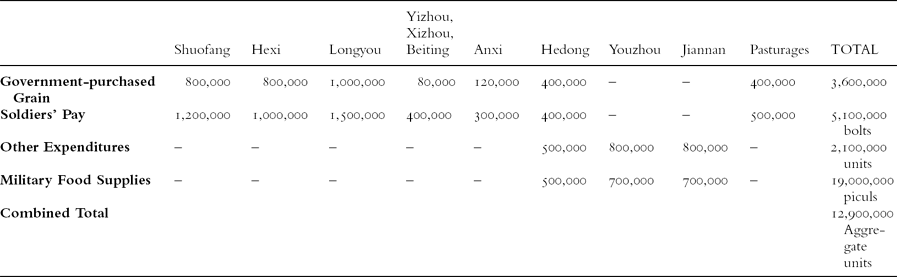
From the late 720s through the 750s, many honorific military titles were granted, and the military expenses increased each year. Du You tells us that the expenditures for government-purchased grain (dimisu 糴米粟) were 3,600,000 bolts; for soldiers’ pay, 5,300,000 bolts; for other items, 2,100,000 (no unit given); and for food supplies for the military 1,900,000 piculs. (See accompanying table for a breakdown of the regions where these funds were spent.)
Tang military expenditures by region (according to Du You).

Du You's encyclopaedia lists the receipts and expenditures involving tax cloth in the early eighth century. Hemp cloth and silk are denominated in bolts; silk floss, silk thread and hemp thread in hanks; grain in piculs; and coins in strings of 1,000 coins. All of these could be given in full units, or in smaller units: thus, silk and hemp were measured in bolts (pi/duan 疋/端), decafeet (zhang 丈), feet (chi 尺) and inches (cun 寸); silk floss, silk thread and hemp thread was in hanks (tun 屯) and ounces (liang 兩); grain was in piculs (shi 石), pecks (dou 斗) and pints (sheng 升); coins were in strings (guan 貫) and individual coins (qian 錢). When aggregating these figures, officials dropped the units and added them together as appropriate (for example, pi-duan or pi-duan-tun-guan-shi), but when they had to convert from one to the other, they calculated the value in strings and coins and then used those values to convert into another unit. Coins were therefore the basic unit of account. Following this principle, they carried out the purchase of tax cloth and keeping accounts.
For the portion paid in silk we have to look at the next line, which uses combined bolts of silk/hemp (pi-duan) as a unit; the state's annual expenditure on soldiers’ pay was 10,200,000 bolts of silk/hemp (pi-duan). For the expenditures of cloth in the north-west – the focus of our attention here – Du You tells us that the Anxi Area Command, the Xizhou (modern Turfan, Xinjiang), Tingzhou and Yizhou (modern Hami) military governors and the Hexi military commission spent 1,000,000 bolts of silk/hemp to buy grain, and 1,700,000 bolts of silk/hemp to pay soldiers’ salaries. In sum, each year the centre sent 2,700,000 bolts of silk to Anxi, Beiting (modern Beshbaliq), and Hexi (in the Gansu Corridor), nearly 30 per cent of the government's total spending on the Military Commissioners.
This is the backdrop to the shift after 735 in military organisation from militia soldiers, who were part-time farmers, part-time soldiers, to a regular standing army of professional soldiers whose food supply was guaranteed by government purchases of grain.Footnote 12 For the Hexi military command alone, as Du You reports, the central government sent 1,800,000 bolts of silk/hemp, a huge increase over the spending of the previous century.Footnote 13 One can easily imagine how such an increase would have strained the existing postal-station horse transport system.
The Tang government made two types of grain purchases: one from long-distance traders who brought the grain to the army from places where the price was low (jiaodi 交糴), the other from local residents, in theory at least, at fair market value (hedi 和糴).Footnote 14 (In English, these are both referred to as “harmonious purchase”.) The central importance of Liangzhou as the collection point for tax silk is clear from the report giving the total expenditures of grain purchased for the Doulu Army in Hexi Circuit dated 745 [Document Pelliot 3348]:Footnote 15
合當軍天寶四載和瀘, 准旨支貳萬段, 出武威郡, 准估折請得絮絹練綿等, 惣壹萬肆阡陸伯孀拾捌屯疋参丈伍尺肆寸壹拾銖。伍阡陸伯疋大生絹, 伍伯伍拾疋河南府絮, 貳伯 孀拾疋縵緋, 貳伯孀拾疋縵綠, 壹阡玖伯貳拾孀屯壹拾銖大 綿, 壹阡孀伯疋陜郡絮, 肆阡参伯陸拾壹疋参丈伍尺肆寸大練。
In 745, for this army to purchase grain from local residents a payment of 20,000 bolts is authorised from Liangzhou Wuwei prefecture, which, when converted to xu-batting for quilting, juan-silk, lian-degummed silk, and silk floss (mian 綿) totalled 14678 hank/bolts (tun-pi 屯疋), 3 decafeet, 5 feet, 4 inches, 10 tenth-inches comprising:
5,600 bolts of big-loom juan-silk (da sheng juan大生绢)
550 bolts of Henan xu-batting
270 bolts of plain silk dyed red (manfei 縵緋)
270 bolts of plain silk dyed green(manlü 縵綠)
1,927 hanks (tun 屯) 10 zhu 銖[1/24th of an ounce] of silk floss (da mian 大綿)
1,700 bolts of Shaan prefecture xu-batting
4,361 bolts 3 decafeet 5 feet 4 inches of broadloom lian-degummed silk (dalian 大練)Footnote 16
The Journey Overseer (xinggang 行綱), who was the Adjutant (canjun 參軍) of Dunhuang prefecture, Wu Shaoluan, followed the order dated the 12th day of the 10th month of 744, and went to Liangzhou where he received a total of 7,017 hank/bolts (tun-pi 屯疋) 10/24th ounce, which was the equivalent of the stipulated 10,000-bolt payment for purchasing grain from the local residents. These goods were used to buy grain from the residents, and the entire amount was spent in full.
For the 5,600 bolts of wide loom plain silk (da sheng juan 大生絹), the value of each bolt was 465 coins, totalling 2,604 strings of coins. The document gives the cost for each of the remaining types of cloth: 550 coins [later emended to 620 coins] per bolt of batting (xu 絮); 550 coins per bolt of plain silk dyed red (manfei 縵緋); 460 coins per bolt plain silk dyed green (manlü 縵綠); and silk floss, 150 coins per hank. The total value of the different types of cloth – 7,017 hank/bolts (tun-pi 屯疋) 10 zhu 銖 (1/24th ounce) – came to 3,266 strings, 759 coins, which purchased 10,115 piculs 6 pecks 9 pints 1 tenth-pint of grain. The amount of grain was checked by the Commissioner for Finance (zhidushi 支度使) against the account for the purchase of grain from the winter of 743 and then reported to the Department of the Treasury, the Department of Judicial Control (bibu 比部)Footnote 17 and the Department of Public Revenue: 9247 piculs 7 pecks 4 tenth-pints of foxtail millet (su 粟) at a price of 32 coins for each peck, for a total of 2,959 strings 64.4 coins. In addition, the document gives the same calculations of value for wheat (xiaomai 小麥), another species of broomcorn millet (mi 穈), naked barley (qingmai 青麥) and peas (wandou 豌豆) to reach the total of 10,115 piculs 6 pecks 9 pints 1 tenth-pint of the different grains combined.
In short, this detailed account records the authorised payment of 20,000 bolts from Liangzhou to the Doulu Army to purchase grain from the local residents. In fact, because the shipment contained different types of textiles, the Doulu Army received 14,678 bolts, 3 decafeet, 5 feet, 4 inches, 10/24 ounces of five different types of textiles and silk floss. Particularly worthy of note is the unit used: duan 段 for a bolt of hemp for textiles, as in the 678/679 directive from the Department of Treasury, discussed above.Footnote 18 The Encyclopaedic History of Institutions uses a combined unit for bolts of silk/hemp (pi-duan 疋段), which was abbreviated often as duan 段, the word usually reserved for hemp. For bookkeeping purposes, officials recorded the different amounts of various textiles, converted each to coins, totalled the coins, and then did a second, similar conversion from coins for each type of grain.
Even though the central government set aside a certain amount of silk for annual military expenses, it could increase the payment if there was additional military activity, as we can see in a letter to Niu Xianke, Vice Military Commander of Hexi, who served from 729 to 737.Footnote 19 An edict that he drafted in 735 mentions a one-time payment of 200,000 bolts of silk, because of a violent military conflict with the Turgesh, which was ten times higher than the regular payment discussed above. The increased payments in textiles from Liangzhou continued in subsequent years.
Of the different textiles shipped from Liangzhou to the north-west, the 745 document (P3348) gives the origin of the xu-batting as from Henan and Shaanzhou prefectures. Where were the other textiles from?
The Distribution of Prefectures Paying Tax Textiles in the Eighth CenturyFootnote 20
First let us take a look at the distribution of prefectures paying silk in the Tang. The main sources are Chapters 3 and 20 of the Liu dian 六典 [Compendium of administrative law of the six divisions of the Tang bureaucracy, hereafter referred to as the Compendium] about the Board of Finance and the Court of the Treasury.Footnote 21 According to Hamaguchi Shigekuni, The Compendium was written in 722 and presented to the throne in 738. Chapter 3 gives the contents of an edict listing the tax textiles paid by each prefecture in 737.Footnote 22
According to the Compendium, Henan and Hebei circuits submitted plain silk (juan 絹); Jiannan, Huainan, Shannan and the capital circuits submitted plain silk (juan 絹) and hemp cloth (bu 布); and Hedong, Longyou, Jiangnan and Lingnan circuits submitted hemp cloth (bu 布). The silk listed here is the plainer tax silk, a lower quality textile that is distinct from the higher quality and more elaborate brocaded jin-silk, ling-twill and luo-gauze. Xu-batting, which was made of cotton or silk, is stipulated for only a handful of prefectures while many more places paid in juan-silk. Juan refers to silk woven with equally weighted threads (which gives a smooth, even appearance) and is used as a general term to include: lian-degummed silk, juan-silk and plain silk dyed red (man 縵). The word bolian, an even broader ‘catch-all’ term for textiles, privileges lian (degummed silk) yet is a basic term for all tax textiles. It included lian, shengjuan, man and shi as we can see from the 743 price list from the market at Turfan, which uses “bolian” as a general category for similar merchandise sold in the same row of shops: big and small-loom lian (dalian 大練 and xiaolian 小練), shi, shengjuan and man.Footnote 23 As Map 1 shows, Hebei, Henan and Jiannan circuits produced most of the tax silk.
If we aggregate the data, we see that approximately 99 prefectures contributed juan-silk and approximately 250 submitted hemp cloth (because some prefectures submitted both, we cannot be more exact). Despite the uncertainty, we can see that the number of prefectures contributing juan-silk was less than half of those paying hemp cloth, but silk accounted for 40 per cent of the total tax revenue.
Du You estimated that, between 742 and 755, a total of 8,200,000 registered households paid the tax in textiles: 3,700,000 paid juan-silk or silk floss (mian 綿), while 4,500,000 paid hemp cloth.Footnote 24
Because the border prefectures of Lingnan circuit are included, one cannot make a simple comparison, but the places producing silk clearly were areas which had a larger population. Hebei, Hedong, Henan and Jiangnan East circuit (but not the two capital circuits at Chang'an and Luoyang) paid increasing amounts of silk tax textiles between 639 and 742.Footnote 25 Note that in 742, 19 of the prefectures had more than 90,000 people, (16 had more than 100,000 people) and of these 19, 13 were in the north, with Hebei and Henan as the core areas (see map). While the number of tax-paying households in Jiangnan West, Huainan, Hedong and Jiannan Circuits increased dramatically, the number in Shannan, Qianzhong, Longyou and Lingnan was small to start with and showed no increase in the eighth century. Accordingly, in the first half of the eighth century, Hebei and Henan Circuits, with the highest number of prefectures over 100,000 households (not considering the capital circuits of Luoyang and Chang'an) paid most of the silk tax, with Jiannan Circuit coming next.Footnote 26 Parenthetically, we should observe that Jiangnan East Circuit paid the most hemp in taxes with Jiangxi West, Huainan and Hedong Circuits coming next.
The major silk-producing centres of the Tang were exactly those of the Six Dynasties period (220–589): Dingzhou, Xiangzhou and Beizhou prefectures north of the Yellow River (Huanghe), then different places to the north and south of the Yangzi River and finally Sichuan.Footnote 27 In the late Tang, although silk production increased in the Yangzi and Huai River valleys, Henan and Hebei remained the key centres.Footnote 28 In sum, Henan and Hebei were the most important silk-producing centres, with Jiannan next.
Putting aside the highest-quality silks, Hebei and Henan produced the best plain silk (juan 絹) while that from Jiannan was slightly inferior. It is worth noticing that the Sogdian settlements followed the trunk routes and that their settlements overlapped with Hebei and Henan.
Government Transport of Tax Textiles and the Occupying Armies of the Eighth Century
As we have seen above, in the seventh century and continuing into the eighth, the tax textiles of the different prefectures of Jiannan and additionally those of Hebei and Henan circuits continued to be sent to Liangzhou and from there to the armies stationed west of Hexi. But there was a major change: unlike previously, in the eighth century, the Journey Overseer (xinggang 行綱) and the Shipment Supervisors (guandian 官典) now had to go to Liangzhou to pick up the shipment. For example, the report from the Hexi Military Commander (Pelliot 3348, cited above) giving the accounts for the harmonious purchase of husked millet from local residents (hedi 和糴) and from merchants (jiaodi 交糴) explains:
7,661 hank/bolts (tun/pi) 3 decafeet, 5 feet, 4 inches silk/hemp bolts
The Adjunct Commandant (biejiang 別將) Zhang Qianlian 張虔廉, on the 18th day of the 3rd month of 745 at Liangzhou Prefecture receives payment in full of the 10,000 bolts as specified in the directive of 745. As it is time for the spring payment (chunji xinfu 春季新附) to the army, this cloth is given to the populace as payment for piculs and pecks of grain in accord with the regulations of the Department of the Treasury (jinbu 金部) and paid to the Vice Commissioner (fushi 副使) for salaries of the Doulu Army. It was spent in full.
This document indicates that the payment of 20,000 bolts of silk (discussed above) was split into two instalments and that the Journey Overseer went to Liangzhou to pick it up. Two men were sent from Dunhuang to Liangzhou: specifically the Adjutant from Dunhuang and the Assault Resisting Garrison official on the spot who was Adjunct Commandant responsible for delivering the tax, which was used to pay salaries. Presumably all the armies of the north-west received their tax textiles in this way.
A similar document records the receipt of 1,000 pounds (jin 斤) of steel at Kucha by a Journey Overseer who travelled from Liangzhou:Footnote 29
鋼壹阡斤兩行綱涼州明威鎮兵曹武鳳祥 典龍
右得涼州牒稱得朔方軍興 [晨?]
1,000 pounds [approximately 600 kg] of steel: convoy directed by Wu Fengxiang, War Section Head (bingcao 兵曹) of the Mingwei garrison in Liangzhou prefecture. Dian 典 clerk, surnamed Long.
According to the report from Liangzhou appended above, the army of Shuofang.Footnote 30
At the time the materials needed by the Military Commanders (jiedushi 節度使) and occupying armies were provided sometimes at regular intervals, sometimes not, and the military commanders and occupying armies dispatched Journey Overseers to collect the items, sometimes requiring them to go a considerable distance, as from Kucha to Liangzhou.
The Hexi region and the Military Commanders to the west could use the horses, donkeys, carts and cattle of the government long-distance stables and long-distance cart depots.Footnote 31 But the dramatic increases in spending during the eighth century strained these facilities, especially when the more distant prefectures like the Area Command of Yizhou, Xizhou, Beiting and that of Anxi had to go all the way to Liangzhou to pick up supplies. It would have placed too great a burden on each long-distance horse stable or cart depot to transport such large shipments, and the horses and carts were reserved for short-distance transport. The following section will explore how they supplemented the means of transport.
What the Turfan Documents Reveal about Long-Distance Shipment of Tax Silk
First, we have a long and informative document about shipment to a distant place, in this case, the Anxi Protectorate in Kucha in 733. This 188-line document concerns a case heard in Turfan in the first and second months of 733 (Kaiyuan 21) about Wang Fengxian, a man who travelled without the correct travel document, so therefore without authorisation and in violation of the law.Footnote 32
安西給過所放還京人王奉仙
右得岸頭府界都遊弈所狀, 稱上件人無向北庭行文, 至酸棗戍捉獲, 今隨狀送者。
依問王奉仙得款, 貫京兆府華源縣, 去年三月內共行綱李承胤下馱主徐忠驅驢, 送兵賜至安西輸納了 。 却迴至西州判得過所, 行至赤亭為患。
復承負物主張思忠負奉仙錢三千文, 隨後却趁來至酸棗, 趁不及, 遂被戍家捉來。 所有行文見在, 請檢即知者。
依檢:王奉仙並驢一頭, 去年八月廿九日, 安西大都護府給放還京已來過所有實。 其年十一月十日到西州, 都護押過向東, 十四日, 赤亭鎮勘過, 檢上件人無却迴赴北庭來行文者。
又問王仙得款:去年十一月十日, 經都督批得過所, 十四日至赤亭鎮官勘過, 為卒患不能前進。 承有債者張思忠過向州來, 即隨張忠驢馱到州, 趁張忠不及, 至酸棗戍, 即被捉來。 所有不陳却來行文, 兵夫不解, 伏聽處分。 亦不是諸軍鎮逃走及影名假代等色。 如後推問, 稱不是徐忠作人, 求受重罪者。
又款:到赤亭染患, 在赤亭車坊內將息, 經十五日至廿九日, 即隨鄉家任元祥却到蒲昌, 在任祥傔人姓王不得名家停止。 經五十日餘。今年正月廿一日, 從蒲昌却來趁張忠, 廿五日至酸棗, 趁不及【下闕】州, 所有不陳患由及却來文【下闕】從西行到安昌城死訖者 【下闕】無過所, 今【下闕】
[Concerning the matter of] the Area Command of Anxi granting a travel pass to Wang Fengxian 王奉仙 so that he can return home to the capital.
With regard to the above, the following charge has been received from the reconnaissance office (duyou yisuo 都遊奕所) in the jurisdiction of Antou prefecture 岸頭府: “The accused had no instructions recorded [in the travel pass he was carrying] to proceed to Beiting [and as a result] was arrested by the Suanzao fort. Now we send him in for questioning along with the written charges.”
Wang Fengxian's deposition obtained as a result of examination of the charges [carried out by the Personnel Evaluation Section (gongcaosi 功曹司)] in the Xizhou bureau was as follows: “I, being registered as a resident of Huayuan 華源 county in the capital, in the third month of last year, in the company of Xu Zhong 徐忠, pack master [charged with transportation of textiles under the supervision] of Journey Overseer Li Chengyin 李承胤, led a donkey train, forwarded military supplies to Anxi and completed the delivery of them. On my return, on reaching Xizhou prefecture, on the decision [of the said prefecture], I was reissued with a travel pass, but on reaching Chiting 赤亭 [garrison], I fell ill.
Furthermore, as I had lent 3,000 cash to Zhang Sizhong 張思忠, I went in pursuit of him and, doubling back [from Chiting], went to Suanzao garrison, but being unable to catch him, I was then myself apprehended by soldiers from the [Suanzao] guard post. I am now carrying the travel pass that I received then [from the Suanzao guard post]. I humbly request that you examine and confirm the facts relative to this case in my deposition.”
Subsequently, when an examination was carried out [to determine whether the facts recorded in the account of the cross-examination should be amended], it was confirmed that on the 29th day of the eighth month of last year, the protectorate-general of Anxi did issue a travel pass for Wang Fengxian and his donkeys to return to the capital. On reaching Xizhou on the 10th day of the eleventh month of the same year, having obtained the signature of the prefect, he passed through to proceed eastwards and on the 14th day, received a passage check at Chiting garrison. Investigation confirms that the travel pass of the accused does not record the reason for doubling back to Beiting.
Furthermore, the deposition obtained from the second questioning of Wang Fengxian [by the said section] is as follows: “On the 10th day of the eleventh month of last year, having been authorised by the prefect, I obtained a travel pass. On the 14th day, on reaching Chiting garrison, I underwent examination and was given permission to pass through, but a sudden attack of sickness made it impossible for me to proceed right away. [Thereafter], my debtor, Zhang Sizhong, went through [Puchang 蒲昌 district] proceeding to the prefectural seat and I, leading my donkeys in pursuit of him, made for Xizhou city. Before I could catch up with him, when I got to Suanzao guard post, I was arrested. The travel pass that I am currently carrying makes no mention of the point of doubling back, [so the Suanzao guard post] troops refused to release me. I ask leave to submit to your decision. Moreover, I am not an army deserter nor have I gone under a false identity, or the like. If on further examination it is decided I am not Xu Zhong's helper, I ask that I be punished for a serious crime.”
Then, in a [separate] deposition: “I arrived in Chiting (garrison), but I fell ill and recuperated in the carter's hostel (chefang 車坊) of Chiting (garrison), and stayed [there] from the 15th to the 29th. Thereafter, accompanying sub-district manager Ren Yuanxiang 任元祥, I turned back to Puchang district and [there] passed 50 or so days lodging at the home of a certain Mr Wang, an attendant of Ren [Yuan]xiang. Then, on the 21st day of the first month of this year (733), in pursuit of Zhang [Si]zhong, from Puchang, I doubled back, reaching Suanzao on the 25th day. I was, however, unable to catch up with [Zhang Sizhong]. . .” at [gap in text] prefecture. In the travel pass he was carrying, there is no mention of the particulars of the illness which was his reason for doubling back. . .arriving from the west in Anchang 安昌 city, he died (?). . . without a travel pass, now (?). . . [The text contains gaps; the end is omitted]
The officials in Antou county forwarded the case to the Personnel Evaluation Section in Turfan on the 27th day of the first month. That official received the materials on the 29th day of the first month and sent his report to Liang Yuanjing 梁元璟, the Administrator in the Revenue Section (hucaosi 戶曹司), who received it on the fifth day of the second month. His decision does not survive.
According to the document, under the supervision of the Journey Overseer Li Chengying, Wang Fengxian was a labourer (zuoren 作人)Footnote 33 hired by the pack leader (tuozhu 駄主) Xu Zhang to transport military supplies to Anxi and was apprehended at Suanzao Fort in Turfan. This passage clearly concerns the payment of silk to the armies to cover salaries.Footnote 34
Another instance of someone caught without a travel pass concerns a native of Chang'an who joined a transport team going from Liangzhou to Beiting and who stayed in the north-west first as a migrant (kehu 客戶) and later as a registered commoner. Because of poverty, he took a job transporting silk to purchase harmonious-purchase grain under a man named Guo Lin 郭林, who drove mules to Hami. His travel pass was stolen just as he was about to depart from Turfan. Given the 1,000,000 bolts of silk being shipped to the north-west between 715 and 741, he was probably one of the many people hired to carry tax textiles.Footnote 35
Many Journey Overseers must have gone to Liangzhou to pick up tax textiles. The ci-poem entitled “Liangzhou” by Zhang Ji 張籍 captures the scene of the silk shipments: “With countless tinkling of bells passing the dunes/the camel trains carry white degummed silk to Anxi”.Footnote 36 The next section will examine the exact configuration of the silk convoys.
Long Distance Transport Convoys, Non-Resident Merchants and Commoners
The long document about travel passes in section 5 recorded the names of three people who took silk from Liangzhou to Turfan: the Journey Overseer, the pack master and the hired labourer who went all the way to Turfan with the donkeys and horses. This means that the shipment did not proceed in short intervals from one district to the next using official donkeys and carts as was customary for government shipments. Instead, this was a long-distance shipment of silk to supply the army, and, as we saw above, the quantities of silk increased because of the fighting with the Turgesh. Instead of using government donkeys and carts, the convoys hired locals to cover the entire journey.
In the Tang dynasty there were two ways in which officials could do this. Either the Journey Overseer directly paid and supervised the workers he hired or he delegated the task to non-resident merchants, which was strictly forbidden. Even so, as the report of Chen Zi'ang 陳子昂 to his superiors indicates, the practice was common in Jiangnan and Huainan even before 700.Footnote 37 According to Kikuchi Hideo, this became the norm, so much so that the 737 recension of The Tang Code omitted the regulation banning the practice.Footnote 38 This was the case in central China, but in Central Asia the hired labourer Wang Xianfeng was hired by the pack master and not the Journey Overseer. We can deduce that the pack master was the actual caravan leader and that the Journey Overseer hired him and other labourers to transport the silk. This document does not say so, but we can surmise that non-resident merchants operated between Liangzhou and Turfan. Because the pack leader Xu Zhong received the travel pass, he was probably a native of the capital. The legal case that I have written about elsewhere between Cao Lushan and Li Shaojin indicates that both Sogdian and Chinese merchants operated between the capital and the north-west.Footnote 39
This discussion raises the issue of security. The Journey Overseer took full responsibility for getting the tax textiles from Liangzhou to the military commanders and armies who needed it: he hired the merchants who formed the convoys that went from place to place in his name. The pack master must have carried a government pass that allowed the bearer to stay at government hostels and get government grain. And the troops moving with the transports “to defend and to help” must have been provided by the government. Even if we cannot be sure that the pack masters were non-resident merchants, we do know that commoners, non-resident merchants and transport labourers were all involved.Footnote 40
It became increasingly common for the Journey Overseers to be non-resident merchants who hired either registered commoners or unregistered non-Chinese households to transport the tax textiles all the way from Liangzhou to the north-west. Although private merchants were involved, the Journey Overseers could use government post roads, inns and garrisons, and so in effect the shipping was an official government function. In the document about Wang Fengxian, this is why both the pack master and the hired labourer could stay at the carter's hostel in Chiting. The Transportation Commissioners (zhuanyunshi 轉運使)Footnote 41 arranged the shipment of tax textiles by means of government shipping facilities and tried to minimise any obstacles, and they used private merchants to ensure the shipment and delivery of tax textiles.
The above investigation has shown that the caravans organised by the Journey Overseers and Shipment Supervisors used the same post roads that were used for the transport of military supplies, and that the transport of textiles was carried out by non-resident households (xingke 行客), resident households (baixing百姓) and non-Chinese merchants (xinghu 興胡). Unlike the categories of non-resident household and resident household, that of non-Chinese merchant was not a formal, legal category. Still, we can be confident that it usually denoted foreign merchants.
Let us compare the shipping of military goods in the north-west with that in north and north-east China. In the north-east, in the Fanyang Military Commission (in the vicinity of modern Beijing) and Pinglu Military Commission (in modern Shandong), there were water and overland transportation commissioners. Grain was the main good transported long distance by water along the Grand Canal, but silk and hemp textiles were also sent to the military.Footnote 42 The water transport commissioner was based in Shizhou (modern Chaoyang, Liaoning), and his task was to oversee water transport. For both ocean and inland shipping, there were water transport labourers called ‘waterhands’ (shuishou 水手) who were classed as performing corvée but really were full-time workers who were paid salaries.Footnote 43
Although we lack detailed information about the official supervision of overland and river shipping, we can surmise how it worked. In most of north China the ‘waterhands’ usually provided the labour, while in Hebei much of the shipping on the Grand Canal was farmed out to non-resident merchants.Footnote 44
In Central Asia where there were many Sogdian and Chinese non-resident merchants, under the supervision of the Journey Overseers, non-resident merchants did most of the shipping of tax textiles. In Youzhou (modern Beijing) and Yingzhou 營州 (modern Chaoyang, Liaoning) the heavy traffic of Chinese and Sogdian merchants is shown by the existence of Sogdian inns (dian 店), which provided lodging, board, storage, shipping, as well as financial services, like sales to the imperial household and brokerage services. It seems very likely that before 755 the shipment of tax textiles in north China, as in north-west China, involved non-resident merchants. We cannot, however, be certain whether the Journey Overseers delegated the supervision of the shipping entirely, or partially, to non-resident merchants.
On the other hand, in north China, the Shuofang Military Commissioner (in northern Gansu and western Inner Mongolia) used much the same system of paid ‘waterhands’ on the Yellow River (Huanghe) as on the Grand Canal. Maruhashi Mitsuhiro has shown that, at least before 650, on the northern Grand Canal the state hired labourers directly and there is no evidence of private merchant activity.Footnote 45 Since Guannei circuit – unlike the post roads of the rest of north China – did not have Sogdian colonies or inns, it seems less likely that non-resident merchants were very active in that region. Thus, the shipping – at least before 755 – of tax textiles in Guannei circuit was not done by non-resident merchants.
To sum up, the shipping of military supplies in the north and north-east was different from that in the north-west, except in areas where non-resident merchants were involved in the shipment of tax goods.
Conclusion
During the Tang dynasty, north-west China was under military rule, and each year the region received tax textiles shipped from the central prefectures. These payments were primarily to cover the salaries of and to purchase grain for the soldiers of the occupying armies, and prior to the establishment of the Military Commissioners (jiedushi 節度使) in the early 700s, the total amount of tax textiles sent there was small. In this period, it is incontrovertible that the tax textiles were sent from Jiannan Circuit to the Liangzhou Area Command, where the Shipment Supervisors shipped the tax textiles from Liangzhou to their respective destinations on the front lines. They utilised the postal-station relay horses that stood ready in each prefecture as part of the postal-station system.
But when the system of military commissions was established and regularised in the early eighth century, the amount of tax textiles shipped to cover military expenses increased dramatically. For this purpose, while the central role of the Liangzhou Area Command continued, the system itself underwent profound change. The three key circuits that produced the most silk were Jiannan, Hebei and Henan. The system by which large amounts of tax silk were shipped to Liangzhou using postal relay horses was abandoned and the responsibility for shipping the tax silk shifted to the armies who received the tax silk. Each army sent an official to supervise the shipment (Journey Overseers and Shipment Supervisors were the officials in charge of the transport corps) who, in turn, delegated that responsibility to merchants. In fact, the transport officials did not cede all of their authority to these merchants; the convoys stayed on government postal roads, and officials were still responsible for their safe passage. This was how the tax textiles were shipped to the north-west in the eighth century.