In 2012, an estimated 804,000 suicide deaths occurred worldwide which represents a suicide rate of 11.4 per 100,000 populations. Every suicide is a tragedy that has long-lasting effects for the relatives of suicide. That year suicide was the second leading cause of death in the age group of 15–29 years around the world. It is a global phenomenon affecting all regions of the world. In 2012, 75% of suicides in the world took place in low and middle income countries. The aim of the World Health Organization (WHO) is a 10% global rate reduction for 2020 (WHO, 2014).
The ultimate aim of the research is the explanation and identification of risk factors for suicide in order to carry out strategies of prevention as well as clinical treatment in cases of risk, which include suicide attempts. Close relations have been found between factors that increase or decrease the suicide risk levels and conduct (American Psychiatric Association, 2003).
Several studies highlight psychosocial risk factors related to stressful situations such as personal loss (divorce, separation, death), being separated or without a partner, financial loss (loss of money or job), previous psychiatric record and /or suicide in the family (Agerbo, Nordentoft, & Mortensen, Reference Agerbo, Nordentoft and Mortensen2002), or the existence of stressful life situations (Nock et al., Reference Nock, Borges, Bromet, Cha, Kessler and Lee2008; WHO, 2014).
Previous studies involve socio-demographic, personal and situational variables related to both attempted suicide and completed suicide (Cooper et al., Reference Cooper, Kapur, Webb, Lawlor, Guthrie, Mackway-Jones and Appleby2005; Nordentoft, Reference Nordentoft2007). However, less is known about the psychosocial factors that influence the initial stages of the process, being remarkable that prior suicidal ideation is one of the most important risk factors that greatly increase, along with planning, the risk of suicide (Nock et al., Reference Nock, Borges, Bromet, Cha, Kessler and Lee2008). It is suggested that the same risk factors tend to operate in different stages of the suicide process, and its size or weight differs between steps (Diekstra, Reference Diekstra1996).
Thinking about suicide is prevalent among those individuals with limited skills in problem solving, depressed, pessimistic or hopeless (Chioqueta & Stiles, Reference Chioqueta and Stiles2007), or those suffering from a recurrent pain or disease with poor prognosis (Tang & Crane, Reference Tang and Crane2006). Furthermore, the overall perceived stress or the family stress in particular (in the form of negative events and persistent difficulties) such as the stigmatization of mental illness or suicide attempters (Pompili, Mancinelli, & Tatarelli, Reference Pompili, Mancinelli and Tatarelli2003), the interaction and the social support are associated with suicidal ideation (Kinkel, Bailey, & Josef, Reference Kinkel, Bailey and Josef1988). Moreover, a suicidal person often presents limited communication skills and usually avoids asking for help, a process called denial of aid (Deane, Wilson, & Ciarrochi, Reference Deane, Wilson and Ciarrochi2001).
The existing research on the protective effects of religion against suicide is extensive (Maris & Lazerwitz, Reference Maris and Lazerwitz1981). Regarding the suicidal ideation specifically, less religious individuals report higher ideation compared to highly religious people (Simonson, Reference Simonson2008).
It is important to analyze the role that attitudes play towards suicide as a predictor of the suicidal ideation, since they reflect the belief that it is an acceptable option directly linked to suicidal behavior itself, including attempts and completed suicides (McAuliffe, Corcoran, Keeley, & Perry, Reference McAuliffe, Corcoran, Keeley and Perry2003). Gibb, Andover, and Beach (Reference Gibb, Andover and Beach2006) suggest that pro-suicide attitudes may increase the attractive perception of the act itself, and a person is more likely to consider life-threatening actions when presented with situational cues.
In order to examine attitudes related to suicidal behavior, several questionnaires have been built such as the SOQ (Suicide Opinion Questionnaire), the SUIATT (Suicide Attitudes Questionnaire) and the Semantic Differencial Scale Attitudes towards Suicidal Behavior (SEDAS, by its Spanish acronym). The SOQ (Domingo, Moore, Westlake, & Gibson, Reference Domingo, Moore, Westlake and Gibson1982) has received numerous and important criticism (Diekstra & Kerkhof, Reference Diekstra, Kerkhof, Diekstra, Maris, Platt, Schmidtke and Sonneck1989; Jenner & Niesing, Reference Jenner and Niesing2000) referring to its psychometric properties (Rogers & De Shon, Reference Rogers and DeShon1995). A later proposal, the SUIATT (Diekstra & Kerkhof, Reference Diekstra, Kerkhof, Diekstra, Maris, Platt, Schmidtke and Sonneck1989) tried to overcome these problems, but its authors highlight its limitations: it takes too long to be applied and its use for clinical purposes is complicated. The difficulty to differentiate the subscales was also argued (Etzersdorfer, Vijayakumar, Schöny, Grausgruber, & Sonneck, Reference Etzersdorfer, Vijayakumar, Schöny, Grausgruber and Sonneck1998). In order to overcome the above mentioned scales, Jenner and Niesing (Reference Jenner and Niesing2000) developed SEDAS, but its application still takes a long time and there are not enough studies yet to validate its psychometric properties.
The previously mentioned reasons fostered the creation of the CCCS-18 (Attitudinal Beliefs Questionnaire about Suicidal Behavior, by its Spanish acronym) (Ruiz et al., Reference Ruiz Hernández, Navarro-Ruiz, Torrente Hernández and Rodríguez González2005). It consists on a short and easy to interpret instrument (18 items) that includes four factors in its original study. The first factor, Legitimization of suicide, includes 6 items related to the perception of the suicide as a logically acceptable act (Suicide should be a legitimate way of dying). The second factor is referred to the Suicide in terminally ill patients and it also includes 4 rational items (Dignified suicide should be permitted to those suffering from incurable diseases). The third factor indicated the Moral dimension of the suicide from a social point of view. It includes 4 items (Suicide is an immoral act, Suicidal people threaten the society). The last factor focuses on the Suicide itself and it is divided in 4 items (If I felt very lonely and depressed I would try to commit suicide). These factors have not remained steady in the version adapted to the Argentinean population, and a different structure with a different number of factors can be found (Desuque, Vargas, & Lemos, Reference Desuque, Vargas and Lemos2011).
Due to the importance of early detection of suicide risk, the main objective of this study is to continue the validating process of the questionnaire. For this purpose a bigger and more socio-culturally varied sample of adult population than the one used for the original study was analyzed. This piece of work is aimed to provide construct validity evidences through confirmatory factor and convergent validity criterion analysis along with other predictive psycho-social, psycho-emotional and psycho-somatic factors of suicidal ideation. Differences between the resulting groups generated by the different variables related to suicide (Ideation, Planning, Attempt, Probability and Impediment) will be also analyzed.
Method
Participants
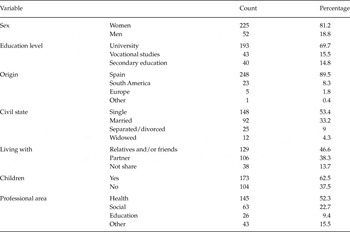
The instrument was administered in an Open Workshop on Grief (held in a welfare center in the Region of Madrid). From the 400 participants, 277 subjects answered the questionnaire (reply rate close to 70%), 81.2% (225) of which were women and 18.8% (52) men. The average age was 39.95 years old (SD = 15.9). As for their education level, 69.7% of the sample had higher education studies (university), 15.5% had vocational studies and the other 14.8% had completed secondary education (see Table 1).
Description of the sample

Instruments
The Attitudinal Beliefs Questionnaire about Suicidal Behavior (CCCS -18) was created in Spain, at the University of Murcia by Ruiz et al. (Reference Ruiz Hernández, Navarro-Ruiz, Torrente Hernández and Rodríguez González2005). The original test was analyzed with a sample of 219 college students, 81.73% of which were girls and 18.27% boys, with a mean age of 20.72 years old.
Once the initial scale was refined, it led to a final 18-item scale divided into four factors that explained 60.74% of the variance. The first factor (Legitimacy of suicide) gathers items number 1, 5, 8, 10 and 18 and it explains 18.6% of the variance. Its reliability using Cronbach’s alpha was = .84. The second factor (Suicide of terminally ill patients) includes 4 items (2, 6, 11 and 15) and explains the 15.52% of the variance (α = .82). The third factor (Moral dimension of the suicide; items 3, 7, 12 and 16) explains a 13.9% of the variance (α = .78). The last factor (Suicide itself; items 4, 9, 13 and 17) explains the 12.72% of the variance (α = .78). The Likert response scale includes seven options where 1 = strongly disagree and 7 = strongly agree.
In order to obtain evidences of predictive and discriminant validity direct suicidal behavior-related variants were collected: Suicidal ideation (Have you ever considered threatening your life?), Planning (Have you ever thought about how to perform it?), Attempt (Have you ever tried it?), Probability (If things went wrong, would you come to commit suicide?), the answers being yes / no. Information about the existence of any Impediment (in a list of 12 reasons not to commit suicide) was also collected, gathered for the analysis in three possible answers: my beliefs or values, my loved ones, no impediments.
IRIS risk index
A Predictive Suicidal Ideation Risk Index (IRIS, by its Spanish acronym) was developed collecting information on socio-demographic, psychosocial, psycho-emotional and psychosomatic suicide-related variables (below, options considered as a risk factor in the literature reviewed are listed in italics):
-
a. Marital status: Single / Separated / Widowed / In a relationship
-
b. Employment status: Unemployed / Unstable or insufficient job / Stable job / Student / Housewife
-
c. Socioeconomic status: Low / Medium / High
-
d. Religion: Catholic / Atheist / Other religion
-
e. Having children: Yes/ No
-
f. Current home situation: Living alone / Living with other people
-
g. Family issues: Family with health problems / Family with no health problems
-
h. Previous record of psychiatric disorders in the family: Yes / No
-
i. Social network: I have few friends / I have enough friends / I have many friends
-
j. Presence of pain: I don’t usually feel pain / Sometimes I feel pain / I feel a lot of pain
-
k. Presence of disease: I don’t usually get sick / Sometimes I get sick / I am sick very often
-
l. Overall perceived stress: I don’t live in tranquility / I live in tranquility
-
m. Emotional instability: I consider myself emotionally stable / I consider myself emotionally unstable
-
n. Psycho-emotional personality characteristics: I consider myself a pessimistic person / I consider myself an optimistic person
-
o. When faced with a hard-to-cope situation: I get depressed / It is hard for me to get ahead / I bring out the best in me
-
p. I seek help in difficult situations: Yes / No
-
q. Ability to communicate with others: scale from 1 (= None) to 10 (= Strong)
Procedure
The questionnaires were distributed to all participants at the beginning of an Open Workshop on Grief, along with the inscriptions. This workshop last for one and a half days and are held every year since 10 in a welfare center in the north of Madrid. Participants were indicated to deposit them in boxes at the registration desk before they would leave. They were detailed that participation was voluntary and anonymous, and that strict confidentiality would be kept in the use of the collected data.
Statistical analysis
CCCS-18 analysis: Once the data was collected the punctuation of the inverse items was recorded, and the analysis of the omission distribution was performed. No questionnaire presented more than 10% of omissions and those were replaced by the mean of the series.
Reliability analysis: Omega coefficient (McDonald, Reference McDonald1999) was calculated as a measure of internal consistency since it is considered a more sensitive index compared to other alternatives when categorical variables are being analyzed (Revelle & Zinbarg, Reference Revelle and Zinbarg2009). The software R version 3.2.1 was used to calculate it.
Construct validity: It was tested using the confirmatory factor analysis (CFA). The suitability of the CFA depends on the number of items, the complexity of the model and the minimum sample size around 200 subjects (Izquierdo, Olea, & Abad, Reference Izquierdo, Olea and Abad2014). Previous to an adequate implementation of factorial procedures for categorical variables, the degree of violation of the assumptions of the classical linear model was analyzed. An analysis of the normality of the indicators was held using the Mardia’s test, Kolmogorov-Smirnov tests and unvaried skewness and kurtosis values. Following the recommendations of Flora and Curran (Reference Flora and Curran2004), the polychoric correlation matrix, more suitable in this case given the nature of the collected variants, was used as a starting point under the estimation of ULS (Unweighted Least Squared method). PRELIS was the program used for the estimation of the polychoric correlation matrix and the asymptotic variance-covariance matrix, and LISREL 8.8 was used to undergo the CFA. In order to test adjustment of the models the following indicators were used: 1. Absolute fit index: given the sensitivity of χ2 to sample size, χ2 quotient was divided by its degrees of freedom (df) (Fujikoshi, Reference Fujikoshi2000) (χ2 /df is considered a valid indicator as long as the resulting values vary from 1 to 3) (Jöreskog, Reference Jöreskog1970) and sRMR (Standardized Root Mean Squared Residual); 2. Comparative fit index: Comparative Fit Index (CFI) (Bentler, Reference Bentler1989); and 3. Goodness of fit index that penalize less parsimonious models: the Root Mean Square Error of Approximation (RMSEA) (Brown, Reference Brown2006).
We follow the guidelines of Kline (Reference Kline2005), Worthington and Whitaker’s (Reference Worthington and Whittaker2006) and Abad, Olea, Ponsoda, and García (Reference Abad, Olea, Ponsoda and García2011) for fit index values; below 0.1 for sRMR and RMSEA; above .95 for CFI (specially in ordinal data) (Weston & Gore, Reference Weston and Gore2006).
IRIS risk Index; Multiple logistic regression was used to calculate the IRIS risk index, taking suicidal ideation (yes / no) as the dichotomous dependent variable and the before-mentioned variables as predictors. Hierarchical regression strategy was used to create it. The variables that ultimately became part of the equation (analyzing their weights using the corresponding odds ratio) were the following:
IRIS = (low socioeconomic status * 4.333) + (emotional instability * 3.059) + (overall perceived stress * 3.004) + (psychiatric record in the family * 2.373) + (limited social network * 2.330) + (presence of disease/s * 2,279) + (no religion * 2,059).
Discriminant and predictive validity: Pearson’s correlations were carried out between the IRIS index used as a predictor of the Suicidal Ideation and the scores on the CCCS-18 scale and subscales using SPSS v19.
Finally, the differences of means were estimated using the Student’s t-test for independent samples among the groups generated by the variables: Suicidal ideation, Suicidal planning, Suicide attempt, Probability, and Impediment to commit suicide. Due to the small size of the groups resulting from Suicide attempt and Absence of impediment to commit suicide non-parametric tests were used (Mann-Whitney U test and Kruskal-Wallis H test, respectively). The calculation of the size effects by Cohen’s d (Reference Cohen1988) was also included in order to compare, among a large set of significant differences, the true explanatory importance of some of them over the rest.
Results
Sample description (see Table 1)
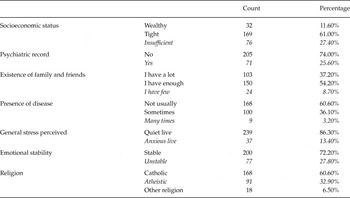
They were mainly (81.2%) women with an average age of 39.95 years old (SD = 15.9) and high education level (69.7%). Most of them (89.5%) from Spain, 8.3%. 53.4% declared to be single, followed by married (33.2%), separated or divorced (9%) and widowed (4.3%). Moreover, 46.6% of the sample stated to live with relatives and/or friends, 38.3% were living with their partner, and 13.7% did not share their home with other people. In addition, 62.5% said to have children. Regarding the socioeconomic status of the participants, 61% classified themselves in a medium level, 27.4% in a high level and 11.6% in the low level. As for their religious beliefs, 60.6% stated to be Catholic, 32.9% atheist / agnostic, and 6.5% declared to follow a different religion. Finally, in relation to their professional profile, 52.3% worked in the health sector and 22.7% in the social sphere.
Model fit
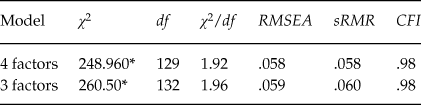
Once the data from contrasting the four-factor model was obtained, the second three-factor model was also contrasted. The goodness of fit index for both models are detailed in Table 2.
Goodness of fit index of the contrasted models using CFA

Note: RMSEA = Root mean square error of approximation, sRMR = standardized root mean square residual, CFI = comparative fit index, *p < .001.
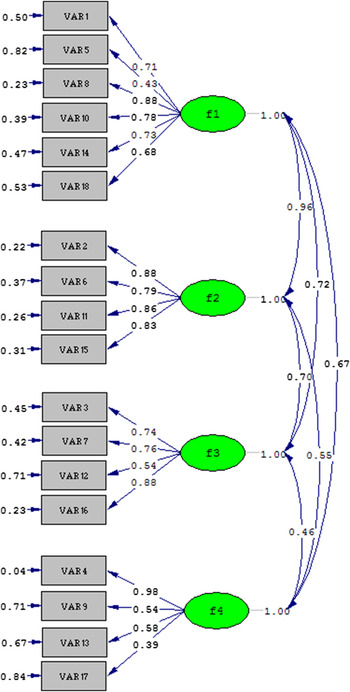
Although the four-factor model initially contrasted presents reasonably satisfactory adjustment rates, the solution throws a correlation of r = .96 between the first and the second factor (Figure 1).
CCCS-18 four factor confirmatory model result. Correlations between factors and saturation values for each item are shown, VAR = item.

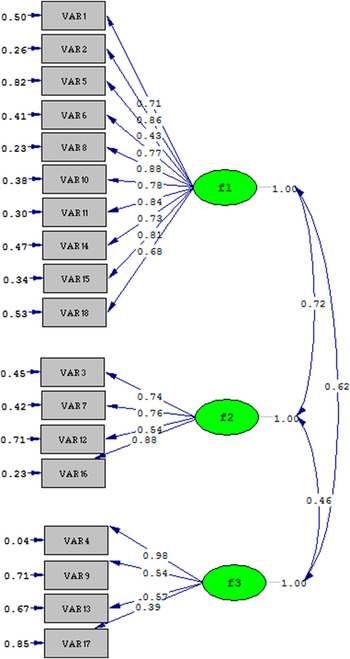
Two factors with such a high rate of correlation should be joined or added in a single factor (Mangin, Reference Mangin, Mangin and Varela Mallou2003). Therefore, both subscales were merged resulting in a three-factor model (Figure 2) that offered favorable fit index resembling the original model, and being this the most convenient and admissible alternative. The saturation values of the items can be seen in Figure 2.
CCCS-18 three factor confirmatory model result. Correlations between factors and saturation values for each item are shown, VAR= item.

The resulting factors were name according to the content of the items and also following the nomenclature from the original study; Factor 1: Legitimization and terminal disease, Factor 2: Moral dimension, and Factor 3: Suicide itself. The resulting reliability index using the omega coefficient (ω h ) for the global questionnaire and the three subscales came out between .68 and .92 (Table 3).
Descriptive statistics and reliability of the scale and subscales

Note: CI = confidence interval.
Mean comparison among groups
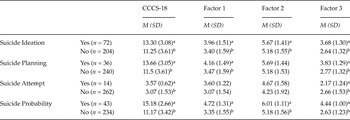
Statistically significant differences in the means between the scores in the different scales (final scales and subscales) were found for the means of the groups generated by the variables of Ideation, Planning and Probability of suicide (Table 4).
Means (and SD) for the different groups generated by the variables of Ideation, Planning and Probability of suicide. Student’s T for independent samples

Note: CCCS-18; Attitudinal Beliefs Questionnaire about Suicidal Behavior, by its Spanish acronym. a, b superscripts; Means of same cell with a different superscripts resulted in significant differences between them with at least p < .05.
Subjects who think or have thought about threatening their lives show significantly higher scores in the final scale (t (275) = 4.23, p < .001; and d = .66), in Factor 1 (t (275) = 2.4, p < .05, d = .44), in F2 (t (275) = 2.34, p < .05, d = .60) and in F3 (t (275) = 5.85, p < .001, d = .74).
Moreover, individuals who have thought about some way of carrying it out, they also show significant differences in their responses both in the final scale (t (274) = 3.45, p < .001, d = .66), in Factor 1 (t (274) = 2.47, p < .001, d = .66) and F3 (t (274) = 4.41, p < .001, d = .71). No differences were found in the case of Factor 2 (t (274) = 1.72, p > .05).
Significant differences in the total scale between those who declared having threatened their life at least once and those who did not were found (U = 2566.5, p < .05, d = .63) and also in Factor 3 (U = 2660, p < .05, d = .68). However, there was not any significant difference in the F1 (U = 2337, p > .05) and the F2 (U = 2166, p > .05).
Regarding the Probability of committing suicide, those who confirmed a higher likeability of committing suicide in the future when faced with an extreme situation showed significantly higher scores in the global scale (t (275) = 8.64, p < .001; d = .80) and in Factors 1 (t (275) = 6.1, p < .001, d = .75), F2, (t (275) = 4.2, p < .001, d = .66), and F3 (t (275) = 10.5, p < .001, d = .85).
Other significant differences were observed in the variable of Impediment to commit suicide (Table 5) between its categories in the scale (H = 19.21, p < .001, d = .76) and in the factors F1 (H = 15.69, p < .001, d = .74), F2 (H = 9.84, p < .001, d = .75) and F3 (H = 13.01, p < .001, d = .65), being those individuals who declared not having any impediment the ones with the higher scores, while those who answered having their beliefs or values as an impediment the ones with the lower scores.
Means (and SD) for the different groups generated by the variables the variable Impediment to commit the suicide

Note: CCCS-18; Attitudinal Beliefs Questionnaire about Suicidal Behavior, by its Spanish acronym.
Construction of the IRIS index. Binary logistic regression
The model allows a correct estimation (χ 2 = 57.662, p < .001) for 76.4% of the cases, being part of the equation the following predictive variables: low socioeconomic status (Wald = 7.246, p = .007), emotional instability (Wald = 6.859, p < .001), overall perceived stress (Wald = 6.005, p = .015), limited social network (Wald = 5.715, p = .019), presence of disease/s (Wald = 4.88, p = .032) and absence of religious beliefs (Wald = 9.37, p = .002). The regression equation resulted as follows:
Logit (suicidal ideation = 1) = –6.986 + 1.466 (low socioeconomic status) + 1.118 (emotional instability) + .991 (overall stress perceived) + .843 (psychiatric record in the family) + .791 (limited social network) + .764 (presence of disease/s) + .712 (absence of religious beliefs).
Table 6 shows the descriptive of the replies to the questionnaire regarding the predictive variables that were part of the equation and with which the IRIS index has been estimated.
Description of the answers given for the predictive IRIS risk index and their classification regarding its consideration of risk categories (options considered as a risk factor in the literature reviewed are listed in italics)

Evidences of criterion validity, IRIS index
The results obtained from the Pearson’s correlation analysis between the scores in every scale and subscale and the IRIS index variable show a positive and significant correlation in all the correlations for the full questionnaire (r = .26, p < .001), F1, Legimization and terminal disease (r = .163, p < .01), F2, Moral dimension (r = .22, p < .001) and F3, Suicide itself (r = .252, p < .001).
Discussion
The structure that best fits these data is the three-factor model. The original factors Legitimization of the suicide and Suicide in terminally ill patients are joined to indicate that they measure the same construct instead of two well-defined constructs, as explained by the original authors (Ruiz et al., Reference Ruiz Hernández, Navarro-Ruiz, Torrente Hernández and Rodríguez González2005). Suicide in terminally ill patients implies a right that is part of the legitimization of the suicide itself, and vice versa: this legitimization hosts a right that emerges as a consequence of the terminally ill patient’s own suffering. Therefore, it seems reasonable that the obtained solution indicates that they are, in fact, the same attribute. Even though it has the same number of factors, this internal structure differs completely from the three-factor model found in the adaptation of the CCCS-18 for the Argentinean population (Desuque et al., Reference Desuque, Vargas and Lemos2011).
This instrument presents good psychometric reliability properties, with high internal consistency rates (omega coefficient between .68 and .92). Besides, the IRIS risk index obtained by logistic regression has been a good measure for predicting the suicidal ideation since it has allowed the correctly classification of 76.3% of the cases.
The positive association between the IRIS risk index and the scores obtained from the questionnaire, despite the size effects being small, are consistent with findings such as Vilhjálmsson’s, Kristjansdottir’s, and Sveinbjarnardottir’s (Reference Vilhjálmsson, Sveinbjarnardottir and Kristjansdottir1998) on suicidal ideation in adult population. Those individuals with highly unfavorable domestic, financial or legal circumstances, experiencing physical and/or health problems and perceiving their life as stressful, are more likely to consider suicide. Accordingly with Pompili et al. (Reference Pompili, Mancinelli and Tatarelli2003), when mental illness is present or in case of having attempted to commit suicide, they might feel the stigma attached to it. This stigmatization can prevent from seeking treatment and also may lead to assume that suicide is the best solution. Their attitude towards suicide will act as a moderator variable between the predictive variables of Suicidal ideation and the Suicidal ideation itself, strengthening the said relationship. The association between the IRIS index and the CCCS-18 highlights the close link between the very suicidal ideation tendencies and the favorable attitude towards the suicide, providing predictive validity evidences.
Finally, the different means and size effects found between the generated groups from the variables of Ideation, Planning, Attempt, Probability of suicide and Impediment to commit suicide constitute another evidence of the validity properties of the CCCS-18. Attempt variable in factor 3 comparison does not show the expected result; however, as sample sizes are not equivalent, this result should be taken with caution.
In fact, limitations of the study are considered; when comparing the means for the different groups generated by the variables of Ideation, Planning, Attempt and Probability of suicide, samples are not equivalent, (72 versus 204, 36 versus 240, 14 versus 262 and 43 versus 234), for this reason the conclusions must be conservative. Furthermore, the sample used for this study includes a majority of socio-health workers that were attending an Open Workshop on Grief, which may already imply a bias and the three-factor structure can be a product of the dependence of some factor to some sub-sample. Therefore, further validation studies of the CCCS-18 must be carried out using samples with different socio-demographic characteristics. On the other hand, the analysis on temporal stability remains pending in order to verify if this structure is maintained over the time.
Evaluation and detecting self-critical behavior-oriented thoughts by the health professionals is a vital task in order to stop the suicide process progression before the planning or the attempt (Harris & Barraclough, Reference Harris and Barraclough1997). The CCCS-18, in its tridimensional version presents good psychometric properties. It constitutes a step forward in terms of parsimony and simplicity of interpretation. This instrument can be considered a valid alternative for the evaluation of these attitudes, especially favorable attitudes towards suicide in terminally ill patients, which can be legitimated as a consistent right due to patients suffering. Its use represents a useful way of preventing suicidal-related attitudes.