Introduction
Classical and molecular cytogenetics provide an integrated approach for structural, functional and evolutionary analyses of chromosomes. This ranges from karyotype analyses to molecular mapping of chromosomes.
To date, studies concerning chromatin structure and organization have been mainly focused on eukaryotes having monocentric chromosomes, whereas species possessing holocentric/holokinetic chromosomes have been rather neglected. Chromosomes with diffused centromeric activity have been found in Protista, as well as in plant and animal species (Wrensch et al., Reference Wrensch, Ketheley, Norton and Houck1994). The chromosomes of aphids, like those of other hemipteran insects, have diffuse centromeres so that kinetic activity is dispersed along the entire length of each chromatid at least in mitotic divisions, thus influencing chromosome behaviour (White, Reference White1973). In organisms possessing this kind of chromatin organization, chromosome fusions and fissions can occur without any duplication or loss of centromeres. This has consequences for the survival of the de novo chromosomal changes through mitosis and meiosis, and hence for karyotype evolution. Autosomal fusions and fissions, particularly the latter, seemed to play a pivotal role in aphid karyotype evolution (Blackman, Reference Blackman1980), although this view is at present somewhat speculative due to a lack of knowledge concerning the mechanisms involved in rearrangements of the holocentric chromosomes (Spence & Blackman, Reference Spence and Blackman2000).
A recurrent chromosomal rearrangement found in the peach-potato aphid Myzus persicae (Sulzer) (Hemiptera: Aphididae) populations collected worldwide involves a A1–3 reciprocal translocation associated with increased levels of resistance to organophosphate and carbamate insecticides (Blackman et al., Reference Blackman, Takada and Kawakami1978; Spence & Blackman, Reference Spence, Blackman, Nafría and Dixon1998).
The standard female karyotype of this species is 2n = 12, but specimens with a chromosome complement of either 2n = 13 or 14 have also been reported (Blackman, Reference Blackman1980; Lauritzen, Reference Lauritzen1982). On the basis of relative chromosome lengths, Blackman (Reference Blackman1971) concluded that the 2n = 13 karyotype raised from a break in one autosome of the pair A3, whereas a break in one chromosome of either the A2 and A3 pairs led to a 2n = 14 karyotype. Rare cases of strain possessing 2n = 11 and 3n = 18 have also been reported (Blackman, Reference Blackman1980; Yang & Zhang, Reference Yang and Zhang2000). Very recently, the analysis of mitotic metaphase chromosomes of a M. persicae laboratory strain revealed different chromosome numbers, ranging from 12 to 17, within each embryo (intraclonal genetic variation sensu Loxdale & Lushai (Reference Loxdale and Lushai2003)). Chromosome length measurements revealed that the observed chromosomal mosaicism is due to recurrent fragmentations of chromosomes X, 1 and 3 (Monti et al., Reference Monti, Mandrioli, Rivi and Manicardi2012).
The present study shows cytogenetic data regarding 66 M. persicae strains collected in different Italian regions showing several chromosomal rearrangements, the most common being the A1–3 reciprocal translocation, which we here reported for the first time in Italy. We have also looked for the presence of a relationship between karyotype variations and the host plants.
Material and methods
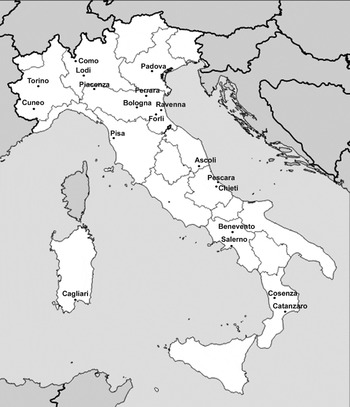
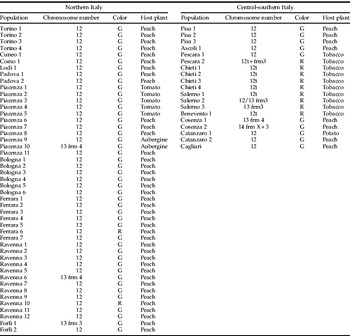
Myzus persicae populations were collected mainly from peach (Prunus persica (L.) Batsch) orchards (48), but also from herbaceous hosts like tobacco (10), tomato (5), potato (1) and aubergine (2) at various locations in different areas of Italy (see table 1, fig. 1) and maintained as parthenogenetic female colonies on pea-seedlings (Pisum sativum cv ‘Meraviglia d'Italia’) under constant environmental conditions: 21 °C, 16h light:8h dark photoperiod.
Geographic distribution of the sampling sites.

List of the Italian populations of M. persicae analyzed.

For chromosome spreads, adult females were dissected in Ringer saline solution and embryos were kept in a 1% hypotonic solution of sodium citrate for 30min. The embryos were then transferred to minitubes and centrifuged at 350g for 3min. Methanol-acetic acid 3:1 was added to the pellet, which was made to flow up and down for 1min through a needle of a 1ml hypodermic syringe to obtain disgregation of the material followed by a further centrifugation at 1000 × g for 3min. This step was repeated with fresh fixative. Finally, the pellet was resuspended in new fixative, and 20μl of cellular suspension was dropped onto clean slides and stained with 5% Giemsa solution in Soerensen buffer, pH 6.8 for 10min. Silver staining of nucleolar organizing regions (NORs) was achieved following Howell & Black (Reference Howell and Black1980). Slides were examined using a Nikon Eclipse 80i fluorescence microscope with UV filters, and photographs were taken using Nikon digital sight DS-U1. Morphometric analyses of mitotic plates were carried out on 30 metaphases using the software MicroMeasure, freely available at the Biology Department at Colorado State University website (http://rydberg.biology.colostate.edu/MicroMeasure). Male induction for Salerno 03, Pescara 02, Cosenza 02 and Pisa 01 strains was evaluated by exposing parthenogenetic female aphids to short photoperiods (8h light:16h dark) according to Crema (Reference Crema1979).
Results
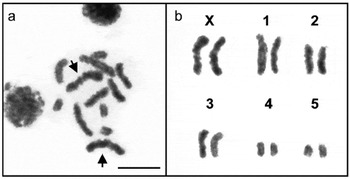
The analysis of mitotic cells of embryos, obtained from parthenogenetic females, confirmed that 2n = 12 is the standard chromosome number in M. persicae (fig. 2), but 14 out of 66 strains analysed showed intraspecific karyotype variants due to both structural and numerical variations in chromosome complements (table 1, figs 3–6).
Metaphase plate of the M. persicae strain Ferrara 03 stained with (a) Giemsa and (b) relative karyotype. Arrows indicate X chromosomes. Bar corresponds to 10μm.

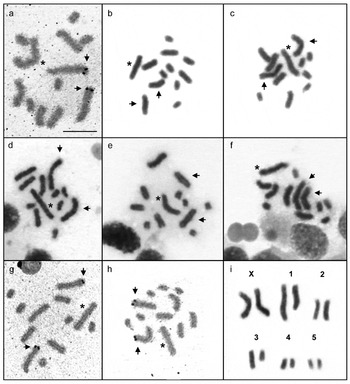
M. persicae chromosome complements showing A1–3 reciprocal translocation. (a) Benevento 01 is silver stained, (b) Salerno 01, (c) Chieti 02 and (e) Chieti 03 are stained with Giemsa, whereas (d, g) Chieti 1 and (f, h) Chieti 4 are both Giemsa and silver stained. The (i) karyotype is derived from (c) Chieti 02. Arrows indicate X chromosomes. Asterisks indicate A1–3 translocated chromosomes. Bar corresponds to 10μm.

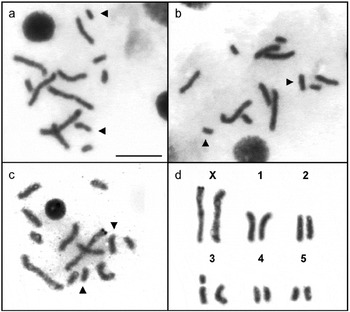
M. persicae chromosome complements showing A3 fission. (a) Forlì 01 and (b) Salerno 02 are stained with Giemsa, whereas (c) Salerno 03 and (d) its relative karyotype are silver stained. Arrow heads indicate chromosomes involved in the fission. Bar corresponds to 10μm.

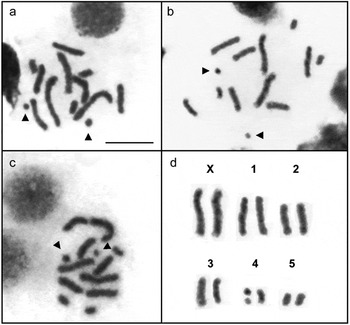
Giemsa staining of M. persicae chromosome complements showing A4 fission: (a) Cosenza 01, (b) Ravenna 06 and (c) Piacenza 10. The (d) karyotype is derived from (b) Ravenna 06. Arrow heads indicate chromosomes involved in the fission. Bar corresponds to 10μm.

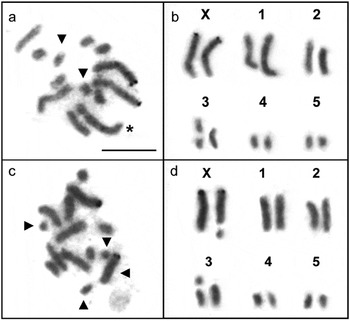
(a) Pescara 02 complement stained with AgNO3 and (b) relative karyotype. (c) Cosenza 02 complement silver stained with (d) relative karyotype. Arrow heads indicate chromosomes involved in the fissions. Asterisk indicates A1–3 translocated chromosomes. Bar corresponds to 10μm.

The most frequent chromosomal rearrangement found in Italian populations is related to the A1–3 reciprocal translocation, which was found either alone (fig. 3) or together with an A3 fission (in one strain; fig. 6a, b). Other chromosome fissions involved A3 (found in two cases; fig. 4) and A4 (found in three cases; fig. 5), whereas a strain possessing 14 chromosomes as a consequence of both X and A3 fissions was also found (fig. 6c, d). Lastly, we identified a strain showing an intra-individual chromosome mosaicism due to the presence of mitotic plates with 12 (24% of the observed plates) and 13 (76%) chromosomes as a consequence of an A3 fission (fig. 4b).
NOR staining (figs 3a, c, g, h and 6c) revealed the presence of heteromorphism in the size of rDNA genes in strains Salerno 3 (fig. 4c) and Cosenza 2 (fig. 6c) and evidenced that the fission of the X chromosomes observed in Cosenza 2 always occurred in the X chromosome bearing the smallest NOR-positive telomere and involved the X telomere opposite to the rDNA-bearing one (fig. 6c).
Considering the geographical distribution, it is evident that almost all karyotype variations (11 out of 14) were present in central and southern Italian regions, whereas only three were found in northern locations. Furthermore, all but one of the strains collected on tobacco showed chromosomal rearrangements; and, in particular, all the strains possessing the A1–3 reciprocal translocation were found on this plant and were red in colour.
Male induction revealed that the M. persicae strains Salerno 03, Pescara 02 and Cosenza 02, all possessing different kinds of karyotype variations, are anholocyclic since it was not possible to induce the sexual generation differently from that obtained under the same experimental conditions with the M. persicae strain Pisa 1, which showed a normal karyotype.
Discussion
The typical aphid karyotype consists of pairs of rod-like chromosomes, whose number is typically stable within a genus, as shown in the large genus Aphis, where the typical chromosome number is eight with the exception of A. farinosa with 2n = 6 (Blackman, Reference Blackman1980; Hales et al., Reference Hales, Tomiuk, Wohrmann and Sunnucks1997). Nevertheless, exceptions have been published as revealed in the genus Amphorophora, where the chromosome number varies from 2n = 4 to 2n = 72 (Blackman, Reference Blackman1980).
Rearrangements most commonly involved autosomes, as shown in M. persicae, where, despite a standard chromosome number of 2n = 12, several strains possessing karyotypes consisting of 11–14 chromosomes have previously been reported (Blackman, Reference Blackman1980). On the contrary, Hales (Reference Hales1989) and Monti et al. (Reference Monti, Mandrioli, Rivi and Manicardi2012) demonstrated a complex pattern of associations and fissions occurring on both autosomes and X chromosomes in Schoutedenia lutea (van der Goot) (Hemiptera: Aphididae) and M. persicae, respectively, suggesting different scenarios for understanding aphid karyotype evolution.
The most common chromosomal variant described in M. persicae complement is a reciprocal translocation between the first and the third autosome pairs, leading to females with 2n = 12 karyotype showing a marked structural heterozygosity (Blackman, Reference Blackman1980).
The empirical data, as presented in this paper, reveal for the first time that this chromosomal aberration also occurs in Italy since seven strains showed karyotype variations due to the A1–3 reciprocal translocation. In view of the absence of any primary constriction, which is typical of the holocentric chromosomes, together with the lack of specific banding patterns after conventional banding procedures, we combined procedures of standard chromosome staining (such as Giemsa and silver staining) with chromosome length evaluation. In particular, we used silver staining to confirm the exclusive localization of NORs regions on X chromosome telomeres in M. persicae and analyzed the involvement of sex chromosomes in the translocation event (Manicardi et al., Reference Manicardi, Mandrioli, Bizzaro, Bianchi, Sobti, Obe and Athwal2002). Afterwards, in the absence of any other cytogenetic markers, the morphometric analysis was employed to identify autosomes A1 and A3 as the chromosomes engaged in the rearrangement.
According to the literature, a link exists between the A1–3 chromosomal reciprocal translocation and resistance to organophosphate and carbamate insecticides due to E4 gene amplification (Blackman et al., Reference Blackman, Spence, Field and Devonshire1995), perhaps involving the removal of a repressor gene away from the structural genes in controls (Blackman et al., Reference Blackman, Takada and Kawakami1978). Preliminary data involving PCR and Southern blot analysis revealed that, in one of the Italian populations with this chromosomal aberration (Chieti 1), the FE4 gene (electrophoretically fast variant (allele) of the normal expressed carboxylesterase 4 (E4) enzyme) only was present (Rivi et al., Reference Rivi, Mazzoni, Criniti, Cassanelli, Bizzaro and Manicardi2009). This strain showed a moderate increase in esterase activity and was considered an S/R1 (susceptible/first resistance level) strain sensu Devonshire et al. (Reference Devonshire, Devine and Moores1992). The aforementioned data allows us to suggest that this is the first M. persicae strain possessing the A1–3 chromosomal reciprocal translocation linked to an FE4 and not directly related to a high level of esterase-based insecticide resistance. Experiments currently in progress are aimed to extend this experimental procedure to all Italian strains possessing A1–3 reciprocal translocations, in order to better clarify the relationships between this chromosomal rearrangement and the insecticide resistance in M. persicae populations.
Other fissions relatively frequent in the studied Italian M. persicae populations occurred at autosomes 3 and 4, whereas in one case only the fission involved the X chromosome. Different autosome fragmentations have been repeatedly described in M. persicae populations collected worldwide, whereas the X fragmentation has been observed only in a M. persicae laboratory strain characterised by an extensive chromosomal mosaicism (Monti et al., Reference Monti, Mandrioli, Rivi and Manicardi2012). In this connection, it must be emphasized that in both such cases, the X fission occurs in X chromosomes possessing a low number of rDNA genes and in the telomeric region opposite to the NORs-bearing one. The recurrent fission of the same chromosomes in the same region argues that the M. persicae genome possesses some fragile/labile sites that could be the basis for the observed changes in the chromosome number.
For many years, chromosome evolution has been generally explained by considering the random-breakage model (Becker & Lenhard, Reference Becker and Lenhard2007). On the contrary, a number of comparative cytogenetic studies evidences a relationship between chromosomal rearrangements and specific chromosomal architecture and suggests a role of the repetitive DNAs in chromosome rearrangements. The nature of the repetitive DNA within chromosomal breakpoint regions varies significantly, from clusters of rRNA and tRNA genes to simple di- and tri-nucleotide expansions (Caceres et al., Reference Caceres, Ranz, Barbadilla, Long and Ruiz1999; Carlton et al., Reference Carlton, Angiuoli, Suh, Kooij, Pertea, Silva, Ermolaeva, Allen, Selengut, Koo, Peterson, Pop, Kosack, Shumway, Bidwell, Shallom, van Aken, Riedmuller, Feldblyum, Cho, Quackenbush, Sedegah, Shoaibi, Cummings, Florens, Yates, Raine, Sinden, Harris, Cunningham, Preiser, Bergman, Vaidya, van Lin, Janse, Waters, Smith, White, Salzberg, Venter, Fraser, Hoffman, Gardner and Carucci2002; Coghlan & Wolfe, Reference Coghlan and Wolfe2002; Kellis et al., Reference Kellis, Patterson, Endrizzi, Birren and Lander2003; Renciuk et al., Reference Renciuk, Kypr and Vorlickova2011). The data reported in this paper confirmed recent observations regarding the recurrent fission of the same chromosomes in the same region (Monti et al., Reference Monti, Mandrioli, Rivi and Manicardi2012), allowing us to further support the hypothesis concerning the presence of fragile/labile sites in the M. persicae holocentric chromosomes.
Chromosomal rearrangements in aphids have been hypothesized to affect some complex phenotypic traits, such as the host plant choice (Blackman, Reference Blackman1987; ffrench-Constant et al., Reference ffrench-Constant, Byrne, Stribley and Devonshire1988). For example, karyotypic variants observed in the corn leaf aphid Rhopalosiphum maidis (Fitch) have been associated with changes in the host choice. Similarly, an association of chromosome number with host plant has been described within the Sitobion genus, which shows 2n = 12 on ferns and 2n = 18 on grasses (Brown & Blackman, Reference Brown and Blackman1988; Hales et al., Reference Hales, Tomiuk, Wohrmann and Sunnucks1997).
A peculiar example of host adaptation concerns M. persicae strains feeding on tobacco. Morphometric analyses of specific taxonomic markers revealed that they are distinguishable from those living on other host plant so that the tobacco-feeding form was elevated to the status of a separate species by Blackman (Reference Blackman1987). Further molecular evidences failed to confirm the genetic isolation of the population living on tobacco (Field et al., Reference Field, Javed, Stribley and Devonshire1994; Clements et al., Reference Clements, Sorenson, Wiegmann, Neese and Roe2000), although other data, as well as behavioural/pheromonal evidence, suggest that the two forms undergone some significant degree of ecological-evolutionary divergence (Kephalogianni et al., Reference Kephalogianni, Tsitsipis and Margaritopoulos2002; Margaritopolous et al., Reference Margaritopoulos, Blackman and Tsitsipis2003; Blackman et al., Reference Blackman, Malarky and Margaritopoulos2007).
Our data put in evidence that all but one of the strains collected on tobacco plants showed karyotype variations, whereas only four of the 56 population collected on other hosts (corresponding to about 7% of the total) displayed chromosomal rearrangements. A suggestive explanation for the observed relationships between chromosomal rearrangements and tobacco plants could rely in the clastogenic effect of nicotine.
Nicotine is a naturally occurring alkaloid found primarily in members of the solanaceous plant family, including Nicotiana tabacum. Several reports showed that nicotine, as a consequence of DNA replication fork stress (Richards, Reference Richards2001; Freudenreich, Reference Freudenreich2005), produces genotoxic effects on Chinese hamster ovarian (CHO) cells (Trivedi et al., Reference Trivedi, Dave and Adhvaryu1990, 1993) and sister chromatid exchanges and chromosome aberrations in bone marrow cells of mice (Sen et al., Reference Sen, Sharma and Talukder1991). Extensive chromosomal rearrangements have also been described in a mice population known as ‘tobacco mice’ since they live close to kiln for drying tobacco (Fraguedakis-Tsolis et al., Reference Fraguedakis-Tsolis, Hauffe and Searle1997). In addition, DNA fragmentation by nicotine has been demonstrated both in peripheral lymphocytes (Sassen et al., Reference Sassen, Richter, Semmler, Harreus, Gamarra and Kleinsasser2005) and in human spermatozoa (Arabi, Reference Arabi2004). Nicotine, together with ultraviolet exposure, has also been considered an exogenous factor which can contribute to the generation of mutations which could be at the basis of chromosomal mosaicism (De, Reference De2011), a very rare phenomenon we have observed in Salerno 02, one of the strains collected on tobacco plants.
Even if there are no literature data analyzing nicotine effects on organisms possessing holocentric chromosomes, the previously reported data allow us to propose at least that chromosome architecture, rather than random breakages, has a pivotal role in aphid chromosome evolution and rearrangements.
The high telomerase expression, previously reported in M. persicae (Monti et al., Reference Monti, Giusti, Bizzaro, Manicardi and Mandrioli2011), that stabilized chromosomes involved in fragmentations, coupled to reproduction by obligate apomictic parthenogenesis, could be at the basis of the stabilization of the observed chromosome instability on M. persicae strains collected on tobacco plants favouring the inheritance of the variant karyotypes.