In Manila on November 26, 1904, a British couple listed under the name of Mr. Campbell Dauncey disembarked from the steamship Zafiro after a two-day journey from Hong Kong.Footnote 1 Over the next nine months, Dauncey worked alongside British merchants in the central Philippine sugar port of Iloilo while his wife jotted down her daily observations. One of the things that fascinated Mrs. Campbell Dauncey, as she identified herself in her diary, was the pervasive repetition of a recent American two-step called “Hiawatha.” She noted how the catchy ragtime composition became an inescapable part of her life in the Philippines: a Filipino pianist played it in a movie theater, fishermen whistled the tune as they worked, and on Palm Sunday, she observed a religious procession “headed by a banda de musica playing ‘Hiawatha.’”Footnote 2
Mrs. Dauncey's encounters with “Hiawatha” in the Philippines occurred during a period when the song was captivating audiences across the globe. Between the summer of 1903 and early 1905, “Hiawatha” traveled rapidly throughout much of the colonized world via the routes of the imperial steamship trade and the global expansion of US and European commercial music industries. Over the course of roughly eighteen months, “Hiawatha” completed what one of the song's main promoters, the bandleader John Philip Sousa, accomplished several years later with his 1911 around-the-world excursion. Thanks to a combination of sheet music, recordings, and both amateur and professional musicians, “Hiawatha” carried out “a circuit tour of the globe.”Footnote 3 During this tour, the two-step sped from city to city through the generative force of countless performances.
But rather than strengthening a kind of singular, stable meaning, the song's innumerable repetitions also acquired a new array of resonances as it came to take on life in diverse settings. Dauncey's writings hint at the polysemic potential “Hiawatha” generated through its circulation, an accumulation of meanings that could exceed interpretations confining the song to a narrow symbol of US colonial ambition. As it circulated throughout much of the world via the expansion of the commercial music industry and the infrastructures of colonialism, “Hiawatha” simultaneously became a kind of colonizing force and also a tune that had the potential to sound out other sentiments. By pointing out the interplay between the role of “Hiawatha” as both a colonizing force and a polysemic medium, I am not simply claiming that Hiawatha took on new meanings as it circulated or that it was remade by audiences across the colonial world. Rather, I am suggesting that these new meanings accrued precisely because of its repetitious circulation. The very qualities that led to its dominance—particularly its inescapable presence as an audible agent of the political and economic dimensions of empire—also resulted in a proliferation of meanings that could run counter to its dominating form. This contradictory nature that marked the spread of “Hiawatha” throughout much of the colonial world is a central characteristic of what I will be calling “imperial pop.”
By exploring how the circulation of “Hiawatha” reveals a contradictory impulse in the global spread of US popular song, I seek to bring together some prominent themes from cultural studies and scholarship on empire. In some sense, this article builds from the foundational work of Stuart Hall, who explored “the double-stake in popular culture, the double movement of containment and resistance.”Footnote 4 Hall's interest in what he calls the “deeply contradictory” nature of popular culture is not quite the same as recognizing the inherent polysemy of musical performance, the ways in which music can mean in multiple and even incompatible ways.Footnote 5 Instead, Hall describes popular culture as a “battlefield,” a result of the tension between the culture industries and consumers who can remake popular culture in unexpected ways.Footnote 6
Hall's vision of the struggle inherent in popular culture is especially useful for considering a related tension in both imperial pop and colonial conquest. The foundational work of scholars such as Amy Kaplan and Ann Stoler, which has inspired a multi- and inter-disciplinary imperial turn since the early 2000s, recognizes the very real violence of colonial endeavors but also explores the incomplete and anxious qualities of imperialism.Footnote 7 Similar to how Hall views popular culture as a terrain for struggle, Kaplan argues for “thinking about imperialism as a network of power relations that changes over space and time and is riddled with instability, ambiguity, and disorder, rather than as a monolithic system of domination.”Footnote 8 Furthermore, recent studies of the unstable process of imperialism have shown popular culture to be a medium for this process by casting empire, as Partha Chatterjee argues, as “something that had to be practiced, as a normal everyday business.”Footnote 9 In other words, scholars have increasingly argued that examining everything from intimate acts to seemingly mundane pop songs is critical for understanding the contradictory nature of the imperial project.Footnote 10 “Hiawatha” offers a case study to explore how Hall's idea of the double-stake of popular culture is also central to what Ann Stoler and Frederick Cooper call the “tensions of empire.”Footnote 11 In particular, the circulation of Daniels's two-step demonstrates the critical role of imperial pop in contributing to the ongoing struggle that marked the colonizing process.
I explore the ways in which the circulations of “Hiawatha” reveal the contradictory double-stake of imperial pop in two broad sections. First, I argue that the song exhibited imperial tendencies: it saturated soundscapes throughout much of the world and, as part of an emerging form of new musical commodities, coaxed listeners into recognizing their shifting status from auditors to consumers. I begin making this argument by briefly tracing the rapid movement of “Hiawatha” through much of the colonized world and presenting the song's widespread circulation as a generative force. I show how the travels of “Hiawatha” inspired listeners to imagine the song through an exaggerated discourse that represents the encroachment of a commercial music industry whose global expansion along imperial trade routes transformed listening and consumption practices around much of the world. In addition, I show how “Hiawatha” was not only a colonizing force but also a medium that sounded out the imperial process itself. To many, the song's associations with Native Americans inspired what Renato Rosaldo calls “imperialist nostalgia,” a sense based on an evolutionary anthropological racial science that also informed imperial ambitions across the colonized world.Footnote 12
The very qualities that made “Hiawatha” a colonizing song, however, also increased the complexity of its meaning as it circuited the globe. In the second section of this article, I offer interpretations of two moments when Mrs. Dauncey's musings about “Hiawatha” reveal how the song's repeated performances gave rise to new possibilities that could run counter to its colonizing force. My interpretation of Dauncey is necessarily speculative; she does not theorize about “imperial pop” nor does she dwell on the significance of hearing “Hiawatha” in so many varied places. Yet, given the difficulty of locating historical voices that offer different views on Daniels's song, her writings can still reveal both the mundane and the unexpected ways that “Hiawatha” could accumulate unanticipated meanings that might not align with the logic of colonial rule. Dauncey's diary offers a view into the workings of “imperial pop,” the ways in which songs such as “Hiawatha” acted as ambiguous agents of empire, as mediums of both conquest and disruptive possibility.
“Hiawatha's” Circuit Tour of the Globe
Before it spread rapidly throughout much of the colonial world, “Hiawatha” was simply a song waiting for a spark of luck that would make it a hit. The aspiring young St. Louis songwriter and publisher Charles N. Daniels wrote the two-step in 1901 under the pseudonym Neil Moret but was frustrated by its slow initial success. To spur sales, Daniels approached John Philip Sousa as the bandleader had already helped promote Daniels's previous hit: the 1898 song “Margery.” Sousa agreed to place “Hiawatha” in his regular programs and the song quickly began to catch the attention of not only the public but also the Detroit publishing company Whitney Warner.Footnote 13 At the end of November 1902, with “Hiawatha” gaining popularity across the United States, Whitney Warner offered Daniels a position in their firm and paid $10,000 for the rights to his composition, reportedly the most ever paid for a song at the time. Whitney Warner was keen on this transaction because they saw an economic opportunity in purchasing the ragtime instrumental that Daniels claimed was inspired by a train ride through the town of Hiawatha, Kansas. The firm hired James O'Dea to write Indian-themed lyrics to the melody of “Hiawatha” and began an extensive campaign promoting the song.Footnote 14
Thanks to its promotion by Whitney Warner and Sousa, “Hiawatha” became practically inescapable across the United States during the summer of 1903. From New York City to Los Angeles, brass bands played the two-step in public concerts and high school graduations, buskers played it in the streets, and player-piano salesmen demonstrated it to sell their wares.Footnote 15 From April until August 1903, “Hiawatha” was one of the two most popular songs in the United States, and it remained prominent through December.Footnote 16 Record companies seeking to cash in on the popularity of “Hiawatha” also contributed to its ubiquity: over the course of 1903, at least seven different groups recorded the song for Victor, including Sousa himself.Footnote 17
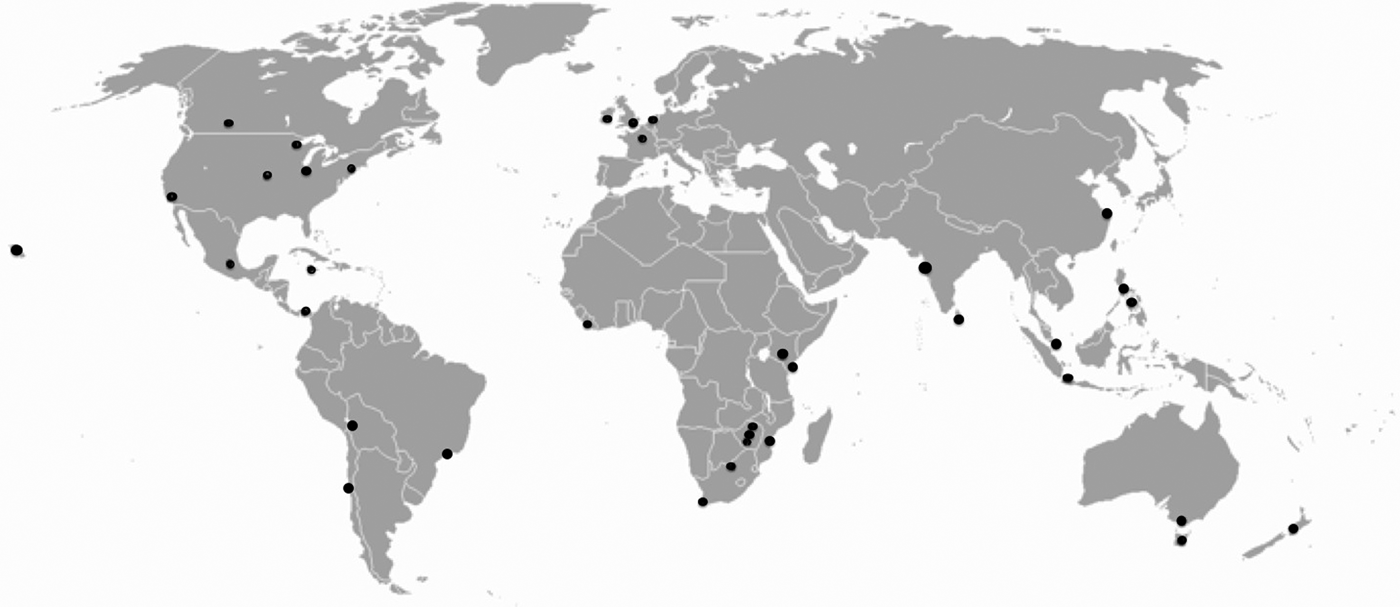
The circulation of “Hiawatha” was not confined to the contiguous United States. Reports from colonial newspapers and travelogues reveal that the dynamic rhythms of Daniels's composition radiated outwards in all directions. As “Hiawatha” sailed towards the Philippines by way of performers, sheet music, and recordings, it first stopped in the US territory of Hawaii, where brass bands in Honolulu incorporated the song into their repertoire by April 1903.Footnote 18 Pacific steamships also carried Daniels's two-step further south across Australia and New Zealand.Footnote 19 By 1904, “Hiawatha” had also traveled southward through Central America to the Caribbean and South America. Bands performed the song in locales such as Mexico City, Panama City, Havana, Black River (Jamaica), Rio de Janeiro, La Paz (Bolivia) and Valparaiso (Chile).Footnote 20 During the height of its popularity in the United States, Canadians from Ottawa to Vancouver were also entranced by Daniels's composition.Footnote 21
In the manner of most American popular songs in the early 1900s, transatlantic steamships also carried “Hiawatha” eastward. In early 1904, the New York Times warned Americans who “fled” to London “to get away from the thing [‘Hiawatha’]” would be sorely disappointed: “The bands play it, the boys whistle it, the hand organs grind it out, and the hawkers of pirated music sell it on the street.”Footnote 22 By the summer of 1904, “Hiawatha” also made its way into Ireland and across the English Channel, where it was a favorite of Dutch bands and enjoyed popularity in cities such as Paris, Hamburg, and Bolzano.Footnote 23 According to one London report during these months, “‘Hiawatha’ has penetrated to every corner of the Continent.”Footnote 24
Listeners in London assumed that “Hiawatha” would continue to circulate throughout the British Empire and beyond. As one writer mused in February 1904, “by now, doubtless, that bewitching, tantalizing tune ‘Hiawatha’ will have found its way out to the Straits.”Footnote 25 Indeed, just as steamships bore “Hiawatha” across the Atlantic Ocean, they also spread the song around the globe via trade routes connecting Europe to ports in colonized parts of Asia and the Pacific. By early 1904, “Hiawatha” had slipped through the Suez Canal to Bombay and Ceylon and then raced onwards to Singapore, Batavia, and Shanghai.Footnote 26 The global journey of “Hiawatha” global journey also reached parts of Africa. “Well-to-do natives” played it on record in Monrovia, Liberia, while European colonists and touring British performers helped spread Daniels's two-step across southern and eastern Africa, from South Africa through Southern Rhodesia to the eastern port cities of Beira, Mombasa, and Nairobi.Footnote 27
Performances of “Hiawatha” between 1903 and 1905 cited in this article. 1912 world map template from Wikipedia Commons.

Less than two years after Sousa began promoting Daniels's two-step, “Hiawatha” had completed a circuit tour of the globe. The song had by no means infiltrated the soundscape of every inhabited place on earth, but it had raced through what Michael Denning describes as an “archipelago of colonial ports,” as well as numerous inland cities that served as nodes in a vast web of colonial exchange.Footnote 28 Denning's turn of phrase here is particularly useful because it frames the movements of “Hiawatha” in terms of circuits of travel that, as Lara Putnam shows, can serve as alternatives to stories based on “national or imperial boundaries.”Footnote 29 Recognizing how Daniels's composition spread within an archipelago that was both connected by and extended beyond colonial borders is critical for understanding “Hiawatha” as an imperial song in the broadest sense of the word. Its movements were aligned with what David Harvey—drawing on Giovanni Arrighi—identifies as the twin logics of empire: territorial domination and capitalist expansion.Footnote 30 In other words, the global dissemination of “Hiawatha” was informed both by political geography and by the uneven currents of global capitalism. The route of “Hiawatha” frequently followed the contours of European and US empire, but it also moved along the networks formed by transnational businesses whose pursuit of profit commonly crossed political borders.
The global tour of “Hiawatha” was not simply the end result of imperial processes, however. Rather, it was the circulation and endless repetition of “Hiawatha” that transformed the song into imperial pop. By emphasizing the significance of the movement of “Hiawatha” here I draw on Benjamin Lee and Edward LiPuma's critical re-imagining of circulation “as more than simply the movement of people, ideas, and commodities from one culture to another.”Footnote 31 Instead, they argue, circulation must be viewed as a realm where meaning is made or, as Dilip Gaonkar and Elizabeth Povinelli put it, as a “generative matrix.”Footnote 32 In music studies, David Novak has built from Lee and LiPuma to show how processes of circulation and repetition can generate new meanings, ideas, and sounds as “people discover other meanings in culture as it unravels, disconnects, and folds in on itself.”Footnote 33 The doubleness of “Hiawatha” as a form of imperial pop depends upon this generative force of the song's circulation. The movements of “Hiawatha” across the colonial world caused it to accumulate an array of multiple meanings, becoming simultaneously a dominating imperial force and also a medium to express the ambiguities of empire.
“It Maddens, But Allures”
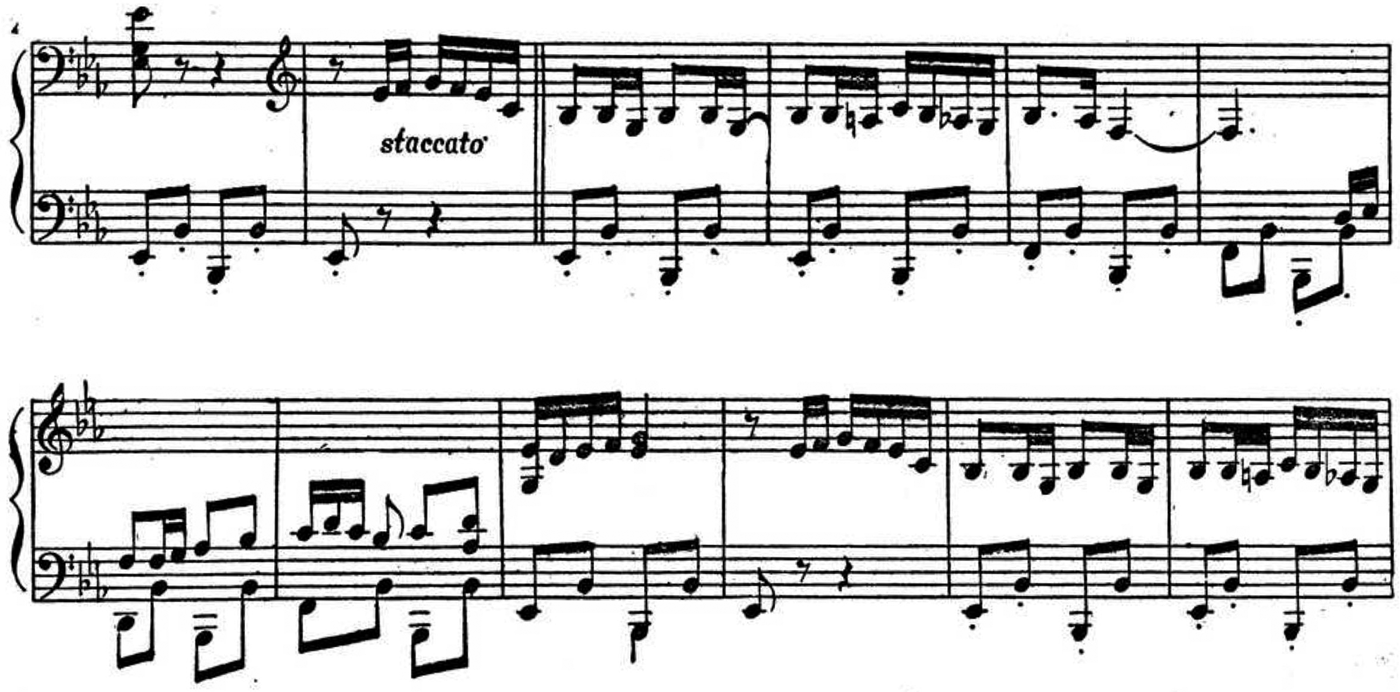
The travels and wide popularity of “Hiawatha” were likely due not only to extensive advertising but also to the song's rather formulaic construction. Despite the song's evocative title, “Hiawatha” was a typical ragtime two-step. It bore little resemblance to the ethnographically inspired “Indianist” art music composers of the period and was devoid of the stereotypical popular musical markers that signified what Philip Deloria has called “the sound of Indian.”Footnote 34 The absence of these sounds should be of no surprise because Daniels insisted that his song was inspired by Hiawatha, Kansas, not Longfellow's poem. Instead, “Hiawatha” featured many conventional Tin Pan Alley musical characteristics, especially the sort of internal repetition that seemed intended to help the song lodge in a listener's ears.Footnote 35 For example, Daniels's two-step is constructed out of a series of two eight-measure phrases in an AAAABBAA form. Example 1 below shows how the first A theme is immediately repeated. In Sousa's recording of the song, “Hiawatha's” main “A” melodic phrase is repeated six times in barely over a minute. Furthermore, this phrase reinforces the sense of repetition with a descending and ascending melody that forms a loop leading right back to its own beginning, a kind of ragtime ouroboros (see Example 1). The amount of repetition within Daniels's two-step was by no means atypical, but it likely contributed to the song's success.
Measures 11–22 of “Hiawatha,” showing the first iteration of the “A” theme after the introduction (mm. 12–19) and the first three measures of the “A” theme's first repetition (mm. 20–22). Neil Moret [Charles Daniels], “Hiawatha: A Summer Idyll” (Detroit: Whitney Warner, 1902).

Yet although Daniels's composition may have sounded unremarkable, it inspired unusually strong reactions, many of which focused on the song's continual reiterations. During one of her trips across the Iloilo harbor, for example, Mrs. Dauncey writes about how the ship's Filipino string band “struck up ‘Hiawatha.’” After one time through the song, the band “began again, and again, and again— and I have no doubt they would have played that air contentedly the whole way out and back, and probably fully intended to do so, if they had not been implored to stop.”Footnote 36 In Dauncey's account, Daniels's song seemed to inspire two conflicting reactions: on the one hand, the musicians clearly enjoyed repeating the melody while, on the other, the restatement of the “Hiawatha” theme led a listener to plead for a change of tune. The pairing of these two responses— of the desire for repetition and the need for this repetition to cease—is a critical element in the circulation of “Hiawatha.” An anonymous British composer came to a similar conclusion when he offered his opinion about the popularity of “Hiawatha.” The song, he decided, “maddens, but allures.”Footnote 37 This was precisely the paradox of “Hiawatha” and imperial pop in general: the song's circulation grew from a repetition that simultaneously infuriated and attracted listeners.Footnote 38
The tension between the maddening and alluring qualities of “Hiawatha” inspired hyperbolic stories about the song's repetitions. In January 1904, for example, an English-language newspaper in Singapore published a story about a group of young men in Virginia who formed an “Anti-‘Hiawatha’ Club.”Footnote 39 Later that summer, the same paper described a Philadelphia man who “was so sickened with the constant repetition [of ‘Hiawatha’]” that he attempted to burn down a record pressing plant in order to prevent further manufacturing of “Hiawatha” records.Footnote 40 The allegedly extreme reactions to the over-saturation of “Hiawatha” also inspired comic accounts, such as the following piece from the New York Times, printed during the song's popular reign:
Judge: You say you got that black eye as the result of a blow by the defendant?
Prosecuting Witness: Yes, Sir.
Judge: Tell me the circumstances under which he struck you.
Prosecuting Witness: This man met me as I was coming along Calvert Street whistling “Hiawatha,” and—
Judge: That'll do. The prisoner is dismissed.Footnote 41
Daniels's two-step, these stories suggest, was so attractive that certain listeners wanted to hear the song again and again. At the same time, though, others were reportedly driven to violence to escape Daniels's melody. To be clear, “Hiawatha” was not unique in inspiring these sorts of stories but they added to the song's mystique.Footnote 42
The accounts of the repetitions of “Hiawatha” that preceded, followed, and circulated alongside the travels of the song itself contributed to its power as a dominating force. During the song's rise in popularity stories from Europe and the United States appeared in newspapers in cities such as Singapore and Batavia to alert readers about the “bewitching, tantalizing tune” that had led listeners to react in comically exaggerated ways.Footnote 43 Newspapers in Tasmania, for example, reprinted articles depicting the song as a “pest” that had “over-run” the United Kingdom.Footnote 44 These stories of the song's irresistible popularity were a critical part of its maddening allure. They helped form a feedback loop of discourse and sound—what Matt Sakakeeny calls a “circulatory system”—that played a critical part in the notorious repetitions of “Hiawatha”.Footnote 45
The provocative reputation of “Hiawatha” was not simply a symptom of the song's success, however. Rather, it was a critical factor in the song's meteoric rise. When Daniels approached Sousa to promote his song, he was embracing a strategy employed by music publishers across the United States who believed that a song's sales depended in part upon it appearing in as many places as possible. In 1906, the same year that Dauncey published her Philippine diary, the American songwriter Charles Harris advised aspiring composers that performing a new song everywhere was critical for its financial success: “if the piece has merit and you contrive to have it sung and played at every conceivable opportunity, it will spread rapidly, news of it will be carried to other towns and cities, some one [sic] will sing it there … and a sort of endless chain is set in motion.”Footnote 46 As David Suisman argues, Harris's strategy of ceaseless performances became the “fundamental law that guided the industry's development.”Footnote 47 The inescapable repetitions of “Hiawatha” represented not an anomalous phenomenon but rather the fulfillment of an innovative marketing strategy developed by Harris and other US music publishing firms. The Filipino musicians Dauncey heard performing the tune in the Philippines had effectively become part of the same “endless chain” that Sousa had helped “set in motion” in the summer of 1903.
The countless stories of the contentious reception of “Hiawatha” also reveal a dramatic shift taking place in the popular music industry. The new strategies American music publishing companies pioneered to systematically saturate public spaces with new songs were hugely controversial. Although these companies made the “mass exposure and repetition” of popular music seem “commonplace,” as Suisman argues, their strategy for reaching the ears of the public was “actually radical and extraordinary.”Footnote 48 Their efforts contributed to reshaping the aural environment into what Suisman calls “a field of marketing” that informed new practices of listening.Footnote 49 In effect, publishers sought to transform listening audiences into consumers of popular music by inundating them with an endless barrage of advertisements—the songs themselves.Footnote 50 Although listeners had varied reactions to this sonic onslaught, publishers hoped that the endless repetition of hit songs would, as Theodor Adorno later bemoaned, lead “the listener to become enraptured with the inescapable.”Footnote 51 As one of the new commodities of the popular music industry, “Hiawatha” was strategically deployed to capture new listeners and extract financial gain from untapped markets, a process that required listeners to undergo an uneasy transformation.
The domestic strategies of Tin Pan Alley publishers dovetailed neatly into larger efforts to reshape markets around the globe to be amenable to US and European commercial interests. There is a striking similarity between the aspirations of music publishers trying to create new consumers and the goals of American and European business leaders who, as Matthew Fry Jacobson argues, backed imperial actions in the hopes that “foreign peoples would keep the American economy afloat as both auxiliary consumers in a vast, worldwide export market, and as auxiliary workers in an ever-expanding domestic labor market.”Footnote 52 Supporters of imperialism in both the United States and Europe anticipated that the imperial spread of their products would bring untold numbers into new practices of consumption and boost their own profits. And although US music publishers at the turn of the twentieth century may not have taken explicit steps to invest in global markets, their products were also circulating throughout much of the colonial world.
“Hiawatha” was one of many songs that contributed to the clamor of colonialism and the spread of western tonality and practices of European-style music-making through the threat—or realization—of violence.Footnote 53 But “Hiawatha” can also be heard as a colonizing force by bringing a new class of listening consumers into relation with an emerging popular music industry. “Hiawatha” further contributed to the spread of Tin Pan Alley's aural marketing and to the goal of transforming new audiences into eager consumers of the latest products from the United States.
The Imperial Nostalgia of “Hiawatha”
“Hiawatha” exhibited imperial tendencies even beyond its wide presence and repetitive insistence. Although other songs traveled rapidly and extensively, “Hiawatha” differed from many Tin Pan Alley hits because listeners likely also associated the two-step with the imperial process itself, specifically the US government's violent actions against Native Americans.Footnote 54 It might seem logical to assume that this association came from James O'Dea's 1903 lyrics to “Hiawatha.” O'Dea recast the song as a trite marriage plea from Hiawatha to his “Indian bride” Minnehaha, set in a “little birch canoe” on a stream in a “forest glade.”Footnote 55 These lyrics perpetuated an image of the Noble Savage who existed outside of modernity and ultimately vanished in the face of US “civilization.” I do not, however, want to place too much weight on O'Dea's lyrics, for “Hiawatha” primarily seems to have circulated as an instrumental. In the Philippines, for example, Dauncey describes Filipinos performing the song in brass bands, on piano and “penny flute,” or by “whistling,” never by singing.Footnote 56 Even though a “song” version of “Hiawatha” existed on sheet music and on record, it seems that the two-step was far more likely to be heard as an instrumental work.Footnote 57
Even without the addition of lyrics, though, the song's title alone would have been enough to inspire some listeners to imagine Indian themes. The name “Hiawatha” resonated widely in the decades before Daniels's song through the influence of Henry Wadsworth Longfellow's popular 1855 poem “The Song of Hiawatha.” This epic underwent a revival around 1900 and inspired countless musical compositions and theatrical events on both sides of the Atlantic.Footnote 58 Americans and Europeans helped disseminate Longfellow's poem as they traveled abroad. In the years preceding the publication of Daniels's two-step, the character of “Hiawatha” was referenced regularly in newspapers from Mexico and Brazil to Australia, Singapore, and the Dutch East Indies.Footnote 59 The revival of Longfellow's poem also intersected with a broad array of media and popular entertainment venues—such as “Buffalo Bill” Cody's Wild West Shows—that represented Native Americans as “noble savages.”Footnote 60 These images of Native Americans filtered beyond European audiences in varied ways, including to Asian and African elites studying in Europe. To be clear, “Hiawatha” and the image of the Noble Savage were by no means universally known. But the name “Hiawatha” clearly traveled widely, even appearing as the name of a horse belonging to a Chinese racehorse owner in Shanghai the year before Daniels's song reached the city.Footnote 61
Given the wide recognition of the name “Hiawatha,” it appears that the title of Daniels's two-step informed how some listeners interpreted the song. In August 1904, for example, a London composer offered an analysis of “Hiawatha” concluding that the song “weeps for the poor Indian, and afflicts the whole white race.”Footnote 62 His musical analysis is suspect but it is striking that he heard the melody of “Hiawatha” as a reference to Native Americans, especially because the song lacked any stereotypical musical markers of Indian-ness. What is more, the composer did not seem to associate “Hiawatha” with anything African-American, despite the song's ragtime-like qualities. It would not be far-fetched to imagine that other listeners might also be drawn in by the song's title instead of syncopated rhythms that, in the United States, would typically be heard as signifying black musical qualities. For even though ragtime compositions and blackface minstrelsy were circulating widely by the late nineteenth century, local associations between race and musical elements were far from universal, especially as performers and songs moved through different colonial regimes.Footnote 63
Recognizing the resonance of the title “Hiawatha” is important because Daniels's song appeared during a moment in which the popularity of an Indian theme was directly linked with what Renato Rosaldo has called “imperialist nostalgia.”Footnote 64 Rosaldo argues that this concept “revolves around a paradox: a person kills somebody and then mourns his or her victim.”Footnote 65 Recasting the violence of imperialism as a kind of peaceful yearning is central to the significance of “Hiawatha,” both as a popular song and as a poem. In Longfellow's epic, Hiawatha is a tragic “Indian brave” who commits symbolic suicide by departing at the end of the poem, a literary transformation of the decades of violent “Indian removal” in the United States.Footnote 66 Hiawatha's departure was critical for the popularity of the poem since, as Philip Deloria argues, the power and appeal of Indian-ness in the popular imagination “necessarily went hand in hand with the dispossession and conquest of actual Indian people.”Footnote 67
The popularity of Longfellow's poem and Daniels's two-step must be situated in relation to a growing sense of imperialist nostalgia about the conquest of Native Americans. As various scholars argue, the dozens of nostalgic “Indian Intermezzos” that followed Daniels's two-step, as well as the “Indianist” art music movement, cannot be separated from the contemporary belief that Native Americans were a dying race.Footnote 68 This belief was bolstered by continued efforts of the US federal government not only to take over Indian lands but also to silence Native American cultural practices, including musical performance.Footnote 69 Indian Intermezzos such as “Hiawatha” became attempts to assuage what William J. Schafer and Johannes Riedel describe as the “public guilt” about the violence of US imperial expansion within North America.Footnote 70
It is deeply ironic, then, that the Filipino musicians Dauncey encountered were performing a song that might have inspired “imperialist nostalgia” among white American and British listeners. Prevailing theories of racial science at the time posited that Filipinos and Native Americans shared a common bond, a bond strengthened in the crucible of US imperialism. According to this line of thinking, different races represented distinct stages in the history of human evolution, with white Europeans and Americans claiming the spot as most evolved and groups such as Native Americans and Filipinos stuck in an earlier stage of development.Footnote 71 Social scientists such as Frances Densmore applied the language of racial science to make comparisons between Native Americans and Filipinos, but even non-academics, such as American tourists in the Philippines, imagined similarities between the two groups.Footnote 72 The supposed links between Filipinos and Native Americans was further exploited during the American conquest of the Philippines. Filipinos faced US soldiers and bureaucrats who initially attempted to export strategies they used against Native Americans to the Philippines.Footnote 73 They also struggled against a white supremacist racial hierarchy that sought to justify American violence against brown-skinned people—at home and abroad—as benevolent actions. In other words, the feelings of imperialist nostalgia that “Hiawatha” may have inspired among some listeners cannot be separated from the racial logic that inspired the colonization of the Philippines. Thus, “Hiawatha” acted as a colonizing force both by saturating soundscapes in the colonial world “Hiawatha” and also by perpetuating a nostalgic myth about the benevolence of imperial conquest.
Dispersion and Accumulation
As a form of “imperial pop,” however, “Hiawatha” was not solely a dominating force of empire. Rather, the repetition and ubiquity of Daniels's song also contributed to its accumulation of a multiplicity of meanings that overwhelmed the apparent coherence of its musical circuit tour. Similar to how colonized people subverted aspects of imperial conquest to form unexpected alliances, the circulation of “Hiawatha” also allowed for the song to resonate in ways that did not always align with its seemingly dominating force.Footnote 74 By calling attention here to the accumulation of meanings by “Hiawatha,” however, I do not simply mean to reinforce what Gavin Steingo describes as the “truism of ethnomusicological discourse”: the notion that “the global is continually appropriated (or ‘translated’) for local use.”Footnote 75 My intent is not to repeat the long-acknowledged claim that popular songs can “mean many things to a great many people,” or that “mundane objects … [can] take on a symbolic dimension.”Footnote 76 Instead, just as Steingo complicates the celebration of local translation as a way in which “cultural imperialism is thwarted,” I contend that the dense polysemy of “Hiawatha” is a necessary quality of its nature as a colonial force, a quality that reveals the anarchic and contradictory qualities of imperial pop.Footnote 77 Uncovering the many meanings of Daniels's composition is a challenge, however, especially the meanings imagined by colonized people who did not publish accounts of their thoughts. Moreover, even among American and European diaries and travelogues from the early twentieth century, it is rare to find one with an extended discussion of this particular song. As a result, Mrs. Campbell Dauncey's diary serves as a critical source to speculate about the two-step's accumulation of meanings. Although her observations do not include explicit examples of “Hiawatha” exceeding the narrow sentiments of US imperialism, she does include moments where we can begin to hear the song taking on a new life.
One of these moments occurs when “Hiawatha” spurs a dramatic transformation among a group of Filipino musicians. In her diary, Dauncey describes the 1905 Fourth of July Ball at Iloilo's Spanish Club. The ball included American, European, and Filipino patrons who danced to the music of the Iloilo Philippine Constabulary Band, a group affiliated with the military force tasked with driving out remaining anti-American resistance.Footnote 78 After watching the dancers in the main hall, Dauncey focused her attention on the ensemble, then playing a stately Spanish rigodón. From the balcony, she observed that many of the band's twenty-five members
sat and blew… wherever they pleased, most of them festooned gracefully about the steps of the stand; some lying almost full length on one elbow; and some huddled up with their chins on their knees, looking exactly like performing monkeys. One man with strips of black sticking-plaster on his flat, brown face, lay on the steps of the stand, gazing at the ceiling, and playing his cornet in one hand. … They seemed to be playing instinctively while thinking of other things. One small boy on the bench by us was fast asleep, with his fingers still moving up and down on the stops.Footnote 79
On one level, Dauncey is merely describing band members exhausted after parading in the hot sun. However, by translating Dauncey's observations “into an anthropological code,” as Bennett Zon has done with representations of music in travelogues, Dauncey's writing reveals how her views on race and empire inform her accounts of “Hiawatha” in the Philippines.Footnote 80 Even in descriptive passages of the most mundane events, Dauncey regularly describes Filipinos in terms of racial evolution, dismissing them as an “inferior race” and “ignorant half-breeds.”Footnote 81 Her discussion of Filipino musicality is similarly informed by her thinking on race. For example, only a month after her arrival, Dauncey concluded that “the Filipinos have a natural gift for music,” a trope that is ubiquitous among European and American visitors to the Philippines.Footnote 82 Although many Filipinos have celebrated this stereotype of Filipino natural musicality—a stereotype that parallels descriptions of other groups such as African Americans and Roma—Dauncey's conclusion here reinforces racial hierarchies.Footnote 83 Her belief in Filipino musicality stemming from an instinctive, innate ability distinguishes it from the supposedly artistic, intellectual process of white music-making. In Dauncey's account, as in many others, Filipino musicality is childlike and un-studied. Filipino musicians have to rely upon their intellect so little that, as Dauncey suggested, they can even perform in their sleep. Dauncey's depiction of Filipino Constabulary Band members as lethargic and instinctual musicians should not be considered merely as a kind of objective account. Rather, it reveals the racial ideology of white supremacy that shapes her understanding of the world around her.
By employing seemingly commonsense racial hierarchies to comment on life in the Philippines, Dauncey's writing is closely related to the work of social scientists who drew on ideas about racial evolution to understand the world. I single out the American anthropologist Frances Densmore here because she was studying Filipino musical performance at the St. Louis World's Fair in 1904, the same year Dauncey arrived in the Philippines. Despite their differences, both Densmore and Dauncey use similar tropes to make sense of Philippine life and music. In her study of the Filipino groups at the fair, Densmore comments on Filipino Negritos, a group of highland indigenous non-Christians. Just as Dauncey likens Filipino musicians to “performing monkeys,” Densmore compares the Negritos to primates. They are, she writes, “a people in whom the human seems absolutely blended with the animal life” and who “draw themselves up by their arms like monkeys.”Footnote 84 Densmore also echoes Dauncey's belief in Filipino natural musicality by concluding that the Negritos’ musical performances were “an instinctive form of expression,” devoid of higher thought.Footnote 85 The parallels between Dauncey's and Densmore's comments on Filipino music demonstrate how Dauncey's depiction of the Iloilo Constabulary Band needs to be considered in relation to a broader discourse about race and empire. If, as Krystyn Moon argues, Densmore's study of Filipino music supports imperial logic and demonstrates “how evolutionary racism, American colonialism, and music scholarship intermingled at the beginning of the twentieth century,” then Dauncey's diary is also deeply implicated in the colonial project.Footnote 86
Approaching Dauncey's writings as part of a broader anthropological and colonial discourse sheds light on how she describes what happens next at the ball. After the Constabulary Band languidly finished the rigodón, a familiar tune quickly transformed the scene:
a bandsman suddenly sprang up from a recumbent position on the steps and tootled the first few bars of “Hiawatha,” which they all struck into with a swing, and some of the sleepers opened one dull eye, while the man with the black sticking-plaster on his face was suddenly galvanized into walking up and down to the tune—a sort of dancing walk—in front of the bandstand.Footnote 87
Perhaps it was merely the tune's faster tempo, but Daniels's two-step energized a group of performers so weary from the day's events that some had even fallen asleep on the job. Performing “Hiawatha” appeared a welcome escape that brought about a joyful manner of performance that Dauncey did not describe elsewhere during the night.
And although Dauncey herself likely did not intend this passage to be anything other than an account of the evening's events, she frames it in a way that begs to be unpacked, especially given her general adherence to standard tropes of imperial white supremacy. For just moments after Dauncey portrays the Filipino musicians as lazy and possessing both natural musicality and “monkey”-like qualities, “Hiawatha” seemed to inspire the musicians to reject her portrayal. Daniels's two-step motivated the band members to wake up, open their eyes, and transition from simian to upright postures. It is not merely that the musicians appeared to have a special affinity for “Hiawatha” or that the they took personal pleasure in playing its melody. It is also a symbolic awakening of sorts, one that troubles Dauncey's racialized language.
If we push this interpretation even further, this passage could even reveal how Dauncey—inadvertently, it seems—notes a moment when the repetitions of “Hiawatha” facilitate a subtle challenge to her view of racial order. In particular, with their “tootling” of “Hiawatha,” Iloilo's Philippine Constabulary Band momentarily seemed to test the boundaries of what W. E. B. Du Bois called the “Color Line.” Although Du Bois introduced this concept in 1903, he would expand upon it in his 1906 article “The Color Line Belts the World,” the same year Dauncey published her travelogue. Here Du Bois defined the Color Line as an ideology of white supremacy that circuited the globe in a similar manner to “Hiawatha”: it spread by way of what Du Bois described as the “territorial, political and economic expansion” of “the great nations of the day.”Footnote 88 Most critically, though, in this article, Du Bois offered a revision to his earlier use of the term to suggest that the Color Line was a line that could be crossed or even broken.
Du Bois was inspired to write this essay because such a crossing had just occurred in a dramatic manner. Between early 1904 and late 1905, while “Hiawatha” was racing around the globe, the Japanese army was defeating Russian troops in what became known as the Russo-Japanese War. This was a momentous occurrence, for it marked one of the first times a modern “white nation” had been defeated in military conflict. News of the battles between Russia and Japan riveted observers throughout the globe who saw in the conflict a larger struggle over white supremacy.Footnote 89 Du Bois was among those who hoped that Japan's victory could spark a global revolution: “The awakening of the yellow races is certain,” he exclaimed, “the awakening of the brown and black races will follow in time.”Footnote 90
Du Bois's article provides critical context for examining how the conventional language of “awakening” in Dauncey's diary can also relate to racial and social transformation. Although Du Bois depicted colonialism as a sleep-inducing force that must by shaken off with “the awakening of these sleepy millions,” Dauncey thought of it differently.Footnote 91 In one passage, she described her conversation with an American official who explained that Filipinos “will learn to appreciate our civilisation [sic] and then … these island will wake up and flourish.”Footnote 92 Imperial benevolence, in this case, was recast as a kind of paternalistic alarm clock summoning Filipinos to take part in the fast-paced world of American civilization. Because Dauncey believed that Filipinos were not sufficiently advanced to benefit from US imperial governance, however, she argued, “but why should the Filipinos wake up? … It seems such a pity to daze their poor brains, and hurry them about like this.”Footnote 93 Filipinos were better left asleep, Dauncey implied. Against the backdrop of Du Bois and Dauncey's comments, the case of “Hiawatha” ushering Filipino musicians from sleep to wakefulness acquires a new symbolism. On the most literal level, Daniels's two-step appeared to invigorate the band members in ways that other songs did not. On a more metaphorical level, though, it is far more significant. Under Dauncey's framework, “Hiawatha” forced the musicians to wake up and take part in the American colonial project. As Du Bois would have it, though, “Hiawatha” contributed to a larger global awakening, one characterized by colonized people challenging white supremacy.
The endless repetitions of “Hiawatha” also led Dauncey to provide other glimpses of how the song could accumulate multiple potentially contradictory meanings. Four months after she arrived in the Philippines, Dauncey attempted to make sense of the frequency with which Filipinos performed “Hiawatha.” They played it so often, she mused, that it “seems to have become a sort of Filipino National Anthem.”Footnote 94 Dauncey did not reflect much on this comment, but her conclusion reveals the subtle subversion of imperial pop. Dauncey's casual consideration of “Hiawatha” as a Philippine national anthem is surprising because she believed Filipinos were unfit for self-rule and unworthy of their own national song. Indeed, one way to read Dauncey's description of “Hiawatha” as a Philippine national anthem is a demeaning continuation of a long-running discourse denying Filipino originality.Footnote 95 It certainly does not say much about Filipinos if they had to turn to a popular American two-step to give voice to their own derivative nationalist sentiments.
But Dauncey's proposal to reimagine “Hiawatha” as a theme for a Philippine nation takes on deeper significance in its proper context. Dauncey's statement occurred during a period when, between 1901 and 1907, the American government in the Philippines outlawed what they considered to be seditious acts, including the display of the Philippine flag.Footnote 96 At the time of “Hiawatha's” popularity, Americans still faced violent resistance from Filipino fighters and sought to crack down on subversive activities.Footnote 97 During these years, Filipinos faced fines, imprisonment, and worse for displaying any nationalist sentiment that seemed to challenge American rule, even in musical compositions or theatre productions.Footnote 98 The American policies that censored and forbade nationalist expression drove the actual Philippine national anthem underground alongside the Philippine flag.
When Dauncey attended a New Year's Eve ball in Iloilo with American, Spanish, British, German, and Filipino guests, she recalled that a brass band celebrated the dawn of 1905 by playing the American and Spanish national anthems as well as “a few bars of ‘God Save the King,’ which did for us [the British] and the Germans equally well.”Footnote 99 Despite the presence of Filipino patrons in the audience, the band purposefully omitted a separate anthem for them. Given the conspicuous absence of a Filipino national anthem in this and other settings, Dauncey seems to be seeking out alternative tunes to fill this void. By doing so, though, she appears to inadvertently imagine “Hiawatha” as giving voice to a Philippine nation struggling to emerge from the US colonial yoke.
There is no evidence to suggest that Filipinos were actually using Daniels's two-step to subvert American rule, but it is not unreasonable for Dauncey to entertain the notion that Filipinos might find inspiration from a work of imperial pop, especially one associated with Native Americans. In the late nineteenth and early twentieth centuries, Filipino elites attempted to challenge their colonial subjugation to both Spain and the United States by strategically reworking their supposed connection to Native Americans. José Rizal and other members of the elite ilustrado class of Filipinos pursuing education in Europe famously drew inspiration from the daring actions of the Native American performers in Buffalo Bill's European tour to describe themselves as “los indios bravos,” a play on the Spaniards’ depiction of Filipinos as “indios.”Footnote 100 Similarly, in the early twentieth century, the historian Paul Kramer describes several cases where Filipino elites pointed out the hypocrisy of the American claim of imperial benevolence by strategically accepting or contesting the belief in a Filipino–Native American commonality, depending on the situation.Footnote 101 Thus, during the moment in which Dauncey briefly imagined “Hiawatha” as a Filipino national anthem, a class of Filipinos was already thinking critically about how they might capitalize upon the legacy of US Indian removal and imperialist nostalgia to assert their own claims for independence.
Dauncey had also likely heard how Tin Pan Alley songs such as “Hiawatha” were reworked in the Philippines. By the time Dauncey arrived in Iloilo, Filipinos had repurposed US pop songs in a variety of ways. In the years immediately preceding “Hiawatha,” numerous travelers to the Philippines noted that Filipinos incorporated blackface minstrel songs into Catholic religious processions, gave Tin Pan Alley songs lyrics in local languages, and performed songs popularized by American soldiers—especially “Hot Time in the Old Town Tonight”—during funerals and city holidays.Footnote 102 Over the following decades, Filipinos also adopted American Tin Pan Alley tunes for overtly political purposes. In the American journalist Katherine Mayo's notorious 1925 book The Isles of Fear, she describes a political demonstration in the southern city of Zamboanga where three Filipino community leaders used the recent hit “Yes, We Have No Bananas” to protest the policies of a local official whose name—Saguin—sounded similar to the word for “banana” in several Filipino languages.Footnote 103 Given these varied examples, it would be within the realm of possibility to imagine that Dauncey had experienced how popular songs accumulated new meanings or were reworked to bypass colonial censorship. During a period in which the sounds of Filipino nationalism were stifled, it was not entirely fanciful to consider the possibility of taking Dauncey seriously: of “Hiawatha” serving as an anthem for political resistance.
Dauncey's myriad reports of “Hiawatha” in the Philippines offer no conclusive accounts about how its circulation led it to resonate in ways that subverted racial logic or colonial order. Dauncey did not emphatically claim that Filipino musicians drew inspiration from the song to demand national sovereignty or challenge the color line. Nonetheless, her diary contains fleeting moments that seem to acknowledge that “Hiawatha” resonated with Filipinos in ways that Dauncey herself did not understand. Daniels's two-step became more than simply an agent of empire. The song's repeated performances also generated new possibilities for it to be adopted and heard, opportunities for the ragtime hit to reveal sentiments and expressions that did not merely reinforce American colonial ambitions.
Conclusion
As “Hiawatha” traveled along its circuit tour of the globe, it left behind some listeners eager to hear the song again and others infuriated by its sounds. But the ceaseless repetition of “Hiawatha” also motivated audiences in countless other ways as its circulation formed a generative matrix that was an active part of a vast colonial network. Its movements helped create an array of new and unexpected meanings that now survive only in glimpses and whispers. The song's travels also helped spur moments of awakening that would mark the experiences of musicians engaging with later iterations of imperial pop, especially the hundreds of Filipino performers who became the premier interpreters of jazz throughout colonial Asia in the 1920s and 1930s.Footnote 104
Yet even though her diary offered indications of the generative power of the imperial circulation of “Hiawatha,” Dauncey herself seems to have little interest in the catalytic properties of the song's reiterations. In the last sentence of her dairy, written while the Philippines disappeared over the horizon, Dauncey considers the numbing quality of repetition: “We saw and did and heard the same things so often that I am left with an impression of as many years as we have been there months.”Footnote 105 Despite Dauncey's lament about the repetitive nature of colonial life Dauncey's writing actually shows that even when she “heard the same things so often” they did not mean the same thing each time. On the contrary, although some of her accounts of “Hiawatha” characterize the song as a “pest” and a kind of imperial force, she also hinted at how Daniels's two-step could accumulate meanings that exceeded its role as an agent of colonial conquest. Indeed, the repetitiveness of “Hiawatha” was critical to the song's generative capacity.
It is this contradictory, ambiguous quality that marks “Hiawatha” as an example of imperial pop. Through its wide circulation via imperial trade routes and the expanding presence of the commercial music industry, Daniels's two-step became a colonial force on multiple fronts. The song's ubiquity was itself an act of violent aural domination that drowned out other melodies throughout the colonial world. In its regular public reiterations, “Hiawatha” also sounded out the radical transformations of an emerging commercial music industry intent on transforming listeners into consumers. Furthermore, its nostalgic reference to Native Americans participated in ideas about racial development that justified imperial violence in colonial projects worldwide. But although “Hiawatha” took on imperial tendencies through its continual repetition, its wide circulation also led to an accumulation of meanings that rendered the song a highly ambiguous phenomenon. Indeed, it is precisely because “Hiawatha” was so successful as a colonizing force that it soon began to sound out other possibilities. “Hiawatha” was neither wholly a dominating force nor one that only disturbed imperial logic. Rather, it was always only possible to be both.