Introduction
Worldwide there is a significant trend recognising the importance of teamwork and the impact team cohesiveness has on performance which can be directly translated to profitability in the business world and medical errors in health care.Reference Lacerenza, Marlow and Tannenbaum1 The amount of time lost by management to deal with the impact and aftermath of incivility in the workplace is unaccounted for, with one reference by Porath et al. (2015)Reference Porath, Gerbasi and Schorch2 estimating the cost to organisations in the USA at about 6 billion dollars yearly. The Institute of Medicine report ‘To Err is Human’,Reference Kohn, Corrigan and Donaldson3 precipitated an emergence of literature specific to medical errors and patient safety. A Canadian report followed in 2004 identifying 7·5% of hospital admissions are involved in an adverse event with one-third of these events preventable.Reference Goh, Chan and Kuziemsky4 These seminal documents were a precipitating factor in the increased awareness and importance placed upon team training and research to support further growth and development in building effective teams. Collaborative teamwork improves patient safety outcomes with supporting evidence of how team functions can be linked to team failures.Reference Goh, Chan and Kuziemsky4 Within RT, more than 60% of incidents are linked to human error and team failures.Reference Greenwalt, Mittauer and Liu5 Team trust and communication are key characteristics that have the potential to impact quality and safety in treatment delivery.Reference Udowicz, Civitella and Gunning-Mooney6
Team dynamics are defined as behaviours and interactions that impact performance.Reference Yardley7 Cohesiveness and collaboration are essential in patient safety as well as overall job satisfaction, with reported outcomes showing an association between positive team dynamics and an increase in overall satisfaction for both patients and staff.Reference Song, Ryan and Tenulkar8 The necessity for cohesive teams is driven by the increased complexity of health care and specialisation, resulting in an increased risk of adverse events.Reference Babiker, El Husseini and Al Nemri9 With the demand for high-quality person-centred health care, ease of access to personal health information and greater patient autonomy, there is an increased focus on team performance in healthcare delivery.Reference Song, Ryan and Tenulkar8,Reference Babiker, El Husseini and Al Nemri9
There is a causal link between team dynamics and team performance to patient satisfaction, staff satisfaction and medical errors, yet barriers still exist within teams that hinder the ability to allow for improved development and growth.Reference Song, Ryan and Tenulkar8,Reference van de Ven, Houterman and Steinweg10,Reference Ezziane, Maruthappu and Gawn11 Within RT, team training is limited due to the very nature of treatment delivery, composition of teams and how education is implemented. Most often training is initiated due to changes in protocols, technology or departmental processes and completed individually. Radiation therapists work closely together within a team environment multi-tasking, interacting with multiple software programmes and multiple healthcare disciplines including patients and caregivers simultaneously. The complexity and nature of RT teams adds another layer of difficulty for team training as teams are comprised of multi-professional experts with diverse skill sets and responsibilities working in partnership, relying on each other to deliver high-quality RT to a variety of oncological sites.Reference Chera, Jackson and Lukasz12,Reference Pacelli, Caroprese and Palma13 Due to these multifaceted teams and the fluidity of the team, as teams are in constant flux due to staffing limitations and time constraints, team training is prohibitive. There is the inability to close an RT department or treatment unit to conduct team training.
There is a gap within the literature on the impact of the changing team, lack of leadership and conflict resolution strategies that need to be further explored to aid in the development of team dynamics within RT. Most literature on improving team dynamics is very specific to primary care practitioners in medicine and nursing. Also lacking is evidence on the sustainability, long-term efficacy of interventions and tools that engage teams to improve team dynamics in health care.
Due to the unique qualities of teams in RT, much of the literature on team building in health care cannot be translated directly to RT practice Most reported evidence on team training and team dynamics are comprised of consistent teams with two professional groups, which is not representative of teams within RT.
The aim of this paper is to form a better understanding of team dynamics and how it can be translated into RT to better engage staff to work together, improve team dynamics and promote team building. Lessons learnt could be utilised in the future development of training and team building to improve overall team dynamics.
Materials and Methods
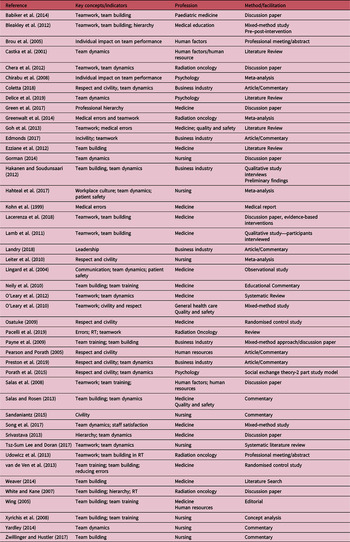
While this was not a systematic review of the literature a thorough e-Search was conducted through the University of Toronto library utilising databases Google Scholar, EBSCO, OVID, Proquest and PubMed to identify common themes in RT team building. An initial search on team building/teamwork in RT generated minimal articles; specifically, only two articles that stood out on team building in RT by White and KaneReference White and Kane14 and Udowicz et al.,Reference Udowicz, Civitella and Gunning-Mooney6 which led to the need for a larger search parameter. The e-Search was expanded to include a search timeframe from 2000 to present and was carried out using MeSH and free text words or a combination of words; ‘team dynamics’, ‘teamwork’, ‘team dynamics in healthcare’, ‘respect and civility’, ‘improving team dynamics’, ‘changing culture in teams in healthcare’, ‘effect of team dynamics on patient safety’ and ‘team building’. Such a large search term was chosen due to the lack of literature available, as well as the significance of the medical report ‘Too err is human’ in 2000 by Kohn et al., a catalyst for much of the literature to date. Only abstracts written in English with full text and references available were included and duplicates were removed. The remaining abstracts were screened and relevant articles selected by the author if they met the search criteria that included relevancy related to team building, contributory factors on team dynamics, team-based learning, team performance and implication of civility. There is inclusion bias as articles were selected by the writer based on their relevancy to the subject-matter and selection was based on the search terms utilised. Selected articles shown in Table 1 were from scholarly journals, publishers, professional organisations and citations that were written in English. Exclusion criteria included studies that were primarily student or trainee focused or simulation-based team training and non-English articles.
Overview of articles used within this paper

Results
The final e-Search resulted in over 10,000 articles. After screening for duplicates, English language and full-text availability, just over 200 articles remained. Review of the abstracts by the author produced 45 relevant articles for analysis (Table 1).
The 45 articles were focused on the professions of medicine and medical education (51%), business and human resources (22%), nursing (18%), psychology (7%) and health care in general (2%). Only 3 of the articles (7%) included the RT profession, although 5 articles were from the discipline of radiation oncology.
The majority of the articles included a discussion of more than one theme. The most frequently occurring themes discussed by over 30% of all articles were team dynamics (16/45, 36%), team building (16/45, 36%) and teamwork (14/45, 31%). Other common themes included in more than 10% of all articles were respect and civility (9/45, 20%), team training (6/45, 13%), leadership and hierarchy (5/45, 11%) and medical errors (5/45, 11%).
Discussion
The aim of this paper was to form a better understanding of contributory factors to team dynamics to aid in the development of a framework for team building within RT. Although the literature search found many valuable insights on contributing factors that impact team dynamics, little evidence was found particular to RT. This conceivably could be due to the innate complexity of teamwork in RT and the added difficulty in the design and ability to conduct research on team building.
Leadership, communication, professional hierarchy, respect and civility are recurring key themes found in the literature search that impact team dynamics. The discussion presented here will focus on these factors as they are easily transferable to RT and continue to be existing issues in team building today, not only within RT but all professional groups, including medicine and private industry, as demonstrated over the 20-plus years my literature search covered. There is also recognition in the fact that there are many other factors equally important, such as skill gaps, trust, role clarity, generational differences and lack of engagement that have not been addressed within the scope of this paper, as well as the impact of organisational learning and psychological safety on team dynamics.
Leadership
Evident within the literature is the impact of effective leadership on team dynamics.Reference Salas and Rosen15 Effective leadership is dependent on numerous variables such as staff, values, beliefs, as well as the organisational structure and values. Poor leadership can result in loss of productivity, poor morale, staff satisfaction and potentially a root cause of increased costs to the organisational healthcare system.Reference Castka, Bamber and Sharp16–Reference Landry18
Aligning with the literature, the Harvard Business School highlights six characteristics of an effective leader that include transparency, ability to influence others, has integrity, is innovative, responsible and ethical.Reference Edmonds19 Ezziane et al. (2012)Reference Ezziane, Maruthappu and Gawn11 suggest leadership as an important requirement in building an effective team and to alleviate the many barriers faced in healthcare teams today. Leadership can provide interconnected goals and direction to help define the team and its purpose. An effective leader should model the behaviour, provide coaching and ensure accountability to all staff members to promote respect and civility within the workplace. Within RT, leadership plays a large part in defining the team and ensuring role clarity to ensure safe clinical practice.
Civility and respect
Civility and respect are becoming an important mantra that is slowly being embedded in organisational cultures today. Civility is ‘a collection of positive behaviours that produce feelings of respect, dignity and trust’.Reference Edmonds19 Team dynamics will be enhanced through the promotion of civility as a culture; achieved through effective communication, education, autonomy and mutual trust.Reference Pearson and Porath20
Civility and respect includes displaying care, esteem and consideration to each individual as well as recognising the attributes that each individual brings to the team.Reference Osatuke, Moore and Ward21 This includes valuing yourself and being valued by others. Osatuke et al. (2009)Reference Osatuke, Moore and Ward21 notes civility is especially important in health care due to the high demands and emotional impact of the job. The article further links incivility to burnout, absenteeism, errors, poor job performance, patient outcomes and patient satisfaction.
The role civility plays within team dynamics is crucial as it has a large impact on trust, communication and how the team interacts as a whole.Reference Porath, Gerbasi and Schorch2,Reference Tsz-Sum Lee and Doran22 Trust is the foundation of team dynamics, as lack of trust could negatively impact communication, respect, productivity, loyalty and empowerment.Reference Hakanen and Soudunsaari23 Companies within the private industry, such as Google are promoting civility as a culture that is now manifesting into the healthcare profession. In 2018, an article by the Human Executive Resource made headlines with a report on Google and its enforcement and policy change of promoting civility in the workplace. Google sent employees guidelines on how to interact with each other respectfully such as ‘no name calling, using blanket statements, understand more not be right’.Reference Coletta24 While Google has received push back on the integration of such policies, they continued with key messaging on civility in the workplace to improve overall team dynamics.Reference Coletta24 The impact of incivility within the team has been linked to patient wait times, staff sick time, overtime, complaints and overall staff performance, similarly observed in RT.Reference Osatuke, Moore and Ward21
Communication
Communication is a fundamental part of team dynamics. 91% of adverse events can be attributed to poor communication and lack of team cohesiveness due to interpersonal factors and relations such as perception bias, beliefs, trust and respect.Reference Tsz-Sum Lee and Doran22,Reference O’Leary, Ritter and Wheeler25 Within health care, 70–80% of errors are caused by human factors (environment, teamwork, stress, fatigue and decision-making) with as high as 50% avoidable through improved communication.Reference Xyrichis and Ream26
Professional hierarchy can be a root cause of poor communication and is counterproductive in the development of good team dynamics.Reference Babiker, El Husseini and Al Nemri9,Reference Srivastava27 Physicians or healthcare professionals in higher authority may override suggestions from the team in clinical situations and their presence alone may result in individuals unable to speak up due to fear of reprisal.Reference Ezziane, Maruthappu and Gawn11 It is difficult to dispel professional hierarchy as it can inherent to the culture of the department or organisation. Individual team members perceive team dynamics differently, specifically physicians rate teamwork among their team as highly collaborative, whereas conversely allied health professionals within the same team would rate it low.Reference O’Leary, Sehgal and Terrell28 Within RT, the hierarchy can be seen within RT teams, such that junior radiation therapists may find it difficult to voice their opinion or concerns to more experienced RTs. This becomes more evident during difficult situations when decision-making needs to be done at the moment and quickly. There is also the hierarchal relationship between physicians, physicists and radiation therapists that can create barriers within RT team dynamics.
Interprofessional collaboration and education
Over the last 15 years in health care, there has been a shift from individual professional training to interprofessional team training. Team training provides shared knowledge to facilitate improved team efficiency and overall team dynamics.Reference Gorman29 Most team learning occurs through team discussions and interactions.Reference White and Kane14 There is supporting evidence on the linkage of team training to improved team dynamics and patient safety.Reference Goh, Chan and Kuziemsky4,Reference Salas and Rosen15 Treatment delivery in RT requires an interprofessional approach, yet education and training tend to be siloed by profession.
In 2014, Weaver et al.Reference Weaver, Dy and Rosen30 conducted a review of the literature on the current state of team training in the healthcare setting. Team training has been shown to improve patient safety and healthcare outcomes but sustainability and long-term follow-up are lacking. It is also important to note there is a lack of robust clinical evidence on the impact of team training approaches. One must also acknowledge that research methodologies may not capture the complexity of team training. The approach to team training is not simplistic. One must consider gaps in skills and knowledge, as well as both the psychomotor and didactic component to provide a holistic approach to team training. Within health care, team training needs to be evidence and practice based, incorporating feedback and measurement tools to be impactful.Reference Salas and Rosen15
Highlighted in the literature the domains of effective team training includes education, standardised communication, standardised processes, as well as a structural understanding that include role clarification, leadership and support.Reference Salas and Rosen15 Much of the literature related to team training is simulation based or trainee focused, lacking the inclusion of the efficacy and long-term impact. Some articles identified a specific linkage to patient outcomes. One example is a large multi-institutional study by Neily et al. (2010)Reference Neily, Mills and Young-Xu31 who noted an 18% decrease in mortality rates from surgical procedures after the completion of a comprehensive formalised team training programme. Team training was conducted using an aviation theoretical model, whereby teams trained together to develop a safety culture with specific training focused on communication, conflict resolution and checklist guided briefings. The study design included 1-year follow-up identifying an associated reduction in mortality rates across 108 facilities. Neily et al. reported mortality rates quarterly throughout a 1-year post-training period and compared rates from teams that completed team training versus non-trained teams at different institutions with a high confidence interval of their findings.Reference Neily, Mills and Young-Xu31
Weaver et al.Reference Weaver, Dy and Rosen30 note an increasing publication trend in teamwork topics, yet there is still a gap in longitudinal evidence on the long-term impact and sustainability of team training that needs to be completed. One must also acknowledge the difficulty in applying quantitative measurements in team training, due to the complexity and nature of teams in health care. They can be fluid and dynamic with interchangeable variables such as staff and processes, which explains the under-reporting of team training in healthcare literature.Reference O’Leary, Sehgal and Terrell28
Clinical implications for consideration
The recognition and the importance of team building in healthcare practice is gaining momentum. Quantitative measurement still poses an ongoing difficulty to provide evidence of sustainable change due to the complexity and changing dynamics of teams. Team dynamics are not only impacted by individuals (personalities) but situational demands, external factors, time and organisational structures.Reference Delice, Rouseeua and Feitosa32 Current empirical studies are weak, with no long-term follow-up and most rely heavily on self-reporting which does not provide evidence to support notable changes in team dynamics.Reference Delice, Rouseeua and Feitosa32
In health care, working within a silo is not an option to deliver optimal patient care. Unfortunately, there can be many challenges that exist within healthcare teams that impact the team as a whole through lack of productivity, motivation and mistrust.Reference Yardley7 In RT practice, there is cross-boundary teamwork, yet the hierarchal model still exists and plays an impactful role on how the team functions.Reference White and Kane14 Furthermore, teams are placed in constant flux as RTs are placed on a team with little choice or transition time to meet the demands of the day-to-day work environment, staffing, workload and technology. High-performing teams is the most influential attribute of an organisations’ defined success. RT has the ability to create high-performing teams and deliver high-quality care in an engaging cohesive team environment with team building providing the foundation to support these teams in practice.
In Ontario, teamwork and collaboration are a standard of practice in the College of Medical Radiation and Imaging Technologists in Ontario (CMRITO). The CMRITO states ‘Members must be able to practice effectively within interprofessional care teams to achieve the best possible outcomes for the patient. Members are responsible for communicating about and coordinating care provision with other members of the team, and must be able to take the appropriate action to address gaps and differences in judgement about care provision’.33 The importance of teamwork and collaboration is identified across professions and should be made inherent to practice, yet the culture of professional hierarchy within health care still exists. This can be seen in the evolution of RT professional practice and cross-boundary practice, adding another layer of difficulty in defining roles and dispelling professional hierarchy.Reference White and Kane14 Although an interprofessional approach to healthcare delivery has improved professional hierarchy it still needs to be addressed as the impact on patient safety and overall team performance is well acknowledged in the literature and continues to be a barrier today.
Strong leadership plays an integral role in team development as it has the ability to cultivate a cohesive team environment and build high-performing teams by effectively maximising team members’ abilities resulting in productivity, creativity and overall job satisfaction.Reference Castka, Bamber and Sharp16 The top factors discussed above have been established within business and the private sector; relevant literature in health care has yet to address these issues and the role it plays on team dynamics, leading to the importance of future scholarly evidence.
Conclusion
Leadership, personality clashes, professional hierarchy and communication were cited as some of the top barriers in developing team dynamics. Due to the complex nature of teams, empirical research on team dynamics is difficult with many limitations on quantifying any notable changes to help support specific tools and frameworks for team building. Although a few parallels in practice to RT can be drawn from some of the current evidence found within the literature-specific research on team dynamics in RT is warranted.
The results of this paper have implications for both practice and research. It is clearly essential to enhance and improve safe and effective practice with the dedication of time for team building and the acknowledgement of the contributory factors that impact team dynamics. This includes integrating respect and civility as a culture, as well as developing communication skills and team dynamics that should be incorporated into any future team building sessions within RT. Future research with a long-term approach, including research specific to RT should be conducted to broaden our understanding of the connections between team building, team dynamics, patient and staff satisfaction, errors and patient outcomes.
Acknowledgements
The authors would like to acknowledge the support of the Sunnybrook Health Sciences Centre and the Sheffield Hallam University online distance learning programme.
Financial support
None.
Conflicts of interest
The authors have no conflicts of interest to declare.